-
人教版新课标PEP小学英语四年级上册My Friends教案2篇
1.叫一名学生在班里走动,站在一名学生的后面。 2.教师举起一张本单元的单词图片。先正确地说出这个单词第一个字母的读音的学生坐下,另一名学生继续在班里走动,继续活动。 板书设计 :My friends 黑板上方:上课前打好的四线三格,在课堂上随讲随写的字母Ww, Xx, Yy, Zz 黑板下方: 教案点评: 本课时主要学习字母Ww, Xx, Yy, Zz及相关单词。因为本课时将结束字母的学习,因此在热身、复习环节,有必要先进行字母Aa-Vv的听写。然后出示字母卡、单词卡让学生认读字母和复习单词。呈现新课环节,教师可将字母教学放到单词中进行。在教学过程 中,教师结合图片或实物逐个进行字母和单词的教学,可辅以字母课件进行教学,便于学生更好的领会和掌握。教师要注意侧重字母的书写教学,使学生养成正确的书写习惯。两个小游戏“Bingo”和“Listen and show”帮助学生在趣味活动中巩固了所学的全部字母。扩展性活动的设计目的在于复习本单元的单词。
人教版新课标PEP小学英语三年级下册Where is my ruler教案2篇
1.Let’s say学习字母Uu, Vv, Ww,以及以这些字母开头的单词。2.Let’s do本部分通过有韵律的歌谣,来复习巩固A-W的字母。【教学重点】学习字母Uu, Vv, Ww及以其为首字母的单词【教学难点】单词umbrella, violin, wind和字母Uu, Vv, Ww的发音.【教具准备】1 教师准备教材配套的录音带。2 教师准备 umbrella, vest, violin, window, wind 的图片和词卡。3 教师准备字母卡 Aa----Ww 。【教学过程】1 热身、复习 (Warm-up/Revision)(1)Oral practice学生口语会话展示。教师可根据学生情况提示他们增加对内容。(2)游戏:“猜猜看”。教师用简笔画的方法在黑板上画某种交通工具的某个部位,边画边问:What is it? 学生随意想象,猜图说:A panda? A jeep? A pear? … 教师再继续画一两笔,让学生接着猜,并以小组为单位讨论,最后由一名学生代表说出一个答案。教师将图画完,带领学生一起说: Look! It’s a … 猜对的小组赢得一分。(以交通工具、玩具和文具词为主) 还可让学生代替教师进行此项活动。
人教版新课标PEP小学英语四年级上册My Schoolbag教案2篇
教师问:Can you spell these words? 如有学生能够拼出单词,教师要给与表扬并说:那让我们来看一看他拼的对不对,然后出示单词卡。如没有学生拼出单词,教师说:我们学习单词不仅要会说还要会写,今天我们就来学习几个单词的拼写,看谁学得快。然后出示单词卡。 让学生看单词卡拼读单词。 教师让学生看单词回答:How many letters in this word?学生回答后,让他们背着拼出单词。 教师让学生在四线三格中默写字母b, o, k, r, l, e, p, n, c, I, a,教师教学生在四线三格中书写单词。告诉学生首先要把每个字母书写正确,然后按照单词的拼写把字母写在一起,注意单词的每个字母间要有一点距离。教师在教写ruler和pencil-case时, 注意小写u和s还没有学习书写,让学生照着板书写就可以了。 让学生照板书抄字头,然后每个单词写一行。 (三)趣味操练(Practice)
人教版新课标PEP小学英语六年级下册Recycle2 A Farewell Party教案
3. 新课呈现(Presentation) Let’s make (1)教师说:Miss White is making a book about her students. So she can remember them well.Who are the students? 请学生独立或分小组朗读四段短文,解释学生不理解的句子,然后说:There are four pictures below. Would you like to help Miss/White glue the pictures? 教师知道学生完成图文搭配的练习。 (2)教师发给每名学生一张铅画纸,说:Now please draw a picture of your best classmate. Then describe him or her.学生画一副最要好的同学的肖像,并在傍边配上对该同学的英语介绍。 学生上讲台介绍自己最要好的同学,请其他学生猜是谁,看谁说的生动又贴切,教师给予评价时注意强调第三人称单数形式的使用。 Story time 教师向学生展示Story time部分的教学挂图,指着最后一副图中的Zoom 和 Zip说 Look at the picture. Zoom and Zip are sad. They are saying goodbye to each other. Now let’s see What happened. 学生同桌之间合作阅读或是,然后教师提出问题Where is Zip going? Is this good news for zoom ? What grade is Zip going to be in? 教师放录音,学生录音跟读故事,然后再分角色朗读.
人教版新课标PEP小学英语四年级上册Recycle1教案2篇
Part two1. Teaching AimsMaster the 26 letters.Master the pronunciation of the letters.2. Teaching Aidsa tape-recorder, some cards, some papers and so on.3. Important pointsThe pronunciation of the letters4. Teaching steps1) Greetings and revisionLet some groups act out the dialogue in the last lesson.2) New contentsLet them say out the 26 letters and let some ones say them out.Then listen and learn the letters song.First, give them some minutes and let them read the letters. Let’s see whether there is anyone who can learn anything in them. Then give them some information and let them read again. At last, give them the answer and read again.Let them remember it.PracticeShow the cards where are written the math patterns and let some answer it. Then ask “Who can read it in English?” Let some one read it. Others follow him.Next, show the cards and ask others answer them. T asks and S answers. Then S asks and S answers. Practice in pairs.HomeworkMaster the letters.Teaching notesPart three1. Teaching AimsIntroduce self and others using the words and phrases.Let’s play.2. Teaching Aidsa tape-recorder, some cards3. Important pointsShe has…She likes…I have…4. Teaching stepsGreetings and revisionLet some one read the letters and divide them by the pronunciations.
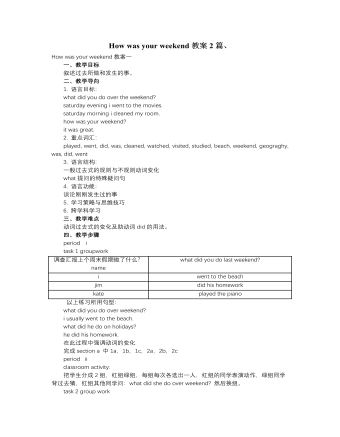
人教版新目标初中英语七年级下册How was your weekend教案2篇
Teaching Goal:1. General aims:Talk about recent past events2. Particular aims:A. Language Focus.Talk about recent past events and think of the past events.B. Language goalsHow was….?It was …What did …do over the weekend?C. Language structures:(1). How was your weekend? I was great. Pay attention to no form.(2). What did you do over the weekend? I played soccer. We went to the beach.D. Useful words and phrases:Words: was, did, went, beach, over, project, test, wasn’t, false, number, geography, spend, week, most, mixture, their, had, little, cook, read, saw, change, everyone, sit, sat, no, anythingPhrases: did one’s homework, played soccer, cleaned my room, went to the beach, played tennis, went to the movies, on Saturday morning, over the weekend, cook … for, what about, do some reading, have a party, talk show, go shoppingE. Grammar language:Present simple past tenseRegular and irregular verbsF. Learning strategies:Tour and holidaysG. Interdiscipinary:H. Emotion and manner:Teaching time: 5 periodsTeaching procedures:Period One教学步骤、时间 教师活动 学生活动 媒体应用Step 1Free talk 3’ Ask some questions like:Who’s on duty today?What’s the weather like? Answer and talk about something.让同学们回答下列问题1. Do you like weekend? (Let some students answer)It takes them three minutes to talk about the question.2. Why do you like weekend? (let the students answer) Most of the students like the weekend此时教师用汉语问:“在周末期间问你干了什么?这句话用英语这么回答?Let the students guess.At last the teacher give them right answer3. What did you do over the weekend?(板书、学习)
人教版新目标初中英语七年级下册Where is the post office教案2篇
Period 2 (3a----Section B 2c)Preview(Pre-task): Key points: What laAdd another information about their pen pals----their language on the cardnguage does she/he speak?She/He speaks....Does she/he have any brothers and sisters? Does she/he speak English?Preview(Pre-task): Add another information about their pen pals----their language on the cardKey points: What language does she/he speak?She/He speaks....Does she/he have any brothers and sisters? Does she/he speak English?Step 1 Revision1.Revisionand dictation of the new words 2.Revise the drills they learned yesterday.(by pairwork and grammar exercise)Step 2 Leading-inT has a conversation with one student. The conversation is following:---Do you have a pen pal?---Yes, I do.---What's your pen pal's name? ---His/Her name is....---Where is your pen pal from? ---He/She is from...---Where does he/she live? ---He/She lives in....---What language does he/she speak?He/She speaks...Write the new words on the Bb. They are following: EnglishChineseJapaneseFrenchStep 3 LearnLearn the new words with the whole class.Finish 3a with the students3b Pairwork T still does an example with one student Then the Ss practise in pairs. The example is following:--Curry Muray is my pen pal. He is from the United States.---What language does he speak?
人教版新目标初中英语七年级下册I want to be an actor教案2篇
三、教学建议第一课时:1. Lead in (Vocabulary)A) Before class, teacher should collect some pictures of working places. For example: Bank, TV Station, Restaurant, Police Station, Hospital ...B) In class, show students the pictures (PowerPoint, OHP). Ask students to tell the name of the working places and the name of the jobs.Shop assistant, doctor, actor, reporter, police office, waiter, bank clerk, studentC) Do exercise 1a and 3a.2. Bingo GameAsk groups of students to make up pairs of cards with a job on one and the related workplace on the other. For example, waiter / restaurant, teacher / school, doctor / hospital. Encourage students to use both the job / workplace combinations in the book and the ones that students came up during class discussions. Be sure they have twice as many sets of cards as there are students in the group. They can make two sets of cards for a single job / workplace, if necessary. Then have each group mix up its set of cards and hand their cards out in random order. Each time a student gets a pair of cards that match, he or she can lay these cards down. The goal is to have no cards in your hand at the end.3. Task OneA) Ask students to work in pairs and ask the partner what does he / she want to be in the future.e. g. :What do you / does he / does she want to be?I want to be a.Why?Because it's (adj).B) Vocabulary: Section B, 1a4. Homework 1.2.
人教版新目标初中英语八年级上册How was your school trip教案2篇
“Go for it!” is based on “Task-Based Language Teaching”. It adheres to “The authenticity principle”, “The form-function principle”, “The task dependency principle” and “The principle of learning by doing”. These principles all accord with the demands of curriculum focus.In and of Grade Seven (II), “Go for it!”, students have learned “The Simple Past Tense”. And it appears again in of Grade Eight (I). teaches students more about how to talk about events in the past. In addition, it gives affirmative and negative statements in the past tense, such as the sentence patterns “Did you see …?” “Were there …?” “Did you go …?” As the first part of Unit 8, Section A opens with a picture presenting the last school trip in the aquarium and continues with several step-by-step practice activities, which are all good for students to master “The Simple Past Tense”. Doing well in Section A will help students integrate the new target language with that in Section B. Thus, they can describe the events in the past freely and foster their own ability of reflecting and practicing. II. Teaching ObjectivesTeaching objective is the beginning and aim of teaching activities. According to the overall goal of the English elementary course--- improve students' synthetic ability of language application, which should be based on the development of students’ “Language knowledge”, “Language skills”, “Character building”, “Learning strategies” and “Cross-cultural awareness”. The teaching objectives are described as follows(I). Knowledge objectivesi. Master the simple past tense of regular and irregular verbsii. Recite the new words and expressions about the last school trip in the aquarium, including their pronunciation and intonation
人教版新目标初中英语八年级上册I’m more outgoing than my sister教案2篇
1 交通工具的比较此活动为小组活动。学生通过讨论找出到达某一城市可乘坐的各种交通工具,并选择最佳出行方式。Teacher:We’re going to Shanghai. How many ways can we use to get there? Yes, there are four ways: by bus, by plane, by train, by ship. Please discuss how you are going to get there.操作建议:(1)学生以小组为单位展开活动,谈论本组所选择的交通工具。(2)各组选代表向全班汇报,阐述本组所选择的交通工具的利和弊。完成任务所需要的语言结构:We can go there by ship. It’s more comfortable and cheaper than any other transportation.We can go there by bus. It’s cheaper but it takes longer time.2 哪个城市更合适?此活动具有挑战性。假设中国要举行2014年世界杯足球赛,分别从历史,人文,天气等方面对各城市(北京,大连,上海,昆明)进行比较,选择最佳举办城市。T: Imagine China is holding the 2014 FIFA World Cup. Which city do you think is the best for the World Cup, Beijing, Dalian, Shanghai or Kunming? Let’s work in groups. If you choose Beijing, please join the Team Red. If you chose Dalian, please join the Team White. If you choose Shanghai, please join the Team Blue. If you choose Kunming, please join the Team Green. Please show us its advantages. Then let’s see which team will win.
人教版新目标初中英语八年级下册If you go to the party, you’ll have a great time教案2篇
区分宾语从句、定于从句和状语从句宾语从句和状语从句,都叫做主从复合句。宾语从句主要是中考必考的,是初中阶段必掌握的从句,宾语从句主要是掌握三要素,所谓宾语从句,就是宾语在主从复合句当中充当宾语的一个句子,叫做宾语从句。主句的谓语动词是及物动词,后面如果是词或者是短语的话,是简单句,如果是句子的话,肯定是宾语从句。I know that he good at English.就是宾语从句,三要素,一要素是要注意连词,连词一共学了三类连词,一类连词是that口语当中可以省略,就像刚才说的那一句,I hear he is good at English.还有疑问代词、疑问副词,how where when,疑问代词、疑问副词。还有一类连词weather是否的意思,不是状语从句当中的如果,这一定要和如果区分开,这是是否。I don't know if he interested at English。宾语从句要注意if是连词。第二要素是语序,要用陈述举语序。比如说你家有几口人,我们都说How many people are there in you family?但是这是简单句,一旦说成宾语从句,你可以告诉我你家有几口人吗?Could you tell me how many people there are in you family ?
人教版新目标初中英语八年级下册It’s a nice day, isn’t it教案2篇
"Hello! Welcome to English class! Introduce yourself. Meet your new classmates." That's what the teacher says. What do you say? "Oh no!" It can be difficult talking to new people. But it can be fun, and you can make friends. How do you do it? Make small talk. Small talk is polite conversation. "Wang Nan is a great pingpang player, isn't she?" "I'd love to meet her, wouldn't you?" "It's been raining a lot, hasn't it?" Tag questions are a form of polite speech. To make small talk successfully, you should know how to make them. You should also know what topics to talk about. Try to learn this unit carefully. The next time you're in English class, you'll find out. Making small talk's easy, isn't it? (“你好!欢迎你!请做一下自我介绍。认识一下你的新同学。”通常在课上老师会这样说。你会说什么呢?“噢,不!”与陌生人谈话太困难了。但是这也很有意思,并且你还能交到朋友。你该怎么做呢?闲聊。闲聊指得是礼貌的对话。“王楠是一个很棒的乒乓球运动员,不是吗?”“我希望自己能认识她,你呢?“今年的雨水很多,不是吗?”反意疑问句是一种礼貌用语。为了使得谈话成功,你应该知道怎样去进行闲聊。你还应该知道与不同的人该谈论什么样的话题。认真的学习这个单元吧,下次在英语课上,你会发现与大家展开谈话是一件很容易的事情,不信我们来试试。)
人教版新目标初中英语八年级下册What were you doing when the UFO arrived教案2篇
(一).知识方面: 1.培养学生能运用过去进行时来描述、谈论过去某个时间正在发生的事情或动作的意识和能力,能就过去某个时间正在发生的动作做出正确的描述。 2.培养学生的想象力和角色扮演的合作能力。 3.培养学生讲述过去发生的事情经过的能力。能正确运用一般过去时来讲述故事。 (二).技能方面: 1.本单元的语言目标是Talk about past events and tell a story(谈论过去的时间和讲述一个故事),围绕这一目标,要涉及句型: What were you doing when the UFO arrived? ----I was sitting in the barber’s chair. The barber was cutting my hair. 因此必须学习standing、studying、cleaning、sleeping、cooking、making、eating、cutting、等表示地点的词,以便为上述句型提供语言材料。2.学习过去进行时的有关知识。Was/were+现在分词,是该时态的表达式。 3.在学习过程中,要区分The boy was walking down the street when the UFO landed.和While the boy was walking down the street, the UFO landed.这两种由when和while引导的状语从句的句型结构。注意它们的不同。
人教版新目标初中英语九年级上册Teenagers should be allowed to choose their own clothes教案2篇
Step 1 Greeting Greet the class and check the homeworkStep 2 A duty report The S on duty gives a report on the rules in his home and lead in 3a “Sun Fei’s and Wu Yu’s rules” Step 3 ReadingSs read the conversation and write the two girls’ rules in the chart. Check the answers.Get Ss to read after the tape and then read aloud by themselves. Then, T explains the language points.Step 4 Pairwork 3bRole play. Use the information in chart to practice with the conversation in 3a covered. They can look at the sample conversation in the right box.Step 5 Task 2 “Who’s the best reporter?”Make a survey by asking any 5 students the questions in the chart in activity 4. Then give out a report about it. See who is the best reporter? And the best reporter will get a nice ball-pen.Step 6 Summary and homework:Write out the report in your exercise-books.Period ThreeStep 1 Greeting and a duty reportThe S gives a duty report talking about his experience of being late for school. Lead in the question “Do you ever get to school late? How often do you get to school late? Always, usually, sometimes, or never?Step 2 1a Get Ss to finish writing.Step 3 Pairwork 1b Get Ss to talk about their answers with their partners using the sample conversation in the box on the right.Step 4 Listening practice2a Lead-in: What will happen if you get to school late? What about Peter? Let’s listen to a conversation between Peter and his father. Get Ss to finish 2a (As usual, for the first time, Ss only listen.) Check the answers.
人教版新目标初中英语九年级上册Where would you like to visit教案2篇
The First PeriodⅠ.Teaching Aims and DemandsKnowledge Objects(1) Key Vocabularytiring, educational, fascinating, thrilling, peaceful, exotic, trek, jungle, take it easy, explore, historic, site(2) Target LanguageWhere would you like to go on vacation?I’d like to trek through the jungle, because I like exciting vacations.2. Ability Objects(1)Train students to talk about places they would like to visit with the target language.(2)Train students to describe vacations with different adjectives.(3)Train students' listening skill.3. Moral Object,It′s more interesting to go on vacating somewhere instead of staying at home.Ⅱ. Teaching Key Points1. Key Vocabularytiring, educational, fascinating, thrilling, peaceful, exotic, trek, jungle, take it easy, explore, historic, site2. Target LanguageTalk about different places with the target language.Ⅲ. Teaching Difficult Points1. Describe vacations with different adjectives.2. Talk about different places with the target language.Ⅳ. Teaching Methods1. Teaching by illumination2. Teaching by doing chain drills3. Teaching by pairworkⅤ. Teaching Aids1. A tape recorder2. Some pictures of different places with famous views
人教版新目标初中英语七年级下册Don’t eat in class教案2篇
Don’t fight. =You can’t fight. (板书,教读)教师把这些句子板书在黑板上,并请学生大声整齐地读祈使句和“can’t”句型,并让学生注意两种句型表达形式的不同和转换,“Don’t …=You can’t…”;并对学生说:These are our school rules. (板书,教读) You can’t break the school rules. Don’t break the school rules.(板书,教读)步骤3 :Practicea. T: Now, each of the students is breaking one of these rules.Please finish 1a.学生看图,完成1a的内容,检查答案并大声朗读校规。b. 听录音,完成1b,选出四位学生都违反了哪条校规;听之前,学生要读会英文名。c. 请两位学生朗读1c部分的句型;要求学生两人一组对话表演,SA扮演外校转来新生,SB告知本校校规。(学生可经过讨论,多说出他们想到的校规,不必只限于书上;教师应给予帮助)2) 第二课时(2a~4)步骤1 :warming up of revisionT: What are the rules at your school?学生使用“can”或祈使句表达各条校规;其中老师可引出“eat in the cafeteria outside”的表达。步骤2 :Practicea.T: Christina is an exchange student. She doesn’t know the rules. Let’s listen, what activities they’re talking about?学生听第一遍时,完成2a;第二遍时,完成2b;b. 请学生领读2c部分,看着2a完成的表格,理解2c活动的要求;分成小组针对2a进行问答;
人教版新目标初中英语七年级下册It’s raining教案2篇
1 Each group choose one place to describe and what you are doing in it Choose one place, and describe what they are doing 2 Move around the room and give suggestions Talk about it and write it down 3 Ask one to show their works and act it Choose one of each group to make a report 4 Evaluate the best group and the best reporter Choose the best one Homework Ask your friends their ideal place and write about it教学反思:新课程标准中强调学生在课堂中的主体地位,在综合课中他们的主体地位就更加突出。在各个活动中给不同程度的学生不同层次的任务,让各层面的学生都有表现发挥的机会,从而产生对英语的兴趣。使用照片图片多媒体来辅助教学,效果更好。同时让了解其他国家风景,风俗的同学介绍ideal place,增加学生的背景知知识,实现跨学科交流的目的。教案点评:采用任务型教学模式,在各个活动中给不同程度的学生不同层次的任务,让各层面的学生都有表现发挥的机会,从而产生对英语的兴趣。使用照片图片多媒体来辅助教学,效果更好。让了解其他国家风景,风俗的同学介绍ideal place,增加学生的背景知识,实现跨学科交流的目的。
人教版新目标初中英语七年级下册Why do you like koalas教案2篇
单元整体说明(一)单元教材分析本单元的核心话题是描述动物和表达个人喜好,以及句式why do you like…? Because…。这也是本单元的教学重点。通过本单元的学习,学生应能较流利地运用所学词汇和句型描述动物,表达个人喜好。(二)单元知识结构1.词汇动物名称 tiger, elephant, koala, dolphin, etc.词汇描述性形容词: smart, cute, ugly, clever, shy, etc.国家名: Australia, South Africa2.句型Why do you like koala hears? Because they are cute.Where are pandas from? They're from China.What animals do you like? I like dolphins.(三)单元整体目标1.Master the vocabulary2.Master and use: Why do you like koalas? Because they am cute.Where are pandas from? They're from China.What animals do you like? I like dolphins.(四)单元教学重难点一览(五)单元学情分析学生此前已经学过由why, where, what 引导的特殊疑问句句型,具有了学习本单元知识的认知前提。形形色色的动物能激发学生的好奇心,产生了解它们的欲望,这有利于本单元知识的教学和学生学习兴趣的培养。
人教版新目标初中英语八年级上册How do you make a banana milk shake教案2篇
1. First, ... then, ... next, ... finally, ...首先,……然后,……接着,……最后,……这是英语中表达做某事的步骤的一种说法。如果步骤较多,还可以说:first-next-after that-later on-finally/at last通常你会听到说英语国家的人在说 first, next, then, finally 和后面的内容时,他们会做一些停顿。这样就能提前告诉听者接下来讲的是一系列的步骤。这一点在朗读和听力中应特别注意。2. how many, how much均为疑问词,同是“多少”,但用法不同。请看:how many修饰可数名词复数,how much修饰不可数名词。但在用法上,同学们常犯如下错误:1) [误] How many are there bananas on the table?[正] How many bananas are there on the table?[析] how many, how much 中的many,much是形容词,常修饰名词作定语,故后面跟名词。2) [误]How much tea are there on the table?[正]How much tea is there on the table?[析] how much修饰不可数名词时,谓语动词用单数。how many与how much的区别可简记为:前how many:问“多少”,复数名词后面跑;how much问“多少”,不可数名词单数好。前者答语用基数词,后者答语用数量关系。

人教版新目标初中英语八年级上册How do you get to school教案2篇
Step Ⅶ Role play ( Work on 1b)1. First ask two students to read the dialogue to the class.Sa: How do you get to school?Sb: Well, I ride my bike to the subway station. Then I take the subway.2. Now work with a partner.Suppose you use two kinds of transportation to get to school \Hangzhou\Beijing... (bus, train, subway, walking, bike, etc.) Tell how you get there. You may use the phrases in 1a.3. Then ask different pairs of students to present their conversations to the class.Step ⅧListening1. Work on 2a(1) First ask students to read the list of information that Thomas wants to know.…where Nina lives.…how far from school she lives.…how long it takes to get to school.…how she gets to school.…what she thinks of the transportation.(2) Tell students what transportation and bus stop mean.bus stop 汽车站 transportation n. 运送;运输Then tell students we'll hear a recording. Please put a checkmark in front of each thing that Thomas wants to know.(3) Now play the recording for students.( Have students pay attention to the sample answer.) (4) Then correct the answers.