-
人教版新目标初中英语八年级上册How was your school trip教案2篇
“Go for it!” is based on “Task-Based Language Teaching”. It adheres to “The authenticity principle”, “The form-function principle”, “The task dependency principle” and “The principle of learning by doing”. These principles all accord with the demands of curriculum focus.In and of Grade Seven (II), “Go for it!”, students have learned “The Simple Past Tense”. And it appears again in of Grade Eight (I). teaches students more about how to talk about events in the past. In addition, it gives affirmative and negative statements in the past tense, such as the sentence patterns “Did you see …?” “Were there …?” “Did you go …?” As the first part of Unit 8, Section A opens with a picture presenting the last school trip in the aquarium and continues with several step-by-step practice activities, which are all good for students to master “The Simple Past Tense”. Doing well in Section A will help students integrate the new target language with that in Section B. Thus, they can describe the events in the past freely and foster their own ability of reflecting and practicing. II. Teaching ObjectivesTeaching objective is the beginning and aim of teaching activities. According to the overall goal of the English elementary course--- improve students' synthetic ability of language application, which should be based on the development of students’ “Language knowledge”, “Language skills”, “Character building”, “Learning strategies” and “Cross-cultural awareness”. The teaching objectives are described as follows(I). Knowledge objectivesi. Master the simple past tense of regular and irregular verbsii. Recite the new words and expressions about the last school trip in the aquarium, including their pronunciation and intonation

人教版新目标初中英语八年级上册How do you get to school教案2篇
Step Ⅶ Role play ( Work on 1b)1. First ask two students to read the dialogue to the class.Sa: How do you get to school?Sb: Well, I ride my bike to the subway station. Then I take the subway.2. Now work with a partner.Suppose you use two kinds of transportation to get to school \Hangzhou\Beijing... (bus, train, subway, walking, bike, etc.) Tell how you get there. You may use the phrases in 1a.3. Then ask different pairs of students to present their conversations to the class.Step ⅧListening1. Work on 2a(1) First ask students to read the list of information that Thomas wants to know.…where Nina lives.…how far from school she lives.…how long it takes to get to school.…how she gets to school.…what she thinks of the transportation.(2) Tell students what transportation and bus stop mean.bus stop 汽车站 transportation n. 运送;运输Then tell students we'll hear a recording. Please put a checkmark in front of each thing that Thomas wants to know.(3) Now play the recording for students.( Have students pay attention to the sample answer.) (4) Then correct the answers.

人教版新目标初中英语八年级上册What are you doing for vacation教案2篇
Teaching goals : 1. Words & phrases: babysit ,get back , fishing , rent , think about , decide(on) , tourist etc. 2. How to talk about future plans . 3. 现在进行时表示将来计划或行动. 4. 特殊疑问句(where , when , how long引导) Important and difficult points : Drills :What are you doing for vacation ? I’m watching TV . When are you going ? I’m going … . How long are you staying ? We’re staying for five days . Teaching aids : cards and a tape ,a large wall calendar . Period 1 Teaching procedures : Step 1Leading in1. Free talk . 2. Put up the wall calendar . T: I’m staying home on Saturday (pointing to next Saturday ).Ss repeat . Ss: I’m staying home on Saturday . T: OK. Today we’ll learn how to talk about future plans. Step 2Pre-task SB Page 13 , 1a . 1. Look at the picture carefully and tell what you see in the picture . 2. Write the activities from the pictures in the box and add some more . 3. Practice reading . Step 3While-task1. Using the activities we write in 1a to make conversations .For example :What are you doing for vacation ? I’m visiting my uncle . 2. Pairwork .Practice in pairs . 3. 用第三人称练习对话.
人教版新目标初中英语八年级上册I’m going to be a basketball player教案3篇
教学目标1.知识目标:(1)学习What are you going to be when you grow up?/How are you going to do that?句式。(2)学会用英语描述有关职业的表达法。2.能力目标:(1)能够谈论为实现理想所做出的打算和安排。(2)能够谈论未来自己与他人理想的职业及原因。(3)能用英语描述课余时间的活动安排,最终具备表达综合信息的能力。3.情感目标:新学期到来之际,让他们在学习、体育、饮食、特长、读书等方面制定计划,教育学生合理安排自己的课外生活,思考自己的理想职业及适合自己的职业。教学重点、难点本单元的重点为“be going to”表将来,want to be, what,where, when,how引导的特殊疑问句。难点是语言目标的实现。教材分析本单元以I am going to be a basketball player为话题,共设计了三部分的内容:一、Section A该部分有4个模块。第一模块围绕Do you think these jobs are interesting?这一话题展开思维(1a)、听力(1b)、口语(1c)训练;
人教版新目标初中英语八年级上册What’s the best radio station教案2篇
教学重点和难点:运用所掌握的语言描述,比较不同地点的特点。在练习中学习掌握英语比较级和最高级的用法。课前准备分配小组,每组五至六人。通过上网或翻阅报刊杂志等方法,确定旅游线路,做出基本的旅游计划。教学设计:本节课流程图 学法指导:1.由于这是一堂新课,在教学中应注意面向全体,发挥学生的主体性,引导学生积极参与,激发学生的求知欲和学习积极性,指导学生积极思维,主动获取知识,养成良好的学习方法。逐步学会独立解决问题。总之要尽可能调动学生的非智力因素促进智力因素的发展。教法选择:1.电化教学法2.课堂讨论法3.任务型教学法采用这些方法的目的是为了充分调动学生的学习积极性,使学生变被动学习为主动学习。通过电脑形象的演示,加强印象,提高兴趣,突破难点,提高教学效率,进而增大教学的容量和信息量。充分体现教师为主导,学生为主体的教学原则。
人教版新目标初中英语八年级上册What’s the matter教案2篇
She shouldn’t go to the party tonight.Step7. TaskT: You know, there are lots of problems in our life. If you are a doctor, please tell us how to solve the problem. I will divide you into 9 groups. Please work in groups. And then choose one of you to report your ideas.The following are the problems:I have a toothache.I am hungry. I have a sore throat.I am stressed out. I have a sore back.I am tired. I can’t sleep.I have a cold. I have a headache.Report: If you have a headache, you should go to bed early. You should see the doctor. You should eat some medicine. You shouldn’t wash your face with cold water.You shouldn’t sleep late.You shouldn’t swim.…..T encourages the students to give advice as much as possible.Homework:1. Chose one of the problems, and write down your advice2. Copy the new words这一步是用于热身的,同时也可以让他们复习一部分的表示人体部位的单词,扩充知识.学习语言的过程也是一个不断积累的过程,复习旧知识,增添新知识.通过小游戏,强化学生对Does she/he have…这个句子的运用能力.通过复习,自然的引到下面新知识的学习。充分利用表格,由句子到对话,再到文章,让学生循序渐进. 提高学生的综合语言运用能力,运用以前学过的知识来解决身边的问题.Period 5 (Section B 3a—3c, selfcheck)教学内容与分析:
人教版新目标初中英语九年级上册Teenagers should be allowed to choose their own clothes教案2篇
Step 1 Greeting Greet the class and check the homeworkStep 2 A duty report The S on duty gives a report on the rules in his home and lead in 3a “Sun Fei’s and Wu Yu’s rules” Step 3 ReadingSs read the conversation and write the two girls’ rules in the chart. Check the answers.Get Ss to read after the tape and then read aloud by themselves. Then, T explains the language points.Step 4 Pairwork 3bRole play. Use the information in chart to practice with the conversation in 3a covered. They can look at the sample conversation in the right box.Step 5 Task 2 “Who’s the best reporter?”Make a survey by asking any 5 students the questions in the chart in activity 4. Then give out a report about it. See who is the best reporter? And the best reporter will get a nice ball-pen.Step 6 Summary and homework:Write out the report in your exercise-books.Period ThreeStep 1 Greeting and a duty reportThe S gives a duty report talking about his experience of being late for school. Lead in the question “Do you ever get to school late? How often do you get to school late? Always, usually, sometimes, or never?Step 2 1a Get Ss to finish writing.Step 3 Pairwork 1b Get Ss to talk about their answers with their partners using the sample conversation in the box on the right.Step 4 Listening practice2a Lead-in: What will happen if you get to school late? What about Peter? Let’s listen to a conversation between Peter and his father. Get Ss to finish 2a (As usual, for the first time, Ss only listen.) Check the answers.

人教版新目标初中英语九年级上册How do you study for a test教案2篇
内容提示本单元主要内容是学会利用verb十by/with gerund表示方式方法来讨论学习英语的策略,认识自己在学习方面的长处和不足。初步了解现在完成时的结构和用法。现在完成时由助动词have/has+动词的过去分词构成,主要表示过去发生的某一动作对现在仍有影响或造成的后果,常与already,yet,just,ever,never等副词连用。教学目标一、学习目标(Language Goal) 1. Talk about how to study . 学会讨论各种学习方法和策略。2. Find out your suitable learning methods. 找出适合自己的学习方法。 二、语言结构(Language Structures) 1. Verb + by with gerund by+动名词短语 表示“通过…途径,方法” 2. How questions have引导的特殊疑问句 三、目标语言(Target Language) 1. How do you study for tests ? 你是怎样准备考试的?Well , I study by working with my classmates. 哦,我和同学们一起学习。2. Have you ever studied with a group ? 你曾经参加过学习小组吗?Yes , I have . I’ve learned a lot that way . 是的,参加过。通过这种方式我学了许多。
人教版新目标初中英语九年级上册It must belong to Carla教案
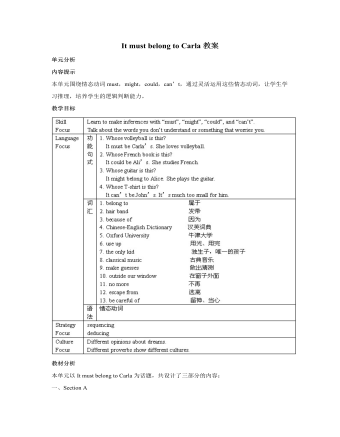
一、Section A该部分有4个模块。第一模块围绕Whose volleyball is this? 这一话题展开思维( 1a)、听力(1b)、口语( 1c)训练;第二模块围绕上一模块中的话题进行听力( 2a-2b)、口语训练( 2c);第三模块继续围绕前两个模块中的“making inferences”展开训练。训练形式为阅读排序( 3a)和两人问答(3b);第四模块仍就上一话题展开讨论。二、Section B该部分有4个模块。第一模块要求根据图画和所提供的单词写出合理的句子;第二模块在听力( 2a-2b)和分角色口语训练( 2c)的基础上,继续进行“推测”训练; 第三模块围绕“Strange events in Bell Tower neighborhood”这一话题展开阅读( 3a)和写作(3b -3c)训练;第四模块以dream为话题展开小组活动。三、Self Check该部分有3个模块。第一模块以填空形式对所学词汇进行训练;第二模块就8个谚语展开阅读和讨论。
人教版新目标初中英语九年级上册Where would you like to visit教案2篇
The First PeriodⅠ.Teaching Aims and DemandsKnowledge Objects(1) Key Vocabularytiring, educational, fascinating, thrilling, peaceful, exotic, trek, jungle, take it easy, explore, historic, site(2) Target LanguageWhere would you like to go on vacation?I’d like to trek through the jungle, because I like exciting vacations.2. Ability Objects(1)Train students to talk about places they would like to visit with the target language.(2)Train students to describe vacations with different adjectives.(3)Train students' listening skill.3. Moral Object,It′s more interesting to go on vacating somewhere instead of staying at home.Ⅱ. Teaching Key Points1. Key Vocabularytiring, educational, fascinating, thrilling, peaceful, exotic, trek, jungle, take it easy, explore, historic, site2. Target LanguageTalk about different places with the target language.Ⅲ. Teaching Difficult Points1. Describe vacations with different adjectives.2. Talk about different places with the target language.Ⅳ. Teaching Methods1. Teaching by illumination2. Teaching by doing chain drills3. Teaching by pairworkⅤ. Teaching Aids1. A tape recorder2. Some pictures of different places with famous views
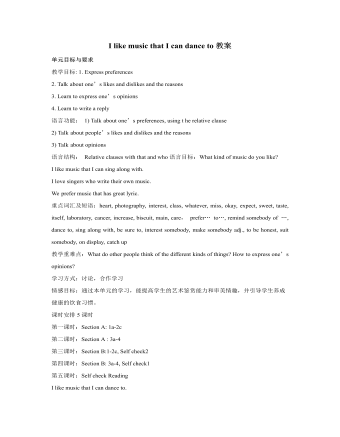
人教版新目标初中英语九年级上册I like music that I can dance to教案
教学目标: 1. Express preferences2. Talk about one’s likes and dislikes and the reasons3. Learn to express one’s opinions 4. Learn to write a reply 语言功能: 1) Talk about one’s preferences, using t he relative clause2) Talk about people’s likes and dislikes and the reasons3) Talk about opinions语言结构: Relative clauses with that and who语言目标:What kind of music do you like?I like music that I can sing along with.I love singers who write their own music.We prefer music that has great lyric.重点词汇及短语:heart, photography, interest, class, whatever, miss, okay, expect, sweet, taste, itself, laboratory, cancer, increase, biscuit, main, care, prefer… to…, remind somebody of …, dance to, sing along with, be sure to, interest somebody, make somebody adj., to be honest, suit somebody, on display, catch up教学重难点:What do other people think of the different kinds of things? How to express one’s opinions? 学习方式:讨论,合作学习情感目标:通过本单元的学习,能提高学生的艺术鉴赏能力和审美情趣,并引导学生养成健康的饮食习惯。课时安排5课时第一课时:Section A: 1a-2c第二课时:Section A : 3a-4第三课时:Section B:1-2c, Self check2第四课时:Section B: 3a-4, Self check1第五课时:Self check ReadingI like music that I can dance to.
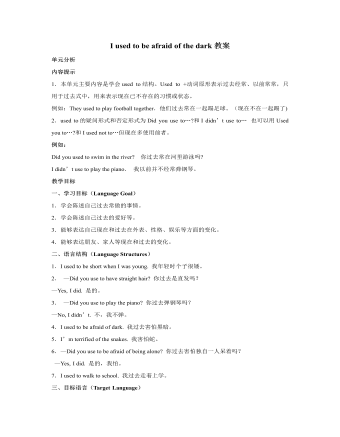
人教版新目标初中英语九年级上册I used to be afraid of the dark教案
内容提示1.本单元主要内容是学会used to结构。Used to +动词原形表示过去经常、以前常常,只用于过去式中,用来表示现在已不存在的习惯或状态。例如:They used to play football together.他们过去常在一起蹋足球。(现在不在一起踢了)2.used to的疑问形式和否定形式为Did you use to…?和I didn’t use to… 也可以用Used you to…?和I used not to…但现在多使用前者。例如:Did you used to swim in the river? 你过去常在河里游泳吗?I didn’t use to play the piano. 我以前并不经常弹钢琴。教学目标一、学习目标(Language Goal) 1.学会陈述自己过去常做的事情。2.学会陈述自己过去的爱好等。3.能够表达自己现在和过去在外表、性格、娱乐等方面的变化。4.能够表达朋友、家人等现在和过去的变化。二、语言结构(Language Structures) 1.I used to be short when I was young. 我年轻时个子很矮。 2. —Did you use to have straight hair? 你过去是直发吗?—Yes, I did. 是的。 3. —Did you use to play the piano? 你过去弹钢琴吗?—No, I didn’t. 不,我不弹。 4.I used to be afraid of dark. 我过去害怕黑暗。 5.I’m terrified of the snakes. 我害怕蛇。
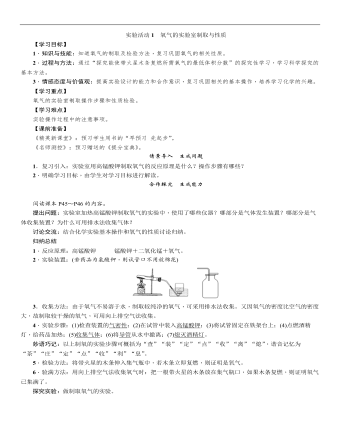
初中化学人教版九年级上册《实验活动1氧气的实验室制取与性质》教案
【学习目标】1.知识与技能:知道氧气的制取及检验方法,复习巩固氧气的相关性质。2.过程与方法:通过“探究能使带火星木条复燃所需氧气的最低体积分数”的探究性学习,学习科学探究的基本方法。3.情感态度与价值观:提高实验设计的能力和合作意识,复习巩固相关的基本操作,培养学习化学的兴趣。【学习重点】氧气的实验室制取操作步骤和性质检验。【学习难点】实验操作过程中的注意事项。【课前准备】《精英新课堂》:预习学生用书的“早预习先起步”。《名师测控》:预习赠送的《提分宝典》。情景导入 生成问题1.复习引入:实验室用高锰酸钾制取氧气的反应原理是什么?操作步骤有哪些?2.明确学习目标,由学生对学习目标进行解读。合作探究 生成能力阅读课本P45~P46的内容。提出问题:实验室加热高锰酸钾制取氧气的实验中,使用了哪些仪器?哪部分是气体发生装置?哪部分是气体收集装置?为什么可用排水法收集气体?讨论交流:结合化学实验基本操作和氧气的性质讨论归纳。

部编人教版四年级下册《 短诗三首》教案
一、导入课题,释义诗题1.【出示课件2】《纸船》——寄母亲我从不肯妄弃了一张纸,总是留着——留着,叠成一只一只很小的船儿,从舟上抛下在海里。有的被天风吹卷到舟中的窗里,有的被海浪打湿,沾在船头上。我仍是不灰心的每天的叠着,总希望有一只能流到我要它到的地方去。母亲,倘若你梦中看见一只很小的白船儿,不要惊讶它无端入梦。这是你至爱的女儿含着泪叠的,万水千山求它载着她的爱和悲哀归去。这是冰心先生的一首小诗。让我们一起朗读欣赏。诗歌,让我们用美丽的眼睛看世界。今天就让我们来学习冰心先生的三首短诗。
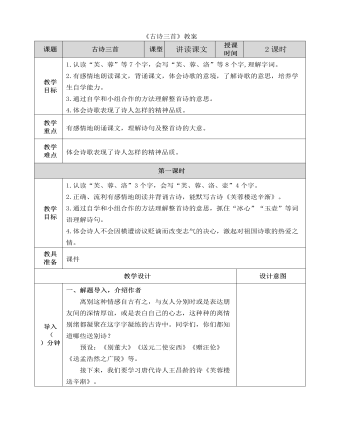
部编人教版四年级下册《古诗词三首》教案
四、品读诗文,赏析感悟1.品读前两句诗(1)请大家默读前两句,看看都写到了哪几种景物?(雨:什么时候下起了什么样的雨?江:江面上是一番怎样的景象?山:在作者眼里楚山什么样?诗中还暗含着两个人物)【课件出示9】(2)“连”“入”两个动词写“寒雨”表现一种怎样的气氛?(“连”“入”两个动词写“寒雨”的绵绵不断和无声无息,渲染出离别时的暗淡气氛。)“楚山孤”表达作者怎样的情感?(表达诗人离开朋友时的强烈的凄冷孤寂感。)【课件出示10】(板书:凄冷、孤寂感)(3)前两句有一对表示时间的词语:“夜和平明”,王昌龄一共写了两首,这首是天亮时在芙蓉楼送别辛渐时所作,另外一首描绘的是前一天夜里两人在芙蓉楼里饮酒话别时的情景。【课件出示11】(出示第一首诗)师:窗外秋雨绵绵,芙蓉楼内二人相对而坐,饮酒道别,这此情此景,给你一种什么感觉?(凄凉,忧愁)。这种情感凝聚在诗中的哪个字中?(孤)带着这种感觉,再读前两句。师:王昌龄才华横溢,官至县蔚,后来因事被贬谪岭南,在北返长安时在江宁县任职,在江宁数年,又遭人诋毁,再次被贬为龙标县蔚,龙标镇非常偏僻,曾有许多的官员被贬于此地。他一生壮志未酬,与好友分别,心中怎能不孤单、苦闷呢?
部编人教版四年级下册《古诗词三首》创新教案
二、指导预习。 1.借助汉语拼音读准字音。洗砚池墨痕乾坤2.朗读古诗。3.联系注释,想想每句诗的意思,不理解的词语查字典或者划下来。4.分组交流自己查找到的有关资料。三、检查预习。以读准字音、质疑为重点。四、学习古诗1.了解诗人解诗题。(1)这首诗的作者是谁?(2)《墨梅》作者:元代著名画家王冕。王冕(公元1287——1359)我国元代著名画家。字元章,号煮石山农,诸暨人(今浙江绍兴)。(3)这首诗的题目是什么?(墨梅。这是一首题画诗。墨梅,顾名思义,即为用水墨画的梅花。)(4)从题目上,你知道了什么?还想知道什么?(知道了这首诗写的是水墨画的梅花。想知道这幅梅花图是谁画的?墨梅有什么特点?诗人为什么要写《墨梅》这首诗?要表达自己什么样的感情?)
部编人教版四年级下册《 短诗三首》创新教案
教学目标1.反复朗读优秀诗文,注意在诵读过程中体验情感,展开想象,领悟诗文大意。2.初步了解现代诗的一些特点,体会诗歌的情感。教学过程一、导入新课同学们都读过哪些诗歌呢?你认为读诗歌有什么好处呢?(学生踊跃发言)教师小结:(诗歌能净化人的心灵,升华人的情感。)著名作家冰心的一句话“读书好,多读书,读好书。”就是对名著阅读最好的诠释。
人教部编版七年级下册叶圣陶先生二三事教案
我认识圣陶先生是在成都,1941年春天的一个细雨蒙蒙的上午。那时候我在华西大学中国文化研究所工作,圣陶先生在四川省教育科学馆工作。教育科学馆计划出一套供中学语文教师用的参考书。其中有一本《精读指导举隅》和一本《略读指导举隅》,是由圣陶先生和朱佩弦先生合作编写的。计划里边还有一本讲文法的书,圣陶先生从顾颉刚先生那里知道我曾经在云南大学教过这门课,就来征求我的意见,能否答应写这样一本书。我第一次见到圣陶先生,跟我想象中的“文学家”的形象全不一样:一件旧棉袍,一把油纸雨伞,说话慢言细语,像一位老塾师。他说明来意之后,我答应试试看。又随便谈了几句关于语文教学的话,他就回去了。那时候圣陶先生从乐山搬来成都不久,住家和办公都在郊外。过了几天,他让人送来一套正中书局的国文课本,供我写书取用例句。
大班健康教案:神奇的关节教案
1、知道关节能使身体弯曲,对人体活动有重要作用。2、学会简单保护关节的方法。 活动材料与相关环境创设: 纸夹板、纸夹长臂、线绳、水彩笔若干、大型积木一套。 图书区投放与人体关节骨骼有关的书。《幼儿用书》中画有人体关节图人手一张。 教师录制幼儿生活和游戏中推、拉、拽和不注意自我保护的现象。 活动准备: 对人体骨骼有初步的了解与认知。 引导幼儿观察讨论:有关人体各部位能弯曲变化的问题。 教师录制幼儿生活和游戏中推、拉、拽和不注意自我保护的现象。 活动过程:1、教师带幼儿在户外练习跳绳、玩“高矮人”游戏后回班讨论:绳子是怎样摇起来的?人为什么能变高变矮?(摇绳时靠臂的什么部位,下蹲或站起时靠腿的什么部位)引发幼儿认识人体的关节。
大班健康教案:我们的生命教案
2、了解生命是有限的,生命失去了就不会再来,应该珍惜生命。教学重点、难点、关键点:重点:知道生命是有限的,生命失去了就不会再来,应该珍惜生命。难点:知道生命是有限的,生命失去了就不会再来,应该珍惜生命。关键点:通过探自己的生命历程,了解成长的不易,知道自己的生命承载了许多亲人的爱和期望。课前准备:1、调查访谈:(含采访记录)①、找一找妈妈怀孕时的照片或者当时的录像,看看那时侯妈妈的样子与妈妈怀孕以前的照片以及现在的样子有什么不同?②问问爸爸、妈妈,当你还在妈妈肚子里的时候,他们有些什么想法、感受和期盼,为了生个聪明健康的宝宝,他们是怎样做的?③、问一问爸爸、妈妈、爷爷、奶奶或者其他家人,你出生的那一天,他们是怎样度过的?在你即将出世的时候,他们的心情如何?在你出生的那一刻,在第一眼看到你时,他们的心情又怎样?④、找出出生记录或成长册,看看刚出生时自己的体重和身长各是多少,请家长说说当时自己是什么样的。找找小时侯的衣服、鞋帽和自己不同年龄的照片,请家长讲一讲在你成长过程中,家长印象最深的一件或几件事。想一想,我们的生命仅仅属于我们自己吗? 2、实物投影。 3、录音机。 4、简单的课件。教学过程:一、导入:珍惜生命,永不放弃生的希望,这是对自己、对社会负责任的表现。因为每一个生命的诞生都会给许多人带来快乐和幸福。板书课题。 1、要求根据课前的调查访谈提示的准备,每人选择其中一个选题,在所在的小组里发言,并选出代表,准备在班里汇报成果。 2、把自己收集到的照片、实物(衣服、小手印……)、录像、图画等介绍给组里的同学。把自己在访谈过程中感受最深的事情讲给小组同学听,并谈谈经过这次调查访谈,自己有哪些感触。 3、组长组织组员准备在全班进行汇报展示。每个小组可以用不同的形式,将全组同学的资料进行整理,如照片展、服装展、录像展、图画集、故事集等多种形式。 4、集体汇报展示、交流。小结:自己能够为他人带来欢乐,所以要珍惜生命,肯定自己生命的价值。(课件出示)