-
收藏模板
- 模板信息
- 更新时间:2023-09-09
- 字数:约18685字
- 页数:约15页
- 格式:.doc
- 推荐版本:Office2016及以上版本
- 售价:5 金币
您可能喜欢的文档
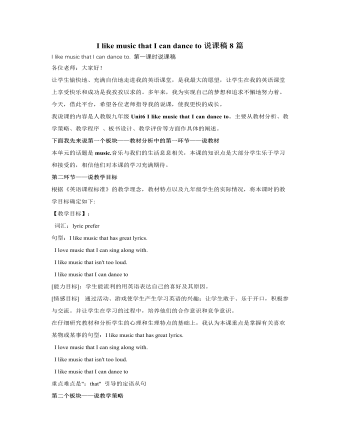
人教版新目标初中英语九年级上册I like music that I can dance to说课稿8篇
2、 难点结合功能句进行听力练习。确定目标的根据新课程标准规定,通过听、说、读、写的训练,使学生获得英语基础知识和初步运用英语进行交际的能力,激发学生的学习兴趣,为进一步的学习打基础。此外,根据我国国情及新课程标准的要求,现阶段英语教学的素质主要包括思想素质教育,潜在英语能力的培养,非智力因素的培养等几个方面。而我们班的学生本身英语基础不太好,部分学生已经对英语失去了信心,还有一部分学生觉得英语越来越难,渐渐力不从心了,不感兴趣了,上课注意力也不集中了。针对这种情况,备课时要增加趣味性,以此来提高学生对英语的学习兴趣。二、教法学法1、 教法:采取“任务型”教学法。教师根据本节课内容,安排合适的任务,让学生在完成任务的过程中达到本节课所拟定的目标。
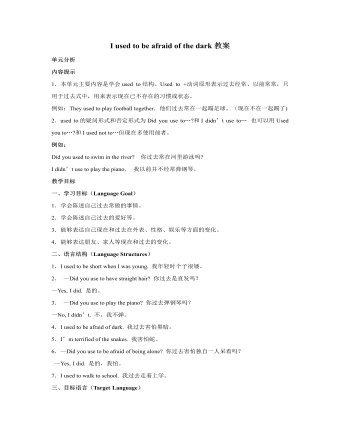
人教版新目标初中英语九年级上册I used to be afraid of the dark教案
内容提示1.本单元主要内容是学会used to结构。Used to +动词原形表示过去经常、以前常常,只用于过去式中,用来表示现在已不存在的习惯或状态。例如:They used to play football together.他们过去常在一起蹋足球。(现在不在一起踢了)2.used to的疑问形式和否定形式为Did you use to…?和I didn’t use to… 也可以用Used you to…?和I used not to…但现在多使用前者。例如:Did you used to swim in the river? 你过去常在河里游泳吗?I didn’t use to play the piano. 我以前并不经常弹钢琴。教学目标一、学习目标(Language Goal) 1.学会陈述自己过去常做的事情。2.学会陈述自己过去的爱好等。3.能够表达自己现在和过去在外表、性格、娱乐等方面的变化。4.能够表达朋友、家人等现在和过去的变化。二、语言结构(Language Structures) 1.I used to be short when I was young. 我年轻时个子很矮。 2. —Did you use to have straight hair? 你过去是直发吗?—Yes, I did. 是的。 3. —Did you use to play the piano? 你过去弹钢琴吗?—No, I didn’t. 不,我不弹。 4.I used to be afraid of dark. 我过去害怕黑暗。 5.I’m terrified of the snakes. 我害怕蛇。
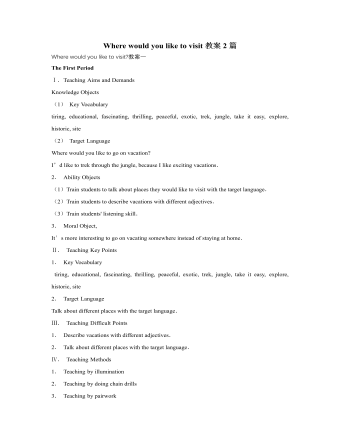
人教版新目标初中英语九年级上册Where would you like to visit教案2篇
The First PeriodⅠ.Teaching Aims and DemandsKnowledge Objects(1) Key Vocabularytiring, educational, fascinating, thrilling, peaceful, exotic, trek, jungle, take it easy, explore, historic, site(2) Target LanguageWhere would you like to go on vacation?I’d like to trek through the jungle, because I like exciting vacations.2. Ability Objects(1)Train students to talk about places they would like to visit with the target language.(2)Train students to describe vacations with different adjectives.(3)Train students' listening skill.3. Moral Object,It′s more interesting to go on vacating somewhere instead of staying at home.Ⅱ. Teaching Key Points1. Key Vocabularytiring, educational, fascinating, thrilling, peaceful, exotic, trek, jungle, take it easy, explore, historic, site2. Target LanguageTalk about different places with the target language.Ⅲ. Teaching Difficult Points1. Describe vacations with different adjectives.2. Talk about different places with the target language.Ⅳ. Teaching Methods1. Teaching by illumination2. Teaching by doing chain drills3. Teaching by pairworkⅤ. Teaching Aids1. A tape recorder2. Some pictures of different places with famous views
人教版新目标初中英语九年级上册I used to be afraid of the dark说课稿4篇
2、说说写写通过读写训练,进一步学会用 used to 结构来表达自己和同伴过去害怕,或现在仍旧害怕的事情,并且要把最后的结果书写下来,然后让他们将结果用英语告之其他同学,为学生创造展示才能的机会。这样能使全体同学都积极参与,集中精力认真听。既巩固了本节课的目标语言,又为下一个环节3b的对话打下基础。活动结问题比较容易,英语基础较差的学生也能够独立完成,因此,在检查答案是尽量让这部分学生回答,使他们体验到成功后的喜悦,提高他们学习英语的兴趣。 3.对话练习:让学生两人一组,模仿3a中的对话,根据提供的信息与提示词进行对话练习,目的在于对新学的目标语言进行口头练习与设定情景中的运用。为学生创造展示才能的机会。推荐两至三组的同学到教室前面,就所编的对话进行角色表演。
人教版新目标初中英语九年级上册What would you do教案
本课采用任务型教学法,用What would you do if you had a million dollars?这个问句,引出谈论假想情况的话题。 采用提问、启发和归纳的教法,让学生易于接受教材内容,培养学生的语言运用能力。 四、 教学过程设计 Step Ⅰ. Greet the whole class as usual. Step Ⅱ. Warming-up T: Do you have ten Yuan in your pocket? S1: No, I don’t. T: (Take out ten Yuan and give it to the student) OK, never mind. What would you do if it was yours? What would you do if you had ten Yuan? S1: I would buy snacks. T: OK, thank you. Sit down, please. (To the whole class) Just now, it was only ten Yuan. What about 100 Yuan? What would you doif you had 100 Yuan? S2: I’d buy a beautiful jacket. T: Thank you. (To the whole class) Now suppose you had a million dollars, what would you do? We know thatone dollar nearly equals eight Yuan, so that’s a large sum of money. Think it over carefully and tellme your ideas. What would you do if you had a million dollars? S3: I’d buy a big house. S4: I’d buy a sports car. S5: I’d put it in the bank. T: OK, stop here. Please look at the blackboard and guess what would I do if I had a million
- 查看更多相关Word文档
I like music that I can dance to教案
单元目标与要求
教学目标: 1. Express preferences
2. Talk about one’s likes and dislikes and the reasons
3. Learn to express one’s opinions
4. Learn to write a reply
语言功能: 1) Talk about one’spreferences, using t he relative clause
2) Talk about people’s likes and dislikes and the reasons
3) Talk about opinions
语言结构: Relative clauses with that and who语言目标:What kind of music do you like?
I like music that I can sing along with.
I love singers who write their own music.
We prefer music that has great lyric.
重点词汇及短语:heart, photography, interest, class, whatever, miss,okay, expect, sweet, taste, itself, laboratory, cancer, increase, biscuit,main, care, prefer… to…, remind somebody of …,dance to, sing along with, be sure to, interest somebody, make somebody adj.,to be honest, suit somebody, on display, catch up
教学重难点:What do other people think of the different kinds ofthings? How to express one’s opinions?
学习方式:讨论,合作学习
情感目标:通过本单元的学习,能提高学生的艺术鉴赏能力和审美情趣,并引导学生养成健康的饮食习惯。
课时安排5课时
第一课时:Section A: 1a-2c
第二课时:Section A : 3a-4
第三课时:Section B:1-2c, Self check2
第四课时:Section B: 3a-4, Self check1
第五课时:Self check Reading
I like musicthat I can dance to.
Period 1 (Section A: 1a-2c)
Teaching aims:
1. Knowledge aims:
1) Ss can use the following words: prefer, lyric, gentle
2) Ss can use the following sentence patterns: What kind ofmusic do you like?
I like music that I can sing along with.
I love singers who write their own music.
We prefer music that has great lyric.
3) Ss can use the attributive clause.
2. Ability aims: Learn to express their preferences.
3. Emotion aims: Let Ss gain the abilities of appreciatingmusic.
Important & difficult points:
Learn how to use the attributive clauses to talk about theirpreferences
Teaching aids: recorder, computer
Teaching design:
Teaching stepsSuggestions
Step 1 Warming-up and Presentation 1. Greetings. 2. (Show some pictures of our school and teachers) Ask: Do you like our school? What do you like best about our school? What kind of school do you like? Why? (Help Ss to say): I like the school that is beautiful Which teacher do you like best? What kind of teacher do you like? Why? (Help Ss to say): I like the teacher who is friendly to us 3.Notes: the attributive clause: Step 2 Word Study and Practice 1. Say: We have learned the attributive clause. Are you feeling tired? Let’s have a relax. (Play some different kinds of music.) 2. Then ask: Do you like listening to music? Who wrote the music? Can you sing along with it? Can you dance to it? And how about the lyrics? Are they great? What kind of music do you like/prefer? Why? What kind of musicians do you like/prefer? Why? 3. Teach some new words and expressions. 4. Work on Section A, 1a. Present the picture and ask: What kind of music do you like? Step 3 Listening and practice 1. T: We know something about you .What about Tony and Betty? What kind of music do they like? S1: I think Tony likes music that S2: I think Betty likes music that T: Well. Let’s listen to the tape and complete the chart in Section A 1b. 2.Work on Section A 1b 3. Work on Section A 1c Step 4 Practice 1. Say: Carmen and Xu Fei are our new friends. Do you want to know what kind of music /musicians they prefer? 2. Work on Section A 2a. Listen and circle. 3. Work on Section A 2b.Listen again and complete the sentences. 4. Work on Section A 2c.Ask and answer. Step 5 Make a survey 1. Work in groups of four and make a survey. Say: Well done! We know different people may like different kinds of music. What do our classmates like? Ask: What kind of music/musicians/groups do you like/prefer? 2. Fill in the form.(Hand out the sheets before class)
3. Make a report. My friend…likes music that …, and she /he prefer musicians who…. Step6 Consolidation (1)在复合句中修饰名词或代词的从句叫定语从句。 人(n.)+ who + 从句 物 (n.) + that + 从句 (2)Model: 1) I have an apple. An apple is red.-I have an apple that is red. 2) I like some friends. Some friends like sports.- I like some friends who like sports. 3) Have a try.
Homework: 1. Listen to the tape of 1b/2a and repeat. 2. Copy the new words in Period1. 3. Finish the exercises in this period. Bb design:
|
通过师生问候,拉近师生距离,让学生很快融入到英语学习的氛围中,另外,教师选取学生身边的、非常熟悉的校园生活作为话题,使学生有话可说,同时为下面引出定语从句的教学作好铺垫。 利用学校和教师的图片,可以激发学生学习的兴趣和参与学习活动的欲望。 在课堂中播发音乐,既活跃了课堂气氛,又很自然引出生词。
从谈论学生本人过渡到教材中的人物,对学生来说是轻车熟路了。
培养学生的听说能力和获取信息、处理信息的能力。
利用小组合作学习,拓展了教材,巩固了知识,有利于培养学生综合运用英语语言的能力。
小结语言知识,巩固对定语从句的理解。 |
I like musicthat I can dance to.
Period 2 (Section A: 3a-4)
TeachingAims:
1. Knowledge aims:
1) Ss can use the following words:dislike, remind of, heart, string
2) Ss can use the following sentencepatterns:
I like groups that________I love singerswho_________
3) Review the use of the attributiveclause.
2.Ability aims: Learn to talk about Ss’ favorite music and musicians..
3.Emotion aims: Learn to live in a happy and healthy way.
TeachingKey Points & Difficult Points:
1. How to teach the Ss to talk about theirfavorite music and musicians.
2.How to use the attributive clause.
Teaching aids: recorder, CAI
Teaching
Teaching Steps: Step1. Warming upand revision 1. Enjoy and sing some English songs. 2. Proverbs: All work and no play make Jack a dull boy. 只会用功不玩耍,聪明孩子也变傻。 The man that suffers much knows much. 磨难多,见识广。 Heaven helps those who help themselves. 自助者天助。 He who laughs last laughs best.谁笑到最后,谁笑得最好。 3. Revise the attributive clause by brainstorming: I like/dislike the gifts that... I like/dislike the friends who 4. Grammar focus: the attributive clause. 5. Fill in the blanks. Step2. Reading 1. Ask: Have you ever received any gifts from your friends? Have you ever received any CDs as gifts? What do you think of them? What do they remind you of? 2.Work on Section A 3a 1) Say: Jennifer has got a CD, please read her CD review and match the sentence parts. 2) Check the answers. 3) T: This is a review online. Next I will ask more questions: a) What review is it? b) Who gives this review? c) What kind of music is it? d) What does she think of the songs? e) Why does like it? f) What does it remind her of? g) What do you know about her from this review? Step3. Practice ( Section A 3b) Ask: What CD did you listen to recently? What’s the name of the CD? Why do you like this CD? What do you dislike about this CD? What does it remind you of? 1. T: Now please write your own review about your favourite CD, movie, book, game or TV show.
3. Get Ss to ask and answer, and make new dialogues. Step4. Pair work 1. T: Wonderful! I like music that’s quiet and gentle, but I can’t stand music that’s boring. What about you? 2. T: Now please complete this survey. Then find classmates who agree with you.
3. Pair work: A: I like groups that wear really cool clothes. B: That’s not really important to me. I like groups that can sing. A: What’ your favorite group? B: My favorite is Step5 Homework 1. Copy the new words. 2. Write a review about their favorite CDs they have got on the exercise books. Bb design
|
课前通过听唱英文歌曲、欣赏包含定语从句的谚语及头脑风暴活动,既复习了上节课所学的知识,又使学生能够迅速地融入到英语课堂中来。
通过对前一课时知识的复习,自然引入到本单元的话题中来。
从教材内容回归到学生的实际生活,使教学内容更加生活化。
通过生生互动交流,使语言知识在真实的生活中得到升华。
| |||||||||||||||||||||||
I like musicthat I can dance to.
Period 3 (Section B: 1-2c, Self check 2)
Teaching aims
Knowledge aims:
1.Ss can use the following words and expressions: sink, honest, course, expect,suit sb. fine
2.Ss can use the following sentence patterns: I like movies that are sad/havescary monsters.
Helikes clothes that are unusual.
Ability aims:
Learnto talk about likes of oneself and others
Learnto write a reply to an e-mail
Emotional aims:
Letthe Ss know how to express one’s own likes and respect others’ likes
Importantand difficult points
Useattributive clause to talk about likes of oneself and others
Teaching aids: computer
Teaching steps Suggestions
Teaching steps Step1 Revision and lead-in 1. T: Do you like music? What kind of music do you like? 2. T: There are many famous bands that can play music very well, do you know any of them? Let the Ss say the names of the bands and then present pictures of some bands. T: What kind of band do you like? Which is your favorite band? Ss may answer: I like the bands that play pop music. My favorite band is…. 3. Talk about books and movies 4. Let the Ss fill in the chart in Section B 1 .Write names of their favorite band, book and movie. Step 2 Group work 1. Let the Ss discuss their favorite things, say why they like each thing. A: I like movies that are sad. I love “Sinking Ship”. B: Oh, I don’t. I like movies that have scary monsters. I really like 2. Ask some groups to express their likes and dislikes 3. The other Ss listen carefully and say something about the likes and dislikes of the groups. Step 3 Listening 1. 1. Read the instructions on 2a and point to the picture. Say, Michael and Ali are talking about some of the things in the room. Listen and write down three things they are talking about. 2.Check the answers 3. Work on 2b Step 4 Reading 1. T: What kind of clothes do you like to wear in summer? T: What kind of places do you like to go to in summer? S: I like to go to places that are not too hot. T: So you can go to places such as Qingdao, Dalian, Hong Kong, etc. Have you ever been to Hong Kong? Do you know anything about it? Present some pictures of Hong Kong and let the Ss say something about it. 2. Let the Ss read Self check 2, the e-mail from Lingling and answer some questions: 1) What does Lingling think of Hong Kong? 2) Why is she there? 3) What kind of music does she prefer? 4) What did she do before the concert? 5) What is she going to do next weekend? 3. Let the Ss write a reply to Lingling Pay attention to the questions she raised in the e-mail. They can write something about language, music, food and films, etc. Homework:Write a reply to Lingling in the exercise books. The design of the Bb |
以谈论music复习前两节课学过的定语从句并引出本节课要讲的bands, books and movies.
让学生在小组中谈论自己的爱好,使他们在表达自己爱好的同时聆听别人的爱好并要求用第三人称的形式来讲述别人的爱好
以夏天喜欢去的地方引入香港,并用一些图片来简单地介绍一下香港,为下面的阅读做好铺垫
在阅读之前设计几个问题,让学生有针对性地去阅读,有利于加深对学生文章的理解
在写信之前给学生一些提示,降低 写的难度
|
Unit6 I likemusic that I can dance to
Period 4 (Section B: 3a, 3b, 3c, 4)
Teaching aims:
Knowledge aims:
1. Review how to express preferences and causes.
2. Understand the three reviews well.
3. Write a review of a book, a movie or a C D.
Ability aims: 1. Master how to express preferences and causes.
2. Learn to write a review ofa book, a movie or a C D.
3. Improve the ability of reading.
Emotion aims: Enable the students to understand some strict rules they haveto follow.
Key points: 1. Understand the three reviews well.
2. Write a review ofa book, a movie or a C D.
Difficult points: How to write a review of a book, a movie or a C D.
Teaching tools: Somepictures, CAI,a tape recorder.
Teaching design:
Teaching steps | Suggestions | ||||||||||||||||||||||||||||||||||
Step1. Revision 1. T: Are you happy today? What did you do last night? Did you go out with your friends? Do you have a lot of friends? What kind of friends do you prefer? S: I prefer friends who are outgoing/ smart/ modest love sports/ get good grades/ can keep secrets I don’t like friends who are T: Do you like music? What kind of music do you prefer? S: I prefer music that I can sing along with. has great lyrics. is quiet, loud, gentle, energetic, slow, fast, exciting, crazy, not noisy,not too loud I don’t like the music that What kind of movie do you prefer/ you don’t like? What kind of band do you prefer/you don’t like? Step2:Groupwork (4) T: What do you like to do next week? In our city, there will be a lot of special events. Now discuss in groups and decide what you and your friends prefer to do together next week?
My friend and I prefer to go to …on…Because we like …that Step 3. Reading 1. Have you ever written a review after you watched a movie or read a book or listened to a CD? Today, we will learn three reviews. They are reviews of a movie, an exhibition of photography and a band. First, please read these three reviews and circle the things the reviewers like and underline the things the reviewers don’t like. (3a) 2. Read the passage after the tape again and explain some new words, phrases and grammar points. 3. Use the information from the reviews to complete the chart.(3b)
Step4. Writing Do you want to write a review? How to write a review? If we want to write a review of a book we have read, a CD we have listened to or a movie we have seen, we should write about the following four parts: 1. What’s the name of the book, the CD or the movie? 2. What do you like in it? Why? 3. What do you dislike in it? Why? 4. What does it remind you of? A sample: Recently I listened to a CD named Dance, Dance, Dance. The music is great because you can dance to it. You can take this to a party. Also, these musicians write their own lyrics. Some songs are too long. Some of the singers don’t sing the words clearly. The music reminds me of Brazilian dance music. Stept5. Practice Finish Self check 1 Step6. Homework Write a review of a book you have read, a CD you have listened to, or a movie you have seen. Bb design
|
由平常的问候自然引入到本单元的话题,进而进行上节课句型以及新词的复习。
这部分重点复习了定语从句句型。从朋友、音乐、电影和乐队四个话题进行复习。
这个部分主要完成了课本第四部分的任务,由复习部分的话题很自然地引入到这个任务环节。最后以定语从句的形式让学生作报告。
分三个步骤对本节课的阅读文章进行处理,先让学生略读,完成课本中的任务,第二步跟录音进行精读,对某些生字、词以及语法重点进行解释,使学生进一步地了解文章内容,从而为第三步完成表格作好铺垫。
学完文章后教授学生如何写评论,通过提供4个问题给学生以写作的框架,并且提供样本文章进行实例解说,从而使学生能够依照这个框架顺利完成写作任务。
给学生一次做主人的特权,让他们自己制订一次家规,发挥小组效应,制定既符合现代学生的需求又不违反常理的家规。
|
转载请注明出处!本文地址:
https://www.lfppt.com/worddetails_9884686.html最新课件教案文档
-

新年好运来福马迎春马年春节小报手抄报
这套以 “新年到好运来” 为主题的 2026 马年手抄报,设计兼顾美观与实用性,包含彩色成品、空白填写版及黑白线稿版,适配不同使用需求。整体风格喜庆活泼,融合传统年味与童趣元素,画面以红橙为主色调,搭配福字、金元宝、红灯笼、烟花等传统装饰,还有孩童放鞭炮的可爱插画,契合春节氛围。内容板块清晰,设有 “春节起源” 栏目,可科普春节古称 “岁首” 及上古祭祀的起源背景;“马年初一” 板块聚焦新年首日习俗,寓意马年吉祥顺遂;“2026 新年心愿” 栏目则为使用者预留了书写美好期许的空间,既具知识性,又能承载个性化祝福,是一份兼具教育意义与互动性的新年手抄报模板。
精选高中生期末评语
1、该生学习态度端正 ,能够积极配合老师 ,善于调动课堂气氛。 能够积极完成老师布置的任务。学习劲头足,听课又专注 ,做事更认 真 ,你是同学们学习的榜样。但是,成绩只代表昨天,并不能说明你 明天就一定也很优秀。所以,每个人都应该把成绩当作自己腾飞的起 点。2、 你不爱说话 ,但勤奋好学,诚实可爱;你做事踏实、认真、为 人忠厚 ,是一个品行端正、有上进心、有良好的道德修养的好学生。在学习上,积极、主动,能按时完成老师布置的作业,经过努力 ,各 科成绩都有明显进步,你有较强的思维能力和学习领悟力,学习也有 计划性,但在老师看来,你的潜力还没有完全发挥出来,学习上还要有持久的恒心和顽强的毅力。
公司2024第一季度意识形态工作联席会议总结
一是要把好正确导向。严格落实主体责任,逐条逐项细化任务,层层传导压力。要抓实思想引领,把理论学习贯穿始终,全身心投入主题教育当中;把理论学习、调查研究、推动发展、检视整改等有机融合、一体推进;坚持学思用贯通、知信行统一,努力在以学铸魂、以学增智、以学正风、以学促干方面取得实实在在的成效。更加深刻领会到******主义思想的科学体系、核心要义、实践要求,进一步坚定了理想信念,锤炼了政治品格,增强了工作本领,要自觉运用的创新理论研究新情况、解决新问题,为西北矿业高质量发展作出贡献。二是要加强应急处事能力。认真组织开展好各类理论宣讲和文化活动,发挥好基层ys*t阵地作用,加强分析预警和应对处置能力,提高发现力、研判力、处置力,起到稳定和引导作用。要坚决唱响主旋律,为“打造陕甘片区高质量发展标杆矿井”、建设“七个一流”能源集团和“精优智特”新淄矿营造良好的舆论氛围。三是加强舆情的搜集及应对。加强职工群众热点问题的舆论引导,做好舆情的收集、分析和研判,把握时、度、效,重视网上和网下舆情应对。
关于2024年上半年工作总结和下半年工作计划
二是深耕意识形态。加强意识形态、网络舆论阵地建设和管理,把握重大时间节点,科学分析研判意识形态领域情况,旗帜鲜明反对和抵制各种错误观点,有效防范处置风险隐患。积极响应和高效落实上级党委的决策部署,确保执行不偏向、不变通、不走样。(二)全面深化党的组织建设,锻造坚强有力的基层党组织。一是提高基层党组织建设力量。压实党建责任,从政治高度检视分析党建工作短板弱项,有针对性提出改进工作的思路和办法。持续优化党建考核评价体系。二是纵深推进基层党建,打造坚强战斗堡垒。创新实施党建工作模式,继续打造党建品牌,抓实“五强五化”党组织创建,广泛开展党员教育学习活动,以实际行动推动党建工作和经营发展目标同向、部署同步、工作同力。三是加强高素质专业化党员队伍管理。配齐配强支部党务工作者,把党务工作岗位作为培养锻炼干部的重要平台。
XX区民政局党支部开展主题教育工作情况总结报告
二要专注于解决问题。根据市委促进经济转型的总要求,聚焦“四个经济”和“双中心”的建设,深入了解基层科技工作、学术交流、组织建设等方面的实际情况,全面了解群众的真实需求,解决相关问题,并针对科技工作中存在的问题,采取实际措施,推动问题的实际解决。三要专注于急难愁盼问题。优化“民声热线”,推动解决一系列基层民生问题,努力将“民声热线”打造成主题教育的关键工具和展示平台。目前,“民声热线”已回应了群众的8个政策问题,并成功解决其中7个问题,真正使人民群众感受到了实质性的变化和效果。接下来,我局将继续深入学习主题教育的精神,借鉴其他单位的优秀经验和方法,以更高的要求、更严格的纪律、更实际的措施和更好的成果,不断深化主题教育的实施,展现新的风貌和活力。
交通运输局在巡回指导组主题教育阶段性工作总结推进会上的汇报发言
今年3月,市政府出台《关于加快打造更具特色的“水运XX”的意见》,提出到2025年,“苏南运河全线达到准二级,实现2000吨级舶全天候畅行”。作为“水运XX”建设首战,谏壁闸一线闸扩容工程开工在即,但项目开工前还有许多实际问题亟需解决。结合“到一线去”专项行动,我们深入到谏壁闸一线,详细了解工程前期进展,实地察看谏壁闸周边环境和舶通航情况,不断完善施工设计方案。牢牢把握高质量发展这个首要任务,在学思践悟中开创建功之业,坚定扛起“走在前、挑大梁、多做贡献”的交通责任,奋力推动交通运输高质量发展持续走在前列。以学促干建新功,关键在推动高质量发展持续走在前列。新时代中国特色社会主义思想着重强调立足新发展阶段、贯彻新发展理念、构建新发展格局,推动高质量发展,提出了新发展阶段我国经济高质量发展要坚持的主线、重大战略目标、工作总基调和方法论等,深刻体现了这一思想的重要实践价值。

今日更新Word
-
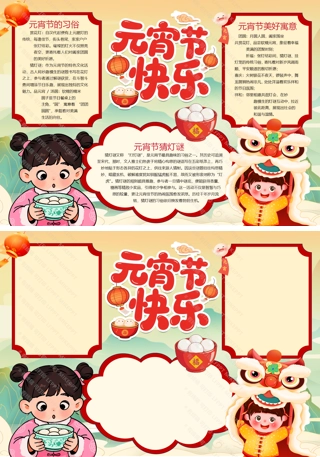
【元宵节】2026马年元宵节手抄报
这套 “元宵节快乐” 手抄报以暖黄为主色调,融入萌娃吃汤圆、醒狮贺岁、红灯笼等元素,年味浓郁且充满童真,包含彩色成品、彩色空白、黑白线稿、浅线稿四种版式,兼顾范例参考与自主创作。内容板块聚焦元宵节核心民俗,“元宵节的习俗” 介绍赏花灯、猜灯谜的传统由来;“元宵节美好寓意” 解读团圆、祈福的文化内涵;“元宵节猜灯谜” 讲述这一趣味活动的历史与魅力。各板块以矩形、云朵形边框清晰划分,层次分明,成品提供详实的民俗知识与文案范例,空白版本便于学生填充个人的元宵经历与感悟,是兼具文化性与实用性的元宵节主题手抄报模板。
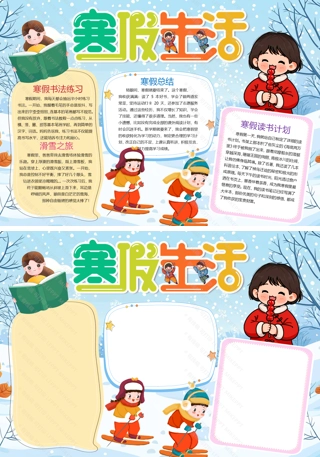
【寒假生活】卡通寒假生活冬天小报手抄报Word模版
这套 “寒假生活” 手抄报以冬日雪景为基底,搭配滑雪孩童、捧书阅读等童趣插画,色彩明快且充满生活气息,涵盖彩色成品、彩色空白、黑白线稿、浅线稿四种版式,兼顾范例参考与学生自主创作需求。内容板块设计贴合小学生寒假日常,“滑雪之旅” 记录户外滑雪的趣味经历与挑战自我的感悟;“寒假书法练习” 讲述坚持练字的过程与收获;“寒假读书计划” 分享《海底两万里》等书籍的阅读心得;“寒假总结” 复盘假期的学习、运动与志愿服务收获,反思不足并规划新学期。各板块以异形边框清晰划分,层次分明,成品提供优质文案范例,空白版本便于学生填充个人假期故事,是助力小学生梳理寒假生活、记录成长的实用模板。
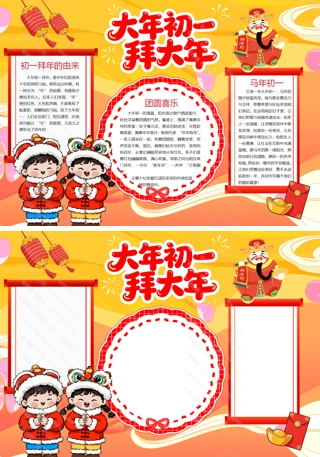
【迎新年】大年初一拜大年新年福马迎春马年春节小报手抄报
这套 “大年初一拜大年” 手抄报以红金为主色调,融入萌娃拜年、财神送福、红灯笼等元素,年味浓郁且童趣十足,包含彩色成品、彩色空白、黑白线稿、浅线稿四种版式,兼顾范例参考与自主创作。内容板块聚焦大年初一传统习俗,“初一拜年的由来” 讲述年兽传说与拜年习俗的起源;“团圆喜乐” 描绘初一阖家团圆、吃饺子年糕、收红包的温馨场景;“马年初一” 则结合生肖寓意,传递新春的活力与美好祝福。各板块以矩形、圆形边框清晰划分,层次分明,成品提供详实的民俗知识与文案范例,空白版本便于学生填充个人的拜年经历与新春感悟,是兼具文化性与实用性的春节主题手抄报模板。
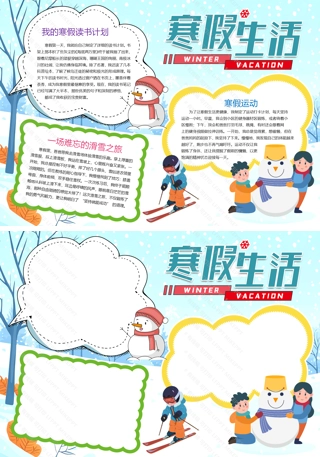
【寒假计划】我的寒假生活冬天寒假计划小报手抄报Word模版
这套 “寒假生活” 手抄报以冬日雪景为背景,融入滑雪、堆雪人等童趣插画,整体风格清新活泼,兼具观赏性与实用性,包含彩色成品、彩色空白、黑白线稿、浅线稿四种版式,适配不同创作需求。内容板块设计贴合小学生寒假生活,“我的寒假读书计划” 记录阅读《海底两万里》等书籍的收获,分享做读书笔记的心得;“一场难忘的滑雪之旅” 讲述滑雪的经历与 “坚持就能成功” 的感悟;“寒假运动” 板块则介绍了每日运动计划与健身收获。各板块以云朵、矩形等异形边框区分,层次分明,成品提供优质内容范例,空白版本便于学生填充个人假期故事,是助力小学生梳理寒假生活的优质模板。
【寒假计划】卡通寒假生活寒假计划冬天小报手抄报Word模版
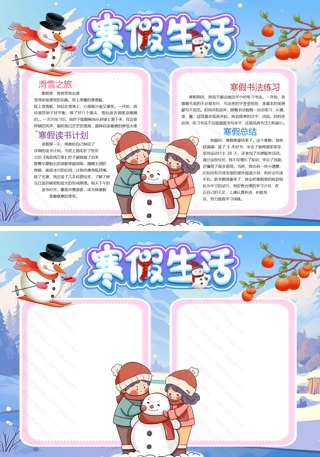
这套 “寒假生活” 手抄报设计充满冬日暖意,以蓝白为主色调,搭配雪人、红柿、孩童堆雪等元素,既显节日氛围又富童真。版式包含彩色成品、彩色空白、黑白线稿、浅线稿四种,兼顾范例参考与自主创作需求。内容板块聚焦寒假核心生活,“滑雪之旅” 记录户外体验的乐趣与挑战,“寒假读书计划” 分享《海底两万里》等书籍的阅读收获,“寒假书法练习” 讲述坚持练字的成长感悟,“寒假总结” 复盘假期的收获与不足。板块以粉色边框清晰划分,内容兼具趣味性与教育性,空白版本则为学生预留了书写个人假期故事的空间,是适配小学生的优质寒假作业模板。
【寒假计划】寒假生活寒假计划冬天卡通小报手抄报Word模版
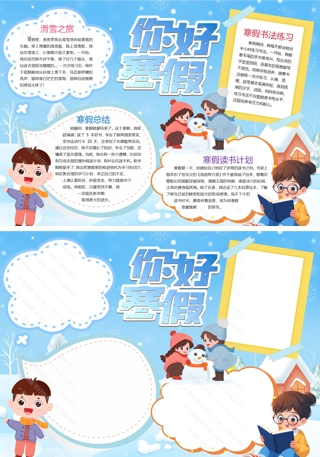
这套 “你好寒假” 手抄报设计精巧,兼具实用性与美观性,以冬日蓝为主色调,搭配堆雪人、读书等童趣插画,营造出浓厚的假期氛围。版式上分为彩色成品、彩色空白、黑白线稿、浅线稿四种版本,适配不同使用需求。内容板块丰富且贴合小学生生活,“滑雪之旅” 记录户外实践的快乐,“寒假总结” 复盘成长收获,“寒假读书计划” 分享阅读感悟,“寒假书法练习” 展现坚持的意义。各板块以云朵、矩形等边框区分,层次清晰,既为学生提供了优秀的内容范例,空白版本也方便孩子们填充自己的假期故事,是一份兼具展示与创作价值的寒假作业模板。