-
人教版新目标初中英语七年级下册Where is the post office教案2篇
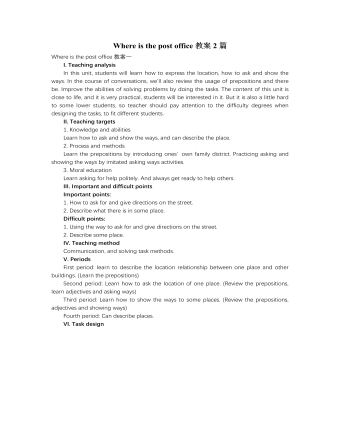
Period 2 (3a----Section B 2c)Preview(Pre-task): Key points: What laAdd another information about their pen pals----their language on the cardnguage does she/he speak?She/He speaks....Does she/he have any brothers and sisters? Does she/he speak English?Preview(Pre-task): Add another information about their pen pals----their language on the cardKey points: What language does she/he speak?She/He speaks....Does she/he have any brothers and sisters? Does she/he speak English?Step 1 Revision1.Revisionand dictation of the new words 2.Revise the drills they learned yesterday.(by pairwork and grammar exercise)Step 2 Leading-inT has a conversation with one student. The conversation is following:---Do you have a pen pal?---Yes, I do.---What's your pen pal's name? ---His/Her name is....---Where is your pen pal from? ---He/She is from...---Where does he/she live? ---He/She lives in....---What language does he/she speak?He/She speaks...Write the new words on the Bb. They are following: EnglishChineseJapaneseFrenchStep 3 LearnLearn the new words with the whole class.Finish 3a with the students3b Pairwork T still does an example with one student Then the Ss practise in pairs. The example is following:--Curry Muray is my pen pal. He is from the United States.---What language does he speak?
人教版新目标初中英语七年级下册I ’d like some noodles教案
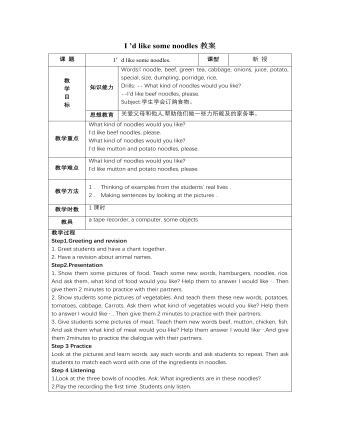
教学过程Step 1: warming-up Sing a song---------“food and drink” Step 2: Revision1 Dictation2 Revise: What kind of noodles would you like?I’d like …What size bowl of noodles would you like?I’d like…Step 3: Presentation1 show pictures of food, ask students say the words.2 Students read the newspaper ad in 3a. Fill in blanks with words in the box. Then read the ad together, the teacher explains some difficult language points.3 Check the answers Step 4 PracticeAsk students to finish 3b in the same way according to 3a. Students read the short passage and fill in the blanks .At last, check the answers.Step 5 productionAsk students to write their own ad for dumplings, noodles, drinks, and other foods they know. Then ask students to read their partner’s ad. Then order food and drink from their partner.Step 6 Home workGroup work – make an ad about “food and drink”
人教版新目标初中英语七年级下册I want to be an actor教案2篇
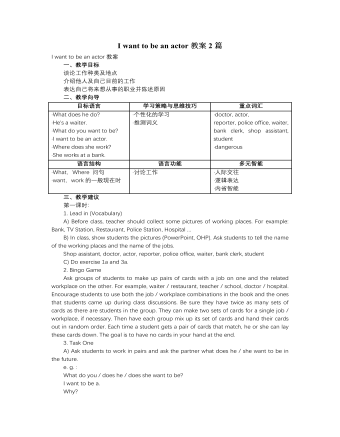
三、教学建议第一课时:1. Lead in (Vocabulary)A) Before class, teacher should collect some pictures of working places. For example: Bank, TV Station, Restaurant, Police Station, Hospital ...B) In class, show students the pictures (PowerPoint, OHP). Ask students to tell the name of the working places and the name of the jobs.Shop assistant, doctor, actor, reporter, police office, waiter, bank clerk, studentC) Do exercise 1a and 3a.2. Bingo GameAsk groups of students to make up pairs of cards with a job on one and the related workplace on the other. For example, waiter / restaurant, teacher / school, doctor / hospital. Encourage students to use both the job / workplace combinations in the book and the ones that students came up during class discussions. Be sure they have twice as many sets of cards as there are students in the group. They can make two sets of cards for a single job / workplace, if necessary. Then have each group mix up its set of cards and hand their cards out in random order. Each time a student gets a pair of cards that match, he or she can lay these cards down. The goal is to have no cards in your hand at the end.3. Task OneA) Ask students to work in pairs and ask the partner what does he / she want to be in the future.e. g. :What do you / does he / does she want to be?I want to be a.Why?Because it's (adj).B) Vocabulary: Section B, 1a4. Homework 1.2.
人教版新目标初中英语七年级下册It’s raining教案2篇
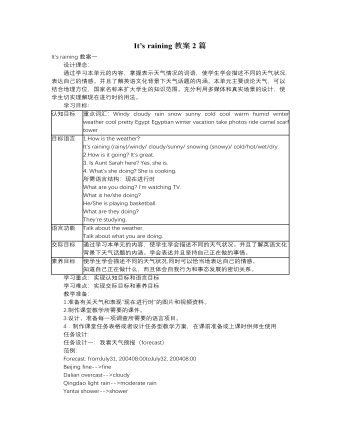
1 Each group choose one place to describe and what you are doing in it Choose one place, and describe what they are doing 2 Move around the room and give suggestions Talk about it and write it down 3 Ask one to show their works and act it Choose one of each group to make a report 4 Evaluate the best group and the best reporter Choose the best one Homework Ask your friends their ideal place and write about it教学反思:新课程标准中强调学生在课堂中的主体地位,在综合课中他们的主体地位就更加突出。在各个活动中给不同程度的学生不同层次的任务,让各层面的学生都有表现发挥的机会,从而产生对英语的兴趣。使用照片图片多媒体来辅助教学,效果更好。同时让了解其他国家风景,风俗的同学介绍ideal place,增加学生的背景知知识,实现跨学科交流的目的。教案点评:采用任务型教学模式,在各个活动中给不同程度的学生不同层次的任务,让各层面的学生都有表现发挥的机会,从而产生对英语的兴趣。使用照片图片多媒体来辅助教学,效果更好。让了解其他国家风景,风俗的同学介绍ideal place,增加学生的背景知识,实现跨学科交流的目的。
人教版新目标初中英语七年级下册Where did you go on vacation教案
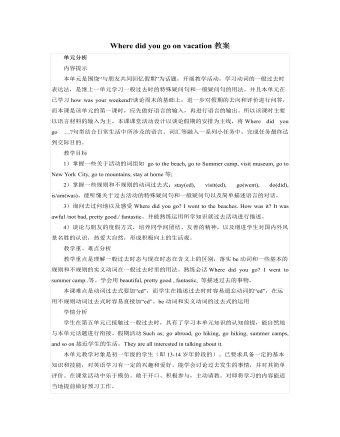
句型: Where did you go on vacation? I went to summer camp.Did she go to Central Park?Yes,she did.No, she didn’t语法:一般过去时特殊疑问句、一般疑问句及肯、否定回答。课时安排4课时第一课时:Section A:la,1b,lc,2a,2b,2c 第二课时:Section A:3a,3b,4第三课时:Section B:1,2a,2b,2c第四课时:Section B:3a,3b,3c,4 and Self Check第一课时教学目标掌握描写假期生活的形容词。假期里自己所做事情的简单表达。谈论假期做的事情及当时情况。谈论假期时旅游的天气,旅游者以及食物等。教学过程一、导入播放一首英文歌曲:Let’s travel 说明:通过让学生听节奏欢快迪斯尼英语歌曲Let’s travel.引入本节课谈论的话题vacation and travel. 让歌曲使学生的思维活跃,增强课堂气氛,激发学生提高学习英语的兴趣。T:How is the trip ?Ss : It’s pretty good/ happy/exciting /relaxing/busy/dangerous/ fantastic说明:这个问题是为了操练形容词。建议让多个Ss作答。鼓励他们用不同的形容词。上述个别形容词本应在第二课时中出现,但可以在warming-up中第一次非正式出现。这些形容词也可在老师的评价语中适时出现,以加深学生对词汇的印象。
人教版新目标初中英语八年级下册Have you ever been to an amusement park教案
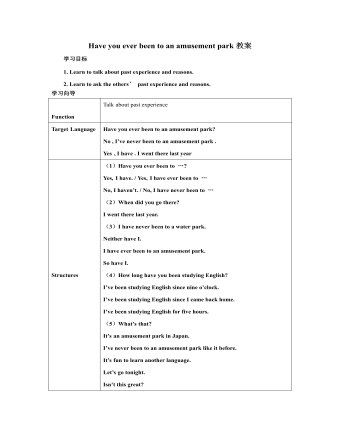
(1)Have you ever been to …? Yes, I have. / Yes, I have ever been to …No, I haven’t. / No, I have never been to …(2)When did you go there? I went there last year. (3)I have never been to a water park. Neither have I. I have ever been to an amusement park. So have I. (4)How long have you been studying English? I’ve been studying English since nine o’clock. I’ve been studying English since I came back home. I’ve been studying English for five hours. (5)What’s that? It’s an amusement park in Japan. I’ve never been to an amusement park like it before. It’s fun to learn another language. Let’s go tonight. Isn’t this great?space museum, amusement park, water park, South America, Peru, Holland, European culture, tour guide, flight attendant, musical instrument, more than, be from, get to, take lessons, neither, discover, graduate, change
人教版新目标初中英语八年级下册It’s a nice day, isn’t it教案2篇
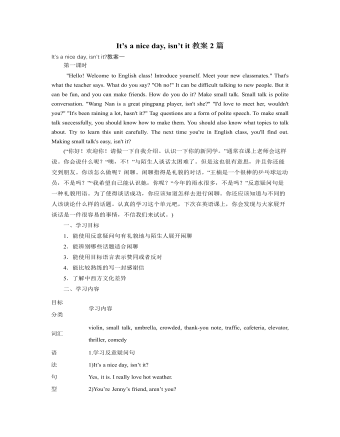
"Hello! Welcome to English class! Introduce yourself. Meet your new classmates." That's what the teacher says. What do you say? "Oh no!" It can be difficult talking to new people. But it can be fun, and you can make friends. How do you do it? Make small talk. Small talk is polite conversation. "Wang Nan is a great pingpang player, isn't she?" "I'd love to meet her, wouldn't you?" "It's been raining a lot, hasn't it?" Tag questions are a form of polite speech. To make small talk successfully, you should know how to make them. You should also know what topics to talk about. Try to learn this unit carefully. The next time you're in English class, you'll find out. Making small talk's easy, isn't it? (“你好!欢迎你!请做一下自我介绍。认识一下你的新同学。”通常在课上老师会这样说。你会说什么呢?“噢,不!”与陌生人谈话太困难了。但是这也很有意思,并且你还能交到朋友。你该怎么做呢?闲聊。闲聊指得是礼貌的对话。“王楠是一个很棒的乒乓球运动员,不是吗?”“我希望自己能认识她,你呢?“今年的雨水很多,不是吗?”反意疑问句是一种礼貌用语。为了使得谈话成功,你应该知道怎样去进行闲聊。你还应该知道与不同的人该谈论什么样的话题。认真的学习这个单元吧,下次在英语课上,你会发现与大家展开谈话是一件很容易的事情,不信我们来试试。)
人教版新目标初中英语八年级下册Why don’t you get her a scarf教案
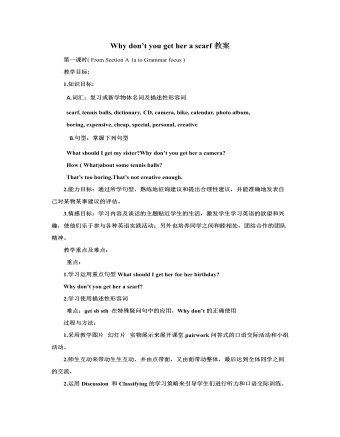
教师带领学生复习有关描述宠物的词汇,采用教师提问学生回答的方进行。如:T:What animals do you think would be good pets?What animals do you think would be bad pets?What do you think are good animals for a six-year-old child?然后学生进行 pairwork 练习。Task two: 师生互动,学习探究 1、播放3a部分的录音,引导学生一边听录音,一边跟读。2、通过听录音学生回答以下问题:Why do you think pot-bellied pigs are popular?What are the advantages and disadvantages of keeping such a pet?教师对学生的回答进行及时点评。3.学习范文,学习重点短语,为下步的模仿写作提供语言素材。T :1. )Have you ever kept a pig as a pet?Do you like pigs? St.:No.…Why don’t you like to keep a pig? St: No.They’re too dirty and lazy(Do you know in some foreign countries like Hollyland, Australia,pigs are the most popular pet.there’s a kind of pig.(图)it has an interesting name? it ‘s called a pot-bellied pig.) Now,let’s learn an article about this kind of interesting pet.2.)play the tapeSt.:Listen and repeat3.)show some Qs on computer(本子St.: read silently,then answerthe Qs(本子)4.)Ask ss. Close book and retell this passage.(what is a pot-bellied pig? Is it a good or bad pet? ) St.: retell it to each other“A pot –bellied pig is a popular pet now…”5.read the article together.St.:.practice reading
人教版新目标初中英语八年级下册Would you mind turning down the music教案
Step 4. Group work (4)1. Ask a pair of students to read the dialogue. Say, This activity provides speaking, listening and writing practice using the target language.2. Ask students to complete the work in groups.3. Check the answers with the whole class. 4. Explain some of the language points. Step 5. Word review (Self check 1)1. Ask students to read the words and the phrases given. 2. Fill in the blanks with proper forms of these words to complete the sentences. 3. Check the answers with the whole class. Homework:Do activity 2 on page 57 after class. Period 6Teaching aims: 1. Teach vocabulary words and the useful expressions. 2. Enable the students to learn etiquette in different culture. 3. Help the students learn how to behave politely in public places and in daily life. Teaching procedures:Step 1. RevisionHelp students to review the function of making requests through a free talk. Then lead them to the topic of etiquette. Explain the meaning of etiquette. Or, ask students to look it up in the dictionary. Step 2. Pre-reading (Section 1)1. Ask students to read the picture and make a list with their partner about how many rules of etiquette can be seen being broken.
人教版新目标初中英语九年级下册By the time I got outside, the bus had already left教案
Ⅰ. Teaching Aims and Demands1. Knowledge Objects(1) Key Vocabularyoversleep(2) Target LanguageWhat happened?I overslept. And by the time I got up, my brother had already gotten in the shower.2. Ability Objects(1) Teach the students to use the new words.(2) Train the students to narrate past events with the Past Perfect Tense.(3) Train the students' listening and speaking skills with the target language.3. Moral ObjectIt’s a good habit to go to bed early in the evening and get up early in the morning. So you’ll never be in a hurry in the morning.Ⅱ. Teaching Key Points1. Key Vocabularyoversleep2. Target LanguageNarrate past events with the Past Perfect TenseⅢ. Teaching Difficult Points1. Train the students to narrate past events with the Past Perfect Tense.2. Train the students to understand the target language in spoken conversation.Ⅳ. Teaching Methods1. Thinking of examples from the students' real lives.2. Making sentences by looking at the pictures.Ⅴ. Teaching AidA tape recorderⅥ. Teaching ProceduresStep I Revision1. Revise the language points in Unit 8.Ask some questions like this: What volunteer work would you like to do?Help the students to answer, I’d like to…/I love to…/I hope to2. Practice the dialogue in Activity 3c on page 62 again. Get students to role play the similar dialogues with the following.
人教版新目标初中英语九年级下册I’ll help clean up the city parks教案
Talk about offering help (P60)I’ll help clean up the city parks.A: I’d like to work ...B: You could help ...Talk about ways to tell people about the Clean-Up Day (P61)We need to ...We can’t ...I’ll ...Talk about the work the volunteers do (P62)These three students all volunteer their time to help other people.Somebody loves to ... / helps ... / plans to ... / wants to ...A: What do you like doing?B: I like ... A: What kind of volunteer work do you think I could do?B: You could ...1. 重点词汇advertisement, fix, repair, pleasure, blind, deaf, shut, carry, specially, fetch2. 认读词汇hunger, homeless, cheer, clean-up, sign, establish, major, commitment, elementary, veterinarian, coach, similar, call-in, strategy, disabled, organization, unable, support, appreciate, donation, part of speech, pronoun, adverb, preposition, conjunction, donate, Jimmy, Sally3. 词组clean up, cheer up, give out, put off, set up, think up, take after, fix up, give away, put up, hand out, work out, at once
小学美术人教版一年级下册《第12课妈妈的节日》教案
教学重点:1、通过绘画、制作表达自己的愿望。2、学会认同自己的作品。3、敢于运用不同的材料表现自己的创意。教学难点:能够发挥想象,运用不同的材料表现自己特殊的创意。教师准备:妈妈的生活录像、学生作品照片、小制作若干、各种动物亲情照片、教学课件学生准备:彩纸、橡皮泥、彩色卡纸、剪刀、彩笔、小盒子、纽扣、丝带、信纸
人教版新课标小学数学五年级下册数学广角教案
教学要求1. 通过生活中的事例,学会解决“找次品”这类问题的思想方法。2. 体会解决问题策略的多样性及运用优化的方法解决问题的有效性。3. 感受到数学在日常生活中的广泛应用,培养应用意识和解决实际问题的能力。学情分析有化是一种重要的数学思想方法,可有效地分析和解决问题。本单元主要以“找次品”这一操作活动为载体,让学生通过观察、猜测、推理的方法感受解决问题策略的多样性,在此基础上,通过归纳、推理的方法体会运用优化策略解决问题的有效性,感受数学的魅力。这些内容对五年级的学生来说有一定的难度,所以应让学生在具体操作和试验中感悟、体会,由此使学生养成勤于思考、勇于探索的精神。教学重点学会解决“找次品”这类问题的方法。
人教版新课标小学数学一年级下册小小商店教案2篇
3、同学们,你们看今天老师带来了什么?(出示一个学生喜欢的玩具)这是昨天老师去商店时买的,猜猜看,这个需要多少钱?(学生猜,教师可提示,最后得出正确标价)今天我们也来开个小小商店玩一玩买卖商品的游戏,想玩吗?4、选营业员及经理。我觉得当营业员最重要的是精通业务,计算能力强。谁想来当?(等学生举手后,教师选出4人。)考虑到我们呆会儿买的人会比较多,每个柜台一个营业员忙不过来,我还准备再选4名商店经理,做好以下几项工作:1)做好接待服务工作,顾客有困难能主动帮助。2)做好买卖过程中的组织工作,让大家有秩序地买商品。3)当营业员计算碰到困难时,两人能商量着解决。觉得自己能做到以上三点的同学可举手参加竞选。(学生举手后,选出4名经理)
人教版新课标小学数学二年级下册万以内的加法和减法(一)教案2篇
3.小结。引导学生归纳两位数加减法的口算步骤:要把加上或减去的两位数看成一个整十数和一个一位数,先算两位数加、减整十数,再算两位数加减一位数。三、巩固练习课本第93页的做一做。分别指名口算,并说说怎么想的。四、全课总结1.根据学生回答,教师归纳小结并出示课题:口算两位数加、减两位数。2.口算两位数加、减两位数应注意什么?五、布置作业教后反思《标准》提倡算法多样化,目的是提倡学生个性化的学习。本单元仍然注意体现这一理念,如本课时教学口算两位数加、减两位数时,既呈现了口算方法,还出现了在脑中想竖式的方法;在教学笔算时,还出现口算的方法。其目的就是鼓励学生展开思路,在交流、比较的基础上不断地完善自己的想法,学习计算方法。
人教版新课标小学数学五年级下册因数与倍数教案
因此,本套教材中删去了“整除”的数学化定义,而是借助整除的模式na=b直接引出因数和倍数的概念。在本册教材中,由于允许学生采用多样的方法求最大公因数和最小公倍数,分解质因数也失去了其不可或缺的作用,同时,也是为了减少这一单元的理论概念,教材不再把它作为正式教学内容,而是作为一个补充知识,安排在“你知道吗?”中进行介绍。由于这部分内容较为抽象,很难结合生活实例或具体情境来进行教学,学生理解起来有一定的难度。在过去的教学中,一些教师往往忽视概念的本质,而是让学生死记硬背相关概念或结论,学生无法理清各概念间的前后承接关系,达不到融会贯通的程度。再加上有些教师在考核时使用一些偏题、难题,导致学生在学习这部分知识时觉得枯燥乏味,体会不到初等数论的抽象性、严密性和逻辑性,感受不到数学的魅力。所以在教学中应注意以下两点: (1)加强对概念间相互关系的梳理,引导学生从本质上理解概念,避免死记硬背。(2)由于本单元知识特有的抽象性,教学时要注意培养学生的抽象思维能力。
人教版新课标小学数学一年级下册20以内的退位减法教案2篇
一、揭题:小朋友们,今天我们一起来做练习。二、练习:1、第8题:这是一道计算题。(1)明确要求:看谁算得又对又快。(2)学生独立完成。(3)订正答案。(4)有错的学生,说一说计算顺序是怎样的,每一步的计算结果是多少?2、第9题:这是一道用数学的题。(1)看图,同位两个互相说说图意,并提出数学问题。(2)根据问题列算式解答。(3)订正答案。3、第10题:比一比。(1)明确要求,看谁先夺得红旗。(2)各小组派代表参加比赛。(3)对算得又对又快的学生提出表扬,并奖励给一个小标志。(4)再加入几组比赛题,尽量让学生多参与。4、第11题:这是一道用数学的题。(1)看图,说图意,提出数学问题。(2)列算式解答,指名板演订正。(3)说一说为什么用加法计算?5、思考题:小组讨论完成。一共12人,每两人之间插入一个女生,一共能插入11人。
人教版新课标小学数学一年级下册数的组成教案
3.让学生同桌合作,一人任意说出两位数,另一个人说说它是由几个十、几个一组成的?然后互换。4.完成例3下面的“做一做”,之后请学生汇报汇报。课堂作业做练习七第二题。1.课件出示“百球图”。先让学生整体观察,然后估一估,“有多少个球?”2.在学生估测的基础上引导学生数数。用小精灵聪聪的话问:“怎样数比较快?”然后点名让学生在班上交流自己数的方法。3.引导学生将数出的准确数100与自己估测的数对比。检验自己估的对不对,表扬估对的同学。小结组织学生小结:让学生用自己的话说一说本节课学习的内容。在学生较凌乱叙述的基础上教师概括出本节课所学的知识。课后作业让学生课后数数主题图中小羊的只数,每数十只圈一下,看看到底有多少只羊,检验自己刚开始时估的对不对?
人教版新课标小学数学一年级下册100以内的加法和减法(一)教案
一、谈话引入,激发学生学习兴趣师:六一快到了,很多小朋友都想了很多的方式来庆祝,有的小朋友想去公园,有的小朋友想用自己攒的零花钱去买玩具呢,我们也和他们一起去看看吧!(电脑出示玩具店的货架和玩具的标价。)二、自主探索,提出问题。1、仔细看图,提出问题师:看货架上都有哪些玩具?你喜欢什么玩具?你从图上知道了哪些信息?(观察后指名回答。)课件出示:两个小朋友的对话师:货架下的两个小朋友在说什么?你知道了什么信息?(指明生说出题意)师:怎样才知道左边的小朋友买大象玩具后还剩多少元?右边的小朋友还差多少元呢?(用减法算)师:你知道这么列式吗?(师根据生回答板书算式)师:大家会算上面的算式吗?先在小组里摆一摆,算一算。2、分组操作,形成思维。学生摆小棒,教师巡回指导学生操作。3、信息反馈,抽象算法。师:大家摆出了上面两道题的得数吗?谁来说一说是怎样摆的?
人教版新课标小学数学一年级下册两位数加一位数和整十数教案
二、新授:1、出示屏幕,教师给小朋友发新书了。你可以提出哪些数学问题?(引导学生认真观察情景图)(数学书有多少本?语文书有多少本?一包数学书和一包语文书共有多少本?零星的语文书和数学书共有多少本?)2、学生独立从图上寻找解决问题所需要的数据和信息。板书:35+3 30+8 35+30 8+3请你找一找,哪几个算式已经学过了?得数是多少?(30+8=38,8+3=11)[那么剩下的两道道题35+3 35+30就是我们今天要学的内容:两位数加一位数和整十数(引导学生得出课题并板书)。请同学们想想35+3 35+30得多少呢?首先请同学们看第一题35+3我们可以用什么方法来计算呢?3、四人小组讨论交流各种计算方法生:接着数,摆小棒······A.动手操作:用小棒摆:先摆3捆5根加上3根得到8根小棒,再和3捆小棒合起来是38。出示3捆5根加上3根得到38。(生自己动手操作并请摆得好的学生演示)不用小棒也可以直接算:先把个位上的5加上3得8,再加30得38B.观察算式,掌握口算的方法