-
人教版新目标初中英语八年级下册It’s a nice day, isn’t it教案2篇
"Hello! Welcome to English class! Introduce yourself. Meet your new classmates." That's what the teacher says. What do you say? "Oh no!" It can be difficult talking to new people. But it can be fun, and you can make friends. How do you do it? Make small talk. Small talk is polite conversation. "Wang Nan is a great pingpang player, isn't she?" "I'd love to meet her, wouldn't you?" "It's been raining a lot, hasn't it?" Tag questions are a form of polite speech. To make small talk successfully, you should know how to make them. You should also know what topics to talk about. Try to learn this unit carefully. The next time you're in English class, you'll find out. Making small talk's easy, isn't it? (“你好!欢迎你!请做一下自我介绍。认识一下你的新同学。”通常在课上老师会这样说。你会说什么呢?“噢,不!”与陌生人谈话太困难了。但是这也很有意思,并且你还能交到朋友。你该怎么做呢?闲聊。闲聊指得是礼貌的对话。“王楠是一个很棒的乒乓球运动员,不是吗?”“我希望自己能认识她,你呢?“今年的雨水很多,不是吗?”反意疑问句是一种礼貌用语。为了使得谈话成功,你应该知道怎样去进行闲聊。你还应该知道与不同的人该谈论什么样的话题。认真的学习这个单元吧,下次在英语课上,你会发现与大家展开谈话是一件很容易的事情,不信我们来试试。)
人教版新目标初中英语七年级下册How was your weekend教案2篇
Teaching Goal:1. General aims:Talk about recent past events2. Particular aims:A. Language Focus.Talk about recent past events and think of the past events.B. Language goalsHow was….?It was …What did …do over the weekend?C. Language structures:(1). How was your weekend? I was great. Pay attention to no form.(2). What did you do over the weekend? I played soccer. We went to the beach.D. Useful words and phrases:Words: was, did, went, beach, over, project, test, wasn’t, false, number, geography, spend, week, most, mixture, their, had, little, cook, read, saw, change, everyone, sit, sat, no, anythingPhrases: did one’s homework, played soccer, cleaned my room, went to the beach, played tennis, went to the movies, on Saturday morning, over the weekend, cook … for, what about, do some reading, have a party, talk show, go shoppingE. Grammar language:Present simple past tenseRegular and irregular verbsF. Learning strategies:Tour and holidaysG. Interdiscipinary:H. Emotion and manner:Teaching time: 5 periodsTeaching procedures:Period One教学步骤、时间 教师活动 学生活动 媒体应用Step 1Free talk 3’ Ask some questions like:Who’s on duty today?What’s the weather like? Answer and talk about something.让同学们回答下列问题1. Do you like weekend? (Let some students answer)It takes them three minutes to talk about the question.2. Why do you like weekend? (let the students answer) Most of the students like the weekend此时教师用汉语问:“在周末期间问你干了什么?这句话用英语这么回答?Let the students guess.At last the teacher give them right answer3. What did you do over the weekend?(板书、学习)
人教版新目标初中英语七年级下册Don’t eat in class教案2篇
Don’t fight. =You can’t fight. (板书,教读)教师把这些句子板书在黑板上,并请学生大声整齐地读祈使句和“can’t”句型,并让学生注意两种句型表达形式的不同和转换,“Don’t …=You can’t…”;并对学生说:These are our school rules. (板书,教读) You can’t break the school rules. Don’t break the school rules.(板书,教读)步骤3 :Practicea. T: Now, each of the students is breaking one of these rules.Please finish 1a.学生看图,完成1a的内容,检查答案并大声朗读校规。b. 听录音,完成1b,选出四位学生都违反了哪条校规;听之前,学生要读会英文名。c. 请两位学生朗读1c部分的句型;要求学生两人一组对话表演,SA扮演外校转来新生,SB告知本校校规。(学生可经过讨论,多说出他们想到的校规,不必只限于书上;教师应给予帮助)2) 第二课时(2a~4)步骤1 :warming up of revisionT: What are the rules at your school?学生使用“can”或祈使句表达各条校规;其中老师可引出“eat in the cafeteria outside”的表达。步骤2 :Practicea.T: Christina is an exchange student. She doesn’t know the rules. Let’s listen, what activities they’re talking about?学生听第一遍时,完成2a;第二遍时,完成2b;b. 请学生领读2c部分,看着2a完成的表格,理解2c活动的要求;分成小组针对2a进行问答;
人教版新目标初中英语七年级下册I want to be an actor教案2篇
三、教学建议第一课时:1. Lead in (Vocabulary)A) Before class, teacher should collect some pictures of working places. For example: Bank, TV Station, Restaurant, Police Station, Hospital ...B) In class, show students the pictures (PowerPoint, OHP). Ask students to tell the name of the working places and the name of the jobs.Shop assistant, doctor, actor, reporter, police office, waiter, bank clerk, studentC) Do exercise 1a and 3a.2. Bingo GameAsk groups of students to make up pairs of cards with a job on one and the related workplace on the other. For example, waiter / restaurant, teacher / school, doctor / hospital. Encourage students to use both the job / workplace combinations in the book and the ones that students came up during class discussions. Be sure they have twice as many sets of cards as there are students in the group. They can make two sets of cards for a single job / workplace, if necessary. Then have each group mix up its set of cards and hand their cards out in random order. Each time a student gets a pair of cards that match, he or she can lay these cards down. The goal is to have no cards in your hand at the end.3. Task OneA) Ask students to work in pairs and ask the partner what does he / she want to be in the future.e. g. :What do you / does he / does she want to be?I want to be a.Why?Because it's (adj).B) Vocabulary: Section B, 1a4. Homework 1.2.
人教版新目标初中英语七年级下册It’s raining教案2篇
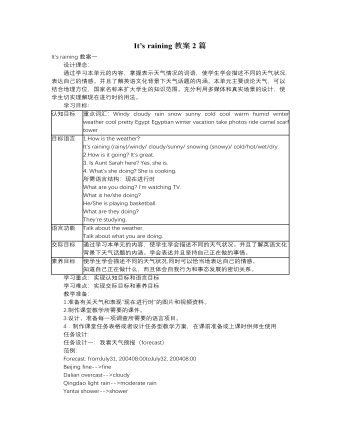
1 Each group choose one place to describe and what you are doing in it Choose one place, and describe what they are doing 2 Move around the room and give suggestions Talk about it and write it down 3 Ask one to show their works and act it Choose one of each group to make a report 4 Evaluate the best group and the best reporter Choose the best one Homework Ask your friends their ideal place and write about it教学反思:新课程标准中强调学生在课堂中的主体地位,在综合课中他们的主体地位就更加突出。在各个活动中给不同程度的学生不同层次的任务,让各层面的学生都有表现发挥的机会,从而产生对英语的兴趣。使用照片图片多媒体来辅助教学,效果更好。同时让了解其他国家风景,风俗的同学介绍ideal place,增加学生的背景知知识,实现跨学科交流的目的。教案点评:采用任务型教学模式,在各个活动中给不同程度的学生不同层次的任务,让各层面的学生都有表现发挥的机会,从而产生对英语的兴趣。使用照片图片多媒体来辅助教学,效果更好。让了解其他国家风景,风俗的同学介绍ideal place,增加学生的背景知识,实现跨学科交流的目的。
人教版新目标初中英语八年级下册What should I do教案2篇
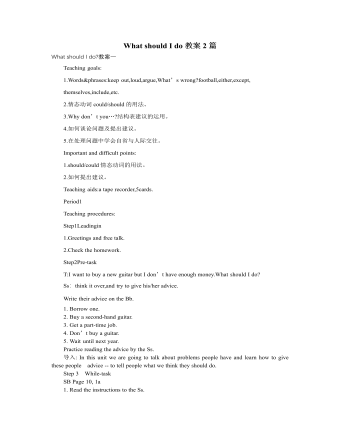
说明:在帮Li Lei提建议的同时,教育学生如何学好英语。第三课时教学目标1. 语言目标:a) 词汇: Original, in style, haircut, the same as.b) 语言结构:My friend wears the same clothes and has the same haircut as I do.2. 能力目标:大多数学生能够谈论自己喜欢哪种服装,提高查找信息的能力。3. 情感目标:学会如何与朋友相处,要有自己对时尚的看法。教学重点掌握一些重要词汇。教学难点学会谈论问题,并能提出书面建议。◆教学突破首先针对Erin的问题,提出个人的建议,模仿2c部分的对话展开双人交际Pair-work;听老师诵读3a部分的信件,并找出LEFT OUT的问题所在;学生完成3b部分的内容,给Left Out提出书面的建议;学以口头形式提出自己目前存在的某个问题,讲给大家听,让同学们给自己提出一个建议,并作笔录;学生两、三个人分成一组,随意性地进行口语交际,谈论P14的第4部分的某个问题,相互交换意见。
人教版新目标初中英语八年级下册He said I was hard-working教案2篇
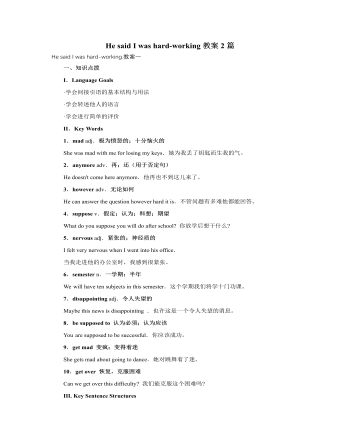
This activity introduces some new vocabulary and provide oral practice using the target language.Task 1 . Ask four students to stand in front of the class, and the teacher asks them the following questions as a reporter.1.What are you going to do when you grow up?2.What are you going to do next week?3.What are going to do after school?The students will give different answers, then ask a good student to report what they said.I am going to e a doctor.What did she say?----------She said she was going to be a doctor.I am going to have a party on Friday night.What did he say?-------He said he was going to have a party on Friday night.I am going to do my homework.What did she say ?------ She said she was going to do her homework.I am going home after school.What did she say?-----She said she was going home after school.Say In this unit we are going to learn to use words like to report what someone said.Task 2. Read the instructions. Then ask a student to read the four questions. And write the words on the Bb. Explain what soap opera is.Task 3. Ask the students to Look at the pictures, point out the TV screens in the picture. Ask one girl to read what Marcia said.What did Marcia say? She said She said she was having a surprise party for Lana on Friday night. Repeat the other pictures in the same way.Activity3. Listen and number the pictures in activity 1a.
人教版新目标初中英语八年级下册How long have you been collecting shells教案2篇
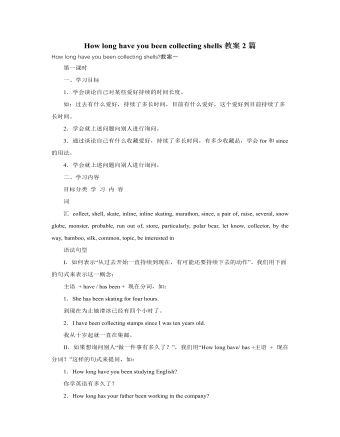
Step Ⅱ Show the new words on the screen and teach the new words. Read the new words to students and ask them to repeat.Step Ⅲ 3aThis activity introduces new vocabulary and provides reading practice using the target language.In this activity first look at the four pictures.T: What can you see in the pictures?Ss: Four snow globes.T: Right. There are four snow globes in the pictures. And what are they?Ss: They are a monster, two polar bears, two penguins and a birthday cake.Write these words on the blackboard: snow globe; monster; polar bear; penguin and birthday cake. Read them to the class and ask students to repeat each one. Make sure students understand each word.Use a computer to show the E-mail message on the screen and read the message to students.Get students to read the e-mail on their own, and then draw lines connecting each snow globe and its description.Correct the answers.AnswersA line should connect each snow globe picture with the words that describe it in the letter.Step Ⅳ 3bThis activity provides writing practice using the target language.First review Activity 2a on Page 47.Then ask students to complete the message according to Activity 2a.Some partial sentences are given to students. Write about one person's collection.When students work, walk around the room checking the progress and offering help as needed.When they finish, ask some students to read their messages to the class.
人教版新目标初中英语八年级下册What were you doing when the UFO arrived教案2篇
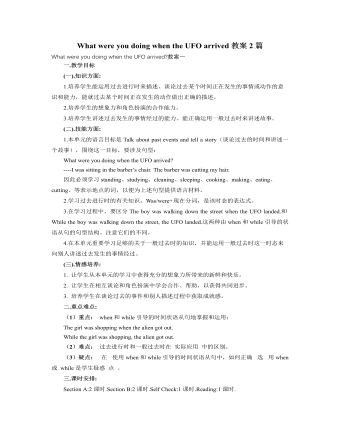
(一).知识方面: 1.培养学生能运用过去进行时来描述、谈论过去某个时间正在发生的事情或动作的意识和能力,能就过去某个时间正在发生的动作做出正确的描述。 2.培养学生的想象力和角色扮演的合作能力。 3.培养学生讲述过去发生的事情经过的能力。能正确运用一般过去时来讲述故事。 (二).技能方面: 1.本单元的语言目标是Talk about past events and tell a story(谈论过去的时间和讲述一个故事),围绕这一目标,要涉及句型: What were you doing when the UFO arrived? ----I was sitting in the barber’s chair. The barber was cutting my hair. 因此必须学习standing、studying、cleaning、sleeping、cooking、making、eating、cutting、等表示地点的词,以便为上述句型提供语言材料。2.学习过去进行时的有关知识。Was/were+现在分词,是该时态的表达式。 3.在学习过程中,要区分The boy was walking down the street when the UFO landed.和While the boy was walking down the street, the UFO landed.这两种由when和while引导的状语从句的句型结构。注意它们的不同。
北师大版初中七年级数学下册用图象表示的变量间关系说课稿
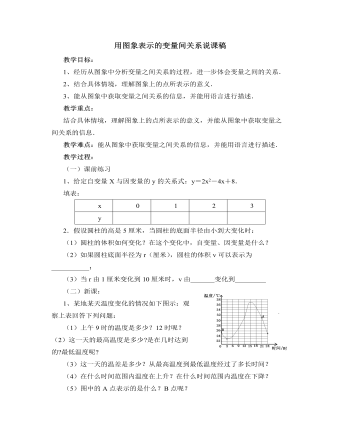
(1)上午9时的温度是多少?12时呢?(2)这一天的最高温度是多少?是在几时达到的?最低温度呢?(3)这一天的温差是多少?从最高温度到最低温度经过了多长时间?(4)在什么时间范围内温度在上升?在什么时间范围内温度在下降?(5)图中的A点表示的是什么?B点呢?(6)你能预测次日凌晨1时的温度吗?说说你的理由.2、议一议:骆驼被称为“沙漠之舟”,你知道关于骆驼的一些趣事吗?例:它的体温随时间的变化而发生较大的变化:白天,随沙漠温度的骤升,骆驼的体温也升高,当体温达到40℃时,骆驼开始出汗,体温也开始下降.夜间,沙漠的温度急剧降低,骆驼的体温也继续降低,大约在凌晨4时,骆驼的体温达到最低点.3、如下图,是骆驼的体温随时间变化而变化的的关系图,据图回答下列问题:
人教部编版语文八年级下册《礼记》二则教案
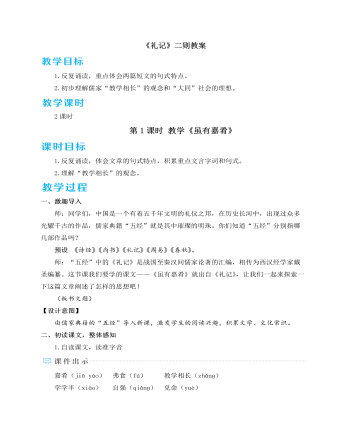
预设 (1)“大道”可以理解为治理社会的最高准则。“大同”指儒家的理想社会或人类社会的最高阶段。“大道之行也”是指执政者施行“大道”,老百姓便可以生活在安定和平的大同社会。(2)天下为公;选贤与能,讲信修睦。(3)“大同”社会是以“五帝之世”的传闻为依据,经过加工提炼而后构想出来的一个理想社会的模式。意在建立一个合理的社会,以消除现实社会中的黑暗现象和不合理的地方。3.拓展延伸师:你认为这种理想社会在当时实现了吗?如何理解这种思想?(生交流讨论,师引导)预设 “谋闭而不兴,盗窃乱贼而不作”是一种和平安定的局面,是对“大同”社会的一个总结,这个理想在当时并没有实现,因为小生产的物质基础不足以支撑“大同”社会的运转,还有搞阴谋、盗窃财物和作乱等奸邪之事。这种理想在当时虽不能实现,但它具有积极意义,是我们的精神财富。
人教部编版语文八年级下册《庄子》二则教案
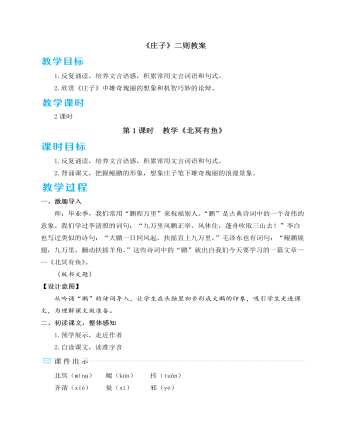
庄子是战国时期著名的思想家、哲学家和文学家。他是道家学派主要代表人物之一,他继承并发展了老子的思想,与老子并称“老庄”。《庄子》又名《南华经》,是道家经典著作之一。《庄子》主要反映了庄子的批判哲学、美学等,其内容丰富,博大精深,涉及哲学、人生、政治、社会、艺术、宇宙生成论等诸多方面。《庄子》是一部文学的典范著作。“道”是庄子思想的核心,“逍遥游”是庄子不满黑暗现实的羁绊而提出的一种生活方式与社会理想。庄子主张超然物外,绝对自由地生活在世界上,他认为生命的意义不在于庸俗地活着,而在于逍遥地神游,这些精神的遨游是绝对自由的,在庄子看来,自然是一种超凡脱俗的状态,一种妙不可言的境界。庄子的“逍遥游”是一种感性的生活方式,他告诉我们要去追求功利之外独立的生命价值,追求人生的真实自我。从当下来看,庄子追求的逍遥境界,是无法实现的主观唯心主义幻想,是一种乌托邦式的美好的臆想。
人教部编版七年级下册外国诗二首教案
五、细读诗歌,明确写法1.明确文章写法。这首诗中诗人描写的是自然界的道路,但是同时又暗含着诗人对人生之路的思考。这首诗中的这种写法与《假如生活欺骗了你》中的写法一样吗?为什么?预设 不一样。这首诗中诗人运用了大量形象阐释哲理,运用了许多咏物诗、哲理诗采用的象征手法,耐人寻味。对诗歌创作,弗罗斯特有独具一格的方法与原则,他认为诗歌应“始于愉悦,终于智慧”,应该给人以美的享受和思想上的启迪。从以上的学习中我们可以看出,诗人弗罗斯特用简单的语言、丰富的象征,巧妙地将自己对社会、自然、人生的了解和思考融入丰富的诗歌形象之中,运用人们熟悉又带有神秘色彩的自然场景,向人们阐释人生哲理,向人们展示他理解的人生,以及他对人生、对社会的探索。2.了解象征手法。象征是诗歌创作中经常运用的一种写作方法,诗歌一般都会通过一定的艺术形象,生动鲜明地将主题含蓄地表达出来。
人教部编版语文八年级下册《诗经》二首教案
1.《蒹葭》中的“伊人”究竟为何人?长期以来,人们对《蒹葭》主题的解读众说纷纭,莫衷一是,直接导致了对诗中“伊人”形象有多重理解。持“爱情说”者,认为“伊人”是意中人;持“政治说”者,认为“伊人”是贤能之人;持“理想说”者,认为“伊人”象征着理想。其实,无论“伊人”是何人,指的是什么,诗歌中的主人公都是经历了许多波折,一直苦苦追寻着“伊人”。这其实体现了一种深刻的人生意义,美好的事物总是可望难即的,不管最后主人公是否寻得“伊人”,这追寻过程本身就具有极大的意义。2.《关雎》和《蒹葭》在内容情感和表现形式上有什么异同?相同点:《关雎》和《蒹葭》都属于《诗经》中的“国风”,都是当时的民歌;都运用了“兴”的手法,借景抒情,托物寄意;都大量使用重章叠句的艺术形式,反复咏唱;在语言形式上大多四言一句,二二拍,一般隔句用韵,但并不拘泥,而是富于变化;都使用了双声叠韵词,富于声韵美。
北师大版初中七年级数学下册同底数幂的除法说课稿2篇
设计意图:知识的掌握需要由浅到深,由易到难.我所设计的三个例题难度依次上升,根据由简到难的原则,先让学生学会熟悉选用公式,再进一步到公式的变形应用,巩固知识.特别是第三题特别强调了运用法则的前提:必需要底数相同.为加深学生对法则的理解记忆,形成“学以致用”的思想.同时为了调动学生思考,接下来让学生进入反馈练习阶段,进一步巩固记忆.4、知识反馈,提高反思练习1(1)口答设计意图:根据夸美纽斯的教学巩固性原则,为了培养学生独立解决问题的能力,在例题讲解后,通过让个别同学上黑板演演,其余同学在草稿本上完成练习的方式来掌握学生的学习情况,从而对讲解内容作适当的补充提醒.同时,在活动中引起学生的好奇心和强烈的求知欲,在获得经验和策略的同时,获得良好的情感体验.
北师大版初中七年级数学下册同底数幂的乘法说课稿2篇
4、巩固新知,拓展新知(羊羊竞技场)本环节在学生对性质基本熟悉后安排了四组训练题,为避免学生应用性质的粗糙感,以小羊展开竞技表演为背景,让学生在轻松愉快的氛围中层层递进,不断深入,达到强化性质,拓展性质的目的。提高学生的辨别力;进一步增强学生运用性质解决问题的能力;训练学生的逆向思维能力,增强学生应变能力和解题灵活性.5、提炼小结完善结构(羊羊总结会)“通过本节课的学习,你在知识上有哪些收获,你学到了哪些方法?”引导学生自主总结。设计意图:使学生对本节课所学知识的结构有一个清晰的认识,能抓住重点进行课后复习。以及通过对学习过程的反思,掌握学习与研究的方法,学会学习,学会思考。6、课堂检测,发展潜能(大战灰太狼)
北师大版初中数学八年级下册因式分解说课稿2篇
情景感知概括运用设疑诱导动手操作合作交流尝试活动启发引导类比发现演练结合观察分析自主探索问题讨论利用尝试活动“我来当老师!”给学生提供设计问题的机会,培养他们实事求是的科学态度,勇于质疑、敢于创新的良好习惯及数学应用能力。例1、根据因式分解的概念,判断下列由左边到右边的变形,哪些是因式分解,哪些不是,为什么?通过罗列一些似是而非、容易产生错误的对象让学生辨析,促使他们认识概念的本质、确定概念的外延,从而形成良好的认知结构。例2:解答下列问题:(1)993-99能被99整除吗?能被98整除吗?能被100整除吗?(2)求代数式IR1+IR2+IR3的值,其中R1=19.2,R2=35.4,R3=32.4,I=2.5。让学生进一步体会用分解因式解决相关问题的简捷性。例3、填空:若x2+mx-n能分解成(x-2)(x-5),则m=,n=。
北师大版初中数学八年级下册线段的垂直平分线说课稿2篇
活动四:自主学习,尺规作图先阅读,再尝试作图,思考作图道理,小组讨论,“为什么作图过程中必须以大于1/2AB的长为半径画弧?”同桌演示尺规作图。最后折纸验证,使整个学习过程更加严谨。我将用下面这个课件给学生展示作图过程。再次回顾情境,让学生完成情境中的问题。(三)讲练结合,巩固新知第一个题目是直接运用性质解决问题,比较简单,面向全体学生。我还设计了第二个题目,想训练学生审题的能力。(四)课堂小结在学生们共同归纳总结本节课的过程中,让学生获得数学思考上的提高和感受成功的喜悦并进一步系统地完善本节课的知识。(五)当堂检测为了检测学生学习情况,我设计了当堂检测。第一个题目,让学生学会转化的思想来解决问题;第二个题目练习尺规作图。
北师大版初中七年级数学下册整式的乘法说课稿2篇
练习3、先化简,再求值:2a(a-b)-b(2a-b)+2ab,其中a=2,b=-3.(通过例题和联系将所学知识升华,提升)练习4、动动脑。(让学生进一步感知生活中处处有数学)(四)、畅谈收获、拓展升华1、本节课你学到了什么?依据是什么?整式的乘法存在什么没有解决的问题?(同桌互讲,师生共同小结)2、布置作业:习题1.9知识技能1四、说课小结本堂课我主要采用引导探索法教学,倡导学生自主学习、尝试学习、探究学习、合作交流学习,鼓励学生用所学的知识解决身边的问题,注重教学效果的有效性。学生在合作学习中,可以活跃课堂气氛,消除心理压力,在愉快的环境中学习知识,有效地拓展学生思维,成功地培养学生的观察能力、思维能力、合作探究能力、交流能力和数学学习能力。但由于本人对新课标和新教材的理解不一定十分到位,所以在教材本身内在规律的把握上,会存在一定的偏差;另外,由于对学生的认知规律认识不够,所以教学活动的设计不一定十分有效。所有这些都有待教学实践的检验。
北师大版初中七年级数学下册轴对称现象说课稿2篇
此题的设计目的:及时的练习一是起到巩固新知识的目的,二是及时了解学生掌握新知识的情况,起到反馈的目的。这样设计的依据是:小题多,是让更多的学生参与到学习中来,及时给予他们更正,更多的是对他们的鼓励和表扬,有简单的题尽量让基础不太好的的学生去说,以让他们感受到成功的乐趣;并且《新课标》中指出课程内容应处于学生“最近发展区”的范围以内,让成功始终伴随学生学习的旅程,以保证学生不会因过多的失败而放弃他们的努力,失去发展的机会。第四环节:师生合作,归纳总结。先由学生个人总结,然后教师补充。设计目的:通过学生个人小结,教师可以了解学生掌握知识的情况,培养学生总结概括的能力,教师补充起到完善所学知识的目的。第五环节:布置作业,巩固提高。设计目的:因材施“作业”,分层次布置作业,减轻学生的负担,全面推行素质教育,让学生学有用的数学,不同的学生学习不同的数学,在数学中得到不同的发展,以求彰显学生的个性。