-
人教版新目标初中英语七年级下册Where did you go on vacation教案
句型: Where did you go on vacation? I went to summer camp.Did she go to Central Park?Yes,she did.No, she didn’t语法:一般过去时特殊疑问句、一般疑问句及肯、否定回答。课时安排4课时第一课时:Section A:la,1b,lc,2a,2b,2c 第二课时:Section A:3a,3b,4第三课时:Section B:1,2a,2b,2c第四课时:Section B:3a,3b,3c,4 and Self Check第一课时教学目标掌握描写假期生活的形容词。假期里自己所做事情的简单表达。谈论假期做的事情及当时情况。谈论假期时旅游的天气,旅游者以及食物等。教学过程一、导入播放一首英文歌曲:Let’s travel 说明:通过让学生听节奏欢快迪斯尼英语歌曲Let’s travel.引入本节课谈论的话题vacation and travel. 让歌曲使学生的思维活跃,增强课堂气氛,激发学生提高学习英语的兴趣。T:How is the trip ?Ss : It’s pretty good/ happy/exciting /relaxing/busy/dangerous/ fantastic说明:这个问题是为了操练形容词。建议让多个Ss作答。鼓励他们用不同的形容词。上述个别形容词本应在第二课时中出现,但可以在warming-up中第一次非正式出现。这些形容词也可在老师的评价语中适时出现,以加深学生对词汇的印象。
人教版新目标初中英语七年级下册Why do you like koalas教案2篇
单元整体说明(一)单元教材分析本单元的核心话题是描述动物和表达个人喜好,以及句式why do you like…? Because…。这也是本单元的教学重点。通过本单元的学习,学生应能较流利地运用所学词汇和句型描述动物,表达个人喜好。(二)单元知识结构1.词汇动物名称 tiger, elephant, koala, dolphin, etc.词汇描述性形容词: smart, cute, ugly, clever, shy, etc.国家名: Australia, South Africa2.句型Why do you like koala hears? Because they are cute.Where are pandas from? They're from China.What animals do you like? I like dolphins.(三)单元整体目标1.Master the vocabulary2.Master and use: Why do you like koalas? Because they am cute.Where are pandas from? They're from China.What animals do you like? I like dolphins.(四)单元教学重难点一览(五)单元学情分析学生此前已经学过由why, where, what 引导的特殊疑问句句型,具有了学习本单元知识的认知前提。形形色色的动物能激发学生的好奇心,产生了解它们的欲望,这有利于本单元知识的教学和学生学习兴趣的培养。

人教版新目标初中英语八年级上册How do you get to school教案2篇
Step Ⅶ Role play ( Work on 1b)1. First ask two students to read the dialogue to the class.Sa: How do you get to school?Sb: Well, I ride my bike to the subway station. Then I take the subway.2. Now work with a partner.Suppose you use two kinds of transportation to get to school \Hangzhou\Beijing... (bus, train, subway, walking, bike, etc.) Tell how you get there. You may use the phrases in 1a.3. Then ask different pairs of students to present their conversations to the class.Step ⅧListening1. Work on 2a(1) First ask students to read the list of information that Thomas wants to know.…where Nina lives.…how far from school she lives.…how long it takes to get to school.…how she gets to school.…what she thinks of the transportation.(2) Tell students what transportation and bus stop mean.bus stop 汽车站 transportation n. 运送;运输Then tell students we'll hear a recording. Please put a checkmark in front of each thing that Thomas wants to know.(3) Now play the recording for students.( Have students pay attention to the sample answer.) (4) Then correct the answers.
人教版新目标初中英语八年级上册What are you doing for vacation教案2篇
Teaching goals : 1. Words & phrases: babysit ,get back , fishing , rent , think about , decide(on) , tourist etc. 2. How to talk about future plans . 3. 现在进行时表示将来计划或行动. 4. 特殊疑问句(where , when , how long引导) Important and difficult points : Drills :What are you doing for vacation ? I’m watching TV . When are you going ? I’m going … . How long are you staying ? We’re staying for five days . Teaching aids : cards and a tape ,a large wall calendar . Period 1 Teaching procedures : Step 1Leading in1. Free talk . 2. Put up the wall calendar . T: I’m staying home on Saturday (pointing to next Saturday ).Ss repeat . Ss: I’m staying home on Saturday . T: OK. Today we’ll learn how to talk about future plans. Step 2Pre-task SB Page 13 , 1a . 1. Look at the picture carefully and tell what you see in the picture . 2. Write the activities from the pictures in the box and add some more . 3. Practice reading . Step 3While-task1. Using the activities we write in 1a to make conversations .For example :What are you doing for vacation ? I’m visiting my uncle . 2. Pairwork .Practice in pairs . 3. 用第三人称练习对话.
人教版新目标初中英语八年级上册What’s the best radio station教案2篇
教学重点和难点:运用所掌握的语言描述,比较不同地点的特点。在练习中学习掌握英语比较级和最高级的用法。课前准备分配小组,每组五至六人。通过上网或翻阅报刊杂志等方法,确定旅游线路,做出基本的旅游计划。教学设计:本节课流程图 学法指导:1.由于这是一堂新课,在教学中应注意面向全体,发挥学生的主体性,引导学生积极参与,激发学生的求知欲和学习积极性,指导学生积极思维,主动获取知识,养成良好的学习方法。逐步学会独立解决问题。总之要尽可能调动学生的非智力因素促进智力因素的发展。教法选择:1.电化教学法2.课堂讨论法3.任务型教学法采用这些方法的目的是为了充分调动学生的学习积极性,使学生变被动学习为主动学习。通过电脑形象的演示,加强印象,提高兴趣,突破难点,提高教学效率,进而增大教学的容量和信息量。充分体现教师为主导,学生为主体的教学原则。
人教版新目标初中英语八年级上册What’s the matter教案2篇
She shouldn’t go to the party tonight.Step7. TaskT: You know, there are lots of problems in our life. If you are a doctor, please tell us how to solve the problem. I will divide you into 9 groups. Please work in groups. And then choose one of you to report your ideas.The following are the problems:I have a toothache.I am hungry. I have a sore throat.I am stressed out. I have a sore back.I am tired. I can’t sleep.I have a cold. I have a headache.Report: If you have a headache, you should go to bed early. You should see the doctor. You should eat some medicine. You shouldn’t wash your face with cold water.You shouldn’t sleep late.You shouldn’t swim.…..T encourages the students to give advice as much as possible.Homework:1. Chose one of the problems, and write down your advice2. Copy the new words这一步是用于热身的,同时也可以让他们复习一部分的表示人体部位的单词,扩充知识.学习语言的过程也是一个不断积累的过程,复习旧知识,增添新知识.通过小游戏,强化学生对Does she/he have…这个句子的运用能力.通过复习,自然的引到下面新知识的学习。充分利用表格,由句子到对话,再到文章,让学生循序渐进. 提高学生的综合语言运用能力,运用以前学过的知识来解决身边的问题.Period 5 (Section B 3a—3c, selfcheck)教学内容与分析:
人教版新目标初中英语八年级下册If you go to the party, you’ll have a great time教案2篇
区分宾语从句、定于从句和状语从句宾语从句和状语从句,都叫做主从复合句。宾语从句主要是中考必考的,是初中阶段必掌握的从句,宾语从句主要是掌握三要素,所谓宾语从句,就是宾语在主从复合句当中充当宾语的一个句子,叫做宾语从句。主句的谓语动词是及物动词,后面如果是词或者是短语的话,是简单句,如果是句子的话,肯定是宾语从句。I know that he good at English.就是宾语从句,三要素,一要素是要注意连词,连词一共学了三类连词,一类连词是that口语当中可以省略,就像刚才说的那一句,I hear he is good at English.还有疑问代词、疑问副词,how where when,疑问代词、疑问副词。还有一类连词weather是否的意思,不是状语从句当中的如果,这一定要和如果区分开,这是是否。I don't know if he interested at English。宾语从句要注意if是连词。第二要素是语序,要用陈述举语序。比如说你家有几口人,我们都说How many people are there in you family?但是这是简单句,一旦说成宾语从句,你可以告诉我你家有几口人吗?Could you tell me how many people there are in you family ?
人教版新目标初中英语八年级下册He said I was hard-working教案2篇
This activity introduces some new vocabulary and provide oral practice using the target language.Task 1 . Ask four students to stand in front of the class, and the teacher asks them the following questions as a reporter.1.What are you going to do when you grow up?2.What are you going to do next week?3.What are going to do after school?The students will give different answers, then ask a good student to report what they said.I am going to e a doctor.What did she say?----------She said she was going to be a doctor.I am going to have a party on Friday night.What did he say?-------He said he was going to have a party on Friday night.I am going to do my homework.What did she say ?------ She said she was going to do her homework.I am going home after school.What did she say?-----She said she was going home after school.Say In this unit we are going to learn to use words like to report what someone said.Task 2. Read the instructions. Then ask a student to read the four questions. And write the words on the Bb. Explain what soap opera is.Task 3. Ask the students to Look at the pictures, point out the TV screens in the picture. Ask one girl to read what Marcia said.What did Marcia say? She said She said she was having a surprise party for Lana on Friday night. Repeat the other pictures in the same way.Activity3. Listen and number the pictures in activity 1a.
人教版新目标初中英语八年级下册What were you doing when the UFO arrived教案2篇
(一).知识方面: 1.培养学生能运用过去进行时来描述、谈论过去某个时间正在发生的事情或动作的意识和能力,能就过去某个时间正在发生的动作做出正确的描述。 2.培养学生的想象力和角色扮演的合作能力。 3.培养学生讲述过去发生的事情经过的能力。能正确运用一般过去时来讲述故事。 (二).技能方面: 1.本单元的语言目标是Talk about past events and tell a story(谈论过去的时间和讲述一个故事),围绕这一目标,要涉及句型: What were you doing when the UFO arrived? ----I was sitting in the barber’s chair. The barber was cutting my hair. 因此必须学习standing、studying、cleaning、sleeping、cooking、making、eating、cutting、等表示地点的词,以便为上述句型提供语言材料。2.学习过去进行时的有关知识。Was/were+现在分词,是该时态的表达式。 3.在学习过程中,要区分The boy was walking down the street when the UFO landed.和While the boy was walking down the street, the UFO landed.这两种由when和while引导的状语从句的句型结构。注意它们的不同。
人教版新目标初中英语九年级上册Teenagers should be allowed to choose their own clothes教案2篇
Step 1 Greeting Greet the class and check the homeworkStep 2 A duty report The S on duty gives a report on the rules in his home and lead in 3a “Sun Fei’s and Wu Yu’s rules” Step 3 ReadingSs read the conversation and write the two girls’ rules in the chart. Check the answers.Get Ss to read after the tape and then read aloud by themselves. Then, T explains the language points.Step 4 Pairwork 3bRole play. Use the information in chart to practice with the conversation in 3a covered. They can look at the sample conversation in the right box.Step 5 Task 2 “Who’s the best reporter?”Make a survey by asking any 5 students the questions in the chart in activity 4. Then give out a report about it. See who is the best reporter? And the best reporter will get a nice ball-pen.Step 6 Summary and homework:Write out the report in your exercise-books.Period ThreeStep 1 Greeting and a duty reportThe S gives a duty report talking about his experience of being late for school. Lead in the question “Do you ever get to school late? How often do you get to school late? Always, usually, sometimes, or never?Step 2 1a Get Ss to finish writing.Step 3 Pairwork 1b Get Ss to talk about their answers with their partners using the sample conversation in the box on the right.Step 4 Listening practice2a Lead-in: What will happen if you get to school late? What about Peter? Let’s listen to a conversation between Peter and his father. Get Ss to finish 2a (As usual, for the first time, Ss only listen.) Check the answers.
人教版新目标初中英语九年级上册I like music that I can dance to教案
教学目标: 1. Express preferences2. Talk about one’s likes and dislikes and the reasons3. Learn to express one’s opinions 4. Learn to write a reply 语言功能: 1) Talk about one’s preferences, using t he relative clause2) Talk about people’s likes and dislikes and the reasons3) Talk about opinions语言结构: Relative clauses with that and who语言目标:What kind of music do you like?I like music that I can sing along with.I love singers who write their own music.We prefer music that has great lyric.重点词汇及短语:heart, photography, interest, class, whatever, miss, okay, expect, sweet, taste, itself, laboratory, cancer, increase, biscuit, main, care, prefer… to…, remind somebody of …, dance to, sing along with, be sure to, interest somebody, make somebody adj., to be honest, suit somebody, on display, catch up教学重难点:What do other people think of the different kinds of things? How to express one’s opinions? 学习方式:讨论,合作学习情感目标:通过本单元的学习,能提高学生的艺术鉴赏能力和审美情趣,并引导学生养成健康的饮食习惯。课时安排5课时第一课时:Section A: 1a-2c第二课时:Section A : 3a-4第三课时:Section B:1-2c, Self check2第四课时:Section B: 3a-4, Self check1第五课时:Self check ReadingI like music that I can dance to.
人教版新目标初中英语九年级下册By the time I got outside, the bus had already left教案
Ⅰ. Teaching Aims and Demands1. Knowledge Objects(1) Key Vocabularyoversleep(2) Target LanguageWhat happened?I overslept. And by the time I got up, my brother had already gotten in the shower.2. Ability Objects(1) Teach the students to use the new words.(2) Train the students to narrate past events with the Past Perfect Tense.(3) Train the students' listening and speaking skills with the target language.3. Moral ObjectIt’s a good habit to go to bed early in the evening and get up early in the morning. So you’ll never be in a hurry in the morning.Ⅱ. Teaching Key Points1. Key Vocabularyoversleep2. Target LanguageNarrate past events with the Past Perfect TenseⅢ. Teaching Difficult Points1. Train the students to narrate past events with the Past Perfect Tense.2. Train the students to understand the target language in spoken conversation.Ⅳ. Teaching Methods1. Thinking of examples from the students' real lives.2. Making sentences by looking at the pictures.Ⅴ. Teaching AidA tape recorderⅥ. Teaching ProceduresStep I Revision1. Revise the language points in Unit 8.Ask some questions like this: What volunteer work would you like to do?Help the students to answer, I’d like to…/I love to…/I hope to2. Practice the dialogue in Activity 3c on page 62 again. Get students to role play the similar dialogues with the following.
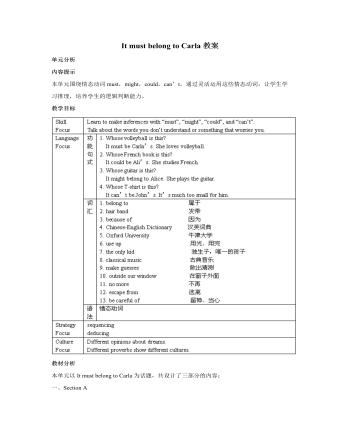
人教版新目标初中英语九年级上册It must belong to Carla教案
一、Section A该部分有4个模块。第一模块围绕Whose volleyball is this? 这一话题展开思维( 1a)、听力(1b)、口语( 1c)训练;第二模块围绕上一模块中的话题进行听力( 2a-2b)、口语训练( 2c);第三模块继续围绕前两个模块中的“making inferences”展开训练。训练形式为阅读排序( 3a)和两人问答(3b);第四模块仍就上一话题展开讨论。二、Section B该部分有4个模块。第一模块要求根据图画和所提供的单词写出合理的句子;第二模块在听力( 2a-2b)和分角色口语训练( 2c)的基础上,继续进行“推测”训练; 第三模块围绕“Strange events in Bell Tower neighborhood”这一话题展开阅读( 3a)和写作(3b -3c)训练;第四模块以dream为话题展开小组活动。三、Self Check该部分有3个模块。第一模块以填空形式对所学词汇进行训练;第二模块就8个谚语展开阅读和讨论。
人教版新目标初中英语九年级下册I’ll help clean up the city parks教案
Talk about offering help (P60)I’ll help clean up the city parks.A: I’d like to work ...B: You could help ...Talk about ways to tell people about the Clean-Up Day (P61)We need to ...We can’t ...I’ll ...Talk about the work the volunteers do (P62)These three students all volunteer their time to help other people.Somebody loves to ... / helps ... / plans to ... / wants to ...A: What do you like doing?B: I like ... A: What kind of volunteer work do you think I could do?B: You could ...1. 重点词汇advertisement, fix, repair, pleasure, blind, deaf, shut, carry, specially, fetch2. 认读词汇hunger, homeless, cheer, clean-up, sign, establish, major, commitment, elementary, veterinarian, coach, similar, call-in, strategy, disabled, organization, unable, support, appreciate, donation, part of speech, pronoun, adverb, preposition, conjunction, donate, Jimmy, Sally3. 词组clean up, cheer up, give out, put off, set up, think up, take after, fix up, give away, put up, hand out, work out, at once
人教版新目标初中英语九年级下册We’re trying to save the manatees教案2篇
本单元主要围绕着有关濒临灭绝的动物这一话题,学习了应该怎样保护我们的环境,以及就某一问题展开辩论。目标提示语言目标能够运用所学知识,就某一问题展开辩论。认知目标1、复习一些语法:现在进行时、一般现在时、用used to 表示一般过去时、现在完成时、一般过去时的被动语态。2、学会表达同意和不同意。3、学会以下基本句型:We’re trying to save the manatees.Manatees eat about 100 pounds of food a day.There used to be a lot of manatees.In 1972,it was discovered that they were endangered.Some of the swamps have become polluted.情感目标了解一些濒临灭绝的动物的生活习性和濒临灭绝的原因,教育学生应该如何保护环境。教学提示充分利用多媒体等教学设备,创设与本课话题相关的情境,如各种不同种类的动物、动物园以及有关环境的画画等等。围绕着本单元的教学目标,设计一些贴近学生实际的教学任务,如让学生谈论自己最喜欢的动物,如何拯救濒危动物,如何保护环境等等。让学生根据所学知识,就动物园是否对动物有利以及其他的话题进行辩论。
人教版新目标初中英语九年级下册You’re supposed to shake hands教案
教学目标:1. 掌握本单元一些重点词汇的写法和用法。2. 学会自如谈论餐桌礼仪。Step 1 RevisionAsk some students to retell the customs at the table in France in the passage in 3a.Step 2 Self checkPart 1. Fill in each bland with the correct word given. Students do the exercises by themselves at first. Then check the answers. Ask the students to comprehend the sentences and help them point out uses of some words, like “arrive (at / in) sw., spend time / money on sth , spend time / money (in) doing sth.”Part 2. Read about Fan Ling’s experience in a western restaurant. Understand the passage. Point out some key points in the passage.1. be / get used to doing sth. 习惯做某事2. begin with = start with 以….开头3. crowd v. 挤满,塞满 the crowd 人群 crowded adj. 拥挤的Then students discuss about how she would solve her problem. Ask some to share their stories with others.Part 3. Complete the crossword by looking at the sentences on the left. Then check the answers.
部编版语文九年级上册《就英法联军远征中国致巴特勒上尉的信》教案
3.作者是如何表达出自己的观点的?明确:作者首先以瑰丽的语言盛赞圆明园在人类文明中的地位,其后,又以比喻及反讽的修辞,将英法联军劫掠圆明园的罪行揭露而出,两者形成鲜明的对比,从而引出谴责英法联军远征中国行为的观点。目标导学三:了解作者心中的圆明园及英法联军的强盗行径1.作者是如何描述他心目中的圆明园的?明确:圆明园是幻想的某种规模巨大的典范,一座言语无法形容的建筑,某种恍若月宫的建筑。作者用大理石,玉石,青铜,瓷器,雪松,宝石,绸缎,神殿,后宫,城楼,神像,异兽,琉璃,珐琅,黄金,脂粉,一座座花园,一方方水池,一眼眼喷泉,成群的天鹅、朱鹭和孔雀等无数华贵的象征,铺就了一张华贵的想象画面,构成他心中的圆明园。正如他所说“总而言之,请你假设人类幻想的某种令人眼花缭乱的洞府,其外观是神庙,是宫殿,那就是这座园林”。
人教版高中语文必修2《就任北京大学校长之演说》教案2篇
(现状:①对于教员,不能以诚相待,礼敬有加,只是利用耳。2段:因做官心切,对于教员,则不问其学问浅深,唯问其官阶之大小。官阶大者,特别欢迎,盖唯将来毕业有人提携。②对于同学校友,不能开诚布公,道义相勖。)他的第三点要求是,要求青年学子。这是从个人涵养方面来说的。尊敬师长,团结友爱,互相勉励,共同提高,是建设良好校风必须具备的条件。端正学风,改善校风,就是为培养学术研究新风气创造条件。全校上下树立了新风尚,学校的学术气也就会很快浓起来。这也是贯彻“思想自由”的办学方针,不可或缺的措施。蔡元培先生在他这次演讲中,始终是围绕着他的办学方针来阐述的。(四)蔡先生提出两点计划,目的为何?思考、讨论、明确:一曰改良讲义,以期学有所得,能裨实用。
人教版高中语文《就任北京大学校长之演说》教案
蔡元培的道德风范和人格力量,具有震撼人心的作用,深为世人所钦仰。“人世楷模”“善良的社会和庄严的人生的模范”(国立音乐专科学校师生1936年1月《祝蔡孑民先生千秋诗》)的赞誉,对他来说绝非溢美之词。任鸿隽称他具有“处处为人无我的真精神”;“对人接物,似乎有两个原则,一个是尊重他人的人格,决不愿意以自己的语言和行动使人感到一点不快或不便,一个是承认他人的理性,以为天下事无不可以和平自由的方法互相了解或处理。”“但在公义一方面,蔡先生却是特立不屈、勇往直前、丝毫不退、毫不假借的斗士。”(重庆《中央日报》1940年3月24日)他的学生冯友兰也回忆说,在蔡先生身边,感同光风霁月,他的人格能造成一种气象。沐浴在这种气象之中,就不能不为他的人格所感化。蔡元培身居高位,一生廉洁,自奉俭朴,直至晚年仍是全家租赁房屋居住,他酷爱的书籍也分散在北平、上海、南京、杭州等地,没有一个归拢庋藏的地方。蔡元培这种真诚待人、无私奉献、光明磊落的精神,源于他对国家、对民族、对事业、对学生深深的眷恋和崇高的责任感。他的这种浩然正气和高尚道德情操,至今仍是公务人员的楷模。
《说文明话, 做文明人》主题班会教案
2、文明礼貌用语我知道。学生二:“三文明”教育活动已经轰轰烈烈的展开了。在学习三文明教材中,我们有一项特殊的作业——收集文明礼貌用语,现在我们就八仙过海,各显神通,看谁语言美。(开火车)学生发言。学生一:听同学们的发言,我已经感受到了我们的语言的确很美,希望在以后的生活中,我们能经常用优美的语言与人交流。3、读书笔记展览。学生二:“文明”教育活动已经渗透到每个同学的心里,我们班同学写了读书笔记。请按顺序依次参观。4、文明手抄报展览。5、为获奖同学颁发奖状。(自制奖状)学生一:我们学了那么多,最终目的就是让我们“说文明话,行文明举,做文明人”。请欣赏〈文明礼仪歌谣〉