-
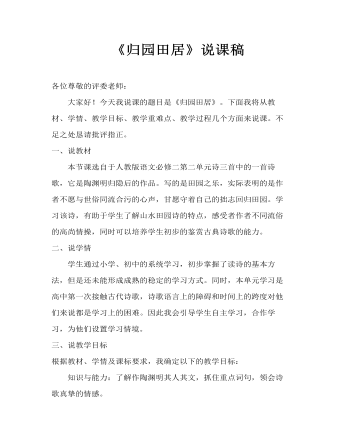
高中语文人教版必修二《归园田居》说课稿
一、说教材本节课选自于人教版语文必修二第二单元诗三首中的一首诗歌,它是陶渊明归隐后的作品。写的是田园之乐,实际表明的是作者不愿与世俗同流合污的心声,甘愿守着自己的拙志回归田园。学习该诗,有助于学生了解山水田园诗的特点,感受者作者不同流俗的高尚情操,同时可以培养学生初步的鉴赏古典诗歌的能力。
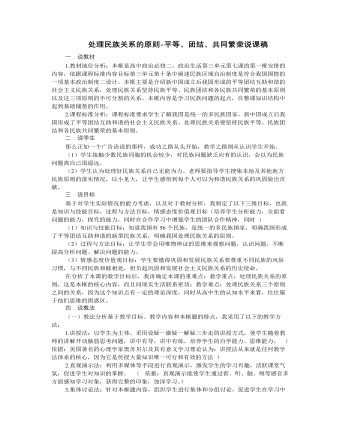
人教版高中政治必修2处理民族关系的原则-平等、团结、共同繁荣说课稿
环节四 情感升华,感悟生活播放《爱我中华》,感受祖国的伟大,民族的团结。设计意图:使学生感受伟大的中华民族的精神,内心产生共鸣,抒发强烈的爱国热情。教师带领学生一起合唱,用歌声结束本堂课内容,能再次唤起学生的爱国情感,使学生认识到:维护国家统一和民族团结是每个公民的义务。环节五 课堂小结 巩固知识本节课我采用线索性的板书,整个知识结构一目了然,为了充分发挥学生在课堂的主体地位,我将课堂小结交由学生完成,请学生根据课堂学习的内容,结合我的板书设计来进行小结,以此来帮助教师在第一时间掌握学生学习信息的反馈,同时培养学生归纳分析能力、概括能力。本节课,我根据建构主义理论,强调学生是学习的中心,学生是知识意义的主动建构者,是信息加工的主体,要强调学生在课堂中的参与性、以及探究性,不仅让他们懂得知识,更让他们相信知识,并且将知识融入到实践当中去,最终达到知、情、意、行的统一。
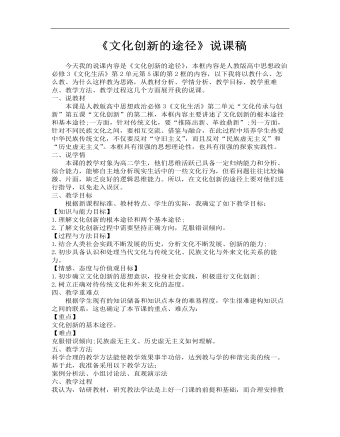
高中思想政治人教版必修三《文化创新的途径》说课稿
二、说学情本课的教学对象为高二学生,他们思维活跃已具备一定归纳能力和分析、综合能力,能够自主地分析现实生活中的一些文化行为,但看问题往往比较偏激、片面,缺乏良好的逻辑思维能力。所以,在文化创新的途径上要对他们进行指导,以免走入误区。三、教学目标根据新课程标准、教材特点、学生的实际,我确定了如下教学目标:【知识与能力目标】1.理解文化创新的根本途径和两个基本途径;2.了解文化创新过程中需要坚持正确方向,克服错误倾向。
人教版高中政治必修3思想道德修养与科学文化修养说课稿
由此引导学生的深思,学生通过合作探究,帮助学生认识到不注重思想道德修养,即使掌握了丰富的科学知识,也难以避免人格上的缺失,甚至危害社会。进而总结出关系二:加强思想道德修养,能够促进科学文化修养。科学文化修养的意义播放感动中国人物徐本禹先进事迹短片。学生观看完视频后,思考:从徐本禹的事迹中,我们可以了解到我们加强科学文化修养的根本意义是什么?引导学生结合自身体会,发表各自见解,在此基础上帮助学生总结出,要使自己的思想道德境界不断升华,为人民服务的本领不断提高,成为一个真正有知识文化涵养的人,成为一个脱离低级趣味的人、有益于人民的人。知识点三:追求更高的思想道德目标根据教材110探究活动(思想道德的差异、反应人们世界观、人生观、价值观的差异)思考:用公民的基本道德规范来衡量这些观点,你赞成哪些观点?反对哪些观点?小组进行合作探究,引导学生根据公民基本道德规范对这些价值观进行评析。
人教版高中政治必修3思想道德修养与知识文化修养说课稿
1.做学问之前首先学会做人2.知识文化修养和思想道德修养的关系三.追求更高的思想道德目标㈤ 说教学评价和反思:1.这节课主要是以学生为主体,老师为主导,让学生充分发表自己的看法,把理论的知识结合在实际的日常生活中,鼓励学生充分发表自己的意见,能调动学生学习的积极性,达到教学目的。这节课学生讨论,发言的机会很多,但由于我校的学生的基础薄弱,在发言时难免偏离老师引导的方向,甚至出现毫不相干的说法,由于本人经验不够此时如何去引导他们可能做的还不够好。2.新课程的教学,如何突破书本知识的局限,延伸更深层次的内容是一个难题。本节课在知识的处理上,把道德的重要性与道德的层次两个知识点补充了进去,目的是让学生在学习之前有一个情感的铺垫,从而更好地达到教学目标。
人教版高中政治必修3思想道德修养与科学文化修养说课稿3篇
(3)改造主观世界同改造客观世界的关系。改造客观世界同改造主观世界,是相互联系、相互作用的。改造主观世界是为了更好地改造客观世界,人们在改造客观世界的同时也改造着自己的主观世界。通过自觉改造主观世界,又能提高改造客观世界的能力。师:人们对自己的思想道德境界的追求,是永远止境的。让我们共同努力,在践行社会主义思想道德的过程中,不断追求更高的目标,像无数先辈那样,加入到为共产主义远大理想而奋斗的行列中吧!课堂小结通过本节课学习使我们认识到面对现实生活中的思想道德冲突,加强知识文化修养和思想道德修养,不断追求更高的思想道德目标的必要性;把握了知识文化修养与思想道德修养的含义及其相互关系;明确了我们应该和怎样追求更高的思想道德目标;认识到这是一个永无止境的过程。我们要脚踏实地,从现在做起、从点滴小事做起,不断提高知识文化修养和思想道德修养,追求更高的思想道德目标。
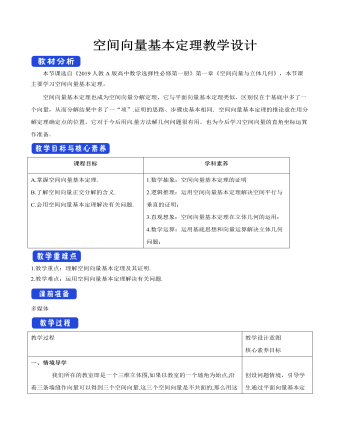
空间向量基本定理教学设计人教A版高中数学选择性必修第一册
反思感悟用基底表示空间向量的解题策略1.空间中,任一向量都可以用一个基底表示,且只要基底确定,则表示形式是唯一的.2.用基底表示空间向量时,一般要结合图形,运用向量加法、减法的平行四边形法则、三角形法则,以及数乘向量的运算法则,逐步向基向量过渡,直至全部用基向量表示.3.在空间几何体中选择基底时,通常选取公共起点最集中的向量或关系最明确的向量作为基底,例如,在正方体、长方体、平行六面体、四面体中,一般选用从同一顶点出发的三条棱所对应的向量作为基底.例2.在棱长为2的正方体ABCD-A1B1C1D1中,E,F分别是DD1,BD的中点,点G在棱CD上,且CG=1/3 CD(1)证明:EF⊥B1C;(2)求EF与C1G所成角的余弦值.思路分析选择一个空间基底,将(EF) ?,(B_1 C) ?,(C_1 G) ?用基向量表示.(1)证明(EF) ?·(B_1 C) ?=0即可;(2)求(EF) ?与(C_1 G) ?夹角的余弦值即可.(1)证明:设(DA) ?=i,(DC) ?=j,(DD_1 ) ?=k,则{i,j,k}构成空间的一个正交基底.
高中历史人教版必修一《第2课秦朝中央集权制度的形成》说课稿
【课件展示】《秦朝中央集权制度的建立》《教材简析》《教学目标》《教法简介》《教学过程设计及特色简述》【师】本节内容以秦代政治体制和官僚系统的建立为核心内容,主要包括秦朝中央集权制的建立的背景、建立过程及影响。本节内容在整个单元中起到承前启后的作用,在整个模块中也有相当重要的地位。让学生了解中国古代中央集权政治体制的初建对于理解我国古代政治制度的发展乃至我们今天的政治体制是十分必要的。 本堂课我采用多媒体和讲授法及历史辩论法相结合,通过巧妙设计问题情境,调动学生的学习积极性,使学生主动学习,探究思考。教师引导和组织学生采取小组讨论、情景体验等方式,达到教学目标。 本节内容分三个部分,下面首先看秦朝中央集权制度建立的前提即秦的统一
新人教版高中英语必修3Unit 1 Festivals and Celebrations-Reading and Thinking教学设计
The topic of this part is “Discover the reasons for festivals and celebrations.The Listening & Speaking & Talking part aims at talking about the experiences and feelings or emotions about the festivals and celebrations. This section aims at detecting the reason why the people celebrate the festivals, the time, the places, the types and the way of celebrations. It also explains why some traditions in the old celebrations are disappearing, like the firecrackers in the big cities and some new things are appearing like the prosperity of business or commerce. 1. Students can talk about what festivals they know and the reasons and the way of celebrating them.2. Students should learn the reading skills such as the headline and get the topic sentences, the structures of articles.3. Students can understand the past, the present situation of some festival around the world and why there are some changes about them. 4. Students can have the international awareness about the festivals.1. Students should learn the reading skills such as the headline and get the topic sentences, the structures of articles.2. Students can understand the past, the present situation of some festival around the world and why there are some changes about them.Step 1 Lead in---Small talkWhat festival do you like best ? Why ?I like the Spring Festivals because I can set off the fireworks, receive the lucky money and enjoy the Gala with my families.Step 2 Before reading---Pair workWhy do people celebrate different festivals ?The Spring Festivals is to celebrate the end of winter and the coming of spring and new life.The Mid-autumn Day is to celebrate the harvest and admire the moon.
新人教版高中英语必修3Unit 3 Diverse Cultures-Reading for Writing教学设计
The topic of this part is “Describe a place with distinctive cultural identity”.This section focuses on Chinese culture by introducing Chinatown, whose purpose is to show the relationship between the Chinese culture and American culture. The Chinese culture in Chinatown is an important part of American culture. Chinatown is an important window of spreading Chinese culture and the spirit homeland of oversea Chinese, where foreigners can experience Chinese culture by themselves.Concretely, the title is “Welcome to Chinatown!”, from which we can know that the article aims at introducing Chinatown. The author used the “Introduction--Body Paragraph--Conclusion” to describe the people, language, architecture, business, famous food and drinks and people’s activities, which can be a centre for Chinese culture and shows its unique charm.1. Read quickly to get main idea; read carefully to get the detailed information.2. Learn the characteristics of writing and language.3. Learn to introduce your own town according to the text.4. Learn to correct others’ writing.1. Learn the characteristics of writing and language.2. Learn to introduce your own town according to the text.Step 1 Lead in ---Small talkIn the reading part, we mentioned the Chinatown of San Francisco. How much do you know about Chinatown of San Francisco ?Chinatown is a main living place for Chinese immigrants, where you can see many Chinese-style buildings, costumes, operas, restaurants, music and even hear Chinese.Step 2 Before reading ---Predict the contentWhat is the writer’s purpose of writing this text ? How do you know ?From the title(Welcome to Chinatown) and some key words from the text(tourist, visit, visitors, experience), we can know the purpose of the text is to introduce Chinatown and show the relationship between Chinese culture and American culture.
新人教版高中英语必修3Unit 4 Space Exploration-Listening&Speaking&Talking教学设计一
Listening and Speaking introduces the topic of “talking about how to become an astronaut”. This period is aimed to inform students some details about the requirements of being an astronaut. Students can be motivated and inspired by the astronauts. Teachers ought to encourage students to learn from them and let them aim high and dream big.Listening and Talking introduces the theme of "talk about life in space". This part also informs students more details about life in space and can inspire students to be curious about this job. 1. Guide students to listen for numbers concerning dates, years and ages etc2. Cultivate students' ability to talk about how to become an astronaut and life in space ; 3. Instruct students to use functional sentences of the dialogue such as “ first of all, I am not sure, so what might be .. I guess.. I wonder…I am curious…)appropriately.1. Guide students to understand the content of listening texts in terms of the whole and key details; 2. Cultivate students' ability to guess the meaning of words in listening; discuss with their peers how to become a qualified astronaut and describe the life in space.Part 1: Listening and SpeakingStep 1: Lead inPredictionThe teacher can ask students to predict what the listening text is about by looking at the pictures.About how to become an astronaut./the requirements of an astronautStep 2: Then, play the radio which is about an interview a. And after finishing listening for the first time, the students need to solve the following tasks.
新人教版高中英语必修3Unit 4 Space Exploration-Discovering Useful Structure教学设计
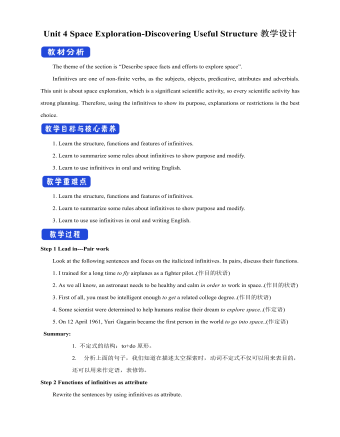
The theme of the section is “Describe space facts and efforts to explore space”. Infinitives are one of non-finite verbs, as the subjects, objects, predicative, attributes and adverbials. This unit is about space exploration, which is a significant scientific activity, so every scientific activity has strong planning. Therefore, using the infinitives to show its purpose, explanations or restrictions is the best choice.1. Learn the structure, functions and features of infinitives.2. Learn to summarize some rules about infinitives to show purpose and modify.3. Learn to use infinitives in oral and writing English. 1. Learn the structure, functions and features of infinitives.2. Learn to summarize some rules about infinitives to show purpose and modify.3. Learn to use use infinitives in oral and writing English.Step 1 Lead in---Pair workLook at the following sentences and focus on the italicized infinitives. In pairs, discuss their functions. 1. I trained for a long time to fly airplanes as a fighter pilot..(作目的状语)2. As we all know, an astronaut needs to be healthy and calm in order to work in space..(作目的状语)3. First of all, you must be intelligent enough to get a related college degree..(作目的状语)4. Some scientist were determined to help humans realise their dream to explore space..(作定语)5. On 12 April 1961, Yuri Gagarin became the first person in the world to go into space..(作定语)Summary:1. 不定式的结构:to+do原形。2. 分析上面的句子,我们知道在描述太空探索时,动词不定式不仅可以用来表目的,还可以用来作定语,表修饰。
新人教版高中英语必修3Unit 4 Space Exploration-Listening&Speaking&Talking教学设计二
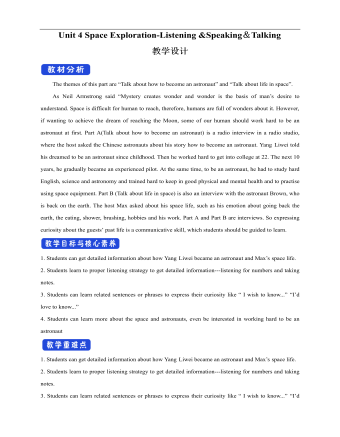
The themes of this part are “Talk about how to become an astronaut” and “Talk about life in space”. As Neil Armstrong said “Mystery creates wonder and wonder is the basis of man’s desire to understand. Space is difficult for human to reach, therefore, humans are full of wonders about it. However, if wanting to achieve the dream of reaching the Moon, some of our human should work hard to be an astronaut at first. Part A(Talk about how to become an astronaut) is a radio interview in a radio studio, where the host asked the Chinese astronauts about his story how to become an astronaut. Yang Liwei told his dreamed to be an astronaut since childhood. Then he worked hard to get into college at 22. The next 10 years, he gradually became an experienced pilot. At the same time, to be an astronaut, he had to study hard English, science and astronomy and trained hard to keep in good physical and mental health and to practise using space equipment. Part B (Talk about life in space) is also an interview with the astronaut Brown, who is back on the earth. The host Max asked about his space life, such as his emotion about going back the earth, the eating, shower, brushing, hobbies and his work. Part A and Part B are interviews. So expressing curiosity about the guests’ past life is a communicative skill, which students should be guided to learn.1. Students can get detailed information about how Yang Liwei became an astronaut and Max’s space life.2. Students learn to proper listening strategy to get detailed information---listening for numbers and taking notes.3. Students can learn related sentences or phrases to express their curiosity like “ I wish to know...” “I’d love to know...”4. Students can learn more about the space and astronauts, even be interested in working hard to be an astronaut
新人教版高中英语必修3Unit 4 Space Exploration-Reading for Writing教学设计二
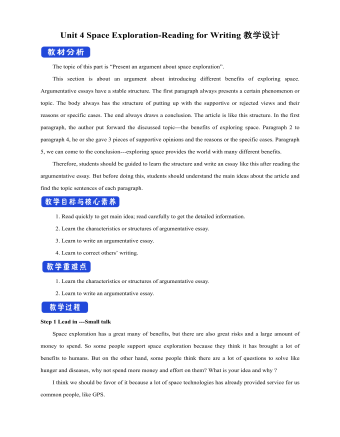
⑦在我看来, 探索太空是值得的。As far as I am concerned, it is worthwhile to explore the space.Step 10 Writing---draftRecently, students in our class have had heated a discussion on whether space is worth exploring. Students hold different ideas about it.30% of us think space exploration is not worthwhile. They think space is too far away from us and our daily life and is a waste of money. And the money spent on space exploration can be used to solve the earth’s problems such as starvation and pollution.On the other hand,70% think space is worth exploring because we have benefited a lot from it,such as using satellites for communication and weather forecast. What’s more,with further space research,we may solve the population problem by moving to other planets one day. Also,space research will enable us to find new sources to solve the problem of energy shortages on the earth.As far as I am concerned, it is worthwhile to explore the space. Not only can it promote the development of society but also enrich our life. Step 11 Pair workExchange drafts with a partner. Use this checklist to help your partner revise his/her draft.1.Does the writer explain why he/she changed/wanted to change?2.Does the writer tell how the changes have improved or will improve his/her life?3.Is the text well-organised?4.Does the writer use words and expressions to show similarities and differences?5.Are there any grammar or spelling errors?6.Does the writer use correct punctuation?
新人教版高中英语必修3Unit 5 The Value of Money- Discovering Useful Structure教学设计
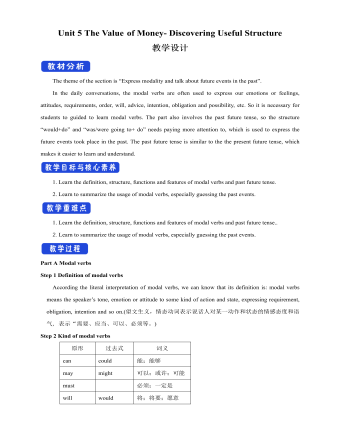
Step 3 Meaning1. 过去将来时表示从过去某一时间来看将要发生的动作或存在的状态, 常用在宾语从句中。一般由“would/should +动词原形”构成。She hoped that they would meet again someday. 她希望将来有一天他们能再见面。2. was/were going to+动词原形: 表示过去将要发生或很有可能发生的动作, 常用于口语中, 表示预言、意图或者打算等。He was going to start work the following week. 他打算下星期开始工作。3. was/were about to do: 常用来表示即将发生的动作, “刚要/正要做……”。注意该结构不与任何时间状语连用。I felt that something terrible was about to happen. 我感到某种可怕的事情即将发生。4.was/were to do: 表示“曾计划做某事”, 如果表示“本来计划做某事, 动作没实现”, 则需用 “was/were to have done”。She said she was to have told me about the accident. 她说她本来想告诉我关于事故的事。5.Start, go, come, leave, see, meet等动词的过去进行时: 表示就过去某一时刻而言即将发生的动作。She was coming later. 她随后就来。I had just put on my overcoat and was leaving to visit a friend of mine. 我刚穿上外套要去看我的一个朋友。
新人教版高中英语必修3Unit 5 The Value of Money-Listening &Speaking&Talking教学设计
4. A:We’d like to have someone to say a word at the beginning to welcome the group.B:↙Who?A:We thought that you or Dr.Johnson might do it.B用降调说Who,其意思是问,对方想让谁在开场时致欢迎词。Step 6 Pronunciation---Practice1. Listen to the short conversation and mark the intonation with ↗, ↙ or ↙, ↗. Then discuss with a partner what they intend to convey by using different intonation.Owner: You know what ?↗ It’s a million-pound bank note↙.Waiter 1: Really ?↗(question)Waiter 2: Really !↙(unbelievable and surprised)Waiter 3: Really ?!↙↗(first question then surprised)2. Listen to the conversations. Underline the parts that are stressed and mark the intonation. Then talk about the implied meanings of the responses with different intonations. Listen again and repeat.1) Henry: It’s a nice suit.Owner: Oh, it’s perfect!↙(The intonation means it is very suitable for Henry.)2) Henry: Well, that’s very kind of you.Owner: Kind, sir ?↗(what you said is not right) No, it’s kind of you. You must come whenever you want and have whatever you like. Just having you sit here is a great honour !!↙(welcome you to come again)3)Henry:Well, to be honest, I have none. Oliver:(happily) What luck!(excited) Brother↗, what luck!↙(It means “Didn’t you hear it?”)Henry: Well, it may seem lucky to you but not to me!↗(angry) If this is your idea of some kind of joke, I don’t think it’s very funny. Now if you’ll excuse me, I ought to be on my way.↙(If so, I would leave.)Roderick: Please don’t go↙...(hope Henry can wait for a moment)Part B Viewing and Talking---Describe people’s changing attitudes in a film clipStep 1 Before-listening---Tell the filmYou are going to watch part of the film The Million Pound Bank Note. Look at these photos and guess what happens in the film.
新人教版高中英语必修3Unit 5 The Value of Money-Listening &Speaking教学设计
Step 4: Listen again and decide if the following statements are true (T) or false (F).1 It was the first time Chen Liyan's story was reported. T口 F口2 Chen found 10,000 yuan in a small plastic bag in Taiyuan railway station口 F口3 Wang Zheng apologized to Chen because he couldn't offer her more money. T口 F口4 Chen took out a large loan to cure her daughter, T口 F口5 Wang set up a fundraising website for Chen's daughter after Chen told him about her situation. T口 F口Step 5:After listening, discuss the questions.1 What kind of person do you think Chen Liyan is?Chen Liyan is generous and honest because she returned a large sum of money to the owner.2 Did Chen return the money because she didn't need it?No. She returned the money because it was the right thing to do. Evidence for this is that she refused to accept the reward money because she felt that it had not been earned. 3 Is it common for people to do what Chen did?It depends on the culture. In some countries it is quite common to return money that has been found. In other countries, people believe "Finders are keepers!" 4 How did Wang Zheng feel about the return of his money?He must have been very happy and relieved to have gotten his money back. We know this because he thanked Chen repeatedly and even offered her a reward.5 Why did Ma Dongbao tell Wang about Chen's family?He must have had great sympathy for Chen and her daughter and wanted to help them.'We know this because he arranged help for them. 6 How did the news reporter feel about Chen's actions?The news reporter felt that it showed that money wasn't the most important thing in life. We know this because the reporter told us that this is what Chen believes. and then said, “that's a great attitude to take."
新人教版高中英语必修3Unit 5 The value of money-Reading and Thinking教学设计二
? Could you offer me some kind of work here?? I don’t want your charity, I just want an honest job.? Careless: I landed in Britain by accident.Step 7:Consolidation.? Find Henry? Roderick and Oliver were I .making a bet when they saw Henry, a poor young man. ? Know Henry? About a month ago, Henry was sailing and later he found himself carried out to sea by a strong wind. Fortunately, he 2.was spotted by a ship. And it was the ship that brought him to 3.England? Offer money to Henry ? Oliver and Roderick gave Henry a letter and told him that there was money in it. They 4.persuaded him to accept it, and made him 5.promise that it wouldn't be opened until 2 o'clock.Step 8:Language pointsa large amount of: a large quantity of; a great deal ofe.g. They bought a large amount of furniture before they moved their new house.make a bet: make an arrangement to risk money, etc. on an event of which the result is doubtful.e.g. We made a bet on the result of the match.permit sb to do something: allow somebody to do somethinge.g. My mother doesn’t permit me to ride in the street after it rained.by accident: as a result of chancee.g. I only found it by accident.stare at: look at somebody or something with the eyes wide open in a fixed gaze( in astonishment, wonder, fear, etc)to be honest: to tell you the truth; to be franke.g. To be honest, I don’t think we have a chance of winning.Step7 Homework:What do you think will happen to Henry? Will the bank-note help him or get him into trouble?
新人教版高中英语必修3Unit 5 The Value of Money-Reading for Writing教学设计二
2. 您能看到, 我头发太长了。You can see that my hair is much too long.3. 无论什么时候, 只要您想回来就回来。Please come back whenever you want.4. 您仅有很少的头发要理! You only have too little hair to cut !5. 为您服务是我的荣幸!It is my honour to serve you!Step 9 Writing(Henry is walking down the street when he sees a sign for a place that cuts hair. He decides to have it cut. )H=Henry B=BarberH: Good afternoon, I’d like to have my hair cut, if I may. (The barber looks at Henry’s hair and continues cutting another man’s hair. ) Er, I’d really like a haircut. As you can see it’s much too long. B: (in a rude manner) Yes, I can see that. Indeed, I can. H: Fine, well, I’ll have a seat then. (He sits in one of the barber’s chairs. The barber turns to look at Henry. )B: It’s quite expensive here, you know! Are you sure you can afford it?H: Yes. I think so. (After his hair is cut, the barber tells Henry how much he must pay. Henry shows the barber the bank note. )B: Why Mr. . . (looks shocked)H: Adams. Henry Adams. I’m sorry. I don’t have any change. B: Please don’t worry! (wearing a big smile) Nothing to worry about! Nothing at all! Please come back whenever you want, even if you only have too little hair to cut! It will be my honour to serve you!Step 10 Pair workExchange drafts with a partner. Use this checklist to help your partner revise his/her draft.1. Are all the elements of a play included and in good order ?2. Do the character use suitable language ?3. Are the stage directions clear and useful ?4. Is the plot clear and exciting enough ?
人教版高中数学选择性必修二等差数列的前n项和公式(1)教学设计
高斯(Gauss,1777-1855),德国数学家,近代数学的奠基者之一. 他在天文学、大地测量学、磁学、光学等领域都做出过杰出贡献. 问题1:为什么1+100=2+99=…=50+51呢?这是巧合吗?试从数列角度给出解释.高斯的算法:(1+100)+(2+99)+…+(50+51)= 101×50=5050高斯的算法实际上解决了求等差数列:1,2,3,…,n,"… " 前100项的和问题.等差数列中,下标和相等的两项和相等.设 an=n,则 a1=1,a2=2,a3=3,…如果数列{an} 是等差数列,p,q,s,t∈N*,且 p+q=s+t,则 ap+aq=as+at 可得:a_1+a_100=a_2+a_99=?=a_50+a_51问题2: 你能用上述方法计算1+2+3+… +101吗?问题3: 你能计算1+2+3+… +n吗?需要对项数的奇偶进行分类讨论.当n为偶数时, S_n=(1+n)+[(2+(n-1)]+?+[(n/2+(n/2-1)]=(1+n)+(1+n)…+(1+n)=n/2 (1+n) =(n(1+n))/2当n为奇数数时, n-1为偶数