-
收藏模板
- 模板信息
- 更新时间:2023-09-24
- 字数:约11023字
- 页数:约6页
- 格式:.docx
- 推荐版本:Office2016及以上版本
- 售价:5 金币
您可能喜欢的文档
新人教版高中英语必修3Unit 3 Diverse Cultures-Listening &Speaking&Talking教学设计
1. In Picture 1 and Picture 2, where do you think they are from? How do you know?From their wearings, we can know they are from ethnic minority of China--- Miao and Dong.Picture 1, they are playing their traditional instrument lusheng in their traditional costumes.Picture 2. the girls are Miao because they wear their traditional costumes and silver accessory.2. In Picture 3, can you find which village it is? What time is it in the picture?It is Dong village. It is at night. Step 2 While-listeningJustin met a new friend while traveling in Guizhou. Listen to their conversation and complete the summaries below.Part 1Justin and Wu Yue watched some Miao people play the lusheng. The instrument has a history of over 3,000 years and it is even mentioned in the oldest collection of Chinese poetry. Then they watched the lusheng dance. Justin wanted to buy some hand-made silver/traditional accessories as souvenirs. He was told that the price will depend on the percentage of silver. Part 2They will go to a pretty Dong minority village called Zhaoxing. they will see the drum towers and the wind and rain bridges. They may also see a performance of the Grand Song of the Dong people.Step 3 Post-listening---TalkingWork in groups. Imagine Justin is telling some friends about his trip to Guizhou. One of you is Justin and the rest of you are his friends. Ask Justin questions about his trip and experience. The following expressions may help you.
新人教版高中英语必修3Unit 1 Festivals and Celebrations-Listening &Speaking&Talking教学设计
The theme of this section is “Talk about festival activities and festival experiences”.Festival and holiday is a relaxing and interesting topic for students. This part talks about the topic from the daily life of students’. In the part A ---Listening and Speaking, there are three conversations among different speakers from three countries(Japan, Rio and China), where the speakers are participating in or going to participate in the festivals and celebrations. So listening for the relationship among them is a fundamental task. Actually, with the globalization and more international communication, it is normal for Chinese or foreigners to witness different festivals and celebrations in or out of China. In the Conversation 1, a foreign reporter is interviewing a Japanese young girl who just had participated in the ceremony of the Coming-of-Age Day on the street and asking her feeling about the ceremony and the afterwards activities. Conversation 2, Chinese girl Li Mei is witnessing the Rio Carnival for the first time, and her friend Carla gives her some advice on the costumes which enables her to match with the carnival to have a good time. Conversation 3, a Chinese guide is showing a group of foreign visitors around the Lantern Festival and introducing the customs of the festival to them. The three conversations have a strong vitality and insert the festival and cultural elements from different countries. So perceiving the festivals and cultures from different countries is the second task. At the same time, the scripts also insert the targeted grammar --- v-ing as attributive and predicative, which students can perceive and experience in a real context and make a road for the further study. That is the third task. In the Part B--- Listening and Talking, the theme is “Talk about festival experience”, which is the common topic in our daily conversations. During the conversation, Song Lin, a Chinese student, asked Canadian friend Max about how to spend Christmas. In the conversation, Song Lin talked about experience and the feelings during the Chinese Spring Festival, during which there are not only some enjoyable things but some unpleasant things. After the listening, perhaps students find there are some similarities between Christmas and the Chinese Spring Festival as there are some differences in the origins and celebrations. For example, people always visit friends and relatives, decorate their houses, have a big dinner together, chat and give presents to each other.
新人教版高中英语必修3Unit 4 Space Exploration-Listening&Speaking&Talking教学设计二
The themes of this part are “Talk about how to become an astronaut” and “Talk about life in space”. As Neil Armstrong said “Mystery creates wonder and wonder is the basis of man’s desire to understand. Space is difficult for human to reach, therefore, humans are full of wonders about it. However, if wanting to achieve the dream of reaching the Moon, some of our human should work hard to be an astronaut at first. Part A(Talk about how to become an astronaut) is a radio interview in a radio studio, where the host asked the Chinese astronauts about his story how to become an astronaut. Yang Liwei told his dreamed to be an astronaut since childhood. Then he worked hard to get into college at 22. The next 10 years, he gradually became an experienced pilot. At the same time, to be an astronaut, he had to study hard English, science and astronomy and trained hard to keep in good physical and mental health and to practise using space equipment. Part B (Talk about life in space) is also an interview with the astronaut Brown, who is back on the earth. The host Max asked about his space life, such as his emotion about going back the earth, the eating, shower, brushing, hobbies and his work. Part A and Part B are interviews. So expressing curiosity about the guests’ past life is a communicative skill, which students should be guided to learn.1. Students can get detailed information about how Yang Liwei became an astronaut and Max’s space life.2. Students learn to proper listening strategy to get detailed information---listening for numbers and taking notes.3. Students can learn related sentences or phrases to express their curiosity like “ I wish to know...” “I’d love to know...”4. Students can learn more about the space and astronauts, even be interested in working hard to be an astronaut
新人教版高中英语必修3Unit 2 Morals and Virtues-Listening &Speaking&Talking教学设计
Example:One day, a poor boy who was trying to pay his way through school by sending newspapers door to door found that he only had one dime(一角)left. He was so hungry that he decided to beg for a meal at the next house.However, he lost his nerve when a lovely young woman opened the door. Instead of a meal he asked for a drink of water. She thought he looked hungry so she brought him a large glass of milk. He drank it slowly, and then asked, “How much do I owe you?” “You don’t owe me anything,” she replied, “Mother has taught me never to accept pay for a kindness.” “Then I thank you from the bottom of my heart.” With these words, Howard Kelly left that house.Years later the woman became badly ill and was finally sent to the hospital in a big city. Dr. Howard Kelly, now famous, was called in. When he heard the name of the town she came from, a strange light filled his eyes. Dressed in his doctor’s clothes, Dr. Kelly went into her room and recognized her at once. From that day on, he gave special attention to her, and decided to do his best to save her life.At last the woman was saved. Dr. Kelly asked the business office to pass the final bill to him. He looked at it and then wrote something on the side. The bill was sent to the woman’s room. She was afraid to open it because she was sure that it would take the rest of her life to pay for it off. Finally she looked, and the note on the side of the bill caught her attention. She read these words: “Paid in full with a glass of milk, Dr. Howard Kelly.” Tear of joy flooded her eyes.
新人教版高中英语必修3Unit 4 Space Exploration-Listening&Speaking&Talking教学设计一
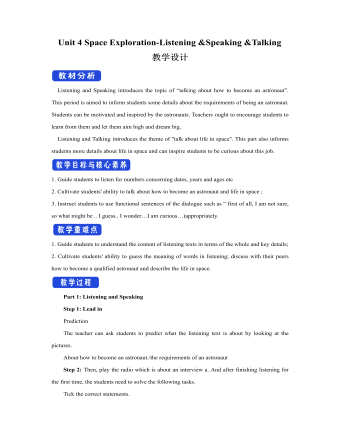
Listening and Speaking introduces the topic of “talking about how to become an astronaut”. This period is aimed to inform students some details about the requirements of being an astronaut. Students can be motivated and inspired by the astronauts. Teachers ought to encourage students to learn from them and let them aim high and dream big.Listening and Talking introduces the theme of "talk about life in space". This part also informs students more details about life in space and can inspire students to be curious about this job. 1. Guide students to listen for numbers concerning dates, years and ages etc2. Cultivate students' ability to talk about how to become an astronaut and life in space ; 3. Instruct students to use functional sentences of the dialogue such as “ first of all, I am not sure, so what might be .. I guess.. I wonder…I am curious…)appropriately.1. Guide students to understand the content of listening texts in terms of the whole and key details; 2. Cultivate students' ability to guess the meaning of words in listening; discuss with their peers how to become a qualified astronaut and describe the life in space.Part 1: Listening and SpeakingStep 1: Lead inPredictionThe teacher can ask students to predict what the listening text is about by looking at the pictures.About how to become an astronaut./the requirements of an astronautStep 2: Then, play the radio which is about an interview a. And after finishing listening for the first time, the students need to solve the following tasks.
- 查看更多相关Word文档
Unit 5 The Value ofMoney-Listening &Speaking&Talking教学设计
This themes of thesection are “Discuss the good deed of returning lost money” and “Describepeople’s changing attitudes in a film clip”.
Just as FrancisBacon said “Money is a good servant and a bad master”. Faced with the money,people’s attitudes are quite different. Some are tempted by it, but some arenot; some use it to help others, but some use it to do evil things; some loveit but honestly earn; some love it but lick others’ boots. Part A (Discuss thegood deed of returning lost money) tells the story that a cleaner Chen Liyan,who works at Taiyuan Railways Station,
found a plastic bag inside which thereis 100,000 yuan and kept on returning it to the owner without get any rewardalthough her daughter Liu Xia has a seriously illness and she had a large loanfor her daughter’s illness. Section B(Describe people’s changing attitudes in afilm clip) is the Act 1, Scene 4 of the film The Million Pound Bank Note, inwhich the American Henry Adams ate in a small restaurant after he got themillion pound bank note, but when he paid for his bill, the people such as theowner and the servant had different attitudes towards him---trying to make upto him. Therefore, faced with the value of money, different people havedifferent attitudes. Part A and Part B is a bright comparison. In fact, it’s atest of humanity when people are faced with it.
1. Students can get the detailed information from the listening and thevideo.
2. Students learn the listening strategy---make inferences in order tounderstand the inner information.
3. Students learn the value of money from the two stories and have agood attitudes towards the money.
4. Students can retell a story by using the sequencing words andconnecting words.
1. Students can get the detailed information from the listening and thevideo..
2. Students learn the listening strategy---make inferences in order tounderstand the inner information.
3. Students can retell a story by using the sequencing words andconnecting words.
Part AListening and Speaking--- Discuss the good deed of returning lost money
Step 1Before listening--Small talk
1.We knowmoney is very important. What can you use it to do ?
We can use it to do a lot of things,such as buying what we want, helping others, harm or hurt others...
2.What dopeople have to buy in order to lead a good life?
Some necessary thing to lead a goodlife, such as a house, beds, clothing, food,...
3.What canpeople not buy with money ?
buy love, friendship,...
Step 2 While listening---Task 1
Listen to the news report and match the people with the correctinformation.
1. Chen Liyan A. the owner of the lost money
2. Wang Zheng B.a cleaner at Taiyuan railway station
3. Ma Dongbao C.a police officer living in Chen’s apartment building
4. Liu Xia D.Chen’s 16-year-old daughter
Step 3 While listening---Task 2
Listen againand put these events in the correct order.
_______ Chen Liyan found Wang Zheng’s money and returned it to him.
_______ Chen gave an interview to the local newspaper.
_______ Wang built a website to help raise funds for Liu Xia.
_______ Ma Dongbao shared Chen’s story with Wang.
_______ Chen spent all her savings and took out a large loan.
_______ Wang offered Chen 5, 000 yuan.
Answers: 1 3 6 5 4 2
Step 4 While listening---Task 3
1. It was the first time Chen Liyan’s story was reported. T F
2. Chen found 10,000 yuan in a small plastic bag in Taiyuan railways station. T F
3. Wang Zheng apologised to Chen because he couldn’t offer her more money. T F
4. Chen took out a large loan to cure her daughter. T F
5. Wang set up a fundraising website for Chen’s daughter after Chen told himabout her situation.
T F
Step 4 Post listening---Speaking
1. Discuss your answers to the questions withyour partner and explain your reasoning.
1)What kind of person do you think ChenLiyan is?
She is honest and determined.
2).Did Chen return the money becauseshe didn’t need it ?
No, she didn’t. Because her daughterhad a serious illness.
3) Is it common for people to do whatChen did ?
Yes, it is.
4) How did Wang Zheng feel about thereturn of his money ?
surprised
5) Why did Ma Dongbao tell Wang aboutChen’s family ?
Because he was moved by Chen’saction.
6) How did the news reporter feel aboutChen’s actions.
The reporter feelChen Liyan’s example shows different thinking about money. Money is important,but people like Chen’s differently isn’t everything.
Example
A: What kind of person do you think Chen Liyan is?
B: I think she must be an honest person because she returned themoney to its owner Wang Zheng and didn’t accept any reward.
A: I bet she’s really determined too. You can tell this by how longshe waited for the owner.
2. Work in groups of four. Discuss thefollowing questions.
1) Do you agree with Chen Liyan ? Whatwould you do if you were in her situation ?
2) When we help someone, should weexpect to get something in return ?
3) What do you think is the best way toget money ?
4) Should we judge people based on howmuch money they have ?
Example
A: I think that Chen Liyan did the right thing by returning the moneyand refusing to take a single cent from Wang Zheng.
B: Well, I think that Chen Liyan was correct in returning the money, butshe should have accepted the money Wang offered.
Step 5Pronunciation---Intonation
语调(intonation),即说话的腔调,就是一句话里的声调(pitch) 高低抑扬轻重的配置和变化。世界上没有一种语言是单一的声调说出的,以英语为例,英语有五种基本语调:升调(↗)、降调(↙)、升降调(∧)、降升调(∨) 以及平调(→)。升调和降调是英语中最基本,也是最重要的两种语调。
降调的基本意义是表示肯定、完整、结束等意义,主要用于陈述。
升调的基本意义是表示不肯定、不完整、未结束等意义,主要用于提问。
例如:
1.A:Jean,can you bring me the newspaper?
B:↗Sorry?
Jean用升调说Sorry,其意思是Ididn’t hear you. Could you say that again,please?
2.A:Jean,can you bring me the newspaper?
B:↙Sorry.
Jean用降调说Sorry,显然其意思是拒绝帮助或无能为力。
3.A:Mr.Smiththinks we ought to get the money in hand first.
B:↗Who?
A:Mr.Smith.
B用升调说Who,表示听不清对方谈话中的某一部分,要求对方再重复那一部分。
4.A:We’dlike to have someone to say a word at the beginning to welcome the group.
B:↙Who?
A:Wethought that you or Dr.Johnson might do it.
B用降调说Who,其意思是问,对方想让谁在开场时致欢迎词。
Step 6 Pronunciation---Practice
1. Listento the short conversation and mark the intonation with ↗, ↙ or ↙, ↗.Then discuss with a partner what they intend to convey by using differentintonation.
Owner: You know what ?↗ It’s a million-poundbank note↙.
Waiter 1: Really ?↗(question)
Waiter 2: Really !↙(unbelievable andsurprised)
Waiter 3: Really ?!↙↗(first question thensurprised)
2. Listen to the conversations. Underline the parts that are stressed and markthe intonation. Then talk about the implied meanings of the responses withdifferent intonations. Listen again and repeat.
1) Henry: It’s a nice suit.
Owner: Oh, it’s perfect!↙(The intonation means it is very suitable for Henry.)
2) Henry: Well, that’s very kind of you.
Owner: Kind, sir ?↗(what you said is not right) No, it’s kind of you. You mustcome whenever you want and have whatever you like. Just having yousit here is a great honour !!↙(welcomeyou to come again)
3)Henry:Well, to be honest, I have none.
Oliver:(happily) Whatluck!(excited) Brother↗, what luck!↙(It means “Didn’t you hear it?”)
Henry: Well, it may seem luckyto you but not to me!↗(angry)If this is your idea of some kind of joke, I don’t think it’svery funny. Now if you’ll excuse me, I ought to be on my way.↙(If so, I would leave.)
Roderick: Please don’t go↙...(hope Henry can wait for a moment)
Part B Viewingand Talking---Describe people’s changing attitudes in a film clip
Step 1 Before-listening---Tell the film
You are going towatch part of the film The Million Pound Bank Note. Look at these photos andguess what happens in the film.
The film tells Henry went to a small restaurant to eat.After he finishedhis meal, the owner asked him to pay for the bill, but he didn’t have money topay for his bill until 2:00 p.m. At 2:00, he opened the letter and took out themoney---Million Bank Note, everyone was shocked. Finally, the owner changed hisattitude towards him and made his meal free. When he was leaving, the ownerbowed.
Step 2 While viewing---Watch the filmWatch the film and answer the followingquestions.
1. Why does the owner of the restaurant want Henry to sit somewhere else ?
Because Henry is in rags.
2. What does Henry order ? Why is the waiter surprised ?
Two hams and eggs, and two nice thickbig juicy steaks with all the trimmings and two long cool tankards of ale.
转载请注明出处!本文地址:
https://www.lfppt.com/worddetails_92577030.html最新课件教案文档
-

新年好运来福马迎春马年春节小报手抄报
这套以 “新年到好运来” 为主题的 2026 马年手抄报,设计兼顾美观与实用性,包含彩色成品、空白填写版及黑白线稿版,适配不同使用需求。整体风格喜庆活泼,融合传统年味与童趣元素,画面以红橙为主色调,搭配福字、金元宝、红灯笼、烟花等传统装饰,还有孩童放鞭炮的可爱插画,契合春节氛围。内容板块清晰,设有 “春节起源” 栏目,可科普春节古称 “岁首” 及上古祭祀的起源背景;“马年初一” 板块聚焦新年首日习俗,寓意马年吉祥顺遂;“2026 新年心愿” 栏目则为使用者预留了书写美好期许的空间,既具知识性,又能承载个性化祝福,是一份兼具教育意义与互动性的新年手抄报模板。
精选高中生期末评语
1、该生学习态度端正 ,能够积极配合老师 ,善于调动课堂气氛。 能够积极完成老师布置的任务。学习劲头足,听课又专注 ,做事更认 真 ,你是同学们学习的榜样。但是,成绩只代表昨天,并不能说明你 明天就一定也很优秀。所以,每个人都应该把成绩当作自己腾飞的起 点。2、 你不爱说话 ,但勤奋好学,诚实可爱;你做事踏实、认真、为 人忠厚 ,是一个品行端正、有上进心、有良好的道德修养的好学生。在学习上,积极、主动,能按时完成老师布置的作业,经过努力 ,各 科成绩都有明显进步,你有较强的思维能力和学习领悟力,学习也有 计划性,但在老师看来,你的潜力还没有完全发挥出来,学习上还要有持久的恒心和顽强的毅力。
公司2024第一季度意识形态工作联席会议总结
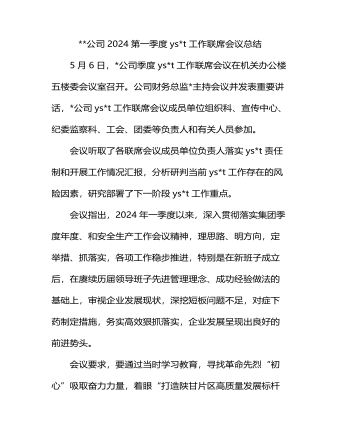
一是要把好正确导向。严格落实主体责任,逐条逐项细化任务,层层传导压力。要抓实思想引领,把理论学习贯穿始终,全身心投入主题教育当中;把理论学习、调查研究、推动发展、检视整改等有机融合、一体推进;坚持学思用贯通、知信行统一,努力在以学铸魂、以学增智、以学正风、以学促干方面取得实实在在的成效。更加深刻领会到******主义思想的科学体系、核心要义、实践要求,进一步坚定了理想信念,锤炼了政治品格,增强了工作本领,要自觉运用的创新理论研究新情况、解决新问题,为西北矿业高质量发展作出贡献。二是要加强应急处事能力。认真组织开展好各类理论宣讲和文化活动,发挥好基层ys*t阵地作用,加强分析预警和应对处置能力,提高发现力、研判力、处置力,起到稳定和引导作用。要坚决唱响主旋律,为“打造陕甘片区高质量发展标杆矿井”、建设“七个一流”能源集团和“精优智特”新淄矿营造良好的舆论氛围。三是加强舆情的搜集及应对。加强职工群众热点问题的舆论引导,做好舆情的收集、分析和研判,把握时、度、效,重视网上和网下舆情应对。
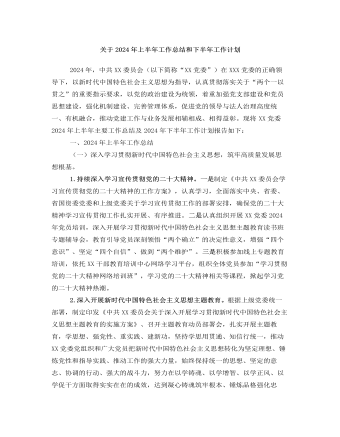
关于2024年上半年工作总结和下半年工作计划
二是深耕意识形态。加强意识形态、网络舆论阵地建设和管理,把握重大时间节点,科学分析研判意识形态领域情况,旗帜鲜明反对和抵制各种错误观点,有效防范处置风险隐患。积极响应和高效落实上级党委的决策部署,确保执行不偏向、不变通、不走样。(二)全面深化党的组织建设,锻造坚强有力的基层党组织。一是提高基层党组织建设力量。压实党建责任,从政治高度检视分析党建工作短板弱项,有针对性提出改进工作的思路和办法。持续优化党建考核评价体系。二是纵深推进基层党建,打造坚强战斗堡垒。创新实施党建工作模式,继续打造党建品牌,抓实“五强五化”党组织创建,广泛开展党员教育学习活动,以实际行动推动党建工作和经营发展目标同向、部署同步、工作同力。三是加强高素质专业化党员队伍管理。配齐配强支部党务工作者,把党务工作岗位作为培养锻炼干部的重要平台。
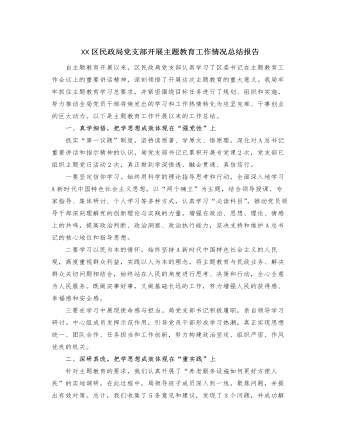
XX区民政局党支部开展主题教育工作情况总结报告
二要专注于解决问题。根据市委促进经济转型的总要求,聚焦“四个经济”和“双中心”的建设,深入了解基层科技工作、学术交流、组织建设等方面的实际情况,全面了解群众的真实需求,解决相关问题,并针对科技工作中存在的问题,采取实际措施,推动问题的实际解决。三要专注于急难愁盼问题。优化“民声热线”,推动解决一系列基层民生问题,努力将“民声热线”打造成主题教育的关键工具和展示平台。目前,“民声热线”已回应了群众的8个政策问题,并成功解决其中7个问题,真正使人民群众感受到了实质性的变化和效果。接下来,我局将继续深入学习主题教育的精神,借鉴其他单位的优秀经验和方法,以更高的要求、更严格的纪律、更实际的措施和更好的成果,不断深化主题教育的实施,展现新的风貌和活力。
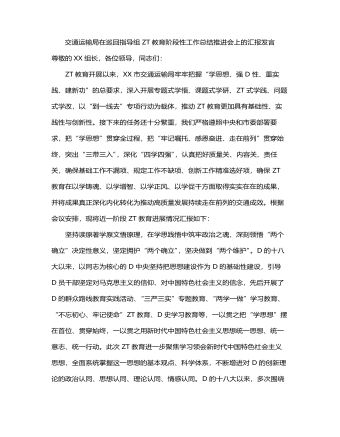
交通运输局在巡回指导组主题教育阶段性工作总结推进会上的汇报发言
今年3月,市政府出台《关于加快打造更具特色的“水运XX”的意见》,提出到2025年,“苏南运河全线达到准二级,实现2000吨级舶全天候畅行”。作为“水运XX”建设首战,谏壁闸一线闸扩容工程开工在即,但项目开工前还有许多实际问题亟需解决。结合“到一线去”专项行动,我们深入到谏壁闸一线,详细了解工程前期进展,实地察看谏壁闸周边环境和舶通航情况,不断完善施工设计方案。牢牢把握高质量发展这个首要任务,在学思践悟中开创建功之业,坚定扛起“走在前、挑大梁、多做贡献”的交通责任,奋力推动交通运输高质量发展持续走在前列。以学促干建新功,关键在推动高质量发展持续走在前列。新时代中国特色社会主义思想着重强调立足新发展阶段、贯彻新发展理念、构建新发展格局,推动高质量发展,提出了新发展阶段我国经济高质量发展要坚持的主线、重大战略目标、工作总基调和方法论等,深刻体现了这一思想的重要实践价值。

今日更新Word
-
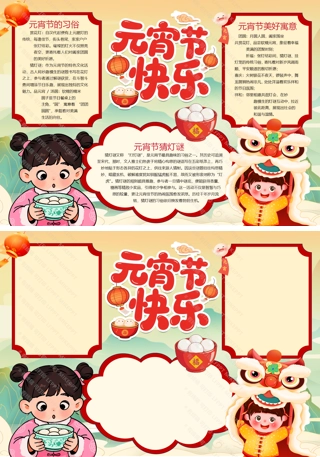
【元宵节】2026马年元宵节手抄报
这套 “元宵节快乐” 手抄报以暖黄为主色调,融入萌娃吃汤圆、醒狮贺岁、红灯笼等元素,年味浓郁且充满童真,包含彩色成品、彩色空白、黑白线稿、浅线稿四种版式,兼顾范例参考与自主创作。内容板块聚焦元宵节核心民俗,“元宵节的习俗” 介绍赏花灯、猜灯谜的传统由来;“元宵节美好寓意” 解读团圆、祈福的文化内涵;“元宵节猜灯谜” 讲述这一趣味活动的历史与魅力。各板块以矩形、云朵形边框清晰划分,层次分明,成品提供详实的民俗知识与文案范例,空白版本便于学生填充个人的元宵经历与感悟,是兼具文化性与实用性的元宵节主题手抄报模板。
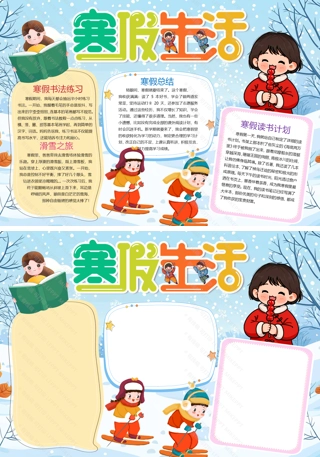
【寒假生活】卡通寒假生活冬天小报手抄报Word模版
这套 “寒假生活” 手抄报以冬日雪景为基底,搭配滑雪孩童、捧书阅读等童趣插画,色彩明快且充满生活气息,涵盖彩色成品、彩色空白、黑白线稿、浅线稿四种版式,兼顾范例参考与学生自主创作需求。内容板块设计贴合小学生寒假日常,“滑雪之旅” 记录户外滑雪的趣味经历与挑战自我的感悟;“寒假书法练习” 讲述坚持练字的过程与收获;“寒假读书计划” 分享《海底两万里》等书籍的阅读心得;“寒假总结” 复盘假期的学习、运动与志愿服务收获,反思不足并规划新学期。各板块以异形边框清晰划分,层次分明,成品提供优质文案范例,空白版本便于学生填充个人假期故事,是助力小学生梳理寒假生活、记录成长的实用模板。
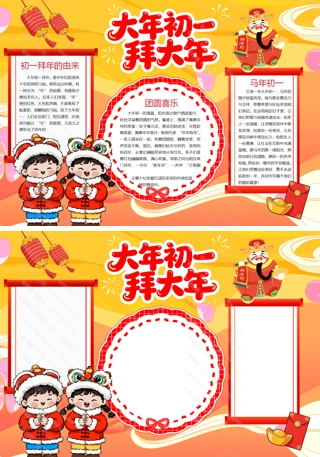
【迎新年】大年初一拜大年新年福马迎春马年春节小报手抄报
这套 “大年初一拜大年” 手抄报以红金为主色调,融入萌娃拜年、财神送福、红灯笼等元素,年味浓郁且童趣十足,包含彩色成品、彩色空白、黑白线稿、浅线稿四种版式,兼顾范例参考与自主创作。内容板块聚焦大年初一传统习俗,“初一拜年的由来” 讲述年兽传说与拜年习俗的起源;“团圆喜乐” 描绘初一阖家团圆、吃饺子年糕、收红包的温馨场景;“马年初一” 则结合生肖寓意,传递新春的活力与美好祝福。各板块以矩形、圆形边框清晰划分,层次分明,成品提供详实的民俗知识与文案范例,空白版本便于学生填充个人的拜年经历与新春感悟,是兼具文化性与实用性的春节主题手抄报模板。
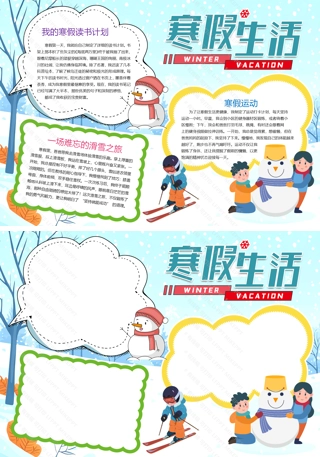
【寒假计划】我的寒假生活冬天寒假计划小报手抄报Word模版
这套 “寒假生活” 手抄报以冬日雪景为背景,融入滑雪、堆雪人等童趣插画,整体风格清新活泼,兼具观赏性与实用性,包含彩色成品、彩色空白、黑白线稿、浅线稿四种版式,适配不同创作需求。内容板块设计贴合小学生寒假生活,“我的寒假读书计划” 记录阅读《海底两万里》等书籍的收获,分享做读书笔记的心得;“一场难忘的滑雪之旅” 讲述滑雪的经历与 “坚持就能成功” 的感悟;“寒假运动” 板块则介绍了每日运动计划与健身收获。各板块以云朵、矩形等异形边框区分,层次分明,成品提供优质内容范例,空白版本便于学生填充个人假期故事,是助力小学生梳理寒假生活的优质模板。
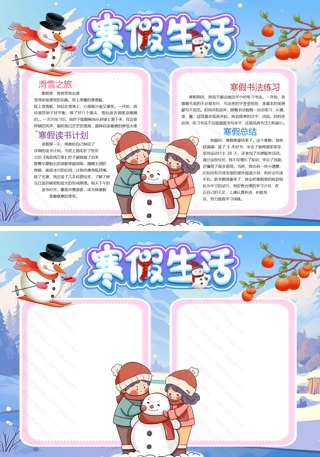
【寒假计划】卡通寒假生活寒假计划冬天小报手抄报Word模版
这套 “寒假生活” 手抄报设计充满冬日暖意,以蓝白为主色调,搭配雪人、红柿、孩童堆雪等元素,既显节日氛围又富童真。版式包含彩色成品、彩色空白、黑白线稿、浅线稿四种,兼顾范例参考与自主创作需求。内容板块聚焦寒假核心生活,“滑雪之旅” 记录户外体验的乐趣与挑战,“寒假读书计划” 分享《海底两万里》等书籍的阅读收获,“寒假书法练习” 讲述坚持练字的成长感悟,“寒假总结” 复盘假期的收获与不足。板块以粉色边框清晰划分,内容兼具趣味性与教育性,空白版本则为学生预留了书写个人假期故事的空间,是适配小学生的优质寒假作业模板。
【寒假计划】寒假生活寒假计划冬天卡通小报手抄报Word模版
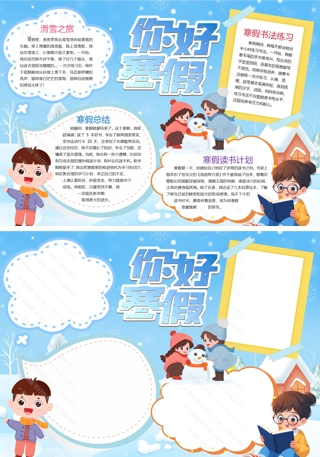
这套 “你好寒假” 手抄报设计精巧,兼具实用性与美观性,以冬日蓝为主色调,搭配堆雪人、读书等童趣插画,营造出浓厚的假期氛围。版式上分为彩色成品、彩色空白、黑白线稿、浅线稿四种版本,适配不同使用需求。内容板块丰富且贴合小学生生活,“滑雪之旅” 记录户外实践的快乐,“寒假总结” 复盘成长收获,“寒假读书计划” 分享阅读感悟,“寒假书法练习” 展现坚持的意义。各板块以云朵、矩形等边框区分,层次清晰,既为学生提供了优秀的内容范例,空白版本也方便孩子们填充自己的假期故事,是一份兼具展示与创作价值的寒假作业模板。