-
人教版新目标初中英语八年级下册How long have you been collecting shells教案2篇
Step Ⅱ Show the new words on the screen and teach the new words. Read the new words to students and ask them to repeat.Step Ⅲ 3aThis activity introduces new vocabulary and provides reading practice using the target language.In this activity first look at the four pictures.T: What can you see in the pictures?Ss: Four snow globes.T: Right. There are four snow globes in the pictures. And what are they?Ss: They are a monster, two polar bears, two penguins and a birthday cake.Write these words on the blackboard: snow globe; monster; polar bear; penguin and birthday cake. Read them to the class and ask students to repeat each one. Make sure students understand each word.Use a computer to show the E-mail message on the screen and read the message to students.Get students to read the e-mail on their own, and then draw lines connecting each snow globe and its description.Correct the answers.AnswersA line should connect each snow globe picture with the words that describe it in the letter.Step Ⅳ 3bThis activity provides writing practice using the target language.First review Activity 2a on Page 47.Then ask students to complete the message according to Activity 2a.Some partial sentences are given to students. Write about one person's collection.When students work, walk around the room checking the progress and offering help as needed.When they finish, ask some students to read their messages to the class.
人教版新目标初中英语八年级下册What were you doing when the UFO arrived教案2篇
(一).知识方面: 1.培养学生能运用过去进行时来描述、谈论过去某个时间正在发生的事情或动作的意识和能力,能就过去某个时间正在发生的动作做出正确的描述。 2.培养学生的想象力和角色扮演的合作能力。 3.培养学生讲述过去发生的事情经过的能力。能正确运用一般过去时来讲述故事。 (二).技能方面: 1.本单元的语言目标是Talk about past events and tell a story(谈论过去的时间和讲述一个故事),围绕这一目标,要涉及句型: What were you doing when the UFO arrived? ----I was sitting in the barber’s chair. The barber was cutting my hair. 因此必须学习standing、studying、cleaning、sleeping、cooking、making、eating、cutting、等表示地点的词,以便为上述句型提供语言材料。2.学习过去进行时的有关知识。Was/were+现在分词,是该时态的表达式。 3.在学习过程中,要区分The boy was walking down the street when the UFO landed.和While the boy was walking down the street, the UFO landed.这两种由when和while引导的状语从句的句型结构。注意它们的不同。
人教版新目标初中英语八年级下册Why don’t you get her a scarf教案
教师带领学生复习有关描述宠物的词汇,采用教师提问学生回答的方进行。如:T:What animals do you think would be good pets?What animals do you think would be bad pets?What do you think are good animals for a six-year-old child?然后学生进行 pairwork 练习。Task two: 师生互动,学习探究 1、播放3a部分的录音,引导学生一边听录音,一边跟读。2、通过听录音学生回答以下问题:Why do you think pot-bellied pigs are popular?What are the advantages and disadvantages of keeping such a pet?教师对学生的回答进行及时点评。3.学习范文,学习重点短语,为下步的模仿写作提供语言素材。T :1. )Have you ever kept a pig as a pet?Do you like pigs? St.:No.…Why don’t you like to keep a pig? St: No.They’re too dirty and lazy(Do you know in some foreign countries like Hollyland, Australia,pigs are the most popular pet.there’s a kind of pig.(图)it has an interesting name? it ‘s called a pot-bellied pig.) Now,let’s learn an article about this kind of interesting pet.2.)play the tapeSt.:Listen and repeat3.)show some Qs on computer(本子St.: read silently,then answerthe Qs(本子)4.)Ask ss. Close book and retell this passage.(what is a pot-bellied pig? Is it a good or bad pet? ) St.: retell it to each other“A pot –bellied pig is a popular pet now…”5.read the article together.St.:.practice reading
人教版新目标初中英语九年级上册Teenagers should be allowed to choose their own clothes教案2篇
Step 1 Greeting Greet the class and check the homeworkStep 2 A duty report The S on duty gives a report on the rules in his home and lead in 3a “Sun Fei’s and Wu Yu’s rules” Step 3 ReadingSs read the conversation and write the two girls’ rules in the chart. Check the answers.Get Ss to read after the tape and then read aloud by themselves. Then, T explains the language points.Step 4 Pairwork 3bRole play. Use the information in chart to practice with the conversation in 3a covered. They can look at the sample conversation in the right box.Step 5 Task 2 “Who’s the best reporter?”Make a survey by asking any 5 students the questions in the chart in activity 4. Then give out a report about it. See who is the best reporter? And the best reporter will get a nice ball-pen.Step 6 Summary and homework:Write out the report in your exercise-books.Period ThreeStep 1 Greeting and a duty reportThe S gives a duty report talking about his experience of being late for school. Lead in the question “Do you ever get to school late? How often do you get to school late? Always, usually, sometimes, or never?Step 2 1a Get Ss to finish writing.Step 3 Pairwork 1b Get Ss to talk about their answers with their partners using the sample conversation in the box on the right.Step 4 Listening practice2a Lead-in: What will happen if you get to school late? What about Peter? Let’s listen to a conversation between Peter and his father. Get Ss to finish 2a (As usual, for the first time, Ss only listen.) Check the answers.
人教版新目标初中英语九年级上册I used to be afraid of the dark教案
内容提示1.本单元主要内容是学会used to结构。Used to +动词原形表示过去经常、以前常常,只用于过去式中,用来表示现在已不存在的习惯或状态。例如:They used to play football together.他们过去常在一起蹋足球。(现在不在一起踢了)2.used to的疑问形式和否定形式为Did you use to…?和I didn’t use to… 也可以用Used you to…?和I used not to…但现在多使用前者。例如:Did you used to swim in the river? 你过去常在河里游泳吗?I didn’t use to play the piano. 我以前并不经常弹钢琴。教学目标一、学习目标(Language Goal) 1.学会陈述自己过去常做的事情。2.学会陈述自己过去的爱好等。3.能够表达自己现在和过去在外表、性格、娱乐等方面的变化。4.能够表达朋友、家人等现在和过去的变化。二、语言结构(Language Structures) 1.I used to be short when I was young. 我年轻时个子很矮。 2. —Did you use to have straight hair? 你过去是直发吗?—Yes, I did. 是的。 3. —Did you use to play the piano? 你过去弹钢琴吗?—No, I didn’t. 不,我不弹。 4.I used to be afraid of dark. 我过去害怕黑暗。 5.I’m terrified of the snakes. 我害怕蛇。
人教版新目标初中英语九年级下册I’ll help clean up the city parks教案
Talk about offering help (P60)I’ll help clean up the city parks.A: I’d like to work ...B: You could help ...Talk about ways to tell people about the Clean-Up Day (P61)We need to ...We can’t ...I’ll ...Talk about the work the volunteers do (P62)These three students all volunteer their time to help other people.Somebody loves to ... / helps ... / plans to ... / wants to ...A: What do you like doing?B: I like ... A: What kind of volunteer work do you think I could do?B: You could ...1. 重点词汇advertisement, fix, repair, pleasure, blind, deaf, shut, carry, specially, fetch2. 认读词汇hunger, homeless, cheer, clean-up, sign, establish, major, commitment, elementary, veterinarian, coach, similar, call-in, strategy, disabled, organization, unable, support, appreciate, donation, part of speech, pronoun, adverb, preposition, conjunction, donate, Jimmy, Sally3. 词组clean up, cheer up, give out, put off, set up, think up, take after, fix up, give away, put up, hand out, work out, at once
新人教版高中英语必修1Unit 1 Teenage Life-Listening and Speaking & Listening and Talking教案
Step 2 Listening and Talking1. The teacher is advised to talk with their new students about the related topic: Boys and girls, do you know some structures to talk about future activities? Talking about future activitiesWe’ll …I plan to …There’ll be …I hope to …We’re going to …2. After their small talk, the teacher can move on by playing the listening and solve the following task.Underline the expressions in the sentences below Cao Jing and Max use to talk about the future.We’ll learn useful skills.I plan to improve my spoken English.There’ll be students from different schools.I hope to make new friends.We’ll talk about teenage life.I’ll learn to make a fire.There’ll be students from different countries at the camp.There’ll be some experts there to show us how to live in the wild.We’re going to learn about wildlife.I’m going to give a speech.I think I’m going to enjoy the activities.I think we’ll have a lot of fun.3. Work in groups. Plan a youth camp.Teacher make the Ss think of ideas for the camp. And they can use the questions below to get started. And have the Ss present their ideas for a youth camp to the class.●What kind of camp is it?●Who will be there?●What will they do?●What will they learn?
新人教版高中英语必修1Unit 3 Sports and Fitness-Listening and Speaking & Listening and Talking教案
Finally, after finishing the task above, the teacher is expected to instruct students to work in groups to finish the following project:Speaking ProjectWhat event or activity would you like to invite your friend to? Make a conversation with a partner.Ski Race: Zhangjiakou, a beautiful city in northern China, will host the Youth Ski Race in December.Track Meet: a great event for track –and –field lovers on 26 October.Gym Class: come and work out at a gym! You can make it.Part 2: Listening and Talking:The teacher is advised to talk with their new students about the related topic: Boys and girls , what do you think of sportsmanship? Let’s listen and find out:Play the listening and match each opinion with the right speaker. Who do you agree with? Why?Cao Jing _____________ Lily _____________ Max _____________A. An athlete should do his/her best to win.B. The girl should stop and help the other girl. Good sportsmanship is more important than wining!C. An athlete should think about honor and his/her fans if he/she is competing for his/her country.Listen again and circle the expressions that you hear in the conversation.
人教版新目标初中英语七年级上册Can you play the guitar教案
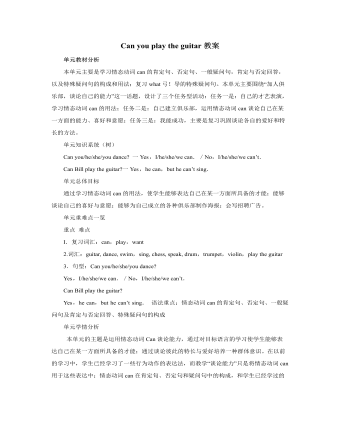
本单元主要是学习情态动词can的肯定句、否定句、一般疑问句,肯定与否定回答,以及特殊疑问句的构成和用法;复习what弓!导的特殊疑问句。本单元主要围绕“加人俱乐部,谈论自己的能力”这一话题,设计了三个任务型活动:任务一是:自己的才艺表演,学习情态动词can的用法;任务二是:自己建立俱乐部,运用情态动词can谈论自己在某一方面的能力、喜好和意愿;任务三是:我能成功,主要是复习巩固谈论各自的爱好和特长的方法。单元知识系统(树)Can you/he/she/you dance? 一Yes,I/he/she/we can./No,I/he/she/we can’t.Can Bill play the guitar?一Yes,he can,but he can’t sing.单元总体目标通过学习情态动词can的用法,使学生能够表达自己在某一方面所具备的才能;能够谈论自己的喜好与意愿;能够为自己成立的各种俱乐部制作海报;会写招聘广告。单元重难点一览重点 难点I.复习词汇:can,play,want2.词汇:guitar, dance, swim,sing, chess, speak, drum,trumpet,violin,play the guitar3.句型:Can you/he/she/you dance?Yes,I/he/she/we can./No,I/he/she/we can’t.Can Bill play the guitar?
人教版新目标初中英语七年级上册Do you have a soccer ball教案
在这一单元中,学生要学会就有关人与物之间所属关系进行问答的句子。本单元大量引入有关运动的名词,要求学生彼此询问有无此类物品,并做出相应的回答。 同时学习表示建议的句型Let’s运动的形容词。 本单元所选用的话题来自学生所喜欢的生活片段,在教学中生生交流、师生交流会更融洽,会促进师生彼此间的了解,成功的教学还会让部分学生养成良好的运动习惯和收藏习惯。 教学目标 1) 语言知识:A.在询问对方是否有某物的对话中学会使用do和does引导的一般疑问句; B. 学会使用描述性的形容词来评价事物; C. 学会在对话中使用名词复数; D. 学会用祈使句来向对方提出建议. 2) 语言技能:A. 学会用祈使句询问某人是否有某物; B. 学会向他人提出建议的句子. 3) 学习策略:A.通过与同学讨论,做出猜测;
人教版新目标初中英语七年级上册How much are these pants教案
个性练习设计 阅读广告:在日常生活中,人们去买东西之前,一般要阅读广告,从广告中获取该商品的一些有用信息,包括价格、性能等。所以给学生提供有些商品的广告或让学生去商店去阅读一些商品的广告,从中获取商品的价格,即可以锻炼学生的阅读能力,又能提高实践能力。 Self Check 教学内容 Self Check(教材P42) 教学目标 知识与能力 复习词汇pant,sock,T-shirt,sweater,shoes,color,black,white,red,green,blue,big,short,long,数字10--31; 学习词汇Zig Zag,clothes,shop,yellow,ask,which;学会谈论服装的价格、颜色、大小和长短;学会填写价格标签。 过程与方法 运用Summarizing和Classifying的学习策略。在复习教学中,运用听写、绘画、互相询问调查与检测等手段,促使学生不断地使用所学内容,从而提高他们灵活运用知识的能力。 情感态度价值观 该部分学习内容主要是复习谈论服装的价格和颜色以及对服装的喜好,能引起学生的共鸣;通过购物的对话练习教学生学会购物时使用的礼貌用语和如何感谢人。
人教版新目标初中英语七年级下册What does he look like教案3篇
所需要用到的句子:Who is that?That is Jack. I like him.Why do you like him?I like him because he is interesting.Task 4: 设计理想中的人类Step one: 设计理想中的人类的外貌。把全班同学分成若干小组,学生可以边说边在纸上画出他们的模样。Step two: 设计理想中人类的性格。学生们可以把那些能描述性格的单词写在图画的旁边。Step three: 每组选出一名同学,其他同组同学提问,他作简单回答,并说明原因。所需用到的句子:What does he or she look like?He or she ...What is he or she like?He or she is ...Why?Because ...Task 5: 挑战性活动调查性格是天生的还是后天形成的,让每个同学回家去调查一下自己成长过程中性格是否有变化,具体是怎样的,为什么会这样? Teaching Aims:1. Enable students to have a general understanding of how to talk about people's physical appearance.2. Enable students to tackle some essential vocabularies and patterns about describing people. Provide them with necessary skills and methods.3. Create various chances for students to describe the persons they're familiar with, such as classmates, family members, teachers, idols, etc.
人教版新目标初中英语七年级下册I ’d like some noodles教案
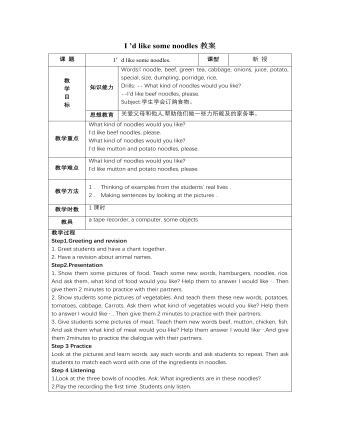
教学过程Step 1: warming-up Sing a song---------“food and drink” Step 2: Revision1 Dictation2 Revise: What kind of noodles would you like?I’d like …What size bowl of noodles would you like?I’d like…Step 3: Presentation1 show pictures of food, ask students say the words.2 Students read the newspaper ad in 3a. Fill in blanks with words in the box. Then read the ad together, the teacher explains some difficult language points.3 Check the answers Step 4 PracticeAsk students to finish 3b in the same way according to 3a. Students read the short passage and fill in the blanks .At last, check the answers.Step 5 productionAsk students to write their own ad for dumplings, noodles, drinks, and other foods they know. Then ask students to read their partner’s ad. Then order food and drink from their partner.Step 6 Home workGroup work – make an ad about “food and drink”
人教版新目标初中英语七年级下册It’s raining教案2篇
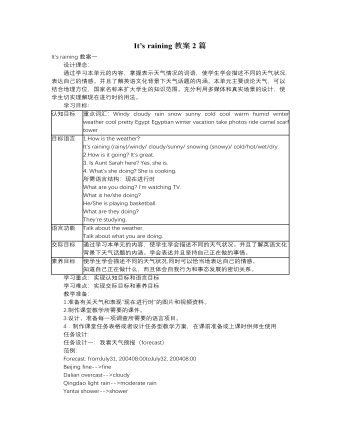
1 Each group choose one place to describe and what you are doing in it Choose one place, and describe what they are doing 2 Move around the room and give suggestions Talk about it and write it down 3 Ask one to show their works and act it Choose one of each group to make a report 4 Evaluate the best group and the best reporter Choose the best one Homework Ask your friends their ideal place and write about it教学反思:新课程标准中强调学生在课堂中的主体地位,在综合课中他们的主体地位就更加突出。在各个活动中给不同程度的学生不同层次的任务,让各层面的学生都有表现发挥的机会,从而产生对英语的兴趣。使用照片图片多媒体来辅助教学,效果更好。同时让了解其他国家风景,风俗的同学介绍ideal place,增加学生的背景知知识,实现跨学科交流的目的。教案点评:采用任务型教学模式,在各个活动中给不同程度的学生不同层次的任务,让各层面的学生都有表现发挥的机会,从而产生对英语的兴趣。使用照片图片多媒体来辅助教学,效果更好。让了解其他国家风景,风俗的同学介绍ideal place,增加学生的背景知识,实现跨学科交流的目的。
人教版新目标初中英语七年级下册Where did you go on vacation教案
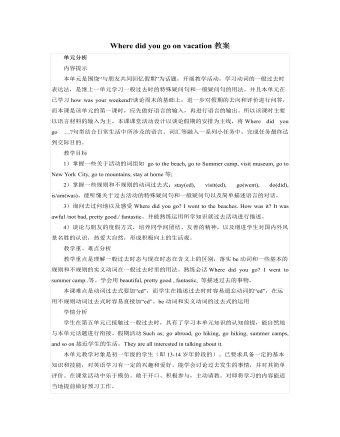
句型: Where did you go on vacation? I went to summer camp.Did she go to Central Park?Yes,she did.No, she didn’t语法:一般过去时特殊疑问句、一般疑问句及肯、否定回答。课时安排4课时第一课时:Section A:la,1b,lc,2a,2b,2c 第二课时:Section A:3a,3b,4第三课时:Section B:1,2a,2b,2c第四课时:Section B:3a,3b,3c,4 and Self Check第一课时教学目标掌握描写假期生活的形容词。假期里自己所做事情的简单表达。谈论假期做的事情及当时情况。谈论假期时旅游的天气,旅游者以及食物等。教学过程一、导入播放一首英文歌曲:Let’s travel 说明:通过让学生听节奏欢快迪斯尼英语歌曲Let’s travel.引入本节课谈论的话题vacation and travel. 让歌曲使学生的思维活跃,增强课堂气氛,激发学生提高学习英语的兴趣。T:How is the trip ?Ss : It’s pretty good/ happy/exciting /relaxing/busy/dangerous/ fantastic说明:这个问题是为了操练形容词。建议让多个Ss作答。鼓励他们用不同的形容词。上述个别形容词本应在第二课时中出现,但可以在warming-up中第一次非正式出现。这些形容词也可在老师的评价语中适时出现,以加深学生对词汇的印象。
人教版新目标初中英语八年级上册How do you make a banana milk shake教案2篇
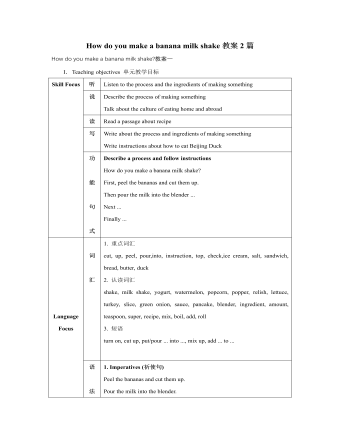
1. First, ... then, ... next, ... finally, ...首先,……然后,……接着,……最后,……这是英语中表达做某事的步骤的一种说法。如果步骤较多,还可以说:first-next-after that-later on-finally/at last通常你会听到说英语国家的人在说 first, next, then, finally 和后面的内容时,他们会做一些停顿。这样就能提前告诉听者接下来讲的是一系列的步骤。这一点在朗读和听力中应特别注意。2. how many, how much均为疑问词,同是“多少”,但用法不同。请看:how many修饰可数名词复数,how much修饰不可数名词。但在用法上,同学们常犯如下错误:1) [误] How many are there bananas on the table?[正] How many bananas are there on the table?[析] how many, how much 中的many,much是形容词,常修饰名词作定语,故后面跟名词。2) [误]How much tea are there on the table?[正]How much tea is there on the table?[析] how much修饰不可数名词时,谓语动词用单数。how many与how much的区别可简记为:前how many:问“多少”,复数名词后面跑;how much问“多少”,不可数名词单数好。前者答语用基数词,后者答语用数量关系。
人教版新目标初中英语八年级上册How was your school trip教案2篇
“Go for it!” is based on “Task-Based Language Teaching”. It adheres to “The authenticity principle”, “The form-function principle”, “The task dependency principle” and “The principle of learning by doing”. These principles all accord with the demands of curriculum focus.In and of Grade Seven (II), “Go for it!”, students have learned “The Simple Past Tense”. And it appears again in of Grade Eight (I). teaches students more about how to talk about events in the past. In addition, it gives affirmative and negative statements in the past tense, such as the sentence patterns “Did you see …?” “Were there …?” “Did you go …?” As the first part of Unit 8, Section A opens with a picture presenting the last school trip in the aquarium and continues with several step-by-step practice activities, which are all good for students to master “The Simple Past Tense”. Doing well in Section A will help students integrate the new target language with that in Section B. Thus, they can describe the events in the past freely and foster their own ability of reflecting and practicing. II. Teaching ObjectivesTeaching objective is the beginning and aim of teaching activities. According to the overall goal of the English elementary course--- improve students' synthetic ability of language application, which should be based on the development of students’ “Language knowledge”, “Language skills”, “Character building”, “Learning strategies” and “Cross-cultural awareness”. The teaching objectives are described as follows(I). Knowledge objectivesi. Master the simple past tense of regular and irregular verbsii. Recite the new words and expressions about the last school trip in the aquarium, including their pronunciation and intonation
人教版新目标初中英语八年级上册Could you please clean your room教案3篇
一、 教学内容Section A 1a----1c二、 教学目标1.学习词汇do the dishes, make the bed, take out the trash, fold the clothes, do the laundry, sweep the floor, clean the living room.2.句型 Could you please clean your room? Yes, sure.三、 教学准备 学生预习本单元所有的词汇多媒体课件 活动表 奖品四、 教学过程Pre-task1. Warming upEnjoy ourselves. Watch cartoon Cinderella. 看动画片段《灰姑娘》导如入本课话题和新词汇“chores”美丽善良的鬼姑娘因继母的嫉妒,每天得做所有的家务。片段的主题使学生联想到本课的话题。2. learn new words and phrasesLook! What is she / he dong? 看图学习动词词组do chores, do the dishes, make the bed, take out the trash, fold the clothes, do the laundry, clean the living room.3. Guessing game.What is she doing ? 4. Pair work. 1a, Do you do these things at home? Write “Y” for “yes” and “N” for “no”.5. Listening . 1b , Peter’s chores or Mom’s chores?理解目标语Could you please clean your room? Yes, sure.Write “M” for Mom’s chores, “P” for Peter’s chores in the chart.6. PairworkLook at the picture,Ask your partner to do the chores that you see. 7. Interview Who is the most able at home? 1) What chores do you do at home? How often do you do the chores? Work in four, interview each of the students in the group, fill in the chart.

人教版新目标初中英语八年级上册How do you get to school教案2篇
Step Ⅶ Role play ( Work on 1b)1. First ask two students to read the dialogue to the class.Sa: How do you get to school?Sb: Well, I ride my bike to the subway station. Then I take the subway.2. Now work with a partner.Suppose you use two kinds of transportation to get to school \Hangzhou\Beijing... (bus, train, subway, walking, bike, etc.) Tell how you get there. You may use the phrases in 1a.3. Then ask different pairs of students to present their conversations to the class.Step ⅧListening1. Work on 2a(1) First ask students to read the list of information that Thomas wants to know.…where Nina lives.…how far from school she lives.…how long it takes to get to school.…how she gets to school.…what she thinks of the transportation.(2) Tell students what transportation and bus stop mean.bus stop 汽车站 transportation n. 运送;运输Then tell students we'll hear a recording. Please put a checkmark in front of each thing that Thomas wants to know.(3) Now play the recording for students.( Have students pay attention to the sample answer.) (4) Then correct the answers.
人教版新目标初中英语八年级下册Have you ever been to an amusement park教案
(1)Have you ever been to …? Yes, I have. / Yes, I have ever been to …No, I haven’t. / No, I have never been to …(2)When did you go there? I went there last year. (3)I have never been to a water park. Neither have I. I have ever been to an amusement park. So have I. (4)How long have you been studying English? I’ve been studying English since nine o’clock. I’ve been studying English since I came back home. I’ve been studying English for five hours. (5)What’s that? It’s an amusement park in Japan. I’ve never been to an amusement park like it before. It’s fun to learn another language. Let’s go tonight. Isn’t this great?space museum, amusement park, water park, South America, Peru, Holland, European culture, tour guide, flight attendant, musical instrument, more than, be from, get to, take lessons, neither, discover, graduate, change