-
人教版新目标初中英语八年级上册What are you doing for vacation教案2篇
Teaching goals : 1. Words & phrases: babysit ,get back , fishing , rent , think about , decide(on) , tourist etc. 2. How to talk about future plans . 3. 现在进行时表示将来计划或行动. 4. 特殊疑问句(where , when , how long引导) Important and difficult points : Drills :What are you doing for vacation ? I’m watching TV . When are you going ? I’m going … . How long are you staying ? We’re staying for five days . Teaching aids : cards and a tape ,a large wall calendar . Period 1 Teaching procedures : Step 1Leading in1. Free talk . 2. Put up the wall calendar . T: I’m staying home on Saturday (pointing to next Saturday ).Ss repeat . Ss: I’m staying home on Saturday . T: OK. Today we’ll learn how to talk about future plans. Step 2Pre-task SB Page 13 , 1a . 1. Look at the picture carefully and tell what you see in the picture . 2. Write the activities from the pictures in the box and add some more . 3. Practice reading . Step 3While-task1. Using the activities we write in 1a to make conversations .For example :What are you doing for vacation ? I’m visiting my uncle . 2. Pairwork .Practice in pairs . 3. 用第三人称练习对话.
人教版新目标初中英语八年级下册What should I do教案2篇
说明:在帮Li Lei提建议的同时,教育学生如何学好英语。第三课时教学目标1. 语言目标:a) 词汇: Original, in style, haircut, the same as.b) 语言结构:My friend wears the same clothes and has the same haircut as I do.2. 能力目标:大多数学生能够谈论自己喜欢哪种服装,提高查找信息的能力。3. 情感目标:学会如何与朋友相处,要有自己对时尚的看法。教学重点掌握一些重要词汇。教学难点学会谈论问题,并能提出书面建议。◆教学突破首先针对Erin的问题,提出个人的建议,模仿2c部分的对话展开双人交际Pair-work;听老师诵读3a部分的信件,并找出LEFT OUT的问题所在;学生完成3b部分的内容,给Left Out提出书面的建议;学以口头形式提出自己目前存在的某个问题,讲给大家听,让同学们给自己提出一个建议,并作笔录;学生两、三个人分成一组,随意性地进行口语交际,谈论P14的第4部分的某个问题,相互交换意见。
人教版新目标初中英语八年级上册What’s the matter教案2篇
She shouldn’t go to the party tonight.Step7. TaskT: You know, there are lots of problems in our life. If you are a doctor, please tell us how to solve the problem. I will divide you into 9 groups. Please work in groups. And then choose one of you to report your ideas.The following are the problems:I have a toothache.I am hungry. I have a sore throat.I am stressed out. I have a sore back.I am tired. I can’t sleep.I have a cold. I have a headache.Report: If you have a headache, you should go to bed early. You should see the doctor. You should eat some medicine. You shouldn’t wash your face with cold water.You shouldn’t sleep late.You shouldn’t swim.…..T encourages the students to give advice as much as possible.Homework:1. Chose one of the problems, and write down your advice2. Copy the new words这一步是用于热身的,同时也可以让他们复习一部分的表示人体部位的单词,扩充知识.学习语言的过程也是一个不断积累的过程,复习旧知识,增添新知识.通过小游戏,强化学生对Does she/he have…这个句子的运用能力.通过复习,自然的引到下面新知识的学习。充分利用表格,由句子到对话,再到文章,让学生循序渐进. 提高学生的综合语言运用能力,运用以前学过的知识来解决身边的问题.Period 5 (Section B 3a—3c, selfcheck)教学内容与分析:
人教版新目标初中英语八年级下册If you go to the party, you’ll have a great time教案2篇
区分宾语从句、定于从句和状语从句宾语从句和状语从句,都叫做主从复合句。宾语从句主要是中考必考的,是初中阶段必掌握的从句,宾语从句主要是掌握三要素,所谓宾语从句,就是宾语在主从复合句当中充当宾语的一个句子,叫做宾语从句。主句的谓语动词是及物动词,后面如果是词或者是短语的话,是简单句,如果是句子的话,肯定是宾语从句。I know that he good at English.就是宾语从句,三要素,一要素是要注意连词,连词一共学了三类连词,一类连词是that口语当中可以省略,就像刚才说的那一句,I hear he is good at English.还有疑问代词、疑问副词,how where when,疑问代词、疑问副词。还有一类连词weather是否的意思,不是状语从句当中的如果,这一定要和如果区分开,这是是否。I don't know if he interested at English。宾语从句要注意if是连词。第二要素是语序,要用陈述举语序。比如说你家有几口人,我们都说How many people are there in you family?但是这是简单句,一旦说成宾语从句,你可以告诉我你家有几口人吗?Could you tell me how many people there are in you family ?
人教版新目标初中英语八年级下册How long have you been collecting shells教案2篇
Step Ⅱ Show the new words on the screen and teach the new words. Read the new words to students and ask them to repeat.Step Ⅲ 3aThis activity introduces new vocabulary and provides reading practice using the target language.In this activity first look at the four pictures.T: What can you see in the pictures?Ss: Four snow globes.T: Right. There are four snow globes in the pictures. And what are they?Ss: They are a monster, two polar bears, two penguins and a birthday cake.Write these words on the blackboard: snow globe; monster; polar bear; penguin and birthday cake. Read them to the class and ask students to repeat each one. Make sure students understand each word.Use a computer to show the E-mail message on the screen and read the message to students.Get students to read the e-mail on their own, and then draw lines connecting each snow globe and its description.Correct the answers.AnswersA line should connect each snow globe picture with the words that describe it in the letter.Step Ⅳ 3bThis activity provides writing practice using the target language.First review Activity 2a on Page 47.Then ask students to complete the message according to Activity 2a.Some partial sentences are given to students. Write about one person's collection.When students work, walk around the room checking the progress and offering help as needed.When they finish, ask some students to read their messages to the class.
人教版新目标初中英语八年级下册Would you mind turning down the music教案
Step 4. Group work (4)1. Ask a pair of students to read the dialogue. Say, This activity provides speaking, listening and writing practice using the target language.2. Ask students to complete the work in groups.3. Check the answers with the whole class. 4. Explain some of the language points. Step 5. Word review (Self check 1)1. Ask students to read the words and the phrases given. 2. Fill in the blanks with proper forms of these words to complete the sentences. 3. Check the answers with the whole class. Homework:Do activity 2 on page 57 after class. Period 6Teaching aims: 1. Teach vocabulary words and the useful expressions. 2. Enable the students to learn etiquette in different culture. 3. Help the students learn how to behave politely in public places and in daily life. Teaching procedures:Step 1. RevisionHelp students to review the function of making requests through a free talk. Then lead them to the topic of etiquette. Explain the meaning of etiquette. Or, ask students to look it up in the dictionary. Step 2. Pre-reading (Section 1)1. Ask students to read the picture and make a list with their partner about how many rules of etiquette can be seen being broken.

人教版新目标初中英语八年级上册What’s the best radio station说课稿6篇
3、重点和难点:重点:学会用形容词的最高级来对事物或人物进行描述。难点:形容词的最高级加est还是加most.二、 说教法:为了更好的突出重点,突破难点,我主要采用了:1、任务型教学法:新课标倡导的“玩中学,学中玩”的理念很受学生欢迎。例如,阅读文章时,我设计了一张表格,让学生阅读后完成表格并复述。培养学生逻辑分类与表述能力。2、 竞赛教学法:根据初中生争强好胜的性格特征,我每堂课都进行俩俩对话,激发学生兴趣,给学生创造外语语言氛围,培养学生集体荣誉感。三、说学法:1、 善于抓住用英语交际的机会,充分感知,积极体验,大胆实践。例如在导入新课时的One minute dialogue(每组都有一次机会),pairwork (每人都有机会),groupwork(每组一次机会)。2、 积极参与,善于合作。例如本课设计了几个任务,操作简单,学生一定很感兴趣并且积极参与,从而合作完成任务,培养了团队精神。
人教版新目标初中英语八年级上册What are you doing for vacation说课稿4篇
这一环节我采用电影《哈利波特》中哈利去霍格华兹的图片引入“how does Harry go to school?” 进而引入” how do you go to school?” 呈现“the ways to go to school” 让学生明确take 的使用及与交通工具的搭配。接着让学生根据实际情况回答自己采用的交通方式,期间可以引入“how does he /she go to school?” 基本了解了怎么说后进入课文,完成1a 部分练习 和1 b 的听力练习。完成后让学生玩一个数字游戏,帮学生回忆数字。通过问学生从家里出发时间和到达时间,引出“it takes ?? minutes .” 的句型。借助ppt 图片进行句型操练。然后完成听力练习2a—2c。本环节用时20分钟。While-task:本堂课的主要任务是让学生运用已学的语言知识,完成一个任务,即计算从学校到上海各种交通工具所需要的时间和费用,讨论应选用和种交通工具和各种优缺点。这一环节将用时10分钟。
人教版新目标初中英语八年级下册He said I was hard-working说课稿7篇
三、教学重、难点:(1)本部分的主要话题是谈论肥皂剧以及转述别人所说的话。因此,学习掌握间接引语的句子结构是本部分的重点。(2)根据我校学生的实际情况,学生学习英语起步慢,综合能力不是很强。因此,直接引语变为间接引语是学生学习中的难点。四、教学过程(一)激趣课堂在本活动中,我告诉学生们说:今天晚上电视台将播出一部卡通片,大家想看吗?这些就是剧中的人物,片名是“Young lives” 它是一部肥皂剧。根据学生的心理,如果学生对于一件事物有极大的兴趣,他们就会排除主观和客气的种种消极因素,全身心地投入到知识的学习中。(二)自主学习,寻求探究。通过活动一,学生们的注意力已完全集中,根据八年级学生的特点,注意力集中不久,我便趁热打铁,利用刚才的卡通画,让学生扮演上面的角色,让出后面的句子。我便问:“What did she say?”通过这一问,便引导出直接引语与间接引语,以及语法项目可由复杂变为简单,由抽象变为具体,更能体现了教师为主导,学生为主体的教学现念。
人教版新目标初中英语八年级下册What were you doing when the UFO arrived说课稿10篇
知识目标:a. 掌握新单词:shout; jump down; climb; scaredb. 掌握并会运用句型:—What were you doing at 8o’clock last night?—I was doing my homework.技能目标:a. 能听懂听力材料的内容,并能做出相应的练习。b. 提高学生听和说的能力。二.教法与学法本节课采取了任务型教学法,通过让学生完成不同的任务来完成不同的教学活动。本节课采用了Brainstorming、Pairwork、Groupwork等活动,实现了让学生说的目标。通过补充故事让学生巩固新学的单词,通过小组的活动让学生参与到问题的讨论中,让学生开口说。三.学情分析通过几个学期的学习,学生已经积累了一定的词汇,并熟练掌握了一些句型。本节课的热身部分是给了学生一个问题:What were you doing at 8 o’clock last night? 通过学生本身的活动来引起他们的兴趣,并对前面的内容进行了复习。四.教学重难点a.掌握本节课所学新单词:shout; jump down; climb; scaredb.掌握和巩固本单元的句型和语法(过去进行时)
人教版新目标初中英语八年级下册Will people have robots说课稿9篇
(一) 导入新课(1’)运用多媒体课件,播放有关机器人的视频,引起学生共鸣,激发学生学习兴趣。 边看边展示与课文相关的新单词。让学生想像机器人都是什么样的,机器人能做什么?(这样导入新课,自然创设学习情景,引起学生共鸣,引起学生的兴趣。)(二)快速阅读(skimming)(4’)任务:让学生带着要求快速阅读课文:Get the main idea of the whole passage.这个环节是让学生初读课文,目的是训练快速阅读技巧,学生以较快的速度完成阅读,迅速找到答案。(学法指导:注意:用浏览、跳读和快读的技巧,培养自己快速获有用信息的能力---抓住关键词、主题句和中心大意的能力。Tips: Reading for meaning , not for details(细节).不必逐行阅读(三)深层阅读(5’)任务一:默读文章,回答下列问题,我利用多媒体出示2个问题,(把2个问题打出来)然后让学生带着问题进行有目的阅读。(这样做可以充分利用课本资源,而且化难为易.在全班校对答案之前我让学生先进行同桌相互校对,充分发挥生生互动。)
人教版新目标初中英语九年级上册I used to be afraid of the dark教案
内容提示1.本单元主要内容是学会used to结构。Used to +动词原形表示过去经常、以前常常,只用于过去式中,用来表示现在已不存在的习惯或状态。例如:They used to play football together.他们过去常在一起蹋足球。(现在不在一起踢了)2.used to的疑问形式和否定形式为Did you use to…?和I didn’t use to… 也可以用Used you to…?和I used not to…但现在多使用前者。例如:Did you used to swim in the river? 你过去常在河里游泳吗?I didn’t use to play the piano. 我以前并不经常弹钢琴。教学目标一、学习目标(Language Goal) 1.学会陈述自己过去常做的事情。2.学会陈述自己过去的爱好等。3.能够表达自己现在和过去在外表、性格、娱乐等方面的变化。4.能够表达朋友、家人等现在和过去的变化。二、语言结构(Language Structures) 1.I used to be short when I was young. 我年轻时个子很矮。 2. —Did you use to have straight hair? 你过去是直发吗?—Yes, I did. 是的。 3. —Did you use to play the piano? 你过去弹钢琴吗?—No, I didn’t. 不,我不弹。 4.I used to be afraid of dark. 我过去害怕黑暗。 5.I’m terrified of the snakes. 我害怕蛇。
人教版新目标初中英语九年级上册I used to be afraid of the dark说课稿4篇
2、说说写写通过读写训练,进一步学会用 used to 结构来表达自己和同伴过去害怕,或现在仍旧害怕的事情,并且要把最后的结果书写下来,然后让他们将结果用英语告之其他同学,为学生创造展示才能的机会。这样能使全体同学都积极参与,集中精力认真听。既巩固了本节课的目标语言,又为下一个环节3b的对话打下基础。活动结问题比较容易,英语基础较差的学生也能够独立完成,因此,在检查答案是尽量让这部分学生回答,使他们体验到成功后的喜悦,提高他们学习英语的兴趣。 3.对话练习:让学生两人一组,模仿3a中的对话,根据提供的信息与提示词进行对话练习,目的在于对新学的目标语言进行口头练习与设定情景中的运用。为学生创造展示才能的机会。推荐两至三组的同学到教室前面,就所编的对话进行角色表演。
人教版新目标初中英语九年级下册Rainy days make me sad教案
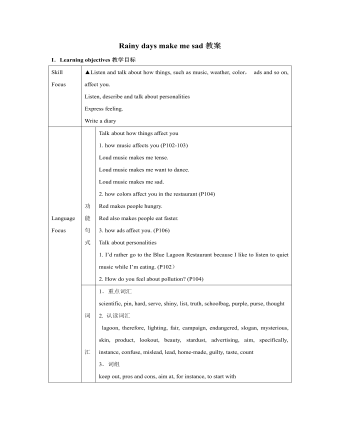
1. 教材分析本单元以how do things affect you?为话题, 从颜色、天气、音乐、广告、产品等方面谈论了外界事物如何影响人的心情。要求学生掌握表达某物或某事给人带来的感觉、看法或影响等。共设计了四个部分的内容:Section A 该部分有4个模块:第一模块围绕Which restaurant would you like to go to?这一话题展开思维(1a)、听力(1b)、口语(1c)训练;第二模块围绕How does music affect you? 进行听力(2a-2b)、口语训练(2c);第三模块继续围绕how do colors in the restaurant affect you这一话题展开训练,训练形式为阅读和问题体验(3a)和小组活动(3b);第四模块仍就How do things affect you这一话题以调查的形式展开讨论。Section B该部分有4个模块:第一模块围绕产品广告对人们的影响这一话题以“配对”(1a)与“列举”(1b)两种形式展开训练;第二模块继续围绕How do things affect you? 进行听力(2a-2b)、口语对话训练(2c);第三模块围绕“Advertising”这一话题展开阅读(3a-3b)和写作(3c)训练;第四模块围绕How posters affect you这一话题以口语训练形式展开小组活动。
人教版新目标初中英语九年级下册When was it invented说课稿7篇
《新目标英语》中的具体语言目标是通过各种各样的Tasks来实现的;学生需要运用具体而特定的行动来完成一定的交际任务。整个教学过程中,各种语言结构与语言功能与不同的学习任务有机的结合。任务活动所谋求的效果不是一种机械的语言训练,而是侧重在执行任务中学生自我完成任务的能力和策略的培养;重视形式在完成任务过程中的参与和在交流活动中所获得的经验。因此本节课我将始终引导学生通过完成具体的任务活动来学习语言,让学生为了特定的学习目的去实施特定的语言行动,通过完成特定的交际任务来获得和积累相应的学习经验,让学生在用中学,在学中用。 2、教学原则 l 活动性原则 提倡学生主动参与,体验,交流,合作,探究等多种学习。 l 合作性原则 以学生为主体,师生合作,生生合作,体现教与学的互动,交往。 l 任务型原则 任务驱动—激发动机;任务完成—激励学习积极性;执行任务—培养责任 心和合作精神。 l 情感性原则 激发学生学习英语的兴趣和始终保持良好的学习情绪。
人教版新目标初中英语九年级下册We’re trying to save the manatees说课稿5篇
教材分析本单元是九年级的最后一个教学新课的单元。这个单元主要是围绕着有关濒临灭绝的动物这一话题,让学生学习怎样保护我们的环境,以及就某一问题展开辩论。在学习新知识的同时,还复习一般现在时(Present Simple)、现在进行时( Present Progress)、一般过去时( Past Tense)、现在完成时(Present Perfect)等时态及被动语态(Passive Voice)。本课为第一课时,是培养听说能力为主的新授课。这节课要为整个单元的学习起到一个热身的作用,不仅要求学生掌握一定的词汇量,为下面的学习打下很好的基础,而且要求学生收集有关濒临灭绝的动物的信息,为后面的话题提供了充分的语言基础和语言依据。因此,我把本课的重点、难点确定于:1、语音、词汇方面:一些表示动物名称的名词(nouns)和描写动物特征的形容词(description words);2、通过听说等练习,让学生运用描述动物的形容词来描述所看到及所知道的动物的特征,同时也复习一般现在时表示主语具备的性格、特征的用法。
新人教版高中英语必修1Unit 1 Teenage Life-Listening and Speaking & Listening and Talking教案
Step 2 Listening and Talking1. The teacher is advised to talk with their new students about the related topic: Boys and girls, do you know some structures to talk about future activities? Talking about future activitiesWe’ll …I plan to …There’ll be …I hope to …We’re going to …2. After their small talk, the teacher can move on by playing the listening and solve the following task.Underline the expressions in the sentences below Cao Jing and Max use to talk about the future.We’ll learn useful skills.I plan to improve my spoken English.There’ll be students from different schools.I hope to make new friends.We’ll talk about teenage life.I’ll learn to make a fire.There’ll be students from different countries at the camp.There’ll be some experts there to show us how to live in the wild.We’re going to learn about wildlife.I’m going to give a speech.I think I’m going to enjoy the activities.I think we’ll have a lot of fun.3. Work in groups. Plan a youth camp.Teacher make the Ss think of ideas for the camp. And they can use the questions below to get started. And have the Ss present their ideas for a youth camp to the class.●What kind of camp is it?●Who will be there?●What will they do?●What will they learn?
新人教版高中英语必修1Unit 2 Travelling Around-Listening and Speaking & Listening and Talking教案
【教学目标与核心素养】1. Instruct students to get main facts by listening and motivate them to talk about the topics about how to prepare for the trip and make reservations by listening and ultimately can make travel arrangements and reservations. 2. Develop students’ sense of cooperative learning and individual thinking capability. 3. Develop students’ different listening skills to solve different listening comprehensive problems.4. Help students to understand how to use the structures “the present continuous tense (be doing) is used to express future plans.【教学重难点】1. Teach students how to focus on key words, not on single words or grammar.2. Prompt Ss to talk about the related topics, such as how to prepare for the trip and make a travel plan.【教学过程】Step 1: Listening and SpeakingLead inThe teacher is advised to talk with their students about the places that they want to travel most both at home and abroad: boys and girls, if you have a chance to travel around the world, where will you go? After their small talk, the teacher can move on by finishing the following listening task:Before travelling, what do we need to prepare for the trip?
新人教版高中英语必修1Unit 3 Sports and Fitness-Listening and Speaking & Listening and Talking教案
Finally, after finishing the task above, the teacher is expected to instruct students to work in groups to finish the following project:Speaking ProjectWhat event or activity would you like to invite your friend to? Make a conversation with a partner.Ski Race: Zhangjiakou, a beautiful city in northern China, will host the Youth Ski Race in December.Track Meet: a great event for track –and –field lovers on 26 October.Gym Class: come and work out at a gym! You can make it.Part 2: Listening and Talking:The teacher is advised to talk with their new students about the related topic: Boys and girls , what do you think of sportsmanship? Let’s listen and find out:Play the listening and match each opinion with the right speaker. Who do you agree with? Why?Cao Jing _____________ Lily _____________ Max _____________A. An athlete should do his/her best to win.B. The girl should stop and help the other girl. Good sportsmanship is more important than wining!C. An athlete should think about honor and his/her fans if he/she is competing for his/her country.Listen again and circle the expressions that you hear in the conversation.
新人教版高中英语必修3Unit 1 Festivals and celebrations-Discovering Useful Structure教学设计
4.That was an experience that frightened everyone. →That was _____________________. 答案:1. taking 2. being discussed 3. in the reading room 4. a frightening experienceStep 6 The meaning and function of V-ing as the predicative动词-ing形式作表语,它通常位于系动词后面,用以说明主语“是什么”或“怎么样”一种表示主语的特质、特征和状态, 其作用相当于形容词; 另一种具体说明主语的内容, 即主语等同于表语, 两者可互换。The music they are playing sounds so exciting. 他们演奏的音乐听起来令人激动。The result is disappointing. 结果令人失望。Our job is playing all kinds of music. 我们的工作就是演奏各种音乐。Seeing is believing. 眼见为实。Step 7 Practice1. It is ________(amaze) that the boy is able to solve the problem so quickly.2. Buying a car is simply _______(waste) money. 3. Please stop making the noise—it’s getting ________(annoy). 4. complete the passage with the appropriate -ing form.La Tomatina is a festival that takes place in the Spanish town Bunol every August. I think many food festivals are __________ because people are just eating. however, this festival is _________ because people don't actually eat the tomatoes. Instead, they throw them at each other! the number of people ________ part in this tomato fight, can reach up to 20,000, and it is a very __________ fight that lasts for a whole hour. The _______ thing is how clean Bunol is after the tomatoes are washed away after the fight. this is because the juice form tomatoes is really good for making surfaces clean!答案:1. amazing 2. wasting 3. annoying4. boring interesting taking exciting amazing