-
人教版新目标初中英语七年级上册Good morning教案
一、知识和能力目标本单元要求学生掌握英文字母A—H,能认读其印刷体和手写体字母的大小写等四种形式。书写(大写和小写,笔顺,笔画)基本合乎要求。能看,听,说本单元所列的日常交际用语,重点学会打招呼,并做到语音语调正确。注意一些字母及日常交际用语的发音,提醒学生不要将C/si:/发成/sei:/; ?/发成/e?/,也不要将Good?H /e /等。??????'????说成/???????'???morning/二、过程和方法目标教师要尽量用英语组织教学。充分利用课堂的40分钟,不讲或少讲汉语,尽量给学生创造英语情景。教师可以用手势,表情,动作等示意,帮助学生听懂课堂用语和日常交际用语,第一次介绍某个用语时,说英语,加译文及手势,以后可酌情省去译文,最后只说英语,逐步让学生听懂。
人教版新课标PEP小学英语六年级下册Last Weekend教案
一、教学内容:Part B Let’s learn Let’s play. Part C Task time Let’s check 二、教学目标与要求 1、掌握四会词组:went to a park, went swimming, read a book, went fishing, went hiking. 2、学会用句型What did you/ (name) do last weekend/ yesterday? I(name) (did) last weekend/ yesterday. Did you….? Yes, I did. 来进行问答并完成Task time的表格。 三、教学重点 掌握四会词组,并用所学词组和句型进行调查 四、教学难点 掌握四会词组(不规则动词过去式变化),并用所学词组和句型进行调查 五、课前准备 1、教师准备所需的词卡及图片。 2、学生准备词卡。 六、教学过程 1、Warm-up 1) Free-talk: T: What day is today? A: Today is… T: What day was yesterday? (强调 yesterday) B: Yesterday/ It was… T: What did you do yesterday? C: I (did)…yesterday. ( 用前几课时已经学的词组) 2) Chain-drill: C: I (did)…yesterday. What did you do yesterday? D: I (did)…yesterday. What did you do yesterday? E, F… (ask the teacher) T: I went to a park yesterday. 2、Presentation and practice let’s learn (1)继续Chain-drill,由T 引出并出示新授词组:went hiking. (2)学生已经了解了go 的过去式后, T 边用I went ( 这个动词用动作表示)yesterday.表达自己昨天去做什么了,边做动作.让学生帮老师说出: went swimming, went fishing.
人教版新目标初中英语七年级上册Do you like bananas教案
教学目标 ⑴知识目标:A、学会询问对方喜欢与不喜欢的食物; B、学习并激情 些食物的词汇; C、学会谈论自己与他人早、中、晚 餐喜爱吃的食物; D、学会营养配。 ⑵能力目标:A、能准备表达喜欢和不喜欢的食物; B、能根据具体情景对话,与他人沟通信息,合作完成任务; C、通过听、说、读、写四项技能的训练,促进学生语言运用能力的提高。⑶情感目标:A、通过学习西文食品文化,促使学生了解西方生活方式与文化,培养跨 文化交际的意识; B、通过开展小组活动,指导学生积极与他人合作,培养他们的合作精神; C、通过任务型活动,使学生学会在实际生活中均衡饮食,合理配餐。 教学重点、难点 重点:A动词like一般现在时的各种句式及一般疑问句的肯定、否定回答; B关于各种食物的词汇; C名词复数的使用。 难点:一般现在时中单数第三人称的变化形式。
人教版新目标初中英语七年级上册What color is it教案
一、知识和能力目标通过本单元教学,使学生能运用所学英语,正确地描述物体的颜色;同时进一步学习分辨人物的用语,并加以运用。二、过程和方法目标本单元口语训练应当自始至终在一种鲜明的色彩背景下进行,旨在营造那种为学生所喜爱的欢快气氛,教师应当在十种颜色上大做文章;在使用实物时要使颜色醒目;在组合图画时,要尽量用大色块;在使用投影时要使颜色突出来。教师可以从教室环境上入手营造色彩气氛,如:选取十种颜色的硬色板,剪成各个大写字母;或者将色板剪成各种卡通动物形象,悬挂在教室当中或在墙上,注明各种颜色的英语字块。三、情感态度和价值观目标用各种可以调动学生积极性的活动来提高学生的活跃性,激发他们参与讨论的热情。同时可以对学生进行美育教育,从小培养他们对美的正确认识。
人教版新目标初中英语七年级上册When is your birthday教案
本单元主要学习名词所有格 ('s 所有格 ) 的构成和使用。在初次接触 “ 名词所有格 ” 时,学生较难理解的可能是 “ 所有格 ” 这个名称,对于它的构成,学生也许会觉得较容易。教师可通俗地告诉学生 “ 所有格 ” 的意思是表示 “…… 的 ” ,这样学生反而容易接受。在使用 “ 名词所有格 ” 形式时,学生容易犯错误或混淆的主要是:将这种一 's 构成形式与 is 的缩写形式混淆,如: My father's name's Jin Zhi .,可以这样告诉学生:名词所有格的后面一般应接名词;勿将这种一 's 结构盲目套用与人称代词上,代替物主代词使用,如 He's father's name is Li Cheng 。在教学初期,可不讲授名词所有格的其它形式,待时机成熟,再向学生介绍复数名词所有格形式的结构一 ' ,如: the students' bikes 。 Self Check 教学内容 Self Check( 教材 P52) 教学目标 知识与能力 复习词汇 birthday , date , month , January , February , March , April , May , June , July , August , September , October , November , December , date , birth , age , old , speech . contest . trip , party , event , an , festival , pop , concert , chorus , lecture , music ;引导学生复习、巩固“询问和谈论日期”的目标语言并运用所学知识安排活动。
人教版新目标初中英语七年级上册Where’s my backpack教案
教师: 搜集单词卡片、背景资料。 学生:彩笔、大白纸、相关新单词。 教学设计 Step One: Learn the new words. 1.Present the new words. (Show some pictures and words on the screen to teach the students the new words.) T: What’s this? S1: It’s a room. T: Do you have a room like this? S2: Yes, I do./ No, I don’t. T: Read after me. R-O-O-M, room. Ss: R-O-O-M, room. (Teach the other words “TV, desk, picture” in the same way.) T: There are some words here. Read the words after me and spell them. (Learn the other words without pictures on the cards.) T: This is a word. Can you spell this word? (Point to a word in the card.) S1: Yes, I can. / No, I can’t. (Let them know the meaning of “can”.) T: I can spell your name. Can you spell my name? S1: Yes, I can. T: Can you write your name? S: Sorry, I can’t. I have no pen. T: You need a pen.( Give him a pen.) ( Let the students understand the word “need”.) T: I bring a football to school every day. Now it is on the floor. After class I take it to my home. (Teach “bring” and “take”. Put a football on the floor and point to the floor to teach the word “floor”.) 2.Practice the words. (Give the examples to the students and get the students to understand the new words.) Step To Listen and practice.
人教版新目标初中英语八年级下册Will people have robots教案
Teaching goals:1.Words&phrases: robot, paper, less, fewer, simple, unpleasant, factory, seem, etc .2.will 构成的一般将来时态的陈述句、否定句、疑问句及回答.3.There be 句型的一般将来时.4.more , less , fewer 的用法.5.学习一般将来时态的相关知识,学会对未来进行预测.6.对five years ago ,today ,in five years 简洁回顾与展望的方式,贴近实际符合学生心理,激发学习兴趣.7.通过时间对比复习一般过去时态、一般现在时态,巩固一般将来时.Important and difficult points :1.will构成一般将来时态的句式。2.There be 句型的一般将来时态。3.more , fewer , less 的用法。4.How to make predictions .Period 1Teaching procedures:Step 1 Leading in1.Greetings: Welcome to school .What’s the date today ? Who’s on duty today ?Do you enjoy your winter holiday ?Do you finish your homework ?Do you want to live on the moon ?Can you guess what will happen in ten years ?Collect the Ss’ answers and say something about their predictions .Step 2 Pre-taskSB Page 2 ,1a .1.Look at the picture :How will the world be different in the future ,100 years from now ?We’re going to talk about sth in 100 years .
人教版新目标初中英语九年级上册What would you do教案
本课采用任务型教学法,用What would you do if you had a million dollars?这个问句,引出谈论假想情况的话题。 采用提问、启发和归纳的教法,让学生易于接受教材内容,培养学生的语言运用能力。 四、 教学过程设计 Step Ⅰ. Greet the whole class as usual. Step Ⅱ. Warming-up T: Do you have ten Yuan in your pocket? S1: No, I don’t. T: (Take out ten Yuan and give it to the student) OK, never mind. What would you do if it was yours? What would you do if you had ten Yuan? S1: I would buy snacks. T: OK, thank you. Sit down, please. (To the whole class) Just now, it was only ten Yuan. What about 100 Yuan? What would you doif you had 100 Yuan? S2: I’d buy a beautiful jacket. T: Thank you. (To the whole class) Now suppose you had a million dollars, what would you do? We know thatone dollar nearly equals eight Yuan, so that’s a large sum of money. Think it over carefully and tellme your ideas. What would you do if you had a million dollars? S3: I’d buy a big house. S4: I’d buy a sports car. S5: I’d put it in the bank. T: OK, stop here. Please look at the blackboard and guess what would I do if I had a million
人教版新目标初中英语九年级下册When was it invented教案
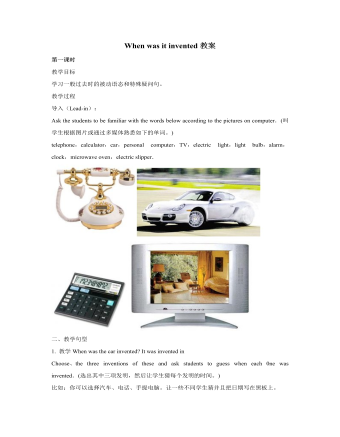
二、教学 1a,1b.1.First the teacher asks the students what kind of fruit food and drink you like the best and writes down on the blackboard.教师问学生最喜欢什么水果和饮料并把它们写在黑板上。比如:potato chips,ice cream,tea,lemon,chocolate,oranges,salad,popcorn,pickle and so on.2.接着叫学生表达以上食物的味道,引出新单词——sweet,crispy,salty,sour,delicious,hot,awful,nice…并且完成lb教学内容通过此活动,以旧带新引入新单词。其目的是让学生自主学习新知识。 三、教学 2a,2b1.首先,听力前的brainstormFirst,Let students describe how potato chips taste and describe how helpful the potato chips.Then,ask:When and where were potato chips invented?Who were potato chips invented by?How were potato chips invented?(Let students guess according to the following key words.)Key words:by accident,customer,restaurant,by mistake.(说明:通过问题让学生对对话内容有整体了解,为听力练习做好准备;又培养学生的注意力,想像力,观察力。)
人教版新目标初中英语九年级下册Have you packed yet教案
教学目标:1.学习现在完成时。2.学already和yet用法。3. 能够运用所学知识,谈论或询问最近已经发生的事情语言功能:能够运用所学知识,谈论或询问最近已经发生的语言结构:现在完成时态、一般现在时、一般过去时、一般将来时语言目标:Have you watered the plants yet?No, I haven’t.Have you fed the cat?No, I haven’t fed her yet.I have to do my homework. I started about an hour ago, but I haven’t finished. I will visit Hong Kong next year.重点词汇及短语:water, wood, farm, ocean, hit, appear, turn, government, thousands of, southern, villager, strongly, step, clean out, some day, be off, so far, go for walks, thanks to, look forward to学习策略与思维技巧:引导、合作跨学科学习:历史知识、文化学习教学重点:现在完成时态的构成及应用教学难点:现在完成时与一般过去时的区别 学习方式:自主、合作学习 情感目标: 教育学生做事情要有条理,养成“今日事,今日毕”的好习惯。培养学生养成反省的好习惯。增强学生做事的条理性及计划性。课前任务:记录和查找自己和别人已做过或仍没做的事情。
人教版高中英语必修4Body Language说课稿4篇
Textbook: Senior English for China (Book 4), by Liu Daoyi Time Allotment: 1 period (40 minutes)Date: March 20, 2014Teaching aids: blackboard, Multi-media, Power Point, chalk I. Text Analysis (教材分析)This unit is about body language, and the text selected in the reading part demonstrates the difference and similarity of body language in many parts of the world. Through learning this passage, students are required to raise their awareness of using body language in different parts of the world. As body language is closely related to our daily life, it is easy to arouse students’ interest in learning this text. Reading skills and speaking training are designed around the text.II. Teaching Objectives (教学目标)By the end of the lesson, students will be able to:1. Language Skill Objective(语言技能目标): develop reading ability (skimming and scanning)as well as speaking ability.2. Cultural Knowledge Objective(文化知识目标): know about the cultural differences of using body language.3. Affective Objective(情感目标): increase students’ awareness of using body language correctly in different cultures. III.Teaching Focuses and Difficulties(教学重点和难点)1. Teaching Focuses(教学重点): the difference and similarity of body language in many parts of the world.2. Teaching Difficulties(教学难点): develop students’ reading abilities of skimming and scanning and ask the students to show their opinions with fluent English.
人教版高中英语必修1Anne's best friend说课稿
Step 7 Language points 1.Vocabulary (1) go through (2) set down (3) a series of (4) on purpose (5) in order to (6)at dusk (7)entirely (8)face to face 2.Important sentences (1)…I’ve grown so crazy about everything to do with nature. (2)There was a time when … (3)I stayed awake on purpose until … (4)It was the first time … that I’d seen the night … (5)It’s no pleasure looking through … Purpose: 1.Master the required vocabulary and sentence structures. 2.Use them freely. Step 8 Consolidation 1.Find out the topic sentences 2.Retell the text according to the topic sentences Purpose: I want to know if my students understand the text. Step 9 Discussion Imagine you have to go into hiding like Anne and her family, what would you miss most? Giveyour reasons. Purpose: Train Ss’ oral English ability. Step 10 Homework Write an article on Friends. Purpose: 1. Improve the Ss’ writing ability. 2 Train the Ss’ ability of self—teaching and looking up information by themselves. Part 5 Blackboard design(说板书设计)Unit 1 Friendship Reading Anne’s Best Friend 1.Main idea of each paragraph: Para. 1 Anne made her diary her best friend. Para .2 Anne wrote her feelings in her diary. Para .3 Anne missed nature. Para.4 Anne saw the night face to face Para.5 Anne wanted to experience nature outdoors. 2.Listening: Exx.1 P3 3.Discussion: Exx.3 P3 Purpose: 1.Make Ss familiar with the passage 2.Make the design inductive, instructive and artistic.
人教版高中英语必修1English around the world说课稿
(3)v. 给:提出;展现,显现present sb. with sth. ; present sth. to sb. 把. . 交给;颁发;授予present sth. (for sth. )/present sth. to sb. e. g. Om his birthday, his friends presented him a collection of stamps. 在他生日时,他的朋友们送给他一套邮票作为礼物。The sword was presented by the family to the museum. 这家人把宝剑捐赠给了博物馆。The committee will present the final report to Parliament in June. 委员会将在六月向议会提交最后的报告。You need to present yourself better. 你需要更善于展现自己。It is essential that we present a united front. 至关重要的是我们要表现得更加团结。Step 4 ConsolidationT:Now that we have got a general idea of these words and phrases. Lets make up some sentences using them to master them. Suggested sentences:1. Your duties include typing letters and answering the telephone. 2. It is one of the greatest roles that she has played. 3. A large number of people have applied for the job. 4. The number of the panda is declining. 5. I'11 go there, even if I have to walk. 6. He came up to me to ask for a light. 7. The novel is about a family who can't communicate with each other. 8. He based his plan on interests of most people. 9. Why doesn't he make use of his singing talent?Step 5 Summary and homeworkT:Today we dealt with several new words and phrases. After class I hope that youcan read them again and again to keep them in mind. That's all for today. You aredismissed.
人教版高中英语必修1Nelson Mandela--A Modern Hero说课稿
In this step, give students a few minutes to read the passage . While they are reading, I will write some key words of the text on the blackboard. Then ask students to retell the passage according to the key words.By retelling, students can improve their ability of language organization and have an overall understanding of the article.Step 4 Group discussionIn this step, students will be divided into groups of 4 to discussion the following question: What qualities make a great person?After their discussion, invite a few groups to make a report to the class.This group discussion can practice students’ oral English and cultivate their abilities of cooperation and communication.Step 5. HomeworkLet students write a short passage to introduce a great person he or she admires.The homework can consolidate the knowledge the students have learned and cultivate their writing ability. Part 6 Blackboard Design(板书设计)That’s all my teaching procedures. Finally, I’d like to say sth about part 6 blackboard design. On the top is the title. On the left, there will be some new words and expressions. In the middle of the blackboard, I will write some useful sentence structures so that the students can know clearly what they’ve learned and then try to master the knowledge.OK. That’s all for my presentation. Thank you for your attention.
人教版高中英语必修2Computers说课稿3篇
一. 教材分析1. 本单元的中心话题是“计算机(Computers)”,内容涉及计算机的发展历史,计算机的应用等。本节课是该单元的第一课时,我将Warming up, Pre-reading and Comprehending这四部分整合为一节精读课。其中。Reading部分是题为WHO AM I?的文章,以第一人称的拟人手法介绍了计算机发长演变的历史和计算机在各个领域的应用,其主旨是表达计算机的发展变化之快以及在生活中用途之广。而Warming up部分以图片的形式展现了计算机的发展历程;Pre-reading中的问题和排序分别是为了预测语篇的内容和测试学生对计算机历史了解的情况;Comprehending则通过各项练习训练学生的阅读技能,从而加深对文章的理解。可见这几部分是一个有机的整体。2. 教学目标:1) 语言目标:重点词汇及短语:abacus, calculate, calculator, PC, laptop, PDA, robot, analytical, technological, universal, mathematical, artificial, intelligent, network, explore, in common, as a result.重点句子:a. My real father was Alan Turing, who in 1963 wrote a book to describe how computers could be made to work, and build a “universal machine” to solve any mathematical problem.
新人教版高中英语选修2Unit 2 Learning about Language教学设计
The activity theme of this section is to design various activities around the key words in the first text. Therefore, the activities require students to pay attention to the spelling of words. On the other hand, let students grasp the meaning of words more accurately through sentences and short texts. This kind of teaching design also helps to improve the ability of using English thinking.1. Cultivating students' ability to use word formation to induce and memorize vocabulary, and the ability to use lexical chunks to express meaning.2. Guide the students to think independently and use the correct form of words to complete sentences3. Cultivate students' habit of using lexical chunks to express language completely, guide students to draw words in sentences quickly, pay attention to word collocation, so as to accumulate more authentic expressions4. Instruct students to create sentences with the chunks.1. Enable students to use the language points in the real situation or specific contexts flexibly and appropriately.2. Guiding the Ss to use unit topic words and the sentence patterns in a richer context.Step1: Think of a word that best fits each definition.1. to remember sth2.to accept, admit, or recognize sth or the truth/existence of sth3. the process of changing sth or yourself to suit a new situation4 .to make sb feel less worried or unhappy5. a strong desire to achieve sth
新人教版高中英语选修2Unit 2 Reading and thinking教学设计
Her tutor told her to acknowledge __________ other people had said if she cited their ideas, and advised her _______(read) lots of information in order to form __________wise opinion of her own.Now halfway __________ her exchange year, Xie Lei felt much more at home in the UK. She said __________ (engage) in British culture had helped and that she had been__________ (involve) in social activities. She also said while learning about business, she was acting as a cultural messenger __________(build) a bridge between the two countries. keys:Xie Lei, a 19yearold Chinese student, said goodbye to her family and friends in China and boarded (board) a plane for London six months ago in order to get a business qualification. She was ambitious(ambition) to set up a business after graduation. It was the first time that she had left (leave) home.At first, Xie Lei had to adapt to life in a different country. She chose to live with a host family, who can help with her adaptation (adapt) to the new culture. When she missed home, she felt comforted (comfort) to have a second family. Also Xie Lei had to satisfy academic requirements. Her tutor told her to acknowledge what other people had said if she cited their ideas, and advised her to read lots of information in order to form a wise opinion of her own.Now halfway through her exchange year, Xie Lei felt much more at home in the UK. She said engaging (engage) in British culture had helped and that she had been involved (involve) in social activities. She also said while learning about business, she was acting as a cultural messenger building a bridge between the two countries.
新人教版高中英语选修2Unit 3 Reading for writing教学设计
The theme of this part is to write an article about healthy diet. Through reading and writing activities, students can accumulate knowledge about healthy diet, deepen their understanding of the theme of healthy diet, and reflect on their own eating habits. This text describes the basic principles of healthy diet. The author uses data analysis, definition, comparison, examples and other methods. It also provides a demonstration of the use of conjunctions, which provides important information reference for students to complete the next collaborative task, writing skills, vivid language materials and expressions.1. Teach Ss to learn and skillfully use the new words learned from the text.2. Develop students’ ability to understand, extract and summarize information.3. Guide students to understand the theme of healthy diet and reflect on their own eating habits.4. To guide students to analyze and understand the reading discourse from the aspects of theme content, writing structure, language expression, etc., 5. Enable Ss to write in combination with relevant topics and opinions, and to talk about their eating habits.1. Guide students to analyze and understand the reading discourse from the aspects of theme content, writing structure, language expression, etc.2. Enable them to write in combination with relevant topics and opinions, and to talk about their eating habits.3. Guide the students to use the cohesive words correctly, strengthen the textual cohesion, and make the expression fluent and the thinking clear.Step1: Warming upbrainstorm some healthy eating habits.1.Eat slowly.2.Don’t eat too much fat or sugar.3.Eat healthy food.4.Have a balanced diet.Step2: Read the passage and then sum up the main idea of each paragraph.
新人教版高中英语选修2Unit 2 Using langauge-Listening教学设计
? B: Absolutely! Getting involved with Chinese cultural activities there definitely helped a lot. I got to practice my Chinese on a daily basis, and I could learn how native Chinese speakers spoke.? A: What do you feel is your biggest achievement?? B: Learning Chinese characters! I have learnt about 1,500 so far. When I first started, I didn't think it was even going to be possible to learn so many, but now I find that I can read signs, menus, and even some easy newspaper articles.? A: What are you most keen on?? B: I've really become keen on learning more about the Chinese culture, in particular Chinese calligraphy. As I have learnt Chinese characters, I have developed a great appreciation for their meaning. I want to explore Chinese characters by learning how to write them in a more beautiful way. ? A: Finally, what do you want to say to anyone interested in learning Chinese?? I have really become keen on learning more about the Chinese culture, in particular Chinese Calligraphy. As I have learnt Chinese character, I have developed a great appreciation for their meaning. I want to explore Chinese characters by learning how to write them in a more beautiful way.? A: Finally, what do you want to say to anyone interested in learning Chinese?? B: I'd say, give it a shot! While some aspects may be difficult, it is quite rewarding and you will be happy that you tried.? A: Thanks for your time. ? B:You're welcome.
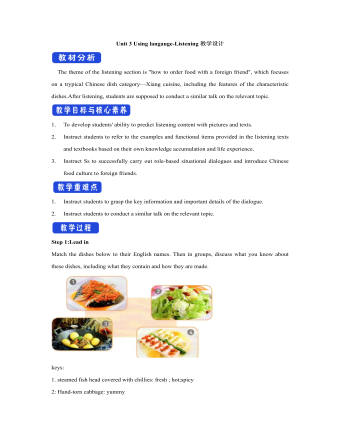
新人教版高中英语选修2Unit 3 Using langauge-Listening教学设计
1. How is Hunan cuisine somewhat different from Sichuan cuisine?The heat in Sichuan cuisine comes from chilies and Sichuan peppercorns. Human cuisine is often hotter and the heat comes from just chilies.2.What are the reasons why Hunan people like spicy food?Because they are a bold people. But many Chinese people think that hot food helps them overcome the effects of rainy or wet weather.3.Why do so many people love steamed fish head covered with chilies?People love it because the meat is quite tender and there are very few small bones.4.Why does Tingting recommend bridge tofu instead of dry pot duck with golden buns?Because bridge tofu has a lighter taste.5 .Why is red braised pork the most famous dish?Because Chairman Mao was from Hunan, and this was his favorite food.Step 5: Instruct students to make a short presentation to the class about your choice. Use the example and useful phrases below to help them.? In groups of three, discuss what types of restaurant you would like to take a foreign visitor to, and why. Then take turns role-playing taking your foreign guest to the restaurant you have chosen. One of you should act as the foreign guest, one as the Chinese host, and one as the waiter or waitress. You may start like this:? EXAMPLE? A: I really love spicy food, so what dish would you recommend?? B: I suggest Mapo tofu.? A: Really ? what's that?