-
收藏模板
- 模板信息
- 更新时间:2023-09-07
- 字数:约9565字
- 页数:约8页
- 格式:.doc
- 推荐版本:Office2016及以上版本
- 售价:5 金币
您可能喜欢的文档
人教版新目标初中英语七年级上册Good morning说课稿
1.课堂活动中的竞赛制:以记奖评优的形式无声的评价每一个活动,包括个体和小群体。在第一课时评最佳演员和导演奖,第二课时评最佳团体奖,既节约时间又明确有效。使学生能提高语言质量,增强参与意识,提高学习兴趣。2. 教师课堂上语言、表情激励制:在课堂活动中教师要乐于 、善于用激励性语言。从good, super, smart, excellent , great ,wonderful等,用微笑,皱眉,摇头、点头等身体语言对于学生的评价是方便又有效的途径。3.课后作业评价:口头作业在第二天课堂上表演,接受全体同学的评价。笔头作业有教师批阅,以评语的方式出现。优秀作业予以展出或交流。积极地肯定和鼓励学生是我们评价的重要目的之一。4.单元结束后综合性评价:除了笔试以外,也可以根据学生实际开展丰富的活动,如:调查报告、小品表演、专题演讲等。
人教版新目标初中英语七年级上册Do you like bananas教案
教学目标 ⑴知识目标:A、学会询问对方喜欢与不喜欢的食物; B、学习并激情 些食物的词汇; C、学会谈论自己与他人早、中、晚 餐喜爱吃的食物; D、学会营养配。 ⑵能力目标:A、能准备表达喜欢和不喜欢的食物; B、能根据具体情景对话,与他人沟通信息,合作完成任务; C、通过听、说、读、写四项技能的训练,促进学生语言运用能力的提高。⑶情感目标:A、通过学习西文食品文化,促使学生了解西方生活方式与文化,培养跨 文化交际的意识; B、通过开展小组活动,指导学生积极与他人合作,培养他们的合作精神; C、通过任务型活动,使学生学会在实际生活中均衡饮食,合理配餐。 教学重点、难点 重点:A动词like一般现在时的各种句式及一般疑问句的肯定、否定回答; B关于各种食物的词汇; C名词复数的使用。 难点:一般现在时中单数第三人称的变化形式。
人教版新目标初中英语七年级上册What color is it教案
一、知识和能力目标通过本单元教学,使学生能运用所学英语,正确地描述物体的颜色;同时进一步学习分辨人物的用语,并加以运用。二、过程和方法目标本单元口语训练应当自始至终在一种鲜明的色彩背景下进行,旨在营造那种为学生所喜爱的欢快气氛,教师应当在十种颜色上大做文章;在使用实物时要使颜色醒目;在组合图画时,要尽量用大色块;在使用投影时要使颜色突出来。教师可以从教室环境上入手营造色彩气氛,如:选取十种颜色的硬色板,剪成各个大写字母;或者将色板剪成各种卡通动物形象,悬挂在教室当中或在墙上,注明各种颜色的英语字块。三、情感态度和价值观目标用各种可以调动学生积极性的活动来提高学生的活跃性,激发他们参与讨论的热情。同时可以对学生进行美育教育,从小培养他们对美的正确认识。
人教版新目标初中英语七年级上册Is this your pencil教案
T: Please look at the pictures and learn the new words.(用多媒体展示新单词效果较好。)1.at prep. 在(里面或附近);在(点刻);2.theart.表示特指的人、物、事或群体 3.lostadj.丢失的;遗失的4.Found adj. (find的过去式、过去分词)找回的5.lost and found 失物招领6.please adv.请7.school n. 学校8.a set of一套;一副(Teach students to read the words.)2. Practice the new words. (事先录制一段短的听力,让学生通过听的训练来强化所学的新单词,并为学习写寻物启示和失物招领作好准备。)T: Please listen to a short passage twice then fill the blanks using the words we learned.(Show students a short passage and play the recording for the students to listen.)There are many things in (1)_____________________in my (2)__________. Look, here’s (3)_________keys. Is this yours? (4)__________call Jim (5)___________753-2289.Typescript:There are many things in the Lost and Found in my school. Look, here’s a set of keys. Is this yours? Please call Jim at 753-2289.
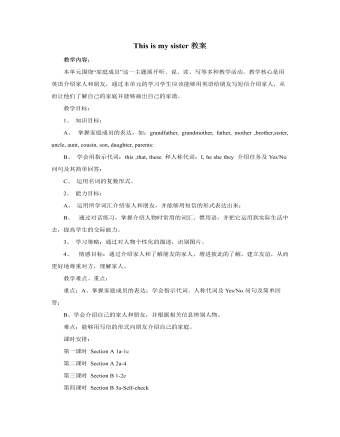
人教版新目标初中英语七年级上册This is my sister教案
(Play the recording twice again.) (Check the answer.) ③Pairwork. Draw your own picture and talk about it. T: We find out the picture of Lin Hai’s family. Can you draw a picture of your family? SS: … T: OK. When you finish drawing, tell your partner about your picture. You can use “This is …” and “ These are …” to talk about. Then report it to the class. (Students work.) (Check students’ work. Ask two or three students to report.) Step Three: Task. Talk about the family tree. T: Look at the family tree. I think it’s a big family. You can do it in groups of four or three. You can do it in pairs or only by yourself. Then report it to the class. (Students work. Teacher walks around in the classroom and helps the students.) T: Stop here. Let’s check it out. (Choose students to do it.) S1: Look at my family tree. This is my… This is my … They have two … This is my … This is my …This is my …This is my. My parents have two children. This is…This is my …My uncle and my aunt have a son. He is my … (Ask two more students to do it.) Homework. Write a passage about your family.
- 查看更多相关Word文档
Good morning教案
课程目标
一、知识和能力目标
本单元要求学生掌握英文字母A—H,能认读其印刷体和手写体字母的大小写等四种形式。书写(大写和小写,笔顺,笔画)基本合乎要求。能看,听,说本单元所列的日常交际用语,重点学会打招呼,并做到语音语调正确。注意一些字母及日常交际用语的发音,提醒学生不要将C/si:/发成/sei:/; ʧ/发成/eʧ/,也不要将GoodIH /e /等。NIn:Cmedu^说成//NIn:Cmdu^morning/
二、过程和方法目标
教师要尽量用英语组织教学。充分利用课堂的40分钟,不讲或少讲汉语,尽量给学生创造英语情景。教师可以用手势,表情,动作等示意,帮助学生听懂课堂用语和日常交际用语,第一次介绍某个用语时,说英语,加译文及手势,以后可酌情省去译文,最后只说英语,逐步让学生听懂。
三、情感态度和价值观目标
万事开头难,首先利用这个单元培养学生们对英语的兴趣,因为兴趣是最好的老师。
学情分析
体会打招呼用语的奥妙所在,做到灵活运用。
1.Good morning /afternoon/evening:适用于比较正式客气的场合,双方都应说Good morning /afternoon/evening!例如:
A:Good morning,Miss Zhao.早晨好,赵老师。
B:Good morning,Mr.Wang.早晨好,王校长。
2.Morning:适用于比较熟悉的朋友之间或比较繁忙的情况下。
3.Hello:是最广泛、最简单的打招呼语,显得亲切自然。例如:
A:Hello,Kate.你好,凯特。
B:Hero,Li Lei.你好,李雷。
4.Hi:在现代英语中,Hi比Hello用得更多,显得更随和。例如:
A:Hi,Han Meimei.你好,韩梅梅。
B:Hi,Lucy.你好,露西。
教学准备
tape—recorder,multi—medium.
课时参考
四课时
Period 1
Step 1:Introduction
Begin by greeting the class with a smile andgood morning!
Now,introduce the words“teacher” and “class”.by using gestures.Repeat
this several times andhave the class repeat after you.Students Can answer asa whole group.As rows and as individuals.Repeat “I am your teacher and you are the class” several times.
Now,introduce the class tothe instructions:Class,please sit down and class,please stand up byusing actions and gestures.They can practice thisseveral times.
Step 2:Lead—in
You may want t0 leave the class again tointroduce the usual Good morning routine.Say Good morning class.Help students respond with Good morning.Point to yourself and say I’m Miss/,Mr.…Have them repeat.Explain the terms Missand Mr.in Chinese.
Repeat this a few timeswith rows and individuals or try a “back-chain” drill:
Miss,Mr.…(Ss repeat)
Morning,Miss/M r.…(Ss repeat)
Good morning,Miss,Mr.… (Ss repeat)
Step3:Practice
Say:Stand up,please! (Ss stand up)
Leave the classroom,return and say Good morning,class! Help thestudents respond with Good morning,Miss/,Mr.…Say Sit down,please.Now let’s start thelesson.
Step 4:Presentation and activity
Now point to yourselfand say My name is Miss/Mr. … I am your teacher.
Find a student you knowand say your name is…(Beth).Then ask What is yourname? Help them respond with My name is… . When the student answers, respondwith Hello…Nice to meet you! Repeat this activity several times,first with students you know and then with others.Help them to respond with Nice to meet you,too.Explain the Word “too’’in Chinese.
Step 5:Practice
Get the students to practice the f0llowingdialogue in pairs.
S1:Good morning.
S2:Good morning.I’m (Ben).What’s your name?
Sl:My name is (Dale).Nice to meet you!
S2:Nice to meet you.too.
Call out several pairs of students to givetheir performance.Praise their efforts asmuch as possible.Help the slowerstudents with patience.
Step 6:Presentation
Do activity 1a:Look at the picture.Find the small lettersfor these big letters.
First present lettersa-h,and get the students to repeat these letters.Call the students to ʧ/ not /eʧ/Iattention the letter C/si:/not/sei:/.H /e
Step 7:Listening and writing
Get the students to listen to the tape andfinish the task list on the book.Make sure all thestudents know what they should do.
Have the students watchthe teacher writing the letters on the blackboard, then ask them to follow theteacher and write down these letters on their exercise—books.Let the students know the diffences between the big letters andthe small letters.
Step 8:Games time
Let the students do some letters games toenjoy your lesson,the following is theinstruction.
抢读字母游戏:教师将全班分成若干小组,然后逐个出示字母卡片,学生们举手抢答。教师让最先举手的学生读出该字母,读对的给该组记lO分,得分最多的组为优胜组。
Step 9: Homework
Copy the conversation and letters. (Doentering famous school)
Period2
Step 1:Lead—in
Do free talk:Greet students and ask them to greet each other. Play a role game.Ask students to collect information about their idols such as Bill Gates,Thomas Edison, Jacky Cheng and so on and write their names down. Get them actas their idols and introduce themselves to their partners. The following issample:
T: Good morning, Myname is Bill Gates.
S: Good morning, I’mJacky Cheng.
T: Nice to meet you,Jacky.
S: Nice to meet you,too. Bill.
Encourage the studentsto care what kind of English they can find in the street or in the other ways.Show the students some CDs and ask them if they know what it is. Repeat withthe other things. And add some more things such as DVD and KFC. Train thestudents to care the things happening around them, such as: ID meansidentification card. OK means all right. Then get them to finish the exerciseon the screen. Go on doing the above step to ask them to list more about theabbreviation. (See the power point)
Step 2:Pairwork
Let students work inpairs to practice the dialogue on 3 A.Get them to act it out after practicing. Do 3 B.Make sure all thestudents know the answers correctly. Let the students try their best toremember how to pronounce all the names.
Let the students try
Step 3:Practice
Play the tape and askthe students to sing after it in chorus and individual. Give them a chance toperform.Praise their efforts as much as possible.Help the slower students with patience.
Step 4:Homework
Copy the letters andthe new words and finish off the workbook. (Do entering famous school)
Period3
Step 1: Lead-in
Begin the class withsinging the song of “Good morning” together. Free talk. Ask : Hi! Good morning,Tom. Or Morning, Dale. etc. Let the students get used to speaking English inclass,even after class, Encourage the students tospeak English as much as possible.Say out all the lettersin English while you are pointing the letters or things in the classroom.Make sure all the students know what you are saying and what it isin English.
Speech Cassette la of section B.Play the tape and askthe students to listen to it carefully, then act it out, also do the task of lbon the book.Next get the students to write down thesmall letters for each word (abbr.).
Step 2:Pairwork
Get the students topractise the dialogue by pointing out the things they know how to say inEnglish.Ask the students to exchange the roles.Let them fill in the missing letter of each word in pairs.
Step 3:Listen and repeat
List out the letter Aon the blackboard and encourage the students to say out what other words a1somake the same pronunciation. Givethem some tips. Present the other letters the same as the 1etter A.Let the students followthe chant after the tape.
Step 4:Homework
Finish off the workbook.(Do entering famous school)
Period4
Step 1:Go through all the contents list on this part,make sure all the students understand them. If they don’t,you may use Chinese toexplain it. (Do entering famous school)
单元教学测评
一、写出下列字母左邻右舍
1. _____B______ 2.______c ______ 3. _____f______ 4. ____E_____ 5. _____g _____
二、写出下列大字字母的小写字母。
1. BEE ________2. BAG_______ 3. BED _______ 4. HB _______ 5. CD _______
6. ABC ________ 7. AD_______ 8. CAAC _______ 9. BEC _______ 10. FACE _______
三、比较下列每组字母或单词的读音,相同的用(S),不同的用(D)表示。
1. b, a ( ) 2. c, e ( )3.a, e ( ) 4. b, d () 5. a, c ( )6. Dale, Alice ( )
7. Frank, thanks ( )8.evening, Helen ( ) 9. A, H ( )10. E, F ()
四、看图写出下列图所表示内容的缩写字母或单词。
1.2.3.4. 5.
__________ ______________________________________________
五、单项选择
( )1. ---Good evening,Eric. ---_________, Cindy.
A. Good morning B. Goodafternoon C. Good evening
( )2.一Good morning! ---_________
A.Thank you B.Good morning! C.Hello!
( )3.一Hello!一_________
A.Hello! B.Thank you C.I’m fine
( )4.一Sit down,P1ease.---_________.
A.I’m fine B.My name is Li Lei C.Thank you
( )5.一What’s your name? --________.
A.Clark B. I’m OK. C.Thank you
六、从所给选项中选出能回答以下问题的交际用语
1.A:Good morning,class.
B: __________________.
2.A:Hello,Jim.How are you?
B:________.
3.A:What’s your name?
B:____________ .
4.A:Sit down,please.
B:___________.
5.A:What’s this?
B:__________.
A.It’s “B”. B.Good morning,teacher. C.Fine,thank you.
D.My name is Jim.e.Thank you.
七、连词成句
1.good,you,to,morning
2.you, hi, how, Grace, are
3.name,my,Jim,is
4.sit,Please,down
5.fine,you,thank
转载请注明出处!本文地址:
https://www.lfppt.com/worddetails_4607910.html最新课件教案文档
-

新年好运来福马迎春马年春节小报手抄报
这套以 “新年到好运来” 为主题的 2026 马年手抄报,设计兼顾美观与实用性,包含彩色成品、空白填写版及黑白线稿版,适配不同使用需求。整体风格喜庆活泼,融合传统年味与童趣元素,画面以红橙为主色调,搭配福字、金元宝、红灯笼、烟花等传统装饰,还有孩童放鞭炮的可爱插画,契合春节氛围。内容板块清晰,设有 “春节起源” 栏目,可科普春节古称 “岁首” 及上古祭祀的起源背景;“马年初一” 板块聚焦新年首日习俗,寓意马年吉祥顺遂;“2026 新年心愿” 栏目则为使用者预留了书写美好期许的空间,既具知识性,又能承载个性化祝福,是一份兼具教育意义与互动性的新年手抄报模板。
精选高中生期末评语
1、该生学习态度端正 ,能够积极配合老师 ,善于调动课堂气氛。 能够积极完成老师布置的任务。学习劲头足,听课又专注 ,做事更认 真 ,你是同学们学习的榜样。但是,成绩只代表昨天,并不能说明你 明天就一定也很优秀。所以,每个人都应该把成绩当作自己腾飞的起 点。2、 你不爱说话 ,但勤奋好学,诚实可爱;你做事踏实、认真、为 人忠厚 ,是一个品行端正、有上进心、有良好的道德修养的好学生。在学习上,积极、主动,能按时完成老师布置的作业,经过努力 ,各 科成绩都有明显进步,你有较强的思维能力和学习领悟力,学习也有 计划性,但在老师看来,你的潜力还没有完全发挥出来,学习上还要有持久的恒心和顽强的毅力。
公司2024第一季度意识形态工作联席会议总结
一是要把好正确导向。严格落实主体责任,逐条逐项细化任务,层层传导压力。要抓实思想引领,把理论学习贯穿始终,全身心投入主题教育当中;把理论学习、调查研究、推动发展、检视整改等有机融合、一体推进;坚持学思用贯通、知信行统一,努力在以学铸魂、以学增智、以学正风、以学促干方面取得实实在在的成效。更加深刻领会到******主义思想的科学体系、核心要义、实践要求,进一步坚定了理想信念,锤炼了政治品格,增强了工作本领,要自觉运用的创新理论研究新情况、解决新问题,为西北矿业高质量发展作出贡献。二是要加强应急处事能力。认真组织开展好各类理论宣讲和文化活动,发挥好基层ys*t阵地作用,加强分析预警和应对处置能力,提高发现力、研判力、处置力,起到稳定和引导作用。要坚决唱响主旋律,为“打造陕甘片区高质量发展标杆矿井”、建设“七个一流”能源集团和“精优智特”新淄矿营造良好的舆论氛围。三是加强舆情的搜集及应对。加强职工群众热点问题的舆论引导,做好舆情的收集、分析和研判,把握时、度、效,重视网上和网下舆情应对。
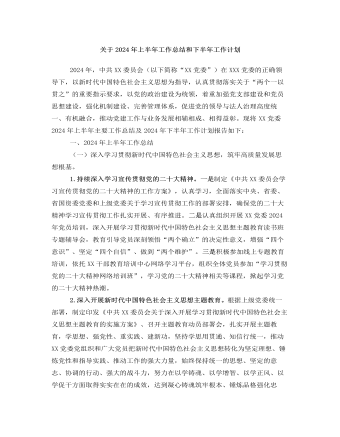
关于2024年上半年工作总结和下半年工作计划
二是深耕意识形态。加强意识形态、网络舆论阵地建设和管理,把握重大时间节点,科学分析研判意识形态领域情况,旗帜鲜明反对和抵制各种错误观点,有效防范处置风险隐患。积极响应和高效落实上级党委的决策部署,确保执行不偏向、不变通、不走样。(二)全面深化党的组织建设,锻造坚强有力的基层党组织。一是提高基层党组织建设力量。压实党建责任,从政治高度检视分析党建工作短板弱项,有针对性提出改进工作的思路和办法。持续优化党建考核评价体系。二是纵深推进基层党建,打造坚强战斗堡垒。创新实施党建工作模式,继续打造党建品牌,抓实“五强五化”党组织创建,广泛开展党员教育学习活动,以实际行动推动党建工作和经营发展目标同向、部署同步、工作同力。三是加强高素质专业化党员队伍管理。配齐配强支部党务工作者,把党务工作岗位作为培养锻炼干部的重要平台。
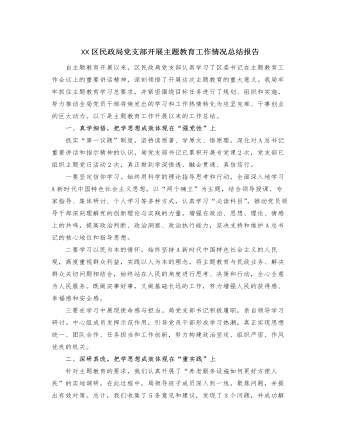
XX区民政局党支部开展主题教育工作情况总结报告
二要专注于解决问题。根据市委促进经济转型的总要求,聚焦“四个经济”和“双中心”的建设,深入了解基层科技工作、学术交流、组织建设等方面的实际情况,全面了解群众的真实需求,解决相关问题,并针对科技工作中存在的问题,采取实际措施,推动问题的实际解决。三要专注于急难愁盼问题。优化“民声热线”,推动解决一系列基层民生问题,努力将“民声热线”打造成主题教育的关键工具和展示平台。目前,“民声热线”已回应了群众的8个政策问题,并成功解决其中7个问题,真正使人民群众感受到了实质性的变化和效果。接下来,我局将继续深入学习主题教育的精神,借鉴其他单位的优秀经验和方法,以更高的要求、更严格的纪律、更实际的措施和更好的成果,不断深化主题教育的实施,展现新的风貌和活力。
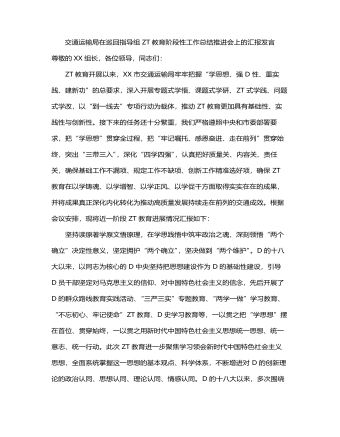
交通运输局在巡回指导组主题教育阶段性工作总结推进会上的汇报发言
今年3月,市政府出台《关于加快打造更具特色的“水运XX”的意见》,提出到2025年,“苏南运河全线达到准二级,实现2000吨级舶全天候畅行”。作为“水运XX”建设首战,谏壁闸一线闸扩容工程开工在即,但项目开工前还有许多实际问题亟需解决。结合“到一线去”专项行动,我们深入到谏壁闸一线,详细了解工程前期进展,实地察看谏壁闸周边环境和舶通航情况,不断完善施工设计方案。牢牢把握高质量发展这个首要任务,在学思践悟中开创建功之业,坚定扛起“走在前、挑大梁、多做贡献”的交通责任,奋力推动交通运输高质量发展持续走在前列。以学促干建新功,关键在推动高质量发展持续走在前列。新时代中国特色社会主义思想着重强调立足新发展阶段、贯彻新发展理念、构建新发展格局,推动高质量发展,提出了新发展阶段我国经济高质量发展要坚持的主线、重大战略目标、工作总基调和方法论等,深刻体现了这一思想的重要实践价值。

今日更新Word
-
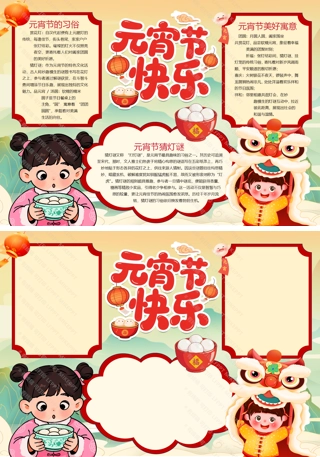
【元宵节】2026马年元宵节手抄报
这套 “元宵节快乐” 手抄报以暖黄为主色调,融入萌娃吃汤圆、醒狮贺岁、红灯笼等元素,年味浓郁且充满童真,包含彩色成品、彩色空白、黑白线稿、浅线稿四种版式,兼顾范例参考与自主创作。内容板块聚焦元宵节核心民俗,“元宵节的习俗” 介绍赏花灯、猜灯谜的传统由来;“元宵节美好寓意” 解读团圆、祈福的文化内涵;“元宵节猜灯谜” 讲述这一趣味活动的历史与魅力。各板块以矩形、云朵形边框清晰划分,层次分明,成品提供详实的民俗知识与文案范例,空白版本便于学生填充个人的元宵经历与感悟,是兼具文化性与实用性的元宵节主题手抄报模板。
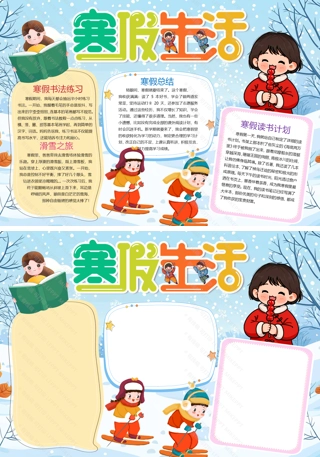
【寒假生活】卡通寒假生活冬天小报手抄报Word模版
这套 “寒假生活” 手抄报以冬日雪景为基底,搭配滑雪孩童、捧书阅读等童趣插画,色彩明快且充满生活气息,涵盖彩色成品、彩色空白、黑白线稿、浅线稿四种版式,兼顾范例参考与学生自主创作需求。内容板块设计贴合小学生寒假日常,“滑雪之旅” 记录户外滑雪的趣味经历与挑战自我的感悟;“寒假书法练习” 讲述坚持练字的过程与收获;“寒假读书计划” 分享《海底两万里》等书籍的阅读心得;“寒假总结” 复盘假期的学习、运动与志愿服务收获,反思不足并规划新学期。各板块以异形边框清晰划分,层次分明,成品提供优质文案范例,空白版本便于学生填充个人假期故事,是助力小学生梳理寒假生活、记录成长的实用模板。
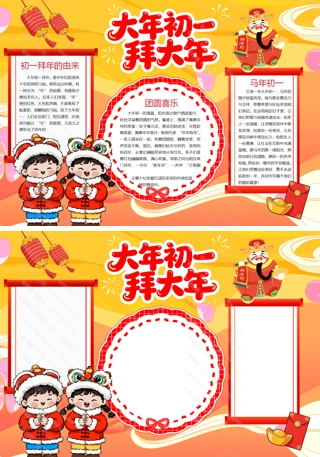
【迎新年】大年初一拜大年新年福马迎春马年春节小报手抄报
这套 “大年初一拜大年” 手抄报以红金为主色调,融入萌娃拜年、财神送福、红灯笼等元素,年味浓郁且童趣十足,包含彩色成品、彩色空白、黑白线稿、浅线稿四种版式,兼顾范例参考与自主创作。内容板块聚焦大年初一传统习俗,“初一拜年的由来” 讲述年兽传说与拜年习俗的起源;“团圆喜乐” 描绘初一阖家团圆、吃饺子年糕、收红包的温馨场景;“马年初一” 则结合生肖寓意,传递新春的活力与美好祝福。各板块以矩形、圆形边框清晰划分,层次分明,成品提供详实的民俗知识与文案范例,空白版本便于学生填充个人的拜年经历与新春感悟,是兼具文化性与实用性的春节主题手抄报模板。
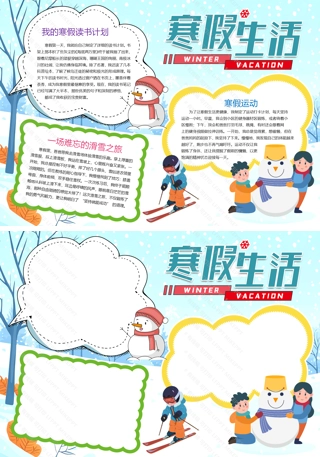
【寒假计划】我的寒假生活冬天寒假计划小报手抄报Word模版
这套 “寒假生活” 手抄报以冬日雪景为背景,融入滑雪、堆雪人等童趣插画,整体风格清新活泼,兼具观赏性与实用性,包含彩色成品、彩色空白、黑白线稿、浅线稿四种版式,适配不同创作需求。内容板块设计贴合小学生寒假生活,“我的寒假读书计划” 记录阅读《海底两万里》等书籍的收获,分享做读书笔记的心得;“一场难忘的滑雪之旅” 讲述滑雪的经历与 “坚持就能成功” 的感悟;“寒假运动” 板块则介绍了每日运动计划与健身收获。各板块以云朵、矩形等异形边框区分,层次分明,成品提供优质内容范例,空白版本便于学生填充个人假期故事,是助力小学生梳理寒假生活的优质模板。

【寒假计划】卡通寒假生活寒假计划冬天小报手抄报Word模版
这套 “寒假生活” 手抄报设计充满冬日暖意,以蓝白为主色调,搭配雪人、红柿、孩童堆雪等元素,既显节日氛围又富童真。版式包含彩色成品、彩色空白、黑白线稿、浅线稿四种,兼顾范例参考与自主创作需求。内容板块聚焦寒假核心生活,“滑雪之旅” 记录户外体验的乐趣与挑战,“寒假读书计划” 分享《海底两万里》等书籍的阅读收获,“寒假书法练习” 讲述坚持练字的成长感悟,“寒假总结” 复盘假期的收获与不足。板块以粉色边框清晰划分,内容兼具趣味性与教育性,空白版本则为学生预留了书写个人假期故事的空间,是适配小学生的优质寒假作业模板。
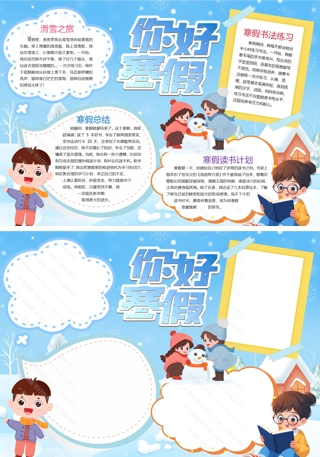
【寒假计划】寒假生活寒假计划冬天卡通小报手抄报Word模版
这套 “你好寒假” 手抄报设计精巧,兼具实用性与美观性,以冬日蓝为主色调,搭配堆雪人、读书等童趣插画,营造出浓厚的假期氛围。版式上分为彩色成品、彩色空白、黑白线稿、浅线稿四种版本,适配不同使用需求。内容板块丰富且贴合小学生生活,“滑雪之旅” 记录户外实践的快乐,“寒假总结” 复盘成长收获,“寒假读书计划” 分享阅读感悟,“寒假书法练习” 展现坚持的意义。各板块以云朵、矩形等边框区分,层次清晰,既为学生提供了优秀的内容范例,空白版本也方便孩子们填充自己的假期故事,是一份兼具展示与创作价值的寒假作业模板。