-
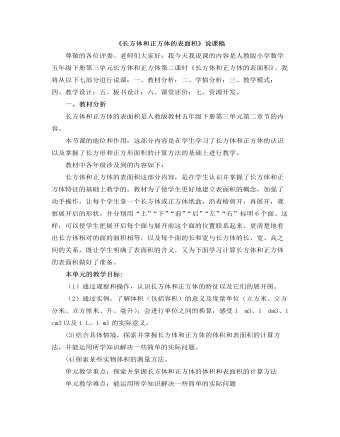
小学数学人教版五年级下册《长方体和正方体的表面积》说课稿
一、教材分析长方体和正方体的表面积是人教版教材五年级下册第三单元第二章节的内容。本节课的地位和作用:这部分内容是在学生学习了长方体和正方体的认识以及掌握了长方形和正方形面积的计算方法的基础上进行教学。教材中各年级涉及到的内容如下:长方体和正方体的表面积这部分内容,是在学生认识并掌握了长方体和正方体特征的基础上教学的。教材为了使学生更好地建立表面积的概念,加强了动手操作,让每个学生拿一个长方体或正方体纸盒,沿着棱剪开,再展开,观察展开后的形状。并分别用“上”“下”“前”“后”“左”“右”标明6个面。这样,可以使学生把展开后每个面与展开前这个面的位置联系起来,更清楚地看出长方体相对的面的面积相等,以及每个面的长和宽与长方体的长、宽、高之间的关系,既让学生明确了表面积的含义,又为下面学习计算长方体和正方体的表面积做好了准备。
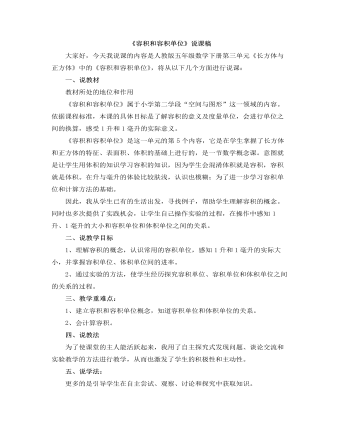
小学数学人教版五年级下册《容积和容积单位》说课稿
因此,我从学生已有的生活出发,寻找例子,帮助学生理解容积的概念。同时也多次提供了实践机会,让学生自己操作实验的过程,在操作中感知1升、1毫升的大小和容积单位和体积单位之间的关系。二、说教学目标1、理解容积的概念,认识常用的容积单位,感知1升和1毫升的实际大小,并掌握容积单位、体积单位间的进率。2、通过实验的方法,使学生经历探究容积单位、容积单位和体积单位之间的关系的过程。三、教学重难点:1、建立容积和容积单位概念,知道容积单位和体积单位的关系。2、会计算容积。四、说教法为了使课堂的主人能活跃起来,我用了自主探究式发现问题、谈论交流和实验教学的方法进行教学,从而也激发了学生的积极性和主动性。五、说学法:更多的是引导学生在自主尝试、观察、讨论和探究中获取知识。
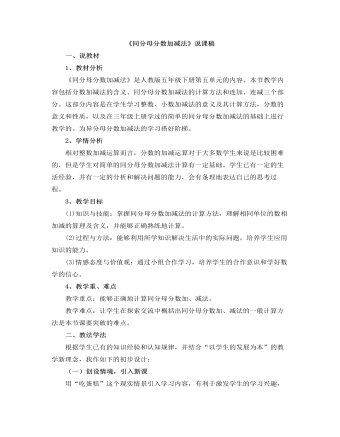
小学数学人教版五年级下册《同分母分数加减法》说课稿
1、教材分析《同分母分数加减法》是人教版五年级下册第五单元的内容。本节教学内容包括分数加减法的含义、同分母分数加减法的计算方法和连加、连减三个部分。这部分内容是在学生学习整数、小数加减法的意义及其计算方法,分数的意义和性质,以及在三年级上册学过的简单的同分母分数加减法的基础上进行教学的。为异分母分数加减法的学习搭好阶梯。2、学情分析相对整数加减运算而言,分数的加减运算对于大多数学生来说是比较困难的,但是学生对简单的同分母分数加减法计算有一定基础。学生已有一定的生活经验,并有一定的分析和解决问题的能力,会有条理地表达自己的思考过程。3、教学目标(1)知识与技能:掌握同分母分数加减法的计算方法,理解相同单位的数相加减的算理及含义,并能够正确熟练地计算。(2)过程与方法:能够利用所学知识解决生活中的实际问题,培养学生应用知识的能力。(3)情感态度与价值观:通过小组合作学习,培养学生的合作意识和学好数学的信心。
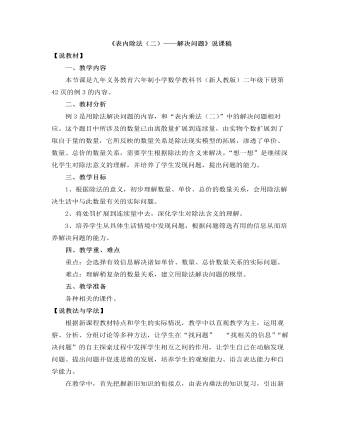
小学数学人教版二年级下册《表内除法(二)——解决问题》说课稿
一、教学内容本节课是九年义务教育六年制小学数学教科书(新人教版)二年级下册第42页的例3的内容。二、教材分析例3是用除法解决问题的内容,和“表内乘法(二)”中的解决问题相对应。这个题目中所涉及的数量已由离散量扩展到连续量,由实物个数扩展到了取自于量的数量,它所反映的数量关系是除法现实模型的拓展,渗透了单价、数量、总价的数量关系,需要学生根据除法的含义来解决。“想一想”是继续深化学生对除法意义的理解,并培养了学生发现问题,提出问题的能力。三、教学目标1、根据除法的意义,初步理解数量、单价、总价的数量关系,会用除法解决生活中与此数量有关的实际问题。2、将处罚扩展到连续量中去,深化学生对除法含义的理解。3、培养学生从具体生活情境中发现问题,根据问题筛选有用的信息从而培养解决问题的能力。
小学数学人教版二年级下册《数据收集整理》说课稿
2、教材分析本单元是在学生已经学习了比较、分类等知识的基础上学习统计的基本知识。为了让学生能了解学习统计的必要性,教材选择了与学生生活有密切联系的生活情景,通过参与有趣的调查活动,使学生经历收集信息、处理信息的过程,了解调查的方法,学习收集、整理、描述和分析数据,认识统计的意义和作用。本单元学生学习的内容主要是调查、记录和整理结果,意在使学生体会抽样调查的合理性和记录方法的多样性。学会用画“正字”法记录数据,使结果易于整理。3、学情分析学生已经学习了比较、分类等与统计相关的初步知识,为本单元进一步学习调查、记录和整理,简单分析数据奠定了基础。在日常生活中有许多与统计相关的生活场景,只是学生没有发现,需要教师在课堂上引导学生研究和体会:“生活中处处有数学”“数学来源于生活”。4、教学重点本着2011年版数学课程标准,在充分研究了新教材的基础上,我把这节课教学重点确定为让学生掌握如何收集数据并整理数据,同时能够进行简单的分析。
小学数学人教版二年级下册《有余数的除法》说课稿
二、说教学目标1.通过分草莓的操作活动,使学生理解余数及有余数的除法的含义,并会用除法算式表示出来,培养学生观察、分析、比较的能力。2.借助用小棒摆正方形的操作,使学生巩固有余数的除法的含义,并通过观察、比较探索余数和除数的关系,理解余数比除数小的道理。3.渗透借助直观研究问题的意识和方法,使学生经历发现知识的过程,感受学数学,用数学的快乐。三、说学情分析学生在前一阶段刚刚学会表内除法,已经接触过许多正好全部分完的事例,但二年级学生的思维还是以具体形象思维为主,想较好完成由形象思维向抽象逻辑思维转变,就要借助动手操作,让学生亲自去实验,去体验知识的形成过程。本节课我将安排学生大量的动手摆、圈、分的活动。通过动手操作,直观感受余数的产生及意义。根据学生喜欢动手的特点,安排了动手摆小棒的活动,让学生在操作的过程中体会有余数的除法,初步感受余数一定要比除数小的道理。
小学数学人教版二年级下册《用有余数的除法解决问题》说课稿
一、设计思路《数学课程标准》倡导尊重学生的主观能动性,以自主探究、合作交流为主要学习方式。因此,在本节课中我们充分体现了以学生为主体的设计理念,采用具有我校特色的高效课堂模式“三学五环”教学法,学生以“自主学习-合作探究”的方式进行学习,从而展示三学“独学、对学、群学”。在教学流程上以:“情境导入,引入示标;自主尝试;交流展示;精讲点拨;当堂检测”这五大环节来引领学生进入知识的殿堂。二、说教材充分领略教材编排意图,科学精当地分析文本,是采用“以学定教”,实现“有效教学”的第一步。《用有余数除法解决问题》是人教版小学数学二年级下册第67页的内容,它属于数与代数领域。本节课是在学生已经学习了表内除法、用竖式计算除法、有余数除法的基础上进行教学的。同时,本课为今后学习近似数、估算进行了初步的铺垫。
小学数学人教版五年级下册《异分母分数加减法》说课稿
重难点依据人教版数学教材新课程标准,在吃透教材的基础上,我确定了掌握异分母分数加减法的计算法则为教学重点,因为只有掌握了计算法则,才能进行计算。同时,也确定了理解异分母分数加减法计算时必须先通分的算理为教学难点。 二、说教法我们都知道数学是中国教育中一门必修学科,因此,从小学数学教学开始,就不仅要使学生“知其然”,还要使学生“知其所以然”。我们在以师生既为主体又为客体的原则下,展现获取理论知识、解决实际问题的思维过程。考虑到五年级学生的现状,我主要采取设置情景教学法,让学生积极主动地参与教学活动,使他们在活动中得到认识和体验,产生践行的愿望。当然老师自身也是非常重要的教学资源。教师本人应该通过课堂教学感染和激励学生,调动起学生参与的积极性,激发学生对解决实际问题的渴望,并且要培养学生理论联系实际的能力,从而达到最佳的教学效果。
小学数学人教版二年级下册《用7、8的乘法口诀求商》说课稿
一、教材分析用乘法口诀求商是数学计算中的一块重要基石,它在整个计算领域中起着举足轻重的作用。为了让学生掌握好这部分知识,教材根据儿童的认知规律将用乘法口诀求商分为两阶段学习。第一阶段,安排在本册书的第二单元表内除法一:学习“用2~6的乘法口诀求商”,该单元着重让学生掌握求商的一般方法。第二阶段,安排在本册书的第四单元表内除法二:学习“用7、8、9的乘法口诀求商”,本单元着重让学生在熟练掌握用口诀求商一般方法的基础上,综合运用表内乘除法的计算技能解决一些简单的涉及乘,除运算的实际问题。“用7、8的乘法口诀求商” 即是本单元的第一课时,也是在学习“用2~6的乘法口诀求商”的基础上进行教学的。本节课中,教材通过一幅学生熟悉的“欢乐的节日”的主题图,引出要用除法计算的实际问题。通过解决具体问题,使学生体会求商的计算是解决问题的需要,用乘法口诀求商是帮助人们解决实际问题的工具,因此学好这部分知识是非常重要的。
小学数学人教版五年级下册《长方体和正方体的认识》说课稿
3.说教学重、难点依据数学课程标准,及对教材的认识,我确定了本节课的重点和难点。教学重点:掌握长方体和正方体的特征。教学难点:建立“立体图形”的空间概念,了解长方体、正方体的关系。二、说教法根据几何知识的教学特点、本节教学内容以及小学生空间观念薄弱的特点,我将采用以下教学方法。直观演示法:利用图片等手段进行直观演示,激发学生的学习兴趣;观察发现法:通过让学生观察长方体、正方体的一些实物发现新知,培养学生的观察概括能力;合作探究法:引导学生通过自主研究、合作讨论等活动形式来获取知识。同时运用多媒体辅助教学,使学生的观察能力、抽象概括能力逐步提高。三、说学法为了使学生较好地掌握长方体和正方体的特征,并逐步形成空间观念,除了让学生通过观察来认识长方体和正方体的特征以外,在观察实物的基础上,通过动手操作,看一看,摸一摸,数一数,量一量,做一做来学习新知,同时以此来激发学生的学习兴趣,调动学生的积极性。
小学数学人教版五年级下册《长方体和正方体的体积》说课稿
本单元前几课时已经认识了长方体和正方体的特征,学习了表面积的计算。这节课要在此基础上掌握体积的概念和常用的体积单位,学会长方体和正方体的体积计算,掌握公式的意义和用法。这是下一步学习体积单位进率的基础,更是以后学习容积的基础。因此,长方体和正方体的体积计算必须掌握熟练。教学目标1、结合具体自作,引导学生探索并掌握长方体、正方体体积的计算公式,并能熟练地运用公式解决一些实际问题。 2、通过探索活动,培养学生的分析、概括能力,发展学生的空间观念。 3、培养学生数学的应用意识。 重点:掌握长方体、正方体体积的计算方法,并运用公式解决实际问题。 难点:理解体积公式的意义。
人教版新目标初中英语七年级下册Where did you go on vacation教案
句型: Where did you go on vacation? I went to summer camp.Did she go to Central Park?Yes,she did.No, she didn’t语法:一般过去时特殊疑问句、一般疑问句及肯、否定回答。课时安排4课时第一课时:Section A:la,1b,lc,2a,2b,2c 第二课时:Section A:3a,3b,4第三课时:Section B:1,2a,2b,2c第四课时:Section B:3a,3b,3c,4 and Self Check第一课时教学目标掌握描写假期生活的形容词。假期里自己所做事情的简单表达。谈论假期做的事情及当时情况。谈论假期时旅游的天气,旅游者以及食物等。教学过程一、导入播放一首英文歌曲:Let’s travel 说明:通过让学生听节奏欢快迪斯尼英语歌曲Let’s travel.引入本节课谈论的话题vacation and travel. 让歌曲使学生的思维活跃,增强课堂气氛,激发学生提高学习英语的兴趣。T:How is the trip ?Ss : It’s pretty good/ happy/exciting /relaxing/busy/dangerous/ fantastic说明:这个问题是为了操练形容词。建议让多个Ss作答。鼓励他们用不同的形容词。上述个别形容词本应在第二课时中出现,但可以在warming-up中第一次非正式出现。这些形容词也可在老师的评价语中适时出现,以加深学生对词汇的印象。
人教版新目标初中英语七年级下册Why do you like koalas教案2篇
单元整体说明(一)单元教材分析本单元的核心话题是描述动物和表达个人喜好,以及句式why do you like…? Because…。这也是本单元的教学重点。通过本单元的学习,学生应能较流利地运用所学词汇和句型描述动物,表达个人喜好。(二)单元知识结构1.词汇动物名称 tiger, elephant, koala, dolphin, etc.词汇描述性形容词: smart, cute, ugly, clever, shy, etc.国家名: Australia, South Africa2.句型Why do you like koala hears? Because they are cute.Where are pandas from? They're from China.What animals do you like? I like dolphins.(三)单元整体目标1.Master the vocabulary2.Master and use: Why do you like koalas? Because they am cute.Where are pandas from? They're from China.What animals do you like? I like dolphins.(四)单元教学重难点一览(五)单元学情分析学生此前已经学过由why, where, what 引导的特殊疑问句句型,具有了学习本单元知识的认知前提。形形色色的动物能激发学生的好奇心,产生了解它们的欲望,这有利于本单元知识的教学和学生学习兴趣的培养。
人教版新目标初中英语八年级下册It’s a nice day, isn’t it教案2篇
"Hello! Welcome to English class! Introduce yourself. Meet your new classmates." That's what the teacher says. What do you say? "Oh no!" It can be difficult talking to new people. But it can be fun, and you can make friends. How do you do it? Make small talk. Small talk is polite conversation. "Wang Nan is a great pingpang player, isn't she?" "I'd love to meet her, wouldn't you?" "It's been raining a lot, hasn't it?" Tag questions are a form of polite speech. To make small talk successfully, you should know how to make them. You should also know what topics to talk about. Try to learn this unit carefully. The next time you're in English class, you'll find out. Making small talk's easy, isn't it? (“你好!欢迎你!请做一下自我介绍。认识一下你的新同学。”通常在课上老师会这样说。你会说什么呢?“噢,不!”与陌生人谈话太困难了。但是这也很有意思,并且你还能交到朋友。你该怎么做呢?闲聊。闲聊指得是礼貌的对话。“王楠是一个很棒的乒乓球运动员,不是吗?”“我希望自己能认识她,你呢?“今年的雨水很多,不是吗?”反意疑问句是一种礼貌用语。为了使得谈话成功,你应该知道怎样去进行闲聊。你还应该知道与不同的人该谈论什么样的话题。认真的学习这个单元吧,下次在英语课上,你会发现与大家展开谈话是一件很容易的事情,不信我们来试试。)
人教版新目标初中英语八年级下册He said I was hard-working教案2篇
This activity introduces some new vocabulary and provide oral practice using the target language.Task 1 . Ask four students to stand in front of the class, and the teacher asks them the following questions as a reporter.1.What are you going to do when you grow up?2.What are you going to do next week?3.What are going to do after school?The students will give different answers, then ask a good student to report what they said.I am going to e a doctor.What did she say?----------She said she was going to be a doctor.I am going to have a party on Friday night.What did he say?-------He said he was going to have a party on Friday night.I am going to do my homework.What did she say ?------ She said she was going to do her homework.I am going home after school.What did she say?-----She said she was going home after school.Say In this unit we are going to learn to use words like to report what someone said.Task 2. Read the instructions. Then ask a student to read the four questions. And write the words on the Bb. Explain what soap opera is.Task 3. Ask the students to Look at the pictures, point out the TV screens in the picture. Ask one girl to read what Marcia said.What did Marcia say? She said She said she was having a surprise party for Lana on Friday night. Repeat the other pictures in the same way.Activity3. Listen and number the pictures in activity 1a.
人教版新目标初中英语八年级下册How long have you been collecting shells教案2篇
Step Ⅱ Show the new words on the screen and teach the new words. Read the new words to students and ask them to repeat.Step Ⅲ 3aThis activity introduces new vocabulary and provides reading practice using the target language.In this activity first look at the four pictures.T: What can you see in the pictures?Ss: Four snow globes.T: Right. There are four snow globes in the pictures. And what are they?Ss: They are a monster, two polar bears, two penguins and a birthday cake.Write these words on the blackboard: snow globe; monster; polar bear; penguin and birthday cake. Read them to the class and ask students to repeat each one. Make sure students understand each word.Use a computer to show the E-mail message on the screen and read the message to students.Get students to read the e-mail on their own, and then draw lines connecting each snow globe and its description.Correct the answers.AnswersA line should connect each snow globe picture with the words that describe it in the letter.Step Ⅳ 3bThis activity provides writing practice using the target language.First review Activity 2a on Page 47.Then ask students to complete the message according to Activity 2a.Some partial sentences are given to students. Write about one person's collection.When students work, walk around the room checking the progress and offering help as needed.When they finish, ask some students to read their messages to the class.
人教版新目标初中英语九年级下册By the time I got outside, the bus had already left教案
Ⅰ. Teaching Aims and Demands1. Knowledge Objects(1) Key Vocabularyoversleep(2) Target LanguageWhat happened?I overslept. And by the time I got up, my brother had already gotten in the shower.2. Ability Objects(1) Teach the students to use the new words.(2) Train the students to narrate past events with the Past Perfect Tense.(3) Train the students' listening and speaking skills with the target language.3. Moral ObjectIt’s a good habit to go to bed early in the evening and get up early in the morning. So you’ll never be in a hurry in the morning.Ⅱ. Teaching Key Points1. Key Vocabularyoversleep2. Target LanguageNarrate past events with the Past Perfect TenseⅢ. Teaching Difficult Points1. Train the students to narrate past events with the Past Perfect Tense.2. Train the students to understand the target language in spoken conversation.Ⅳ. Teaching Methods1. Thinking of examples from the students' real lives.2. Making sentences by looking at the pictures.Ⅴ. Teaching AidA tape recorderⅥ. Teaching ProceduresStep I Revision1. Revise the language points in Unit 8.Ask some questions like this: What volunteer work would you like to do?Help the students to answer, I’d like to…/I love to…/I hope to2. Practice the dialogue in Activity 3c on page 62 again. Get students to role play the similar dialogues with the following.
人教版新目标初中英语七年级下册How was your weekend教案2篇
Teaching Goal:1. General aims:Talk about recent past events2. Particular aims:A. Language Focus.Talk about recent past events and think of the past events.B. Language goalsHow was….?It was …What did …do over the weekend?C. Language structures:(1). How was your weekend? I was great. Pay attention to no form.(2). What did you do over the weekend? I played soccer. We went to the beach.D. Useful words and phrases:Words: was, did, went, beach, over, project, test, wasn’t, false, number, geography, spend, week, most, mixture, their, had, little, cook, read, saw, change, everyone, sit, sat, no, anythingPhrases: did one’s homework, played soccer, cleaned my room, went to the beach, played tennis, went to the movies, on Saturday morning, over the weekend, cook … for, what about, do some reading, have a party, talk show, go shoppingE. Grammar language:Present simple past tenseRegular and irregular verbsF. Learning strategies:Tour and holidaysG. Interdiscipinary:H. Emotion and manner:Teaching time: 5 periodsTeaching procedures:Period One教学步骤、时间 教师活动 学生活动 媒体应用Step 1Free talk 3’ Ask some questions like:Who’s on duty today?What’s the weather like? Answer and talk about something.让同学们回答下列问题1. Do you like weekend? (Let some students answer)It takes them three minutes to talk about the question.2. Why do you like weekend? (let the students answer) Most of the students like the weekend此时教师用汉语问:“在周末期间问你干了什么?这句话用英语这么回答?Let the students guess.At last the teacher give them right answer3. What did you do over the weekend?(板书、学习)
人教版新目标初中英语七年级下册What does he look like教案3篇
所需要用到的句子:Who is that?That is Jack. I like him.Why do you like him?I like him because he is interesting.Task 4: 设计理想中的人类Step one: 设计理想中的人类的外貌。把全班同学分成若干小组,学生可以边说边在纸上画出他们的模样。Step two: 设计理想中人类的性格。学生们可以把那些能描述性格的单词写在图画的旁边。Step three: 每组选出一名同学,其他同组同学提问,他作简单回答,并说明原因。所需用到的句子:What does he or she look like?He or she ...What is he or she like?He or she is ...Why?Because ...Task 5: 挑战性活动调查性格是天生的还是后天形成的,让每个同学回家去调查一下自己成长过程中性格是否有变化,具体是怎样的,为什么会这样? Teaching Aims:1. Enable students to have a general understanding of how to talk about people's physical appearance.2. Enable students to tackle some essential vocabularies and patterns about describing people. Provide them with necessary skills and methods.3. Create various chances for students to describe the persons they're familiar with, such as classmates, family members, teachers, idols, etc.
人教版新目标初中英语七年级下册Where is the post office教案2篇
Period 2 (3a----Section B 2c)Preview(Pre-task): Key points: What laAdd another information about their pen pals----their language on the cardnguage does she/he speak?She/He speaks....Does she/he have any brothers and sisters? Does she/he speak English?Preview(Pre-task): Add another information about their pen pals----their language on the cardKey points: What language does she/he speak?She/He speaks....Does she/he have any brothers and sisters? Does she/he speak English?Step 1 Revision1.Revisionand dictation of the new words 2.Revise the drills they learned yesterday.(by pairwork and grammar exercise)Step 2 Leading-inT has a conversation with one student. The conversation is following:---Do you have a pen pal?---Yes, I do.---What's your pen pal's name? ---His/Her name is....---Where is your pen pal from? ---He/She is from...---Where does he/she live? ---He/She lives in....---What language does he/she speak?He/She speaks...Write the new words on the Bb. They are following: EnglishChineseJapaneseFrenchStep 3 LearnLearn the new words with the whole class.Finish 3a with the students3b Pairwork T still does an example with one student Then the Ss practise in pairs. The example is following:--Curry Muray is my pen pal. He is from the United States.---What language does he speak?