-
人教版新目标初中英语八年级下册Would you mind turning down the music教案
Step 4. Group work (4)1. Ask a pair of students to read the dialogue. Say, This activity provides speaking, listening and writing practice using the target language.2. Ask students to complete the work in groups.3. Check the answers with the whole class. 4. Explain some of the language points. Step 5. Word review (Self check 1)1. Ask students to read the words and the phrases given. 2. Fill in the blanks with proper forms of these words to complete the sentences. 3. Check the answers with the whole class. Homework:Do activity 2 on page 57 after class. Period 6Teaching aims: 1. Teach vocabulary words and the useful expressions. 2. Enable the students to learn etiquette in different culture. 3. Help the students learn how to behave politely in public places and in daily life. Teaching procedures:Step 1. RevisionHelp students to review the function of making requests through a free talk. Then lead them to the topic of etiquette. Explain the meaning of etiquette. Or, ask students to look it up in the dictionary. Step 2. Pre-reading (Section 1)1. Ask students to read the picture and make a list with their partner about how many rules of etiquette can be seen being broken.
人教版新目标初中英语九年级上册Teenagers should be allowed to choose their own clothes教案2篇
Step 1 Greeting Greet the class and check the homeworkStep 2 A duty report The S on duty gives a report on the rules in his home and lead in 3a “Sun Fei’s and Wu Yu’s rules” Step 3 ReadingSs read the conversation and write the two girls’ rules in the chart. Check the answers.Get Ss to read after the tape and then read aloud by themselves. Then, T explains the language points.Step 4 Pairwork 3bRole play. Use the information in chart to practice with the conversation in 3a covered. They can look at the sample conversation in the right box.Step 5 Task 2 “Who’s the best reporter?”Make a survey by asking any 5 students the questions in the chart in activity 4. Then give out a report about it. See who is the best reporter? And the best reporter will get a nice ball-pen.Step 6 Summary and homework:Write out the report in your exercise-books.Period ThreeStep 1 Greeting and a duty reportThe S gives a duty report talking about his experience of being late for school. Lead in the question “Do you ever get to school late? How often do you get to school late? Always, usually, sometimes, or never?Step 2 1a Get Ss to finish writing.Step 3 Pairwork 1b Get Ss to talk about their answers with their partners using the sample conversation in the box on the right.Step 4 Listening practice2a Lead-in: What will happen if you get to school late? What about Peter? Let’s listen to a conversation between Peter and his father. Get Ss to finish 2a (As usual, for the first time, Ss only listen.) Check the answers.
人教版新目标初中英语九年级上册I like music that I can dance to教案
教学目标: 1. Express preferences2. Talk about one’s likes and dislikes and the reasons3. Learn to express one’s opinions 4. Learn to write a reply 语言功能: 1) Talk about one’s preferences, using t he relative clause2) Talk about people’s likes and dislikes and the reasons3) Talk about opinions语言结构: Relative clauses with that and who语言目标:What kind of music do you like?I like music that I can sing along with.I love singers who write their own music.We prefer music that has great lyric.重点词汇及短语:heart, photography, interest, class, whatever, miss, okay, expect, sweet, taste, itself, laboratory, cancer, increase, biscuit, main, care, prefer… to…, remind somebody of …, dance to, sing along with, be sure to, interest somebody, make somebody adj., to be honest, suit somebody, on display, catch up教学重难点:What do other people think of the different kinds of things? How to express one’s opinions? 学习方式:讨论,合作学习情感目标:通过本单元的学习,能提高学生的艺术鉴赏能力和审美情趣,并引导学生养成健康的饮食习惯。课时安排5课时第一课时:Section A: 1a-2c第二课时:Section A : 3a-4第三课时:Section B:1-2c, Self check2第四课时:Section B: 3a-4, Self check1第五课时:Self check ReadingI like music that I can dance to.
人教版新目标初中英语九年级上册I used to be afraid of the dark教案
内容提示1.本单元主要内容是学会used to结构。Used to +动词原形表示过去经常、以前常常,只用于过去式中,用来表示现在已不存在的习惯或状态。例如:They used to play football together.他们过去常在一起蹋足球。(现在不在一起踢了)2.used to的疑问形式和否定形式为Did you use to…?和I didn’t use to… 也可以用Used you to…?和I used not to…但现在多使用前者。例如:Did you used to swim in the river? 你过去常在河里游泳吗?I didn’t use to play the piano. 我以前并不经常弹钢琴。教学目标一、学习目标(Language Goal) 1.学会陈述自己过去常做的事情。2.学会陈述自己过去的爱好等。3.能够表达自己现在和过去在外表、性格、娱乐等方面的变化。4.能够表达朋友、家人等现在和过去的变化。二、语言结构(Language Structures) 1.I used to be short when I was young. 我年轻时个子很矮。 2. —Did you use to have straight hair? 你过去是直发吗?—Yes, I did. 是的。 3. —Did you use to play the piano? 你过去弹钢琴吗?—No, I didn’t. 不,我不弹。 4.I used to be afraid of dark. 我过去害怕黑暗。 5.I’m terrified of the snakes. 我害怕蛇。
人教版新目标初中英语九年级下册By the time I got outside, the bus had already left教案
Ⅰ. Teaching Aims and Demands1. Knowledge Objects(1) Key Vocabularyoversleep(2) Target LanguageWhat happened?I overslept. And by the time I got up, my brother had already gotten in the shower.2. Ability Objects(1) Teach the students to use the new words.(2) Train the students to narrate past events with the Past Perfect Tense.(3) Train the students' listening and speaking skills with the target language.3. Moral ObjectIt’s a good habit to go to bed early in the evening and get up early in the morning. So you’ll never be in a hurry in the morning.Ⅱ. Teaching Key Points1. Key Vocabularyoversleep2. Target LanguageNarrate past events with the Past Perfect TenseⅢ. Teaching Difficult Points1. Train the students to narrate past events with the Past Perfect Tense.2. Train the students to understand the target language in spoken conversation.Ⅳ. Teaching Methods1. Thinking of examples from the students' real lives.2. Making sentences by looking at the pictures.Ⅴ. Teaching AidA tape recorderⅥ. Teaching ProceduresStep I Revision1. Revise the language points in Unit 8.Ask some questions like this: What volunteer work would you like to do?Help the students to answer, I’d like to…/I love to…/I hope to2. Practice the dialogue in Activity 3c on page 62 again. Get students to role play the similar dialogues with the following.
人教版新目标初中英语九年级上册It must belong to Carla教案
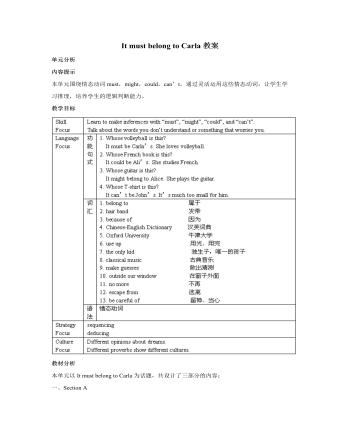
一、Section A该部分有4个模块。第一模块围绕Whose volleyball is this? 这一话题展开思维( 1a)、听力(1b)、口语( 1c)训练;第二模块围绕上一模块中的话题进行听力( 2a-2b)、口语训练( 2c);第三模块继续围绕前两个模块中的“making inferences”展开训练。训练形式为阅读排序( 3a)和两人问答(3b);第四模块仍就上一话题展开讨论。二、Section B该部分有4个模块。第一模块要求根据图画和所提供的单词写出合理的句子;第二模块在听力( 2a-2b)和分角色口语训练( 2c)的基础上,继续进行“推测”训练; 第三模块围绕“Strange events in Bell Tower neighborhood”这一话题展开阅读( 3a)和写作(3b -3c)训练;第四模块以dream为话题展开小组活动。三、Self Check该部分有3个模块。第一模块以填空形式对所学词汇进行训练;第二模块就8个谚语展开阅读和讨论。
人教版新目标初中英语九年级上册Where would you like to visit教案2篇
The First PeriodⅠ.Teaching Aims and DemandsKnowledge Objects(1) Key Vocabularytiring, educational, fascinating, thrilling, peaceful, exotic, trek, jungle, take it easy, explore, historic, site(2) Target LanguageWhere would you like to go on vacation?I’d like to trek through the jungle, because I like exciting vacations.2. Ability Objects(1)Train students to talk about places they would like to visit with the target language.(2)Train students to describe vacations with different adjectives.(3)Train students' listening skill.3. Moral Object,It′s more interesting to go on vacating somewhere instead of staying at home.Ⅱ. Teaching Key Points1. Key Vocabularytiring, educational, fascinating, thrilling, peaceful, exotic, trek, jungle, take it easy, explore, historic, site2. Target LanguageTalk about different places with the target language.Ⅲ. Teaching Difficult Points1. Describe vacations with different adjectives.2. Talk about different places with the target language.Ⅳ. Teaching Methods1. Teaching by illumination2. Teaching by doing chain drills3. Teaching by pairworkⅤ. Teaching Aids1. A tape recorder2. Some pictures of different places with famous views
人教版新目标初中英语九年级下册Rainy days make me sad教案
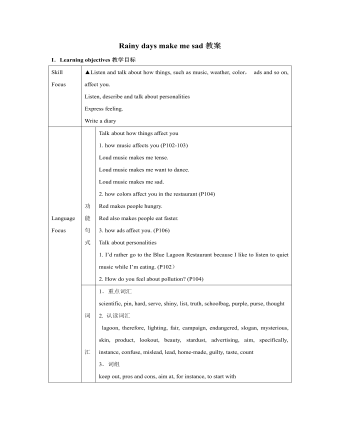
1. 教材分析本单元以how do things affect you?为话题, 从颜色、天气、音乐、广告、产品等方面谈论了外界事物如何影响人的心情。要求学生掌握表达某物或某事给人带来的感觉、看法或影响等。共设计了四个部分的内容:Section A 该部分有4个模块:第一模块围绕Which restaurant would you like to go to?这一话题展开思维(1a)、听力(1b)、口语(1c)训练;第二模块围绕How does music affect you? 进行听力(2a-2b)、口语训练(2c);第三模块继续围绕how do colors in the restaurant affect you这一话题展开训练,训练形式为阅读和问题体验(3a)和小组活动(3b);第四模块仍就How do things affect you这一话题以调查的形式展开讨论。Section B该部分有4个模块:第一模块围绕产品广告对人们的影响这一话题以“配对”(1a)与“列举”(1b)两种形式展开训练;第二模块继续围绕How do things affect you? 进行听力(2a-2b)、口语对话训练(2c);第三模块围绕“Advertising”这一话题展开阅读(3a-3b)和写作(3c)训练;第四模块围绕How posters affect you这一话题以口语训练形式展开小组活动。
人教版新目标初中英语九年级下册I’ll help clean up the city parks教案
Talk about offering help (P60)I’ll help clean up the city parks.A: I’d like to work ...B: You could help ...Talk about ways to tell people about the Clean-Up Day (P61)We need to ...We can’t ...I’ll ...Talk about the work the volunteers do (P62)These three students all volunteer their time to help other people.Somebody loves to ... / helps ... / plans to ... / wants to ...A: What do you like doing?B: I like ... A: What kind of volunteer work do you think I could do?B: You could ...1. 重点词汇advertisement, fix, repair, pleasure, blind, deaf, shut, carry, specially, fetch2. 认读词汇hunger, homeless, cheer, clean-up, sign, establish, major, commitment, elementary, veterinarian, coach, similar, call-in, strategy, disabled, organization, unable, support, appreciate, donation, part of speech, pronoun, adverb, preposition, conjunction, donate, Jimmy, Sally3. 词组clean up, cheer up, give out, put off, set up, think up, take after, fix up, give away, put up, hand out, work out, at once
人教版新目标初中英语九年级下册You’re supposed to shake hands教案
教学目标:1. 掌握本单元一些重点词汇的写法和用法。2. 学会自如谈论餐桌礼仪。Step 1 RevisionAsk some students to retell the customs at the table in France in the passage in 3a.Step 2 Self checkPart 1. Fill in each bland with the correct word given. Students do the exercises by themselves at first. Then check the answers. Ask the students to comprehend the sentences and help them point out uses of some words, like “arrive (at / in) sw., spend time / money on sth , spend time / money (in) doing sth.”Part 2. Read about Fan Ling’s experience in a western restaurant. Understand the passage. Point out some key points in the passage.1. be / get used to doing sth. 习惯做某事2. begin with = start with 以….开头3. crowd v. 挤满,塞满 the crowd 人群 crowded adj. 拥挤的Then students discuss about how she would solve her problem. Ask some to share their stories with others.Part 3. Complete the crossword by looking at the sentences on the left. Then check the answers.
人教版高中历史必修3从“师夷长技”到维新变法教案
4、维新思想推动下的变法运动虽然失败了。但这是中国近代真正意义上的一次思想解放潮流,为什么?展开:维新派提倡西学,兴民权,对封建专制制度和传统观念进行了冲击,促进了中国人民的觉醒,为资产阶级民主思想的传播奠定了基础,具有思想解放的启蒙作用。是一次救亡图存的爱国运动,也是一次发展资本主义的改革运动;他们提倡资产阶级新学,批判封建主义旧学,引导人们重新认识世界,他们痛感民族危机的严重,号召人们奋起救国,谋求国家的独立富强;给古老的中国社会注入的活力是不可低估的,站在历史长河的高度看,由传统农耕社会向近代工业社会转变是一股不可抗拒的历史潮流,尽管它在19世纪末的中国遭到了暂时挫折,但对清朝的封建专制统治却是一次巨大的强烈的冲击波,它留下的痕迹是永不磨灭的,是永远鼓舞与启迪后人的。
新人教版高中英语必修1Unit 1 Teenage Life-Listening and Speaking & Listening and Talking教案
Step 2 Listening and Talking1. The teacher is advised to talk with their new students about the related topic: Boys and girls, do you know some structures to talk about future activities? Talking about future activitiesWe’ll …I plan to …There’ll be …I hope to …We’re going to …2. After their small talk, the teacher can move on by playing the listening and solve the following task.Underline the expressions in the sentences below Cao Jing and Max use to talk about the future.We’ll learn useful skills.I plan to improve my spoken English.There’ll be students from different schools.I hope to make new friends.We’ll talk about teenage life.I’ll learn to make a fire.There’ll be students from different countries at the camp.There’ll be some experts there to show us how to live in the wild.We’re going to learn about wildlife.I’m going to give a speech.I think I’m going to enjoy the activities.I think we’ll have a lot of fun.3. Work in groups. Plan a youth camp.Teacher make the Ss think of ideas for the camp. And they can use the questions below to get started. And have the Ss present their ideas for a youth camp to the class.●What kind of camp is it?●Who will be there?●What will they do?●What will they learn?
新人教版高中英语必修1Unit 2 Travelling Around-Listening and Speaking & Listening and Talking教案
【教学目标与核心素养】1. Instruct students to get main facts by listening and motivate them to talk about the topics about how to prepare for the trip and make reservations by listening and ultimately can make travel arrangements and reservations. 2. Develop students’ sense of cooperative learning and individual thinking capability. 3. Develop students’ different listening skills to solve different listening comprehensive problems.4. Help students to understand how to use the structures “the present continuous tense (be doing) is used to express future plans.【教学重难点】1. Teach students how to focus on key words, not on single words or grammar.2. Prompt Ss to talk about the related topics, such as how to prepare for the trip and make a travel plan.【教学过程】Step 1: Listening and SpeakingLead inThe teacher is advised to talk with their students about the places that they want to travel most both at home and abroad: boys and girls, if you have a chance to travel around the world, where will you go? After their small talk, the teacher can move on by finishing the following listening task:Before travelling, what do we need to prepare for the trip?
新人教版高中英语必修1Unit 3 Sports and Fitness-Listening and Speaking & Listening and Talking教案
Finally, after finishing the task above, the teacher is expected to instruct students to work in groups to finish the following project:Speaking ProjectWhat event or activity would you like to invite your friend to? Make a conversation with a partner.Ski Race: Zhangjiakou, a beautiful city in northern China, will host the Youth Ski Race in December.Track Meet: a great event for track –and –field lovers on 26 October.Gym Class: come and work out at a gym! You can make it.Part 2: Listening and Talking:The teacher is advised to talk with their new students about the related topic: Boys and girls , what do you think of sportsmanship? Let’s listen and find out:Play the listening and match each opinion with the right speaker. Who do you agree with? Why?Cao Jing _____________ Lily _____________ Max _____________A. An athlete should do his/her best to win.B. The girl should stop and help the other girl. Good sportsmanship is more important than wining!C. An athlete should think about honor and his/her fans if he/she is competing for his/her country.Listen again and circle the expressions that you hear in the conversation.
新人教版高中英语必修1Unit 3 Sports and Fitness- Discovering Useful Structures—tag questions教案
【教材分析】This teaching period mainly deals with the grammar: tag questions.This period carries a considerable significance to the cultivation of students’ spoken English. The teacher is expected to enable students to master this period thoroughly and consolidate the knowledge by doing some exercise of good quality.【教学目标与核心素养】1. Get students to have a good understanding of the basic usages of tag questions.2. Enable students to use the basic phrases structures flexibly.3. Develop students’ speaking and cooperating abilities.4. Strengthen students’ great interest in grammar learning.【教学重难点】1. How to enable students to have a good understanding of the basic usages of tag questions.2. How to enable students to use the basic usages of tag questions flexibly.【教学过程】Step1: 语法自主探究一、基本组成方法1.肯定式陈述部分+否定附加疑问部分(前肯后否) You often play badminton, don’t you? 你经常打羽毛球,是吗?You are going to the gym with me, aren’t you?你要和我一起去健身房,是吗?She’s been to shanghai before, hasn’t she? 她以前去过上海,是吗?2.否定式陈述部分+肯定附加疑问部分(前否后肯) It isn't a beautiful flower, is it? 那不是美丽的花,是吗?You didn't go skating yesterday, did you? 你昨天没去滑冰,是吗?They can’t finish it by Friday, can they?他们不能在星期五之前完成,是吗?
新人教版高中英语必修3Unit 5 The Value of Money-Discovering Useful Structures导学案
4.They were going to find someone to take part in their bet when they saw Henry walking on the street outside.[归纳]1.过去将来时的基本构成和用法过去将来时由“would+动词原形”构成,主要表示从过去某一时间来看将要发生的动作(尤其用于宾语从句中),还可以表示过去的动作习惯或倾向。Jeff knew he would be tired the next day.He promised that he would not open the letter until 2 o'clock.She said that she wouldn't do that again.2.表示过去将来时的其他表达法(1)was/were going to+动词原形:该结构有两个主要用法,一是表示过去的打算,二是表示在过去看来有迹象表明将要发生某事。I thought it was going to rain.(2)was/were to+动词原形:主要表示过去按计划或安排要做的事情。She said she was to get married next month.(3)was/were about to+动词原形:表示在过去看来即将要发生的动作,由于本身已含有“即将”的意味,所以不再与表示具体的将来时间状语连用。I was about to go to bed when the phone rang.(4)was/were+现在分词:表示在过去看来即将发生的动作,通常可用于该结构中的动词是come,go,leave,arrive,begin,start,stop,close,open,die,join,borrow,buy等瞬间动词。Jack said he was leaving tomorrow.
人教版新课标高中地理必修2第一章第一节人口的数量变化教案
材料四:印度提倡“只生一个好”——鼓励三人小家庭 生男生女都一样材料五:印度尼西亚《人口发展与幸福家庭法》材料六:我国基本国策 计划生育(小结)通过对以上材料的分析我们可以得出这样的结论,不同的国家应该采取不同的人口政策,对与发达国家来说人口增长缓慢,应采取鼓励生育,吸引移民的措施;发展中国家人口增长较快,实行控制人口的政策已经迫在眉睫。不论是发达国家还是发展中国家共同的目标就是实现环境人口和社会经济的协调发展。【课堂小结】这节课我们主要学习了人口的自然增长,影响人口自然增长的因素有哪些?(人口的自然增长率和人口的基数)世界人口的数量在不同的历史时期表现出不同的特征,同一历史时期的不同地区,人口数量的增长又有不同的特点。面对不同的人口形势,各国应采取不同的人口政策。
人教版新课标高中地理必修2第一章第二节人口的空间变化教案
1.促使美国成为一个移民国家的因素是:①美洲属于未开发的新大陆,需要大量的劳动力;②欧洲失业工人和破产农民增加,人们为了追求更好的经济待遇迁往美洲;③新航线的开辟为人们顺利迁移扫除了障碍;④殖民扩张是人口迁移的促进因素,加快了人口迁移的过程。导致美国人口在本土范围内频繁迁移的原因,归纳起来有:第一次人口迁移是战争因素,第二次是城市化;第三次是自然环境、经济环境的变化;第四次是经济格局的变化,即西部和南部新资源的发现和新兴工业的发展。2.我国古代的人口迁移,深受统治者及其行政力量的束缚。封建帝王为了加强本国的经济和军事实力,对人口迁移严加控制。只有当战乱发生的时候,这种控制才得到削弱,人们为了躲避战乱,寻找安定的生活环境,不得不进行大规模的迁移。我国近几十年的人口迁移主要是由生产资料和劳动力数量上的地区分布不平衡造成的,是经济因素在起主导作用,与古代的人口迁移截然不同。
人教版新课标高中地理必修2第三章第一节农业区位的选择教案
1.澳大利亚混合农业地域在生产结构、经营方式、科技应用、农业专业化和地域化等方面有哪些特点?2.在澳大利亚混合农业地 域形成的过程中,有哪些区位因素在起作用?学生发言,教师适当引导、评点并作讲解。[教师提问]:那么,澳大利亚的墨累—达令盆地的区位因素有什么不足之处?知识拓展:课件展示澳大利亚大分水岭的雨影效应的形成原理及东水西调示意图。[教师讲解]:澳大利亚东南部受大分水岭的影响,降水集中于大分水岭的东侧,在其西侧形成山地的雨影效应,降水丰富地区与农业生产地区分布不一致,灌溉成为澳大利亚农牧业发展的限制性条件。因此,澳大利亚对水利工程建设很 重视,东水西调促进了墨累—达令盆地农牧业的发展。[课堂小结]:这节课我们学习了农业区位选择的基本原理。 通过学习我们了解到,农业的区位选择实质上就是对农业土地的合理利用。
人教版高中地理选修2浦东新区的规划和开发教案
1、图12.5“浦东新区的规划图”首先了解浦东新区的位置,浦东新区位于黄浦江东部,东临东海,北濒长江,面积广阔,地形平坦,和上海市繁华的外滩和南京路只有一江之隔;其次要了解城市规划的功能分区。2、图12.6“浦东新区图”图中可见已建成陆家嘴、张江、金桥、外高桥、孙桥等功能分区,理解浦东作为现代化城市新区的格局已基本形成。3、图12.8“浦东新区的产业结构图(1997年)”读此图应该明确,浦东新区国民经济的主要支柱是工业,第二产业占62.1%,比重最小的是第一产业,仅占0.8%,为充分发挥浦东新区的龙头作用,今后该区应继续把第二产业放在首要位置,成为上海市高新技术产业和现代工业的基地。【教学内容】一、浦东新区的开发条件和作用建设城市新区是上海市发展的必然选择,建设新城区首先要选择合适的区域。