-
人教版新课标PEP小学英语三年级下册At the zoo教案3篇
(二) 呈现新课 (Presentation)1、教师出示学过的缩略语PRCUKCANUSA让孩子读一读,然后拿出相应的卡片贴在黑板上请掌握较好的学生带着同学们读一读缩略语2、出示课文中的缩略语,让孩子们自己试着读一读,然后试着说说缩略语的含义3、听录音,跟读。小组说说4、让孩子们介绍自己收集的生活中的缩略语教师给以适当的扩充:CCTVWTOUFO等5、教师分别出示大小写Hh,让孩子想想大小写的字母分别想什么,用语言描述或是用动作表示。6、Let’s chant听录音,边听边打节奏听录音,边听边出示相应的字母听录音,边听边试着说歌谣孩子们带上自己的头饰,在小组中边演边说各小组展示(三)趣味操练(Practice)1、listen and order the cards让孩子说字母,按照听到的顺序排列字母2、listen and guess教师拼一拼缩略语,孩子快速说出词小组游戏(四) 扩展性活动(Add-activities)纸牌游戏两个孩子分别有一套学过的字母卡,按顺序出卡片,看谁能最先组成一个学过的缩略语。【板书设计】
人教版新课标PEP小学英语三年级下册Recycle 1教案2篇
1.猜袋中东西数 将全班分成若干小组,每组抽一人到前面,背对着班级。教师拿一个袋子,并向学生们借一些书本,铅笔,钢笔,橡皮等,放入袋中,然后让各组学生轮流猜袋子里东西的数目,猜对的给该组记10分。 2.学生一起有节奏地说唱Let’s chant部分的歌谣,并请学生分角色表演。 (二)呈现新课 (Presentation) 1.抢读单词 教师将全班分成若干小组,然后逐个出示一些图片,学生们举手抢答,教师让最先举手的学生将图片的单词说出来,说对的给该组记10分,得分最多的组为优胜。 2.看单词卡读出单词并说出中文,复习1-3单元要求四会的单词。 3.教师用实物投影出示1-3单元课文中的某一幅图片,让学生根据图片内容进行对话练习。 4.让学生填写Assessment部分的内容,自己对1-3单元所学内容的掌握情况进行自我评价。 5.教师向学生出示已制作好的window card:This si a window card.并教读window card教师问学生:Do you like it? Can you make it? Do you want to learn how to make a window card?
人教版新课标PEP小学英语三年级下册Welcome back to school教案
教学过程:1.热身/复习(Warm-up/Revision)(1)教师用肢体语言表示出字母,让学生猜出字母,并大声读出。(2)出示字母卡,学生认读,并提问学生回忆以它开头的单词。(3)放A部分Let’s chant的录音,学生有节奏地跟唱歌谣。2.新课展示(Presentation)(1)出示字母卡学习Dd,再单独呈现大写或小写,反复教读。用同样方法教读Ee。(2)出示以这两个字母为首字母的单词图片,问学生:What’s this ?回答:It’s a duck .教读duck,dog,egg,elephant。注意egg是an egg,不是“a egg”.(3)放Let’s say部分的录音,学生跟读。3.趣味操练(Practice)(1)呈现大写或小写字母的趣味图片,让学生认读。(2)让学生发挥想象,说出这些字母 像什么。(3)教师按笔顺书写字母,让学生观察后按笔顺书写字母。(4)游戏:找朋友游戏:看谁站得快学生手执卡片,听教师发令后,产成一排,下面的学生边读边检查。
人教版新课标PEP小学英语五年级下册Look at the Monkeys教案
教学参考时间:5分钟(1)教师课前在教室里藏好一些动物和人物的图片。(2)给全班学生一分钟时间寻找。(3)请找到图片的学生根据图片上的人物或动物正在做的动作表演对话。活动七:猜一猜教学参考时间:5分钟(1)教师一只手拿一张图片,另一只手用白纸遮住图片,一边慢慢抽动白纸,一边问:What are the…s doing? 学生用They are…猜图片中的内容。(2)猜对的学生上台主持游戏。(3)教师也可以在白纸上剪几个圆洞盖在图片上,慢慢移动白纸的位置让学生猜白纸下面图片的内容。(4)也可以分组利用词卡做该游戏。4、Consolidation and extension (巩固与扩展)活动八:练一练教学参考时间:5分钟(1)活动手册Ask and write. 让学生看一看两个表格,找规律做问答,然后再把表格中所缺单词写出来。(2)活动手册Let’s find out.让学生仔细观察两幅图找出不同的地方,并用英语表达出来。活动九:小结教学参考时间:1分钟本课我们学习了如何询问他、她、它们正在做什么What are they doing? 及回答:They are…5、板书
人教版新课标PEP小学英语五年级下册Recycle1教案(内容详细)
学生搜集中外重要节日及部分中外名人的生日所在的月份。教师准备相关节日及部分中外名人的图片或音像资料片。教师课前准备Let’s find out2的配图画好春、夏、秋、冬四个方框。录音:Listen and number。教学过程:Warm up (热身)活动一复习单词教学参考时间:3分钟(1)教师播放Let’s chant部分的歌谣,学生听一遍后跟唱。(2)出示带有各个月份特征的单词卡片。学生看图说出单词,并一起拼读其缩写形式。帮助学生在有节奏的说唱中巩固记忆单词,为在后面活动中学生能够熟练应用作铺垫。活动二 复习句子教学参考时间:5分钟(1)师生同唱Let’s chant部分歌谣“When Is Your Birthday?”。(2)教师引导学生看歌谣下面的翻滚过山车的动画,师生进行问答,如:When is the rabbit’s birthday? It’s in May. 等。教师示范后请学生进行Pair work,也可以展开竞赛的形式进行“连锁问答”。巩固有关生日问答的语句,为Let’s find out1的活动做准备。
人教版新课标PEP小学英语五年级下册What Are You Doing教案
教学参考时间:2—3分钟教师让学生说出几个家庭成员名称,如:father, mother, sister, brother, uncle等,自己或让学生把单词写在黑板的一侧,再让学生说出几个动词短语的-ing形式,如:washing clothes, writing an e-mail, watching TV等,写到黑板的另一侧。学生在家庭成员名称和动词短语中分别选三至四个,自己编成一首歌谣。课后,可以让学生将创作的歌谣进行展示或举行歌谣朗读比赛。5、Consolidation and extension (扩展活动)活动十:知识扩展教学参考时间:1—2 分钟教师让学生打开书第54页Good to know 部分,了解主要国家的紧急救助电话。如:美国,英国,加拿大,澳大利亚等。教师还帮助学生了解我国的紧急救助电话号码。教师可以利用道具电话让学生做游戏。活动十一:练一练教学参考时间:2—3 分钟做本单元B Let’s talk部分的活动手册第37页的配套练习。教师讲解题目要求。教师播放录音,做Listen and number 部分练习。要求按所听内容在图上写出序号。再次播放,让学生按录音内容填空。鼓励学生自己读读所写句子。
人教版新课标PEP小学英语五年级下册This Is My Day教案
学生初步了解对话内容,在描述中培养学生的语言运用能力。(2)教师让学生自己阅读本部分对话,不理解的生词和句子可以和同学或老师共同商讨。(3)教师帮助学生理解句子:“The weather report says it’s going to rain tomorrow. I can’t play football in the rain. I can’t go hiking, either. Let’s watch TV together.”出示图片:1) 晴天,Zoom在踢足球,图下显示:today;2)天在下雨,Zoom和Zip在屋里看电视,图下显示:tomorrow。与学生展开对话T:What’s the weather like today? S:It’s fine/ sunny. T:What does the weather report say about tomorrow?S:It’s going to rain.T:The weather report says it’s going to rain tomorrow.(呈现句子)(学生重复句子The weather report says it’s going to rain tomorrow.,并说出意思。)T:Can you play football in the rain?S:No,I can’t.T:Can you go hiking ?S:No,I can’t.T:In the rain, we can’t play football. We can’t go hiking, either. (呈现:either)学生跟读either,感悟单词的用法,教师讲解意思:(不......),也不...启发学生用either说两句话:In the rain, I can’t ... I can’t ..., either,从而在应用中巩固单词的读音和用法。
人教版新课标PEP小学英语六年级下册Recycle1 Let’s Take a Trip教案
4.巩固和扩展(Consolidation and extension) (1) 做本单元活动手册配套练习。 (2) 翻卡片说单词。学生两人一组,把单词卡片反面朝上放在桌子上,然后同时翻开两张单词卡(如:going, holiday),就马上组织成一句话(如:Where are you going on the holiday?/ I’m going to Kunming this holiday.),说得快又正确者为胜。 (3) 教师播放C部分Story time的录音或VCD,帮助学生理解故事内容。学生再听一遍录音,跟读故事里的句子,教师指导学生发音。 (4) Bright eyes. 在黑板上张贴Let’s find out的8幅图片,Mike, Zhang Peng, Sarah, Kathy等4个人物图片分别放在8幅图片上,如:Mike ---take pictures---buy presents。学生仔细观察后,请学生闭上眼睛,教师就趁学生闭眼之际交换人物位置(如把Mike放到eat noodles),然后请学生张开眼睛回答:What did Mike do just now ? 引导学生回答: Mike took pictures and bought presents. 教学参考资料库 1.文化背景介绍: 机场标志: Airport 飞机场 Airport lounges 机场休息室Airports shuttle 机场班车 Arrivals 进港Assistance 问讯处Check in area (zone) 办理登机区Departure airport 离港时间Departure times on reverse 返航时间 Welcome aboard 欢迎登机
人教版新课标PEP小学英语六年级下册What’s the Matter, Mike教案
回答:She’s sad. She failed the math test.并板书:fail the math test。准备一张很糟的数学试卷,是学生了解语意。进一步教学其他短语a Chinese test, a English test,并 让学生了解pass the Chinese test, pass the English test, pass the math test. (4)教师请学生扮演Sarah,师生对话如下: T: Hello! Sarah, how are you? You look sad today. Sarah: Yes, I failed the math test. 教师接着说:I’m sorry to hear that.让学生理解意思。并引申出句子:I’m glad to hear that.让学生分角色朗读对话。 (5)Let’s check.让学生看Sarah的表情,并读两篇对话,选出正确的答案。 (6)活动名称:心理医生 活动目的:操练句型“How are you? You look…”.学生间自由组合编排对话.通过对话对学生展开情感教学,让学生理解健康的体魄和愉悦的心情的心情是一个人成功的重要因素,使学生形成良好的心理健康状态。 活动过程:A: How are you? You look bored today. B: Yes. I failed my math test. A: I’m sorry to hear that. Believe yourself. Work hard. You can pass the text next time. (7)活动名称:难忘时刻 活动目的:围绕照片上的表情展开询问和讨论.操练句型 “How do you feel? How does she/he feel?
人教版新目标初中英语七年级下册How was your weekend教案2篇
Teaching Goal:1. General aims:Talk about recent past events2. Particular aims:A. Language Focus.Talk about recent past events and think of the past events.B. Language goalsHow was….?It was …What did …do over the weekend?C. Language structures:(1). How was your weekend? I was great. Pay attention to no form.(2). What did you do over the weekend? I played soccer. We went to the beach.D. Useful words and phrases:Words: was, did, went, beach, over, project, test, wasn’t, false, number, geography, spend, week, most, mixture, their, had, little, cook, read, saw, change, everyone, sit, sat, no, anythingPhrases: did one’s homework, played soccer, cleaned my room, went to the beach, played tennis, went to the movies, on Saturday morning, over the weekend, cook … for, what about, do some reading, have a party, talk show, go shoppingE. Grammar language:Present simple past tenseRegular and irregular verbsF. Learning strategies:Tour and holidaysG. Interdiscipinary:H. Emotion and manner:Teaching time: 5 periodsTeaching procedures:Period One教学步骤、时间 教师活动 学生活动 媒体应用Step 1Free talk 3’ Ask some questions like:Who’s on duty today?What’s the weather like? Answer and talk about something.让同学们回答下列问题1. Do you like weekend? (Let some students answer)It takes them three minutes to talk about the question.2. Why do you like weekend? (let the students answer) Most of the students like the weekend此时教师用汉语问:“在周末期间问你干了什么?这句话用英语这么回答?Let the students guess.At last the teacher give them right answer3. What did you do over the weekend?(板书、学习)
人教版新目标初中英语七年级下册I ’d like some noodles教案
教学过程Step 1: warming-up Sing a song---------“food and drink” Step 2: Revision1 Dictation2 Revise: What kind of noodles would you like?I’d like …What size bowl of noodles would you like?I’d like…Step 3: Presentation1 show pictures of food, ask students say the words.2 Students read the newspaper ad in 3a. Fill in blanks with words in the box. Then read the ad together, the teacher explains some difficult language points.3 Check the answers Step 4 PracticeAsk students to finish 3b in the same way according to 3a. Students read the short passage and fill in the blanks .At last, check the answers.Step 5 productionAsk students to write their own ad for dumplings, noodles, drinks, and other foods they know. Then ask students to read their partner’s ad. Then order food and drink from their partner.Step 6 Home workGroup work – make an ad about “food and drink”
人教版新目标初中英语七年级下册I want to be an actor教案2篇
三、教学建议第一课时:1. Lead in (Vocabulary)A) Before class, teacher should collect some pictures of working places. For example: Bank, TV Station, Restaurant, Police Station, Hospital ...B) In class, show students the pictures (PowerPoint, OHP). Ask students to tell the name of the working places and the name of the jobs.Shop assistant, doctor, actor, reporter, police office, waiter, bank clerk, studentC) Do exercise 1a and 3a.2. Bingo GameAsk groups of students to make up pairs of cards with a job on one and the related workplace on the other. For example, waiter / restaurant, teacher / school, doctor / hospital. Encourage students to use both the job / workplace combinations in the book and the ones that students came up during class discussions. Be sure they have twice as many sets of cards as there are students in the group. They can make two sets of cards for a single job / workplace, if necessary. Then have each group mix up its set of cards and hand their cards out in random order. Each time a student gets a pair of cards that match, he or she can lay these cards down. The goal is to have no cards in your hand at the end.3. Task OneA) Ask students to work in pairs and ask the partner what does he / she want to be in the future.e. g. :What do you / does he / does she want to be?I want to be a.Why?Because it's (adj).B) Vocabulary: Section B, 1a4. Homework 1.2.
人教版新目标初中英语七年级下册It’s raining教案2篇
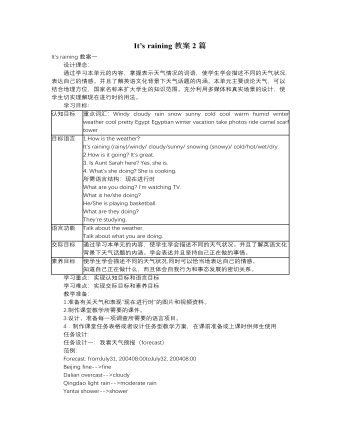
1 Each group choose one place to describe and what you are doing in it Choose one place, and describe what they are doing 2 Move around the room and give suggestions Talk about it and write it down 3 Ask one to show their works and act it Choose one of each group to make a report 4 Evaluate the best group and the best reporter Choose the best one Homework Ask your friends their ideal place and write about it教学反思:新课程标准中强调学生在课堂中的主体地位,在综合课中他们的主体地位就更加突出。在各个活动中给不同程度的学生不同层次的任务,让各层面的学生都有表现发挥的机会,从而产生对英语的兴趣。使用照片图片多媒体来辅助教学,效果更好。同时让了解其他国家风景,风俗的同学介绍ideal place,增加学生的背景知知识,实现跨学科交流的目的。教案点评:采用任务型教学模式,在各个活动中给不同程度的学生不同层次的任务,让各层面的学生都有表现发挥的机会,从而产生对英语的兴趣。使用照片图片多媒体来辅助教学,效果更好。让了解其他国家风景,风俗的同学介绍ideal place,增加学生的背景知识,实现跨学科交流的目的。
人教版新目标初中英语七年级下册What do you think of game shows教案
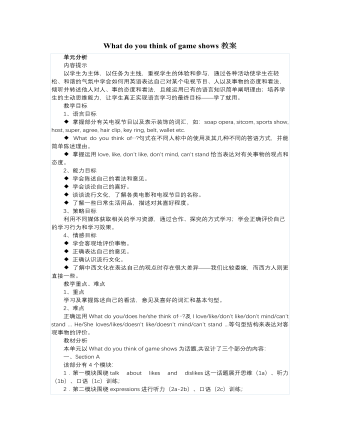
五、教学Section B-2c1. Pair work: What do you think of the belt/sunglasses/…? What does your father/mother/… think of your scarf/belt…?2. Group work(1). Teacher shows some different kinds of school uniforms (制服)and asks : “ What do you think of your school uniforms? If you have a chance to choose your school uniforms, what kind would you like to choose?”(2). Discuss in groups.(3).Get some Ss to report in class.说明:这一步旨在让学生运用已有的语言知识谈论对事物的看法和意见,并简单阐明理由,培养学生的主动思维能力和运用英语的能力。六、教学拓展调查电视节目的收视率任务:调查你周围的人对现在各种电视节目的反响。活动过程:1.教师布置任务,让学生调查周围的人(包括他的亲戚朋友和邻居)喜欢收看哪方面的电视节目。2.学生进行调查活动,运用本单元所学的句型What do you think of….? (Why?)What's your favorite game shows?What do you think of talk show?I doesn’t mind it.I like it.I love it.I can’t stand it.3.记录下排在前10位的TV Program,填写调查表,比较其收视率。
人教版新目标初中英语七年级下册Where did you go on vacation教案
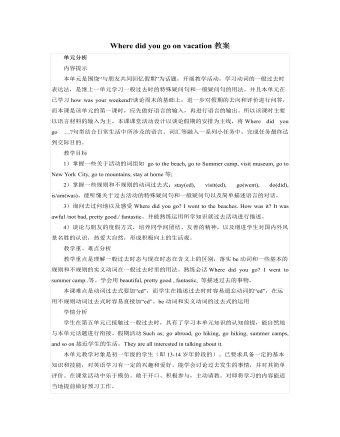
句型: Where did you go on vacation? I went to summer camp.Did she go to Central Park?Yes,she did.No, she didn’t语法:一般过去时特殊疑问句、一般疑问句及肯、否定回答。课时安排4课时第一课时:Section A:la,1b,lc,2a,2b,2c 第二课时:Section A:3a,3b,4第三课时:Section B:1,2a,2b,2c第四课时:Section B:3a,3b,3c,4 and Self Check第一课时教学目标掌握描写假期生活的形容词。假期里自己所做事情的简单表达。谈论假期做的事情及当时情况。谈论假期时旅游的天气,旅游者以及食物等。教学过程一、导入播放一首英文歌曲:Let’s travel 说明:通过让学生听节奏欢快迪斯尼英语歌曲Let’s travel.引入本节课谈论的话题vacation and travel. 让歌曲使学生的思维活跃,增强课堂气氛,激发学生提高学习英语的兴趣。T:How is the trip ?Ss : It’s pretty good/ happy/exciting /relaxing/busy/dangerous/ fantastic说明:这个问题是为了操练形容词。建议让多个Ss作答。鼓励他们用不同的形容词。上述个别形容词本应在第二课时中出现,但可以在warming-up中第一次非正式出现。这些形容词也可在老师的评价语中适时出现,以加深学生对词汇的印象。
人教版新目标初中英语八年级下册Have you ever been to an amusement park教案
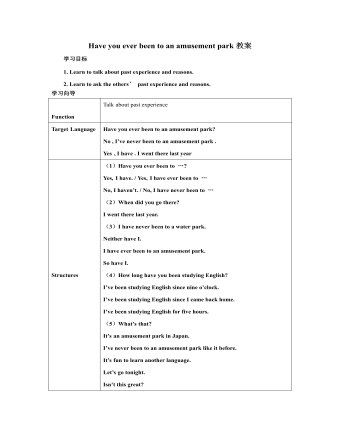
(1)Have you ever been to …? Yes, I have. / Yes, I have ever been to …No, I haven’t. / No, I have never been to …(2)When did you go there? I went there last year. (3)I have never been to a water park. Neither have I. I have ever been to an amusement park. So have I. (4)How long have you been studying English? I’ve been studying English since nine o’clock. I’ve been studying English since I came back home. I’ve been studying English for five hours. (5)What’s that? It’s an amusement park in Japan. I’ve never been to an amusement park like it before. It’s fun to learn another language. Let’s go tonight. Isn’t this great?space museum, amusement park, water park, South America, Peru, Holland, European culture, tour guide, flight attendant, musical instrument, more than, be from, get to, take lessons, neither, discover, graduate, change
人教版新目标初中英语八年级下册He said I was hard-working教案2篇
This activity introduces some new vocabulary and provide oral practice using the target language.Task 1 . Ask four students to stand in front of the class, and the teacher asks them the following questions as a reporter.1.What are you going to do when you grow up?2.What are you going to do next week?3.What are going to do after school?The students will give different answers, then ask a good student to report what they said.I am going to e a doctor.What did she say?----------She said she was going to be a doctor.I am going to have a party on Friday night.What did he say?-------He said he was going to have a party on Friday night.I am going to do my homework.What did she say ?------ She said she was going to do her homework.I am going home after school.What did she say?-----She said she was going home after school.Say In this unit we are going to learn to use words like to report what someone said.Task 2. Read the instructions. Then ask a student to read the four questions. And write the words on the Bb. Explain what soap opera is.Task 3. Ask the students to Look at the pictures, point out the TV screens in the picture. Ask one girl to read what Marcia said.What did Marcia say? She said She said she was having a surprise party for Lana on Friday night. Repeat the other pictures in the same way.Activity3. Listen and number the pictures in activity 1a.
人教版新目标初中英语八年级下册Why don’t you get her a scarf教案
教师带领学生复习有关描述宠物的词汇,采用教师提问学生回答的方进行。如:T:What animals do you think would be good pets?What animals do you think would be bad pets?What do you think are good animals for a six-year-old child?然后学生进行 pairwork 练习。Task two: 师生互动,学习探究 1、播放3a部分的录音,引导学生一边听录音,一边跟读。2、通过听录音学生回答以下问题:Why do you think pot-bellied pigs are popular?What are the advantages and disadvantages of keeping such a pet?教师对学生的回答进行及时点评。3.学习范文,学习重点短语,为下步的模仿写作提供语言素材。T :1. )Have you ever kept a pig as a pet?Do you like pigs? St.:No.…Why don’t you like to keep a pig? St: No.They’re too dirty and lazy(Do you know in some foreign countries like Hollyland, Australia,pigs are the most popular pet.there’s a kind of pig.(图)it has an interesting name? it ‘s called a pot-bellied pig.) Now,let’s learn an article about this kind of interesting pet.2.)play the tapeSt.:Listen and repeat3.)show some Qs on computer(本子St.: read silently,then answerthe Qs(本子)4.)Ask ss. Close book and retell this passage.(what is a pot-bellied pig? Is it a good or bad pet? ) St.: retell it to each other“A pot –bellied pig is a popular pet now…”5.read the article together.St.:.practice reading
人教版新目标初中英语八年级下册Would you mind turning down the music教案
Step 4. Group work (4)1. Ask a pair of students to read the dialogue. Say, This activity provides speaking, listening and writing practice using the target language.2. Ask students to complete the work in groups.3. Check the answers with the whole class. 4. Explain some of the language points. Step 5. Word review (Self check 1)1. Ask students to read the words and the phrases given. 2. Fill in the blanks with proper forms of these words to complete the sentences. 3. Check the answers with the whole class. Homework:Do activity 2 on page 57 after class. Period 6Teaching aims: 1. Teach vocabulary words and the useful expressions. 2. Enable the students to learn etiquette in different culture. 3. Help the students learn how to behave politely in public places and in daily life. Teaching procedures:Step 1. RevisionHelp students to review the function of making requests through a free talk. Then lead them to the topic of etiquette. Explain the meaning of etiquette. Or, ask students to look it up in the dictionary. Step 2. Pre-reading (Section 1)1. Ask students to read the picture and make a list with their partner about how many rules of etiquette can be seen being broken.
人教版新目标初中英语九年级下册We’re trying to save the manatees教案2篇
本单元主要围绕着有关濒临灭绝的动物这一话题,学习了应该怎样保护我们的环境,以及就某一问题展开辩论。目标提示语言目标能够运用所学知识,就某一问题展开辩论。认知目标1、复习一些语法:现在进行时、一般现在时、用used to 表示一般过去时、现在完成时、一般过去时的被动语态。2、学会表达同意和不同意。3、学会以下基本句型:We’re trying to save the manatees.Manatees eat about 100 pounds of food a day.There used to be a lot of manatees.In 1972,it was discovered that they were endangered.Some of the swamps have become polluted.情感目标了解一些濒临灭绝的动物的生活习性和濒临灭绝的原因,教育学生应该如何保护环境。教学提示充分利用多媒体等教学设备,创设与本课话题相关的情境,如各种不同种类的动物、动物园以及有关环境的画画等等。围绕着本单元的教学目标,设计一些贴近学生实际的教学任务,如让学生谈论自己最喜欢的动物,如何拯救濒危动物,如何保护环境等等。让学生根据所学知识,就动物园是否对动物有利以及其他的话题进行辩论。