-
新人教版高中英语选修2Unit 1 Science and Scientists-Discovering useful structures教学设计
The grammatical structure of this unit is predicative clause. Like object clause and subject clause, predicative clause is one of Nominal Clauses. The leading words of predicative clauses are that, what, how, what, where, as if, because, etc.The design of teaching activities aims to guide students to perceive the structural features of predicative clauses and think about their ideographic functions. Beyond that, students should be guided to use this grammar in the context apporpriately and flexibly.1. Enable the Ss to master the usage of the predicative clauses in this unit.2. Enable the Ss to use the predicative patterns flexibly.3. Train the Ss to apply some skills by doing the relevant exercises.1.Guide students to perceive the structural features of predicative clauses and think about their ideographic functions.2.Strengthen students' ability of using predicative clauses in context, but also cultivate their ability of text analysis and logical reasoning competence.Step1: Underline all the examples in the reading passage, where noun clauses are used as the predicative. Then state their meaning and functions.1) One theory was that bad air caused the disease.2) Another theory was that cholera was caused by an infection from germs in food or water.3) The truth was that the water from the Broad Street had been infected by waste.Sum up the rules of grammar:1. 以上黑体部分在句中作表语。2. 句1、2、3中的that在从句中不作成分,只起连接作用。 Step2: Review the basic components of predicative clauses1.Definition
新人教版高中英语选修2Unit 1 Science and Scientists-Learning about Language教学设计
Step 7: complete the discourse according to the grammar rules.Cholera used to be one of the most 1.__________ (fear) diseases in the world. In the early 19th century, _2_________ an outbreak of cholera hit Europe, millions of people died. But neither its cause, 3__________ its cure was understood. A British doctor, John Snow, wanted to solve the problem and he knew that cholera would not be controlled _4_________ its cause was found. In general, there were two contradictory theories 5 __________ explained how cholera spread. The first suggested that bad air caused the disease. The second was that cholera was caused by an _6_________(infect) from germs in food or water. John Snow thought that the second theory was correct but he needed proof. So when another outbreak of cholera hit London in 1854, he began to investigate. Later, with all the evidence he _7_________ (gather), John Snow was able to announce that the pump water carried cholera germs. Therefore, he had the handle of the pump _8_________ (remove) so that it couldn't be used. Through his intervention,the disease was stopped in its tracks. What is more, John Snow found that some companies sold water from the River Thames that __9__________________ (pollute) by raw waste. The people who drank this water were much more likely _10_________ (get) cholera than those who drank pure or boiled water. Through John Snow's efforts, the _11_________ (threaten) of cholera around the world saw a substantial increase. Keys: 1.feared 2.when 3. nor 4.unless 5.that/which 6.infection 7.had gathered 8.removed 9.was polluted 10.to get 11. threat
新人教版高中英语选修2Unit 1 Science and Scientists-Reading and thinking教学设计
Step 5: After learning the text, discuss with your peers about the following questions:1.John Snow believed Idea 2 was right. How did he finally prove it?2. Do you think John Snow would have solved this problem without the map?3. Cholera is a 19th century disease. What disease do you think is similar to cholera today?SARS and Covid-19 because they are both deadly and fatally infectious, have an unknown cause and need serious public health care to solve them urgently.keys:1. John Snow finally proved his idea because he found an outbreak that was clearly related to cholera, collected information and was able to tie cases outside the area to the polluted water.2. No. The map helped John Snow organize his ideas. He was able to identify those households that had had many deaths and check their water-drinking habits. He identified those houses that had had no deaths and surveyed their drinking habits. The evidence clearly pointed to the polluted water being the cause.3. SARS and Covid-19 because they are both deadly and fatally infectious, have an unknown cause and need serious public health care to solve them urgently.Step 6: Consolidate what you have learned by filling in the blanks:John Snow was a well-known _1___ in London in the _2__ century. He wanted to find the _3_____ of cholera in order to help people ___4_____ it. In 1854 when a cholera __5__ London, he began to gather information. He ___6__ on a map ___7___ all the dead people had lived and he found that many people who had ___8____ (drink) the dirty water from the __9____ died. So he decided that the polluted water ___10____ cholera. He suggested that the ___11__ of all water supplies should be _12______ and new methods of dealing with ____13___ water be found. Finally, “King Cholera” was __14_____.Keys: 1. doctor 2. 19th 3.cause 4.infected with 5.hit 6.marked 7.where 8.drunk 9.pump 10.carried 11.source 12.examined 13.polluted 14.defeatedHomework: Retell the text after class and preview its language points
新人教版高中英语选修2Unit 1 Science and Scientists-Using langauge教学设计
This happens because the dish soap molecules have a strong negative charge, and the milk molecules have a strong positive charge. Like magnets, these molecules are attracted to each other, and so they appear to move around on the plate, taking the food coloring with them, making it look like the colors are quickly moving to escape from the soap.Listening text:? Judy: Oh, I'm so sorry that you were ill and couldn't come with us on our field trip. How are you feeling now? Better?? Bill: Much better, thanks. But how was it?? Judy: Wonderful! I especially liked an area of the museum called Light Games.it was really cool. They had a hall of mirrors where I could see myself reflected thousands of times!? Bill: A hall of mirrors can be a lot of fun. What else did they have?? Judy: Well, they had an experiment where we looked at a blue screen for a while, and then suddenly we could see tiny bright lights moving around on it. You'll never guess what those bright lights were!? Bill: Come on, tell me!? Judy: They were our own blood cells. For some reason, our eyes play tricks on us when we look at a blue screen, and we can see our own blood cells moving around like little lights! But there was another thing I liked better. I stood in front of a white light, and it cast different shadows of me in every color of the rainbow!? Bill: Oh, I wish I had been there. Tell me more!? Judy: Well, they had another area for sound. They had a giant piano keyboard that you could use your feet to play. But then, instead of playing the sounds of a piano, it played the voices of classical singers! Then they had a giant dish, and when you spoke into it, it reflected the sound back and made it louder. You could use it to speak in a whisper to someone 17 meters away.? Bill: It all sounds so cool. I wish I could have gone with you? Judy: I know, but we can go together this weekend. I'd love to go there again!? Bill: That sounds like a great idea!
新人教版高中英语选修2Unit 3 Food and Culture-Discovering useful structures教学设计
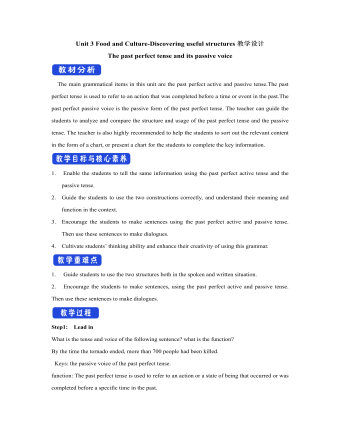
The newspaper reported more than 100 people had been killed in the thunderstorm.报纸报道说有一百多人在暴风雨中丧生。(2)before、when、by the time、until、after、once等引导的时间状语从句的谓语是一般过去时,以及by、before后面接过去的时间时,主句动作发生在从句的动作或过去的时间之前且表示被动时,要用过去完成时的被动语态。By the time my brother was 10, he had been sent to Italy.我弟弟10岁前就已经被送到意大利了。Tons of rice had been produced by the end of last month. 到上月底已生产了好几吨大米。(3) It was the first/second/last ... time that ...句中that引导的定语从句中,主语与谓语构成被动关系时,要用过去完成时的被动语态。It was the first time that I had seen the night fact to face in one and a half years. 这是我一年半以来第一次亲眼目睹夜晚的景色。(4)在虚拟语气中,条件句表示与过去事实相反,且主语与谓语构成被动关系时,要用过去完成时的被动语态。If I had been instructed by him earlier, I would have finished the task.如果我早一点得到他的指示,我早就完成这项任务了。If I had hurried, I wouldn't have missed the train.如果我快点的话,我就不会误了火车。If you had been at the party, you would have met him. 如果你去了晚会,你就会见到他的。
新人教版高中英语选修2Unit 3 Food and Culture-Reading and thinking教学设计
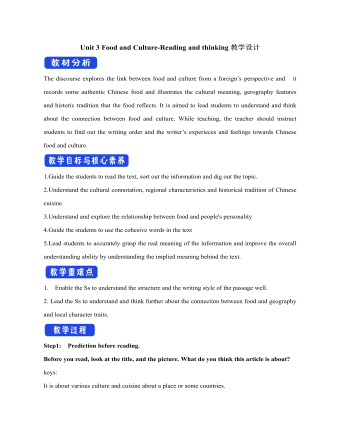
The discourse explores the link between food and culture from a foreign’s perspective and it records some authentic Chinese food and illustrates the cultural meaning, gerography features and historic tradition that the food reflects. It is aimed to lead students to understand and think about the connection between food and culture. While teaching, the teacher should instruct students to find out the writing order and the writer’s experieces and feelings towards Chinese food and culture.1.Guide the students to read the text, sort out the information and dig out the topic.2.Understand the cultural connotation, regional characteristics and historical tradition of Chinese cuisine3.Understand and explore the relationship between food and people's personality4.Guide the students to use the cohesive words in the text5.Lead students to accurately grasp the real meaning of the information and improve the overall understanding ability by understanding the implied meaning behind the text.1. Enable the Ss to understand the structure and the writing style of the passage well.2. Lead the Ss to understand and think further about the connection between food and geography and local character traits.Step1: Prediction before reading. Before you read, look at the title, and the picture. What do you think this article is about?keys:It is about various culture and cuisine about a place or some countries.
新人教版高中英语选修2Unit 5 First Aid-Discovering useful structures教学设计
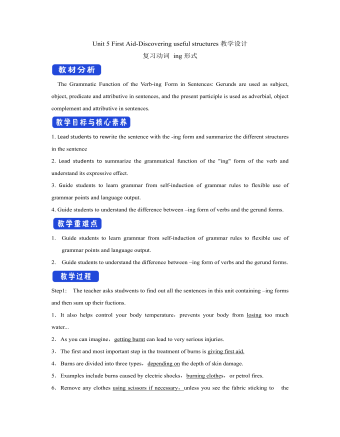
You have no excuse for not going.你没有理由不去。He was punished for not having finished his homework.他因未完成作业而受到惩罚。2.动词ing形式复合结构由物主代词或人称代词宾格、名词所有格或普通格加动词ing,即“sb./sb.'s+doing”构成。动词ing形式的复合结构实际上是给动词ing形式加了一个逻辑主语。动词ing形式的复合结构有四种形式:①形容词性物主代词+动词ing②名词所有格+动词ing③代词宾格+动词ing④名词+动词ingHer coming to help encouraged all of us.她来帮忙鼓舞了我们所有人。The baby was made awake by the door suddenly shutting.这个婴儿被突然的关门声吵醒了。Can you imagine him/Jack cooking at home?你能想象他/杰克在家做饭的样子吗?无生命名词无论是作主语还是作宾语都不能用第②种形式。Tom's winning first prize last year impressed me a lot.汤姆去年得了一等奖使我印象深刻。Do you mind my/me/Jack's/Jack leaving now?你介意我/杰克现在离开吗?Excuse me for my not coming on time.很抱歉我没能按时来。His father's being ill made him worried.他父亲病了,他很担心。We are looking forward to the singer's/the singer to give us a concert.我们盼望着这位歌手来给我们举办一场演唱会。
初中英语人教版九年级全册《Unit 9 I like music that I can dance to》说课稿
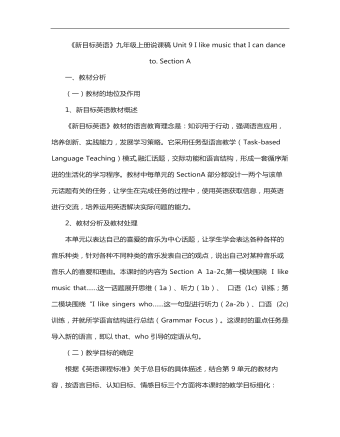
2、教材分析及教材处理本单元以表达自己的喜爱的音乐为中心话题,让学生学会表达各种各样的音乐种类,针对各种不同种类的音乐发表自己的观点,说出自己对某种音乐或音乐人的喜爱和理由。本课时的内容为Section A 1a-2c,第一模块围绕 I like music that……这一话题展开思维(1a)、听力(1b)、 口语 (1c) 训练;第二模块围绕“I like singers who……这一句型进行听力(2a-2b)、口语 (2c) 训练,并就所学语言结构进行总结(Grammar Focus)。这课时的重点任务是导入新的语言,即以that、who引导的定语从句。
人教版新课标PEP小学英语三年级下册Welcome back to school说课稿4篇
2、学生小组间的问答:“Where are you from?”“I’m from…”(根据孩子自己制作的头饰回答)3、请几个小组开火车问答:“Where are you from?”4、教师出示钟表(把时间调到下午):“Good afternoon!”教师带上Mr. Black的头饰(走到一位学生面前)说:“Good afternoon! My name’s Mr. Black. I ’m from China.”孩子根据自己的情况回答:“Good afternoon, Mr. Black. I’m Xiao Dong . I’m from China.”教师提问一组孩子。然后请学生到前面来扮演Mr. Black.5、教师带着Mr. Black 的头饰走到台前,说:“I have a friend in our class. Do you know who’s she?”教师指着扮演Amy的同学说: “This is my friend Amy.”(引导全班孩子问好)Ss: Nice to meet you.A: Nice to meet you, too!Ss: Where are you from?A: I’m from America.Ss: Welcome!6、教师播放Let’s talk部分的课件, 学生观看对话。跟读、模仿,分角色给课件配音。7、小组分角色练习对话。8、小组表演对话。趣味操练 (Practice)1、Listen and order the cards: 将课文图片打乱顺序,让孩子听一听, 摆一摆。2、表演Let’s talk部分的对话。
人教版新课标PEP小学英语四年级上册My Classroom说课稿5篇
一 说教材内容本课时的内容是四年级上册第一单元的第4课时,即Let’s learn, Let’ play, Let’s find out和Story time。本课为单词教学,用已学的有关教室设施的单词来引出5个新单词,并用TPR教学法来巩固和操练单词。通过理解故事,来了解学生对本单元知识的落实情况。二、 说教学目的在认真剖析教材的基础上,我针对学生实际,将本课时的教学目的确定如下:1、知识目的:能够听、说、认读本课时的重要单词,能够在教师的领导下完成游戏。能够完成Let’s find out中找字母的任务。能听懂本单元的故事。2、能力目的:能够用英语简略描写自己的教室,能够说出教师中设施的颜色等。3、情绪目的:重视合作精力,激发学生学习英语的兴趣,使学生建立学习英语的信念。三、说教学重点和难点1、重点:本课时需要重点控制另外四个有关教室设备的单词:computer, teacher’s desk, fan, wall, floor。
人教版新课标PEP小学英语四年级上册My Schoolbag说课稿5篇
(1)Sing a song.由于老师是借班上课,师生间难免会由于陌生而产生距离,所以选一首大家都熟悉的歌曲可以把师生间的距离拉近。(2)通过听指令做动作(如:point to the window , point to the door ….)等复习第一单元的知识,同时为进入本单元的schoolbag作铺垫。第二步:. Presentation 激情引趣,学习新知(1)由point to the bag 导入课题(板课题) 并引导学生说。(2)多媒体课件呈现所学新单词。学习单词按易到难,由浅入深原则逐一学习。先从大家熟悉的English book入手,然后到Chinese book, math book, notebook ,。由于story-book比较难发音,因此安排在最后。(3)通过图片、单词卡片、课本让学生反复指认这些单词。(4)Guessing game .让学生快速抢猜单词。(5)教学句型:How many …do you have? I have….通过学生与老师 ,老师与老师之间的对话来加强学习,在同学们熟悉单词后,引导他们加入How many …do you have? I have….进行操练。
人教版新课标PEP小学英语四年级下册What Time Is It说课稿5篇
三.说教学设计1.Warm-up用Free talk 的方式复习上一课的几个句型。For example: What’s this? // Is this a pen ?/Yes, it is./No, it isn’t.Where is your classroom?How many Ss are there in your class?……用几个How many句型引出数字,达到复习和引出新课的目的,然后sing a song 用数字歌营造良好的英语学习气氛,也为新课呈现做好铺垫。2.Presentation//PracticeA.通过把数字1----12用圆圈起来的方式做出一面钟,从而学习句型What time is it? It’s…… o’clock. 用钟更换不同的时间,让学生操练此句型。B.学生通过图片了解了ZhangPeng 的一天,从而通过单词卡学习新单词:music class, P.E. class, English class, breakfast, lunch, dinner.在单词教学中,我先让学生跟读,拼读,认读,再采用游戏,比赛的方式进一步操练巩固单词,为下一步操练句型打基础。C.在熟练的操练单词之后,结合第一步的句型,引出新句型It’s time for……让学生结合单词句型进行操练。在操练过程中吧Let’s do的内容自然地溶入。在操练Let’s do的时候可边读边做动作让学生通过了解动作了解句子的意义。
人教版新课标PEP小学英语四年级下册Our School说课稿5篇
Step 4.Homework(预计1分钟)1、做本单元B Let’s talk的活动手册配套练习2、将 设计的学校用英文介绍给爸爸妈妈(设计思路:作业 课堂教学的延伸学习的扩展活动 要求学生在熟练 本课时所学内容的基础上 将 设计的学校用英文介绍给 的父母 学生 动口、动手、动脑 发展学生运用知识的能力 ) Our School B Let’s talk Let’s play说课稿一、说教材我说课的内容是PEP小学英语四年级下学期Our school Part B的第二课时,包括Let’s talk和Let’s play两部分。1、教学内容第一单元的教学内容是围绕“School”这个主题展开的。本节课是一个对话教学,我们在前几课时中学过了一些关于学校各个教学活动场所的英语名称,在本节课,我们要将所学到的这些知识运用到对话中来,首先进行简单问答练习,进而让学生学会在真实情景中运用这些语言进行表演和交流。这也正是本课的最终所要达到的效果。
人教版新课标PEP小学英语五年级下册My Birthday说课稿8篇
二、新授环节新授环节是本堂课的重点,我主要分为6步来突破语言点,步步为营,环环相扣,达到既定目标。1、首先我用touch and guess游戏来呈现新授单词present,通过CAI展示各种生日礼物,如衣服,书本,玩具等让学生操练单词:Books can be a present等,操练时做到词不离句。2、接着我借助多媒体让学生说说自己想要的礼物I want a_____,同时我将实现准备的实物和图片作为礼物赠送给他们,新授句子Here’s a present for you,激发学生开口说的兴趣,又为接下来的操练提供了资源。我利用刚才分发的礼物采用游戏 “I’m a little bee”, (S1:I’m a little bee. Today is my birthday. S3:Here’a present for you。)四人小组合作操练这个句型。既避免了操练的机械性又调动了学生的积极性,而且提供了让每个学生开口说的机会,关注学生个体的发展。3、当学生Act完后,我对一学生说:Oh, little bee, what’s your present? Open it and see。让学生打开礼物呈现实物生日贺卡教学词汇birthday card。既做到了呈现自然,又渗透西方文化知识,培养学生跨文化交际意识。
人教版新课标PEP小学英语五年级下册A Field Trip说课稿5篇
二.多维活动体现教师角色的变换 师生是教学中的两个主体,教师是主导,学生是主体。教师角色要适时变换,才能充分发挥学生的主体作用,课堂教学才会成为师生间共同参与的多维活动。在本堂课的教学中,首先,教师是示范者,通过各种手段直观呈现材料,“引发”学生思维,“启动”学生探索。在呈现新知前利用课件创设Field Trips情景,再通过与学生交谈引出本课功能句型,并示范如何用英语去询问。其次,教师是启发者,引导学生去发现去学习。在引出本课功能句型后,老师没有急于告诉学生如何回答,而是引导学生,让他们自己说出完整的答句Yes,he/she is.或No, he /she isn't.。在任务进行的过程中,学生既说又唱,既演又想,手、脑、口、耳、眼、肢,体并用;静态、动态结合。在轻松、愉快的活动中真正用感官和心灵去体验英语语言及其运用。最后,在完成任务的过程中,教师还是助手和观众,引导和帮助学生顺利地完成调查任务,进一步巩固拓展所习得的语言。让他们体会到成功的喜悦,从而树立学好英语的信心。
人教版新课标PEP小学英语五年级上册My New Teachers说课稿4篇
T:Teachers do much work for students. So we should love our teachers. Let’s say something to our teachers.I want to say to the teachers:_______________________________.⑵布置家庭作业。作业1为阅读训练两例,可以进一步巩固提高阅读理解能力。作业2为课后用所学语言知识讨论本班教师,可以让学生将所学语言用于实际生活中,提高语言交际能力。①完成下列阅读理解。(A)判断正误,正确的写“T”,错误的写“F”。I am Ann. I am in Grade Five. Mrs. Heart is our princiPal. She’s fifty. She’s strict, but she is kind. Mr. Liu is my new teacher. He’s a university student. He’s tall and strong. He’s a basketball player. He’s my new P.E. teacher.() 1. Ann is a P.E. teacher.() 2. Mrs. Heart is old.() 3. Mr. Liu is young.() 4. Mrs. Heart is a basketball player.() 5. My P.E. teacher is strict.(B)阅读理解,选出正确答案。Tom is an American boy. He’s thirteen years old. He’s very tall and strong. He likes reading comic books. He likes playing basketball, too. He is good at math and music. He has a lot of friends at school. They often chat (聊天) with each other on the Internet (网上). Tomorrow is Tom’s birthday. His mother buys a lot of food for him. His classmates bring him lots of wonderful things. They are going to have a birthday Party at school.
人教版新课标PEP小学英语五年级上册What Can You Do说课稿8篇
目的是让学生更深入理解Just do it的意思,能在一定情景中运用。接下来出示一些山羊妈妈的动物朋友引出课文内容。让学生先观看课文的视频,这样更生动些,也许也能更引起学生的兴趣些,因为这是一堂相对比较枯燥的读写课,有了视频观看可能更生动和有趣些。通过完成课文填空和课后回答问题,让学生既练习到写,又练习到对课文的理解,之后再让学生演一演深入课文的朗读。在最后一环节再让学生完成一个new dialogue的填空运用。这样使整堂课更完整些,学生再一次运用所学知识得到拓展。What Can You Do? PaRT B 第二课时说课稿一、教材分析1.教学内容本课主要学习有关家务劳动的表述,主要句型有:Can you ……?Yes ,I can No, I can’t .本课时的大部分动词词组在四年级上下册中都已出现过。如:Water the flowers ,sweep the floor ,set the table.2.教学目标。(1)语言技能与知识目标通过本课的学习,能够询问别人能做什么家务。如:Can you set the table ?(2)运用能力目标会用Can you…?语句询问并作出肯定或否定回答。
人教版新课标PEP小学英语五年级下册What Are You Doing说课稿6篇
五、教学程序:下面我结合课件谈谈本节课的教学程序: 1. 课前热身:让同学们边说边做动作。这段Chant联系了两个内容,一是现在进行时,二是We’re having a party. We are happy. 这两点都紧扣本课的两个要点。2. Revision: Are you happy? Let’s do something happy and funny. Let’s play a game. What are you doing? I’m cooking, cooking. 全班分为四组,每组代表轮流提问:what are you doing ,下一组任何一位同学快速回答I’m cooking, cooking.并做相应动作。这一游戏不只复习了大量的动词和进行时,也让同学逐渐在竞赛中趋向兴奋的状态。3. Presentation: I’m happy today, Do you know why? Because it’s my birthday today.把同学的注意力引到我的身上。Look at me. What am I wearing today? I’m wearing a skirt. I am wearing a sweater.引出今天要掌握的单词wear与句型I’m wearing…,然后提问What are you wearing? What is he /she wearing? 同学刚开始回答时可能会用I am in …..?但回答过几轮之后他们就能够正确运用Wear这个词了。
人教版新课标PEP小学英语六年级上册What Does She Do说课稿6篇
My Home本身就是一个与生活有着紧密联系的话题。我从这一点出发,紧紧围绕生活来开展教学。在Write and say这部分内容的教授中,我通过介绍我自己房间里的家具,如:Th is is my room, you can see a window、a door、a desk、a chair、a bed, Oh, It is a nice room . I like it,引出句型What can you see in my room ?引导学生说:I can see a window、a door、a desk、a chair、a bed, Oh, It is a nice room . I like it,然后安排同桌间拿出自己准备的房间图片,根据房间图片,相互之间询问。要求学生简单描述自己的房间,结合学过的语言描述房间内家具陈设的名称、特征等。学生看着自己亲手绘制的房间图片,亲切感、生活的真实感都一股脑儿地涌上心头。此时他们用学习的语言进行交流的愿望也就特别强烈。 最后、渗透情感教育 让学生通过谈论自己的房间,培养学生对家的热爱之情;我在这样的教学中渗透了学生热爱家庭的情感教育:因为,家是我们每个人永远的港湾,我们要爱家,爱护家里的每一样家具。
人教版新课标PEP小学英语六年级上册I Have a Pen Pal说课稿5篇
一、说教学思想我在本课教学设计中坚持以人文科技教育为中心,以学生为主体;以兴趣为支点、以交流为目的、以活动任务为途径的教学原则。通过最新的计算机多媒体等教学手段创造贴近生活的教学情境,并在课堂上大量地采用互动式教学模式(包括人机互动),使学生自然进入英语世界;在教学过程中,综合运用情景教学、任务型教学、交际教学、整体语言教学等手段,全面培养学生的听、说、读、写等语言综合运用能力。在课内、课外全面利用网络技术,如在线英语学习、博客(Blog)、魔灯(Moodle)、QQ群、论坛(BBS)等手段,做到英语与信息技术的完美整合。二、说教材与教材处理本课采用的教材是是人教版小学英语(PEP)六年级上册,内容为学生学完I Have a Pen Pal后的一节综合实践活动(复习)课。本单元教学重点为E-mail和英语书信的写法。通过该单元的学习,学生基本了解一些英语书信书写的方法。但是学生还没有利用计算机网络去写英文E-mail(包括写E-mail内容和写E-mail地址。)