-
人教版新目标初中英语七年级上册Good morning教案
一、知识和能力目标本单元要求学生掌握英文字母A—H,能认读其印刷体和手写体字母的大小写等四种形式。书写(大写和小写,笔顺,笔画)基本合乎要求。能看,听,说本单元所列的日常交际用语,重点学会打招呼,并做到语音语调正确。注意一些字母及日常交际用语的发音,提醒学生不要将C/si:/发成/sei:/; ?/发成/e?/,也不要将Good?H /e /等。??????'????说成/???????'???morning/二、过程和方法目标教师要尽量用英语组织教学。充分利用课堂的40分钟,不讲或少讲汉语,尽量给学生创造英语情景。教师可以用手势,表情,动作等示意,帮助学生听懂课堂用语和日常交际用语,第一次介绍某个用语时,说英语,加译文及手势,以后可酌情省去译文,最后只说英语,逐步让学生听懂。
人教版新课标PEP小学英语六年级下册Last Weekend教案
一、教学内容:Part B Let’s learn Let’s play. Part C Task time Let’s check 二、教学目标与要求 1、掌握四会词组:went to a park, went swimming, read a book, went fishing, went hiking. 2、学会用句型What did you/ (name) do last weekend/ yesterday? I(name) (did) last weekend/ yesterday. Did you….? Yes, I did. 来进行问答并完成Task time的表格。 三、教学重点 掌握四会词组,并用所学词组和句型进行调查 四、教学难点 掌握四会词组(不规则动词过去式变化),并用所学词组和句型进行调查 五、课前准备 1、教师准备所需的词卡及图片。 2、学生准备词卡。 六、教学过程 1、Warm-up 1) Free-talk: T: What day is today? A: Today is… T: What day was yesterday? (强调 yesterday) B: Yesterday/ It was… T: What did you do yesterday? C: I (did)…yesterday. ( 用前几课时已经学的词组) 2) Chain-drill: C: I (did)…yesterday. What did you do yesterday? D: I (did)…yesterday. What did you do yesterday? E, F… (ask the teacher) T: I went to a park yesterday. 2、Presentation and practice let’s learn (1)继续Chain-drill,由T 引出并出示新授词组:went hiking. (2)学生已经了解了go 的过去式后, T 边用I went ( 这个动词用动作表示)yesterday.表达自己昨天去做什么了,边做动作.让学生帮老师说出: went swimming, went fishing.
人教版新目标初中英语七年级上册Is this your pencil教案
T: Please look at the pictures and learn the new words.(用多媒体展示新单词效果较好。)1.at prep. 在(里面或附近);在(点刻);2.theart.表示特指的人、物、事或群体 3.lostadj.丢失的;遗失的4.Found adj. (find的过去式、过去分词)找回的5.lost and found 失物招领6.please adv.请7.school n. 学校8.a set of一套;一副(Teach students to read the words.)2. Practice the new words. (事先录制一段短的听力,让学生通过听的训练来强化所学的新单词,并为学习写寻物启示和失物招领作好准备。)T: Please listen to a short passage twice then fill the blanks using the words we learned.(Show students a short passage and play the recording for the students to listen.)There are many things in (1)_____________________in my (2)__________. Look, here’s (3)_________keys. Is this yours? (4)__________call Jim (5)___________753-2289.Typescript:There are many things in the Lost and Found in my school. Look, here’s a set of keys. Is this yours? Please call Jim at 753-2289.
人教版新目标初中英语七年级上册Do you like bananas教案
教学目标 ⑴知识目标:A、学会询问对方喜欢与不喜欢的食物; B、学习并激情 些食物的词汇; C、学会谈论自己与他人早、中、晚 餐喜爱吃的食物; D、学会营养配。 ⑵能力目标:A、能准备表达喜欢和不喜欢的食物; B、能根据具体情景对话,与他人沟通信息,合作完成任务; C、通过听、说、读、写四项技能的训练,促进学生语言运用能力的提高。⑶情感目标:A、通过学习西文食品文化,促使学生了解西方生活方式与文化,培养跨 文化交际的意识; B、通过开展小组活动,指导学生积极与他人合作,培养他们的合作精神; C、通过任务型活动,使学生学会在实际生活中均衡饮食,合理配餐。 教学重点、难点 重点:A动词like一般现在时的各种句式及一般疑问句的肯定、否定回答; B关于各种食物的词汇; C名词复数的使用。 难点:一般现在时中单数第三人称的变化形式。
人教版新目标初中英语七年级上册This is my sister教案
(Play the recording twice again.) (Check the answer.) ③Pairwork. Draw your own picture and talk about it. T: We find out the picture of Lin Hai’s family. Can you draw a picture of your family? SS: … T: OK. When you finish drawing, tell your partner about your picture. You can use “This is …” and “ These are …” to talk about. Then report it to the class. (Students work.) (Check students’ work. Ask two or three students to report.) Step Three: Task. Talk about the family tree. T: Look at the family tree. I think it’s a big family. You can do it in groups of four or three. You can do it in pairs or only by yourself. Then report it to the class. (Students work. Teacher walks around in the classroom and helps the students.) T: Stop here. Let’s check it out. (Choose students to do it.) S1: Look at my family tree. This is my… This is my … They have two … This is my … This is my …This is my …This is my. My parents have two children. This is…This is my …My uncle and my aunt have a son. He is my … (Ask two more students to do it.) Homework. Write a passage about your family.
人教版新目标初中英语七年级上册What color is it教案
一、知识和能力目标通过本单元教学,使学生能运用所学英语,正确地描述物体的颜色;同时进一步学习分辨人物的用语,并加以运用。二、过程和方法目标本单元口语训练应当自始至终在一种鲜明的色彩背景下进行,旨在营造那种为学生所喜爱的欢快气氛,教师应当在十种颜色上大做文章;在使用实物时要使颜色醒目;在组合图画时,要尽量用大色块;在使用投影时要使颜色突出来。教师可以从教室环境上入手营造色彩气氛,如:选取十种颜色的硬色板,剪成各个大写字母;或者将色板剪成各种卡通动物形象,悬挂在教室当中或在墙上,注明各种颜色的英语字块。三、情感态度和价值观目标用各种可以调动学生积极性的活动来提高学生的活跃性,激发他们参与讨论的热情。同时可以对学生进行美育教育,从小培养他们对美的正确认识。
人教版新目标初中英语七年级上册When is your birthday教案
本单元主要学习名词所有格 ('s 所有格 ) 的构成和使用。在初次接触 “ 名词所有格 ” 时,学生较难理解的可能是 “ 所有格 ” 这个名称,对于它的构成,学生也许会觉得较容易。教师可通俗地告诉学生 “ 所有格 ” 的意思是表示 “…… 的 ” ,这样学生反而容易接受。在使用 “ 名词所有格 ” 形式时,学生容易犯错误或混淆的主要是:将这种一 's 构成形式与 is 的缩写形式混淆,如: My father's name's Jin Zhi .,可以这样告诉学生:名词所有格的后面一般应接名词;勿将这种一 's 结构盲目套用与人称代词上,代替物主代词使用,如 He's father's name is Li Cheng 。在教学初期,可不讲授名词所有格的其它形式,待时机成熟,再向学生介绍复数名词所有格形式的结构一 ' ,如: the students' bikes 。 Self Check 教学内容 Self Check( 教材 P52) 教学目标 知识与能力 复习词汇 birthday , date , month , January , February , March , April , May , June , July , August , September , October , November , December , date , birth , age , old , speech . contest . trip , party , event , an , festival , pop , concert , chorus , lecture , music ;引导学生复习、巩固“询问和谈论日期”的目标语言并运用所学知识安排活动。
人教版新目标初中英语七年级上册Where’s my backpack教案
教师: 搜集单词卡片、背景资料。 学生:彩笔、大白纸、相关新单词。 教学设计 Step One: Learn the new words. 1.Present the new words. (Show some pictures and words on the screen to teach the students the new words.) T: What’s this? S1: It’s a room. T: Do you have a room like this? S2: Yes, I do./ No, I don’t. T: Read after me. R-O-O-M, room. Ss: R-O-O-M, room. (Teach the other words “TV, desk, picture” in the same way.) T: There are some words here. Read the words after me and spell them. (Learn the other words without pictures on the cards.) T: This is a word. Can you spell this word? (Point to a word in the card.) S1: Yes, I can. / No, I can’t. (Let them know the meaning of “can”.) T: I can spell your name. Can you spell my name? S1: Yes, I can. T: Can you write your name? S: Sorry, I can’t. I have no pen. T: You need a pen.( Give him a pen.) ( Let the students understand the word “need”.) T: I bring a football to school every day. Now it is on the floor. After class I take it to my home. (Teach “bring” and “take”. Put a football on the floor and point to the floor to teach the word “floor”.) 2.Practice the words. (Give the examples to the students and get the students to understand the new words.) Step To Listen and practice.
人教版新目标初中英语七年级下册I’m watching TV教案
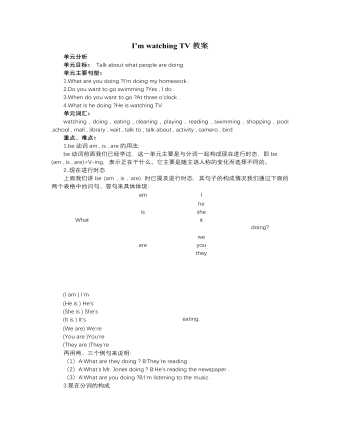
单元分析单元目标: Talk about what people are doing 单元主要句型:1.What are you doing ?I’m doing my homework .2.Do you want to go swimming ?Yes , I do .3.When do you want to go ?At three o’clock .4.What is he doing ?He is watching TV. 单元词汇:watching , doing , eating , cleaning , playing , reading , swimming , shopping , pool ,school , mall , library , wait , talk to , talk about , activity , camero , bird 重点、难点:1.be动词am , is , are的用法;be动词前面我们已经学过,这一单元主要是与分词一起构成现在进行时态,即be (am , is , are)+V-ing,表示正在干什么。它主要是随主语人称的变化而选择不同的。2..现在进行时态上面我们讲be (am , is , are) 时已提及进行时态,其句子的构成情况我们通过下面的两个表格中的问句、答句来具体体现:3.现在分词的构成现在进行时态中be + V - ing 的构成中V-ing被称为现在分词,它的基本构成是动词原形+ing,但也有些特殊情况,下面分几类说明:(1)一般情况+ing如:read→reading,go→going,do→doing,look→looking,listen→listening,watch→watching.(2)以不发音的e结尾的词,去掉e,再加ing.如:write→writing,skate→skating,type→typing,wake→waking,make→making
人教版新目标初中英语八年级上册When was he born教案
1.能掌握单元的词汇,习惯用语和基本句型。2.能用who, when, how long等对句中的事件、时间、人物等提问并作相应的回答。3. 能听懂本单元学习活动中的问题,做出较得体的回答。4. 能掌握有关名人生活的动词且能熟练运用;掌握wh-特殊疑问句的运用。5. 能运用所学词汇询问名人成名的情况,学会使用一般过去时态表示过去所发生的事情。 6. 能对自己小时候会做什么事情这一话题作较具体的描述。7. 能读懂名人简介的文章。8. 能会书写名人的生活简介。9. 能在描述名人的成就时,激起自己发奋图强,努力拼搏,从而为人类的美好明天贡献自己的一份力量。10. 能根据需要进行有目的预习,使其对教师的教学内容起补充作用。11. 能利用网络上的学习资源查找信息,用所学内容进行真实的交际,积极参与课外英语学习。课时安排4课时:第一课时:Section A: 1a 1b 1c Section B: 1a 1b 3c第二课时:Section A:2a 2b 2c Section B: 2a 2b 2c Section B: 3b
人教版新目标初中英语八年级下册Will people have robots教案
Teaching goals:1.Words&phrases: robot, paper, less, fewer, simple, unpleasant, factory, seem, etc .2.will 构成的一般将来时态的陈述句、否定句、疑问句及回答.3.There be 句型的一般将来时.4.more , less , fewer 的用法.5.学习一般将来时态的相关知识,学会对未来进行预测.6.对five years ago ,today ,in five years 简洁回顾与展望的方式,贴近实际符合学生心理,激发学习兴趣.7.通过时间对比复习一般过去时态、一般现在时态,巩固一般将来时.Important and difficult points :1.will构成一般将来时态的句式。2.There be 句型的一般将来时态。3.more , fewer , less 的用法。4.How to make predictions .Period 1Teaching procedures:Step 1 Leading in1.Greetings: Welcome to school .What’s the date today ? Who’s on duty today ?Do you enjoy your winter holiday ?Do you finish your homework ?Do you want to live on the moon ?Can you guess what will happen in ten years ?Collect the Ss’ answers and say something about their predictions .Step 2 Pre-taskSB Page 2 ,1a .1.Look at the picture :How will the world be different in the future ,100 years from now ?We’re going to talk about sth in 100 years .
新人教版高中英语必修1Unit 1 Teenage Life-Reading for Writing教案
【教材分析】This teaching period mainly deals with reading for writing a letter of advice. Students are expected to learn the knowledge about how to write a suggestion letter. The teacher is expected to enable students to master some writing skills concerning suggestion letters and learn to write one.【教学目标与核心素养】1. Get students to have a good understanding of how to write a suggestion letter properly.2. Enable students to use some writing skills flexibly.3. Develop students’ writing and cooperating abilities.4. Strengthen students’ great interest in writing discourses.【教学重难点】1. How to enable students to have a good understanding of the skills of writing a suggestion letter2.How to enable students to write a good recommendation letter using some writing skills properly.【教学过程】Step 1: Lead in Begin the class with the lead-in questions: how to write a letter for advice? What kinds of aspects should be included? It is strongly recommended that the teacher should ask students to discuss the topic freely with their partners and brainstorm some ideas concerning the topic. In this way, students can come up with more ideas and avoid being nervous at the beginning of the class.Step 2: Read to discover details concerning advice letters’ writing style.The teacher is expected to ask students to read a letter offering some advice on page 18 silently and then request students to discuss the questions below.
新人教版高中英语必修1Unit 2 Travelling Around-Reading for Writing教案
Is there a clear purpose for the trip? :Does each paragraph have a clear main idea? Does the writer use the present continuous tense for future plans?Does the writer use commas, stops, and question marks correctly? Are all the words spelt correctly?Are all the proper nouns capitalized?Revise your draft according to your partner's comments.Step 5:The summary of how to write a travel plan.旅游计划是一种常见的应用文写作。旅游可分为观光游、文化游、美食游及探险游等不同类型,因此旅游计划也要根据不同的旅游目的进行设计。常规的旅游计划需要明确以下几个方面的问题:Travel planWhen will you leave for? Where is your the destination?How will you get there?What will you do there?How long will you there?Is there a clear purpose for the trip? 为了提升旅行计划的层级,还需注意以下几个方面的问题:1.每段是否有明确清晰的主题;2.用一般现在时代替一般将来时;3.用更高级的形容词词汇。例如:表达“好”时,不要总用“nice”,我们还可以用“smart, clean, excellent, exciting, beautiful, wonderful, clever, famous, grand”等表达更具有指向性的词汇;4.用更高级的动词词汇。比如:我们可以用“seem stand, lie .get stay, remain, look . sound, become . keep, grow”等代替"be";
新人教版高中英语必修1Unit 3 Sports and Fitness-Reading and Thinking教案
2. Sort out detailed information about Michael Jordan.(1) Understand the transitional sentence.Q: Which part is about Michael Jordan as a master? Which part is about the example he set?(2) Have the Ss Focus on why Michael Jordan is a master and what good examples Michael Jordan set when they’re reading. And think about these questions as below:Q1: How does the author describe his impressive skills?Q2: How do you understand “time seemed to stand still”?Q3: What does “graceful” mean?Q4. Which sentence do you think best describes his mental strength?Q5. Which words is important in the sentence in describing his mental strength? Why?Q6: How do you understand “unique”?Q7: What can we learn from Michael Jordan?Step 5 Discussing and recommendingRecommend their own living legends of sports.Work in groups to choose your own living legend of sports and give the reasons of your choice. Step 6 HomeworkReview the stories of Lang Ping and Michael Jordan, and try to retell them.
新人教版高中英语必修1Unit 4 Natural Disasters- Reading for writing教案
①标题——标题应当简洁明了。②导语——导语是消息开头的第一段或第一句话,简明扼要地揭示出消息的核心内容。③主体——主体是消息的主要部分,要用充足的事实表现主题,对导语的内容作进一步的展开和阐述。④结束语——通常是对全文内容进行概括性的总结。3. 新闻报道增分句子(1)陈述事实常用的句型:①A terrible storm hit/struck ... , killing ..②It was a cool autumn night when the earthquake happened. A large number of buildings fell down and roads were destroyed, leaving a great many people homeless.地震发生在一个凉爽的秋夜。大量的建筑物倒塌,道路被毁,许多人无家可归。③With the help of the rescue team, people who were the trapped in the flood were saved.在救援队的帮助下,困在洪水中的人们得救了。(2)陈述观点常用的句型:①Clearly/Obviously/In my opinion/It seemed that people were shocked.显然/在我看来/似乎人们震惊了。②The whole city was in ruins after the earthquake.地震后整个城市成了一片废墟。(3)揭示原因常用的句型:Because of/As a result of/Thanks to the help of the army, people who got injured were sent to the hospital immediately.
新人教版高中英语必修1Unit 4 Natural Disasters-Listening and Speaking教案
【教材分析】高考听力材料的选用非常重视语言真实性和交际性的原则,语言材料一般来源于实际生活,对话的内容大都取材于日常生活,即衣、食、住、行、工作、学习、天气、生活环境等话题,可分为校园、公共场所、家庭等方面,如: shopping, finding the way, doing one’s homework, seeing a doctor, making a phone call, weather report, asking for different kinds of information等。新教材的特点就是利用生活中真实文本,只是降低难度,让学生注重语言的应用,将是我们高考把握方向的重要因素。【教学目标与核心素养】学习能力目标:在听力当中,学生应该有效规划学习方法,选择恰当的策略与方法。这节课的训练目标是让学生有正确的预测和抓住问题的关键信息,从而用心去听来找寻关键信息。根据生活中实际情况和高考常见语境,我们不难发现提前预测和抓住题干中的w很重要,即what, where, when, why等等。
新人教版高中英语必修1Unit 4 Natural Disasters-Reading & Thinking教案
5. Read to get detailed information about Paragraph 5.Q1. What shows the revival of Tangshan?Q2. How can Tangshan revive itself and get up on its feet again?Q3. In times of disasters, how can we go through it?T: In times of disasters, we should unify, show the wisdom and stay positive.Step 4 Activity 4 Highlighting the theme and reflecting1. Make a summary of the text.2. Further understand the titleQ: After our learning, why do you think the earth didn’t sleep on that night?T: An earthquake happened. The people in the earthquake suffered a lot, and the people outside Tangshan were concerned about the people there a lot.3. Reflect through discussion on what can be learnt after reading.T: Disasters are powerful. Unpreparedness can be deadly. Life is weak, but if people work together to help each other, disasters can be defeated.There is no love from disaster, but we have love in the human heart.Step 5 Assignment How does the writer convey that the earthquake was deadly, and that people were helpless during the earthquake? Try to find some attractive and impressive expressions and note them down.
新人教版高中英语必修1Unit 5 Languages Around the World-Reading and Thinking教案
【教材分析】本节课是高中英语第一册的最后一个单元的阅读和思考部分,文章难度明显增加,体现在以下几个方面:文章题材是说明文,比较难理解;话题生疏,涉及到历史等知识;生词量增大,而且在语境中理解词汇的要求提高。面对这些,教师的难度和高度也要有所提升,通过探讨说明顺序,了解背景知识等帮助他们找到说明文阅读的方法。【教学目标与核心素养】1. 文化意识目标新课程中指出,文化意识是对中外文化的理解和对优秀文化的认同。文化意识的的培养有助于学生增加国家认同和家国情怀,成为有文明素养和社会责任感的人。我们这个单元很好体现了这一点,通过了解汉字书写的体系和发展,学生可以有一种文化自豪感,同时也能够帮助学生深入挖掘这篇文章,从而想到更多和中国文化相关的方面。2. 学习能力目标
新人教版高中英语必修1Welcome Unit-Reading and Thinking教案
Step 2 New WordsUse ppt to show some words from the passage.Tell the students to remember the meanings.Step3 Skimming and Thinking1. Skim the text and decide which order Han Jing follows to talk about her first day. Time order or place order?Time order2. What is Han Jing worried about before she goes to senior high school?She is worried about whether she will make new friends and if no one talks to her, what she should do.Step 4 Fast Reading1. Match the main ideas with each paragraphParagraph 1:The worries about the new school day Paragraph 2Han Jing’s first maths classParagraph 3Han Jing’s first chemistry classParagraph 4Han Jing’s feelings about her first senior school dayStep 5 Careful Reading1. Fill in the chart with the words and phrases about Han Jing’s day. Answers: Senior high school, a little nervous; Her first maths class, classmates and teachers, friendly and helpful; Chemistry lab; new; great; annoying guy; Confident; a lot to explore2. Read the text again and discuss the questions.1) Why did Han Jing feel anxious before school?Because she was a new senior high student and she was not outgoing. What was more, she was worried about whether she can make friends.2) How was her first maths class?It was difficult but the teacher was kind and friendly. 3) What happened in the chemistry class? What would you do if this happened to you? A guy next to Han Jing tried to talk with her and she couldn’t concentrate on the experiment.
新人教版高中英语必修2Unit 1 Cultural Heritage-Discovering Useful Structure教案二
This theme of the part is “ Describe people or things in greater detail”. Students have learned the grammar(restrictive relative clauses) in Book 1, and further review and consolidate its structure “prep+relative pronouns(which/whom)” and the relative adverbs(when, where and why), besides students should understand its form, meaning and functions. In this section, students should be able to express the grammar correctly in daily communication and in the writing. 1. Review the basic usages of relative pronouns and adverbs of attributive clauses . 2. Learn to use some special cases about restrictive relative clauses.3. Learn to write sentences with restrictive relative clauses flexibly according to the context.1. Review the basic usages of relative pronouns and adverbs of attributive clauses .2. Learn to use some special cases about restrictive relative clauses.3. Learn tow rite sentences with restrictive relative clauses flexibly according to the context.Step 1. Observe the following sentences, and mark the relative pronouns and the adverbs. 1. After listening to the scientists who had studied the problems, and citizens who lived near the dam, the government turned to the United Nations for help.2. Temples and other cultural sites were taken down piece by piece, and then moved and put back together again in a place where they were safe from the water.Step 2 PracticePlease complete these sentences with relative pronouns and relative adverbs and answer the following questions.Questions: 1. What is the head noun ?2. What relative words should be used ?3. What elements do they act in these sentences ?