-
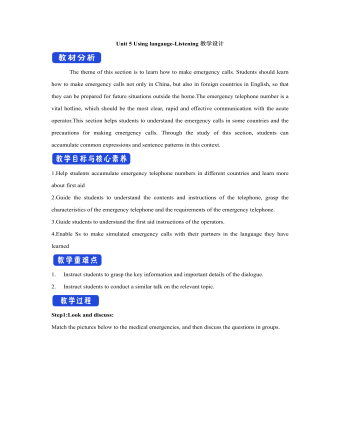
新人教版高中英语选修2Unit 5 Using langauge-Listening教学设计
The theme of this section is to learn how to make emergency calls. Students should learn how to make emergency calls not only in China, but also in foreign countries in English, so that they can be prepared for future situations outside the home.The emergency telephone number is a vital hotline, which should be the most clear, rapid and effective communication with the acute operator.This section helps students to understand the emergency calls in some countries and the precautions for making emergency calls. Through the study of this section, students can accumulate common expressions and sentence patterns in this context. 1.Help students accumulate emergency telephone numbers in different countries and learn more about first aid2.Guide the students to understand the contents and instructions of the telephone, grasp the characteristics of the emergency telephone and the requirements of the emergency telephone.3.Guide students to understand the first aid instructions of the operators.4.Enable Ss to make simulated emergency calls with their partners in the language they have learned1. Instruct students to grasp the key information and important details of the dialogue.2. Instruct students to conduct a similar talk on the relevant topic.Step1:Look and discuss:Match the pictures below to the medical emergencies, and then discuss the questions in groups.
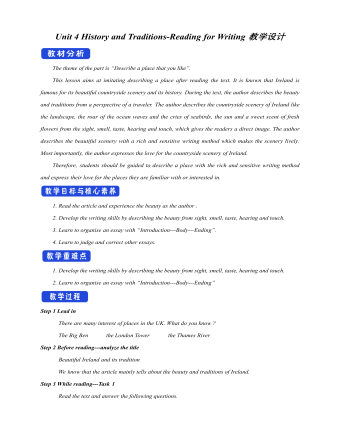
新人教版高中英语必修2Unit 4 History and Traditions-Reading for Writing教案
Step 1 Lead inThere are many interest of places in the UK. What do you know ?The Big Ben the London Tower the Thames RiverStep 2 Before reading---analyze the titleBeautiful Ireland and its traditionWe know that the article mainly tells about the beauty and traditions of Ireland. Step 3 While reading---Task 1Read the text and answer the following questions.Q1: What makes the Irish countryside exciting and inspiring?Its beauty and how it offers something for all the scenes.Q2: What are the best ways to experience some Irish traditions and cultures?By stopping by a village pub and relaxing with a drink and traditional meal while listening to music and watching dancingQ3: What is the meaning of “breathe in the sweet scent of fresh flowers while birds greet the new day with their morning song ?”It means to not just smell but also breathe in the smell of fresh flowers early in the morning as the birds sing their first song of the new day.Q4: What are the best ways to experience Chinese traditions and customs ?By travelling to different places and using all your senses to experience everything and by interacting with local people.Step 4 While reading---Task 2Analyze the descriptive paragraph1. Identify and underline the paragraph’s introductory sentence and the ending sentence.Introductory sentence: Ireland’s beautiful countryside has always had a great influence on its people and traditions.Ending sentence: And if you introduce yourself to a friendly face, you are more than likely to experience local culture and customs first-hand.2. The paragraph talks about different senses in different places. Write the senses and places in the order that they appear.
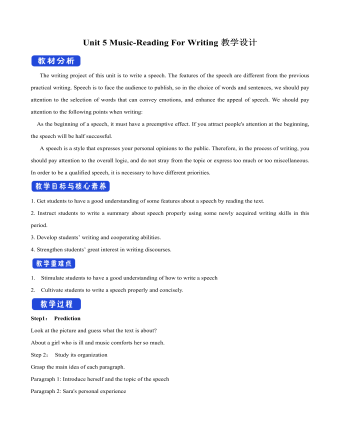
新人教版高中英语必修2Unit 5 Music-Reading For Writing教案一
(4)Now we have heard a number of outstanding speeches ... 我们已经聆听了许多精彩的发言……(5)Because we wanted the nations of the world, working together, to deal with ... 因为我们希望全世界各国团结起来去应对……(6)And if we do not act ... 如果我们不采取行动……(7)Now, I share the concerns that have been expressed ... 我也同意对于……表达的担心(8)Let us show the world that by working together we can ... 让我们告诉全世界,通过一起努力我们可以……(9)It is now time for us to ... 是时候我们……(10)And I have always wished that ... 我一直希望……(11)Thank you for letting me share this day with me.感谢你们和我共度这一天。实践演练:假如你是高中生李华,你校将举办一次以“音乐”为主题的演讲比赛,请你按照主题,写下你的演讲稿。注意:词数100左右。First of all, thank you for listening to my speech. My topic is: love music like love yourself.Music is like the air we need to maintain our normal lives around us. You can't imagine how terrible a world without music would be. Movies and TV shows have no music, only dry conversations and scenes; mobile phones only vibrations; streets only noisy crowds; cafes, western restaurants only depressed meals. What a terrible world it is!As a student, I hope we all can enjoy the fun brought by music in our spare time. Instead of just listening to music, we can even make our own music. Let's enjoy the fun of music!Thanks again for your attention!
新人教版高中英语必修2Unit 2 Wildlife Protection-Reading For Writing教案一
1. 标题首先根据海报的特点、格式写明标题。海报中往往把内容作为大标题。例如: Save the earth, Save the birds。2. 正文部分不同的海报其正文部分的侧重点不同。对于介绍性的海报, 首先要引出话题, 其次列出原因, 最后是总结。对于宣传类的海报, 要写明具体内容, 如: 活动内容, 地点以及参加活动的注意事项, 主持或举办单位等。1. 图片: 要选择引人注目的图片, 与主题要相关, 色彩明亮。话题句式 1. It is a treasure of our country. 它是我国的国宝。2. Believe it or not, at present only several thousand pandas exist in the world. 信不信由你, 目前世界上仅现存几千只熊猫。 3.It’s because of human activities that tigers are endangered. 正是因为人类的活动, 老虎处于濒危的状态。4. Many wild animals are in danger of dying out. 很多野生动物面临着灭绝的危险。 5. The government has taken effective measures to protect them. 政府已采取有效的措施来保护它们。6. People should raise the awareness of the protection of wild animals. 人们应该提高保护野生动物的意识。 7. It’s amazing that there are merely less than 1, 000 finless porpoises living in China. 非常令人吃惊, 目前中国仅有不足1 000只江豚。
人教A版高中数学必修一奇偶性教学设计(2)
《奇偶性》内容选自人教版A版第一册第三章第三节第二课时;函数奇偶性是研究函数的一个重要策略,因此奇偶性成为函数的重要性质之一,它的研究也为今后指对函数、幂函数、三角函数的性质等后续内容的深入起着铺垫的作用.课程目标1、理解函数的奇偶性及其几何意义;2、学会运用函数图象理解和研究函数的性质;3、学会判断函数的奇偶性.数学学科素养1.数学抽象:用数学语言表示函数奇偶性;2.逻辑推理:证明函数奇偶性;3.数学运算:运用函数奇偶性求参数;4.数据分析:利用图像求奇偶函数;5.数学建模:在具体问题情境中,运用数形结合思想,利用奇偶性解决实际问题。重点:函数奇偶性概念的形成和函数奇偶性的判断;难点:函数奇偶性概念的探究与理解.教学方法:以学生为主体,采用诱思探究式教学,精讲多练。
人教A版高中数学必修一对数的运算教学设计(2)
学生已经学习了指数运算性质,有了这些知识作储备,教科书通过利用指数运算性质,推导对数的运算性质,再学习利用对数的运算性质化简求值。课程目标1、通过具体实例引入,推导对数的运算性质;2、熟练掌握对数的运算性质,学会化简,计算.数学学科素养1.数学抽象:对数的运算性质;2.逻辑推理:换底公式的推导;3.数学运算:对数运算性质的应用;4.数学建模:在熟悉的实际情景中,模仿学过的数学建模过程解决问题.重点:对数的运算性质,换底公式,对数恒等式及其应用;难点:正确使用对数的运算性质和换底公式.教学方法:以学生为主体,采用诱思探究式教学,精讲多练。教学工具:多媒体。一、 情景导入回顾指数性质:(1)aras=ar+s(a>0,r,s∈Q).(2)(ar)s= (a>0,r,s∈Q).(3)(ab)r= (a>0,b>0,r∈Q).那么对数有哪些性质?如 要求:让学生自由发言,教师不做判断。而是引导学生进一步观察.研探.
人教A版高中数学必修一对数的概念教学设计(2)
对数与指数是相通的,本节在已经学习指数的基础上通过实例总结归纳对数的概念,通过对数的性质和恒等式解决一些与对数有关的问题.课程目标1、理解对数的概念以及对数的基本性质;2、掌握对数式与指数式的相互转化;数学学科素养1.数学抽象:对数的概念;2.逻辑推理:推导对数性质;3.数学运算:用对数的基本性质与对数恒等式求值;4.数学建模:通过与指数式的比较,引出对数定义与性质.重点:对数式与指数式的互化以及对数性质;难点:推导对数性质.教学方法:以学生为主体,采用诱思探究式教学,精讲多练。教学工具:多媒体。一、 情景导入已知中国的人口数y和年头x满足关系 中,若知年头数则能算出相应的人口总数。反之,如果问“哪一年的人口数可达到18亿,20亿,30亿......”,该如何解决?要求:让学生自由发言,教师不做判断。而是引导学生进一步观察.研探.
人教A版高中数学必修一函数的概念教学设计(2)
函数在高中数学中占有很重要的比重,因而作为函数的第一节内容,主要从三个实例出发,引出函数的概念.从而就函数概念的分析判断函数,求定义域和函数值,再结合三要素判断函数相等.课程目标1.理解函数的定义、函数的定义域、值域及对应法则。2.掌握判定函数和函数相等的方法。3.学会求函数的定义域与函数值。数学学科素养1.数学抽象:通过教材中四个实例总结函数定义;2.逻辑推理:相等函数的判断;3.数学运算:求函数定义域和求函数值;4.数据分析:运用分离常数法和换元法求值域;5.数学建模:通过从实际问题中抽象概括出函数概念的活动,培养学生从“特殊到一般”的分析问题的能力,提高学生的抽象概括能力。重点:函数的概念,函数的三要素。难点:函数概念及符号y=f(x)的理解。
人教A版高中数学必修一集合的概念教学设计(2)
例7 用描述法表示抛物线y=x2+1上的点构成的集合.【答案】见解析 【解析】 抛物线y=x2+1上的点构成的集合可表示为:{(x,y)|y=x2+1}.变式1.[变条件,变设问]本题中点的集合若改为“{x|y=x2+1}”,则集合中的元素是什么?【答案】见解析 【解析】集合{x|y=x2+1}的代表元素是x,且x∈R,所以{x|y=x2+1}中的元素是全体实数.变式2.[变条件,变设问]本题中点的集合若改为“{y|y=x2+1}”,则集合中的元素是什么?【答案】见解析 【解析】集合{ y| y=x2+1}的代表元素是y,满足条件y=x2+1的y的取值范围是y≥1,所以{ y| y=x2+1}={ y| y≥1},所以集合中的元素是大于等于1的全体实数.解题技巧(认识集合含义的2个步骤)一看代表元素,是数集还是点集,二看元素满足什么条件即有什么公共特性。
人教A版高中数学必修一任意角教学设计(2)
学生在初中学习了 ~ ,但是现实生活中随处可见超出 ~ 范围的角.例如体操中有“前空翻转体 ”,且主动轮和被动轮的旋转方向不一致.因此为了准确描述这些现象,本节课主要就旋转度数和旋转方向对角的概念进行推广.课程目标1.了解任意角的概念.2.理解象限角的概念及终边相同的角的含义.3.掌握判断象限角及表示终边相同的角的方法.数学学科素养1.数学抽象:理解任意角的概念,能区分各类角;2.逻辑推理:求区域角;3.数学运算:会判断象限角及终边相同的角.重点:理解象限角的概念及终边相同的角的含义;难点:掌握判断象限角及表示终边相同的角的方法.教学方法:以学生为主体,采用诱思探究式教学,精讲多练。教学工具:多媒体。一、 情景导入初中对角的定义是:射线OA绕端点O按逆时针方向旋转一周回到起始位置,在这个过程中可以得到 ~ 范围内的角.但是现实生活中随处可见超出 ~ 范围的角.例如体操中有“前空翻转体 ”,且主动轮和被动轮的旋转方向不一致.
人教A版高中数学必修一诱导公式教学设计(2)
本节主要内容是三角函数的诱导公式中的公式二至公式六,其推导过程中涉及到对称变换,充分体现对称变换思想在数学中的应用,在练习中加以应用,让学生进一步体会 的任意性;综合六组诱导公式总结出记忆诱导公式的口诀:“奇变偶不变,符号看象限”,了解从特殊到一般的数学思想的探究过程,培养学生用联系、变化的辩证唯物主义观点去分析问题的能力。诱导公式在三角函数化简、求值中具有非常重要的工具作用,要求学生能熟练的掌握和应用。课程目标1.借助单位圆,推导出正弦、余弦第二、三、四、五、六组的诱导公式,能正确运用诱导公式将任意角的三角函数化为锐角的三角函数,并解决有关三角函数求值、化简和恒等式证明问题2.通过公式的应用,了解未知到已知、复杂到简单的转化过程,培养学生的化归思想,以及信息加工能力、运算推理能力、分析问题和解决问题的能力。
人教A版高中数学必修一基本不等式教学设计(2)
《基本不等式》在人教A版高中数学第一册第二章第2节,本节课的内容是基本不等式的形式以及推导和证明过程。本章一直在研究不等式的相关问题,对于本节课的知识点有了很好的铺垫作用。同时本节课的内容也是之后基本不等式应用的必要基础。课程目标1.掌握基本不等式的形式以及推导过程,会用基本不等式解决简单问题。2.经历基本不等式的推导与证明过程,提升逻辑推理能力。3.在猜想论证的过程中,体会数学的严谨性。数学学科素养1.数学抽象:基本不等式的形式以及推导过程;2.逻辑推理:基本不等式的证明;3.数学运算:利用基本不等式求最值;4.数据分析:利用基本不等式解决实际问题;5.数学建模:利用函数的思想和基本不等式解决实际问题,提升学生的逻辑推理能力。重点:基本不等式的形成以及推导过程和利用基本不等式求最值;难点:基本不等式的推导以及证明过程.
新人教版高中英语选修2Unit 1 Science and Scientists-Discovering useful structures教学设计
The grammatical structure of this unit is predicative clause. Like object clause and subject clause, predicative clause is one of Nominal Clauses. The leading words of predicative clauses are that, what, how, what, where, as if, because, etc.The design of teaching activities aims to guide students to perceive the structural features of predicative clauses and think about their ideographic functions. Beyond that, students should be guided to use this grammar in the context apporpriately and flexibly.1. Enable the Ss to master the usage of the predicative clauses in this unit.2. Enable the Ss to use the predicative patterns flexibly.3. Train the Ss to apply some skills by doing the relevant exercises.1.Guide students to perceive the structural features of predicative clauses and think about their ideographic functions.2.Strengthen students' ability of using predicative clauses in context, but also cultivate their ability of text analysis and logical reasoning competence.Step1: Underline all the examples in the reading passage, where noun clauses are used as the predicative. Then state their meaning and functions.1) One theory was that bad air caused the disease.2) Another theory was that cholera was caused by an infection from germs in food or water.3) The truth was that the water from the Broad Street had been infected by waste.Sum up the rules of grammar:1. 以上黑体部分在句中作表语。2. 句1、2、3中的that在从句中不作成分,只起连接作用。 Step2: Review the basic components of predicative clauses1.Definition
新人教版高中英语选修2Unit 1 Science and Scientists-Learning about Language教学设计
Step 7: complete the discourse according to the grammar rules.Cholera used to be one of the most 1.__________ (fear) diseases in the world. In the early 19th century, _2_________ an outbreak of cholera hit Europe, millions of people died. But neither its cause, 3__________ its cure was understood. A British doctor, John Snow, wanted to solve the problem and he knew that cholera would not be controlled _4_________ its cause was found. In general, there were two contradictory theories 5 __________ explained how cholera spread. The first suggested that bad air caused the disease. The second was that cholera was caused by an _6_________(infect) from germs in food or water. John Snow thought that the second theory was correct but he needed proof. So when another outbreak of cholera hit London in 1854, he began to investigate. Later, with all the evidence he _7_________ (gather), John Snow was able to announce that the pump water carried cholera germs. Therefore, he had the handle of the pump _8_________ (remove) so that it couldn't be used. Through his intervention,the disease was stopped in its tracks. What is more, John Snow found that some companies sold water from the River Thames that __9__________________ (pollute) by raw waste. The people who drank this water were much more likely _10_________ (get) cholera than those who drank pure or boiled water. Through John Snow's efforts, the _11_________ (threaten) of cholera around the world saw a substantial increase. Keys: 1.feared 2.when 3. nor 4.unless 5.that/which 6.infection 7.had gathered 8.removed 9.was polluted 10.to get 11. threat
新人教版高中英语选修2Unit 1 Science and Scientists-Reading and thinking教学设计
Step 5: After learning the text, discuss with your peers about the following questions:1.John Snow believed Idea 2 was right. How did he finally prove it?2. Do you think John Snow would have solved this problem without the map?3. Cholera is a 19th century disease. What disease do you think is similar to cholera today?SARS and Covid-19 because they are both deadly and fatally infectious, have an unknown cause and need serious public health care to solve them urgently.keys:1. John Snow finally proved his idea because he found an outbreak that was clearly related to cholera, collected information and was able to tie cases outside the area to the polluted water.2. No. The map helped John Snow organize his ideas. He was able to identify those households that had had many deaths and check their water-drinking habits. He identified those houses that had had no deaths and surveyed their drinking habits. The evidence clearly pointed to the polluted water being the cause.3. SARS and Covid-19 because they are both deadly and fatally infectious, have an unknown cause and need serious public health care to solve them urgently.Step 6: Consolidate what you have learned by filling in the blanks:John Snow was a well-known _1___ in London in the _2__ century. He wanted to find the _3_____ of cholera in order to help people ___4_____ it. In 1854 when a cholera __5__ London, he began to gather information. He ___6__ on a map ___7___ all the dead people had lived and he found that many people who had ___8____ (drink) the dirty water from the __9____ died. So he decided that the polluted water ___10____ cholera. He suggested that the ___11__ of all water supplies should be _12______ and new methods of dealing with ____13___ water be found. Finally, “King Cholera” was __14_____.Keys: 1. doctor 2. 19th 3.cause 4.infected with 5.hit 6.marked 7.where 8.drunk 9.pump 10.carried 11.source 12.examined 13.polluted 14.defeatedHomework: Retell the text after class and preview its language points
新人教版高中英语选修2Unit 1 Science and Scientists-Using langauge教学设计
This happens because the dish soap molecules have a strong negative charge, and the milk molecules have a strong positive charge. Like magnets, these molecules are attracted to each other, and so they appear to move around on the plate, taking the food coloring with them, making it look like the colors are quickly moving to escape from the soap.Listening text:? Judy: Oh, I'm so sorry that you were ill and couldn't come with us on our field trip. How are you feeling now? Better?? Bill: Much better, thanks. But how was it?? Judy: Wonderful! I especially liked an area of the museum called Light Games.it was really cool. They had a hall of mirrors where I could see myself reflected thousands of times!? Bill: A hall of mirrors can be a lot of fun. What else did they have?? Judy: Well, they had an experiment where we looked at a blue screen for a while, and then suddenly we could see tiny bright lights moving around on it. You'll never guess what those bright lights were!? Bill: Come on, tell me!? Judy: They were our own blood cells. For some reason, our eyes play tricks on us when we look at a blue screen, and we can see our own blood cells moving around like little lights! But there was another thing I liked better. I stood in front of a white light, and it cast different shadows of me in every color of the rainbow!? Bill: Oh, I wish I had been there. Tell me more!? Judy: Well, they had another area for sound. They had a giant piano keyboard that you could use your feet to play. But then, instead of playing the sounds of a piano, it played the voices of classical singers! Then they had a giant dish, and when you spoke into it, it reflected the sound back and made it louder. You could use it to speak in a whisper to someone 17 meters away.? Bill: It all sounds so cool. I wish I could have gone with you? Judy: I know, but we can go together this weekend. I'd love to go there again!? Bill: That sounds like a great idea!
人教A版高中数学必修一充分条件与必要条件教学设计(1)
本课是高中数学第一章第4节,充要条件是中学数学中最重要的数学概念之一, 它主要讨论了命题的条件与结论之间的逻辑关系,目的是为今后的数学学习特别是数学推理的学习打下基础。从学生学习的角度看,与旧教材相比,教学时间的前置,造成学生在学习充要条件这一概念时的知识储备不够丰富,逻辑思维能力的训练不够充分,这也为教师的教学带来一定的困难.“充要条件”这一节介绍了充分条件,必要条件和充要条件三个概念,由于这些概念比较抽象,中学生不易理解,用它们去解决具体问题则更为困难,因此”充要条件”的教学成为中学数学的难点之一,而必要条件的定义又是本节内容的难点.A.正确理解充分不必要条件、必要不充分条件、充要条件的概念;B.会判断命题的充分条件、必要条件、充要条件.C.通过学习,使学生明白对条件的判定应该归结为判断命题的真假.D.在观察和思考中,在解题和证明题中,培养学生思维能力的严密性品质.
人教A版高中数学必修一函数y=Asin(ωχ+φ)教学设计(1)
本节课选自《普通高中课程标准实验教科书数学必修1》5.6.2节 函数y=Asin(ωx+φ)的图象通过图象变换,揭示参数φ、ω、A变化时对函数图象的形状和位置的影响。通过引导学生对函数y=sinx到y=Asin(ωx+φ)的图象变换规律的探索,让学生体会到由简单到复杂、由特殊到一般的化归思想;并通过对周期变换、相位变换先后顺序调整后,将影响图象变换这一难点的突破,让学生学会抓住问题的主要矛盾来解决问题的基本思想方法;通过对参数φ、ω、A的分类讨论,让学生深刻认识图象变换与函数解析式变换的内在联系。通过图象变换和“五点”作图法,正确找出函数y=sinx到y=Asin(ωx+φ)的图象变换规律,这也是本节课的重点所在。提高学生的推理能力。让学生感受数形结合及转化的思想方法。发展学生数学直观、数学抽象、逻辑推理、数学建模的核心素养。
人教A版高中数学必修一函数的零点与方程的解教学设计(1)
本节课是新版教材人教A版普通高中课程标准实验教科书数学必修1第四章第4.5.1节《函数零点与方程的解》,由于学生已经学过一元二次方程与二次函数的关系,本节课的内容就是在此基础上的推广。从而建立一般的函数的零点概念,进一步理解零点判定定理及其应用。培养和发展学生数学直观、数学抽象、逻辑推理和数学建模的核心素养。1、了解函数(结合二次函数)零点的概念;2、理 解函数零点与方程的根以及函数图象与x轴交点的关系,掌握零点存在性定理的运用;3、在认识函数零点的过程中,使学生学会认识事物的特殊性与一般性之间的关系,培养数学数形结合及函数思想; a.数学抽象:函数零点的概念;b.逻辑推理:零点判定定理;c.数学运算:运用零点判定定理确定零点范围;d.直观想象:运用图形判定零点;e.数学建模:运用函数的观点方程的根;
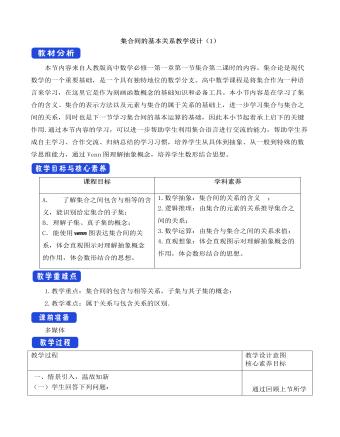
人教A版高中数学必修一集合间的基本关系教学设计(1)
本节内容来自人教版高中数学必修一第一章第一节集合第二课时的内容。集合论是现代数学的一个重要基础,是一个具有独特地位的数学分支。高中数学课程是将集合作为一种语言来学习,在这里它是作为刻画函数概念的基础知识和必备工具。本小节内容是在学习了集合的含义、集合的表示方法以及元素与集合的属于关系的基础上,进一步学习集合与集合之间的关系,同时也是下一节学习集合间的基本运算的基础,因此本小节起着承上启下的关键作用.通过本节内容的学习,可以进一步帮助学生利用集合语言进行交流的能力,帮助学生养成自主学习、合作交流、归纳总结的学习习惯,培养学生从具体到抽象、从一般到特殊的数学思维能力,通过Venn图理解抽象概念,培养学生数形结合思想。