-
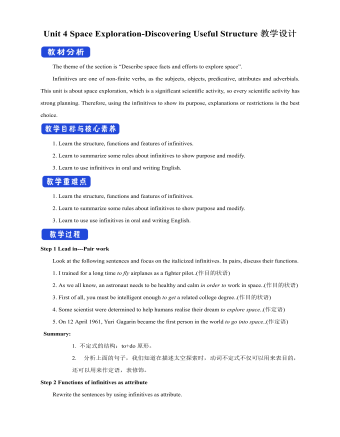
新人教版高中英语必修3Unit 4 Space Exploration-Discovering Useful Structure教学设计
The theme of the section is “Describe space facts and efforts to explore space”. Infinitives are one of non-finite verbs, as the subjects, objects, predicative, attributes and adverbials. This unit is about space exploration, which is a significant scientific activity, so every scientific activity has strong planning. Therefore, using the infinitives to show its purpose, explanations or restrictions is the best choice.1. Learn the structure, functions and features of infinitives.2. Learn to summarize some rules about infinitives to show purpose and modify.3. Learn to use infinitives in oral and writing English. 1. Learn the structure, functions and features of infinitives.2. Learn to summarize some rules about infinitives to show purpose and modify.3. Learn to use use infinitives in oral and writing English.Step 1 Lead in---Pair workLook at the following sentences and focus on the italicized infinitives. In pairs, discuss their functions. 1. I trained for a long time to fly airplanes as a fighter pilot..(作目的状语)2. As we all know, an astronaut needs to be healthy and calm in order to work in space..(作目的状语)3. First of all, you must be intelligent enough to get a related college degree..(作目的状语)4. Some scientist were determined to help humans realise their dream to explore space..(作定语)5. On 12 April 1961, Yuri Gagarin became the first person in the world to go into space..(作定语)Summary:1. 不定式的结构:to+do原形。2. 分析上面的句子,我们知道在描述太空探索时,动词不定式不仅可以用来表目的,还可以用来作定语,表修饰。
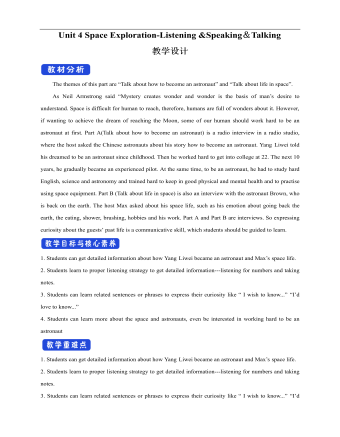
新人教版高中英语必修3Unit 4 Space Exploration-Listening&Speaking&Talking教学设计二
The themes of this part are “Talk about how to become an astronaut” and “Talk about life in space”. As Neil Armstrong said “Mystery creates wonder and wonder is the basis of man’s desire to understand. Space is difficult for human to reach, therefore, humans are full of wonders about it. However, if wanting to achieve the dream of reaching the Moon, some of our human should work hard to be an astronaut at first. Part A(Talk about how to become an astronaut) is a radio interview in a radio studio, where the host asked the Chinese astronauts about his story how to become an astronaut. Yang Liwei told his dreamed to be an astronaut since childhood. Then he worked hard to get into college at 22. The next 10 years, he gradually became an experienced pilot. At the same time, to be an astronaut, he had to study hard English, science and astronomy and trained hard to keep in good physical and mental health and to practise using space equipment. Part B (Talk about life in space) is also an interview with the astronaut Brown, who is back on the earth. The host Max asked about his space life, such as his emotion about going back the earth, the eating, shower, brushing, hobbies and his work. Part A and Part B are interviews. So expressing curiosity about the guests’ past life is a communicative skill, which students should be guided to learn.1. Students can get detailed information about how Yang Liwei became an astronaut and Max’s space life.2. Students learn to proper listening strategy to get detailed information---listening for numbers and taking notes.3. Students can learn related sentences or phrases to express their curiosity like “ I wish to know...” “I’d love to know...”4. Students can learn more about the space and astronauts, even be interested in working hard to be an astronaut
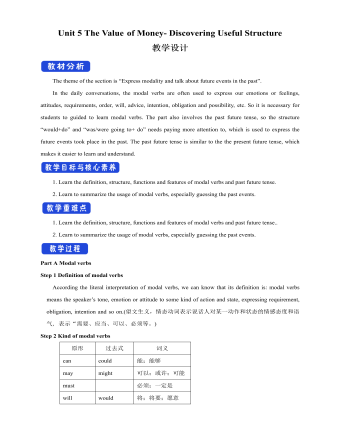
新人教版高中英语必修3Unit 5 The Value of Money- Discovering Useful Structure教学设计
Step 3 Meaning1. 过去将来时表示从过去某一时间来看将要发生的动作或存在的状态, 常用在宾语从句中。一般由“would/should +动词原形”构成。She hoped that they would meet again someday. 她希望将来有一天他们能再见面。2. was/were going to+动词原形: 表示过去将要发生或很有可能发生的动作, 常用于口语中, 表示预言、意图或者打算等。He was going to start work the following week. 他打算下星期开始工作。3. was/were about to do: 常用来表示即将发生的动作, “刚要/正要做……”。注意该结构不与任何时间状语连用。I felt that something terrible was about to happen. 我感到某种可怕的事情即将发生。4.was/were to do: 表示“曾计划做某事”, 如果表示“本来计划做某事, 动作没实现”, 则需用 “was/were to have done”。She said she was to have told me about the accident. 她说她本来想告诉我关于事故的事。5.Start, go, come, leave, see, meet等动词的过去进行时: 表示就过去某一时刻而言即将发生的动作。She was coming later. 她随后就来。I had just put on my overcoat and was leaving to visit a friend of mine. 我刚穿上外套要去看我的一个朋友。
新人教版高中英语必修3Unit 5 The Value of Money-Listening &Speaking&Talking教学设计
4. A:We’d like to have someone to say a word at the beginning to welcome the group.B:↙Who?A:We thought that you or Dr.Johnson might do it.B用降调说Who,其意思是问,对方想让谁在开场时致欢迎词。Step 6 Pronunciation---Practice1. Listen to the short conversation and mark the intonation with ↗, ↙ or ↙, ↗. Then discuss with a partner what they intend to convey by using different intonation.Owner: You know what ?↗ It’s a million-pound bank note↙.Waiter 1: Really ?↗(question)Waiter 2: Really !↙(unbelievable and surprised)Waiter 3: Really ?!↙↗(first question then surprised)2. Listen to the conversations. Underline the parts that are stressed and mark the intonation. Then talk about the implied meanings of the responses with different intonations. Listen again and repeat.1) Henry: It’s a nice suit.Owner: Oh, it’s perfect!↙(The intonation means it is very suitable for Henry.)2) Henry: Well, that’s very kind of you.Owner: Kind, sir ?↗(what you said is not right) No, it’s kind of you. You must come whenever you want and have whatever you like. Just having you sit here is a great honour !!↙(welcome you to come again)3)Henry:Well, to be honest, I have none. Oliver:(happily) What luck!(excited) Brother↗, what luck!↙(It means “Didn’t you hear it?”)Henry: Well, it may seem lucky to you but not to me!↗(angry) If this is your idea of some kind of joke, I don’t think it’s very funny. Now if you’ll excuse me, I ought to be on my way.↙(If so, I would leave.)Roderick: Please don’t go↙...(hope Henry can wait for a moment)Part B Viewing and Talking---Describe people’s changing attitudes in a film clipStep 1 Before-listening---Tell the filmYou are going to watch part of the film The Million Pound Bank Note. Look at these photos and guess what happens in the film.
新人教版高中英语必修3Unit 5 The Value of Money-Listening &Speaking教学设计
Step 4: Listen again and decide if the following statements are true (T) or false (F).1 It was the first time Chen Liyan's story was reported. T口 F口2 Chen found 10,000 yuan in a small plastic bag in Taiyuan railway station口 F口3 Wang Zheng apologized to Chen because he couldn't offer her more money. T口 F口4 Chen took out a large loan to cure her daughter, T口 F口5 Wang set up a fundraising website for Chen's daughter after Chen told him about her situation. T口 F口Step 5:After listening, discuss the questions.1 What kind of person do you think Chen Liyan is?Chen Liyan is generous and honest because she returned a large sum of money to the owner.2 Did Chen return the money because she didn't need it?No. She returned the money because it was the right thing to do. Evidence for this is that she refused to accept the reward money because she felt that it had not been earned. 3 Is it common for people to do what Chen did?It depends on the culture. In some countries it is quite common to return money that has been found. In other countries, people believe "Finders are keepers!" 4 How did Wang Zheng feel about the return of his money?He must have been very happy and relieved to have gotten his money back. We know this because he thanked Chen repeatedly and even offered her a reward.5 Why did Ma Dongbao tell Wang about Chen's family?He must have had great sympathy for Chen and her daughter and wanted to help them.'We know this because he arranged help for them. 6 How did the news reporter feel about Chen's actions?The news reporter felt that it showed that money wasn't the most important thing in life. We know this because the reporter told us that this is what Chen believes. and then said, “that's a great attitude to take."
新人教版高中英语必修3Unit 5 The value of money-Reading and Thinking教学设计二
? Could you offer me some kind of work here?? I don’t want your charity, I just want an honest job.? Careless: I landed in Britain by accident.Step 7:Consolidation.? Find Henry? Roderick and Oliver were I .making a bet when they saw Henry, a poor young man. ? Know Henry? About a month ago, Henry was sailing and later he found himself carried out to sea by a strong wind. Fortunately, he 2.was spotted by a ship. And it was the ship that brought him to 3.England? Offer money to Henry ? Oliver and Roderick gave Henry a letter and told him that there was money in it. They 4.persuaded him to accept it, and made him 5.promise that it wouldn't be opened until 2 o'clock.Step 8:Language pointsa large amount of: a large quantity of; a great deal ofe.g. They bought a large amount of furniture before they moved their new house.make a bet: make an arrangement to risk money, etc. on an event of which the result is doubtful.e.g. We made a bet on the result of the match.permit sb to do something: allow somebody to do somethinge.g. My mother doesn’t permit me to ride in the street after it rained.by accident: as a result of chancee.g. I only found it by accident.stare at: look at somebody or something with the eyes wide open in a fixed gaze( in astonishment, wonder, fear, etc)to be honest: to tell you the truth; to be franke.g. To be honest, I don’t think we have a chance of winning.Step7 Homework:What do you think will happen to Henry? Will the bank-note help him or get him into trouble?
新人教版高中英语选修2Unit 1 Science and Scientists-Discovering useful structures教学设计
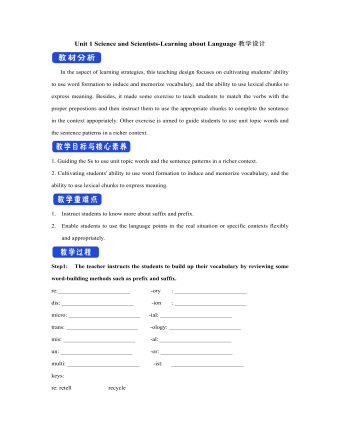
The grammatical structure of this unit is predicative clause. Like object clause and subject clause, predicative clause is one of Nominal Clauses. The leading words of predicative clauses are that, what, how, what, where, as if, because, etc.The design of teaching activities aims to guide students to perceive the structural features of predicative clauses and think about their ideographic functions. Beyond that, students should be guided to use this grammar in the context apporpriately and flexibly.1. Enable the Ss to master the usage of the predicative clauses in this unit.2. Enable the Ss to use the predicative patterns flexibly.3. Train the Ss to apply some skills by doing the relevant exercises.1.Guide students to perceive the structural features of predicative clauses and think about their ideographic functions.2.Strengthen students' ability of using predicative clauses in context, but also cultivate their ability of text analysis and logical reasoning competence.Step1: Underline all the examples in the reading passage, where noun clauses are used as the predicative. Then state their meaning and functions.1) One theory was that bad air caused the disease.2) Another theory was that cholera was caused by an infection from germs in food or water.3) The truth was that the water from the Broad Street had been infected by waste.Sum up the rules of grammar:1. 以上黑体部分在句中作表语。2. 句1、2、3中的that在从句中不作成分,只起连接作用。 Step2: Review the basic components of predicative clauses1.Definition
新人教版高中英语选修2Unit 4 Journey Across a Vast Land教学设计
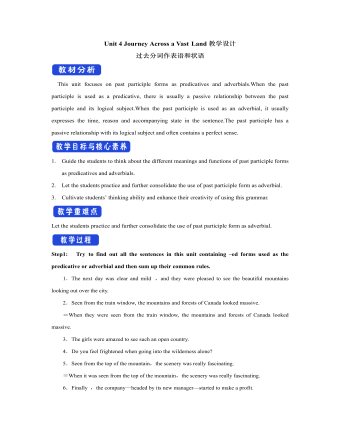
当孩子们由父母陪同时,他们才被允许进入这个运动场。3.过去分词(短语)作状语时的几种特殊情况(1)过去分词(短语)在句中作时间、条件、原因、让步状语时,相当于对应的时间、条件、原因及让步状语从句。Seen from the top of the mountain (=When it is seen from the top of the mountain), the whole town looks more beautiful.从山顶上看,整个城市看起来更美了。Given ten more minutes (=If we are given ten more minutes), we will finish the work perfectly.如果多给十分钟,我们会完美地完成这项工作。Greatly touched by his words (=Because she was greatly touched by his words), she was full of tears.由于被他的话深深地感动,她满眼泪花。Warned of the storm (=Though they were warned of the storm), the farmers were still working on the farm.尽管被警告了风暴的到来,但农民们仍在农场干活。(2)过去分词(短语)在句中作伴随、方式等状语时,可改为句子的并列谓语或改为并列分句。The teacher came into the room, followed by two students (=and was followed by two students).后面跟着两个学生,老师走进了房间。He spent the whole afternoon, accompanied by his mom(=and was accompanied by his mom).他由母亲陪着度过了一整个下午。
新人教版高中英语选修2Unit 1 Science and Scientists-Learning about Language教学设计
Step 7: complete the discourse according to the grammar rules.Cholera used to be one of the most 1.__________ (fear) diseases in the world. In the early 19th century, _2_________ an outbreak of cholera hit Europe, millions of people died. But neither its cause, 3__________ its cure was understood. A British doctor, John Snow, wanted to solve the problem and he knew that cholera would not be controlled _4_________ its cause was found. In general, there were two contradictory theories 5 __________ explained how cholera spread. The first suggested that bad air caused the disease. The second was that cholera was caused by an _6_________(infect) from germs in food or water. John Snow thought that the second theory was correct but he needed proof. So when another outbreak of cholera hit London in 1854, he began to investigate. Later, with all the evidence he _7_________ (gather), John Snow was able to announce that the pump water carried cholera germs. Therefore, he had the handle of the pump _8_________ (remove) so that it couldn't be used. Through his intervention,the disease was stopped in its tracks. What is more, John Snow found that some companies sold water from the River Thames that __9__________________ (pollute) by raw waste. The people who drank this water were much more likely _10_________ (get) cholera than those who drank pure or boiled water. Through John Snow's efforts, the _11_________ (threaten) of cholera around the world saw a substantial increase. Keys: 1.feared 2.when 3. nor 4.unless 5.that/which 6.infection 7.had gathered 8.removed 9.was polluted 10.to get 11. threat
初中数学鲁教版七年级上册《第五章 位置与坐标 1 确定位置》教学设计教案
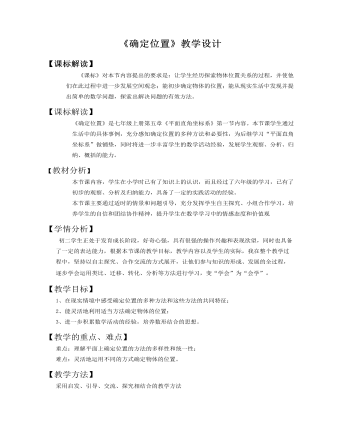
1、通过同位之间互说座位位置,检测知识目标2、3的达成效果。2、通过导学案上的探究一,检测知识目标2、3的达成效果。 3、通过探究二,检测知识目标1、3的达成效果。 4、通过课堂反馈,检测总体教学目标的达成效果。本节课遵循分层施教的原则,以适应不同学生的发展与提高,针对学生回答问题本着多鼓励、少批评的原则,具体从以下几方面进行评价:1、通过学生独立思考、参与小组交流和班级集体展示,教师课堂观察学生的表现,了解学生对知识的理解和掌握情况。教师进行适时的反应评价,同时促进学生的自评与互评。2、通过设计课堂互说座位、探究一、二及达标检测题,检测学习目标达成情况,同时有利于学生完成对自己的评价。3.通过课后作业,了解学生对本课时知识的掌握情况,同时又能检测学生分析解决问题的方法和思路,完成教学反馈评价。
人教A版高中数学必修一两角和与差的正弦、余弦和正切公式教学设计(1)
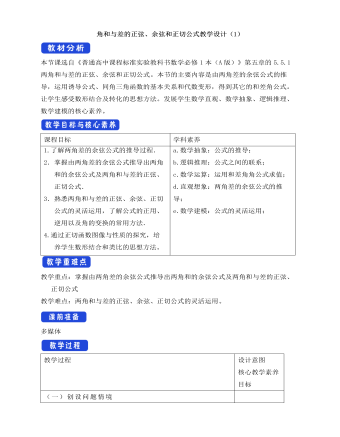
本节课选自《普通高中课程标准实验教科书数学必修1本(A版)》第五章的5.5.1 两角和与差的正弦、余弦和正切公式。本节的主要内容是由两角差的余弦公式的推导,运用诱导公式、同角三角函数的基本关系和代数变形,得到其它的和差角公式。让学生感受数形结合及转化的思想方法。发展学生数学直观、数学抽象、逻辑推理、数学建模的核心素养。课程目标 学科素养1.了解两角差的余弦公式的推导过程.2.掌握由两角差的余弦公式推导出两角和的余弦公式及两角和与差的正弦、正切公式.3.熟悉两角和与差的正弦、余弦、正切公式的灵活运用,了解公式的正用、逆用以及角的变换的常用方法.4.通过正切函数图像与性质的探究,培养学生数形结合和类比的思想方法。 a.数学抽象:公式的推导;b.逻辑推理:公式之间的联系;c.数学运算:运用和差角角公式求值;d.直观想象:两角差的余弦公式的推导;e.数学建模:公式的灵活运用;
人教A版高中数学必修二有限样本空间与随机事件事件的关系和运算教学设计
新知讲授(一)——随机试验 我们把对随机现象的实现和对它的观察称为随机试验,简称试验,常用字母E表示。我们通常研究以下特点的随机试验:(1)试验可以在相同条件下重复进行;(2)试验的所有可能结果是明确可知的,并且不止一个;(3)每次试验总是恰好出现这些可能结果中的一个,但事先不确定出现哪个结果。新知讲授(二)——样本空间思考一:体育彩票摇奖时,将10个质地和大小完全相同、分别标号0,1,2,...,9的球放入摇奖器中,经过充分搅拌后摇出一个球,观察这个球的号码。这个随机试验共有多少个可能结果?如何表示这些结果?根据球的号码,共有10种可能结果。如果用m表示“摇出的球的号码为m”这一结果,那么所有可能结果可用集合表示{0,1,2,3,4,5,6,7,8,9}.我们把随机试验E的每个可能的基本结果称为样本点,全体样本点的集合称为试验E的样本空间。
人教A版高中数学必修一二次函数与一元二次方程、不等式教学设计(2)
三个“二次”即一元二次函数、一元二次方程、一元二次不等式是高中数学的重要内容,具有丰富的内涵和密切的联系,同时也是研究包含二次曲线在内的许多内容的工具 高考试题中近一半的试题与这三个“二次”问题有关 本节主要是帮助考生理解三者之间的区别及联系,掌握函数、方程及不等式的思想和方法。课程目标1. 通过探索,使学生理解二次函数与一元二次方程,一元二次不等式之间的联系。2. 使学生能够运用二次函数及其图像,性质解决实际问题. 3. 渗透数形结合思想,进一步培养学生综合解题能力。数学学科素养1.数学抽象:一元二次函数与一元二次方程,一元二次不等式之间的联系;2.逻辑推理:一元二次不等式恒成立问题;3.数学运算:解一元二次不等式;4.数据分析:一元二次不等式解决实际问题;5.数学建模:运用数形结合的思想,逐步渗透一元二次函数与一元二次方程,一元二次不等式之间的联系。
人教A版高中数学必修一两角和与差的正弦、余弦和正切公式教学设计(2)
本节内容是三角恒等变形的基础,是正弦线、余弦线和诱导公式等知识的延伸,同时,它又是两角和、差、倍、半角等公式的“源头”。两角和与差的正弦、余弦、正切是本章的重要内容,对于三角变换、三角恒等式的证明和三角函数式的化简、求值等三角问题的解决有着重要的支撑作用。 课程目标1、能够推导出两角和与差的正弦、余弦、正切公式并能应用; 2、掌握二倍角公式及变形公式,能灵活运用二倍角公式解决有关的化简、求值、证明问题.数学学科素养1.数学抽象:两角和与差的正弦、余弦和正切公式; 2.逻辑推理: 运用公式解决基本三角函数式的化简、证明等问题;3.数学运算:运用公式解决基本三角函数式求值问题.4.数学建模:学生体会到一般与特殊,换元等数学思想在三角恒等变换中的作用。.
最新劳动合同范本:劳动合同范文
五、社会保险和福利待遇新劳动合同范本(一)劳动合同期内,甲方应依法为乙方办理参加养老、医疗、失业、工伤、生育等社会保险的手续,社会保险费按规定的比例,由甲乙双方负责。(二)乙方患病或非因工负伤,甲方应按国家人力资源和地方的规定给予医疗期和医疗待遇,按医疗保险及其他相关规定报销医疗费用,并在规定的医疗期内支付病假工资或疾病救济费。(三)乙方患职业病、因工负伤或者因工死亡的,甲方应按《工伤保险条例》的规定办理。
电子版劳动合同范本3篇范文
(一)遵守国家及省、市的法律、法规和政策,保障乙方的合法权益;(二)按时足额为乙方缴纳社会保险费;(三)按时支付乙方的工资,不得克扣和无故拖欠;(四)为乙方提供符合国家规定的劳动安全卫生条件和必要的劳动防护用品;(五)依法对女职工和未成年工实行特殊保护;(六)依法支持乙方参加合法的社会活动;(七)保证乙方依法享受国家规定的有关休假待遇;(八)乙方因工或非因工死亡,按国家规定支付丧葬费、抚恤费等;(九)乙方因工负伤或患职业病,按国家有关规定办理。
初一家长会发言讲话稿范文【5篇】
1、多与孩子交流,多关注孩子的学习,询问孩子在校的学习情况。要善于发现孩子学习上的进步,给予充分地肯定和表扬,并提出新的要求。2、多给孩子一点信心,做孩子成长的强有力的后盾。由于孩子的个体差异,免不了学生的成绩有好有坏,有的孩子由于不爱学习,甚至厌学,导致成绩差,我们应该适当的批评。但是孩子很努力,成绩却不理想,我们更应该给他信心,而不是一味的给他泼冷水。3、为了提高学生成绩,学校也想了很多办法:双基周过关考试,月考,上晚自习等4、家长要重视孩子品德方面的教育。孩子的一言一行,一举一动都要关注。先教孩子成人,后教孩子成才。我们班有几个男生自我约束力很差,在学校经常违规违纪:说谎话,拿别人东西,打架骂人,经常被老师抓住,甚至屡教不改。当然,老师也还有很多做的不够的地方,
医院急诊科工作计划范文3篇
1.医疗质量 要在巩固前两年急诊管理年活动成果的基础上,结合等级医院复审整改工作,围绕“质量、安全、服务、价格”,狠抓内涵建设。要进一步加强急诊急救专业队伍的设置,进行急诊医学知识的学习,了解急诊急救在当前社会的重要性,稳进急诊急救队伍。完善急诊、入院、手术“绿色通道”使急诊服务及时、安全、便捷、有效。完善24小时急诊服务目录、急诊工作流程、管理文件资料、对各支持系统服务的规范。协调临床各科对急诊工作的配合。对大批量病员有分类管理的程序。立足使急诊留观病人于24小时内诊断明确、病情稳定后安全入院。加强上级医师急救指导,加强三级会诊,加强与其他专科的协作配合,使急诊危重患者的抢救成功率提高到98%以上。

劳动合同制职工劳动合同范文
第七条 劳动保险和福利待遇乙方因生、老、病、伤、残、死,甲方按国家有关规定处理。甲方按照国家有关规定按期为乙方缴纳养老、医疗、失业、公积金等社会保障。甲方在生产经营状况良好的情况下,为乙方购买的商业保险,在保险期内,甲方有权变更或撤销险种。
离婚协议书范文 离婚协议标准版
1、男女双方于XXX_年____月____日生育女儿___ ,现双方约定女儿由 女方抚养,随同 女方共同生活,男方每月给付女方抚养费,半年支付一次,于每年____月、____月____日前汇入女方帐号为XXXXXX__的XXX_银行卡,直至女儿高中毕业。高中阶段后的有关费用双方日后重新协商。