-
人教版新目标初中英语七年级上册Is this your pencil教案
T: Please look at the pictures and learn the new words.(用多媒体展示新单词效果较好。)1.at prep. 在(里面或附近);在(点刻);2.theart.表示特指的人、物、事或群体 3.lostadj.丢失的;遗失的4.Found adj. (find的过去式、过去分词)找回的5.lost and found 失物招领6.please adv.请7.school n. 学校8.a set of一套;一副(Teach students to read the words.)2. Practice the new words. (事先录制一段短的听力,让学生通过听的训练来强化所学的新单词,并为学习写寻物启示和失物招领作好准备。)T: Please listen to a short passage twice then fill the blanks using the words we learned.(Show students a short passage and play the recording for the students to listen.)There are many things in (1)_____________________in my (2)__________. Look, here’s (3)_________keys. Is this yours? (4)__________call Jim (5)___________753-2289.Typescript:There are many things in the Lost and Found in my school. Look, here’s a set of keys. Is this yours? Please call Jim at 753-2289.
人教版新目标初中英语七年级上册This is my sister教案
(Play the recording twice again.) (Check the answer.) ③Pairwork. Draw your own picture and talk about it. T: We find out the picture of Lin Hai’s family. Can you draw a picture of your family? SS: … T: OK. When you finish drawing, tell your partner about your picture. You can use “This is …” and “ These are …” to talk about. Then report it to the class. (Students work.) (Check students’ work. Ask two or three students to report.) Step Three: Task. Talk about the family tree. T: Look at the family tree. I think it’s a big family. You can do it in groups of four or three. You can do it in pairs or only by yourself. Then report it to the class. (Students work. Teacher walks around in the classroom and helps the students.) T: Stop here. Let’s check it out. (Choose students to do it.) S1: Look at my family tree. This is my… This is my … They have two … This is my … This is my …This is my …This is my. My parents have two children. This is…This is my …My uncle and my aunt have a son. He is my … (Ask two more students to do it.) Homework. Write a passage about your family.
人教版新目标初中英语七年级上册What color is it教案
一、知识和能力目标通过本单元教学,使学生能运用所学英语,正确地描述物体的颜色;同时进一步学习分辨人物的用语,并加以运用。二、过程和方法目标本单元口语训练应当自始至终在一种鲜明的色彩背景下进行,旨在营造那种为学生所喜爱的欢快气氛,教师应当在十种颜色上大做文章;在使用实物时要使颜色醒目;在组合图画时,要尽量用大色块;在使用投影时要使颜色突出来。教师可以从教室环境上入手营造色彩气氛,如:选取十种颜色的硬色板,剪成各个大写字母;或者将色板剪成各种卡通动物形象,悬挂在教室当中或在墙上,注明各种颜色的英语字块。三、情感态度和价值观目标用各种可以调动学生积极性的活动来提高学生的活跃性,激发他们参与讨论的热情。同时可以对学生进行美育教育,从小培养他们对美的正确认识。
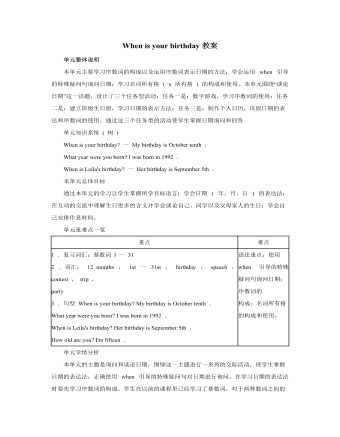
人教版新目标初中英语七年级上册When is your birthday教案
本单元主要学习名词所有格 ('s 所有格 ) 的构成和使用。在初次接触 “ 名词所有格 ” 时,学生较难理解的可能是 “ 所有格 ” 这个名称,对于它的构成,学生也许会觉得较容易。教师可通俗地告诉学生 “ 所有格 ” 的意思是表示 “…… 的 ” ,这样学生反而容易接受。在使用 “ 名词所有格 ” 形式时,学生容易犯错误或混淆的主要是:将这种一 's 构成形式与 is 的缩写形式混淆,如: My father's name's Jin Zhi .,可以这样告诉学生:名词所有格的后面一般应接名词;勿将这种一 's 结构盲目套用与人称代词上,代替物主代词使用,如 He's father's name is Li Cheng 。在教学初期,可不讲授名词所有格的其它形式,待时机成熟,再向学生介绍复数名词所有格形式的结构一 ' ,如: the students' bikes 。 Self Check 教学内容 Self Check( 教材 P52) 教学目标 知识与能力 复习词汇 birthday , date , month , January , February , March , April , May , June , July , August , September , October , November , December , date , birth , age , old , speech . contest . trip , party , event , an , festival , pop , concert , chorus , lecture , music ;引导学生复习、巩固“询问和谈论日期”的目标语言并运用所学知识安排活动。
人教版新目标初中英语七年级下册I’m watching TV教案
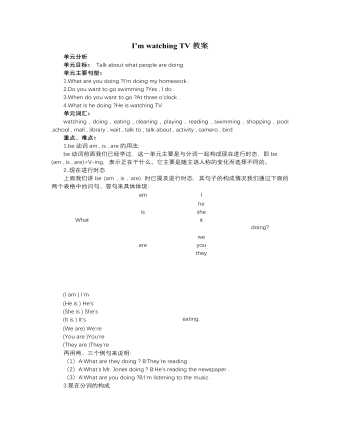
单元分析单元目标: Talk about what people are doing 单元主要句型:1.What are you doing ?I’m doing my homework .2.Do you want to go swimming ?Yes , I do .3.When do you want to go ?At three o’clock .4.What is he doing ?He is watching TV. 单元词汇:watching , doing , eating , cleaning , playing , reading , swimming , shopping , pool ,school , mall , library , wait , talk to , talk about , activity , camero , bird 重点、难点:1.be动词am , is , are的用法;be动词前面我们已经学过,这一单元主要是与分词一起构成现在进行时态,即be (am , is , are)+V-ing,表示正在干什么。它主要是随主语人称的变化而选择不同的。2..现在进行时态上面我们讲be (am , is , are) 时已提及进行时态,其句子的构成情况我们通过下面的两个表格中的问句、答句来具体体现:3.现在分词的构成现在进行时态中be + V - ing 的构成中V-ing被称为现在分词,它的基本构成是动词原形+ing,但也有些特殊情况,下面分几类说明:(1)一般情况+ing如:read→reading,go→going,do→doing,look→looking,listen→listening,watch→watching.(2)以不发音的e结尾的词,去掉e,再加ing.如:write→writing,skate→skating,type→typing,wake→waking,make→making
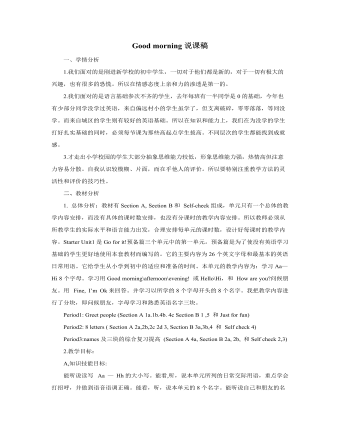
人教版新目标初中英语七年级上册Good morning说课稿
1.课堂活动中的竞赛制:以记奖评优的形式无声的评价每一个活动,包括个体和小群体。在第一课时评最佳演员和导演奖,第二课时评最佳团体奖,既节约时间又明确有效。使学生能提高语言质量,增强参与意识,提高学习兴趣。2. 教师课堂上语言、表情激励制:在课堂活动中教师要乐于 、善于用激励性语言。从good, super, smart, excellent , great ,wonderful等,用微笑,皱眉,摇头、点头等身体语言对于学生的评价是方便又有效的途径。3.课后作业评价:口头作业在第二天课堂上表演,接受全体同学的评价。笔头作业有教师批阅,以评语的方式出现。优秀作业予以展出或交流。积极地肯定和鼓励学生是我们评价的重要目的之一。4.单元结束后综合性评价:除了笔试以外,也可以根据学生实际开展丰富的活动,如:调查报告、小品表演、专题演讲等。
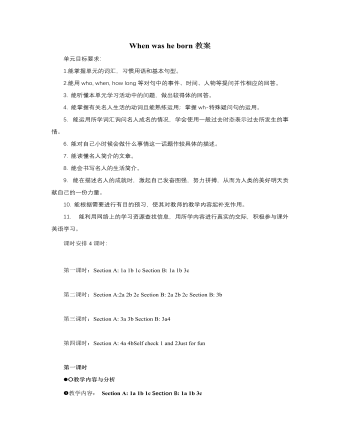
人教版新目标初中英语八年级上册When was he born教案
1.能掌握单元的词汇,习惯用语和基本句型。2.能用who, when, how long等对句中的事件、时间、人物等提问并作相应的回答。3. 能听懂本单元学习活动中的问题,做出较得体的回答。4. 能掌握有关名人生活的动词且能熟练运用;掌握wh-特殊疑问句的运用。5. 能运用所学词汇询问名人成名的情况,学会使用一般过去时态表示过去所发生的事情。 6. 能对自己小时候会做什么事情这一话题作较具体的描述。7. 能读懂名人简介的文章。8. 能会书写名人的生活简介。9. 能在描述名人的成就时,激起自己发奋图强,努力拼搏,从而为人类的美好明天贡献自己的一份力量。10. 能根据需要进行有目的预习,使其对教师的教学内容起补充作用。11. 能利用网络上的学习资源查找信息,用所学内容进行真实的交际,积极参与课外英语学习。课时安排4课时:第一课时:Section A: 1a 1b 1c Section B: 1a 1b 3c第二课时:Section A:2a 2b 2c Section B: 2a 2b 2c Section B: 3b
人教版新目标初中英语八年级下册Will people have robots教案
Teaching goals:1.Words&phrases: robot, paper, less, fewer, simple, unpleasant, factory, seem, etc .2.will 构成的一般将来时态的陈述句、否定句、疑问句及回答.3.There be 句型的一般将来时.4.more , less , fewer 的用法.5.学习一般将来时态的相关知识,学会对未来进行预测.6.对five years ago ,today ,in five years 简洁回顾与展望的方式,贴近实际符合学生心理,激发学习兴趣.7.通过时间对比复习一般过去时态、一般现在时态,巩固一般将来时.Important and difficult points :1.will构成一般将来时态的句式。2.There be 句型的一般将来时态。3.more , fewer , less 的用法。4.How to make predictions .Period 1Teaching procedures:Step 1 Leading in1.Greetings: Welcome to school .What’s the date today ? Who’s on duty today ?Do you enjoy your winter holiday ?Do you finish your homework ?Do you want to live on the moon ?Can you guess what will happen in ten years ?Collect the Ss’ answers and say something about their predictions .Step 2 Pre-taskSB Page 2 ,1a .1.Look at the picture :How will the world be different in the future ,100 years from now ?We’re going to talk about sth in 100 years .
人教版新目标初中英语九年级上册What would you do教案
本课采用任务型教学法,用What would you do if you had a million dollars?这个问句,引出谈论假想情况的话题。 采用提问、启发和归纳的教法,让学生易于接受教材内容,培养学生的语言运用能力。 四、 教学过程设计 Step Ⅰ. Greet the whole class as usual. Step Ⅱ. Warming-up T: Do you have ten Yuan in your pocket? S1: No, I don’t. T: (Take out ten Yuan and give it to the student) OK, never mind. What would you do if it was yours? What would you do if you had ten Yuan? S1: I would buy snacks. T: OK, thank you. Sit down, please. (To the whole class) Just now, it was only ten Yuan. What about 100 Yuan? What would you doif you had 100 Yuan? S2: I’d buy a beautiful jacket. T: Thank you. (To the whole class) Now suppose you had a million dollars, what would you do? We know thatone dollar nearly equals eight Yuan, so that’s a large sum of money. Think it over carefully and tellme your ideas. What would you do if you had a million dollars? S3: I’d buy a big house. S4: I’d buy a sports car. S5: I’d put it in the bank. T: OK, stop here. Please look at the blackboard and guess what would I do if I had a million
人教版新目标初中英语九年级下册When was it invented教案
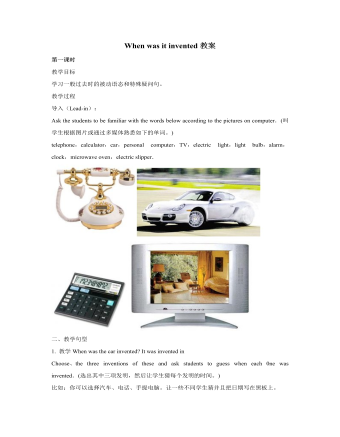
二、教学 1a,1b.1.First the teacher asks the students what kind of fruit food and drink you like the best and writes down on the blackboard.教师问学生最喜欢什么水果和饮料并把它们写在黑板上。比如:potato chips,ice cream,tea,lemon,chocolate,oranges,salad,popcorn,pickle and so on.2.接着叫学生表达以上食物的味道,引出新单词——sweet,crispy,salty,sour,delicious,hot,awful,nice…并且完成lb教学内容通过此活动,以旧带新引入新单词。其目的是让学生自主学习新知识。 三、教学 2a,2b1.首先,听力前的brainstormFirst,Let students describe how potato chips taste and describe how helpful the potato chips.Then,ask:When and where were potato chips invented?Who were potato chips invented by?How were potato chips invented?(Let students guess according to the following key words.)Key words:by accident,customer,restaurant,by mistake.(说明:通过问题让学生对对话内容有整体了解,为听力练习做好准备;又培养学生的注意力,想像力,观察力。)
人教版新目标初中英语九年级下册Have you packed yet教案
教学目标:1.学习现在完成时。2.学already和yet用法。3. 能够运用所学知识,谈论或询问最近已经发生的事情语言功能:能够运用所学知识,谈论或询问最近已经发生的语言结构:现在完成时态、一般现在时、一般过去时、一般将来时语言目标:Have you watered the plants yet?No, I haven’t.Have you fed the cat?No, I haven’t fed her yet.I have to do my homework. I started about an hour ago, but I haven’t finished. I will visit Hong Kong next year.重点词汇及短语:water, wood, farm, ocean, hit, appear, turn, government, thousands of, southern, villager, strongly, step, clean out, some day, be off, so far, go for walks, thanks to, look forward to学习策略与思维技巧:引导、合作跨学科学习:历史知识、文化学习教学重点:现在完成时态的构成及应用教学难点:现在完成时与一般过去时的区别 学习方式:自主、合作学习 情感目标: 教育学生做事情要有条理,养成“今日事,今日毕”的好习惯。培养学生养成反省的好习惯。增强学生做事的条理性及计划性。课前任务:记录和查找自己和别人已做过或仍没做的事情。
人教版高中英语必修4Body Language说课稿4篇
Textbook: Senior English for China (Book 4), by Liu Daoyi Time Allotment: 1 period (40 minutes)Date: March 20, 2014Teaching aids: blackboard, Multi-media, Power Point, chalk I. Text Analysis (教材分析)This unit is about body language, and the text selected in the reading part demonstrates the difference and similarity of body language in many parts of the world. Through learning this passage, students are required to raise their awareness of using body language in different parts of the world. As body language is closely related to our daily life, it is easy to arouse students’ interest in learning this text. Reading skills and speaking training are designed around the text.II. Teaching Objectives (教学目标)By the end of the lesson, students will be able to:1. Language Skill Objective(语言技能目标): develop reading ability (skimming and scanning)as well as speaking ability.2. Cultural Knowledge Objective(文化知识目标): know about the cultural differences of using body language.3. Affective Objective(情感目标): increase students’ awareness of using body language correctly in different cultures. III.Teaching Focuses and Difficulties(教学重点和难点)1. Teaching Focuses(教学重点): the difference and similarity of body language in many parts of the world.2. Teaching Difficulties(教学难点): develop students’ reading abilities of skimming and scanning and ask the students to show their opinions with fluent English.
人教版高中英语必修1Anne's best friend说课稿
Step 7 Language points 1.Vocabulary (1) go through (2) set down (3) a series of (4) on purpose (5) in order to (6)at dusk (7)entirely (8)face to face 2.Important sentences (1)…I’ve grown so crazy about everything to do with nature. (2)There was a time when … (3)I stayed awake on purpose until … (4)It was the first time … that I’d seen the night … (5)It’s no pleasure looking through … Purpose: 1.Master the required vocabulary and sentence structures. 2.Use them freely. Step 8 Consolidation 1.Find out the topic sentences 2.Retell the text according to the topic sentences Purpose: I want to know if my students understand the text. Step 9 Discussion Imagine you have to go into hiding like Anne and her family, what would you miss most? Giveyour reasons. Purpose: Train Ss’ oral English ability. Step 10 Homework Write an article on Friends. Purpose: 1. Improve the Ss’ writing ability. 2 Train the Ss’ ability of self—teaching and looking up information by themselves. Part 5 Blackboard design(说板书设计)Unit 1 Friendship Reading Anne’s Best Friend 1.Main idea of each paragraph: Para. 1 Anne made her diary her best friend. Para .2 Anne wrote her feelings in her diary. Para .3 Anne missed nature. Para.4 Anne saw the night face to face Para.5 Anne wanted to experience nature outdoors. 2.Listening: Exx.1 P3 3.Discussion: Exx.3 P3 Purpose: 1.Make Ss familiar with the passage 2.Make the design inductive, instructive and artistic.
人教版高中英语必修1Nelson Mandela--A Modern Hero说课稿
In this step, give students a few minutes to read the passage . While they are reading, I will write some key words of the text on the blackboard. Then ask students to retell the passage according to the key words.By retelling, students can improve their ability of language organization and have an overall understanding of the article.Step 4 Group discussionIn this step, students will be divided into groups of 4 to discussion the following question: What qualities make a great person?After their discussion, invite a few groups to make a report to the class.This group discussion can practice students’ oral English and cultivate their abilities of cooperation and communication.Step 5. HomeworkLet students write a short passage to introduce a great person he or she admires.The homework can consolidate the knowledge the students have learned and cultivate their writing ability. Part 6 Blackboard Design(板书设计)That’s all my teaching procedures. Finally, I’d like to say sth about part 6 blackboard design. On the top is the title. On the left, there will be some new words and expressions. In the middle of the blackboard, I will write some useful sentence structures so that the students can know clearly what they’ve learned and then try to master the knowledge.OK. That’s all for my presentation. Thank you for your attention.
人教版高中英语必修2Computers说课稿3篇
一. 教材分析1. 本单元的中心话题是“计算机(Computers)”,内容涉及计算机的发展历史,计算机的应用等。本节课是该单元的第一课时,我将Warming up, Pre-reading and Comprehending这四部分整合为一节精读课。其中。Reading部分是题为WHO AM I?的文章,以第一人称的拟人手法介绍了计算机发长演变的历史和计算机在各个领域的应用,其主旨是表达计算机的发展变化之快以及在生活中用途之广。而Warming up部分以图片的形式展现了计算机的发展历程;Pre-reading中的问题和排序分别是为了预测语篇的内容和测试学生对计算机历史了解的情况;Comprehending则通过各项练习训练学生的阅读技能,从而加深对文章的理解。可见这几部分是一个有机的整体。2. 教学目标:1) 语言目标:重点词汇及短语:abacus, calculate, calculator, PC, laptop, PDA, robot, analytical, technological, universal, mathematical, artificial, intelligent, network, explore, in common, as a result.重点句子:a. My real father was Alan Turing, who in 1963 wrote a book to describe how computers could be made to work, and build a “universal machine” to solve any mathematical problem.
人教版高中英语必修2The Olympic Games说课稿2篇
Purpose of my design:To ask the students to do these two tasks will make the Ss predict the story of this passage. As a result, it will deepen Ss’ memory of this story because they will have their own understanding of this story.Step 3. While-readingTask 1. (Individual work _____min)Skimming: ask students to skim the text and the main ideas of each paragraph in this passage. Please read it quickly and then match the sentences with the letters.Task 2. (Individual work _____min)Scanning: read the text quickly and decide the whether the following statements are true or false and give reasons.Task 3. (Pair work _____min)Listen to the tape and fill in the banks. Then read the paragraph with expression to your partner.Task4 (individual work min)Listen to the tape again and write down the main idea in one sentence.Purpose of my design: Enable students to understand the given material better by using different reading skills. And proper competition can arouse the Ss’ interest in English learning. “Task-based” teaching method is used here todevelop the Ss’ ability of communication and also their ability of co-operation will be well trainedStep 4. Post-readingTask 1. (Individual work, pair work, group work, class work; _____min)Discussion (group of 4):1. If you were Hippomenes, would you run against Atlanta?2. Do you think Hippomenes deserved to win the race? Why or why not?Step 5. HomeworkPlease read the story again carefully after class and imagine: What will happen during the race between Hippomenes and Atlanta? Who do you think will win the race? Do you think Atlanta would marry Hippomenes? Write an end for the story with thses questions.Purpose of my design: Homework is so important and necessary for to master the knowledge they learned after class. It will check whether the Ss achieve the teaching aims.Part 5 Blackboard design
人教版高中英语必修3Astronomy the science of the stars说课稿3篇
Step 2 Pre-listeningAfter students finish their discussion, I will show a picture of Newton and ask them: Who is him? What is he famous for? Could you find out some words to describe him? Maybe students will answer that he is genius for his finding of theGravitation, making a great contribution to the progress of human being. At that time I will show another two pictures of Einstein and Hawking, letting students guess who they are and write down their idea about the Gravitation. For I have arranged them to search more information about the gravity before this class, Students have beenfamiliar with the topic and will not be afraid about this abstract conception, which is helpful for their listening.Step 3 While-listeningIn this step, students will be required to listen the material for three times. The first and listening is extensive listening and the second and third listening is intensive listening. In the first time, They are required to listen a material including Part 1 and Part 2 and choose the best summary of the listening text. After they choose the right answer, They also need work in group to explain what is wrong with the others. Then I will make a conclusion that we should pay attention to the first paragraph and last paragraph and some keys to get the main idea. By doing this, their capacity of generalization will have a great improvement.Before the second listening, I will ask students to scan the blank on the power point quickly and ask them to note down some key words .Then ask them to listen to the Part 1again and fill the first column of the chart. Maybe some students just show the ideas of these three scientists an still can’t catch their development of gravity. Therefore, I will ask them to listen to Part 2 again and fill in the rest. After finish the listening, I will give them ten minutes to discuss with their partner. I will also guidethem to improve their answers when they discuss with others.
人教版高中英语必修4A taste of English Humor说课稿3篇
Then I would ask them to think of a funny English or Chinese and tell it to partners. While telling stories, they can use expressions and some acting to help make the story funny. 5 minutes would be given to do this.Those stories they told there will be the material for their writing. Soletting them tell it at first is helpful. And they can make a difference between telling a funny story and writing it down. Generally speaking, it is difficult forstudents to write well because they don’t know what to write and how to write. Asking them to tell their own stories at first can help them come up with what to write.After their telling, I would invite someone to share his/her story with all of us and I would write it down on the blackboard.This example story would be used as a sample to illustrate the format of funny story. Different from a story from teacher or textbook, a story from students can obviously become a interesting material to draw students’ attention.Then I would ask the whole class to put this story into several parts. It might be a little bit difficult for them. So I would ask them to find out whether all the sentences are necessary. After delete some sentences, there are 6 sentences left behind. Then they can easily put them into three parts. After interaction with students, I would teach them the right terms for each part and conclude the format of funny story.This step is the key and difficult point in my lesson. So I mainly usetask-based teaching method in this part and the task for students was divided into several stages. With the separated difficult level, students can find there are usually three parts in writing. They can also learn to write without the unnecessary parts in the process of analyzing. And then I wouldn’t rush to tell them the right terms to them directly. Instead, I would ask them to name them by their own. A confused mind is better for acquiring knowledge.While-writing:Then I would give students 7 minutes to write down this story, without other requirements.With all the preparations in pre-writing, students’ difficulties were cleared. So it would be much easier for them to write down the story within 7 minutes. There are no other requirements because students’ first writing is actually a drafting. It would be revise and edit several times later. Writing, as a skill
人教版高中英语必修3Canada-the true north说课稿4篇
Good afternoon, teachers, It’s my great pleasure to be here sharing my lesson with you.The content of my lesson is Senior English Book 3 Unit 5 Canada —— “The true North”.I’ll be ready to begin this lesson from five parts. Analysis of the teaching material,the teaching methods,the studying methods, the teaching procedure,and Blackboard design.First, let me talk about the teaching material.Part 1 Teaching Material:This unit is about the introduction of Canada. By studying of this unit,we’ll enable the students to learn the geography, population, main cities, and natural beauty, natural resources of Canada. Through the training of the unit, it also requires students to learn some Language skills such as the expressions of position and emotions.So it plays an important part in the English teaching in this book.After studying the teaching material and analyzing the rule of children’s growing of mind,I think the teaching aims are the followings:1.Knowledge objects:(1) make the students learn some new words and phrases(2) make the students understand the content of the lesson.2.Ability objects:(1)To develop the Ss’ abilities of listening, speaking, reading and writing. Especially reading and speaking ability.(2) learn to talk about the characters of Canada in English(3)To train the Ss’ ability of working in pairs.3.Emotion objects:(1)Enable students to understand the characters of Canada..(2)Stimulate Ss to work hard to make China stronger.Part 2 Teaching Methods:I think helping students learn to master new words and phrases and improve the students’ reading and speaking ability is import and the difficult.According to the analysis of the teaching material and the import points and the difficult points,I will use the following teaching methods : question-guiding approach; fast-reading and careful reading; multi-media teaching methods; discussion
人教版高中英语必修3Festivals around the World说课稿3篇
Teaching plan for Unit 1 book3Good morning, teachers. It’s my great pleasure to be here because I can share my lesson with you and I can learn a lot from it. I’ll begin my lesson from the following four parts, the teaching material, the teaching methods, the studying methods and the teaching procedure.Firstly, let me talk about the teaching material. The content of my lesson is the reading passage festivals and celebrations of Unit 1 Festivals around the world. This passage is about festivals and celebrations. By studying this passage, we’ll enable the students to know that festivals exit everywhere, and many of festivals in different countries celebrate similar ideas. As we all know, the reading passage is the center of each unit. If the Ss can learn it well, it will be helpful to make the Ss learn the rest of this unit.After studying the teaching material, I think the teaching aims are as the followings:1. Knowledge aims:(1) The Ss can master the usage of the important words andexpressions.(2)The Ss can use the __________________ (grammar) in the proper situation.Make students know about the festivals all over the world and the detail of the festivals, such as origin, content, and the date of the holiday festivals.2. Ability aims:(1) Students can talk about festivals and celebrations in English(2) To improve the student’s reading ability, especially their skimming and scanning ability.3. Emotion aims:Make the Ss know about the foreign festivals, and respect other countries’ custom.Next, let’s come to the important points and the difficult points.The important point is how to make the Ss understand the text better and the difficult point is how can they talk about it. secondly, Teaching Methods:1. task-based Language Teaching2. Computer assisted language teaching.3. question-and–answer methodThirdly, Studying Methods: