-
收藏模板
- 模板信息
- 更新时间:2023-09-22
- 字数:约12348字
- 页数:约7页
- 格式:.doc
- 推荐版本:Office2016及以上版本
- 售价:5 金币
您可能喜欢的文档
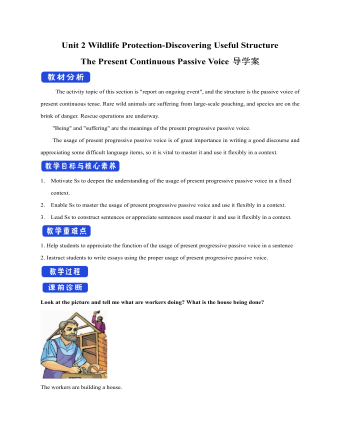
新人教版高中英语必修2Unit 2 Wildlife Protection-Discovering Useful Structure教案一
The activity topic of this section is "report an ongoing event", and the structure is the passive voice of present continuous tense. Rare wild animals are suffering from large-scale poaching, and species are on the brink of danger. Rescue operations are underway. "Being" and "suffering" are the meanings of the present progressive passive voice.The usage of present progressive passive voice is of great importance in writing a good discourse and appreciating some difficult language items, so it is vital to master it and use it flexibly in a context.1. Motivate Ss to deepen the understanding of the usage of present progressive passive voice in a fixed context.2. Enable Ss to master the usage of present progressive passive voice and use it flexibly in a context.3. Lead Ss to construct sentences or appreciate sentences used master it and use it flexibly in a context.1. Help students to appreciate the function of the usage of present progressive passive voice in a sentence2. Instruct students to write essays using the proper usage of present progressive passive voice.Look at the picture and tell me what are workers doing? What is the house being done?
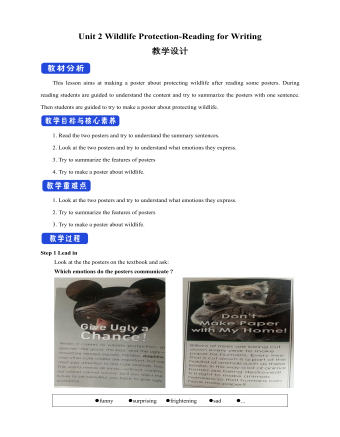
新人教版高中英语必修2Unit 2 Wildlife Protection-Reading for Writing教案二
This lesson aims at making a poster about protecting wildlife after reading some posters. During reading students are guided to understand the content and try to summarize the posters with one sentence. Then students are guided to try to make a poster about protecting wildlife.1. Read the two posters and try to understand the summary sentences.2. Look at the two posters and try to understand what emotions they express.3. Try to summarize the features of posters4. Try to make a poster about wildlife.1. Look at the two posters and try to understand what emotions they express.2. Try to summarize the features of posters3. Try to make a poster about wildlife.Step 1 Lead inLook at the the posters on the textbook and ask:Which emotions do the posters communicate ?Step 2 Read the poster and answer the questions.1. What do you think of the animals in the poster on the left ?I think it is frightening and ugly.2. Why do we should protect the ugly animals ?All species--the good, the bad, and the ugly-- should be treated equally.The world needs all kinds--without variety, our planet cannot survive.3. Why are billions of trees being cut down every year ?To make paper for humans.4. What result will be lead to after the trees are cut down ?A lost of animal homes are being destroyed./The habitat of wildlife is being destroyed.Step 3 Find the feature of posters1. What does each poster use to stir up emotions ?On the left, it makes us a little frightened and it looks a little ugly, but it can activate our curiosity--What is it? And What is wrong with it?On the right, it makes us feel a little sad and want to protect them.
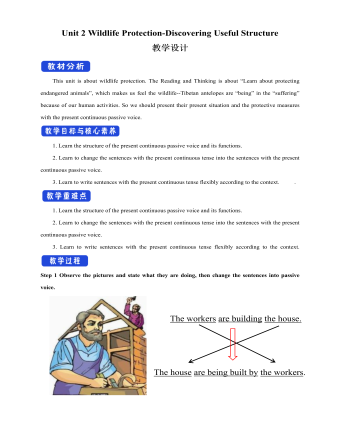
新人教版高中英语必修2Unit 2 Wildlife Protection-Discovering Useful Structure教案二
2.表示现阶段正在进行的被动动作(该动作在说话的瞬间未必正在进行)。Many interesting experiments are being carried out these days.(说话时,并不一定正在进行)3.表示一种经常性的被动行为,常和always,constantly 等表示频度的副词连用,这种用法常常带有赞扬或厌恶的感情色彩。He is always being praised by the leader.4.表示按计划或安排主语将要承受谓语动词所表示的动作(仅限于少数及物动词)。A party is being held tonight.Step 4 Special cases1.像take care of, look after, talk about, think of等动词与介词构成的短语用于现在进行时的被动语态时, 其中的介词不可省略。The ways to stop illegally hunting are being talked about. 2.可与部分情态动词连用,表示对正在发生的事情的推测。She may be being punished by her mother.3.有时可表示按计划或安排将要进行的一个被动动作。A celebration is being held this weekend for his success.4.某些表示“状态、心理活动、存在”等的动词,如have,want,need,love,一般不用现在进行时的被动语态,而常用一般现在时的被动语态。With the population increasing,more land is needed.5.“be+under/in+n.”可表示现在进行时的被动意义。My computer is under repair.=My computer is being repaired.
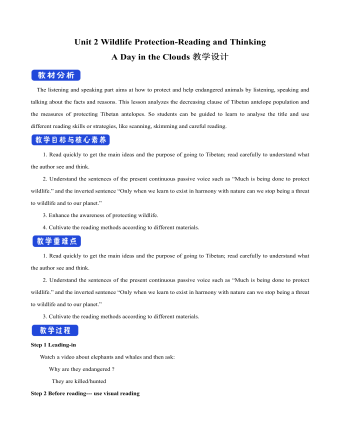
新人教版高中英语必修2Unit 2 Wildlife Protection-Reading and Thinking教案一
The listening and speaking part aims at how to protect and help endangered animals by listening, speaking and talking about the facts and reasons. This lesson analyzes the decreasing clause of Tibetan antelope population and the measures of protecting Tibetan antelopes. So students can be guided to learn to analyse the title and use different reading skills or strategies, like scanning, skimming and careful reading.1. Read quickly to get the main ideas and the purpose of going to Tibetan; read carefully to understand what the author see and think.2. Understand the sentences of the present continuous passive voice such as “Much is being done to protect wildlife.” and the inverted sentence “Only when we learn to exist in harmony with nature can we stop being a threat to wildlife and to our planet.”3. Enhance the awareness of protecting wildlife.4. Cultivate the reading methods according to different materials.1. Read quickly to get the main ideas and the purpose of going to Tibetan; read carefully to understand what the author see and think.2. Understand the sentences of the present continuous passive voice such as “Much is being done to protect wildlife.” and the inverted sentence “Only when we learn to exist in harmony with nature can we stop being a threat to wildlife and to our planet.”3. Cultivate the reading methods according to different materials.Step 1 Leading-inWatch a video about elephants and whales and then ask:Why are they endangered ? They are killed/hunted
新人教版高中英语必修2Unit 2 Wildlife Protection-Listening &Speaking&Talking教案
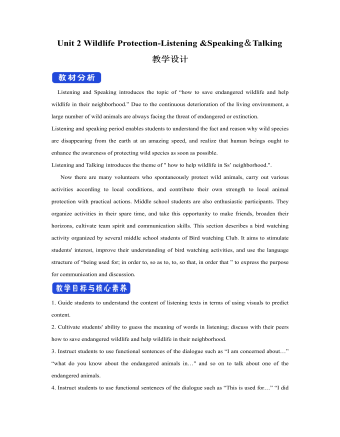
Listening and Speaking introduces the topic of “how to save endangered wildlife and help wildlife in their neighborhood.” Due to the continuous deterioration of the living environment, a large number of wild animals are always facing the threat of endangered or extinction. Listening and speaking period enables students to understand the fact and reason why wild species are disappearing from the earth at an amazing speed, and realize that human beings ought to enhance the awareness of protecting wild species as soon as possible.Listening and Talking introduces the theme of " how to help wildlife in Ss’ neighborhood.". Now there are many volunteers who spontaneously protect wild animals, carry out various activities according to local conditions, and contribute their own strength to local animal protection with practical actions. Middle school students are also enthusiastic participants. They organize activities in their spare time, and take this opportunity to make friends, broaden their horizons, cultivate team spirit and communication skills. This section describes a bird watching activity organized by several middle school students of Bird watching Club. It aims to stimulate students' interest, improve their understanding of bird watching activities, and use the language structure of “being used for; in order to, so as to, to, so that, in order that ” to express the purpose for communication and discussion.1. Guide students to understand the content of listening texts in terms of using visuals to predict content.2. Cultivate students' ability to guess the meaning of words in listening; discuss with their peers how to save endangered wildlife and help wildlife in their neighborhood.3. Instruct students to use functional sentences of the dialogue such as “I am concerned about…” “what do you know about the endangered animals in…" and so on to talk about one of the endangered animals.
- 查看更多相关Word文档
Wildlife Protection说课稿3篇
必修二unit4说课稿一
Unit 4 Wildlife protection
Warming-up & Pre-reading
各位老师大家好!很高兴今天能够在这里与大家分享我的课堂。
我的说课主要分为五个部分:教材分析,教学目标,重难点分析,教学方法,和教学过程。

教材分析
我说课的内容是高中英语必修二的第四单元。本单元是有关于野生动物的保护。随着经济的发展,环境问题越来越突出,人与自然如何和谐共处成为了我们必须面对的问题。作为高中生,应该了解野生动物保护知识,并确立环保观念。希望通过对本单元的学习,能够让学生了解到那些濒临灭绝的野生动物的生存现状,并提高他们保护野生动物的意识。与此同时,希望学生能够知道如何去保护野生动物。这节课是本单元的第一课时,是针对本单元的warming-up和pre-reading的展开的,正如我们所知道的,每一单元的warming-up和pre-reading都是对本单元所学习的中心内容起到铺垫的作用,所以希望通过这节课,可以激发学生对学习本单元以及学习英语的兴趣。
教学目标
这节课的教学目标一共分为三部分:
语言知识目标
1)即让学生对野生动植物的生存现状及其濒临灭绝的原因有所了解;
2)能从这部分内容中学会并使用一些本单元的重点词汇和短语:die out, in peace, in danger 等。
二,能力目标
1)锻炼及提升学生根据标题和图片预测课文内容的能力;
2)锻炼口语表达能力;
3)提升团队合作意识。
三,情感目标
通过对野生动植物生存现状及其数量减少的原因的了解,让学生意识到保护动植物、保护环境的重要性,同时要对大自然的给予心存感恩,另外,学生能够体会到人类在保护环境中的责任,并意识到人类和环境和谐相处的重要性。
重难点分析
本课的教学重点是帮助学生深入了解保护野生动物的重要性,思考动物保护的多种方式。学习重点句型和短语。如重点词汇:wild,decrease,loss,reserve;重点短语:die out,in peace,in danger;重点句型:This is wildlife protection is all about。
本课的教学难点是训练学生获取信息,处理信息,思考问题,解决问题的方法。以及使学生能够使用目标语言表达自己的观点。
教学方法
正如我们所知,国家标准课程改革要求建立以学生为中心的教学模式。而且学好英语,要求教师能够帮助学生提高他们的语感。所以,通过对教材内容以及教学目标的分析,我决定采用以任务型教学为主,交际教学法为辅的教学方法。同时使用多媒体辅助教学,增加课堂教学的生动性。
教学过程
Step I. Lead-in. (8mins)
Greet to the class. And the teacher canask Ss some questions to lead to the new unit.
T: Where do we often see the animals?
Ss: In the zoo…
T: Are these animals all in the zoo?
Ss: No, some of them are in the zoo.
T: And the others?
Ss: In the wild maybe.
T: Yes…
Task 1. Brainstorm. (Group work; 5mins)
Ask Ss work in group to think about thewords related to animals as much as they can, such as milu deer, panda, tiger,die out, in danger. Then compare their list with other group.
Purpose of my design: (1) To catch Ss’ attention about the topic.
(2) And proper competition can arouse theSs’interest in English learning.
Step II. Warming-up (20mins)
Let Ss discuss the questions on the ppt.(Questions: Do you know top 10 most endangered animals in China? And what arethey?).
After discussion, the teacher shows theanswers on the ppt.
Then let Ss read the paragraph and reportin the Warming-up part. And complete the task1.
Task 1. Question discussion. (Group work;15mins)
Questions: 1. What other endangeredspecies do you know of?
2. Do you know any wildlife that has disappeared?
3. Why are they in danger?
Ask Ss to discuss these questions and makea conclusion. Then choose some of them to make a presentation of theirconclusion. Try to let them use the new phrases like die out, in peace and indanger. And then show them some reasons of the third question on the ppt.
Purpose of my design: (1) To get to knowthe situation of endangered animals.
(2) To have a better understanding aboutthe importance of wildlife protection.
Step III. Pre-reading. (15mins)
Task 1. Role-play. (Pair work; 10mins)
Ask student A to play an animal, andstudent B to play a reporter. B try to interview A about his feelings andsuggestions about what our human beings should do.
Useful expressions: I’m sorry to hear that…
I am afraid that…
It is very nice of you but…
It is a shame that…
Why didn’t you tell me that…?
Thank you very much but…
Let Ss go through the questions in thePre-reading part. And ask Ss to discuss what the relationship between peopleand wildlife should be, and what we can do to protect endangered animals. Thenpresent the answers on the ppt.
Purpose of my design: “Task-based” teaching method is used here to developthe Ss’ability of communicating with each other. And also their ability ofco-operation will be well trained.
Step IV. Homework. (2mins)
Review the new words and phrases learnedin this lesson.
Find information about WWF and what wehave done to protect endangered animals on the Internet.
Purpose of my design: Homework is soimportant and necessary for to master the knowledge they learned after class.It will check whether the Ss achieve the teaching aims.
必修二unit4说课稿二
Good morning, ladies and gentlemen. I’m Gu Huizhen. It is my pleasure to be hereto present my teaching plan. The content of my lesson is How Daisy learned tohelp wildlife protection.
Six parts are covered in the plan, theyare analysis of students, teaching material, teaching objectives, teachingmethods, teaching procedure, and teaching reflections. I.First, I’ll give a brief analysis of students.
The student of grade 7 in senior highschool are around
16. At this age they have laid a goodfounddation of knowledge and reading skills . They are active in class andcurious about everything around them.
II.Next, analysis of teaching material
New Senior English ForChina Student’s Book 3 was published by People’s Education Press in 2013 and it is basedon functional-notional syllabus. How Daisy learned to help wildlife is the 2ndpart of this unit, it introduces why we need wildlife protection and how weprotect the wildlife. it is related to our real life, most students areinterested in it.
III. Analysis of teaching objectives
Based on the analysis of the students andteaching materials,the teaching objectives are as follows.
Knowledge objectives:Words and phrases:carpet, fur, mercy, in relief, burstinto laughter, protect…from, pay attention to ;To know thesituation that endangered animals are facing and measures we could take.
Ability objectives: To predict informationthrough title and pictures; To retell the passage with the help of mind map.
Affection objectives:To arouse students’ awareness of wildlife protection; Tolearn to cooperate with others. IV. Part 4 analysis of teaching approach
Task –based language teaching approach will beapplied in this class in order to achieve the objectives effectively. V. let’s come to the most important part,analysis of teaching procedure
Based on the basic principle of TBLTapproach . I am going to apply PWP model, it includes pre-task, while-task andpost-task.
In pre-task, 3 steps are included.
Step 1,I will ask s to think of endangeredanimals, then I will show some pictures . Step 2 , I will ask s the reasons ofdisappearing.Step 3, Task-presentation, make a poster. In while-task,
First of all, I will ask s to predict whatthe passage is mainly talking about with the help of title and pictures in
1’. After predicting, I will give them 5’ for skimming the whole passage to get themain idea of the first three paragraphs, before that I will tell them payattention to the first and last sentences in each paragraph .
Next , 2’ for scanning para1 and tick the correctanswers. And I will tell them read the answers first. 2’ will be given for scanning para 3’ and finish the table. At last, 3’ to scan the 3rd paragraph and answer thequestions with the help of useful phrases .After reading, I will ask studentswork in groups to list at least three ways to protect wildlife.
In post-task,
Students finish their poster with the helpof model, and present their poster in class.
VI. Teaching reflections
Learned-centered; based on the real life;interactive activities.
必修2uni4说课稿三
Lesson Draft of Wildlife Protection
Good morning, ladies and gentlemen. It’s my great honor to be here, sharing mylesson with you. First, let’s watch a short video for 30 seconds andguess what subject I’lltalk about. Yes, you got it “wildlife”. Now I’ll give a short speech in the followingaspects: the analysis of the teaching materials, the teaching aims, theteaching important and difficult points, the teaching and learning methods, theteaching procedures, and the teaching reflection .
First of all, let’s analyze the teaching materials.According to the new standard curriculum and the syllabus, interest is thefirst teacher to the Ss. Warming up is the first step to motivating the Ss’ interest, leading to the successfulaccomplishment of the whole teaching task. It introduces the theme of the unitand gets the Ss well prepared for the study of it. The content of my lesson isWildlife protection from Senior English Book 2 Unit 4 Section 1 Warming up. Inaddition to the original materials, I’ll add some simple listening materials.
After studying the teaching materials andanalyzing the rule of children’s growing of mind, I’ll lay my teaching aims on the following 3goals. 1.Knowledge goal:
After this period of study, the studentscan know something about wildlife and the present situation of some endangeredspecies . 2.Ability goal:
The new standard curriculum demands weshould improve the Ss’ability of listening, speaking, reading and writing, especially listening andspeaking, which play an important role in English learning.
Besides, as a modern teacher, I aim atimproving the Ss’ability of self-study as well as cooperation with others. Try to develop theircreativity and improve their skills of communicating. 3.Emotion goal:
After this period of study, the Ss canraise the awareness of protecting wildlife and the environment.
Then, what are the teaching important anddifficult points?
I always stress the importance of the Ss’ motivation of study. So I’ll spare no effort to light up theirinterest, which is the key to success. What’s more, curiosity can drive them toexplore further. Yet taking the actual state of my Ss into consideration, theSs from the countryside may find it hard to talk about the abstract subject,which seems somehow a little far from their daily life. It’s necessary for us teachers to help themovercome the psychological pressure in communicating. Therefore, as theirguide, organizer, helper and partner of this activity, I must smooth away theirobstacles.
转载请注明出处!本文地址:
https://www.lfppt.com/worddetails_88965725.html最新说课稿文档
-
备战开学季新学期开学小报手抄报word模板
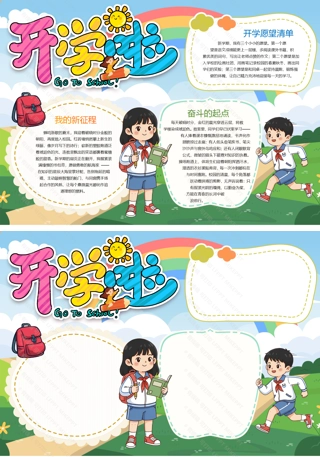
这套 “开学啦” 主题手抄报套装包含彩色填色版、空白编辑版与黑白线稿版,是专为学生打造的开学主题创作模板。它以清新明快的校园插画为底色,搭配彩虹、太阳等充满活力的元素,整体风格活泼可爱。彩色版已为你提供完整范例,包含三个核心板块:“我的新征程”:以优美的文字抒发告别假期、重返校园的期待,表达了在知识海洋里遨游、与同窗携手奋进的愿景。“奋斗的起点”:描绘了晨光里教室的读书声、操场上挥洒的汗水,传递出以勤奋为舟、在青春长河里破浪前行的积极态度。“开学愿望清单”:用具体的小目标,如提升语文成绩、加入校园社团、和同伴坚持晨跑,展现了新学期的成长规划。空白版和线稿版则为学生预留了充足的创作空间,你可以自由填充文字、图案,既能直接借鉴彩色版的文案,也能写下属于自己的新学期期许。无论是用于课堂作业、班级展示,还是作为开学季的自我激励,这套手抄报都能帮你用生动的方式开启新学年。
做一名阳光少年说课稿
1、紧密联系学生的生活实际,所选材料、所有活动均本着为主题服务的原则。2、形式多样化。通过心灵补给站、我来当编剧、心动不如行动等丰富多彩的活动,激发学生的热情,充分发挥他们的主体性。3、用生活中的真人真事激励他们,震撼他们的心灵,对学生进行教育,让他们得到感悟。五、说评价方式:要真正发挥主题队会的教育作用,千万不能把主题队会开成“检讨会”、“批评会”。兴趣是最好的老师,在课堂上,学生有了兴趣,才会有学习的动机,所以,在教学过程中,我努力把学生当作一个平等的朋友来对待,对于学生的回答进行评价时,本着“多表扬少批评,多鼓励少指责”的原则,尽量不用指令性、批评性的语言,最大限度的挖掘学生的优点,进行激烈性评价。
追思先烈魂,弘扬爱国情说课稿
环节四深入实践——弘扬爱国情爱国不是一句口号,要将爱国情怀落实到行动中去,队员们在各队队长的组织下,商讨出了落实方案。1、第一小队和第二小队组成了先烈故事演讲团,利用班会十分钟的时间,在三四年级宣讲先烈故事。2、第三小队和第四小队组成了创编小能手,编唱了爱国童谣、爱国拍手歌,告诉大家,爱国无处不在,爱国要从小事做起。3、第五小队和第六小队编写的爱国倡议书,提倡大家让爱国从口号落实到行动。4、全体队员共同宣誓:时刻准备着,为共产主义事业而奋斗,将活动推向了高潮。环节五大队辅导员总结“风雨沧桑,多遭铁蹄践踏,未有沉沦终奋起;荡涤污浊,重聚华夏精魂,披荆斩棘勇向前。”让我们牢记自己是中国人,怀一颗中国心,明确方向,努力奋斗,早日实现自己的梦想。
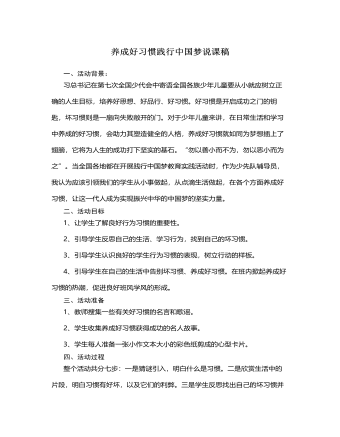
养成好习惯践行中国梦说课稿
第七步:全班学生一起倡读承诺书:(课件出示)我们都是小学生,培养习惯最要紧;上课应当专心听,积极开动小脑筋;作业认真仔细做,按时完成交得勤;有了错误要订正,知识才能学得清;人生要有好习惯,我们牢牢记心上。最后请学生把自己要养成的好习惯写在心意卡上,写好后粘贴在教室后面的园地里,互相督促,使得此次活动教育延续课后,直至影响一生.5、活动效果及反思此次活动开展后,学生们增强了对自身的认识,很多学生下决心改掉自身的坏习惯,并逐步采取了实际行动,从身边的小事做起,而且在学生中间还兴起了互相帮助、互相指正、争相进步的热潮。通过此次活动我也切实的体会到养成教育要开展就要落到实处,从实际出发,让学生亲自去感受,去体会,并且要持之以恒的做下去。同时作为老师更应该有一颗敏感热情的心,随时发现学生身上的闪光点与不足,多指正、多指点、多鼓励、多表扬,做到时时处处皆教育,这样才能赢得孩子,做好教育。
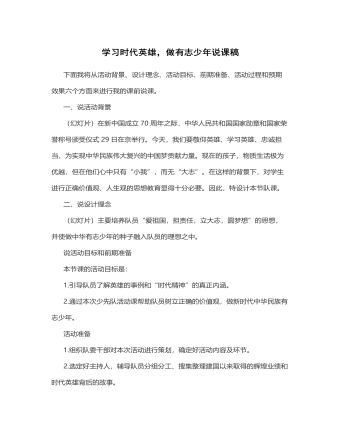
学习时代英雄,做有志少年说课稿
一、说活动背景(幻灯片)在新中国成立70周年之际,中华人民共和国国家勋章和国家荣誉称号颁受仪式29日在京举行。今天,我们要敬仰英雄、学习英雄、忠诚担当,为实现中华民族伟大复兴的中国梦贡献力量。现在的孩子,物质生活极为优越,但在他们心中只有“小我”,而无“大志”。在这样的背景下,对学生进行正确价值观、人生观的思想教育显得十分必要。因此,特设计本节队课。二、说设计理念(幻灯片)主要培养队员“爱祖国,担责任,立大志,圆梦想”的思想,并使做中华有志少年的种子融入队员的理想之中。说活动目标和前期准备本节课的活动目标是:1.引导队员了解英雄的事例和“时代精神”的真正内涵。2.通过本次少先队活动课帮助队员树立正确的价值观,做新时代中华民族有志少年。
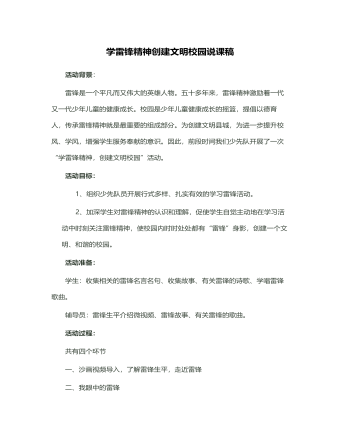
学雷锋精神,创建文明校园说课稿
雷锋精神是什么?这一环节是让学生用简单的词语或句子概括。通过这一活动,让学生概括出雷锋精神的内涵:像无私奉献、乐于助人、为人民服务、勤俭节约、尊老爱幼、勤奋好学、干一行爱一行、言行一致等等都是雷锋精神的体现。我们少年儿童是中国的未来和希望,雷锋精神的发扬和光大,创建文明校园的任务就落在他们的肩上,所以在这里我还设计了为发扬雷锋精神,创建文明校园“我该怎么做”这样的问题,目的就是让他们一起行动起来,学雷锋做好事,并制作了“荣誉”旗,奖励身边的好人好事。活动延伸:这里我设计了一个角色游戏活动——我要义卖献爱心,这个游戏学生们表现得非常积极,他们收集了自己不要的小文具或小玩具,将他们拿到集市上去卖,卖东西获得的钱,捐给王奶奶的孙女,因为王奶奶的孙女生病了,无钱治病。我觉得这个游戏使学生们懂得,一个人只要有爱心,只要愿意去帮助别人,无论什么方式都行,而且在游戏活动中孩子们体会到了帮助别人是一件多么多么快乐的事呀。
今日更新Word
-

【元宵节】2026马年元宵节手抄报
这套 “元宵节快乐” 手抄报以暖黄为主色调,融入萌娃吃汤圆、醒狮贺岁、红灯笼等元素,年味浓郁且充满童真,包含彩色成品、彩色空白、黑白线稿、浅线稿四种版式,兼顾范例参考与自主创作。内容板块聚焦元宵节核心民俗,“元宵节的习俗” 介绍赏花灯、猜灯谜的传统由来;“元宵节美好寓意” 解读团圆、祈福的文化内涵;“元宵节猜灯谜” 讲述这一趣味活动的历史与魅力。各板块以矩形、云朵形边框清晰划分,层次分明,成品提供详实的民俗知识与文案范例,空白版本便于学生填充个人的元宵经历与感悟,是兼具文化性与实用性的元宵节主题手抄报模板。

【寒假生活】卡通寒假生活冬天小报手抄报Word模版
这套 “寒假生活” 手抄报以冬日雪景为基底,搭配滑雪孩童、捧书阅读等童趣插画,色彩明快且充满生活气息,涵盖彩色成品、彩色空白、黑白线稿、浅线稿四种版式,兼顾范例参考与学生自主创作需求。内容板块设计贴合小学生寒假日常,“滑雪之旅” 记录户外滑雪的趣味经历与挑战自我的感悟;“寒假书法练习” 讲述坚持练字的过程与收获;“寒假读书计划” 分享《海底两万里》等书籍的阅读心得;“寒假总结” 复盘假期的学习、运动与志愿服务收获,反思不足并规划新学期。各板块以异形边框清晰划分,层次分明,成品提供优质文案范例,空白版本便于学生填充个人假期故事,是助力小学生梳理寒假生活、记录成长的实用模板。

【迎新年】大年初一拜大年新年福马迎春马年春节小报手抄报
这套 “大年初一拜大年” 手抄报以红金为主色调,融入萌娃拜年、财神送福、红灯笼等元素,年味浓郁且童趣十足,包含彩色成品、彩色空白、黑白线稿、浅线稿四种版式,兼顾范例参考与自主创作。内容板块聚焦大年初一传统习俗,“初一拜年的由来” 讲述年兽传说与拜年习俗的起源;“团圆喜乐” 描绘初一阖家团圆、吃饺子年糕、收红包的温馨场景;“马年初一” 则结合生肖寓意,传递新春的活力与美好祝福。各板块以矩形、圆形边框清晰划分,层次分明,成品提供详实的民俗知识与文案范例,空白版本便于学生填充个人的拜年经历与新春感悟,是兼具文化性与实用性的春节主题手抄报模板。
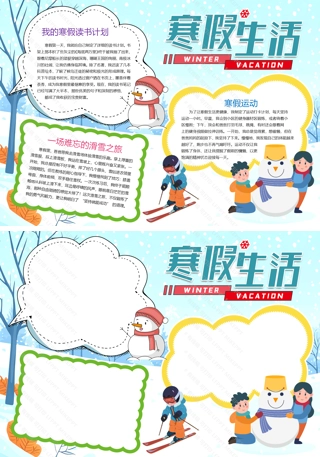
【寒假计划】我的寒假生活冬天寒假计划小报手抄报Word模版
这套 “寒假生活” 手抄报以冬日雪景为背景,融入滑雪、堆雪人等童趣插画,整体风格清新活泼,兼具观赏性与实用性,包含彩色成品、彩色空白、黑白线稿、浅线稿四种版式,适配不同创作需求。内容板块设计贴合小学生寒假生活,“我的寒假读书计划” 记录阅读《海底两万里》等书籍的收获,分享做读书笔记的心得;“一场难忘的滑雪之旅” 讲述滑雪的经历与 “坚持就能成功” 的感悟;“寒假运动” 板块则介绍了每日运动计划与健身收获。各板块以云朵、矩形等异形边框区分,层次分明,成品提供优质内容范例,空白版本便于学生填充个人假期故事,是助力小学生梳理寒假生活的优质模板。

【寒假计划】卡通寒假生活寒假计划冬天小报手抄报Word模版
这套 “寒假生活” 手抄报设计充满冬日暖意,以蓝白为主色调,搭配雪人、红柿、孩童堆雪等元素,既显节日氛围又富童真。版式包含彩色成品、彩色空白、黑白线稿、浅线稿四种,兼顾范例参考与自主创作需求。内容板块聚焦寒假核心生活,“滑雪之旅” 记录户外体验的乐趣与挑战,“寒假读书计划” 分享《海底两万里》等书籍的阅读收获,“寒假书法练习” 讲述坚持练字的成长感悟,“寒假总结” 复盘假期的收获与不足。板块以粉色边框清晰划分,内容兼具趣味性与教育性,空白版本则为学生预留了书写个人假期故事的空间,是适配小学生的优质寒假作业模板。

【寒假计划】寒假生活寒假计划冬天卡通小报手抄报Word模版
这套 “你好寒假” 手抄报设计精巧,兼具实用性与美观性,以冬日蓝为主色调,搭配堆雪人、读书等童趣插画,营造出浓厚的假期氛围。版式上分为彩色成品、彩色空白、黑白线稿、浅线稿四种版本,适配不同使用需求。内容板块丰富且贴合小学生生活,“滑雪之旅” 记录户外实践的快乐,“寒假总结” 复盘成长收获,“寒假读书计划” 分享阅读感悟,“寒假书法练习” 展现坚持的意义。各板块以云朵、矩形等边框区分,层次清晰,既为学生提供了优秀的内容范例,空白版本也方便孩子们填充自己的假期故事,是一份兼具展示与创作价值的寒假作业模板。