-
人教版高中地理必修2城市内部空间结构教案
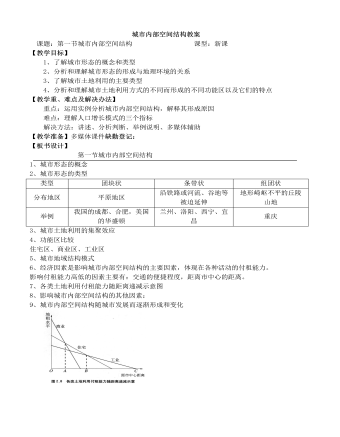
过渡:在实际生活中,城市内部空间结构并非完全按照这一经济规律呈现,而是更具复杂性。这说明除了经济因素外,还有很多其他因素在起作用,请大家结合你的认识、图2.9和案例1:纽约市的少数民族区谈谈你的看法。(2)其他因素I收入——形成不同级别住宅区的常见原因。有能力支付昂贵租金和选择最佳居住环境的人,其居住地往往形成高级住宅区。II知名度——城市内某些地区在历史、文化或经济方面具有很高的声誉,这往往会吸引更多新的住宅或商场建在该处,以提高其知名度。III种族聚居区的形成——在有些城市的某一区域内,如果某个种族或宗教团体占优势,就可能形成种族聚居区。如纽约市的唐人街、哈林区、小意大利区等。IV历史因素——城市的建筑物和街道设计可以维持久远,早期的土地利用方式对日后的功能分区有着深远的影响。
人教版高中地理必修2农业的区位选择教案
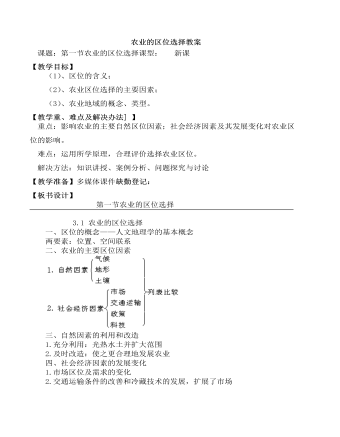
【教学目标】 (1)、区位的含义;(2)、农业区位选择的主要因素;(3)、农业地域的概念、类型。【教学重、难点及解决办法] 】重点:影响农业的主要自然区位因素;社会经济因素及其发展变化对农业区位的影响。难点:运用所学原理,合理评价选择农业区位。解决方法:知识讲授、案例分析、问题探究与讨论【教学准备】多媒体课件缺勤登记:三、自然因素的利用和改造1.充分利用:光热水土并扩大范围2.及时改造:使之更合理地发展农业四、社会经济因素的发展变化1.市场区位及需求的变化2.交通运输条件的改善和冷藏技术的发展,扩展了市场
人教版高中历史必修1辛亥革命教案2篇
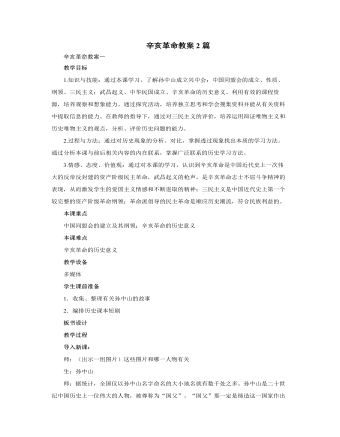
①从政府人员组成看,南京政府是一个以资产阶级革命派为主体的政府。②从政府颁发的法令和措施看,这些法令体现了资产阶级民主革命的要求,对于发展民族资本主义经济、资产阶级民主政治和文化教育以及改革社会风气,都起了积极作用。③从颁布的《中华民国临时约法》看,宪法体现了三权分立的政治体制,体现了资产阶级民主主义的要求,是中国历史上第一部资产阶级民主宪法,具有反封建专制制度的进步意义。(2)从南京临时政府的内外政策分析南京政府的根本弱点①未彻底地反封建。它没有采取比较彻底的反对封建主义的措施,特别是对封建统治的基础——地主阶级土地所有制没有触动,这样,南京临时政府也就不能真正地把广大人民群众动员起来,因而缺乏真正的群众基础。
人教版高中历史必修2古代手工业的进步教案
①原因:封建制度的衰落(根本原因)【合作探究】清朝资本主义萌芽缓慢发展的原因。提示:①封建所有制的束缚。残酷的封建剥削使农民赤贫如洗,无力购买手工业品,限制了手工业产品的销路。封建地租的剥削率很高,又驱使地主和商人把他们的钱财用于购买土地,影响资本主义手工业的扩大再生产。②.封建政府的压制。清政府实行重农抑商的政策,采取了许多妨碍手工业生产和资本主义萌芽发展的措施,主要的有:实行闭关政策,严格限制海外贸易;在国内广设关卡,对商品征收重税;严格控制手工业的生产规模,如建立受官府控制的行会,制定行规限制雇工人数、产品品种、控制原料分配,限制产品销售的价格和地区范围等。②发展的表现:具有资本主义萌芽的部门和地区增多。(参见教材P10“学思之窗”)
人教版高中历史必修2古代的经济政策教案
【本课小结】本课主要讲述了古代中国土地制度的发展情况。明清的资本主义萌芽,是中国封建社会内部产生的新生事物。但资本主义萌芽受到的封建王朝“重农抑商”和“闭关锁国”政策的阻碍。正是这种“闭关锁国”与“重农抑商”政策相结合,导致了资本主义萌芽的缓慢发展,并使中国与世隔绝,不能及时学习西方先进的科学技术,使中国落后于世界潮流,从而埋下了日后落后挨打的祸根。【智能训练】阅读下列材料:材料一自耕农是封建国家直接剥削的对象。为了保证赋税、徭役的供应,封建国家历来关注这一阶层的存在。“稳定小农”是封建王朝长治久安的良策,每一个新王朝建立时,对此尤为关注。他们总是采取鼓励垦荒等政策,积极培植自耕农。诚然,自耕农这一阶层是很不稳定的,经常分化。
人教版高中历史必修3启蒙运动教案2篇
教学目标:1、知识与能力:(1)识记:理性、启蒙运动;伏尔泰、孟德斯鸠、卢梭等伟大的启蒙思想家及其主张;康德及启蒙运动的影响;(2)理解启蒙运动兴起的背景,分析启蒙思想的巨大影响;(3)认识上层建筑对社会发展的巨大反作用。2、过程与方法:(1)指导学生用表格法掌握启蒙运动主要代表人物及其思想主张;(2)运用比较法加深对启蒙思想家观点共性和个性的认识。(3)运用比较法对比文艺复兴和启蒙运动的异同,说明启蒙运动对人文主义思想的发展。3、情感态度与价值观:(1)通过本课的学习,让学生认识到“一定的文化是一定社会的政治和经济在观念上和形态上的反映”;(2)学习启蒙思想家追求真理的精神,培养学生远大的理想与抱负;(3)通过法国启蒙思想产生的巨大影响的分析,使学生认识意识形态对社会发展所起的重大作用,从而提高学习理论的自觉性。
人教版高中地理必修2城市化精品教案
1.改善城市环境:治理河流、控制大气污染物、大力加强绿化建设为改善城市环境,上海市全面展开对大气、河流、噪声等多方面的治理工作。如苏州河的治理、降低城市污染物浓度、加强绿化建设,截止1990年,市区绿化覆盖率达到20.3%。2.改善城市交通、改善居住条件扩宽主干道,修建环城公路,修筑了南浦大桥和扬浦大桥,新修城市高架公路和地铁,改造住宅。3.控制城市规模建立卫星城,开发新区,有效地控制城市中心区的规模。思考:什么时候许多国家采取措施保护和改善城市环境?你认为可以采取哪些措施来保护和改善城市环境?上海市保护和改善城市环境的措施:上海的卫星城有哪些?上海新建了哪个新区?目前浦东新区在上海的地位如何?建立卫星城和开发新区可以起到什么作用?上海市为改善交通条件,做了哪些工作?
人教版高中历史必修2第一次工业革命教案2篇
一、教学目标知识与能力:了解或掌握英国工业革命的条件和重要发明及进程,掌握工业革命的影响。分析工业革命首先发生在英国的条件和工业革命的影响,领会生产力和生产关系,经济基础和上层建筑之间的辩证关系;分析工业革命对世界市场发展的影响,提高材料解析能力;分析世界市场基本形成的影响,培养学生运用辩证唯物主义和历史唯物主义分析历史事件的能力。过程与方法:启发式谈话法,问题探究法:层层设疑,环环相扣,由浅入深地理解知识。联系比较法:构建知识体系,突出事物特点。情感态度与价值观:懂得科学技术是第一生产力,使学生尊重科学,热爱科学;正确认识工业文明的成就与代价,帮助学生形成正确价值观;联系中国历史深刻理解科技兴国,深化改革的必要性。二、教学重点和难点重点:英国工业革命产生的原因、工业革命的主要成就和影响。难点:工业革命对资本主义世界市场发展的影响。课时安排:1课时教具准备: 多媒体课件以及相应教学资料。
人教版高中政治必修2民主选举:投出理性的一票教案
教师活动:那种“选举与我无关”,“选谁都可以”的想法,是公民意识不强、主人翁意识不强的表现。那么,怎样才能行使好自己的选举权呢?请同学们根据上面的学习,谈谈自己的想法。学生活动:思考讨论教师点评:2、 如何行使好自己的选举权(1)要不断提高自己参与民主选举的素养,端正参加选举的态度,提高选举能力,选出切实能代表人民利益的人。(2)要增强主人翁责任感和公民参与意识,积极参加选举,认真行使自己的选举权。(3)要不断提高政治参与能力,在理性判断基础上,郑重投出自己的一票。(三)课堂总结、点评本节内容讲述了我国的选举方式以及如何珍惜自己的选举权利的有关知识,懂得我国是人民民主专政的社会主义国家,人民当家作主,应该增强主人翁责任感,自觉珍惜并运用好选举权,以促进我国的民主政治建设,维护人民的根本利益。
人教版高中政治必修2民主选举:投出理性一票教案
1、第一,材料一和材料二的选举方式有什么异同?(1)相同点:①都采用了演讲和答辩等形式,都带有竞选的性质;②都采用无记名、直接选举的方式进行投票选举;③都属于差额选举。(2)不同点:①材料一是对村主任进行的正式选举,结果是直接产生村主任,材料二是对镇长候选人进行的选举,结果只是确定镇长候选人,镇长人选还有待进行正式选举;②材料一是全体村民都参加选举,材料二是各户派代表参加选举;③材料二比材料一更强调竞选的方式。第二,你还知道哪些选举方式?除了直接选举外,还有间接选举、等额选举、差额选举等。第三,你能对这几种选举方式的意义和效果,作出自己的评估吗?这是学习中要探究的问题,这里不一定能回答出来,等到学完本框内容后,可以得出比较明确的答案。第四,材料三给了你什么启示?这个问题不要求统一的答案,能讲出一两点即可。提示如下:(1)新中国成立后,选举制度经历半个多世纪的发展,正在逐步走向完善;
新人教版高中英语必修3Unit 2 Morals and Virtues-Listening &Speaking&Talking教学设计
Example:One day, a poor boy who was trying to pay his way through school by sending newspapers door to door found that he only had one dime(一角)left. He was so hungry that he decided to beg for a meal at the next house.However, he lost his nerve when a lovely young woman opened the door. Instead of a meal he asked for a drink of water. She thought he looked hungry so she brought him a large glass of milk. He drank it slowly, and then asked, “How much do I owe you?” “You don’t owe me anything,” she replied, “Mother has taught me never to accept pay for a kindness.” “Then I thank you from the bottom of my heart.” With these words, Howard Kelly left that house.Years later the woman became badly ill and was finally sent to the hospital in a big city. Dr. Howard Kelly, now famous, was called in. When he heard the name of the town she came from, a strange light filled his eyes. Dressed in his doctor’s clothes, Dr. Kelly went into her room and recognized her at once. From that day on, he gave special attention to her, and decided to do his best to save her life.At last the woman was saved. Dr. Kelly asked the business office to pass the final bill to him. He looked at it and then wrote something on the side. The bill was sent to the woman’s room. She was afraid to open it because she was sure that it would take the rest of her life to pay for it off. Finally she looked, and the note on the side of the bill caught her attention. She read these words: “Paid in full with a glass of milk, Dr. Howard Kelly.” Tear of joy flooded her eyes.
新人教版高中英语必修3Unit 2 Morals and Virtues-Reading and Thinking教学设计
The topic of this part is “Learn to make choices in life”.The Listening & Speaking & Talking part aims at the moral dilemmas, and this part is about making choices in life. The heroin is Lin Qiaozhi, a famous medical scientist, made a great contribution to our country’s medical care. Most importantly, her life experience can inspire our students whether in studying or the development of career. she had moral dilemmas and life choices, which are similar to the students who will step into society. Besides, Lin has quite good virtues like kindness, self-improvement, insistence, job-loving , generosity and responsibility, which is worth being learned.Concretely, this article is a biography about Lin Qiaozhi. The article tells her whole life according the timeline, among which the life choices is emphasized. For example, whether married or chased her dream, returned home or stayed abroad, family or public, her choices all reflected her faith, spirit, responsibility and devotion.1. Fast reading to get the detailed information about Lin Qiaozhi; careful reading to do the deductive information.2. Learn the reading skills--deductive judgement according the context.3. Study the structure features and language features. 4. Communicate about Lin’s life choices and reflect their own life choices.1. Learn the reading skills--deductive judgement according the context.2. Study the structure features and language features.3. Communicate about Lin’s life choices and reflect their own life choices.Step 1 Lead in---Small talkWhat are some important life choices?Importance choices: university study, jobs and marriage partners. Because they can determine our future.
新人教版高中英语必修3Unit 2 Morals and Virtues-Discovering Useful Structure教学设计
1. 表示时间。Hearing these stories, I’m skeptical about the place. = When I heard these stories. . . 2. 表示原因。Not knowing his address, I can’t send this book to him. = Because/Since/As I don’t know his address. . . 3. 表示结果。His father died, leaving him a lot of money. =. . . and left him a lot of money4. 表示条件。Going straight down the road, you will find the department store. = If you go straight down the road. . . 5. 表示让步。Being tired, they went on working. =Although they were tired. . . 6. 表示行为方式、伴随情况或补充说明。He lay on the grass, staring at the sky for a long time. =. . . and stared at the sky for a long time注意:非谓语动词作状语时, 如所提供的动词不能和句子中的主语保持一致, 动词-ing形式必须有自己的逻辑主语, 通常由名词或代词来担任, 这就是独立主格结构。The last bus having gone, we had to walk home. (having gone的逻辑主语是the last bus, 而不是we)Weather permitting, the football match will be played on Friday. (permitting的逻辑主语是time, 而不是the football match)Step 7 Practice1. ________(study) hard, you are sure to get first prize. 2. People use plastic in their daily life, _______(leave) large amounts of waste. 3. ________(work) hard at your lessons, you are to succeed. 4. The old man, ____________(work) abroad for twenty years, is on the way back to his motherland. 5. ______________(finish) his homework, he was playing on the playground. Answers: 1. Studying 2. leaving 3. Working 4.having worked 5. Having finishedStep 8 HomeworkFinish the homework on Page 22.
新人教版高中英语必修3Unit 1 Festivals and Celebrations教学设计二
1. Ss look at the picture and scan the passage to understand the main idea while teacher is giving the following questions to inspire Ss to think.*Where are those people?*What are they doing?*Why are they so excited?2. Ss complete the passage with the appropriate -ing form. Then discuss and check the answers with class.Answers: boring, interesting, taking, exciting, amazing3. The teacher raises questions for the students to discuss and encourages them to express their opinions.*Do you like La Tomatina? Why or why not?4. Each group representative reports the discussion result, the teacher gives feedback and the evaluation.Step 6 PracticeActivity 41. Ss complete the Ex 2 in Using structures.2. Check the answers after finishing the exercises.①The dragon boat races are the most exciting part of the Dragon Boat Festival.② The children were excited to go Easter egg hunting.③What an amazing performance! This is the best music festival I have ever been to.④We were amazed by her funny-looking hat.⑤His inspiring speech at the conference won the admiration/ favour of the audience.⑥This is a challenging game to test your memory and observation capabilities. 3. T asks Ss to finish Ex 3 and 4 in Using structures by themselves, then check the answers with class.Step 6 Homework1. Understand and master the functions and usage of the -ing form;2. Finish the other exercises in Using structures.1、通过本节内容学习,学生是否理解和掌握动词-ing形式作定语和表语的功能和意义;2、通过本节内容学习,学生能否在理解文段内容的基础上,根据上下文语境和表达逻辑,能正确运用动词-ing形式描述节日庆典。3、通过本节内容学习,学生是否归纳和积累用于表达情绪的相关词汇。
新人教版高中英语必修3Unit 1 Festivals and Celebrations教学设计三
*wide range of origins(= a great number of different origins, many kinds of origins)*It featured a parade and a great feast with music, dancing, and sports. (=A parade and a great feast with music, dancing, and sports were included as important parts of the Egyptian harvest festival.)*.. some traditions may fade away and others may be established.(= Some traditions may disappear gradually, while other new traditions may come into being.)Step 6 Practice(1) Listen and follow the tape.The teacher may remind the students to pay attention to the meaning and usage of the black words in the context, so as to prepare for the completion of the blanks in activity 5 and vocabulary exercises in the exercise book.(2) Students complete the text of activity 5 by themselves.The teacher needs to remind the students to fill in the blanks with the correct form of the vocabulary they have learned in the text.Students exchange their answers with their partners, and then teachers and students check their answers.(3)Finish the Ex in Activity 5 of students’ book.Step 7 Homework1. Read the text again, in-depth understanding of the text;2. Discuss the origin of festivals, the historical changes of related customs, the influence of commercial society on festivals and the connotation and essential meaning of festivals.3. Complete relevant exercises in the guide plan.1、通过本节内容学习,学生是否理解和掌握阅读文本中的新词汇的意义与用法;2、通过本节内容学习,学生能否结合文本特点快速而准确地找到主题句;3、通过本节内容学习,学生能否理清论说文的语篇结构和文本逻辑,了解节日风俗发展与变迁,感悟节日的内涵与意义。
新人教版高中英语必修3Unit 3 Diverse Cultures教学设计三
The price is the same as(the price was)before the war.价格与战前相同。(4)定语从句中的“关系代词+助动词be”可以省略。The ticket(that/which was)booked by his sister has been sent to him.他妹妹订的那张票已送到了他那里。Step 5 PracticeActivity 3(1) Guide students to complete the four activities in the Using Structures part of exercise book, in which activities 1 and 2 focus on ellipsis in dialogue answers, activity 3 focus on signs and headlines, two typical situations where ellipsis is used, and activity 4 focus on ellipsis in diary, an informal style.(2) Combine the examples in the above activities, ask students to summarize the omitted situations in groups, and make their own summary into a poster, and post it on the class wall after class to share with the class.(This step should give full play to the subjectivity of students, and teachers should encourage students to conclude different ellipsis phenomena according to their own understanding, they can conclude according to the different parts omitted in the sentence.)Step 6 Homework1. Understand and master the usages of ellipsis;2. Finish the other exercises in Using structures of Workbook.1、通过本节内容学习,学生是否理解和掌握省略的用法;2、通过本节内容学习,学生能否根据上下文语境或情景恢复句子中省略的成分,体会使用省略的效果;3、通过本节内容学习,学生能否独立完成练习册和导学案中的相关练习。
新人教版高中英语必修3Unit 3 Diverse Cultures教学设计二
(2)Consolidate key vocabulary.Ask the students to complete the exercises of activity 6 by themselves. Then ask them to check the answers with their partners.(The first language:Damage of the 1906 San Francisco earthquake and fire.A second language: Yunnan - one of the most diverse provinces in China).Step 5 Language points1. The teacher asks the students to read the text carefully, find out the more words and long and difficult sentences in the text and draw lines, understand the use of vocabulary, and analyze the structure of long and difficult sentences.2. The teacher explains and summarizes the usage of core vocabulary and asks the students to take notes.3. The teacher analyzes and explains the long and difficult sentences that the students don't understand, so that the students can understand them better.Step 6 Homework1. Read the text again, in-depth understanding of the text;2. Master the use of core vocabulary and understand the long and difficult sentences.3. Complete relevant exercises in the guide plan.1、通过本节内容学习,学生是否理解和掌握阅读文本中的新词汇的意义与用法;2、通过本节内容学习,学生能否结合文本特点了解文章的结构和作者的写作逻辑;3、通过本节内容学习,学生能否了解旧金山的城市风貌、文化特色,以及加利福尼亚州的历史,体会多元文化对美国的影响。
新人教版高中英语必修3Unit 3 Diverse Cultures教学设计四
该板块的活动主题是“介绍一个有显著文化特征的地方”( Describe a place with distinctive cultural identity)。该板块通过介绍中国城继续聚焦中国文化。本单元主题图呈现的是旧金山中国城的典型景象, Reading and Thinking部分也提到中国城,为该板块作铺垫。介绍中国城的目的主要是体现中国文化与美国多元文化的关系,它是美国多元文化的重要组成部分。中国城也是海外华人的精神家园和传播中国文化的重要窗口,外国人在中国城能近距离体验中国文化。1. Read the text to understand the cultural characteristics of Chinatown in San Francisco and the relationship between Chinese culture and American multiculturalism;2. Through reading, learn to comb the main information of the article, understand the author's writing purpose and writing characteristics;3. Learn to give a comprehensive, accurate, and organized description of the city or town you live in;Learn to revise and evaluate your writing.Importance:1. Guide the students to read the introduction of Chinatown in San Francisco and grasp its writing characteristics;2. Guide students to introduce their city or town in a comprehensive, accurate and organized way;3. Learn to comb the main information of the article, understand the author's writing purpose, and master the core vocabulary.
人教版高中语文必修2《成语:中华文化的微缩景观》教案2篇
七、教学反思这堂课有眼下看得见的效果和暂时看不见的长远的效果,学生收益明显:1.学生学到的不只是成语本身。学生从网络上搜集材料,分析整理,不只是学成语,探究能力也得到提高。对成语的梳理探究,是让学生做一件很具体的事——梳理、分析、归类。重在过程,重在课外、课前学生的工作。这样的教学设计很有价值,让学生在活动中得到提高。2.开拓了学生的眼界。学生放眼各种报刊,从报刊中发现问题——大家都可能出错。这样一来学生的眼界变宽了,自信心增强了。3.对成语的理解、运用比过去深刻。让学生从对一个个具体成语的理解入手,进而认识到以后用成语不能犯“望文生义”等错误,从个例上升到一般。4.让学生知道以后自己运用成语应抱什么态度,用什么方法。别人错用成语,是前车之鉴。
人教版高中语文必修2《姓氏源流与文化寻根》教案2篇
据此,研究者认为我国的姓源于原始社会母系氏族时期,并作为一个血缘家族的称号。氏隶属于姓。夏、商、周时期,姓氏作为贵族间区别不同血缘关系的一种制度。自秦汉以后,姓氏不分,合二而一。3、大家有没有听说过《水浒传》中一个人物“西门庆”,他姓西门,为什么姓西门呢?他家住在西门这个地方。大家想想东郭先生为何姓东郭?可见有按居住地而得姓。4、现在如果赋予同学们一个神圣的职责,让你们给一个人赐姓,这个人是杀猪杀鸡杀鸭的,你们觉得要给他一个什么样的姓才合适呢?(自由讨论,姓“屠”)明确:这就是姓氏来源的又一种方法,按照职业取姓。大家想一想有没有其他按照职业得姓的姓氏?(巫、卜、陶等)5、大家通过预习有没有发现其他获得姓氏的方法。(国名、自己祖先的字等。)姓在母系氏族社会以后,逐渐增多,来源极广。主要来源于封国名、谥号、爵位名、官名、居地、职业等。