-
月嫂服务合同范本
雇用(甲方):____________身份证号码:______________月嫂(乙方):____________身份证号码:______________由于甲方有雇用母婴护理员(简称月嫂)方面的需求,乙方愿意为甲方提供“月嫂”服务,并承诺为甲方提供专业、优质、安全的“月嫂”服务。为了明确双方权利和义务,经平等协商,特订立如下合同,双方共同遵守:一、甲乙双方约定事项1.服务期限:(1) 乙方母婴护理员到指定服务地点为甲方提供每日24小时母婴护理服务,时间从______年______月______日起至______年______月______日止。(2)服务时间每月为30天,无休息日。2.服务费用:甲方向乙方支付服务费__ __元(大写__X仟元整__)。其中:合同签订当日,甲方向乙方支付定金_ _元;在正常情况下,服务费按周薪进行支付,即每工作七天由甲方向乙方支付七天服务费,第一周扣除定金_ _元。3.服务内容:(1)产妇:a.负责产妇营养膳食,合理调剂饭菜花样,注意产妇的饮食营养,所需食材由甲方提供;b.指导产妇进行产后乳房按摩及乳房护理,帮产妇掌握母乳喂养的方法及婴儿喂哺常识;

印刷合同范本
根据《中华人民共和国合同法》,经甲乙双方充分协商,就甲方委托乙方印刷下述产品的相关事宜达成本合同并共同信守。名称 页数 数量 单价 金额总金额 交货日期 付款办法 备注 乙方负责运输送达到甲方指定地点并承担运费。乙方义务1、本合同中规定的印刷品的纸张、规格、质量与合同规定不符,甲方可以拒收,乙方应付责返工。2、印刷、装订的质量应符合国家有关规定的印刷品质量标准及双方约定,如不符,乙方承担相关损失及责任。3、印刷样张须甲方审核签字后才能印刷,样张上有差错,甲方签样时未能提出修改,损失由甲方承担。
代运营合同范本
甲、乙双方基于各自拥有的独特优势和能力,本着平等合作、互惠互利的原则,就甲方全权授权委托乙方运作电子商务事宜达成以下协议:1 合作形式本协议所称合作,指由甲方提供品牌和商品,乙方负责该品牌和商品各大电子商务平台架构搭建、营销推广、页面设计,双方联合经营的运营模式。2 合作期限及目标本合同期限自 2016 年月日起至 2016年月日止。3 甲方的资质甲方必须为在中国境内依蜂法登记、注册的经营主体,甲方保证其具有签订本协议的姻主体资格,并依法具有经营本协议所列商品的权利能力和ゥ行为能力。如甲方提供虚假文件,乙方有权随时解除本协怪议及全部附件,甲方还应承担由此产生的法律责任。4┫ 双方的权利与义务乙方权利与义务乙方依据甲方瘌实际情况搭建网上销售平台并提供相应的运营团队支持,堕保证其正常运行,使甲方在网上交易活动得以顺利进行。
加盟合同范本
一、合同各方授权方:______科技发展有限公司(以下简称“甲方”) 法定授权人: 法定地址:___________________________________ 邮编:______被授权方:___________________________________ (以下简称“乙方”)法定代表人:_____________ 法定地址: __________________________________甲乙双方经协商,就乙方为其在特定区域内__经营甲方的“______”专卖店一事,达成如下协议: 二、合同期限 本合同加盟期限为________年__月__日至________年__月__日止。 三、加盟经营 1、 甲方特此授权乙方为 区域内成为“______”的特许经销商。经此授权后,甲方在该区域内将不再授予任何其它企业、个人以同类经销权。 2、 在授权期内,甲方在向乙方提供“______”品牌产品时,甲方应保证所提供的产品质量符合国家有关标准、品级与实物相符,并保证货源供应。 3、 乙方保证在签订本合同7日内需向甲方支付加盟费人民币贰万元/店。每个加盟店首次从甲方购进“______”品牌的产品,按供货价不少于 万元。4、甲方保证向中国大陆内各加盟方交付的产品保持统一的零售标价。 5、甲方将“______”品牌产品按零售标价的4—4.5折售予乙方(详细见配货单),不论首次购货还是后续购货乙方应在提货时一次性支付货款。6、如果出现乙方采用以假汇票、假支票的方式骗取货物的情况,甲方除追究乙方的违约责任外,将依法请求司法机关追究相关人员、单位的刑事责任。
顾问合同范本
甲方 : 乙方:甲、乙双方依据《中华人民共和国合同法》之相关规定,就甲方聘用乙方一事达成协议内容如下,并订立本合同,以兹双方共同信守。一、聘用岗位。甲方聘用乙方担任本公司的公关顾问,提供专业策划、媒体传播、公关活动、活动管理等专业技术服务。二、聘用时间。时间总计为期 年,自 年 月 日开始起算至 年 月 日止。合同每年一签,每年期满双方重新签订。三、聘用报酬。乙方的报酬由两部分构成,一是每年的年薪 万元,支付方式根据实际情况进行安排,或由双方另行商定。第二部分是绩效奖励,按照实际产生效果和企业收益为根据商定。四、保密责任。1、乙方任职期间的保密义务乙方除了履行职务的需要之外,承诺承担下列保密义务:(1)乙方在任职期间,必须遵守甲方规定的任何成文或不成文的保密规章、制度,履行与其工作岗位相应的保密职责;(2)未经甲方同意不得刺探与本职工作或本身业务无关得商业秘密;(3)未经甲方同意不得以泄露、告知、公布、发布、出版、传授、转让或者其他任何方式使任何第三方(包括按照保密制度规定不得知悉该项秘密的甲方其他成员)知悉属于甲方或者属于他人但甲方承诺有保密义务的技术秘密或其他商业秘密信息;

劳动合同大全
根据《中华人民共和国劳动合同法实施条例》第十八条、第十九条规定,劳动合同有固定期限劳动合同、无固定期限劳动合同和单项劳动合同。一、固定期限劳动合同,是指用人单位与劳动者约定合同终止时间的劳动合同。
离婚协议最全
甲乙双方于 年 月 日在 民政局办理结婚登记,(结婚证字号: ),婚后由于双方感情不和,且无和好可能,经双方协商,同意离婚,协议如下:

工作总结大全
秘书处的一个基本职能是文字、档案材料的管理。本学期初,学生会刚换届结束,我们就整理了上届学生会遗留下的一些文字材料,又根据我系学生会在发展过程中遇到的一些实际问题,制定了一些相关的文件。秘书处成员严格分工、各尽其责任,内部建设已初步完善。
学校2023-2024学年第二学期教学工作总结
同时各功能室建立规范的使用记录、活动记录、损坏维修、报损等记录,实验室有实验教学计划、实验进度安排及分组(演示)实验通知单,分组实验报告单,图书室有借阅和阅览记录等原始记录。8.规范学籍管理严格按上级文件要求进行学籍管理,特别是省外学生的转入转出,规范学籍转入、转出、休学、复学等工作。另外,学校作为XX教育集团领头羊,还成功承办了多项区级、教育集团活动,成绩显著。二、待提升的工作1.校本课程因各类特殊原因,本学期校本课程尚未开足开齐,部分外聘教师的课程教学效果有待提高,下学期将提前谋划,精准落实。2.教师发展年轻教师教科研的积极性不高,有待挖掘。如少数年轻教师在参加智慧课堂教学比赛校级遴选时,态度消极,准备不足。三、下一步工作方向进一步完善学校教科研制度,激发教师参与教育科研的积极性;同时探索常态教学检查规范化、制度化,量化检查结果。

人教版新目标初中英语七年级下册How was your weekend教案2篇
Teaching Goal:1. General aims:Talk about recent past events2. Particular aims:A. Language Focus.Talk about recent past events and think of the past events.B. Language goalsHow was….?It was …What did …do over the weekend?C. Language structures:(1). How was your weekend? I was great. Pay attention to no form.(2). What did you do over the weekend? I played soccer. We went to the beach.D. Useful words and phrases:Words: was, did, went, beach, over, project, test, wasn’t, false, number, geography, spend, week, most, mixture, their, had, little, cook, read, saw, change, everyone, sit, sat, no, anythingPhrases: did one’s homework, played soccer, cleaned my room, went to the beach, played tennis, went to the movies, on Saturday morning, over the weekend, cook … for, what about, do some reading, have a party, talk show, go shoppingE. Grammar language:Present simple past tenseRegular and irregular verbsF. Learning strategies:Tour and holidaysG. Interdiscipinary:H. Emotion and manner:Teaching time: 5 periodsTeaching procedures:Period One教学步骤、时间 教师活动 学生活动 媒体应用Step 1Free talk 3’ Ask some questions like:Who’s on duty today?What’s the weather like? Answer and talk about something.让同学们回答下列问题1. Do you like weekend? (Let some students answer)It takes them three minutes to talk about the question.2. Why do you like weekend? (let the students answer) Most of the students like the weekend此时教师用汉语问:“在周末期间问你干了什么?这句话用英语这么回答?Let the students guess.At last the teacher give them right answer3. What did you do over the weekend?(板书、学习)
人教版新目标初中英语七年级下册What does he look like教案3篇
所需要用到的句子:Who is that?That is Jack. I like him.Why do you like him?I like him because he is interesting.Task 4: 设计理想中的人类Step one: 设计理想中的人类的外貌。把全班同学分成若干小组,学生可以边说边在纸上画出他们的模样。Step two: 设计理想中人类的性格。学生们可以把那些能描述性格的单词写在图画的旁边。Step three: 每组选出一名同学,其他同组同学提问,他作简单回答,并说明原因。所需用到的句子:What does he or she look like?He or she ...What is he or she like?He or she is ...Why?Because ...Task 5: 挑战性活动调查性格是天生的还是后天形成的,让每个同学回家去调查一下自己成长过程中性格是否有变化,具体是怎样的,为什么会这样? Teaching Aims:1. Enable students to have a general understanding of how to talk about people's physical appearance.2. Enable students to tackle some essential vocabularies and patterns about describing people. Provide them with necessary skills and methods.3. Create various chances for students to describe the persons they're familiar with, such as classmates, family members, teachers, idols, etc.
人教版新目标初中英语七年级下册Where is the post office教案2篇
Period 2 (3a----Section B 2c)Preview(Pre-task): Key points: What laAdd another information about their pen pals----their language on the cardnguage does she/he speak?She/He speaks....Does she/he have any brothers and sisters? Does she/he speak English?Preview(Pre-task): Add another information about their pen pals----their language on the cardKey points: What language does she/he speak?She/He speaks....Does she/he have any brothers and sisters? Does she/he speak English?Step 1 Revision1.Revisionand dictation of the new words 2.Revise the drills they learned yesterday.(by pairwork and grammar exercise)Step 2 Leading-inT has a conversation with one student. The conversation is following:---Do you have a pen pal?---Yes, I do.---What's your pen pal's name? ---His/Her name is....---Where is your pen pal from? ---He/She is from...---Where does he/she live? ---He/She lives in....---What language does he/she speak?He/She speaks...Write the new words on the Bb. They are following: EnglishChineseJapaneseFrenchStep 3 LearnLearn the new words with the whole class.Finish 3a with the students3b Pairwork T still does an example with one student Then the Ss practise in pairs. The example is following:--Curry Muray is my pen pal. He is from the United States.---What language does he speak?

人教版新目标初中英语七年级下册Don’t eat in class教案2篇
Don’t fight. =You can’t fight. (板书,教读)教师把这些句子板书在黑板上,并请学生大声整齐地读祈使句和“can’t”句型,并让学生注意两种句型表达形式的不同和转换,“Don’t …=You can’t…”;并对学生说:These are our school rules. (板书,教读) You can’t break the school rules. Don’t break the school rules.(板书,教读)步骤3 :Practicea. T: Now, each of the students is breaking one of these rules.Please finish 1a.学生看图,完成1a的内容,检查答案并大声朗读校规。b. 听录音,完成1b,选出四位学生都违反了哪条校规;听之前,学生要读会英文名。c. 请两位学生朗读1c部分的句型;要求学生两人一组对话表演,SA扮演外校转来新生,SB告知本校校规。(学生可经过讨论,多说出他们想到的校规,不必只限于书上;教师应给予帮助)2) 第二课时(2a~4)步骤1 :warming up of revisionT: What are the rules at your school?学生使用“can”或祈使句表达各条校规;其中老师可引出“eat in the cafeteria outside”的表达。步骤2 :Practicea.T: Christina is an exchange student. She doesn’t know the rules. Let’s listen, what activities they’re talking about?学生听第一遍时,完成2a;第二遍时,完成2b;b. 请学生领读2c部分,看着2a完成的表格,理解2c活动的要求;分成小组针对2a进行问答;
人教版新目标初中英语七年级下册I want to be an actor教案2篇
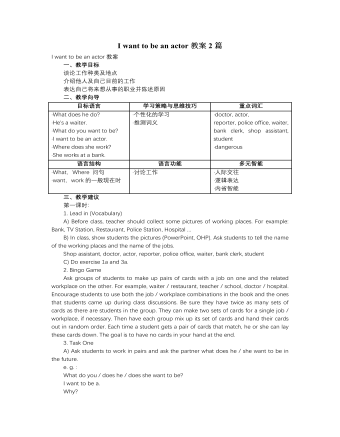
三、教学建议第一课时:1. Lead in (Vocabulary)A) Before class, teacher should collect some pictures of working places. For example: Bank, TV Station, Restaurant, Police Station, Hospital ...B) In class, show students the pictures (PowerPoint, OHP). Ask students to tell the name of the working places and the name of the jobs.Shop assistant, doctor, actor, reporter, police office, waiter, bank clerk, studentC) Do exercise 1a and 3a.2. Bingo GameAsk groups of students to make up pairs of cards with a job on one and the related workplace on the other. For example, waiter / restaurant, teacher / school, doctor / hospital. Encourage students to use both the job / workplace combinations in the book and the ones that students came up during class discussions. Be sure they have twice as many sets of cards as there are students in the group. They can make two sets of cards for a single job / workplace, if necessary. Then have each group mix up its set of cards and hand their cards out in random order. Each time a student gets a pair of cards that match, he or she can lay these cards down. The goal is to have no cards in your hand at the end.3. Task OneA) Ask students to work in pairs and ask the partner what does he / she want to be in the future.e. g. :What do you / does he / does she want to be?I want to be a.Why?Because it's (adj).B) Vocabulary: Section B, 1a4. Homework 1.2.
人教版新目标初中英语七年级下册It’s raining教案2篇
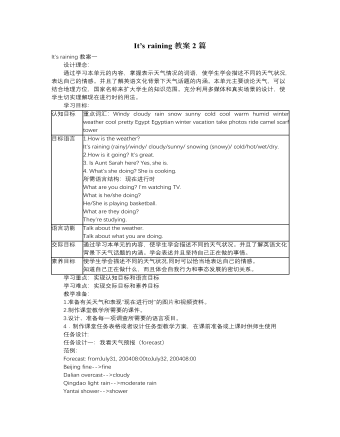
1 Each group choose one place to describe and what you are doing in it Choose one place, and describe what they are doing 2 Move around the room and give suggestions Talk about it and write it down 3 Ask one to show their works and act it Choose one of each group to make a report 4 Evaluate the best group and the best reporter Choose the best one Homework Ask your friends their ideal place and write about it教学反思:新课程标准中强调学生在课堂中的主体地位,在综合课中他们的主体地位就更加突出。在各个活动中给不同程度的学生不同层次的任务,让各层面的学生都有表现发挥的机会,从而产生对英语的兴趣。使用照片图片多媒体来辅助教学,效果更好。同时让了解其他国家风景,风俗的同学介绍ideal place,增加学生的背景知知识,实现跨学科交流的目的。教案点评:采用任务型教学模式,在各个活动中给不同程度的学生不同层次的任务,让各层面的学生都有表现发挥的机会,从而产生对英语的兴趣。使用照片图片多媒体来辅助教学,效果更好。让了解其他国家风景,风俗的同学介绍ideal place,增加学生的背景知识,实现跨学科交流的目的。
人教版新目标初中英语七年级下册Why do you like koalas教案2篇
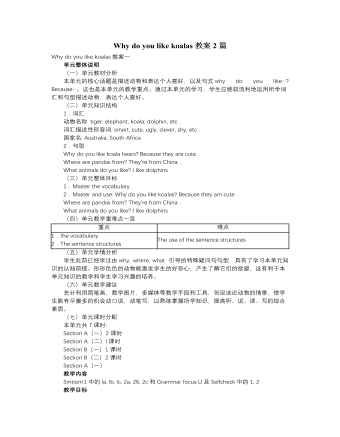
单元整体说明(一)单元教材分析本单元的核心话题是描述动物和表达个人喜好,以及句式why do you like…? Because…。这也是本单元的教学重点。通过本单元的学习,学生应能较流利地运用所学词汇和句型描述动物,表达个人喜好。(二)单元知识结构1.词汇动物名称 tiger, elephant, koala, dolphin, etc.词汇描述性形容词: smart, cute, ugly, clever, shy, etc.国家名: Australia, South Africa2.句型Why do you like koala hears? Because they are cute.Where are pandas from? They're from China.What animals do you like? I like dolphins.(三)单元整体目标1.Master the vocabulary2.Master and use: Why do you like koalas? Because they am cute.Where are pandas from? They're from China.What animals do you like? I like dolphins.(四)单元教学重难点一览(五)单元学情分析学生此前已经学过由why, where, what 引导的特殊疑问句句型,具有了学习本单元知识的认知前提。形形色色的动物能激发学生的好奇心,产生了解它们的欲望,这有利于本单元知识的教学和学生学习兴趣的培养。

人教版新目标初中英语八年级上册Can you come to my party教案3篇
Step 3 (3b)First, tell the students when we talk about our future plans, we often use: I’m+verb+ing When we talk about what we must do, we use have to. Ask the students to fill in the blanks in 3b. The answers are: shopping, go to see, a test, I’m going, my family. Step 4 (3c)Let the students write an e-mail message to a friend. Say why you can’t visit next. Before the exercise, ask the students to give some possible answers and write them on the blackboard. So the students will feel easy to finish the writing exercise. After they finish it, Let them to correct it in groups first. Each group chooses theirs best one to read in front of the whole class. Step 5 ( planning a party )First read the conversation in the box together. Then ask the students to turn to page 88.Write down everything you have to do next week. Write in all the things you have to do . Ask the students to look at the list. Ask them “What day are you free?” This is when you can have your party. Step 6 (Self check 1 )Let the students to fill in the blanks with the words given. Change the forms of the words if possible. Then make their own sentences. The answers are: visit, playing, have to, study, comeStep 7 (Self check 2)Imagine you are Marie. Read the information and look at your schedule. Write replies to the invitation.
人教版新目标初中英语八年级上册How do you make a banana milk shake教案2篇
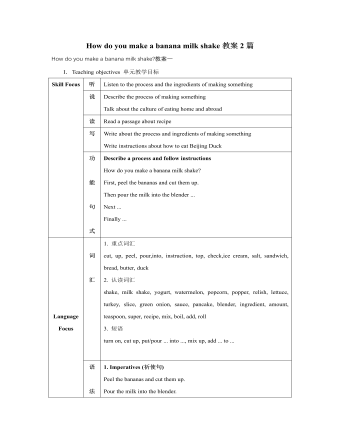
1. First, ... then, ... next, ... finally, ...首先,……然后,……接着,……最后,……这是英语中表达做某事的步骤的一种说法。如果步骤较多,还可以说:first-next-after that-later on-finally/at last通常你会听到说英语国家的人在说 first, next, then, finally 和后面的内容时,他们会做一些停顿。这样就能提前告诉听者接下来讲的是一系列的步骤。这一点在朗读和听力中应特别注意。2. how many, how much均为疑问词,同是“多少”,但用法不同。请看:how many修饰可数名词复数,how much修饰不可数名词。但在用法上,同学们常犯如下错误:1) [误] How many are there bananas on the table?[正] How many bananas are there on the table?[析] how many, how much 中的many,much是形容词,常修饰名词作定语,故后面跟名词。2) [误]How much tea are there on the table?[正]How much tea is there on the table?[析] how much修饰不可数名词时,谓语动词用单数。how many与how much的区别可简记为:前how many:问“多少”,复数名词后面跑;how much问“多少”,不可数名词单数好。前者答语用基数词,后者答语用数量关系。
人教版新目标初中英语八年级上册How was your school trip教案2篇
“Go for it!” is based on “Task-Based Language Teaching”. It adheres to “The authenticity principle”, “The form-function principle”, “The task dependency principle” and “The principle of learning by doing”. These principles all accord with the demands of curriculum focus.In and of Grade Seven (II), “Go for it!”, students have learned “The Simple Past Tense”. And it appears again in of Grade Eight (I). teaches students more about how to talk about events in the past. In addition, it gives affirmative and negative statements in the past tense, such as the sentence patterns “Did you see …?” “Were there …?” “Did you go …?” As the first part of Unit 8, Section A opens with a picture presenting the last school trip in the aquarium and continues with several step-by-step practice activities, which are all good for students to master “The Simple Past Tense”. Doing well in Section A will help students integrate the new target language with that in Section B. Thus, they can describe the events in the past freely and foster their own ability of reflecting and practicing. II. Teaching ObjectivesTeaching objective is the beginning and aim of teaching activities. According to the overall goal of the English elementary course--- improve students' synthetic ability of language application, which should be based on the development of students’ “Language knowledge”, “Language skills”, “Character building”, “Learning strategies” and “Cross-cultural awareness”. The teaching objectives are described as follows(I). Knowledge objectivesi. Master the simple past tense of regular and irregular verbsii. Recite the new words and expressions about the last school trip in the aquarium, including their pronunciation and intonation

人教版新目标初中英语八年级上册Could you please clean your room教案3篇
一、 教学内容Section A 1a----1c二、 教学目标1.学习词汇do the dishes, make the bed, take out the trash, fold the clothes, do the laundry, sweep the floor, clean the living room.2.句型 Could you please clean your room? Yes, sure.三、 教学准备 学生预习本单元所有的词汇多媒体课件 活动表 奖品四、 教学过程Pre-task1. Warming upEnjoy ourselves. Watch cartoon Cinderella. 看动画片段《灰姑娘》导如入本课话题和新词汇“chores”美丽善良的鬼姑娘因继母的嫉妒,每天得做所有的家务。片段的主题使学生联想到本课的话题。2. learn new words and phrasesLook! What is she / he dong? 看图学习动词词组do chores, do the dishes, make the bed, take out the trash, fold the clothes, do the laundry, clean the living room.3. Guessing game.What is she doing ? 4. Pair work. 1a, Do you do these things at home? Write “Y” for “yes” and “N” for “no”.5. Listening . 1b , Peter’s chores or Mom’s chores?理解目标语Could you please clean your room? Yes, sure.Write “M” for Mom’s chores, “P” for Peter’s chores in the chart.6. PairworkLook at the picture,Ask your partner to do the chores that you see. 7. Interview Who is the most able at home? 1) What chores do you do at home? How often do you do the chores? Work in four, interview each of the students in the group, fill in the chart.