-
人教版高中历史必修2开辟新航路教案
材料五航路开辟后,东方香料输入欧洲的总量较中古之时猛增30倍,而胡椒、丁香等在印度购入和在英国卖出的差价亦高达10至29倍,其他货物的获利同样惊人。这一时期,新的商品不断涌现,特别值得注意的是美洲的特产——玉米、马铃薯、烟草、可可等——被传播到欧亚大陆。这时,世界性的对外贸易主要通过大西洋,地中海与意大利皆告衰落,而沿大洋的英、荷等渐居中心。到17世纪时,英国的伦敦与荷兰的阿姆斯特丹成为世界贸易中心。问题4:材料五表明,新航路开辟后对世界贸易产生了哪些重大影响?答案4:结束了世界相对孤立状态;各地文明开始会合交流,日益连成一个整体;欧洲商人直接同世界各地建立商业联系;促进不同国家和贸易的发展,促进世界市场雏形开始出现。
新人教版高中英语必修1Unit 2 Travelling Around-Reading and Thinking教案
Good expressions that students can choose to use: help the travelers choose which tour to take1. In my opinion, you could/might choose…, because you prefer to…2. …could be a perfect choice for you, for…3. As far as I am concerned, you would enjoy…, for…4. …would probably suit you, because you enjoy/love/hate doing…Step 5 Passage ConsolidationLanguage appreciation:1. You can then spend three days exploring the rainforest with a local guide and enjoying the plants and animals unique to the rainforest. 在接下来的三天里,您可以在当地导游的陪同下,深入雨林进行探索,欣赏雨林特有的动植物。本句主体结构为spend some time doing sth. 2. Inca builders cut stones to exact sizes so that nothing was needed to hold walls together other than the perfect fit of the stones. 印加的建筑工人将石头切割成精确的尺寸,仅仅凭着石头间的完美契合,即可稳固墙体。本句为so that引导的结果状语从句。nothing与the perfect fit为并列成分; other than在句中意为“除了”。Step 6 HomeworkSuppose you will travel to Peru, write a short essay about your three-day tour plan.
新人教版高中英语必修1Unit 2 Travelling Around-Reading for Writing教案
Is there a clear purpose for the trip? :Does each paragraph have a clear main idea? Does the writer use the present continuous tense for future plans?Does the writer use commas, stops, and question marks correctly? Are all the words spelt correctly?Are all the proper nouns capitalized?Revise your draft according to your partner's comments.Step 5:The summary of how to write a travel plan.旅游计划是一种常见的应用文写作。旅游可分为观光游、文化游、美食游及探险游等不同类型,因此旅游计划也要根据不同的旅游目的进行设计。常规的旅游计划需要明确以下几个方面的问题:Travel planWhen will you leave for? Where is your the destination?How will you get there?What will you do there?How long will you there?Is there a clear purpose for the trip? 为了提升旅行计划的层级,还需注意以下几个方面的问题:1.每段是否有明确清晰的主题;2.用一般现在时代替一般将来时;3.用更高级的形容词词汇。例如:表达“好”时,不要总用“nice”,我们还可以用“smart, clean, excellent, exciting, beautiful, wonderful, clever, famous, grand”等表达更具有指向性的词汇;4.用更高级的动词词汇。比如:我们可以用“seem stand, lie .get stay, remain, look . sound, become . keep, grow”等代替"be";
新人教版高中英语必修2Unit 1 Cultural Heritage-Discovering Useful Structure教案二
This theme of the part is “ Describe people or things in greater detail”. Students have learned the grammar(restrictive relative clauses) in Book 1, and further review and consolidate its structure “prep+relative pronouns(which/whom)” and the relative adverbs(when, where and why), besides students should understand its form, meaning and functions. In this section, students should be able to express the grammar correctly in daily communication and in the writing. 1. Review the basic usages of relative pronouns and adverbs of attributive clauses . 2. Learn to use some special cases about restrictive relative clauses.3. Learn to write sentences with restrictive relative clauses flexibly according to the context.1. Review the basic usages of relative pronouns and adverbs of attributive clauses .2. Learn to use some special cases about restrictive relative clauses.3. Learn tow rite sentences with restrictive relative clauses flexibly according to the context.Step 1. Observe the following sentences, and mark the relative pronouns and the adverbs. 1. After listening to the scientists who had studied the problems, and citizens who lived near the dam, the government turned to the United Nations for help.2. Temples and other cultural sites were taken down piece by piece, and then moved and put back together again in a place where they were safe from the water.Step 2 PracticePlease complete these sentences with relative pronouns and relative adverbs and answer the following questions.Questions: 1. What is the head noun ?2. What relative words should be used ?3. What elements do they act in these sentences ?
新人教版高中英语必修2Unit 1 Cultural Heritage-Discovering Useful Structure教案一
This teaching period mainly deals with grammar “restrictive relative clauses.” To begin with, teachers should lead students to revise what they have learned about the relative pronouns and relative adverbs. And then, teachers move on to stress more special cases concerning this grammar, such as the “preposition+ relative pronouns which and whom” and cases where we can omit the relative pronouns. This period carries considerable significance to the cultivation of students’ writing competence and lays a solid foundation for the basic appreciation of language beauty. The teacher is expected to enable students to master this period thoroughly and consolidate the knowledge by doing some exercises. 1. Guide students to review the basic usages of relative pronouns and adverbs of attributive clauses.2. Lead students to learn to use some special cases concerning restrictive relative clauses flexibly.2. Enable students to use the basic phrases structures flexibly.3. Strengthen students’ great interest in grammar learning.1. Help students to appreciate the function of relative pronouns and adverbs of attributive clauses in a sentence2. Instruct students to write essays using the proper relative pronouns and adverbs of attributive clauses.本节语法思考:定语从句在复合句中的作用是什么? 关系词有哪些?定语从句在复合句中的作用相当于形容词,它在句中作定语修饰名词或代词。他们在先行词和定语从句之间起到联系作用,同时在意义上代表先行词并在定语从句中担任一个成分。被定语从句所修饰的词称先行词,定语从句一般放在先行词的后面。
新人教版高中英语必修2Unit 4 History and Traditions-Discovering Useful Structure教案一
Step 5 Practice一、完成下列句子。1. Judy and I _______________(把车停下来(park))in an underground car Park near Trafalgar Square, where we could ______________________(让我们的车充电(charge)).2. When we finally reached the service desk to ask for audio guides, we heard it ___________ that there were no audio guides____________(留下,剩下).3. We__________________________(发现自己对...很惊讶)the large number of visitors and the amount of noise at the entrance of the National Gallery.4. Judy ____________________(眼神专注于) Van Gogh’s Sunflowers. It was hard to approach the painting as there were so many people around.5. She ____________________(把这幅画的复制品装箱(box)) to ensure that it was delivered safely.答案:1.had our car parked get our car battery charged 2. announced left 3. found ourselves very surprised 4. had her eyes fixed on 5. had a copy of the painting boxed二、用过去分词对下列句子进行改写。1. Loch Ness was surrounded by beautiful natural landscape, which made it look amazing.2. Carl and his friend stayed with a generous family who offered them bread with butter and honey that was homemade.3. The family’s ancestors once attended to soldiers who were wounded in the First World War.4. The young people were attracted by the legend of Loch Ness. They watched over the lake with their cameras and binoculars, which were positioned on the hill.答案:1. Loch Ness surrounded by beautiful natural landscape looks amazing.2. Carl and his friends stayed with a generous family who offered them homemade bread with butter and honey.3. The family’s ancestors once attended to wounded soldiers in the First World War.4. The young people attracted by the legend of Loch Ness watched over the lake with their cameras and binoculars positioned on the hill.
新人教版高中英语必修2Unit 4 History and Traditions-Listening&Speaking&Talking教案二
Listening and Speaking introduces the topic of “Take part in a youth project”. The listening text is an interview about "sharing views on historical sites". Through listening to a dialogue between Chinese and foreign students on the way to the Confucius Temple, students can understand their views on the Confucius Temple, Confucius, Confucius' descendants and Confucius' educational thoughts, so as to realize and think about the profound influence of Confucius and his thoughts on Chinese historical tradition. At the same time, the dialogue naturally integrates English idioms and mentions Shakespeare, the British playwright, so as to provide language materials and context for students to understand English idioms and related cultural allusions, as well as to compare Chinese and foreign cultures, which is helpful for students to understand and express the language such as history, tradition, culture and custom significant impact.Text analysis: listening text is a dialogue between a British student and a Chinese student when he goes to the Confucius Temple. When William, a British student, visited the Confucius Temple, he asked Xiao Kong, a Chinese student, for directions. Xiao Kong was just going to the Confucius Temple to meet with the members of the research group, so they went together and exchanged their views on the Confucius Temple, Confucius, Confucius' descendants and Confucius' educational thoughts. From the perspective of foreign tourists, this paper describes their thoughts on Confucius, the great son of Confucius, who had a profound impact on Chinese history and cultural tradition, and his education.Listening and Talking introduces a visit to a historic tourist destination. Tourism is a common way to understand a country's history, culture, and customs and so on. Students listen to the dialogue between Xiao Yan, a youth hostel Usher, and Paul, a backpacker, to learn about Pingyao's famous historical and cultural attractions and Paul's travel experience and experience as a foreign tourist.
新人教版高中英语必修2Unit 4 History and Traditions-Reading for Writing教案
Step 1 Lead inThere are many interest of places in the UK. What do you know ?The Big Ben the London Tower the Thames RiverStep 2 Before reading---analyze the titleBeautiful Ireland and its traditionWe know that the article mainly tells about the beauty and traditions of Ireland. Step 3 While reading---Task 1Read the text and answer the following questions.Q1: What makes the Irish countryside exciting and inspiring?Its beauty and how it offers something for all the scenes.Q2: What are the best ways to experience some Irish traditions and cultures?By stopping by a village pub and relaxing with a drink and traditional meal while listening to music and watching dancingQ3: What is the meaning of “breathe in the sweet scent of fresh flowers while birds greet the new day with their morning song ?”It means to not just smell but also breathe in the smell of fresh flowers early in the morning as the birds sing their first song of the new day.Q4: What are the best ways to experience Chinese traditions and customs ?By travelling to different places and using all your senses to experience everything and by interacting with local people.Step 4 While reading---Task 2Analyze the descriptive paragraph1. Identify and underline the paragraph’s introductory sentence and the ending sentence.Introductory sentence: Ireland’s beautiful countryside has always had a great influence on its people and traditions.Ending sentence: And if you introduce yourself to a friendly face, you are more than likely to experience local culture and customs first-hand.2. The paragraph talks about different senses in different places. Write the senses and places in the order that they appear.
新人教版高中英语必修2Unit 5 Music-Discovering Useful Structures教案一
Step1:自主探究。1.(教材P52)Born(bear) in the USA on 2 January 1970, Whitacre began studying music at the University of Nevada in 1988.2.(教材P52) Moved(move) by this music, he said, “It was like seeing color for the first time.”3.(教材P56)I was very afraid and I felt so alone and discouraged(discourage).4.(教材P58)Encouraged(encourage) by this first performance and the positive reaction of the audience, I have continued to play the piano and enjoy it more every day.Step2:语法要点精析。用法1:过去分词作表语1).过去分词可放在连系动词be, get, feel, remain, seem, look, become等之后作表语,表示主语所处的状态Tom was astonished to see a snake moving across the floor.汤姆很惊讶地看到一条蛇正爬过地板。Finally the baby felt tired of playing with those toys.终于婴儿厌倦了玩那些玩具。注意:1).过去分词作表语时与被动语态的区别过去分词作表语时,强调主语所处的状态;而动词的被动语态表示主语是动作的承受者,强调动作。The library is now closed.(状态)图书馆现在关闭了。The cup was broken by my little sister yesterday.(动作)昨天我妹妹把杯子打碎了。2)感觉类及物动词的现在分词与过去分词作表语的区别过去分词作表语多表示人自身的感受或事物自身的状态,常译作“感到……的”;现在分词多表示事物具有的特性,常译作“令人……的”。
新人教版高中英语必修2Unit 5 Music-Listening and Speaking教案
This lesson is about music. Students can classify the types of music through the instruments and its sound and can talk about their preferences about music, even join some activities and play a role in them according to their musical talents. On the basis, they are guided to use the languages to express their preferences and some plosive sounds and their rules.1. Classify the music types through the instruments and its sound.2. Listen and understand what the speakers’ preferences are and the reasons; talk about their own preferences and give their own reasons, using these sentences: “What kind of music do you like? And why? “ “Because it makes/gives me energy/peaceful.../touches my heart...”.3. Learn some plosives and the rules.4. Join some activities and play a role in them according to the talents. 1. Listen and understand what the speakers’ preferences are and the reasons;2. talk about their own preferences and give their own reasons, using these sentences: “What kind of music do you like? And why? “ “Because it makes/gives me energy/peaceful.../touches my heart...”.3. Learn some plosives and incomplete plosives and its rules.Step 1 Lead inPoint at the pictures on P50 and ask Q1: What are the people doing in the pictures below?Q2: What kind of music they are?Then play the MP3s one by oneStep 2 ListeningTask 1: A reporter from the school newspaper is interviewing students about music. Listen to the interviews. Draw lines between the words to make complete sentences. Some words will not be used.
新人教版高中英语必修2Unit 5 Music-Reading and Thinking教案二
1. Get basic information about Eric; read deeply to understand the history and development of the virtual choir.2. Understand what the function of the virtual choir is and how to make a virtual choir.3. Understand the meaning of some languages in the context of the text through question guidance, such as “Many people do not have close friends or contacts who have the same interest in music.” and so on.Step 1 Leading-in1. Answer the following questions.Q1:Do you know the Apps like Tik Tok and Quick Hand?Q2: Do you want to make a Tik Tok video or a Quick Hand video?2. Play a Tik Tok video Step 2: Understanding the title Q1:What does the title mean ?Q2: Is the article a narration or exposition? Why? Q3: Can you change the title ? If you can, what is the title?Step 3: Scanning the whole text and getting the basic information1. Answer the following questions.Q1:Who came up with the idea for a virtual choir?Q2: Where did Eric studied the musical composition?Q3: What is his song?2. Find the main idea of each paragraph3. Deal with some new words.Step 4: Reading carefully to get detailed informationPara 1 How to make a virtual choir1. PreparationA. tools: a virtual camera; an Internet connectionB. hero/heroin: friends or some individuals who have the same interests2. Process
人教版高中地理必修2城市内部空间结构教案
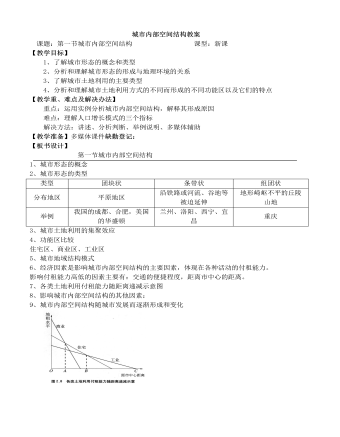
过渡:在实际生活中,城市内部空间结构并非完全按照这一经济规律呈现,而是更具复杂性。这说明除了经济因素外,还有很多其他因素在起作用,请大家结合你的认识、图2.9和案例1:纽约市的少数民族区谈谈你的看法。(2)其他因素I收入——形成不同级别住宅区的常见原因。有能力支付昂贵租金和选择最佳居住环境的人,其居住地往往形成高级住宅区。II知名度——城市内某些地区在历史、文化或经济方面具有很高的声誉,这往往会吸引更多新的住宅或商场建在该处,以提高其知名度。III种族聚居区的形成——在有些城市的某一区域内,如果某个种族或宗教团体占优势,就可能形成种族聚居区。如纽约市的唐人街、哈林区、小意大利区等。IV历史因素——城市的建筑物和街道设计可以维持久远,早期的土地利用方式对日后的功能分区有着深远的影响。
人教版高中语文必修4《短文三篇》教案
③于是,大自然出现了惊人的奇迹,不毛的石缝间丛生出倔强的生命。④或者就只是一簇一簇无名的野草,春绿秋黄。岁岁枯荣。它们只有三两片长长的细瘦的薄叶,那细微的叶脉,告知你生存该是多么艰难;更有的。它们就在一簇一簇瘦叶下自己生长出根须,只为了少向母体吮吸一点乳汁,便自去寻找那不易被觉察到的石缝。这就是生命,如果这是一种本能,那么它正说明生命的本能是多么尊贵,生命有权自认为辉煌壮丽,生机竟是这样地不可扼制。⑤或者就是一团一团小小的山花,大多又都是那苦苦的蒲公英。它们不似田野上的同宗长得那样茁壮,它们的茎显得坚韧而苍老。它们的叶因枯萎而失却光泽。它们已经不能再去为人们作佐餐的鲜嫩的野菜,却默默地为攀登山路的人准备了一个可靠的抓手。生命就这样地被环境规定着,又被环境改变着,适者生存的规律尽管无情。但一切适者就是战胜环境的强者。生命现象告诉你,生命就是拼搏。
人教版高中历史必修3三民主义的形成和发展教案
局限性:新三民主义在理论上、纲领上仍然没有超出资产阶级民主主义的范畴。且与中共民主革命纲领有着原则的区别。与中共革命纲领相比,新三民主义缺少的内容:八小时工作制、彻底实现人民的权利、社会主义。教学小结:(以问题代小结)(1)本课内容涉及孙中山先生一生两次重要的转变。你知道是哪两次吗?在学生讨论的基础上,教师总结:孙中山先生一生有两次重要的转变,第一次是放弃改良而走向革命道路;第二次是在他领导的一系列资产阶级革命活动失败后,接受苏俄和中共的帮助,把旧三民主义发展成为新三民主义,实行“联俄、联共、扶助农工”三大政策,实现了他一生中最伟大的转变。(2)孙中山先生的这两次转变说明了什么?这一问题可以让学生各抒己见,但教师总结时一定要紧扣孙中山先生与时俱进,为民族革命贡献毕生精力的高贵品质。
人教版高中历史必修2殖民扩张与世界市场的拓展教案
●活动与探究从葡萄牙、西班牙、荷兰的兴衰历程,从英国的强盛历程,我们从中可获得什么启示?启示:积极发展本国的工商业;实现制度创新;抓住机遇,及时更新观念;建立能保障自身经济顺利发展的国防力量,尤其是海军力量;积极发展海外贸易,实行对外开放……★本课小结16世纪后期荷兰积极向海外殖民扩张,在17世纪建立了世界范围内的殖民帝国;17世纪开始,英国也积极向海外殖民扩张,并与荷兰、法国进行了激烈的争夺,到18世纪中期,英国成为世界上最大的殖民国家,最终确立了世界殖民霸权;新航路开辟后,伴随着殖民扩张,人类的商业活动开始在全球范围内开展,人类的经济活动由于世界市场的出现而第一次被广泛地联系在一起,而西欧国家对殖民地财富、资源、劳动力的暴力掠夺,是欧洲发展和兴旺的重要条件,也是亚、非、拉美灾难的根源。
人教版高中历史必修1从汉至元政治制度的演变教案
【教学方法】本节课的教学知识点比较琐碎,学生学习和理解起来有较大的困难。教师在并结合教材中所引的文献资料给予必要的点拨,并依据教材,并在此基础上拓展教材引用有关材料,扩展学生的思维,用思考题的形式,有机地将教材的重点、难点知识串联起来,注意培养学生史论结合、论从史出的良好的历史学习品质。【导入新课】秦始皇统一中国后,继承了商鞅变法的成果和实践了韩非子的理论,创立了封建专制主义中央集权的政治制度,即皇帝制、中央官制和郡县制,把专制主义的决策方式和中央集权的政治制度有机结合起来。秦始皇首创的专制主义中央集权的政治体制为我国延续两千多年的封建社会选择了政治体制的基本模式。西汉王朝建立后,刘邦承袭了秦始皇所开创的统一的封建专制主义中央集权制。通过综合概述上节课内容,导入新课。
人教版高中地理必修2中国的可持续发展实践精品教案
师:对。具体说一说沼气池在这个系统中为什么居于核心纽带地位。生:因为沼气池充分利用了生产过程的废料,实现了清洁生产,减少了浪费和污染,而且很好地实现了生态循环。师:不错!留民营生态农业的实质就是:地尽其利,物尽其用,最大限度地循环利用资源和消除环境污染,达到节约、高效的目的,真正实现了生态效益、经济效益、社会效益三方面的高度统一,实现了可持续发展。师:实施可持续发展战略必须依靠公众的支持和参与,我们每一个人都应该从自身做起,那我们可以在日常生活中可以采取哪些有益于可持续发展的行动? 生1:节约粮食、爱惜粮食。生2:不乱扔垃圾,垃圾分类回收。生3:不开“无人灯”。生4:节约用电、用水。生5:减少空调的使用,在冬夏季分别降低、提高空调温度的设置。
人教版高中语文必修3《交际中的语言运用》教案3篇
知识与技能1、指导学生初步掌握称谓语、禁忌语、委婉语等交际语言;2、指导学生根据具体的语境条件运用不同的交际语言,达到交际目的。过程与方法1、通过故事或习题分析,掌握有关交际语言的一些知识;2、讲练结合,有所积累。情感、态度与价值观点燃学生继承中华传统文化的热情,以得体的交际语言营造良好的人际环境。教学重点根据交际中运用语言的要求,引导学生根据不同的语境条件恰当地表情达意。教学难点通过课内探索延伸至课外,积累关于交际中的语言运用的一些知识。教学课时:一课时教学过程一、导入利用一道口语交际训练题引入本节课要探究的内容。例1:下面的场合,如果班长既想达到批评的目的,又想把话说得委婉些,表达恰当的一项是(C)小李和小杨,为了一点小事,两人自习课上大声地争吵起来。这时,班长说:A、你们这样大声争吵,影响很坏。B、你们这样大声争吵,难道不感到羞耻吧?
人教版高中地理必修2人口的空间变化精品教案
经济因素对人口迁移是主要的,经常起作用的因素,是人口迁移的基本动因。通常情况下,经济发展水平的差异决定着人们迁移的方向,人们迁移是为了追求更好的就业机会和更高的经济收入。经济发展水平高的地区往往成为人口迁入地,人口的迁移量取决于迁入地对劳动力的需求状况和迁出地人口相对过剩的状况。师:20世纪80年代深圳、珠海等地设立了经济特区’吸I了大量的人口迁入。这又说明了什么问题? (生回答,师总结)从宏观上看,经济布局也会造成大量的人口迁移。说明经济越发达,对人口的吸引力(即拉力)越大。经济发展水平、规模和速度决定着人口迁移的流向、流量和流速。师:交通和通讯又如何影响着人口的迁移呢?生:交通和通讯的发展,缩小了地区之间的距离,促进了人口迁移。
人教版高中地理必修2人口的数量变化精品教案
过渡:下面我们从时间角度分析世界人口数量变化的趋势是怎样的呢?为什么会这样呢?板书:1、人口自然增长的时间变化(引导学生读课本图1.2和图1.3,让学生分析)教师首先让学生说出阅读地理曲线统计图的一般步骤和方法,然后总结归纳:1、 读图名。2、 读各个坐标分别表示什么变量(两图横坐标均表示时间,纵坐标均为相应时期人口数)。3、 判读图形变化特征(两图中曲线曲率的变化反映对应时段内人口自然增长率的大小)。4、 思考变量之间的因果关系(两图均反映不同历史时期世界人口数量增长的不同特点)。问:世界人口数量变化的总趋势是什么?(让学生结合课本P2读图思考题,分析回答同时让学生阅读课本图1.3,在图1.2中找出图1.3所在的时段,指导学生自学P3第一段,让学生分析近100年全球人口快速增长的原因。最后师生共同归纳总结,填写下表。)