-
新人教版高中英语选修2Unit 5 Using langauge-Listening教学设计
The theme of this section is to learn how to make emergency calls. Students should learn how to make emergency calls not only in China, but also in foreign countries in English, so that they can be prepared for future situations outside the home.The emergency telephone number is a vital hotline, which should be the most clear, rapid and effective communication with the acute operator.This section helps students to understand the emergency calls in some countries and the precautions for making emergency calls. Through the study of this section, students can accumulate common expressions and sentence patterns in this context. 1.Help students accumulate emergency telephone numbers in different countries and learn more about first aid2.Guide the students to understand the contents and instructions of the telephone, grasp the characteristics of the emergency telephone and the requirements of the emergency telephone.3.Guide students to understand the first aid instructions of the operators.4.Enable Ss to make simulated emergency calls with their partners in the language they have learned1. Instruct students to grasp the key information and important details of the dialogue.2. Instruct students to conduct a similar talk on the relevant topic.Step1:Look and discuss:Match the pictures below to the medical emergencies, and then discuss the questions in groups.
新人教版高中英语必修3Unit 1 Festivals and Celebrations教学设计二
1. Ss look at the picture and scan the passage to understand the main idea while teacher is giving the following questions to inspire Ss to think.*Where are those people?*What are they doing?*Why are they so excited?2. Ss complete the passage with the appropriate -ing form. Then discuss and check the answers with class.Answers: boring, interesting, taking, exciting, amazing3. The teacher raises questions for the students to discuss and encourages them to express their opinions.*Do you like La Tomatina? Why or why not?4. Each group representative reports the discussion result, the teacher gives feedback and the evaluation.Step 6 PracticeActivity 41. Ss complete the Ex 2 in Using structures.2. Check the answers after finishing the exercises.①The dragon boat races are the most exciting part of the Dragon Boat Festival.② The children were excited to go Easter egg hunting.③What an amazing performance! This is the best music festival I have ever been to.④We were amazed by her funny-looking hat.⑤His inspiring speech at the conference won the admiration/ favour of the audience.⑥This is a challenging game to test your memory and observation capabilities. 3. T asks Ss to finish Ex 3 and 4 in Using structures by themselves, then check the answers with class.Step 6 Homework1. Understand and master the functions and usage of the -ing form;2. Finish the other exercises in Using structures.1、通过本节内容学习,学生是否理解和掌握动词-ing形式作定语和表语的功能和意义;2、通过本节内容学习,学生能否在理解文段内容的基础上,根据上下文语境和表达逻辑,能正确运用动词-ing形式描述节日庆典。3、通过本节内容学习,学生是否归纳和积累用于表达情绪的相关词汇。
新人教版高中英语必修3Unit 1 Festivals and Celebrations教学设计一
本板块的活动主题是“谈论节日活动”(Talk about festival activities),主要是从贴近学生日常生活的角度来切入“节日”主题。学生会听到发生在三个国家不同节日场景下的简短对话,对话中的人们正在参与或将要亲历不同的庆祝活动。随着全球化的进程加速,国际交流日益频繁,无论是国人走出国门还是外国友人访问中国,都已成为司空见惯的事情。因此,该板块所选取的三个典型节日场景都是属于跨文化交际语境,不仅每组对话中的人物来自不同的文化背景,对话者的身份和关系也不尽相同。1. Master the new words related to holiday: the lantern, Carnival, costume, dress(sb)up, march, congratulation, congratulate, riddle, ceremony, samba, make - up, after all. 2. To understand the origin of major world festivals and the activities held to celebrate them and the significance of these activities;3. Improve listening comprehension and oral expression of the topic by listening and talking about traditional festivals around the world;4. Improve my understanding of the topic by watching pictures and videos about different traditional festivals around the world;5. Review the common assimilation phenomenon in English phonetics, can distinguish the assimilated phonemes in the natural language flow, and consciously use the assimilation skill in oral expression. Importance:1. Guide students to pay attention to the attitude of the speaker in the process of listening, and identify the relationship between the characters;2. Inspire students to use topic words to describe the festival activities based on their background knowledge. Difficulties:In the process of listening to the correct understanding of the speaker's attitude, accurately identify the relationship between the characters.
新人教版高中英语必修3Unit 2 Morals and Virtues教学设计三
The joke set her crying.这个玩笑使她哭起来。Step 5 ReadingActivity 31. Students read the small text in activity 3. The teacher provides several small questions to check whether students understand the content of the text and the ideographic function of the -ing form in the text.*Where are those people?*Why did Dr Bethune come to China?*How did he help the Chinese people during the war?*What did Chairman Mao Zedong say about him?2. Ss try to rewrite some sentences using the -ing form. Then check the answers. When checking the answers, the teacher can ask different students to read the rewritten sentences and give comments.Answers:1. he became very interested in medicine, deciding to become a doctor.2. …after hearing that many people were dying in the war.3. Helping to organise hospitals, he taught doctors and nurses, and showed people how to give first aid./ He helped to organise hospitals, teaching doctors and nurses, and showing people how to give first aid.4. …praising Dr Bethune as a hero to be remembered in China.Step 6 PracticeActivity 4Students complete grammar activities 2 and 3 on page 69 of the workbook.Step 6 Homework1. Understand and master the functions and usage of the -ing form;2. Finish the other exercises in Using structures.1、通过本节内容学习,学生是否理解和掌握动词-ing形式作宾语补足语语和状语语的功能和意义;2、通过本节内容学习,学生能否正确使用动词-ing形式描述人物的行为、动作及其经历;3、通过本节内容学习,学生能否独立完成练习册和导学案中的相关练习。
新人教版高中英语必修3Unit 3 Diverse Cultures教学设计二
(2)Consolidate key vocabulary.Ask the students to complete the exercises of activity 6 by themselves. Then ask them to check the answers with their partners.(The first language:Damage of the 1906 San Francisco earthquake and fire.A second language: Yunnan - one of the most diverse provinces in China).Step 5 Language points1. The teacher asks the students to read the text carefully, find out the more words and long and difficult sentences in the text and draw lines, understand the use of vocabulary, and analyze the structure of long and difficult sentences.2. The teacher explains and summarizes the usage of core vocabulary and asks the students to take notes.3. The teacher analyzes and explains the long and difficult sentences that the students don't understand, so that the students can understand them better.Step 6 Homework1. Read the text again, in-depth understanding of the text;2. Master the use of core vocabulary and understand the long and difficult sentences.3. Complete relevant exercises in the guide plan.1、通过本节内容学习,学生是否理解和掌握阅读文本中的新词汇的意义与用法;2、通过本节内容学习,学生能否结合文本特点了解文章的结构和作者的写作逻辑;3、通过本节内容学习,学生能否了解旧金山的城市风貌、文化特色,以及加利福尼亚州的历史,体会多元文化对美国的影响。
新人教版高中英语必修3Unit 3 Diverse Cultures教学设计一
Activity 81.Grasp the main idea of the listening.Listen to the tape and answer the following questions:Who are the two speakers in the listening? What is their relationship?What is the main idea of the first part of the listening? How about the second part?2.Complete the passage.Ask the students to quickly review the summaries of the two listening materials in activity 2. Then play the recording for the second time.Ask them to complete the passage and fill in the blanks.3.Play the recording again and ask the students to use the structure diagram to comb the information structure in the listening.(While listening, take notes. Capture key information quickly and accurately.)Step 8 Talking Activity 91.Focus on the listening text.Listen to the students and listen to the tape. Let them understand the attitudes of Wu Yue and Justin in the conversation.How does Wu Yue feel about Chinese minority cultures?What does Justin think of the Miao and Dong cultures?How do you know that?2.learn functional items that express concerns.Ask students to focus on the expressions listed in activity. 3.And try to analyze the meaning they convey, including praise (Super!).Agree (Exactly!)"(You're kidding.!)Tell me more about it. Tell me more about it.For example, "Yeah Sure." "Definitely!" "Certainly!" "No kidding!" "No wonder!" and so on.4.Ask the students to have conversations in small groups, acting as Jsim and his friends.Justin shares his travels in Guizhou with friends and his thoughts;Justin's friends should give appropriate feedback, express their interest in relevant information, and ask for information when necessary.In order to enrich the dialogue, teachers can expand and supplement the introduction of Miao, dong, Lusheng and Dong Dage.After the group practice, the teacher can choose several groups of students to show, and let the rest of the students listen carefully, after listening to the best performance of the group, and give at least two reasons.
新人教版高中英语选修2Unit 4 Reading and thinking教学设计
【词汇精讲】highlight n.最好或最精彩的部分 vt.突出;强调;使醒目One of the highlights of the trip was seeing the Taj Mahal.这次旅行的亮点之一是参观泰姬陵。Your resume should highlight your skills and achievements.你的简历应该突出你的技能和成就。The report highlights the major problems facing society today.报告强调了当今社会所面临的主要问题。I’ve highlighted the important passages in yellow.我用黄色标出了重要段落。7.Edmonton is freezing cold in winter,with daily temperatures averaging -10 ℃.埃德蒙顿冬季寒冷,日平均气温为-10°C。【词汇精讲】freezing adj.极冷的;冰冻的Leave a basin of water outside in freezing weather.在冰冻的天气里,放一盆水在室外。It’s freezing cold outside so wear a warm coat.外面超冷的,所以穿一个暖和一点的外套吧。8.It was not until 9:30 a.m.that they finally reached the capital of Ontario,Toronto.直到上午9时30分,他们才终于到达多伦多的首府安大略省。【句式剖析】本句是一个强调句,强调的是句子的时间状语until 9:30。含有not...until...的句子的强调句为It is not until...that...,that后面的句子要用肯定形式。It was not until then that I suddenly realized nobody was happier than I was.直到那时我才突然意识到没有人比我更幸福了。
新人教版高中英语选修2Unit 3 Reading for writing教学设计
The theme of this part is to write an article about healthy diet. Through reading and writing activities, students can accumulate knowledge about healthy diet, deepen their understanding of the theme of healthy diet, and reflect on their own eating habits. This text describes the basic principles of healthy diet. The author uses data analysis, definition, comparison, examples and other methods. It also provides a demonstration of the use of conjunctions, which provides important information reference for students to complete the next collaborative task, writing skills, vivid language materials and expressions.1. Teach Ss to learn and skillfully use the new words learned from the text.2. Develop students’ ability to understand, extract and summarize information.3. Guide students to understand the theme of healthy diet and reflect on their own eating habits.4. To guide students to analyze and understand the reading discourse from the aspects of theme content, writing structure, language expression, etc., 5. Enable Ss to write in combination with relevant topics and opinions, and to talk about their eating habits.1. Guide students to analyze and understand the reading discourse from the aspects of theme content, writing structure, language expression, etc.2. Enable them to write in combination with relevant topics and opinions, and to talk about their eating habits.3. Guide the students to use the cohesive words correctly, strengthen the textual cohesion, and make the expression fluent and the thinking clear.Step1: Warming upbrainstorm some healthy eating habits.1.Eat slowly.2.Don’t eat too much fat or sugar.3.Eat healthy food.4.Have a balanced diet.Step2: Read the passage and then sum up the main idea of each paragraph.
新人教版高中英语选修2Unit 2 Reading for writing教学设计
The theme of this section is to express people's views on studying abroad. With the continuous development of Chinese economic construction, especially the general improvement of people's living standards, the number of Chinese students studying abroad at their own expense is on the rise. Many students and parents turn their attention to the world and regard studying abroad as an effective way to improve their quality, broaden their horizons and master the world's advanced scientific knowledge, which is very important for the fever of going abroad. Studying abroad is also an important decision made by a family for their children. Therefore, it is of great social significance to discuss this issue. The theme of this section is the column discussion in the newspaper: the advantages and disadvantages of studying abroad. The discourse is about two parents' contribution letters on this issue. They respectively express their own positions. One thinks that the disadvantages outweigh the advantages, and the other thinks that the advantages outweigh the disadvantages. The two parents' arguments are well founded and logical. It is worth noting that the two authors do not express their views on studying abroad from an individual point of view, but from a national or even global point of view. These two articles have the characteristics of both letters and argumentative essays1.Guide the students to read these two articles, and understand the author's point of view and argument ideas2.Help the students to summarize the structure and writing methods of argumentative writing, and guides students to correctly understand the advantages and disadvantages of studying abroad3.Cultivate students' ability to analyze problems objectively, comprehensively and deeply
新人教版高中英语选修2Unit 4 Reading for writing教学设计
假定你是英国的Jack,打算来中国旅行,请你给你的中国笔友李华写一封信,要点如下:1.你的旅行计划:北京→泰山→杭州;2.征求建议并询问他是否愿意充当你的导游。注意:1.词数80左右(开头和结尾已给出,不计入总词数);2.可以适当增加细节,以使行文连贯。参考词汇:故宫 the Forbidden City;泰山 Mount TaiDear Li Hua,I'm glad to tell you that 'm going to visit China.First,I am planning to visit Beijing,the capitalof China,where I am looking forward to enjoying the Great Wall,the Forbidden City and somebeautiful parks.Then I intend to go to visit Mount Tai in Shandong Province.I've heard that it is one ofthe most famous mountains in China and I can't wait to enjoy the amazing sunrise there.After that,I amalso going to Hangzhou.It is said that it is a beautiful modern city with breathtaking natural sights,among which the West Lake is a well- known tourist attraction.What do you think of my travel plan? Will you act as my guide? Hope to hear from you soon.
人教A版高中数学必修一诱导公式教学设计(1)
一、复习回顾,温故知新1. 任意角三角函数的定义【答案】设角 它的终边与单位圆交于点 。那么(1) (2) 2.诱导公式一 ,其中, 。终边相同的角的同一三角函数值相等二、探索新知思考1:(1).终边相同的角的同一三角函数值有什么关系?【答案】相等(2).角 -α与α的终边 有何位置关系?【答案】终边关于x轴对称(3).角 与α的终边 有何位置关系?【答案】终边关于y轴对称(4).角 与α的终边 有何位置关系?【答案】终边关于原点对称思考2: 已知任意角α的终边与单位圆相交于点P(x, y),请同学们思考回答点P关于原点、x轴、y轴对称的三个点的坐标是什么?【答案】点P(x, y)关于原点对称点P1(-x, -y)点P(x, y)关于x轴对称点P2(x, -y) 点P(x, y)关于y轴对称点P3(-x, y)
人教A版高中数学必修一幂函数教学设计(2)
幂函数是在继一次函数、反比例函数、二次函数之后,又学习了单调性、最值、奇偶性的基础上,借助实例,总结出幂函数的概念,再借助图像研究幂函数的性质.课程目标1、理解幂函数的概念,会画幂函数y=x,y=x2,y=x3,y=x-1,y=x 的图象;2、结合这几个幂函数的图象,理解幂函数图象的变化情况和性质;3、通过观察、总结幂函数的性质,培养学生概括抽象和识图能力.数学学科素养1.数学抽象:用数学语言表示函数幂函数;2.逻辑推理:常见幂函数的性质;3.数学运算:利用幂函数的概念求参数;4.数据分析:比较幂函数大小;5.数学建模:在具体问题情境中,运用数形结合思想,利用幂函数性质、图像特点解决实际问题。重点:常见幂函数的概念、图象和性质;难点:幂函数的单调性及比较两个幂值的大小.
人教A版高中数学必修一基本不等式教学设计(2)
《基本不等式》在人教A版高中数学第一册第二章第2节,本节课的内容是基本不等式的形式以及推导和证明过程。本章一直在研究不等式的相关问题,对于本节课的知识点有了很好的铺垫作用。同时本节课的内容也是之后基本不等式应用的必要基础。课程目标1.掌握基本不等式的形式以及推导过程,会用基本不等式解决简单问题。2.经历基本不等式的推导与证明过程,提升逻辑推理能力。3.在猜想论证的过程中,体会数学的严谨性。数学学科素养1.数学抽象:基本不等式的形式以及推导过程;2.逻辑推理:基本不等式的证明;3.数学运算:利用基本不等式求最值;4.数据分析:利用基本不等式解决实际问题;5.数学建模:利用函数的思想和基本不等式解决实际问题,提升学生的逻辑推理能力。重点:基本不等式的形成以及推导过程和利用基本不等式求最值;难点:基本不等式的推导以及证明过程.
人教A版高中数学必修一任意角教学设计(1)
本节课选自《普通高中课程标准数学教科书-必修一》(人 教A版)第五章《三角函数》,本节课是第1课时,本节主要介绍推广角的概念,引入正角、负角、零角的定义,象限角的概念以及终边相同的角的表示法。树立运动变化的观点,并由此进一步理解推广后的角的概念。教学方法可以选用讨论法,通过实际问题,如时针与分针、体操等等都能形成角的流念,给学生以直观的印象,形成正角、负角、零角的概念,明确规定角的概念,通过具体问题让学生从不同角度理解终边相同的角,从特殊到一般归纳出终边相同的角的表示方法。A.了解任意角的概念;B.掌握正角、负角、零角及象限角的定义,理解任意角的概念;C.掌握终边相同的角的表示方法;D.会判断角所在的象限。 1.数学抽象:角的概念;2.逻辑推理:象限角的表示;3.数学运算:判断角所在象限;4.直观想象:从特殊到一般的数学思想方法;
人教A版高中数学必修一任意角教学设计(2)
学生在初中学习了 ~ ,但是现实生活中随处可见超出 ~ 范围的角.例如体操中有“前空翻转体 ”,且主动轮和被动轮的旋转方向不一致.因此为了准确描述这些现象,本节课主要就旋转度数和旋转方向对角的概念进行推广.课程目标1.了解任意角的概念.2.理解象限角的概念及终边相同的角的含义.3.掌握判断象限角及表示终边相同的角的方法.数学学科素养1.数学抽象:理解任意角的概念,能区分各类角;2.逻辑推理:求区域角;3.数学运算:会判断象限角及终边相同的角.重点:理解象限角的概念及终边相同的角的含义;难点:掌握判断象限角及表示终边相同的角的方法.教学方法:以学生为主体,采用诱思探究式教学,精讲多练。教学工具:多媒体。一、 情景导入初中对角的定义是:射线OA绕端点O按逆时针方向旋转一周回到起始位置,在这个过程中可以得到 ~ 范围内的角.但是现实生活中随处可见超出 ~ 范围的角.例如体操中有“前空翻转体 ”,且主动轮和被动轮的旋转方向不一致.
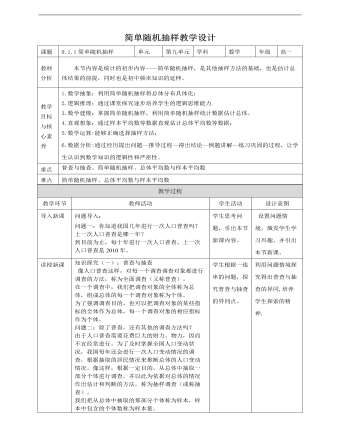
人教A版高中数学必修二简单随机抽样教学设计
知识探究(一):普查与抽查像人口普查这样,对每一个调查调查对象都进行调查的方法,称为全面调查(又称普查)。 在一个调查中,我们把调查对象的全体称为总体,组成总体的每一个调查对象称为个体。为了强调调查目的,也可以把调查对象的某些指标的全体作为总体,每一个调查对象的相应指标作为个体。问题二:除了普查,还有其他的调查方法吗?由于人口普查需要花费巨大的财力、物力,因而不宜经常进行。为了及时掌握全国人口变动状况,我国每年还会进行一次人口变动情况的调查,根据抽取的居民情况来推断总体的人口变动情况。像这样,根据一定目的,从总体中抽取一部分个体进行调查,并以此为依据对总体的情况作出估计和判断的方法,称为抽样调查(或称抽查)。我们把从总体中抽取的那部分个体称为样本,样本中包含的个体数称为样本量。
人教A版高中数学必修一诱导公式教学设计(2)
本节主要内容是三角函数的诱导公式中的公式二至公式六,其推导过程中涉及到对称变换,充分体现对称变换思想在数学中的应用,在练习中加以应用,让学生进一步体会 的任意性;综合六组诱导公式总结出记忆诱导公式的口诀:“奇变偶不变,符号看象限”,了解从特殊到一般的数学思想的探究过程,培养学生用联系、变化的辩证唯物主义观点去分析问题的能力。诱导公式在三角函数化简、求值中具有非常重要的工具作用,要求学生能熟练的掌握和应用。课程目标1.借助单位圆,推导出正弦、余弦第二、三、四、五、六组的诱导公式,能正确运用诱导公式将任意角的三角函数化为锐角的三角函数,并解决有关三角函数求值、化简和恒等式证明问题2.通过公式的应用,了解未知到已知、复杂到简单的转化过程,培养学生的化归思想,以及信息加工能力、运算推理能力、分析问题和解决问题的能力。
人教A版高中数学必修一函数的零点与方程的解教学设计(2)
本章通过学习用二分法求方程近似解的的方法,使学生体会函数与方程之间的关系,通过一些函数模型的实例,让学生感受建立函数模型的过程和方法,体会函数在数学和其他学科中的广泛应用,进一步认识到函数是描述客观世界变化规律的基本数学模型,能初步运用函数思想解决一些生活中的简单问题。1.了解函数的零点、方程的根与图象交点三者之间的联系.2.会借助零点存在性定理判断函数的零点所在的大致区间.3.能借助函数单调性及图象判断零点个数.数学学科素养1.数学抽象:函数零点的概念;2.逻辑推理:借助图像判断零点个数;3.数学运算:求函数零点或零点所在区间;4.数学建模:通过由抽象到具体,由具体到一般的思想总结函数零点概念.重点:零点的概念,及零点与方程根的联系;难点:零点的概念的形成.
人教A版高中数学必修一函数的零点与方程的解教学设计(1)
本节课是新版教材人教A版普通高中课程标准实验教科书数学必修1第四章第4.5.1节《函数零点与方程的解》,由于学生已经学过一元二次方程与二次函数的关系,本节课的内容就是在此基础上的推广。从而建立一般的函数的零点概念,进一步理解零点判定定理及其应用。培养和发展学生数学直观、数学抽象、逻辑推理和数学建模的核心素养。1、了解函数(结合二次函数)零点的概念;2、理 解函数零点与方程的根以及函数图象与x轴交点的关系,掌握零点存在性定理的运用;3、在认识函数零点的过程中,使学生学会认识事物的特殊性与一般性之间的关系,培养数学数形结合及函数思想; a.数学抽象:函数零点的概念;b.逻辑推理:零点判定定理;c.数学运算:运用零点判定定理确定零点范围;d.直观想象:运用图形判定零点;e.数学建模:运用函数的观点方程的根;
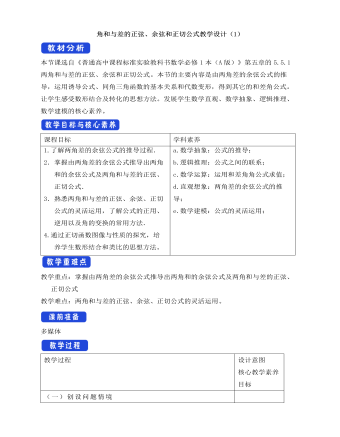
人教A版高中数学必修一两角和与差的正弦、余弦和正切公式教学设计(1)
本节课选自《普通高中课程标准实验教科书数学必修1本(A版)》第五章的5.5.1 两角和与差的正弦、余弦和正切公式。本节的主要内容是由两角差的余弦公式的推导,运用诱导公式、同角三角函数的基本关系和代数变形,得到其它的和差角公式。让学生感受数形结合及转化的思想方法。发展学生数学直观、数学抽象、逻辑推理、数学建模的核心素养。课程目标 学科素养1.了解两角差的余弦公式的推导过程.2.掌握由两角差的余弦公式推导出两角和的余弦公式及两角和与差的正弦、正切公式.3.熟悉两角和与差的正弦、余弦、正切公式的灵活运用,了解公式的正用、逆用以及角的变换的常用方法.4.通过正切函数图像与性质的探究,培养学生数形结合和类比的思想方法。 a.数学抽象:公式的推导;b.逻辑推理:公式之间的联系;c.数学运算:运用和差角角公式求值;d.直观想象:两角差的余弦公式的推导;e.数学建模:公式的灵活运用;