-
新人教版高中英语必修3Unit 1 Festivals and celebrations-Discovering Useful Structure教学设计
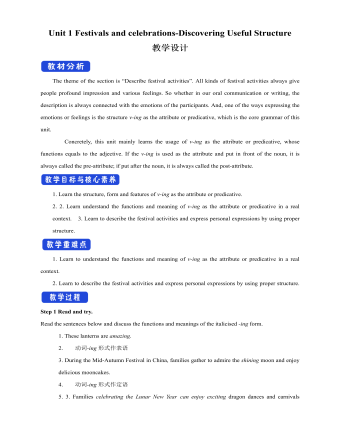
4.That was an experience that frightened everyone. →That was _____________________. 答案:1. taking 2. being discussed 3. in the reading room 4. a frightening experienceStep 6 The meaning and function of V-ing as the predicative动词-ing形式作表语,它通常位于系动词后面,用以说明主语“是什么”或“怎么样”一种表示主语的特质、特征和状态, 其作用相当于形容词; 另一种具体说明主语的内容, 即主语等同于表语, 两者可互换。The music they are playing sounds so exciting. 他们演奏的音乐听起来令人激动。The result is disappointing. 结果令人失望。Our job is playing all kinds of music. 我们的工作就是演奏各种音乐。Seeing is believing. 眼见为实。Step 7 Practice1. It is ________(amaze) that the boy is able to solve the problem so quickly.2. Buying a car is simply _______(waste) money. 3. Please stop making the noise—it’s getting ________(annoy). 4. complete the passage with the appropriate -ing form.La Tomatina is a festival that takes place in the Spanish town Bunol every August. I think many food festivals are __________ because people are just eating. however, this festival is _________ because people don't actually eat the tomatoes. Instead, they throw them at each other! the number of people ________ part in this tomato fight, can reach up to 20,000, and it is a very __________ fight that lasts for a whole hour. The _______ thing is how clean Bunol is after the tomatoes are washed away after the fight. this is because the juice form tomatoes is really good for making surfaces clean!答案:1. amazing 2. wasting 3. annoying4. boring interesting taking exciting amazing
新人教版高中英语必修3Unit 2 Morals and Virtues-Reading and Thinking教学设计
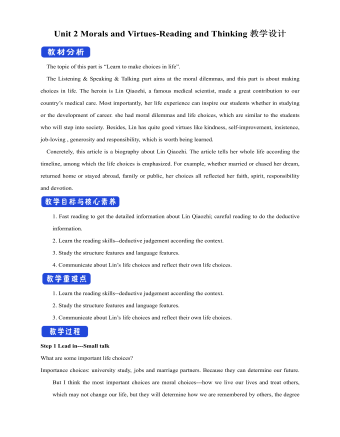
The topic of this part is “Learn to make choices in life”.The Listening & Speaking & Talking part aims at the moral dilemmas, and this part is about making choices in life. The heroin is Lin Qiaozhi, a famous medical scientist, made a great contribution to our country’s medical care. Most importantly, her life experience can inspire our students whether in studying or the development of career. she had moral dilemmas and life choices, which are similar to the students who will step into society. Besides, Lin has quite good virtues like kindness, self-improvement, insistence, job-loving , generosity and responsibility, which is worth being learned.Concretely, this article is a biography about Lin Qiaozhi. The article tells her whole life according the timeline, among which the life choices is emphasized. For example, whether married or chased her dream, returned home or stayed abroad, family or public, her choices all reflected her faith, spirit, responsibility and devotion.1. Fast reading to get the detailed information about Lin Qiaozhi; careful reading to do the deductive information.2. Learn the reading skills--deductive judgement according the context.3. Study the structure features and language features. 4. Communicate about Lin’s life choices and reflect their own life choices.1. Learn the reading skills--deductive judgement according the context.2. Study the structure features and language features.3. Communicate about Lin’s life choices and reflect their own life choices.Step 1 Lead in---Small talkWhat are some important life choices?Importance choices: university study, jobs and marriage partners. Because they can determine our future.
新人教版高中英语必修3Unit 3 Diverse Cultures-Listening &Speaking&Talking教学设计
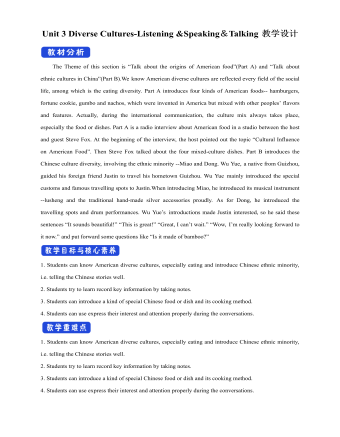
1. In Picture 1 and Picture 2, where do you think they are from? How do you know?From their wearings, we can know they are from ethnic minority of China--- Miao and Dong.Picture 1, they are playing their traditional instrument lusheng in their traditional costumes.Picture 2. the girls are Miao because they wear their traditional costumes and silver accessory.2. In Picture 3, can you find which village it is? What time is it in the picture?It is Dong village. It is at night. Step 2 While-listeningJustin met a new friend while traveling in Guizhou. Listen to their conversation and complete the summaries below.Part 1Justin and Wu Yue watched some Miao people play the lusheng. The instrument has a history of over 3,000 years and it is even mentioned in the oldest collection of Chinese poetry. Then they watched the lusheng dance. Justin wanted to buy some hand-made silver/traditional accessories as souvenirs. He was told that the price will depend on the percentage of silver. Part 2They will go to a pretty Dong minority village called Zhaoxing. they will see the drum towers and the wind and rain bridges. They may also see a performance of the Grand Song of the Dong people.Step 3 Post-listening---TalkingWork in groups. Imagine Justin is telling some friends about his trip to Guizhou. One of you is Justin and the rest of you are his friends. Ask Justin questions about his trip and experience. The following expressions may help you.
新人教版高中英语必修3Unit 5 The value of money-Reading and Thinking教学设计二
? Could you offer me some kind of work here?? I don’t want your charity, I just want an honest job.? Careless: I landed in Britain by accident.Step 7:Consolidation.? Find Henry? Roderick and Oliver were I .making a bet when they saw Henry, a poor young man. ? Know Henry? About a month ago, Henry was sailing and later he found himself carried out to sea by a strong wind. Fortunately, he 2.was spotted by a ship. And it was the ship that brought him to 3.England? Offer money to Henry ? Oliver and Roderick gave Henry a letter and told him that there was money in it. They 4.persuaded him to accept it, and made him 5.promise that it wouldn't be opened until 2 o'clock.Step 8:Language pointsa large amount of: a large quantity of; a great deal ofe.g. They bought a large amount of furniture before they moved their new house.make a bet: make an arrangement to risk money, etc. on an event of which the result is doubtful.e.g. We made a bet on the result of the match.permit sb to do something: allow somebody to do somethinge.g. My mother doesn’t permit me to ride in the street after it rained.by accident: as a result of chancee.g. I only found it by accident.stare at: look at somebody or something with the eyes wide open in a fixed gaze( in astonishment, wonder, fear, etc)to be honest: to tell you the truth; to be franke.g. To be honest, I don’t think we have a chance of winning.Step7 Homework:What do you think will happen to Henry? Will the bank-note help him or get him into trouble?
新人教版高中英语必修3Unit 5 The Value of Money-Reading for Writing教学设计二
2. 您能看到, 我头发太长了。You can see that my hair is much too long.3. 无论什么时候, 只要您想回来就回来。Please come back whenever you want.4. 您仅有很少的头发要理! You only have too little hair to cut !5. 为您服务是我的荣幸!It is my honour to serve you!Step 9 Writing(Henry is walking down the street when he sees a sign for a place that cuts hair. He decides to have it cut. )H=Henry B=BarberH: Good afternoon, I’d like to have my hair cut, if I may. (The barber looks at Henry’s hair and continues cutting another man’s hair. ) Er, I’d really like a haircut. As you can see it’s much too long. B: (in a rude manner) Yes, I can see that. Indeed, I can. H: Fine, well, I’ll have a seat then. (He sits in one of the barber’s chairs. The barber turns to look at Henry. )B: It’s quite expensive here, you know! Are you sure you can afford it?H: Yes. I think so. (After his hair is cut, the barber tells Henry how much he must pay. Henry shows the barber the bank note. )B: Why Mr. . . (looks shocked)H: Adams. Henry Adams. I’m sorry. I don’t have any change. B: Please don’t worry! (wearing a big smile) Nothing to worry about! Nothing at all! Please come back whenever you want, even if you only have too little hair to cut! It will be my honour to serve you!Step 10 Pair workExchange drafts with a partner. Use this checklist to help your partner revise his/her draft.1. Are all the elements of a play included and in good order ?2. Do the character use suitable language ?3. Are the stage directions clear and useful ?4. Is the plot clear and exciting enough ?
新人教版高中英语必修3Unit 5 the value of money-Reading For Writing教学设计一
【参考范文】Narrator:(Henry is smiling as he leaves the restaurant. As he is walking down the street, he sees a sign for a place that cuts hair. He decides to get it cut. )H=Henry;B=Barber;R=rude manH:Good afternoon, I'd like to get a cut, if I may. (The barber looks at Henry's hair and continues cutting another man's hair. )Er, I'd really like a haircut. As you can see it's much too long. B:(in a rude manner) Yes, I can see that. Indeed, I can. H:Fine, well I'll have a seat then. (He sits in one of the barber's chairs. The barber turns to look at Henry. )B:It's quite expensive here, you know!Are you sure you can afford it?H:Yes. I think so. (In comes the rude man. )R:Hey you there. I need a haircut quickly. Can you do me straightaway?B:All right, then, get in the chair and I'll see what I can do. R:Thank you. (sits down in one of the barber's chairs)H:Excuse me, but I was here first. Aren't you going to do my hair first?B:This man's in a hurry. H:Well so am I!I insist that you cut my hair first. B:OK, but I'll have to be quick. This gentleman is waiting. H:Thank you. (They both become quiet. After his hair is cut, the barber tells Henry how much he must pay. Henry shows the barber the bank note. )B:Why, Mr . . . (looks shocked)H:Adams. Henry Adams. I'm sorry, I don't have any change. R:You're that Mr Adams! Well,I'm glad I waited or I might never have known it was you. B:Why, Mr Adams, please don't worry!(wearing a big smile) Nothing to worry about!Nothing at all!Please come back any time, even if you only need too little hairs cut!It will be my honour to serve you!
新人教版高中英语必修3Unit 1 Festivals and Celebrations-Reading for Writing教学设计一
The topic of this part is “Write about your festival experience”.During the Listening and Speaking and Talking, students are just asked to say out their festival experiences such as the Spring Festival, Mid-autumn Day, but this part students will be asked to write down their own festival experiences. During the reading part, it introduces the Naadam Festival in Inner Mongolia Autonomous Region, which can give students a good example to imitate. Students not only learn the festival, but touch and feel the Inner Mongolian’s character, the spirit and cultural atmosphere, which can help students form the cultural awareness and learn to enjoy and value the diversity of Chinese culture.Concretely, the dairy tells the experience that the author spent the Naadam Festival in Inner Mongolia Autonomous Region with his/her friend. The structure is clear. In the opening paragraph, it introduces the topic of the Naadam Festival and the whole feeling. Then it introduces the items of the festival like the ceremony, wrestling and horse racing. Finally, it summarizes this experience. Because this part is a travel journal, we must guide students pay more attention to these details: 1. use the first person. 2. use the past tense to tell the past thing and use the present or future tense to describe the scenery. 3. use the timeline to tell the development. 4. be careful for the author’s psychology, emotion and feeling, etc.1. Read quickly to get main idea; read carefully to get the detailed information about Naadam Festival.2. Learn the structure of the reading article and language.3. Write an article about a festival experience4. Learn to use the psychology, emotions and feeling in the writing.1. Write an article about a festival experience.2. Use the structure of the reading article and language.
新人教版高中英语必修3Unit 3 Diverse Cultures-Discovering Useful Structure教学设计
Step 4 PracticeRead the conversation. Find out which words have been left out.Justin: Linlin, I’m going to Guizhou Province next month. I’m super excited! Any recommendations for places to visit?Linlin: Wow, cool! Guizhou is a province with a lot of cultural diversity. Places to visit...well, definitely the Huangguoshu Waterfall first.Justin: What’s special about the waterfall?Linlin: Well, have you ever heard of the Chinese novel Journey to the West ?Justin: Yes, I have. Why ?Linlin: In the back of the waterfall, you will find a cave, which is the home of the Monkey King.Justin: Really? Cool! I’ll definitely check it out.Linlin:And I strongly recommend the ethnic minority villages. You’ll find Chinese culture is much more diverse than you thought.Justin:Sounds great, thanks.Answers:Justin: Linlin, I’m going to Guizhou Province next month. I’m super excited! Do you have any recommendations for places to visit?Linlin: Wow, that’s cool! Guizhou is a province with a lot of cultural diversity. What are some places to visit in Guizhou ? Well, definitely the Huangguoshu Waterfall is the first place to visit in Guizhou Province.Justin: What’s special about the waterfall?Linlin: Well, have you ever heard of the Chinese novel Journey to the West ?Justin: Yes, I have heard of the Chinese novel Journey to the West . Why do you ask if I have heard of the Chinese novel Journey to the West?Linlin: In the back of the waterfall, you will find a cave, which is the home of the Monkey King from Journey to the West.Justin: That’s really true? It’s Cool! I’ll definitely check it out.Linlin:And I strongly recommend the ethnic minority villages on your trip to Guizhou Province. You’ll find Chinese culture is much more diverse than you thought it was.Justin:This all sounds great, thanks.
新人教版高中英语必修3Unit 3 Diverse Cultures-Reading for Writing教学设计
The topic of this part is “Describe a place with distinctive cultural identity”.This section focuses on Chinese culture by introducing Chinatown, whose purpose is to show the relationship between the Chinese culture and American culture. The Chinese culture in Chinatown is an important part of American culture. Chinatown is an important window of spreading Chinese culture and the spirit homeland of oversea Chinese, where foreigners can experience Chinese culture by themselves.Concretely, the title is “Welcome to Chinatown!”, from which we can know that the article aims at introducing Chinatown. The author used the “Introduction--Body Paragraph--Conclusion” to describe the people, language, architecture, business, famous food and drinks and people’s activities, which can be a centre for Chinese culture and shows its unique charm.1. Read quickly to get main idea; read carefully to get the detailed information.2. Learn the characteristics of writing and language.3. Learn to introduce your own town according to the text.4. Learn to correct others’ writing.1. Learn the characteristics of writing and language.2. Learn to introduce your own town according to the text.Step 1 Lead in ---Small talkIn the reading part, we mentioned the Chinatown of San Francisco. How much do you know about Chinatown of San Francisco ?Chinatown is a main living place for Chinese immigrants, where you can see many Chinese-style buildings, costumes, operas, restaurants, music and even hear Chinese.Step 2 Before reading ---Predict the contentWhat is the writer’s purpose of writing this text ? How do you know ?From the title(Welcome to Chinatown) and some key words from the text(tourist, visit, visitors, experience), we can know the purpose of the text is to introduce Chinatown and show the relationship between Chinese culture and American culture.
新人教版高中英语必修3Unit 5 The Value of Money- Discovering Useful Structure教学设计
Step 3 Meaning1. 过去将来时表示从过去某一时间来看将要发生的动作或存在的状态, 常用在宾语从句中。一般由“would/should +动词原形”构成。She hoped that they would meet again someday. 她希望将来有一天他们能再见面。2. was/were going to+动词原形: 表示过去将要发生或很有可能发生的动作, 常用于口语中, 表示预言、意图或者打算等。He was going to start work the following week. 他打算下星期开始工作。3. was/were about to do: 常用来表示即将发生的动作, “刚要/正要做……”。注意该结构不与任何时间状语连用。I felt that something terrible was about to happen. 我感到某种可怕的事情即将发生。4.was/were to do: 表示“曾计划做某事”, 如果表示“本来计划做某事, 动作没实现”, 则需用 “was/were to have done”。She said she was to have told me about the accident. 她说她本来想告诉我关于事故的事。5.Start, go, come, leave, see, meet等动词的过去进行时: 表示就过去某一时刻而言即将发生的动作。She was coming later. 她随后就来。I had just put on my overcoat and was leaving to visit a friend of mine. 我刚穿上外套要去看我的一个朋友。
新人教版高中英语必修3Unit 5 The Value of Money-Listening &Speaking&Talking教学设计
4. A:We’d like to have someone to say a word at the beginning to welcome the group.B:↙Who?A:We thought that you or Dr.Johnson might do it.B用降调说Who,其意思是问,对方想让谁在开场时致欢迎词。Step 6 Pronunciation---Practice1. Listen to the short conversation and mark the intonation with ↗, ↙ or ↙, ↗. Then discuss with a partner what they intend to convey by using different intonation.Owner: You know what ?↗ It’s a million-pound bank note↙.Waiter 1: Really ?↗(question)Waiter 2: Really !↙(unbelievable and surprised)Waiter 3: Really ?!↙↗(first question then surprised)2. Listen to the conversations. Underline the parts that are stressed and mark the intonation. Then talk about the implied meanings of the responses with different intonations. Listen again and repeat.1) Henry: It’s a nice suit.Owner: Oh, it’s perfect!↙(The intonation means it is very suitable for Henry.)2) Henry: Well, that’s very kind of you.Owner: Kind, sir ?↗(what you said is not right) No, it’s kind of you. You must come whenever you want and have whatever you like. Just having you sit here is a great honour !!↙(welcome you to come again)3)Henry:Well, to be honest, I have none. Oliver:(happily) What luck!(excited) Brother↗, what luck!↙(It means “Didn’t you hear it?”)Henry: Well, it may seem lucky to you but not to me!↗(angry) If this is your idea of some kind of joke, I don’t think it’s very funny. Now if you’ll excuse me, I ought to be on my way.↙(If so, I would leave.)Roderick: Please don’t go↙...(hope Henry can wait for a moment)Part B Viewing and Talking---Describe people’s changing attitudes in a film clipStep 1 Before-listening---Tell the filmYou are going to watch part of the film The Million Pound Bank Note. Look at these photos and guess what happens in the film.
新人教版高中英语必修3Unit 5 The Value of Money-Listening &Speaking教学设计
Step 4: Listen again and decide if the following statements are true (T) or false (F).1 It was the first time Chen Liyan's story was reported. T口 F口2 Chen found 10,000 yuan in a small plastic bag in Taiyuan railway station口 F口3 Wang Zheng apologized to Chen because he couldn't offer her more money. T口 F口4 Chen took out a large loan to cure her daughter, T口 F口5 Wang set up a fundraising website for Chen's daughter after Chen told him about her situation. T口 F口Step 5:After listening, discuss the questions.1 What kind of person do you think Chen Liyan is?Chen Liyan is generous and honest because she returned a large sum of money to the owner.2 Did Chen return the money because she didn't need it?No. She returned the money because it was the right thing to do. Evidence for this is that she refused to accept the reward money because she felt that it had not been earned. 3 Is it common for people to do what Chen did?It depends on the culture. In some countries it is quite common to return money that has been found. In other countries, people believe "Finders are keepers!" 4 How did Wang Zheng feel about the return of his money?He must have been very happy and relieved to have gotten his money back. We know this because he thanked Chen repeatedly and even offered her a reward.5 Why did Ma Dongbao tell Wang about Chen's family?He must have had great sympathy for Chen and her daughter and wanted to help them.'We know this because he arranged help for them. 6 How did the news reporter feel about Chen's actions?The news reporter felt that it showed that money wasn't the most important thing in life. We know this because the reporter told us that this is what Chen believes. and then said, “that's a great attitude to take."
人教A版高中数学必修一函数的零点与方程的解教学设计(2)
本章通过学习用二分法求方程近似解的的方法,使学生体会函数与方程之间的关系,通过一些函数模型的实例,让学生感受建立函数模型的过程和方法,体会函数在数学和其他学科中的广泛应用,进一步认识到函数是描述客观世界变化规律的基本数学模型,能初步运用函数思想解决一些生活中的简单问题。1.了解函数的零点、方程的根与图象交点三者之间的联系.2.会借助零点存在性定理判断函数的零点所在的大致区间.3.能借助函数单调性及图象判断零点个数.数学学科素养1.数学抽象:函数零点的概念;2.逻辑推理:借助图像判断零点个数;3.数学运算:求函数零点或零点所在区间;4.数学建模:通过由抽象到具体,由具体到一般的思想总结函数零点概念.重点:零点的概念,及零点与方程根的联系;难点:零点的概念的形成.
人教A版高中数学必修一函数的零点与方程的解教学设计(1)
本节课是新版教材人教A版普通高中课程标准实验教科书数学必修1第四章第4.5.1节《函数零点与方程的解》,由于学生已经学过一元二次方程与二次函数的关系,本节课的内容就是在此基础上的推广。从而建立一般的函数的零点概念,进一步理解零点判定定理及其应用。培养和发展学生数学直观、数学抽象、逻辑推理和数学建模的核心素养。1、了解函数(结合二次函数)零点的概念;2、理 解函数零点与方程的根以及函数图象与x轴交点的关系,掌握零点存在性定理的运用;3、在认识函数零点的过程中,使学生学会认识事物的特殊性与一般性之间的关系,培养数学数形结合及函数思想; a.数学抽象:函数零点的概念;b.逻辑推理:零点判定定理;c.数学运算:运用零点判定定理确定零点范围;d.直观想象:运用图形判定零点;e.数学建模:运用函数的观点方程的根;
人教版新课标高中物理必修1用牛顿运动定律解决问题(二)说课稿2篇
教师活动:(1)组织学生回答相关结论,小组之间互相补充评价完善。教师进一步概括总结。(2)对学生的结论予以肯定并表扬优秀的小组,对不理想的小组予以鼓励。(3)多媒体投放板书二:超重现象:物体对支持物的压力(或对悬挂物的拉力)大于物体所受到的重力的情况称为超重现象。实质:加速度方向向上。失重现象:物体对支持物的压力(或对悬挂物的拉力)小于物体所受到的重力的情况称为失重现象。实质:加速度方向向下。(4)运用多媒体展示电梯中的现象,引导学生在感性认识的基础上进一步领会基本概念。4.实例应用,结论拓展:教师活动:展示太空舱中宇航员的真实生活,引导学生应用本节所学知识予以解答。学生活动:小组讨论后形成共识。教师活动:(1)引导学生分小组回答相关问题,小组间互相完善补充,教师加以规范。(2)指定学生完成导学案中“思考与讨论二”的两个问题。
人教A版高中数学必修一诱导公式教学设计(1)
一、复习回顾,温故知新1. 任意角三角函数的定义【答案】设角 它的终边与单位圆交于点 。那么(1) (2) 2.诱导公式一 ,其中, 。终边相同的角的同一三角函数值相等二、探索新知思考1:(1).终边相同的角的同一三角函数值有什么关系?【答案】相等(2).角 -α与α的终边 有何位置关系?【答案】终边关于x轴对称(3).角 与α的终边 有何位置关系?【答案】终边关于y轴对称(4).角 与α的终边 有何位置关系?【答案】终边关于原点对称思考2: 已知任意角α的终边与单位圆相交于点P(x, y),请同学们思考回答点P关于原点、x轴、y轴对称的三个点的坐标是什么?【答案】点P(x, y)关于原点对称点P1(-x, -y)点P(x, y)关于x轴对称点P2(x, -y) 点P(x, y)关于y轴对称点P3(-x, y)
人教A版高中数学必修一基本不等式教学设计(2)
《基本不等式》在人教A版高中数学第一册第二章第2节,本节课的内容是基本不等式的形式以及推导和证明过程。本章一直在研究不等式的相关问题,对于本节课的知识点有了很好的铺垫作用。同时本节课的内容也是之后基本不等式应用的必要基础。课程目标1.掌握基本不等式的形式以及推导过程,会用基本不等式解决简单问题。2.经历基本不等式的推导与证明过程,提升逻辑推理能力。3.在猜想论证的过程中,体会数学的严谨性。数学学科素养1.数学抽象:基本不等式的形式以及推导过程;2.逻辑推理:基本不等式的证明;3.数学运算:利用基本不等式求最值;4.数据分析:利用基本不等式解决实际问题;5.数学建模:利用函数的思想和基本不等式解决实际问题,提升学生的逻辑推理能力。重点:基本不等式的形成以及推导过程和利用基本不等式求最值;难点:基本不等式的推导以及证明过程.
人教A版高中数学必修一任意角教学设计(2)
学生在初中学习了 ~ ,但是现实生活中随处可见超出 ~ 范围的角.例如体操中有“前空翻转体 ”,且主动轮和被动轮的旋转方向不一致.因此为了准确描述这些现象,本节课主要就旋转度数和旋转方向对角的概念进行推广.课程目标1.了解任意角的概念.2.理解象限角的概念及终边相同的角的含义.3.掌握判断象限角及表示终边相同的角的方法.数学学科素养1.数学抽象:理解任意角的概念,能区分各类角;2.逻辑推理:求区域角;3.数学运算:会判断象限角及终边相同的角.重点:理解象限角的概念及终边相同的角的含义;难点:掌握判断象限角及表示终边相同的角的方法.教学方法:以学生为主体,采用诱思探究式教学,精讲多练。教学工具:多媒体。一、 情景导入初中对角的定义是:射线OA绕端点O按逆时针方向旋转一周回到起始位置,在这个过程中可以得到 ~ 范围内的角.但是现实生活中随处可见超出 ~ 范围的角.例如体操中有“前空翻转体 ”,且主动轮和被动轮的旋转方向不一致.
人教A版高中数学必修二简单随机抽样教学设计
知识探究(一):普查与抽查像人口普查这样,对每一个调查调查对象都进行调查的方法,称为全面调查(又称普查)。 在一个调查中,我们把调查对象的全体称为总体,组成总体的每一个调查对象称为个体。为了强调调查目的,也可以把调查对象的某些指标的全体作为总体,每一个调查对象的相应指标作为个体。问题二:除了普查,还有其他的调查方法吗?由于人口普查需要花费巨大的财力、物力,因而不宜经常进行。为了及时掌握全国人口变动状况,我国每年还会进行一次人口变动情况的调查,根据抽取的居民情况来推断总体的人口变动情况。像这样,根据一定目的,从总体中抽取一部分个体进行调查,并以此为依据对总体的情况作出估计和判断的方法,称为抽样调查(或称抽查)。我们把从总体中抽取的那部分个体称为样本,样本中包含的个体数称为样本量。
人教A版高中数学必修一诱导公式教学设计(2)
本节主要内容是三角函数的诱导公式中的公式二至公式六,其推导过程中涉及到对称变换,充分体现对称变换思想在数学中的应用,在练习中加以应用,让学生进一步体会 的任意性;综合六组诱导公式总结出记忆诱导公式的口诀:“奇变偶不变,符号看象限”,了解从特殊到一般的数学思想的探究过程,培养学生用联系、变化的辩证唯物主义观点去分析问题的能力。诱导公式在三角函数化简、求值中具有非常重要的工具作用,要求学生能熟练的掌握和应用。课程目标1.借助单位圆,推导出正弦、余弦第二、三、四、五、六组的诱导公式,能正确运用诱导公式将任意角的三角函数化为锐角的三角函数,并解决有关三角函数求值、化简和恒等式证明问题2.通过公式的应用,了解未知到已知、复杂到简单的转化过程,培养学生的化归思想,以及信息加工能力、运算推理能力、分析问题和解决问题的能力。