-
人教版新课标小学数学四年级下册加减法的简便计算说课稿2篇
一、说教材:本节课是在理解和掌握了五条运算定律的基础上进一步学习整数运算中的一些简便计算。这部分内容主要安排了五道例题。我主要教学的是例1和例2,讨论加减法运算中常用的简便计算。例1主要着眼于通过不同解法的比较,使学生认识一个数连续减去两个数可以改为减去这两个数的和。例2主要是加减计算的灵活应用,通过典型的、紧密联系生活,引导学生根据运算特点和数据特点,灵活选用合理简便的计算方法。本节教材最大的特点是:将简便计算的讨论与实际问题的解决有机地结合起来,使问题解决策略的多样化与计算方法的多样化融为一体。根据这一特点,我制定本节课的教学目标有以下几点:1、让学生在解决问题中理解连减的简便计算方法,体验计算方法的多样化。2、使学生感受数学与现实生活中的联系,培养学生根据具体情况选择算法的意识与能力,发展思维性。
人教版新课标小学数学四年级下册折线统计图说课稿3篇
三、制作统计图教师:事先我们一起搜集了这几年中我们班同学家庭拥有计算机的情况,并制成了统计表,请谁来介绍一下。(学生利用事先制成的统计表介绍数据)如果请你将它制作一份折线统计图,你有信心完成吗?小组讨论:你认为在制图时应做哪些工作?有什么注意点?(学生小组讨论后交流)在交流中,教师顺应学生回答,并相应介绍折线统计图各部分名称:(1)横轴:一般用于标明日期的前后;(2)纵轴:标明数据,反映单位长度表示的数据大小,一般最高数据比统计到的最高数据稍高一些;(3)制表日期和单位。学生独立在练习之上尝试练习。教师指名演示,同学互相评价并改正。统计分析:从这张统计图上你可以获得哪些信息?学生相互交流,也可以提问请同学回答。
幼儿园小班纸版画教案:神奇的汽车
活动准备: 1.丰富有关汽车的知识,范图。 2.白纸、铅画纸,勾线笔、硬板纸、胶水、剪刀。 活动过程: 一、以谈话导入活动,了解汽车的不同特征。 教师:小朋友,你们一定见过各种各样的汽车,谁来说一说,你见过的什么汽车?它是什么样子的呢? 师小结:汽车有好多种,他们的名字不同,车身也有着不同的造型,不同的色彩,不过他们都有轮子,车灯、窗户、门等。不同的汽车还有着它不同的功能。汽车作用真大,假如有一辆神奇的汽车就更好了。大三班有个小朋友设计了几辆神奇的汽车,我们一起来看看它到底神奇在哪里。
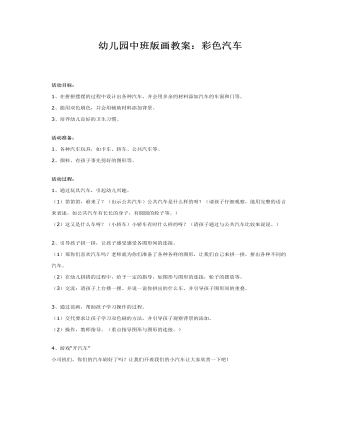
幼儿园中班版画教案:彩色汽车
2、能用双色刷色,并会用辅助材料添加背景。 3、培养幼儿良好的卫生习惯。活动准备: 1、各种汽车玩具,如卡车、轿车、公共汽车等。 2、颜料、有孩子事先剪好的图形等。活动过程: 1、通过玩具汽车,引起幼儿兴趣。 (1)笛笛笛,谁来了?(出示公共汽车)公共汽车是什么样的呀?(请孩子仔细观察,能用完整的语言来表述。如公共汽车有长长的身子,有圆圆的轮子等。) (2)这又是什么车呀?(小轿车)小轿车有时什么样的呀?(请孩子通过与公共汽车比较来说说。)
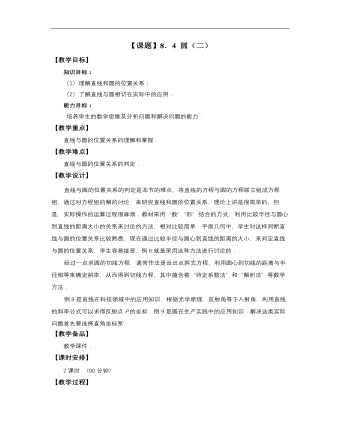
高教版中职数学基础模块下册:8.4《圆》教学设计
教 学 过 程教师 行为学生 行为教学 意图时间 *揭示课题 8.4 圆(二) *创设情境 兴趣导入 【知识回顾】 我们知道,平面内直线与圆的位置关系有三种(如图8-21): (1)相离:无交点; (2)相切:仅有一个交点; (3)相交:有两个交点. 并且知道,直线与圆的位置关系,可以由圆心到直线的距离d与半径r的关系来判别(如图8-22): (1):直线与圆相离; (2):直线与圆相切; (3):直线与圆相交. 介绍 讲解 说明 质疑 引导 分析 了解 思考 思考 带领 学生 分析 启发 学生思考 0 15*动脑思考 探索新知 【新知识】 设圆的标准方程为 , 则圆心C(a,b)到直线的距离为 . 比较d与r的大小,就可以判断直线与圆的位置关系. 讲解 说明 引领 分析 思考 理解 带领 学生 分析 30*巩固知识 典型例题 【知识巩固】 例6 判断下列各直线与圆的位置关系: ⑴直线, 圆; ⑵直线,圆. 解 ⑴ 由方程知,圆C的半径,圆心为. 圆心C到直线的距离为 , 由于,故直线与圆相交. ⑵ 将方程化成圆的标准方程,得 . 因此,圆心为,半径.圆心C到直线的距离为 , 即由于,所以直线与圆相交. 【想一想】 你是否可以找到判断直线与圆的位置关系的其他方法? *例7 过点作圆的切线,试求切线方程. 分析 求切线方程的关键是求出切线的斜率.可以利用原点到切线的距离等于半径的条件来确定. 解 设所求切线的斜率为,则切线方程为 , 即 . 圆的标准方程为 , 所以圆心,半径. 图8-23 圆心到切线的距离为 , 由于圆心到切线的距离与半径相等,所以 , 解得 . 故所求切线方程(如图8-23)为 , 即 或. 说明 例题7中所使用的方法是待定系数法,在利用代数方法研究几何问题中有着广泛的应用. 【想一想】 能否利用“切线垂直于过切点的半径”的几何性质求出切线方程? 说明 强调 引领 讲解 说明 引领 讲解 说明 观察 思考 主动 求解 思考 主动 求解 通过例题进一步领会 注意 观察 学生 是否 理解 知识 点 50
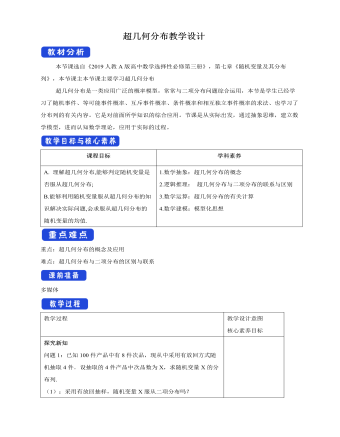
人教版高中数学选修3超几何分布教学设计
探究新知问题1:已知100件产品中有8件次品,现从中采用有放回方式随机抽取4件.设抽取的4件产品中次品数为X,求随机变量X的分布列.(1):采用有放回抽样,随机变量X服从二项分布吗?采用有放回抽样,则每次抽到次品的概率为0.08,且各次抽样的结果相互独立,此时X服从二项分布,即X~B(4,0.08).(2):如果采用不放回抽样,抽取的4件产品中次品数X服从二项分布吗?若不服从,那么X的分布列是什么?不服从,根据古典概型求X的分布列.解:从100件产品中任取4件有 C_100^4 种不同的取法,从100件产品中任取4件,次品数X可能取0,1,2,3,4.恰有k件次品的取法有C_8^k C_92^(4-k)种.一般地,假设一批产品共有N件,其中有M件次品.从N件产品中随机抽取n件(不放回),用X表示抽取的n件产品中的次品数,则X的分布列为P(X=k)=CkM Cn-kN-M CnN ,k=m,m+1,m+2,…,r.其中n,N,M∈N*,M≤N,n≤N,m=max{0,n-N+M},r=min{n,M},则称随机变量X服从超几何分布.
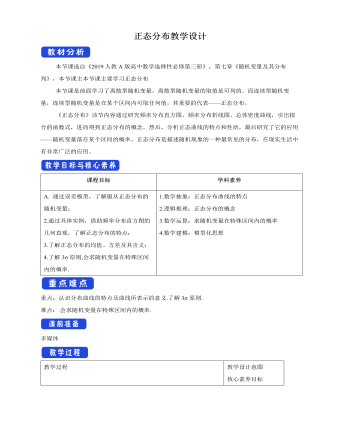
人教版高中数学选修3正态分布教学设计
3.某县农民月均收入服从N(500,202)的正态分布,则此县农民月均收入在500元到520元间人数的百分比约为 . 解析:因为月收入服从正态分布N(500,202),所以μ=500,σ=20,μ-σ=480,μ+σ=520.所以月均收入在[480,520]范围内的概率为0.683.由图像的对称性可知,此县农民月均收入在500到520元间人数的百分比约为34.15%.答案:34.15%4.某种零件的尺寸ξ(单位:cm)服从正态分布N(3,12),则不属于区间[1,5]这个尺寸范围的零件数约占总数的 . 解析:零件尺寸属于区间[μ-2σ,μ+2σ],即零件尺寸在[1,5]内取值的概率约为95.4%,故零件尺寸不属于区间[1,5]内的概率为1-95.4%=4.6%.答案:4.6%5. 设在一次数学考试中,某班学生的分数X~N(110,202),且知试卷满分150分,这个班的学生共54人,求这个班在这次数学考试中及格(即90分及90分以上)的人数和130分以上的人数.解:μ=110,σ=20,P(X≥90)=P(X-110≥-20)=P(X-μ≥-σ),∵P(X-μσ)≈2P(X-μ130)=P(X-110>20)=P(X-μ>σ),∴P(X-μσ)≈0.683+2P(X-μ>σ)=1,∴P(X-μ>σ)=0.158 5,即P(X>130)=0.158 5.∴54×0.158 5≈9(人),即130分以上的人数约为9人.
人教版高中数学选修3二项式定理教学设计
二项式定理形式上的特点(1)二项展开式有n+1项,而不是n项.(2)二项式系数都是C_n^k(k=0,1,2,…,n),它与二项展开式中某一项的系数不一定相等.(3)二项展开式中的二项式系数的和等于2n,即C_n^0+C_n^1+C_n^2+…+C_n^n=2n.(4)在排列方式上,按照字母a的降幂排列,从第一项起,次数由n次逐项减少1次直到0次,同时字母b按升幂排列,次数由0次逐项增加1次直到n次.1.判断(正确的打“√”,错误的打“×”)(1)(a+b)n展开式中共有n项. ( )(2)在公式中,交换a,b的顺序对各项没有影响. ( )(3)Cknan-kbk是(a+b)n展开式中的第k项. ( )(4)(a-b)n与(a+b)n的二项式展开式的二项式系数相同. ( )[解析] (1)× 因为(a+b)n展开式中共有n+1项.(2)× 因为二项式的第k+1项Cknan-kbk和(b+a)n的展开式的第k+1项Cknbn-kak是不同的,其中的a,b是不能随便交换的.(3)× 因为Cknan-kbk是(a+b)n展开式中的第k+1项.(4)√ 因为(a-b)n与(a+b)n的二项式展开式的二项式系数都是Crn.[答案] (1)× (2)× (3)× (4)√
人教版高中数学选修3全概率公式教学设计
2.某小组有20名射手,其中1,2,3,4级射手分别为2,6,9,3名.又若选1,2,3,4级射手参加比赛,则在比赛中射中目标的概率分别为0.85,0.64,0.45,0.32,今随机选一人参加比赛,则该小组比赛中射中目标的概率为________. 【解析】设B表示“该小组比赛中射中目标”,Ai(i=1,2,3,4)表示“选i级射手参加比赛”,则P(B)= P(Ai)P(B|Ai)= 2/20×0.85+ 6/20 ×0.64+ 9/20×0.45+ 3/20×0.32=0.527 5.答案:0.527 53.两批相同的产品各有12件和10件,每批产品中各有1件废品,现在先从第1批产品中任取1件放入第2批中,然后从第2批中任取1件,则取到废品的概率为________. 【解析】设A表示“取到废品”,B表示“从第1批中取到废品”,有P(B)= 112,P(A|B)= 2/11 ,P(A| )= 1/11所以P(A)=P(B)P(A|B)+P( )P(A| )4.有一批同一型号的产品,已知其中由一厂生产的占 30%, 二厂生产的占 50% , 三厂生产的占 20%, 又知这三个厂的产品次品率分别为2% , 1%, 1%,问从这批产品中任取一件是次品的概率是多少?
人教版高中数学选修3条件概率教学设计
(2)方法一:第一次取到一件不合格品,还剩下99件产品,其中有4件不合格品,95件合格品,于是第二次又取到不合格品的概率为4/99,由于这是一个条件概率,所以P(B|A)=4/99.方法二:根据条件概率的定义,先求出事件A,B同时发生的概率P(AB)=(C_5^2)/(C_100^2 )=1/495,所以P(B|A)=(P"(" AB")" )/(P"(" A")" )=(1/495)/(5/100)=4/99.6.在某次考试中,要从20道题中随机地抽出6道题,若考生至少答对其中的4道题即可通过;若至少答对其中5道题就获得优秀.已知某考生能答对其中10道题,并且知道他在这次考试中已经通过,求他获得优秀成绩的概率.解:设事件A为“该考生6道题全答对”,事件B为“该考生答对了其中5道题而另一道答错”,事件C为“该考生答对了其中4道题而另2道题答错”,事件D为“该考生在这次考试中通过”,事件E为“该考生在这次考试中获得优秀”,则A,B,C两两互斥,且D=A∪B∪C,E=A∪B,由古典概型的概率公式及加法公式可知P(D)=P(A∪B∪C)=P(A)+P(B)+P(C)=(C_10^6)/(C_20^6 )+(C_10^5 C_10^1)/(C_20^6 )+(C_10^4 C_10^2)/(C_20^6 )=(12" " 180)/(C_20^6 ),P(E|D)=P(A∪B|D)=P(A|D)+P(B|D)=(P"(" A")" )/(P"(" D")" )+(P"(" B")" )/(P"(" D")" )=(210/(C_20^6 ))/((12" " 180)/(C_20^6 ))+((2" " 520)/(C_20^6 ))/((12" " 180)/(C_20^6 ))=13/58,即所求概率为13/58.
人教版高中数学选修3组合与组合数教学设计
解析:因为减法和除法运算中交换两个数的位置对计算结果有影响,所以属于组合的有2个.答案:B2.若A_n^2=3C_(n"-" 1)^2,则n的值为( )A.4 B.5 C.6 D.7 解析:因为A_n^2=3C_(n"-" 1)^2,所以n(n-1)=(3"(" n"-" 1")(" n"-" 2")" )/2,解得n=6.故选C.答案:C 3.若集合A={a1,a2,a3,a4,a5},则集合A的子集中含有4个元素的子集共有 个. 解析:满足要求的子集中含有4个元素,由集合中元素的无序性,知其子集个数为C_5^4=5.答案:54.平面内有12个点,其中有4个点共线,此外再无任何3点共线,以这些点为顶点,可得多少个不同的三角形?解:(方法一)我们把从共线的4个点中取点的多少作为分类的标准:第1类,共线的4个点中有2个点作为三角形的顶点,共有C_4^2·C_8^1=48(个)不同的三角形;第2类,共线的4个点中有1个点作为三角形的顶点,共有C_4^1·C_8^2=112(个)不同的三角形;第3类,共线的4个点中没有点作为三角形的顶点,共有C_8^3=56(个)不同的三角形.由分类加法计数原理,不同的三角形共有48+112+56=216(个).(方法二 间接法)C_12^3-C_4^3=220-4=216(个).
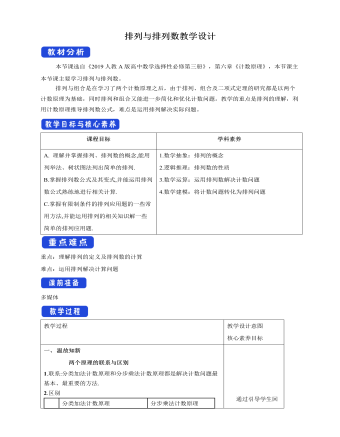
人教版高中数学选修3排列与排列数教学设计
4.有8种不同的菜种,任选4种种在不同土质的4块地里,有 种不同的种法. 解析:将4块不同土质的地看作4个不同的位置,从8种不同的菜种中任选4种种在4块不同土质的地里,则本题即为从8个不同元素中任选4个元素的排列问题,所以不同的种法共有A_8^4 =8×7×6×5=1 680(种).答案:1 6805.用1、2、3、4、5、6、7这7个数字组成没有重复数字的四位数.(1)这些四位数中偶数有多少个?能被5整除的有多少个?(2)这些四位数中大于6 500的有多少个?解:(1)偶数的个位数只能是2、4、6,有A_3^1种排法,其他位上有A_6^3种排法,由分步乘法计数原理,知共有四位偶数A_3^1·A_6^3=360(个);能被5整除的数个位必须是5,故有A_6^3=120(个).(2)最高位上是7时大于6 500,有A_6^3种,最高位上是6时,百位上只能是7或5,故有2×A_5^2种.由分类加法计数原理知,这些四位数中大于6 500的共有A_6^3+2×A_5^2=160(个).
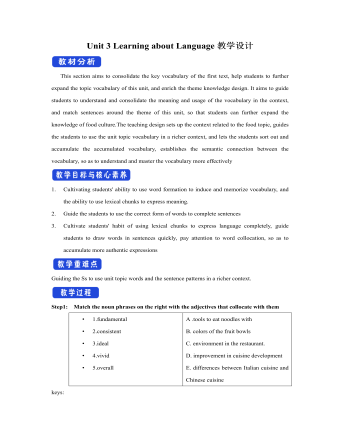
新人教版高中英语选修2Unit 3 Learning about Language教学设计
1. We'll need ten months at least to have the restaurant decorated.2.Some traditional Chinese dishes from before the Ming Dynasty are still popular today.3.My grandpa's breakfast mainly includes whole grain biscuits and a glass of milk.4.People in this area would eat nearly a kilo of cheese per week.5. We enjoyed a special dinner in a fancy restaurant where the waiters all wore attractive suits.6. He prefers this brand of coffee which, as he said, has an unusually good flavor.Key:1. at a minimum 2. prior to3. consist of4. consume5. elegant6. exceptionalStep 5:Familiarize yourself with some food idioms by matching the meaning on the right with the colored words on the left.1.Public concern for the health of farm animals has mushroomed in the UK2.Anderson may be young but he's certainly rolling to doing dough!3.George is a popular lecturer. He often peppers his speech with jokes.4.As the person to bring home the bacon, he needs to find a stable job.5 He is often regarded as a ham actor for his over emphasized facial expressions. The media reported that these companies had treated pollution as a hot potato. 6.The media reported that these companies had treated pollution as a hot potato.7.Don't worry about the test tomorrow. It's going to be a piece of cake!8. It's best to fold the swimming ring when it is as flat as a pancake.A. completely flatB. something that is very easy to do C.an issue that is hard to deal withD.to include large numbers of somethingE.to earn on e's living to support a familyF. wealthyG.to rapidly increase in numberH. an actor who performs badly, especially by over emphasizing emotions
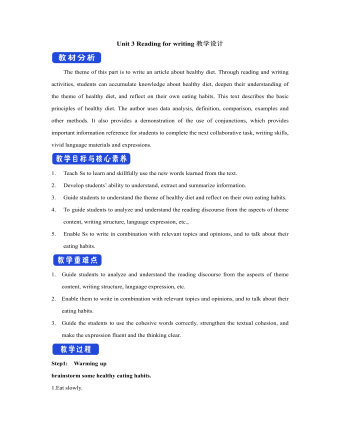
新人教版高中英语选修2Unit 3 Reading for writing教学设计
The theme of this part is to write an article about healthy diet. Through reading and writing activities, students can accumulate knowledge about healthy diet, deepen their understanding of the theme of healthy diet, and reflect on their own eating habits. This text describes the basic principles of healthy diet. The author uses data analysis, definition, comparison, examples and other methods. It also provides a demonstration of the use of conjunctions, which provides important information reference for students to complete the next collaborative task, writing skills, vivid language materials and expressions.1. Teach Ss to learn and skillfully use the new words learned from the text.2. Develop students’ ability to understand, extract and summarize information.3. Guide students to understand the theme of healthy diet and reflect on their own eating habits.4. To guide students to analyze and understand the reading discourse from the aspects of theme content, writing structure, language expression, etc., 5. Enable Ss to write in combination with relevant topics and opinions, and to talk about their eating habits.1. Guide students to analyze and understand the reading discourse from the aspects of theme content, writing structure, language expression, etc.2. Enable them to write in combination with relevant topics and opinions, and to talk about their eating habits.3. Guide the students to use the cohesive words correctly, strengthen the textual cohesion, and make the expression fluent and the thinking clear.Step1: Warming upbrainstorm some healthy eating habits.1.Eat slowly.2.Don’t eat too much fat or sugar.3.Eat healthy food.4.Have a balanced diet.Step2: Read the passage and then sum up the main idea of each paragraph.
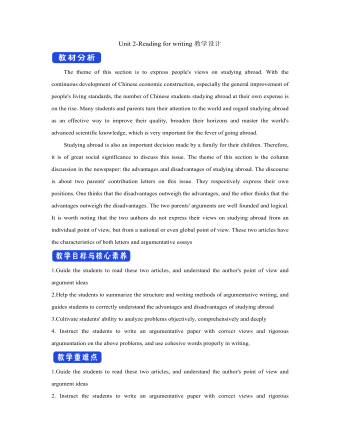
新人教版高中英语选修2Unit 2 Reading for writing教学设计
The theme of this section is to express people's views on studying abroad. With the continuous development of Chinese economic construction, especially the general improvement of people's living standards, the number of Chinese students studying abroad at their own expense is on the rise. Many students and parents turn their attention to the world and regard studying abroad as an effective way to improve their quality, broaden their horizons and master the world's advanced scientific knowledge, which is very important for the fever of going abroad. Studying abroad is also an important decision made by a family for their children. Therefore, it is of great social significance to discuss this issue. The theme of this section is the column discussion in the newspaper: the advantages and disadvantages of studying abroad. The discourse is about two parents' contribution letters on this issue. They respectively express their own positions. One thinks that the disadvantages outweigh the advantages, and the other thinks that the advantages outweigh the disadvantages. The two parents' arguments are well founded and logical. It is worth noting that the two authors do not express their views on studying abroad from an individual point of view, but from a national or even global point of view. These two articles have the characteristics of both letters and argumentative essays1.Guide the students to read these two articles, and understand the author's point of view and argument ideas2.Help the students to summarize the structure and writing methods of argumentative writing, and guides students to correctly understand the advantages and disadvantages of studying abroad3.Cultivate students' ability to analyze problems objectively, comprehensively and deeply
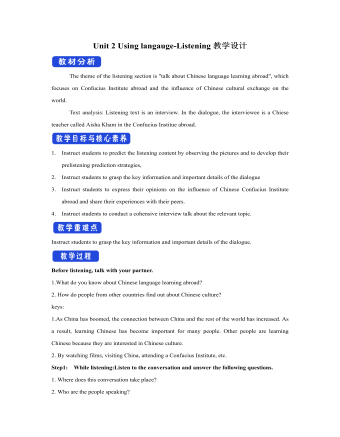
新人教版高中英语选修2Unit 2 Using langauge-Listening教学设计
? B: Absolutely! Getting involved with Chinese cultural activities there definitely helped a lot. I got to practice my Chinese on a daily basis, and I could learn how native Chinese speakers spoke.? A: What do you feel is your biggest achievement?? B: Learning Chinese characters! I have learnt about 1,500 so far. When I first started, I didn't think it was even going to be possible to learn so many, but now I find that I can read signs, menus, and even some easy newspaper articles.? A: What are you most keen on?? B: I've really become keen on learning more about the Chinese culture, in particular Chinese calligraphy. As I have learnt Chinese characters, I have developed a great appreciation for their meaning. I want to explore Chinese characters by learning how to write them in a more beautiful way. ? A: Finally, what do you want to say to anyone interested in learning Chinese?? I have really become keen on learning more about the Chinese culture, in particular Chinese Calligraphy. As I have learnt Chinese character, I have developed a great appreciation for their meaning. I want to explore Chinese characters by learning how to write them in a more beautiful way.? A: Finally, what do you want to say to anyone interested in learning Chinese?? B: I'd say, give it a shot! While some aspects may be difficult, it is quite rewarding and you will be happy that you tried.? A: Thanks for your time. ? B:You're welcome.
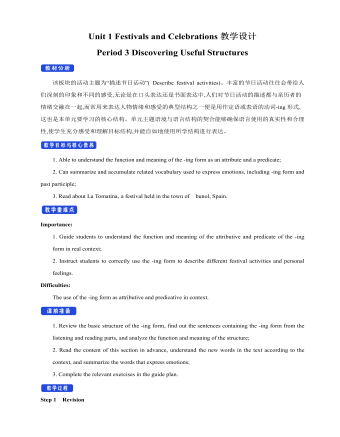
新人教版高中英语必修3Unit 1 Festivals and Celebrations教学设计二
1. Ss look at the picture and scan the passage to understand the main idea while teacher is giving the following questions to inspire Ss to think.*Where are those people?*What are they doing?*Why are they so excited?2. Ss complete the passage with the appropriate -ing form. Then discuss and check the answers with class.Answers: boring, interesting, taking, exciting, amazing3. The teacher raises questions for the students to discuss and encourages them to express their opinions.*Do you like La Tomatina? Why or why not?4. Each group representative reports the discussion result, the teacher gives feedback and the evaluation.Step 6 PracticeActivity 41. Ss complete the Ex 2 in Using structures.2. Check the answers after finishing the exercises.①The dragon boat races are the most exciting part of the Dragon Boat Festival.② The children were excited to go Easter egg hunting.③What an amazing performance! This is the best music festival I have ever been to.④We were amazed by her funny-looking hat.⑤His inspiring speech at the conference won the admiration/ favour of the audience.⑥This is a challenging game to test your memory and observation capabilities. 3. T asks Ss to finish Ex 3 and 4 in Using structures by themselves, then check the answers with class.Step 6 Homework1. Understand and master the functions and usage of the -ing form;2. Finish the other exercises in Using structures.1、通过本节内容学习,学生是否理解和掌握动词-ing形式作定语和表语的功能和意义;2、通过本节内容学习,学生能否在理解文段内容的基础上,根据上下文语境和表达逻辑,能正确运用动词-ing形式描述节日庆典。3、通过本节内容学习,学生是否归纳和积累用于表达情绪的相关词汇。
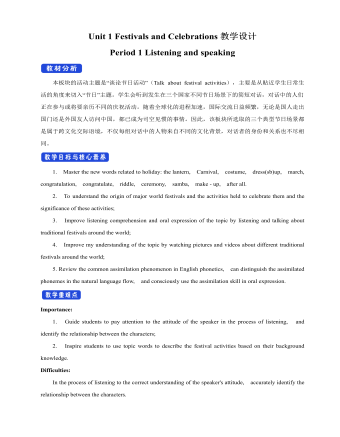
新人教版高中英语必修3Unit 1 Festivals and Celebrations教学设计一
本板块的活动主题是“谈论节日活动”(Talk about festival activities),主要是从贴近学生日常生活的角度来切入“节日”主题。学生会听到发生在三个国家不同节日场景下的简短对话,对话中的人们正在参与或将要亲历不同的庆祝活动。随着全球化的进程加速,国际交流日益频繁,无论是国人走出国门还是外国友人访问中国,都已成为司空见惯的事情。因此,该板块所选取的三个典型节日场景都是属于跨文化交际语境,不仅每组对话中的人物来自不同的文化背景,对话者的身份和关系也不尽相同。1. Master the new words related to holiday: the lantern, Carnival, costume, dress(sb)up, march, congratulation, congratulate, riddle, ceremony, samba, make - up, after all. 2. To understand the origin of major world festivals and the activities held to celebrate them and the significance of these activities;3. Improve listening comprehension and oral expression of the topic by listening and talking about traditional festivals around the world;4. Improve my understanding of the topic by watching pictures and videos about different traditional festivals around the world;5. Review the common assimilation phenomenon in English phonetics, can distinguish the assimilated phonemes in the natural language flow, and consciously use the assimilation skill in oral expression. Importance:1. Guide students to pay attention to the attitude of the speaker in the process of listening, and identify the relationship between the characters;2. Inspire students to use topic words to describe the festival activities based on their background knowledge. Difficulties:In the process of listening to the correct understanding of the speaker's attitude, accurately identify the relationship between the characters.
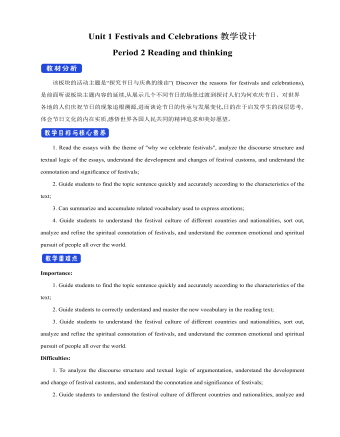
新人教版高中英语必修3Unit 1 Festivals and Celebrations教学设计三
*wide range of origins(= a great number of different origins, many kinds of origins)*It featured a parade and a great feast with music, dancing, and sports. (=A parade and a great feast with music, dancing, and sports were included as important parts of the Egyptian harvest festival.)*.. some traditions may fade away and others may be established.(= Some traditions may disappear gradually, while other new traditions may come into being.)Step 6 Practice(1) Listen and follow the tape.The teacher may remind the students to pay attention to the meaning and usage of the black words in the context, so as to prepare for the completion of the blanks in activity 5 and vocabulary exercises in the exercise book.(2) Students complete the text of activity 5 by themselves.The teacher needs to remind the students to fill in the blanks with the correct form of the vocabulary they have learned in the text.Students exchange their answers with their partners, and then teachers and students check their answers.(3)Finish the Ex in Activity 5 of students’ book.Step 7 Homework1. Read the text again, in-depth understanding of the text;2. Discuss the origin of festivals, the historical changes of related customs, the influence of commercial society on festivals and the connotation and essential meaning of festivals.3. Complete relevant exercises in the guide plan.1、通过本节内容学习,学生是否理解和掌握阅读文本中的新词汇的意义与用法;2、通过本节内容学习,学生能否结合文本特点快速而准确地找到主题句;3、通过本节内容学习,学生能否理清论说文的语篇结构和文本逻辑,了解节日风俗发展与变迁,感悟节日的内涵与意义。
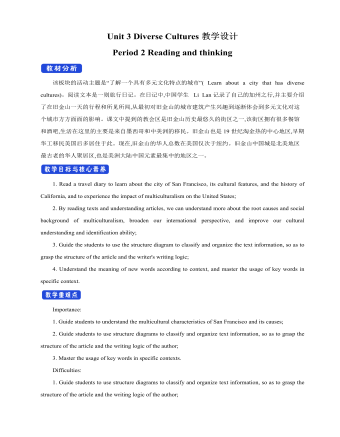
新人教版高中英语必修3Unit 3 Diverse Cultures教学设计二
(2)Consolidate key vocabulary.Ask the students to complete the exercises of activity 6 by themselves. Then ask them to check the answers with their partners.(The first language:Damage of the 1906 San Francisco earthquake and fire.A second language: Yunnan - one of the most diverse provinces in China).Step 5 Language points1. The teacher asks the students to read the text carefully, find out the more words and long and difficult sentences in the text and draw lines, understand the use of vocabulary, and analyze the structure of long and difficult sentences.2. The teacher explains and summarizes the usage of core vocabulary and asks the students to take notes.3. The teacher analyzes and explains the long and difficult sentences that the students don't understand, so that the students can understand them better.Step 6 Homework1. Read the text again, in-depth understanding of the text;2. Master the use of core vocabulary and understand the long and difficult sentences.3. Complete relevant exercises in the guide plan.1、通过本节内容学习,学生是否理解和掌握阅读文本中的新词汇的意义与用法;2、通过本节内容学习,学生能否结合文本特点了解文章的结构和作者的写作逻辑;3、通过本节内容学习,学生能否了解旧金山的城市风貌、文化特色,以及加利福尼亚州的历史,体会多元文化对美国的影响。