-
新人教版高中英语必修3Unit 3 Diverse Cultures教学设计一
Activity 81.Grasp the main idea of the listening.Listen to the tape and answer the following questions:Who are the two speakers in the listening? What is their relationship?What is the main idea of the first part of the listening? How about the second part?2.Complete the passage.Ask the students to quickly review the summaries of the two listening materials in activity 2. Then play the recording for the second time.Ask them to complete the passage and fill in the blanks.3.Play the recording again and ask the students to use the structure diagram to comb the information structure in the listening.(While listening, take notes. Capture key information quickly and accurately.)Step 8 Talking Activity 91.Focus on the listening text.Listen to the students and listen to the tape. Let them understand the attitudes of Wu Yue and Justin in the conversation.How does Wu Yue feel about Chinese minority cultures?What does Justin think of the Miao and Dong cultures?How do you know that?2.learn functional items that express concerns.Ask students to focus on the expressions listed in activity. 3.And try to analyze the meaning they convey, including praise (Super!).Agree (Exactly!)"(You're kidding.!)Tell me more about it. Tell me more about it.For example, "Yeah Sure." "Definitely!" "Certainly!" "No kidding!" "No wonder!" and so on.4.Ask the students to have conversations in small groups, acting as Jsim and his friends.Justin shares his travels in Guizhou with friends and his thoughts;Justin's friends should give appropriate feedback, express their interest in relevant information, and ask for information when necessary.In order to enrich the dialogue, teachers can expand and supplement the introduction of Miao, dong, Lusheng and Dong Dage.After the group practice, the teacher can choose several groups of students to show, and let the rest of the students listen carefully, after listening to the best performance of the group, and give at least two reasons.
新人教版高中英语选修2Unit 4 Learning about Language教学设计
This section guides students to pay attention to the typical context of vocabulary use, helps students accumulate vocabulary around the key vocabulary of this unit, and uses the learned words and word chunks in different contexts to deeply understand their meaning and usage, so as to achieve the purpose of review and consolidation.The teaching design activities aim to guide students to pay attention to the typical context in which the target vocabulary is used, as well as the common vocabulary used in collocation, so that students can complete the sentence with correct words. In terms of vocabulary learning strategies, this unit focuses on cultivating students' ability to pay attention to collocation of words and to use word blocks to express meaning.For vocabulary learning, it is not enough just to know the meaning of a single word, but the most important thing is to master the common collocations of words, namely word blocks.Teachers should timely guide students to summarize common vocabulary collocation, such as verb and noun collocation, verb and preposition collocation, preposition and noun collocation, and so on.1. Guide students to understand and consolidate the meaning and usage of the vocabulary in the context, 2. Guide the students to use the unit topic vocabulary in a richer context3. Let the students sort out and accumulate the accumulated vocabulary, establishes the semantic connection between the vocabulary,4. Enable students to understand and master the vocabulary more effectivelyGuiding the Ss to use unit topic words and the sentence patterns in a richer context.
新人教版高中英语选修2Unit 4 Using langauge-Listening教学设计
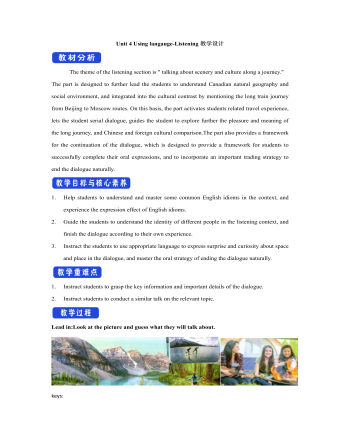
The theme of the listening section is " talking about scenery and culture along a journey."The part is designed to further lead the students to understand Canadian natural geography and social environment, and integrated into the cultural contrast by mentioning the long train journey from Beijing to Moscow routes. On this basis, the part activates students related travel experience, lets the student serial dialogue, guides the student to explore further the pleasure and meaning of the long journey, and Chinese and foreign cultural comparison.The part also provides a framework for the continuation of the dialogue, which is designed to provide a framework for students to successfully complete their oral expressions, and to incorporate an important trading strategy to end the dialogue naturally.1. Help students to understand and master some common English idioms in the context, and experience the expression effect of English idioms.2. Guide the students to understand the identity of different people in the listening context, and finish the dialogue according to their own experience.3. Instruct the students to use appropriate language to express surprise and curiosity about space and place in the dialogue, and master the oral strategy of ending the dialogue naturally.1. Instruct students to grasp the key information and important details of the dialogue.2. Instruct students to conduct a similar talk on the relevant topic.
新人教版高中英语选修2Unit 5 Reading and thinking教学设计
The theme of this activity is to learn the first aid knowledge of burns. Burns is common in life, but there are some misunderstandings in manual treatment. This activity provides students with correct first aid methods, so as not to take them for granted in an emergency. This section guides students to analyze the causes of scald and help students avoid such things. From the perspective of text structure and collaborative features, the text is expository. Expository, with explanation as the main way of expression, transmits knowledge and information to readers by analyzing concepts and elaborating examples. This text arranges the information in logical order, clearly presents three parts of the content through the subtitle, accurately describes the causes, types, characteristics and first aid measures of burns, and some paragraphs use topic sentences to summarize the main idea, and the level is very clear.1. Guide students to understand the causes, types, characteristics and first aid methods of burns, through reading2. Enhance students’ ability to deal withburnss and their awareness of burns prevention3. Enable students to improve the ability to judge the types of texts accurately and to master the characteristics and writing techniques of expository texts.Guide students to understand the causes, types, characteristics and first aid methods of burns, through readingStep1: Lead in by discussing the related topic:1. What first-aid techniques do you know of ?CPR; mouth to mouth artificial respiration; the Heimlich Manoeuvre
新人教版高中英语必修3Unit 2 Morals and Virtues教学设计二
Activity 41. Students complete the task of activity 4, then teachers and students check the answers. 2. The teacher organized the students to work together and asked them to use the tables and mind maps sorted out before to retold the important choices in Lin Qiaozhi's life and their resultsStep 5 Language points1. The teacher asks the students to read the text carefully, find out the core words and long and difficult sentences in the text and draw lines, understand the use of vocabulary, and analyze the structure of long and difficult sentences. 2. The teacher explains and summarizes the usage of core vocabulary and asks the students to take notes. 3. The teacher analyzes and explains the long and difficult sentences that the students don't understand, so that the students can understand them better. Step 6 Homework1. Read the text again, in-depth understanding of the text; 2. Master the use of core vocabulary and understand the long and difficult sentences. 3. Complete relevant exercises in the guide plan. 1、通过本节内容学习,学生是否理解和掌握阅读文本中的新词汇的意义与用法;2、通过本节内容学习,学生能否结合文本特点总结林巧稚的人生原则和人格品质特征;3、通过本节内容学习,学生能否针对人生抉择发表自己的看法;能否全面地、客观地、理性地看待问题,进而对道德和人性有更加深入的思考和理解。
新人教版高中英语必修3Unit 2 Morals and Virtues教学设计三
The joke set her crying.这个玩笑使她哭起来。Step 5 ReadingActivity 31. Students read the small text in activity 3. The teacher provides several small questions to check whether students understand the content of the text and the ideographic function of the -ing form in the text.*Where are those people?*Why did Dr Bethune come to China?*How did he help the Chinese people during the war?*What did Chairman Mao Zedong say about him?2. Ss try to rewrite some sentences using the -ing form. Then check the answers. When checking the answers, the teacher can ask different students to read the rewritten sentences and give comments.Answers:1. he became very interested in medicine, deciding to become a doctor.2. …after hearing that many people were dying in the war.3. Helping to organise hospitals, he taught doctors and nurses, and showed people how to give first aid./ He helped to organise hospitals, teaching doctors and nurses, and showing people how to give first aid.4. …praising Dr Bethune as a hero to be remembered in China.Step 6 PracticeActivity 4Students complete grammar activities 2 and 3 on page 69 of the workbook.Step 6 Homework1. Understand and master the functions and usage of the -ing form;2. Finish the other exercises in Using structures.1、通过本节内容学习,学生是否理解和掌握动词-ing形式作宾语补足语语和状语语的功能和意义;2、通过本节内容学习,学生能否正确使用动词-ing形式描述人物的行为、动作及其经历;3、通过本节内容学习,学生能否独立完成练习册和导学案中的相关练习。
新人教版高中英语必修3Unit 3 Diverse Cultures教学设计三
The price is the same as(the price was)before the war.价格与战前相同。(4)定语从句中的“关系代词+助动词be”可以省略。The ticket(that/which was)booked by his sister has been sent to him.他妹妹订的那张票已送到了他那里。Step 5 PracticeActivity 3(1) Guide students to complete the four activities in the Using Structures part of exercise book, in which activities 1 and 2 focus on ellipsis in dialogue answers, activity 3 focus on signs and headlines, two typical situations where ellipsis is used, and activity 4 focus on ellipsis in diary, an informal style.(2) Combine the examples in the above activities, ask students to summarize the omitted situations in groups, and make their own summary into a poster, and post it on the class wall after class to share with the class.(This step should give full play to the subjectivity of students, and teachers should encourage students to conclude different ellipsis phenomena according to their own understanding, they can conclude according to the different parts omitted in the sentence.)Step 6 Homework1. Understand and master the usages of ellipsis;2. Finish the other exercises in Using structures of Workbook.1、通过本节内容学习,学生是否理解和掌握省略的用法;2、通过本节内容学习,学生能否根据上下文语境或情景恢复句子中省略的成分,体会使用省略的效果;3、通过本节内容学习,学生能否独立完成练习册和导学案中的相关练习。
新人教版高中英语选修2Unit 4 Reading and thinking教学设计
【词汇精讲】highlight n.最好或最精彩的部分 vt.突出;强调;使醒目One of the highlights of the trip was seeing the Taj Mahal.这次旅行的亮点之一是参观泰姬陵。Your resume should highlight your skills and achievements.你的简历应该突出你的技能和成就。The report highlights the major problems facing society today.报告强调了当今社会所面临的主要问题。I’ve highlighted the important passages in yellow.我用黄色标出了重要段落。7.Edmonton is freezing cold in winter,with daily temperatures averaging -10 ℃.埃德蒙顿冬季寒冷,日平均气温为-10°C。【词汇精讲】freezing adj.极冷的;冰冻的Leave a basin of water outside in freezing weather.在冰冻的天气里,放一盆水在室外。It’s freezing cold outside so wear a warm coat.外面超冷的,所以穿一个暖和一点的外套吧。8.It was not until 9:30 a.m.that they finally reached the capital of Ontario,Toronto.直到上午9时30分,他们才终于到达多伦多的首府安大略省。【句式剖析】本句是一个强调句,强调的是句子的时间状语until 9:30。含有not...until...的句子的强调句为It is not until...that...,that后面的句子要用肯定形式。It was not until then that I suddenly realized nobody was happier than I was.直到那时我才突然意识到没有人比我更幸福了。
新人教版高中英语选修2Unit 2 Learning about Language教学设计
The activity theme of this section is to design various activities around the key words in the first text. Therefore, the activities require students to pay attention to the spelling of words. On the other hand, let students grasp the meaning of words more accurately through sentences and short texts. This kind of teaching design also helps to improve the ability of using English thinking.1. Cultivating students' ability to use word formation to induce and memorize vocabulary, and the ability to use lexical chunks to express meaning.2. Guide the students to think independently and use the correct form of words to complete sentences3. Cultivate students' habit of using lexical chunks to express language completely, guide students to draw words in sentences quickly, pay attention to word collocation, so as to accumulate more authentic expressions4. Instruct students to create sentences with the chunks.1. Enable students to use the language points in the real situation or specific contexts flexibly and appropriately.2. Guiding the Ss to use unit topic words and the sentence patterns in a richer context.Step1: Think of a word that best fits each definition.1. to remember sth2.to accept, admit, or recognize sth or the truth/existence of sth3. the process of changing sth or yourself to suit a new situation4 .to make sb feel less worried or unhappy5. a strong desire to achieve sth
新人教版高中英语选修2Unit 5 Reading for writing教学设计
你校英语报计划出版一期急救常识专刊,现面向全校学生公开征集稿件,你有意参加。请你根据下面提示内容,用英语写一篇短文,介绍在车祸现场对伤者进行急救的方法和步骤。1.确保现场的安全;2.询问伤者,确保其呼吸正常;3.检查伤口,如流血则应采取止血措施;4.如需急救,确保其处于康复位置。注意:1.词数80左右;2.可以适当增加细节,以使行文连贯。参考词汇:康复位置 recovery positionAs we all know, having a knowledge of first aid can make a great difference in our daily life. If a traffic accident happens and someone is injured, the following steps can be used to treat the injured.In the first place, we should make sure that the accident scene is safe so that we won’t get hurt. We should ask the injured person if he is OK, and see if he is breathing. What’s more, we should check for cuts and wounds. If he is bleeding badly, it is vital that we should try to stop the bleeding by applying pressure to the injury. This is because if a person loses too much blood, he may die. If necessary, take the injured person to the hospital as soon as possible.Do remember: when giving first aid, please be sure to place the person in a recovery position.
新人教版高中英语选修2Unit 3 Using langauge-Listening教学设计
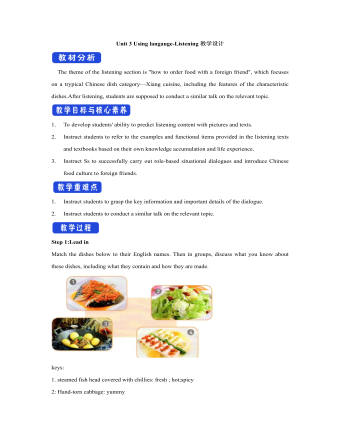
1. How is Hunan cuisine somewhat different from Sichuan cuisine?The heat in Sichuan cuisine comes from chilies and Sichuan peppercorns. Human cuisine is often hotter and the heat comes from just chilies.2.What are the reasons why Hunan people like spicy food?Because they are a bold people. But many Chinese people think that hot food helps them overcome the effects of rainy or wet weather.3.Why do so many people love steamed fish head covered with chilies?People love it because the meat is quite tender and there are very few small bones.4.Why does Tingting recommend bridge tofu instead of dry pot duck with golden buns?Because bridge tofu has a lighter taste.5 .Why is red braised pork the most famous dish?Because Chairman Mao was from Hunan, and this was his favorite food.Step 5: Instruct students to make a short presentation to the class about your choice. Use the example and useful phrases below to help them.? In groups of three, discuss what types of restaurant you would like to take a foreign visitor to, and why. Then take turns role-playing taking your foreign guest to the restaurant you have chosen. One of you should act as the foreign guest, one as the Chinese host, and one as the waiter or waitress. You may start like this:? EXAMPLE? A: I really love spicy food, so what dish would you recommend?? B: I suggest Mapo tofu.? A: Really ? what's that?
新人教版高中英语选修2Unit 4 Reading for writing教学设计
假定你是英国的Jack,打算来中国旅行,请你给你的中国笔友李华写一封信,要点如下:1.你的旅行计划:北京→泰山→杭州;2.征求建议并询问他是否愿意充当你的导游。注意:1.词数80左右(开头和结尾已给出,不计入总词数);2.可以适当增加细节,以使行文连贯。参考词汇:故宫 the Forbidden City;泰山 Mount TaiDear Li Hua,I'm glad to tell you that 'm going to visit China.First,I am planning to visit Beijing,the capitalof China,where I am looking forward to enjoying the Great Wall,the Forbidden City and somebeautiful parks.Then I intend to go to visit Mount Tai in Shandong Province.I've heard that it is one ofthe most famous mountains in China and I can't wait to enjoy the amazing sunrise there.After that,I amalso going to Hangzhou.It is said that it is a beautiful modern city with breathtaking natural sights,among which the West Lake is a well- known tourist attraction.What do you think of my travel plan? Will you act as my guide? Hope to hear from you soon.
新人教版高中英语选修2Unit 5 Using langauge-Listening教学设计
The theme of this section is to learn how to make emergency calls. Students should learn how to make emergency calls not only in China, but also in foreign countries in English, so that they can be prepared for future situations outside the home.The emergency telephone number is a vital hotline, which should be the most clear, rapid and effective communication with the acute operator.This section helps students to understand the emergency calls in some countries and the precautions for making emergency calls. Through the study of this section, students can accumulate common expressions and sentence patterns in this context. 1.Help students accumulate emergency telephone numbers in different countries and learn more about first aid2.Guide the students to understand the contents and instructions of the telephone, grasp the characteristics of the emergency telephone and the requirements of the emergency telephone.3.Guide students to understand the first aid instructions of the operators.4.Enable Ss to make simulated emergency calls with their partners in the language they have learned1. Instruct students to grasp the key information and important details of the dialogue.2. Instruct students to conduct a similar talk on the relevant topic.Step1:Look and discuss:Match the pictures below to the medical emergencies, and then discuss the questions in groups.
新人教版高中英语必修3Unit 2 Morals and virtues教学设计一
(2) students are divided into groups according to the requirements of activity 3. Each student shares a story of personal experience or hearing-witnessing kindness, and then selects the most touching story in the group and shares it with the whole class. Before the students share the story, the teacher can instruct them to use the words and sentence patterns in the box to express. For example, the words in the box can be classified:Time order: first of all, then, after that, later, finally logical relationship :so, however, although, butTeachers can also appropriately add some transitional language to enrich students' expression:Afterwards, afterwards, at last, in the end, eventuallySpatial order: next to, far from, on the left, in front ofOtherwise, nevertheless, as a result, therefore, furthermore, in addition, as well asSummary: in a word, in short, on the whole, to sum up, in briefStep 8 Homework1. Understand the definition of "moral dilemma" and establish a correct moral view;2. Accumulate vocabulary about attitudes and emotions in listening texts and use them to express your own views;3. Complete relevant exercises in the guide plan.1、通过本节内容学习,学生能否理解理解“道德困境”的定义;2、通过本节内容学习,学生能否通过说话人所表达的内容、说话的语气、语调等来判断其态度和情绪;3、通过本节内容学习,学生能否针对具体的道德困境发表自己的看法和见解,能否掌握听力理训练中的听力策略。
新人教版高中英语选修2Unit 2 Reading and thinking教学设计
Her tutor told her to acknowledge __________ other people had said if she cited their ideas, and advised her _______(read) lots of information in order to form __________wise opinion of her own.Now halfway __________ her exchange year, Xie Lei felt much more at home in the UK. She said __________ (engage) in British culture had helped and that she had been__________ (involve) in social activities. She also said while learning about business, she was acting as a cultural messenger __________(build) a bridge between the two countries. keys:Xie Lei, a 19yearold Chinese student, said goodbye to her family and friends in China and boarded (board) a plane for London six months ago in order to get a business qualification. She was ambitious(ambition) to set up a business after graduation. It was the first time that she had left (leave) home.At first, Xie Lei had to adapt to life in a different country. She chose to live with a host family, who can help with her adaptation (adapt) to the new culture. When she missed home, she felt comforted (comfort) to have a second family. Also Xie Lei had to satisfy academic requirements. Her tutor told her to acknowledge what other people had said if she cited their ideas, and advised her to read lots of information in order to form a wise opinion of her own.Now halfway through her exchange year, Xie Lei felt much more at home in the UK. She said engaging (engage) in British culture had helped and that she had been involved (involve) in social activities. She also said while learning about business, she was acting as a cultural messenger building a bridge between the two countries.
新人教版高中英语选修2Unit 5 Learning about Language教学设计
The purpose of this section of vocabulary exercises is to consolidate the key words in the first part of the reading text, let the students write the words according to the English definition, and focus on the detection of the meaning and spelling of the new words. The teaching design includes use English definition to explain words, which is conducive to improving students' interest in vocabulary learning, cultivating their sense of English language and thinking in English, and making students willing to use this method to better grasp the meaning of words, expand their vocabulary, and improve their ability of vocabulary application. Besides, the design offers more context including sentences and short passage for students to practice words flexibly.1. Guide students to understand and consolidate the meaning and usage of the vocabulary in the context, 2. Guide the students to use the unit topic vocabulary in a richer context3. Let the students sort out and accumulate the accumulated vocabulary, establishes the semantic connection between the vocabulary,4. Enable students to understand and master the vocabulary more effectivelyGuiding the Ss to use unit topic words and the sentence patterns in a richer context.Step1: Read the passage about chemical burns and fill in the blanks with the correct forms of the words in the box.
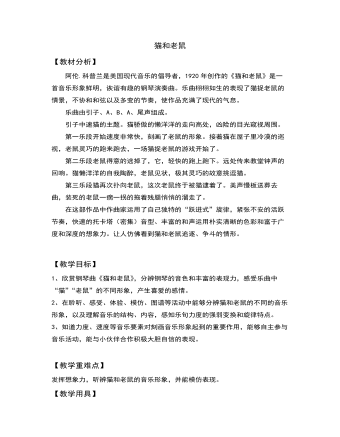
二年级音乐欣赏猫和老鼠教案教学设计
阿伦.科普兰是美国现代音乐的倡导者,1920年创作的《猫和老鼠》是一首音乐形象鲜明,诙谐有趣的钢琴演奏曲。乐曲栩栩如生的表现了猫捉老鼠的情景,不协和和弦以及多变的节奏,使作品充满了现代的气息。乐曲由引子、A、B、A、尾声组成。引子中速猫的主题。猫骄傲的懒洋洋的走向高处,凶险的目光窥视周围。第一乐段开始速度非常快,刻画了老鼠的形象。接着猫在屋子里冷漠的巡视,老鼠灵巧的跑来跑去,一场猫捉老鼠的游戏开始了。第二乐段老鼠得意的逃掉了,它,轻快的跑上跑下。远处传来教堂钟声的回响。猫懒洋洋的自我陶醉,老鼠见状,极其灵巧的故意挑逗猫。第三乐段猫再次扑向老鼠,这次老鼠终于被猫逮着了。美声慢板送葬去曲,装死的老鼠一瘸一拐的拖着残腿悄悄的溜走了。在这部作品中作曲家运用了自己独特的“跃进式”旋律,紧张不安的活跃节奏,快速的托卡塔(密集)音型、丰富的和声运用朴实清晰的色彩和富于广度和深度的想象力。让人仿佛看到猫和老鼠追逐、争斗的情形。
《一百条裙子》阅读课导读教案教学设计
1、书中还有许多描写旺达的片段,哪一处给你留下了深刻的印象呢?请同座位互相交流。全班交流。老师也想和大家一起分享一点感受。老师读第13页片段,并谈感受。课件出示:孤单,被嘲笑者2、你有过被人嘲笑的经历吗?谈一谈。旺达是怎样面对同学们的嘲笑?3、转学之后,十三班的同学们收到了她爸爸的来信。谁愿意读读这封信?圣诞节来临之际,旺达也写来一封信。学生读。读完这两封信,大家肯定感慨万千,一定有很多话想说吧?全班交流课件出示:善良 宽容
人教版新课标PEP小学英语四年级下册It’s Warm Today说课稿10篇
活动三:猜猜天气,真实对话。本课重难点是问句Can I wear my____?句型的自然运用,如何让学生开口去问这个问题,真实情境的创设可化解这一难题。我设计了一个根据提示猜天气的游戏,由生与温度计的互动进行操作,在学生猜的过程中教授句型Can I wear my____?避免了机械式的句型问答操练,调动学生说的积极性。活动四:再编儿歌,整合句型在问句与答句教授完后,朗朗上口的儿歌让学生对新授句型有一个整体的感知,并加深句型理解,为最后学生语言的输出作好准备。活动五:自然承接,理解运用。在学生对Can I wear my____? Yes, you can. No ,you can’t.句型有了初步的感知之后,再去引导学生给别人的穿着提出建议You can wear____.并出示不同特征天气的图片让学生进一步操练,在理解运用中简单带过这一句型。3、搭建语言框架,演绎语篇创设情景,充分挖掘教材中未呈现的内容,以地图为主线,以任务为驱动,充分开展小组合作学习。
人教版新课标小学数学四年级上册田忌赛马说课稿2篇
(四)深入探究,重新审视对策问题解决问题不是学习的最终目的,让学生不断体验对策的价值才是关键所在。对策的价值在哪里?设计对策的关键是什么?把问题抛给学生去思考,一方面让学生再次感受正确对策达到“以小打大”、“以弱胜强”妙处,更重要的是让学生明确设计对策的关键前提是什么?即“知己知彼,百战不殆”的数学思想,以便根据对手的变化灵活运用对策。教学步骤设计:1、学生探讨,如果齐王的下等马都比田忌的上等马快,田忌还有获胜的可能吗?2、田忌赛马第二次获胜的前提是什么?(田忌猜测道齐王安排赛马的出场顺序还和第一次一样)3、如果齐王安排赛马的出场顺序改变了,田忌该怎样才能获得胜利?(找两位同学分角色演示一下)4、回忆课前时候,老师为什么会在纸牌游戏“比大小中”屡战屡胜。