-
人教版高中英语必修1Nelson Mandela--A Modern Hero说课稿
In this step, give students a few minutes to read the passage . While they are reading, I will write some key words of the text on the blackboard. Then ask students to retell the passage according to the key words.By retelling, students can improve their ability of language organization and have an overall understanding of the article.Step 4 Group discussionIn this step, students will be divided into groups of 4 to discussion the following question: What qualities make a great person?After their discussion, invite a few groups to make a report to the class.This group discussion can practice students’ oral English and cultivate their abilities of cooperation and communication.Step 5. HomeworkLet students write a short passage to introduce a great person he or she admires.The homework can consolidate the knowledge the students have learned and cultivate their writing ability. Part 6 Blackboard Design(板书设计)That’s all my teaching procedures. Finally, I’d like to say sth about part 6 blackboard design. On the top is the title. On the left, there will be some new words and expressions. In the middle of the blackboard, I will write some useful sentence structures so that the students can know clearly what they’ve learned and then try to master the knowledge.OK. That’s all for my presentation. Thank you for your attention.
人教版高中英语必修4A taste of English Humor说课稿3篇
Then I would ask them to think of a funny English or Chinese and tell it to partners. While telling stories, they can use expressions and some acting to help make the story funny. 5 minutes would be given to do this.Those stories they told there will be the material for their writing. Soletting them tell it at first is helpful. And they can make a difference between telling a funny story and writing it down. Generally speaking, it is difficult forstudents to write well because they don’t know what to write and how to write. Asking them to tell their own stories at first can help them come up with what to write.After their telling, I would invite someone to share his/her story with all of us and I would write it down on the blackboard.This example story would be used as a sample to illustrate the format of funny story. Different from a story from teacher or textbook, a story from students can obviously become a interesting material to draw students’ attention.Then I would ask the whole class to put this story into several parts. It might be a little bit difficult for them. So I would ask them to find out whether all the sentences are necessary. After delete some sentences, there are 6 sentences left behind. Then they can easily put them into three parts. After interaction with students, I would teach them the right terms for each part and conclude the format of funny story.This step is the key and difficult point in my lesson. So I mainly usetask-based teaching method in this part and the task for students was divided into several stages. With the separated difficult level, students can find there are usually three parts in writing. They can also learn to write without the unnecessary parts in the process of analyzing. And then I wouldn’t rush to tell them the right terms to them directly. Instead, I would ask them to name them by their own. A confused mind is better for acquiring knowledge.While-writing:Then I would give students 7 minutes to write down this story, without other requirements.With all the preparations in pre-writing, students’ difficulties were cleared. So it would be much easier for them to write down the story within 7 minutes. There are no other requirements because students’ first writing is actually a drafting. It would be revise and edit several times later. Writing, as a skill
人教版高中英语必修3Canada-the true north说课稿4篇
Good afternoon, teachers, It’s my great pleasure to be here sharing my lesson with you.The content of my lesson is Senior English Book 3 Unit 5 Canada —— “The true North”.I’ll be ready to begin this lesson from five parts. Analysis of the teaching material,the teaching methods,the studying methods, the teaching procedure,and Blackboard design.First, let me talk about the teaching material.Part 1 Teaching Material:This unit is about the introduction of Canada. By studying of this unit,we’ll enable the students to learn the geography, population, main cities, and natural beauty, natural resources of Canada. Through the training of the unit, it also requires students to learn some Language skills such as the expressions of position and emotions.So it plays an important part in the English teaching in this book.After studying the teaching material and analyzing the rule of children’s growing of mind,I think the teaching aims are the followings:1.Knowledge objects:(1) make the students learn some new words and phrases(2) make the students understand the content of the lesson.2.Ability objects:(1)To develop the Ss’ abilities of listening, speaking, reading and writing. Especially reading and speaking ability.(2) learn to talk about the characters of Canada in English(3)To train the Ss’ ability of working in pairs.3.Emotion objects:(1)Enable students to understand the characters of Canada..(2)Stimulate Ss to work hard to make China stronger.Part 2 Teaching Methods:I think helping students learn to master new words and phrases and improve the students’ reading and speaking ability is import and the difficult.According to the analysis of the teaching material and the import points and the difficult points,I will use the following teaching methods : question-guiding approach; fast-reading and careful reading; multi-media teaching methods; discussion
人教版高中英语必修4Women of achievement说课稿4篇
Good morning, distinguished judges:It’s my honor to talk about my teaching ideas with you. Today my topic is Women of Achievement. My presentation consists of six parts: the analysis of teaching material and student, teaching aims, key and difficult points, teaching and studying method, teaching procedures and blackboard design.First, let’s focus on the analysis of teaching material. This lesson is from New Senior English for China Student’s Book 4 Unit 1, the reading part. The main topic of the passage is the introduction of a student of Africanwildlife. After this lesson, the students will learn more information about her studying chimps in Africa, and their reading and speaking abilities can be developed as well.The next part is the analysis of students. My students are in senior high students. They have learnt English for many years, they’ve known many words and sentences, but their speaking and reading abilities are still not very good. So I will practice their speaking and reading abilities through different exercises.According to the New Standard Curriculum and the present situation, I set the teaching aims as follows: firstly, knowledge aims. Students can grasp some new words, such as worthwhile, move off. Moreover, students can understand the content of the passage and get familiar with the topic of studying chimps in wildlife. Secondly, ability aims. Students can use reading strategies such as skimming and scanning in reading process. Thirdly, emotional aims. Students can have the awareness of protecting animals and care about animals.Based on the above analysis, the key point of this lesson is to get the main idea and the detailed information from the passage; the difficult point is to talk about the wildlife protection and use reading strategies.
人教版高中英语必修4Working The Land说课稿3篇
Knowledge objectives:(1) to make Ss grasp the usage of words, expressions and sentence structures: statistics, struggle, thanks to, rid of, some patterns for persuasion, the “ing” form as subject and object;(2)to use learnt knowledge to persuade sb.Ability objectives:(1) to develop Ss’ reading skills(skimming, scanning, word guessing);(2) to improve Ss’ speaking, communicating and cooperating skills.Emotional objectives:to make Ss know the contribution of Yuan,and learn his spirit and his simple life time.Teaching important and difficult points:(1) some words, expressions and sentence structures mentioned above;(2)the content of the text;(3)training their reading and speaking skills.Teaching methods: CLT, TBLT,QT.Learning strategies: CLS, QLS, TBLS.Teaching procedures:Step 1 lead-in: (1) teacher plays a piece of recent news from CCTV about the harvest of the super hybrid rice, and ask students whether they know Yuan or not, and talk about him and his contribution.(2)Brain storm: let Ss describe Yuan in their minds including his appearance, his living condition and so on.Step 2 fast reading tasks:(1)teacher introduces Yuan and super hybrid rice(2)make Ss read the text as fast as possible with questions. Such as: what’s the general ideaof this passage? What’s Yuan’ dream? (skimming and scanning skill)Step 3 intensive reading tasks(1)let Ss read the text silently, find topic sentence of each paragraph and draw the difficult sentences and the knowledge what they don’t understand.(words guessing)(2)teacher and Ss talk about the important words, expressions and sentences together, and ask Ss to retell the content of the text.(summarizing and paraphrasing)(3)teacher summarize this part.(4) read again following the courseware.
人教版高中英语必修3The million pound bank note说课稿3篇
在接下来的细读环节,我套用了高考对阅读理解的考查方式设置了5个问题,分别为三个推理判断题,一个细节题和一个主旨大意题。学生需要对文章的内容进行分析、归纳、推理、猜测等高级思维活动才能做出正确的回答。【设计意图】这一过程是对学生进行细读的训练,培养学生获取特定信息和挖掘文章深层次信息的能力。第三环节:Intensive-reading (精读) 15′第三个环节精读,既是最重要的环节,也是突破本课重难点的关键。首先,让学生思考剧本中人物看到百万英镑前后的态度发生了怎样的变化。其次,让学生仔细阅读文章,找出可以表现人物态度变化的具体的语言和动作。最后,让学生总结人物的态度发生变化的根本原因是什么,从而引出Money Talks, 供学生思考。【设计意图】通过一系列的活动培养学生学习从人物的语言和动作探究人物的心理,使学生进一步体会戏剧语言的魅力,从而对文章背后所反映的社会问题进行思考,也为下一步的讨论环节做好铺垫。
人教版高中英语必修5First aid说课稿6篇
In this class, I have 3 teaching aims, that is, knowledge aims, ability aims and emotion aims.1) Knowledge-Teach students new words and expressions, such as temporary, bleed,sprain choke, first aid, fall ill and so on.-Enable students to have a better understanding for some basic knowledge of first aid.2) Ability-Train students’ speaking, reading and writing abilities by different teaching activities, such as skimming, comprehending, team work, role play, retelling and writing.-Develop students’ reading strategy on how to move general idea to specific information.3) Emotion-Promote students’ awareness of giving first aid.- Cultivate students’ creativities.Then let’s come to my teaching methods and activities.III. Teaching methods and activities:To achieve different teaching aims, various kinds of teaching methods and activities will be adopted throughout this period, such as TBL (task-based learning), skimming, team work, brainstorm and others, which can offer students opportunities to fulfill tasks in which they can use language to achieve a specific outcome.IV. Teaching aids:Computer and blackboardV. Teaching important points:1) Make students have a clear mind for the structure of the text.2) Help students understand the theme of the text.VI. Teaching difficulties:1) So many new words may affect students’ understanding.2) How to get students to know about the functions of the skin and thecauses, characteristics and treatments for different degree burns,and the knowledge about giving first aid. VII. Blackboard design:
人教版高中英语必修5Great scientists说课稿4篇
通过写文章梗概,培养学生综合运用语言的能力,学习用恰当的英语描述科学家的故事。这是本课的教学难点。教师可以使用完形填空的方式来帮助学生整理语篇,从而来降低难度。本课的教学重点的突破方法是:在阅读前,让学生初步了解得出科学观点所需要的基本程序,从而轻松而自然地导入文章的阅读;在阅读过程中,由易到难设计快速阅读和精读的问题,层层推进各种阅读活动,让学生对阅读内容从整体感知到细节理解,最后深层读懂整篇文章,同时加强阅读策略的指导,让每个学生都主动参与课堂教学活动,最终达到提高阅读能力的目的。Step 4 Post-readingGroup Activities四人小组共同合作,在老师的适当指导下,就以下2个问题展开讨论,让学生就所知、所学、所感和所想融入话题,然后抽若干同学代表作小组发言。1. What do you think about John Snow, and what should we learn from him?2. Cholera was 19th century disease, which two diseases are similar to cholera today? Why?
人教版高中语文必修3《爱的奉献 学习议论中的记叙》说课稿
教学过程:(一)导入:课前放《爱的奉献》歌曲,同时不断播放一些有关“爱”的主题的图片,渲染一种情感氛围。师说:同学们,谁能说说这组图片的主题应该是什么?生(七嘴八舌):母爱,不对是亲情……是友情、还有人与人互相帮助……那组军人图片是说保卫国家,应该是爱国……那徐本禹和感动中国呢?…………生答:是关于爱的方面师说:不错,是关于爱的方面。那么同学们,今天就以“爱的奉献”为话题,来写一篇议论文如何?生答:老师,还是写记叙文吧。生答:就是,要不议论文写出来也象记叙文。师问:为什么?生答:老师,这个话题太有话说了,一举例子就收不住了,怎么看怎么象记叙文。生答:就是,再用一点形容词,就更象了。众人乐。师说:那么同学们谁能告诉我,为什么会出现这种问题?一生小声说:还不是我们笨,不会写。师说:不是笨,也不是不会写,你们想为什么记叙文就会写,一到议论文就不会了,那是因为同学们没有明白议论文中的记叙与记叙文中的记叙有什么不同,所以一写起议论文中的记叙,还是按照记叙文的写法写作,这自然就不行了。那好,今天我们就从如何写议论文中的记叙讲起。
人教A版高中数学必修一函数模型的应用教学设计(2)
本节通过一些函数模型的实例,让学生感受建立函数模型的过程和方法,体会函数在数学和其他学科中的广泛应用,进一步认识到函数是描述客观世界变化规律的基本数学模型,能初步运用函数思想解决一些生活中的简单问题。课程目标1.能利用已知函数模型求解实际问题.2.能自建确定性函数模型解决实际问题.数学学科素养1.数学抽象:建立函数模型,把实际应用问题转化为数学问题;2.逻辑推理:通过数据分析,确定合适的函数模型;3.数学运算:解答数学问题,求得结果;4.数据分析:把数学结果转译成具体问题的结论,做出解答;5.数学建模:借助函数模型,利用函数的思想解决现实生活中的实际问题.重点:利用函数模型解决实际问题;难点:数模型的构造与对数据的处理.
高中思想政治人教版必修三《文化创新的途径》说课稿
二、说学情本课的教学对象为高二学生,他们思维活跃已具备一定归纳能力和分析、综合能力,能够自主地分析现实生活中的一些文化行为,但看问题往往比较偏激、片面,缺乏良好的逻辑思维能力。所以,在文化创新的途径上要对他们进行指导,以免走入误区。三、教学目标根据新课程标准、教材特点、学生的实际,我确定了如下教学目标:【知识与能力目标】1.理解文化创新的根本途径和两个基本途径;2.了解文化创新过程中需要坚持正确方向,克服错误倾向。
高中历史人教版必修一《第2课秦朝中央集权制度的形成》说课稿
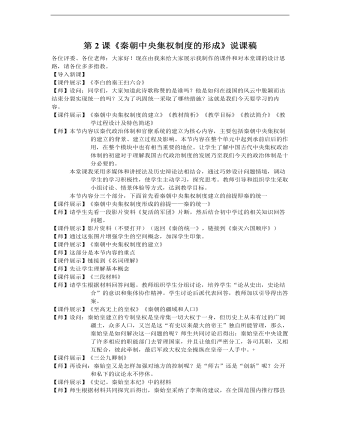
【课件展示】《秦朝中央集权制度的建立》《教材简析》《教学目标》《教法简介》《教学过程设计及特色简述》【师】本节内容以秦代政治体制和官僚系统的建立为核心内容,主要包括秦朝中央集权制的建立的背景、建立过程及影响。本节内容在整个单元中起到承前启后的作用,在整个模块中也有相当重要的地位。让学生了解中国古代中央集权政治体制的初建对于理解我国古代政治制度的发展乃至我们今天的政治体制是十分必要的。 本堂课我采用多媒体和讲授法及历史辩论法相结合,通过巧妙设计问题情境,调动学生的学习积极性,使学生主动学习,探究思考。教师引导和组织学生采取小组讨论、情景体验等方式,达到教学目标。 本节内容分三个部分,下面首先看秦朝中央集权制度建立的前提即秦的统一
人教版高中历史必修3现代中国教育的发展说课稿
一、教材分析下面我来谈一谈对教材的认识:主要从教材的地位和作用、以及在此基础上确立的教学目标、教学重难点这三个方面来谈。首先,来谈教材的地位和作用:本课教材内容主要从三个方面向学生介绍了现代中国教育的发展状况和趋势:人民教育的奠基、动乱中的教育和教育的复兴,全面讲述了新中国教育的三个阶段。本课是文化史中中国史部分的最后一课, 也是必修三册书中唯一涉及教育的一课。而教育是思想文化史中的重要组成部分,江泽民同志在谈到教育的时候曾经说过,“百年大计,教育为本。教育为本,在于育人”。教育是关系国计民生的大事。学生通过学习新中国教育发展的史实,理解“科教兴国”、“国运兴衰,系于教育”的深刻含义。最终由此激发学生树立“知识改变命运、读书成就人生”的信念,树立勤奋学习、成人成才、报效祖国、服务社会的崇高理想。故本课的教学有极大的现实意义。谈完了教材的地位和作用,我再分析一下教学目标:
人教版高中数学选择性必修二导数的四则运算法则教学设计
求函数的导数的策略(1)先区分函数的运算特点,即函数的和、差、积、商,再根据导数的运算法则求导数;(2)对于三个以上函数的积、商的导数,依次转化为“两个”函数的积、商的导数计算.跟踪训练1 求下列函数的导数:(1)y=x2+log3x; (2)y=x3·ex; (3)y=cos xx.[解] (1)y′=(x2+log3x)′=(x2)′+(log3x)′=2x+1xln 3.(2)y′=(x3·ex)′=(x3)′·ex+x3·(ex)′=3x2·ex+x3·ex=ex(x3+3x2).(3)y′=cos xx′=?cos x?′·x-cos x·?x?′x2=-x·sin x-cos xx2=-xsin x+cos xx2.跟踪训练2 求下列函数的导数(1)y=tan x; (2)y=2sin x2cos x2解析:(1)y=tan x=sin xcos x,故y′=?sin x?′cos x-?cos x?′sin x?cos x?2=cos2x+sin2xcos2x=1cos2x.(2)y=2sin x2cos x2=sin x,故y′=cos x.例5 日常生活中的饮用水通常是经过净化的,随着水的纯净度的提高,所需进化费用不断增加,已知将1t水进化到纯净度为x%所需费用(单位:元),为c(x)=5284/(100-x) (80<x<100)求进化到下列纯净度时,所需进化费用的瞬时变化率:(1) 90% ;(2) 98%解:净化费用的瞬时变化率就是净化费用函数的导数;c^' (x)=〖(5284/(100-x))〗^'=(5284^’×(100-x)-"5284 " 〖(100-x)〗^’)/〖(100-x)〗^2 =(0×(100-x)-"5284 " ×(-1))/〖(100-x)〗^2 ="5284 " /〖(100-x)〗^2
人教版高中数学选择性必修二等比数列的概念 (1) 教学设计
新知探究我们知道,等差数列的特征是“从第2项起,每一项与它的前一项的差都等于同一个常数” 。类比等差数列的研究思路和方法,从运算的角度出发,你觉得还有怎样的数列是值得研究的?1.两河流域发掘的古巴比伦时期的泥版上记录了下面的数列:9,9^2,9^3,…,9^10; ①100,100^2,100^3,…,100^10; ②5,5^2,5^3,…,5^10. ③2.《庄子·天下》中提到:“一尺之锤,日取其半,万世不竭.”如果把“一尺之锤”的长度看成单位“1”,那么从第1天开始,每天得到的“锤”的长度依次是1/2,1/4,1/8,1/16,1/32,… ④3.在营养和生存空间没有限制的情况下,某种细菌每20 min 就通过分裂繁殖一代,那么一个这种细菌从第1次分裂开始,各次分裂产生的后代个数依次是2,4,8,16,32,64,… ⑤4.某人存入银行a元,存期为5年,年利率为 r ,那么按照复利,他5年内每年末得到的本利和分别是a(1+r),a〖(1+r)〗^2,a〖(1+r)〗^3,a〖(1+r)〗^4,a〖(1+r)〗^5 ⑥
人教版高中数学选择性必修二等差数列的前n项和公式(1)教学设计
高斯(Gauss,1777-1855),德国数学家,近代数学的奠基者之一. 他在天文学、大地测量学、磁学、光学等领域都做出过杰出贡献. 问题1:为什么1+100=2+99=…=50+51呢?这是巧合吗?试从数列角度给出解释.高斯的算法:(1+100)+(2+99)+…+(50+51)= 101×50=5050高斯的算法实际上解决了求等差数列:1,2,3,…,n,"… " 前100项的和问题.等差数列中,下标和相等的两项和相等.设 an=n,则 a1=1,a2=2,a3=3,…如果数列{an} 是等差数列,p,q,s,t∈N*,且 p+q=s+t,则 ap+aq=as+at 可得:a_1+a_100=a_2+a_99=?=a_50+a_51问题2: 你能用上述方法计算1+2+3+… +101吗?问题3: 你能计算1+2+3+… +n吗?需要对项数的奇偶进行分类讨论.当n为偶数时, S_n=(1+n)+[(2+(n-1)]+?+[(n/2+(n/2-1)]=(1+n)+(1+n)…+(1+n)=n/2 (1+n) =(n(1+n))/2当n为奇数数时, n-1为偶数
人教版高中数学选择性必修二等比数列的前n项和公式 (1) 教学设计
新知探究国际象棋起源于古代印度.相传国王要奖赏国际象棋的发明者,问他想要什么.发明者说:“请在棋盘的第1个格子里放上1颗麦粒,第2个格子里放上2颗麦粒,第3个格子里放上4颗麦粒,依次类推,每个格子里放的麦粒都是前一个格子里放的麦粒数的2倍,直到第64个格子.请给我足够的麦粒以实现上述要求.”国王觉得这个要求不高,就欣然同意了.假定千粒麦粒的质量为40克,据查,2016--2017年度世界年度小麦产量约为7.5亿吨,根据以上数据,判断国王是否能实现他的诺言.问题1:每个格子里放的麦粒数可以构成一个数列,请判断分析这个数列是否是等比数列?并写出这个等比数列的通项公式.是等比数列,首项是1,公比是2,共64项. 通项公式为〖a_n=2〗^(n-1)问题2:请将发明者的要求表述成数学问题.
人教版高中数学选择性必修二等差数列的概念(1)教学设计
我们知道数列是一种特殊的函数,在函数的研究中,我们在理解了函数的一般概念,了解了函数变化规律的研究内容(如单调性,奇偶性等)后,通过研究基本初等函数不仅加深了对函数的理解,而且掌握了幂函数,指数函数,对数函数,三角函数等非常有用的函数模型。类似地,在了解了数列的一般概念后,我们要研究一些具有特殊变化规律的数列,建立它们的通项公式和前n项和公式,并应用它们解决实际问题和数学问题,从中感受数学模型的现实意义与应用,下面,我们从一类取值规律比较简单的数列入手。新知探究1.北京天坛圜丘坛,的地面有十板布置,最中间是圆形的天心石,围绕天心石的是9圈扇环形的石板,从内到外各圈的示板数依次为9,18,27,36,45,54,63,72,81 ①2.S,M,L,XL,XXL,XXXL型号的女装上对应的尺码分别是38,40,42,44,46,48 ②3.测量某地垂直地面方向上海拔500米以下的大气温度,得到从距离地面20米起每升高100米处的大气温度(单位℃)依次为25,24,23,22,21 ③
人教版高中数学选择性必修二数列的概念(1)教学设计
情景导学古语云:“勤学如春起之苗,不见其增,日有所长”如果对“春起之苗”每日用精密仪器度量,则每日的高度值按日期排在一起,可组成一个数列. 那么什么叫数列呢?二、问题探究1. 王芳从一岁到17岁,每年生日那天测量身高,将这些身高数据(单位:厘米)依次排成一列数:75,87,96,103,110,116,120,128,138,145,153,158,160,162,163,165,168 ①记王芳第i岁的身高为 h_i ,那么h_1=75 , h_2=87, 〖"…" ,h〗_17=168.我们发现h_i中的i反映了身高按岁数从1到17的顺序排列时的确定位置,即h_1=75 是排在第1位的数,h_2=87是排在第2位的数〖"…" ,h〗_17 =168是排在第17位的数,它们之间不能交换位置,所以①具有确定顺序的一列数。2. 在两河流域发掘的一块泥板(编号K90,约生产于公元前7世纪)上,有一列依次表示一个月中从第1天到第15天,每天月亮可见部分的数:5,10,20,40,80,96,112,128,144,160,176,192,208,224,240. ②
人教版高中数学选择性必修二函数的单调性(1) 教学设计
1.判断正误(正确的打“√”,错误的打“×”)(1)函数f (x)在区间(a,b)上都有f ′(x)<0,则函数f (x)在这个区间上单调递减. ( )(2)函数在某一点的导数越大,函数在该点处的切线越“陡峭”. ( )(3)函数在某个区间上变化越快,函数在这个区间上导数的绝对值越大.( )(4)判断函数单调性时,在区间内的个别点f ′(x)=0,不影响函数在此区间的单调性.( )[解析] (1)√ 函数f (x)在区间(a,b)上都有f ′(x)<0,所以函数f (x)在这个区间上单调递减,故正确.(2)× 切线的“陡峭”程度与|f ′(x)|的大小有关,故错误.(3)√ 函数在某个区间上变化的快慢,和函数导数的绝对值大小一致.(4)√ 若f ′(x)≥0(≤0),则函数f (x)在区间内单调递增(减),故f ′(x)=0不影响函数单调性.[答案] (1)√ (2)× (3)√ (4)√例1. 利用导数判断下列函数的单调性:(1)f(x)=x^3+3x; (2) f(x)=sinx-x,x∈(0,π); (3)f(x)=(x-1)/x解: (1) 因为f(x)=x^3+3x, 所以f^' (x)=〖3x〗^2+3=3(x^2+1)>0所以f(x)=x^3+3x ,函数在R上单调递增,如图(1)所示