-
新人教版高中英语必修2Unit 5 Music-Listening and Speaking教案
This lesson is about music. Students can classify the types of music through the instruments and its sound and can talk about their preferences about music, even join some activities and play a role in them according to their musical talents. On the basis, they are guided to use the languages to express their preferences and some plosive sounds and their rules.1. Classify the music types through the instruments and its sound.2. Listen and understand what the speakers’ preferences are and the reasons; talk about their own preferences and give their own reasons, using these sentences: “What kind of music do you like? And why? “ “Because it makes/gives me energy/peaceful.../touches my heart...”.3. Learn some plosives and the rules.4. Join some activities and play a role in them according to the talents. 1. Listen and understand what the speakers’ preferences are and the reasons;2. talk about their own preferences and give their own reasons, using these sentences: “What kind of music do you like? And why? “ “Because it makes/gives me energy/peaceful.../touches my heart...”.3. Learn some plosives and incomplete plosives and its rules.Step 1 Lead inPoint at the pictures on P50 and ask Q1: What are the people doing in the pictures below?Q2: What kind of music they are?Then play the MP3s one by oneStep 2 ListeningTask 1: A reporter from the school newspaper is interviewing students about music. Listen to the interviews. Draw lines between the words to make complete sentences. Some words will not be used.
新人教版高中英语必修3Unit 1 Festivals and Celebrations教学设计一
本板块的活动主题是“谈论节日活动”(Talk about festival activities),主要是从贴近学生日常生活的角度来切入“节日”主题。学生会听到发生在三个国家不同节日场景下的简短对话,对话中的人们正在参与或将要亲历不同的庆祝活动。随着全球化的进程加速,国际交流日益频繁,无论是国人走出国门还是外国友人访问中国,都已成为司空见惯的事情。因此,该板块所选取的三个典型节日场景都是属于跨文化交际语境,不仅每组对话中的人物来自不同的文化背景,对话者的身份和关系也不尽相同。1. Master the new words related to holiday: the lantern, Carnival, costume, dress(sb)up, march, congratulation, congratulate, riddle, ceremony, samba, make - up, after all. 2. To understand the origin of major world festivals and the activities held to celebrate them and the significance of these activities;3. Improve listening comprehension and oral expression of the topic by listening and talking about traditional festivals around the world;4. Improve my understanding of the topic by watching pictures and videos about different traditional festivals around the world;5. Review the common assimilation phenomenon in English phonetics, can distinguish the assimilated phonemes in the natural language flow, and consciously use the assimilation skill in oral expression. Importance:1. Guide students to pay attention to the attitude of the speaker in the process of listening, and identify the relationship between the characters;2. Inspire students to use topic words to describe the festival activities based on their background knowledge. Difficulties:In the process of listening to the correct understanding of the speaker's attitude, accurately identify the relationship between the characters.
新人教版高中英语选修1Unit 5 Working the Land教案
1. 完成文本主要信息填空(斜体字部分设空):As a witness to farmers’ poor harvests and even a severe shortage of food, Yuan Longping was determined to devote his life to tackling this crisis. After graduation, he realized that what farmers needed most was to boost yields in the fields. Yuan was convinced that the answer lay in the creation of hybrid rice, one characteristic of which is that it usually achieve higher output than conventional crops. However, it was no easy job. The first difficulty he needed to overcome was scientists’ general assumption that this could not be done. Through trial and error, Yuan managed to generate this incredible crop. It is estimated that about 60 percent of domestic rice consumption in China was comprised of crops generated from Yuan’s hybrid strains. His innovation has enabled Chinese farmers to considerably expand their output and helped feed the world. Unwilling to retire early to a life of leisure and unconcerned about celebrity or fortune, Yuan continues to turn one vision after another into realities.2. 模仿写作:Do some research via the Internet and introduce another agricultural scientist, Chen Risheng(陈日胜), using the structure, expressions and writing techniques you have learnt from the text “A Pioneer for All People”.【设计意图】任务1是对文本内容和词汇学习成效的检测。任务2借助文本中学到的词汇和写作手法仿写另一位科学家,提升学生迁移运用词汇、文体结构和写作方法的能力。
新人教版高中英语选修2Unit 2 Reading and thinking教学设计
Her tutor told her to acknowledge __________ other people had said if she cited their ideas, and advised her _______(read) lots of information in order to form __________wise opinion of her own.Now halfway __________ her exchange year, Xie Lei felt much more at home in the UK. She said __________ (engage) in British culture had helped and that she had been__________ (involve) in social activities. She also said while learning about business, she was acting as a cultural messenger __________(build) a bridge between the two countries. keys:Xie Lei, a 19yearold Chinese student, said goodbye to her family and friends in China and boarded (board) a plane for London six months ago in order to get a business qualification. She was ambitious(ambition) to set up a business after graduation. It was the first time that she had left (leave) home.At first, Xie Lei had to adapt to life in a different country. She chose to live with a host family, who can help with her adaptation (adapt) to the new culture. When she missed home, she felt comforted (comfort) to have a second family. Also Xie Lei had to satisfy academic requirements. Her tutor told her to acknowledge what other people had said if she cited their ideas, and advised her to read lots of information in order to form a wise opinion of her own.Now halfway through her exchange year, Xie Lei felt much more at home in the UK. She said engaging (engage) in British culture had helped and that she had been involved (involve) in social activities. She also said while learning about business, she was acting as a cultural messenger building a bridge between the two countries.
新人教版高中英语选修2Unit 3 Reading for writing教学设计
The theme of this part is to write an article about healthy diet. Through reading and writing activities, students can accumulate knowledge about healthy diet, deepen their understanding of the theme of healthy diet, and reflect on their own eating habits. This text describes the basic principles of healthy diet. The author uses data analysis, definition, comparison, examples and other methods. It also provides a demonstration of the use of conjunctions, which provides important information reference for students to complete the next collaborative task, writing skills, vivid language materials and expressions.1. Teach Ss to learn and skillfully use the new words learned from the text.2. Develop students’ ability to understand, extract and summarize information.3. Guide students to understand the theme of healthy diet and reflect on their own eating habits.4. To guide students to analyze and understand the reading discourse from the aspects of theme content, writing structure, language expression, etc., 5. Enable Ss to write in combination with relevant topics and opinions, and to talk about their eating habits.1. Guide students to analyze and understand the reading discourse from the aspects of theme content, writing structure, language expression, etc.2. Enable them to write in combination with relevant topics and opinions, and to talk about their eating habits.3. Guide the students to use the cohesive words correctly, strengthen the textual cohesion, and make the expression fluent and the thinking clear.Step1: Warming upbrainstorm some healthy eating habits.1.Eat slowly.2.Don’t eat too much fat or sugar.3.Eat healthy food.4.Have a balanced diet.Step2: Read the passage and then sum up the main idea of each paragraph.
新人教版高中英语选修2Unit 3 Using langauge-Listening教学设计
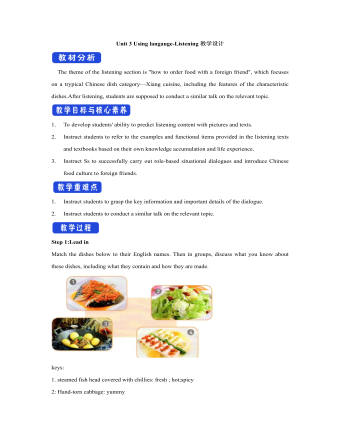
1. How is Hunan cuisine somewhat different from Sichuan cuisine?The heat in Sichuan cuisine comes from chilies and Sichuan peppercorns. Human cuisine is often hotter and the heat comes from just chilies.2.What are the reasons why Hunan people like spicy food?Because they are a bold people. But many Chinese people think that hot food helps them overcome the effects of rainy or wet weather.3.Why do so many people love steamed fish head covered with chilies?People love it because the meat is quite tender and there are very few small bones.4.Why does Tingting recommend bridge tofu instead of dry pot duck with golden buns?Because bridge tofu has a lighter taste.5 .Why is red braised pork the most famous dish?Because Chairman Mao was from Hunan, and this was his favorite food.Step 5: Instruct students to make a short presentation to the class about your choice. Use the example and useful phrases below to help them.? In groups of three, discuss what types of restaurant you would like to take a foreign visitor to, and why. Then take turns role-playing taking your foreign guest to the restaurant you have chosen. One of you should act as the foreign guest, one as the Chinese host, and one as the waiter or waitress. You may start like this:? EXAMPLE? A: I really love spicy food, so what dish would you recommend?? B: I suggest Mapo tofu.? A: Really ? what's that?
新人教版高中英语选修2Unit 4 Using langauge-Listening教学设计
The theme of the listening section is " talking about scenery and culture along a journey."The part is designed to further lead the students to understand Canadian natural geography and social environment, and integrated into the cultural contrast by mentioning the long train journey from Beijing to Moscow routes. On this basis, the part activates students related travel experience, lets the student serial dialogue, guides the student to explore further the pleasure and meaning of the long journey, and Chinese and foreign cultural comparison.The part also provides a framework for the continuation of the dialogue, which is designed to provide a framework for students to successfully complete their oral expressions, and to incorporate an important trading strategy to end the dialogue naturally.1. Help students to understand and master some common English idioms in the context, and experience the expression effect of English idioms.2. Guide the students to understand the identity of different people in the listening context, and finish the dialogue according to their own experience.3. Instruct the students to use appropriate language to express surprise and curiosity about space and place in the dialogue, and master the oral strategy of ending the dialogue naturally.1. Instruct students to grasp the key information and important details of the dialogue.2. Instruct students to conduct a similar talk on the relevant topic.
新人教版高中英语选修3Unit 1 Art教案
[2] An important breakthrough…was… [3] Another innovation was … [4] the emphasis increasingly shifted from…to… [5] New ideas and values gradually replaced… [6] While his paintings still had religious themes… … T: All these expressions serve to show how Western painting has developed. Some of them share similar structure but with varied use of words, which makes the text vivid and more readable. 【设计意图】主题类语言整理有助于学生类化语言应用,提高语言输出的丰富性。处理完文本内容信息后,进入语篇信息处理,进行主题相关的词块归类。引导学生快速阅读,寻找表达相同主题(发展或者艺术)的词和短语,再根据词性、用法和结构进行归类,储备主题相关词汇,丰富语言储备,提升语言素养。 Assignment: Go online to gather more information about Chinese painting and write a short history of it. 【设计意图】结合所学,迁移运用,根据实际语境,进行模仿性运用。在此过程中,学生尝试借鉴已学的语言、内容、语篇结构和写作手法来建构新文本,实现语篇输出,同时关注中西艺术文化的差别,加深对优秀文化的认同,培养文化意识。
新人教版高中英语选修3Unit 2 Healthy Lifestyle教案
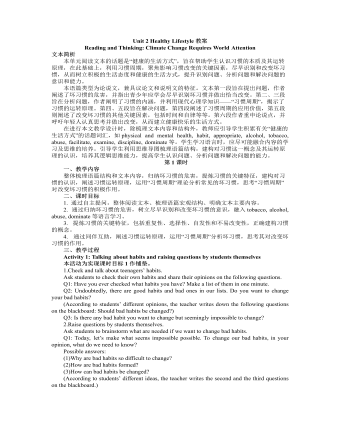
Activity 4: Figuring out the structure and the writing purpose 本活动为实现课时目标2。 1.Read Paragraph 6 and think about its main idea and the writer’s writing purpose. Q1: If you were the author, how would you end your article? “For young people, there is plenty of time to change bad habits. However, there is no “magic pill” or delete button that will help you; you have to think about your bad habits and decide on some changes. You have the power to build a happy and healthy life full of good habits!” Q2: What is Paragraph 6 mainly about? (Possible answer: to appeal to young people including teenagers to change bad habits and live a happy and healthy life.) 2.Think about the writer’s writing purpose and share opinions. Q1: What is the writing purpose? Work in pairs and figure it out. (Possible answer: On the one hand, the passage is written to help teenagers change their bad habits and live a healthy lifestyle. On the other hand, it provides us with a scientific way to identify and analyse our problems objectively, thus strengthening our resolve to tackle the seemingly common yet tough problems in our lives.) 【设计意图】 步骤1旨在预测和验证文章最后一段主要内容,梳理完整的语篇结构,步骤2旨在思考和讨论作者的写作目的。教师也可根据学生课堂反应情况融入对语篇人称多次转换的思考。
新人教版高中英语选修3Unit 4 Adversity And Courage教案
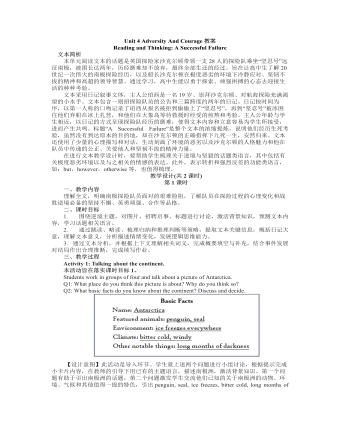
本活动旨在落实课时目标3。 The Student Union is looking for three students for a 3-week voluntary program in Guizhou province. The volunteers have got to be high school students, with a persevering personality and experiences in overcoming adversity. The volunteers need to stay, eat and teach with 20 pupils in a small school up on the hill of a village. There are no facilities but desks and a blackboard in the school. And there is no take-away food to be bought anywhere; the only way to feed yourself is to cook. You’re interested in applying. Write your application letter introducing what adversity you have ever overcome and how persevering you are as well as what you want to do when at work. Dear Student Union,【设计意图】此任务旨在迁移一、二课时所学,解决实际问题。学生对比自己经历过的挑战或挫折,写信给学生会申请前往贵州担任短期支教教师,把个人以前是怎么战胜挫折的经过书写出来。结合所学,迁移创新,分析解决自身实际问题,在真实情境中学生通过仿写进行主题语言的精确输出。完成任务的过程中,能较多地使用已学语言、内容、结构和写作手法来描述自己面对挫折的处理方式、态度和应有的品质,近一步激发学生树立正确的价值观,学会逆境出人才,坚忍不拔,从容不迫,又做到谦让、分享和合作。课后学生修正习作,再次提交。
新人教版高中英语选修4Unit 4 Sharing教案
【核心素养提升点】学会将抽象信息进行可视化表达,提高信息处理能力和分析、推理等高阶思维品质;在跨文化交际中学会以国际视野接受和包容不同的文化。 5.Read Paragraph 2, draw a mind map and answer the questions. Q1:What did Jo learn about Tombe’s life? Q2:What kind of life do the natives lead? Read paragraph 2-5 and draw a mind-map. (Focus on accommodation, possession, diet and belief) 【设计意图】引导学生利用思维导图和问题链等形式来厘清当地人的生活方式,更好地处理和归纳信息 【核心素养提升点】提高信息处理能力、分析和归纳能力,包容异国文化、扩展国际视野。 6.Read Paragraph 3 and answer the questions. Q1:What was Jo’s feeling upon arriving her own home? Q2:Why would she feel that way? Q3:Do you think “It was such a privilege to have spent a day with Tombe’s family”? 【设计意图】通过提问,让学生理解Jo的苦并快乐的心情,并通过对“It was such a privilege to have spent a day with Tombe’s family”这句话的理解,体验志愿者生活的伟大。 【核心素养提升点】学会对信息的综合和归纳,从而理解作者所表达的观点。 Activity4: Summarize the change of Jo's feelings
新人教版高中英语选修4Unit 5 Language Your Career教案
本单元阅读文本向中学生推荐职业能力测试(Career Aptitude Test),旨在建议学生利用职业倾向测试来发现自己更感兴趣、更有潜力的学习或职业方向,并规划自己的未来职业。 本文采用了建议性文本,全篇从职业生涯的重要意义讲起,针对中学生对职业规划比较迷茫的现状,提出了职业倾向测试这一建议。全文共七段,其中第一段和第二段为第一部分,其余五段为第二部分。第一部分论述职业的重要性和职业生涯规划的最佳时间是在校期间,第二部分提出解决职业选择困惑可以通过完成职业能力测试,介绍了不同种类的职业倾向测试,结合图表详细说明其中一种操作步骤,并提醒职业建议也基于学历和经验,最后一段概括论述,建议学生通过职业能力测试这一有效的工具,找到自己真正热爱的事物。 在文本教学设计时,要帮助学生梳理有关职业的话题语言。阅读策略层面,指导学生通过学习图表和图形,在有限的空间内获取广泛信息,如阅读图表标题,图表上的标签,X轴Y轴上的数据所指。
人教版新课标PEP小学英语三年级上册Happy birthday教案
(2)猜猜看每次请一个同学在黑板上画一种刚学到的物品,他每画一笔,就请班上的同学用英语猜他画的是什么。如猜得正确,就请下一位同学再重新开始画另一种物品。(3)Let’s rhyme.将所学的单词替换第一单元的Let’s chant中的文具。教师将全班分为两大组,教师举图片提示,如第一组说:I have a balloon.第二组一起说:Me too. 拍手,举第二幅图时两组交换。以此类推。(4)教师将单词的图片先面朝上贴在黑板上,给学生20秒时间记住这些单词,然后每张图卡用1张彩色纸盖上。学生要先说出彩色纸的颜色,再说出下面卡上的词。待学生熟悉后,可加大游戏难度,将盖着彩色纸的图卡在(黑板上)打乱,进行游戏。(5)让学生听录音,边说边做Let’s do部分的活动。(6)教师将Let’s do中的图卡打乱顺序,贴在黑板上,教师说一个指令,请学生指出正确的图片。正确的可为本组赢一分。
人教版新课标PEP小学英语三年级上册Hello!教案4篇
(3)通过游戏Simon says 来练习以show, open, close, put, carry 所引导的祈使句。教师发指令学生做动作。但只有听到老师带有Simon says的指令时,才能做出相应的动作,否则就是失败。失败的同学退出游戏。(4)听Let's chant的录音,学生边听边做,逐渐过渡成边听边说边做,最后独立说做,并进行比赛。4. 课堂评价(Assessment)做活动手册本单元第5部分练习。学生根据录音,圈出所听到的文具。具体方法和步骤参考如下:(1)学生看图,用英语说出图中每样文具物品。(2)教师讲解题目的意思并指导做的方法。(3)学生听录音做练习。(4)再放录音,在教师的指导下让学生一句一句地跟读并互相核对答案,并说出所圈的文具,再通过给花朵涂色进行自我评价。5. 扩展性活动(Extensive activities)选词游戏。将学生分为六组,每组各派一个选手,教师说单词,选手快步跑到讲台前,找到所说单词,并举起大声读出,正确为胜。
人教版新课标PEP小学英语三年级上册Recycle 2教案
3 趣味操练 (Practice)(1)请学生拿出他们事先准备的材料,指导学生按步骤进行摇摇乐的制作,每句话中的第一个动作都是教师要强调的部分,一定要配合手势,帮助学生理解和记忆。教师可适当给学生充分的时间,让学生用颜色笔将摇摇乐画得更漂亮些,有条件的话,可以用相机将学生的作品拍下来,有机会可以展览。(2)让学生跟着录音一起唱歌曲 Happy New Year,可以在唱歌时打节拍或边唱边舞。4 课堂评价 (Assessment) 做活动手册本单元4、5 部分的练习。本次评价要与课本上的4—6单元评价相结合,让学生自己动手填写评价表,评价自己。5 扩展性活动(Add-activities)新年的时候将歌曲 Happy New Year唱给爷爷奶奶,爸爸妈妈听,祝贺他们新年快乐!板书设计:Recycle 2Let’s make 部分的制作流程图Happy New Year! (一月一日的日历)
人教版新课标PEP小学英语三年级上册We love animals教案
(1)游戏:向它那儿跑去(Run to it!)首先,用图片和词卡练习本课的6个新单词。学生边读老师边把卡片贴在黑板上。将全班分成两队。给学生下一个Run to the bird.这样的指令。每队的第一个学生向带有鸟的图卡和词卡的地方跑,并且用手摸一下这两张卡片。哪组学生先摸到卡片就给他们队得一分。教师也可以用本课刚学的指令:Walk to….Jump to ….Fly to….等指令学生用相同的动作走(跳,飞)到卡片前。(2)教师将Let’s do的图片打乱顺序,让学生听指令,选出正确的图片。(3)游戏:照我说的做(Do as I say)教师发指令,全班同学起立做动作。做错的同学随时坐下。最后,哪组站着的同学多,哪组获胜。教师参考指令: Climb like a monkey/bear.Jump like a squirrel/rabbit.Walk like an elephant/duck.Hunt like a mouse/pig.Act like a cat/dog.Fly like a bird.为了增加游戏的难度和趣味性,教师可逐渐加快指令的速度。4.课堂评价(Assessment)做活动手册本单元第5部分的练习。方法和步骤参考第一单元。
人教版新课标PEP小学英语四年级下册Recycle 2教案
第一课时教学设计教学内容:Read and act教学目标:1.通过游戏及筹备野炊的过程,在实际情景中复习有关天气、蔬菜、水果、食物的单词以及句型:What’s the weather like in…..?How much is/ are …?What do you have ? I have … .I want … .2.能听懂、会说句型:Tomorrow will be … .Let’s go shopping. What do you want to bring? Let’s have a picnic tomorrow.教学重点:能听、说、认读句型:I want … .I have….教学难点:在实际情景中灵活运用Read and act 中的主要句型。教学准备:1.教师准备录音机、磁带和一张大购物单。2.教师准备有关蔬菜、食物、水果和天气的图卡和词卡。3.学生以小组为单位准备一份购物单。教学过程:一、Preparation1.Sing the song :The Coat in the Window.(P66 Unit5 Let’s sing)2.复习有关蔬菜、食物和水果的单词。(蔬菜指的是第六单元中学过的;水果主要复习本课时涉及到的几种常见的即可。)在复习的过程中教师可先出示词卡,让学生认读,并让学生试着说出意思,然后教师出示图卡进行确认。同时教师在黑板上写出shop的字样,把复习过的蔬菜和水果的图卡依次贴到黑板上。
人教版新课标PEP小学英语四年级下册Our School教案
教学重点:Read and write 中的四个四会单词以及问句“Is this a teacher’s desk?”及其答句“Yes, it is.”在四线格中的正确书写。教学难点:拼读单词picture,在四线格中书写句型“Is this a …?”以及总结元音字母a的发音规则。教具准备:1.与教材内容相关的课件、声音、图片等媒体素材。2.教师准备相关的词卡。3.学生准备白纸和彩笔。教学过程(35sk. c om整理):(一)热身/复习(Warm-up/Revision)1.师生合唱该单元的歌曲和歌谣,边歌边舞。2.请学生表演Story time中的对话。3.猜谜语:教师给学生出一些简单的谜语,如:Jack is in a room. There are many books in it. He can see many students. They are reading books. They are quiet. Where is Jack?(二)呈现新课 (Presentation)1.请学生观察Read and write部分的情景图,预先空出来需要书写的四会单词,让学生独立思考,填充对话。
人教版新课标PEP小学英语五年级上册Recycle2教案
教学目标与要求:1、 通过活动和复习句型,介绍及动作短语等。2、 学唱歌曲。教学重、难点:重点为复习巩固介词及存在句型。难点为正确区分内容相近的图片。课前准备:词卡、录音机、录音带、图片教学过程:1、 热身(1) 放歌曲录音,学生跟唱。(2) 师生进行日常会话。2、 预习做“按我说的做”游戏。3、 新授(1) 看图片,问:Where is the …? Ss: It’s in /on/over…(2) 做“猜一猜”游戏。(3) 两人一组完成Pair work,连一连,说一说。(4) 听录音,完成练习。录音原文如下:There are mountains behind her village. There is a river near her house. There is a new air-conditioner in her bedroom. She cleans her bedroom every day.There is a lake near his village. There are many trees in front of his house. There is a big trash bin in his kitchen. He can cook tasty meals.There is a forest near his village. There is a road beside his house. There is a man under a tree. He often waters the flowers.There are many Paths in her village. There are new curtains on the window of her house. There are many new skirts in her closet. She washes the clothes every weekend.巩固延伸:做“幸运摸奖”游戏
人教版新课标PEP小学英语五年级下册A Field Trip教案
活动八:Story time:教学参考时间:5-7分钟打开书,学生自己阅读故事。两人一小组,尝试初步朗读。小组间互相提问回答:一人问,另一人回答。有两个人都不明白的问题,向全班提问。教师提问:(如果这些问题已经被同学问过了就不用再问了。)Is Zoom reading a book?Is he fishing?Are the frogs playing in the river?Are they catching mosquitoes?What are the frogs doing?教师播放故事录音,学生跟读。教师启发学生说一说从故事中学到了什么。教师要适时告诉学生青蛙是人类的朋友,要爱护青蛙。活动目的:Story time的教学,是培养学生阅读能力的有效载体,教师应充分利用。教师要给孩子充分的时间让孩子能够实实在在的进行阅读,从阅读中获得信息。经过了两年的学习,学生应该具备了初步的阅读小故事的方法,因此教师可以引导有能力的学生在原有的基础上,运用已经学过的语言,对故事进行简单的复述。这样做一方面可以检查学生理解的程度,另一方面可以进一步培养、锻炼学生的语言表达能力。