-
新人教版高中英语必修2Unit 5 Music-Discovering Useful Structures教案一
Step1:自主探究。1.(教材P52)Born(bear) in the USA on 2 January 1970, Whitacre began studying music at the University of Nevada in 1988.2.(教材P52) Moved(move) by this music, he said, “It was like seeing color for the first time.”3.(教材P56)I was very afraid and I felt so alone and discouraged(discourage).4.(教材P58)Encouraged(encourage) by this first performance and the positive reaction of the audience, I have continued to play the piano and enjoy it more every day.Step2:语法要点精析。用法1:过去分词作表语1).过去分词可放在连系动词be, get, feel, remain, seem, look, become等之后作表语,表示主语所处的状态Tom was astonished to see a snake moving across the floor.汤姆很惊讶地看到一条蛇正爬过地板。Finally the baby felt tired of playing with those toys.终于婴儿厌倦了玩那些玩具。注意:1).过去分词作表语时与被动语态的区别过去分词作表语时,强调主语所处的状态;而动词的被动语态表示主语是动作的承受者,强调动作。The library is now closed.(状态)图书馆现在关闭了。The cup was broken by my little sister yesterday.(动作)昨天我妹妹把杯子打碎了。2)感觉类及物动词的现在分词与过去分词作表语的区别过去分词作表语多表示人自身的感受或事物自身的状态,常译作“感到……的”;现在分词多表示事物具有的特性,常译作“令人……的”。
新人教版高中英语必修2Unit 5 Music-Listening and Speaking教案
This lesson is about music. Students can classify the types of music through the instruments and its sound and can talk about their preferences about music, even join some activities and play a role in them according to their musical talents. On the basis, they are guided to use the languages to express their preferences and some plosive sounds and their rules.1. Classify the music types through the instruments and its sound.2. Listen and understand what the speakers’ preferences are and the reasons; talk about their own preferences and give their own reasons, using these sentences: “What kind of music do you like? And why? “ “Because it makes/gives me energy/peaceful.../touches my heart...”.3. Learn some plosives and the rules.4. Join some activities and play a role in them according to the talents. 1. Listen and understand what the speakers’ preferences are and the reasons;2. talk about their own preferences and give their own reasons, using these sentences: “What kind of music do you like? And why? “ “Because it makes/gives me energy/peaceful.../touches my heart...”.3. Learn some plosives and incomplete plosives and its rules.Step 1 Lead inPoint at the pictures on P50 and ask Q1: What are the people doing in the pictures below?Q2: What kind of music they are?Then play the MP3s one by oneStep 2 ListeningTask 1: A reporter from the school newspaper is interviewing students about music. Listen to the interviews. Draw lines between the words to make complete sentences. Some words will not be used.
新人教版高中英语必修2Unit 5 Music-Reading and Thinking教案二
1. Get basic information about Eric; read deeply to understand the history and development of the virtual choir.2. Understand what the function of the virtual choir is and how to make a virtual choir.3. Understand the meaning of some languages in the context of the text through question guidance, such as “Many people do not have close friends or contacts who have the same interest in music.” and so on.Step 1 Leading-in1. Answer the following questions.Q1:Do you know the Apps like Tik Tok and Quick Hand?Q2: Do you want to make a Tik Tok video or a Quick Hand video?2. Play a Tik Tok video Step 2: Understanding the title Q1:What does the title mean ?Q2: Is the article a narration or exposition? Why? Q3: Can you change the title ? If you can, what is the title?Step 3: Scanning the whole text and getting the basic information1. Answer the following questions.Q1:Who came up with the idea for a virtual choir?Q2: Where did Eric studied the musical composition?Q3: What is his song?2. Find the main idea of each paragraph3. Deal with some new words.Step 4: Reading carefully to get detailed informationPara 1 How to make a virtual choir1. PreparationA. tools: a virtual camera; an Internet connectionB. hero/heroin: friends or some individuals who have the same interests2. Process
新人教版高中英语必修2Unit 5 Music-Reading and Thinking教案一
This section focuses on "learning about experiencing music Online". This virtual choir is a new form of music performance. Members from all over the world don't need to love to come to a place. Instead, they use the new technology to model the various parts and wonderful virtual harmony group of music in the family. Students need to understand the main meaning of each paragraph. Finding topic sentences is an important way to understand the general idea of a paragraph. After the topic sentence, it is usually the detail sentence that supports and explains the topic sentence. Some paragraphs have obvious subject sentences, for example, the first sentence of the second paragraph is the subject sentence of the paragraph, and the following sentenceStudents need to pay attention to the topic sentences and key sentences, and then pay attention to how the sentences after the meaning explain, explain and support the topic sentences or key sentences before.1.Guide students to learn about experiencing music online2.Guide students to scan and circle the information in the text.3.Guide students to find the numbers and dates to fill in the timeline.4.Guide students to learn more about music by completing the sentences with the correct forms of the words and phrases. And then make a mind map about the outline of the passage.1. Guide students to pay attention to reading strategies, such as prediction, self-questioning and scanning.2. Help students sort out the main meaning of each paragraph and understand the narrative characteristics of "timeline” in illustrative style.3. Lead students to understand the changes that have been caused by the Internet.
新人教版高中英语必修2Unit 5 Music-Reading for Writing教案二
The Internet celebrity Gao Yifeng. Years ago, he owned 5 companies and the staffs over 1,000, but during the economy crisis, he became nothing but debt. He was so worried that his hair became white overnight. There was a time when he wanted to killed himself. But after listening to the song Start Over by Liu Huan, he decided to cheer himself up. He started a steamed bun shop and gradually became a national chain shops. Now he became successful again.Walter Haddon said, “Music is the medicine of a troubled mind.” Music contains such a pleasant and inspiring force. Music gave him courage and bravery. When he listened to the song, it made his spirit fly like a kite in the wind. Music gave him strength and brought him relief. It was the rock I leant on to become strong and to get through those hard times. I hope none of us have to go through the same kind of suffering that he did. At the same time, we all go through various periods when we feel sad or alone. During those times, music can help us in the same way that it helped him. I hope we all will somehow begin to treasure music and make it a part of our life. Thank you for your listening !5.Revise your writing each other.Does he/she explain how music has changed his/her/someone else’s life?Are some of the rhetorical devices included and used properly ?Does he/she talk about how music makes him/her/someone feel?Is the first word in each sentences capitalised?Does he/she use correct punctuation ?
新人教版高中英语必修2Unit 5 Music-Reading For Writing教案一
(4)Now we have heard a number of outstanding speeches ... 我们已经聆听了许多精彩的发言……(5)Because we wanted the nations of the world, working together, to deal with ... 因为我们希望全世界各国团结起来去应对……(6)And if we do not act ... 如果我们不采取行动……(7)Now, I share the concerns that have been expressed ... 我也同意对于……表达的担心(8)Let us show the world that by working together we can ... 让我们告诉全世界,通过一起努力我们可以……(9)It is now time for us to ... 是时候我们……(10)And I have always wished that ... 我一直希望……(11)Thank you for letting me share this day with me.感谢你们和我共度这一天。实践演练:假如你是高中生李华,你校将举办一次以“音乐”为主题的演讲比赛,请你按照主题,写下你的演讲稿。注意:词数100左右。First of all, thank you for listening to my speech. My topic is: love music like love yourself.Music is like the air we need to maintain our normal lives around us. You can't imagine how terrible a world without music would be. Movies and TV shows have no music, only dry conversations and scenes; mobile phones only vibrations; streets only noisy crowds; cafes, western restaurants only depressed meals. What a terrible world it is!As a student, I hope we all can enjoy the fun brought by music in our spare time. Instead of just listening to music, we can even make our own music. Let's enjoy the fun of music!Thanks again for your attention!
新人教版高中英语必修3Unit 2 Morals and Virtues教学设计二
Activity 41. Students complete the task of activity 4, then teachers and students check the answers. 2. The teacher organized the students to work together and asked them to use the tables and mind maps sorted out before to retold the important choices in Lin Qiaozhi's life and their resultsStep 5 Language points1. The teacher asks the students to read the text carefully, find out the core words and long and difficult sentences in the text and draw lines, understand the use of vocabulary, and analyze the structure of long and difficult sentences. 2. The teacher explains and summarizes the usage of core vocabulary and asks the students to take notes. 3. The teacher analyzes and explains the long and difficult sentences that the students don't understand, so that the students can understand them better. Step 6 Homework1. Read the text again, in-depth understanding of the text; 2. Master the use of core vocabulary and understand the long and difficult sentences. 3. Complete relevant exercises in the guide plan. 1、通过本节内容学习,学生是否理解和掌握阅读文本中的新词汇的意义与用法;2、通过本节内容学习,学生能否结合文本特点总结林巧稚的人生原则和人格品质特征;3、通过本节内容学习,学生能否针对人生抉择发表自己的看法;能否全面地、客观地、理性地看待问题,进而对道德和人性有更加深入的思考和理解。
新人教版高中英语必修3Unit 2 Morals and Virtues教学设计三
The joke set her crying.这个玩笑使她哭起来。Step 5 ReadingActivity 31. Students read the small text in activity 3. The teacher provides several small questions to check whether students understand the content of the text and the ideographic function of the -ing form in the text.*Where are those people?*Why did Dr Bethune come to China?*How did he help the Chinese people during the war?*What did Chairman Mao Zedong say about him?2. Ss try to rewrite some sentences using the -ing form. Then check the answers. When checking the answers, the teacher can ask different students to read the rewritten sentences and give comments.Answers:1. he became very interested in medicine, deciding to become a doctor.2. …after hearing that many people were dying in the war.3. Helping to organise hospitals, he taught doctors and nurses, and showed people how to give first aid./ He helped to organise hospitals, teaching doctors and nurses, and showing people how to give first aid.4. …praising Dr Bethune as a hero to be remembered in China.Step 6 PracticeActivity 4Students complete grammar activities 2 and 3 on page 69 of the workbook.Step 6 Homework1. Understand and master the functions and usage of the -ing form;2. Finish the other exercises in Using structures.1、通过本节内容学习,学生是否理解和掌握动词-ing形式作宾语补足语语和状语语的功能和意义;2、通过本节内容学习,学生能否正确使用动词-ing形式描述人物的行为、动作及其经历;3、通过本节内容学习,学生能否独立完成练习册和导学案中的相关练习。
新人教版高中英语必修3Unit 2 Morals and Virtues教学设计四
3.Teachers ask different groups to report the answers to the questions and ask them to try different sentence patterns.The teacher added some sentence patterns for students to refer to when writing.Step 4 Writing taskActivity 51.Write the first draft.Students first review the evaluation criteria in activity 5, and then independently complete the draft according to the outline of activity 4, the answers to the questions listed in the group discussion and report, and the reference sentence pattern.2.Change partners.The teacher guides the students to evaluate their partner's composition according to the checklist of activity 5 and proposes Suggestions for modification.3.Finalize the draft.Based on the peer evaluation, students revise their own compositions and determine the final draft.Finally, through group recommendation, the teacher selects excellent compositions for projection display or reading aloud in class, and gives comments and Suggestions.Step 5 Showing writingActivity 5T call some Ss to share their writing.Step 6 Homework1. Read the passage in this section to better understand the passage.2. Carefully understand the hierarchical structure of the article, and deeply understand the plot of the story according to the causes, process and results;3. Independently complete the relevant exercises in the guide plan.1、通过本节内容学习,学生是否理解和掌握阅读文本中的新词汇的意义与用法;2、通过本节内容学习,学生能否通过人物言行的对比分析道德故事的深层内涵;3、通过本节内容学习,学生能否根据故事的起因、经过和结果来深入理解故事的情节,从而了解文章的层次结构;4、结合现实生活案例发表自己的见解和看法,写一篇观点明确、层次分明的故事评论。
新人教版高中英语必修3Unit 2 Morals and virtues教学设计一
(2) students are divided into groups according to the requirements of activity 3. Each student shares a story of personal experience or hearing-witnessing kindness, and then selects the most touching story in the group and shares it with the whole class. Before the students share the story, the teacher can instruct them to use the words and sentence patterns in the box to express. For example, the words in the box can be classified:Time order: first of all, then, after that, later, finally logical relationship :so, however, although, butTeachers can also appropriately add some transitional language to enrich students' expression:Afterwards, afterwards, at last, in the end, eventuallySpatial order: next to, far from, on the left, in front ofOtherwise, nevertheless, as a result, therefore, furthermore, in addition, as well asSummary: in a word, in short, on the whole, to sum up, in briefStep 8 Homework1. Understand the definition of "moral dilemma" and establish a correct moral view;2. Accumulate vocabulary about attitudes and emotions in listening texts and use them to express your own views;3. Complete relevant exercises in the guide plan.1、通过本节内容学习,学生能否理解理解“道德困境”的定义;2、通过本节内容学习,学生能否通过说话人所表达的内容、说话的语气、语调等来判断其态度和情绪;3、通过本节内容学习,学生能否针对具体的道德困境发表自己的看法和见解,能否掌握听力理训练中的听力策略。
人教版高中地理必修2工业地域类型教案
1.生产上的联系:有投入——产出的关系工业生产的过程复杂,工序繁多,往往需要经过多家工厂的加工才能完成一种产品的生产过程。因此,在这些工厂之间就存在着产品与原料的联系。一家工厂生产的产品是另一家工厂的原料,这两家工厂之间就形成了工序上的工业联系。2.非生产上的联系:如地理空间上的联系布局在同一个工业区内,共同利用工业区的道路、供水、供电、通信等基础设施以及其他生产、生活服务设施,或者共同利用当地廉价的劳动力,形成了空间利用上的工业联系。我国许多地方的经济技术开发区就是建立在这种工业联系基础上的。(二)工业集聚1.形成具有工业联系的一些工厂往往近距离地聚集起来,形成工业集聚现象。2.工业集聚可获得效应(1)工业集聚可以加强企业间的信息交流和技术协作,降低中间产品的运输费用和能源消耗,进而降低生产成本,提高生产效率和利润,取得规模效益。
人教版高中语文必修1《小狗包弟》教案2篇
巴金在十年浩劫中的大致经历:放弃包弟并没有换得保全一家人,1968年8月,巴金被关进牛棚改造,随后经受了大字报、挂牌游街等形式的批斗。1970年,到农村改造,掏大粪、喂猪、背稻草、种地……1972年,妻子萧珊在饱受精神折磨后患上癌症,病逝。巴金的儿子在劳动改造的过程中也饱受精神和肉体上的折磨,性格变得内向抑郁,疾病缠身。此时,巴金69岁。巴金曾在《病中》一文写道:“当姚文元拿着棒子的时候,我给关在牛棚里除了唯唯诺诺之外,敢于做过什么事情?十年间我不过是一条含着眼泪等人宰割的牛。”小结:(幻灯片12)社会是病态的社会,政治是高压的政治,人性是扭曲的人性。十年文革,十年浩劫,给多少人留下了累累不可弥合的精神创伤。即使一条小狗,也可能摆脱不了“文革”无情的迫害,比如包弟,比如艺术家邻居的小狗。
人教版高中语文必修3《劝学》教案2篇
五.研习第一段:1.诵读指导要处理好句中停顿2.请学生对照注释翻译本段重点词句:学不可以已已:停止。青,取之于蓝而青于蓝于:从;比。木直中绳中:zhàng符合,合于。虽有槁暴,不复挺者,揉使之然也有通又,揉通煣,以火烘木,使其弯曲。然:这样。翻译:故木受绳则直,金就砺则利,君子博学而日参省乎己,则知明而行无过矣。所以木材经墨线画过(再用斧锯加工)就直了,金属刀剑拿到磨刀石上(磨过)就锋利了,君子广博地学习并且每天对自己检验反省,就能智慧明达,行为没有过错了。3.本段是从哪个角度论述中心论点的?明确:本段是从学习的意义这个角度论述中心论点的。荀子认为人的知识、道德、才能都不是天生成的,而是后天不断学习获得的,学习的意义十分重大,所以学习不能停止。4.本段中几个比喻句是为了说明什么道理?学生讨论发言,教师明确:
人教版高中语文必修3《马嵬(其二)》教案2篇
结合历史自古以来,江山美人历来都是引无数英雄豪杰竞折腰的,如果说英雄选择了美人却丢了江山,把所有罪名都归结于“女人是祸水”。但是,纣王无道,和有了妲己有必然的联系吗?有人说妲己坏透了,坏透了的妲己如果不是取得纣王的信任是坏不起来的,纣王听信了妲己的谗言,听与不听决定权在纣王,而不在妲己。强势永远在纣王一边。再来看看西施和杨贵妃:西施是作为越国贡献给吴国的供品来到吴王夫差的身边的,杨贵妃更是先是李隆基的儿媳妇被看中而得宠的。所以,西施和杨贵妃这两个可怜的女人根本没有自己的独立选择,没有独立的爱情,如果没有西施,就会有南施,或北施;如果没有杨贵妃,就会有李贵妃,王贵妃,总之什么施,什么妃是不能少的,因为那是吴王和李隆基的需要。
人教版高中历史必修1辛亥革命教案2篇
①从政府人员组成看,南京政府是一个以资产阶级革命派为主体的政府。②从政府颁发的法令和措施看,这些法令体现了资产阶级民主革命的要求,对于发展民族资本主义经济、资产阶级民主政治和文化教育以及改革社会风气,都起了积极作用。③从颁布的《中华民国临时约法》看,宪法体现了三权分立的政治体制,体现了资产阶级民主主义的要求,是中国历史上第一部资产阶级民主宪法,具有反封建专制制度的进步意义。(2)从南京临时政府的内外政策分析南京政府的根本弱点①未彻底地反封建。它没有采取比较彻底的反对封建主义的措施,特别是对封建统治的基础——地主阶级土地所有制没有触动,这样,南京临时政府也就不能真正地把广大人民群众动员起来,因而缺乏真正的群众基础。
人教版高中历史必修2开辟新航路教案
材料五航路开辟后,东方香料输入欧洲的总量较中古之时猛增30倍,而胡椒、丁香等在印度购入和在英国卖出的差价亦高达10至29倍,其他货物的获利同样惊人。这一时期,新的商品不断涌现,特别值得注意的是美洲的特产——玉米、马铃薯、烟草、可可等——被传播到欧亚大陆。这时,世界性的对外贸易主要通过大西洋,地中海与意大利皆告衰落,而沿大洋的英、荷等渐居中心。到17世纪时,英国的伦敦与荷兰的阿姆斯特丹成为世界贸易中心。问题4:材料五表明,新航路开辟后对世界贸易产生了哪些重大影响?答案4:结束了世界相对孤立状态;各地文明开始会合交流,日益连成一个整体;欧洲商人直接同世界各地建立商业联系;促进不同国家和贸易的发展,促进世界市场雏形开始出现。
人教版高中历史必修3启蒙运动教案2篇
教学目标:1、知识与能力:(1)识记:理性、启蒙运动;伏尔泰、孟德斯鸠、卢梭等伟大的启蒙思想家及其主张;康德及启蒙运动的影响;(2)理解启蒙运动兴起的背景,分析启蒙思想的巨大影响;(3)认识上层建筑对社会发展的巨大反作用。2、过程与方法:(1)指导学生用表格法掌握启蒙运动主要代表人物及其思想主张;(2)运用比较法加深对启蒙思想家观点共性和个性的认识。(3)运用比较法对比文艺复兴和启蒙运动的异同,说明启蒙运动对人文主义思想的发展。3、情感态度与价值观:(1)通过本课的学习,让学生认识到“一定的文化是一定社会的政治和经济在观念上和形态上的反映”;(2)学习启蒙思想家追求真理的精神,培养学生远大的理想与抱负;(3)通过法国启蒙思想产生的巨大影响的分析,使学生认识意识形态对社会发展所起的重大作用,从而提高学习理论的自觉性。
人教版高中地理必修2城市化精品教案
1.改善城市环境:治理河流、控制大气污染物、大力加强绿化建设为改善城市环境,上海市全面展开对大气、河流、噪声等多方面的治理工作。如苏州河的治理、降低城市污染物浓度、加强绿化建设,截止1990年,市区绿化覆盖率达到20.3%。2.改善城市交通、改善居住条件扩宽主干道,修建环城公路,修筑了南浦大桥和扬浦大桥,新修城市高架公路和地铁,改造住宅。3.控制城市规模建立卫星城,开发新区,有效地控制城市中心区的规模。思考:什么时候许多国家采取措施保护和改善城市环境?你认为可以采取哪些措施来保护和改善城市环境?上海市保护和改善城市环境的措施:上海的卫星城有哪些?上海新建了哪个新区?目前浦东新区在上海的地位如何?建立卫星城和开发新区可以起到什么作用?上海市为改善交通条件,做了哪些工作?
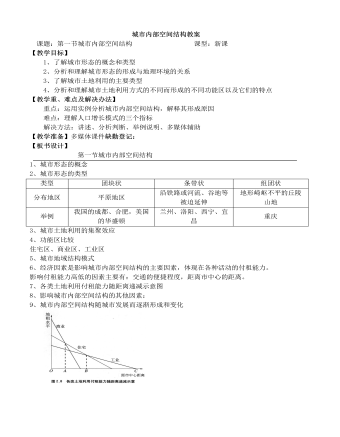
人教版高中地理必修2城市内部空间结构教案
过渡:在实际生活中,城市内部空间结构并非完全按照这一经济规律呈现,而是更具复杂性。这说明除了经济因素外,还有很多其他因素在起作用,请大家结合你的认识、图2.9和案例1:纽约市的少数民族区谈谈你的看法。(2)其他因素I收入——形成不同级别住宅区的常见原因。有能力支付昂贵租金和选择最佳居住环境的人,其居住地往往形成高级住宅区。II知名度——城市内某些地区在历史、文化或经济方面具有很高的声誉,这往往会吸引更多新的住宅或商场建在该处,以提高其知名度。III种族聚居区的形成——在有些城市的某一区域内,如果某个种族或宗教团体占优势,就可能形成种族聚居区。如纽约市的唐人街、哈林区、小意大利区等。IV历史因素——城市的建筑物和街道设计可以维持久远,早期的土地利用方式对日后的功能分区有着深远的影响。
人教版新课标高中物理必修2向心加速度教案2篇
1.教材在学生的原有加速度概念的基础上来讨论“匀速圆周运动速度变化快慢”的问题,让学生知道向心加速度能够表示匀速圆周运动物体速度变化的快慢究竟是怎么一回事。2.教材把向心加速度安排在线速度和角速度知识之后,使学生对描述匀速圆周运动的几个物理量有一个大致的了解。3.教材从了解运动的规律过渡到了解力跟运动关系的规律;把向心加速度放在向心力之前,从运动学的角度来学习向心加速度。4.教材为了培养学生“用事实说话”的“态度”,让一切论述都合乎逻辑,改变了过去从向心力推导向心加速度的教学方式。1.采用理论、实验、体验相结合的教学安排。2.教师启发引导,学生自主阅读、思考,讨论、交流。知识与技能1.会作矢量图表示速度的变化量与速度之间的关系。2.加深理解加速度与速度、速度变化量的区别。3.体会匀速圆周运动向心加速度方向的分析方法。4.知道向心加速度的公式也适用于变速圆周运动;知道变速圆周运动的向心加速度的方向。