-
人教版高中语文必修3《琵琶行 并序》教案
9、在乐曲终了之后,诗人以“东船西舫悄无言,唯见江心秋月白”两句结尾,这两句作用如何?明确:诗人没有直接写听者的热烈反响以说明琵琶女技艺非凡和乐声的感人至深,否则过于直白就不含蓄,不含蓄也就显不出深沉了。用“东船西舫悄无言”的寂静无声,反衬“有声”的音乐效果,可谓“此时无声胜有声”了。人们无声地沉浸、陶醉在艺术的享受之中,那深深打动人的乐声仿佛缭绕迂回耳际,不由得使诗人想到了自己浩茫的心事,引起情绪上的波澜。在这片刻的沉寂中,只见一轮迷蒙的冷月荡漾在江心的微波之中,它提醒诗人从乐声中回到现实中来。这句景物描写点染烘托了浓重的氛围,与复杂的乐声融为一体,共同表现了琵琶女与诗人息息相通的复杂情感,是那么的忧愤、哀怨凄楚、苍凉,给整个音乐形象补足了画龙点睛之笔。
人教版高中语文必修3《动物游戏之迷》教案2篇
一、内容与解析内容:科普说明文《动物游戏之谜》。解析:《动物游戏之谜》是高中语文(必修)3第四单元的一篇科普说明文。科学是人类认识世界的重要工具,是人类文化的重要组成部分,是标志人类文明的尺度。阅读科普文章,可以启迪心志,激发想象,带领我们进入全新的科学天地,在科学海洋中遨游。本文思路清晰,内容生动,揭开了动物日常游戏行为的神秘面纱,摆出研究者的种种结论,既让我们扩大了视野,增长了知识,也让我们明白了科学探索永无止境。学习本文的重点是提高的科普文的阅读能力,培养学生勤于探索、勇于钻研的科学精神。二、教学目标及解析1、理清文章思路,明确本文的说明内容和顺序。2、品读文章,感受本文的语言特色。3、激发探究兴趣,培养筛选信息、提取要素及概括叙述的能力。4、挖掘人文内涵,培养学生保护动物的意识和勤于探索、勇于钻研的科学精神。
人教版高中语文必修3《劝学》教案2篇
五.研习第一段:1.诵读指导要处理好句中停顿2.请学生对照注释翻译本段重点词句:学不可以已已:停止。青,取之于蓝而青于蓝于:从;比。木直中绳中:zhàng符合,合于。虽有槁暴,不复挺者,揉使之然也有通又,揉通煣,以火烘木,使其弯曲。然:这样。翻译:故木受绳则直,金就砺则利,君子博学而日参省乎己,则知明而行无过矣。所以木材经墨线画过(再用斧锯加工)就直了,金属刀剑拿到磨刀石上(磨过)就锋利了,君子广博地学习并且每天对自己检验反省,就能智慧明达,行为没有过错了。3.本段是从哪个角度论述中心论点的?明确:本段是从学习的意义这个角度论述中心论点的。荀子认为人的知识、道德、才能都不是天生成的,而是后天不断学习获得的,学习的意义十分重大,所以学习不能停止。4.本段中几个比喻句是为了说明什么道理?学生讨论发言,教师明确:
人教版高中语文必修3《蜀道难》教案2篇
【明确】“一夫当关,万夫莫开”言剑阁有易守难攻的险要形势,暗示中央朝廷的部队很不容易打进来,因而野心家可以据险发动叛乱,“化为狼与豺”,搞地方割据。如果割据势力之间出现矛盾冲突,难免要发生混战,结果必定是“杀人如麻”。诗人这番预言在十多年后就得到了证实:从上元二年到大历初即有段子璋、徐知道、崔旰等人相继发动叛乱。诗人的意图是要严防野心家发难。诗人从剑阁的险要引出对政治形势的描写。他化用西晋张载《剑阁铭》中形胜之地,匪亲勿居的语句,目的在于劝人引以为鉴戒,警惕战乱的发生,并联系当时的社会背景,揭露了蜀中豺狼的磨牙吮血,杀人如麻,这既是描写蜀道猛兽,又是影射政治黑暗的双关语句,表达了对国事的忧虑与关切,为诗篇增加了现实的内涵、深厚的意蕴。唐天宝初年,太平景象背后正潜伏着危机,后来发生的安史之乱,证明诗人的忧虑是有现实意义的。
人教版高中语文必修3《祝福》教案2篇
小结人们对待祥林嫂这个“嫁而再寡”的不幸女人态度:①、鲁四老爷的态度:不让她干祭祀的活(71、73、75、108通过四婶先后三喊“你放着罢”,杀人不见血地葬送了祥林嫂的性命。而其中尤以最后一次对其打击最大)。鲁四老爷站在顽固维护封建宗法制度的立场上,从精神上残酷地虐杀她。他暗暗地告诫四婶的那段话,就是置祥林嫂于死地而又不露一丝血痕的软刀子。②、鲁四婶的态度:鲁四婶是“大户人家的太太”,头一次留祥林嫂是看她能干,祥林嫂被婆家绑架走以后,她害怕给自己家惹麻烦。之后她惦念祥林嫂不是因为关心她的命运,而是自己的佣人都没有祥林嫂那样可心。以后祥林嫂再来,她“起初还踌蹰”,后来倒是真心怜悯祥林嫂,留下她。但是祥林嫂不像过去那样灵活能干了,四婶开始“不满”,进而“警告”,最后把祥林嫂赶出家门。可以说,四婶只是把祥林嫂当成一件工具罢了,没有把她当人来看。
人教版高中语文必修5《咬文嚼字》教案
【教学过程】第一课时一、导入新课清代唐彪在《读书作文谱》中引用武叔卿的话说:“文章有一笔写成不加点缀而工者,此神到之文,尚矣。其次须精思细改,如文章草创已定,便从头至尾—一标点。”同学们能列举出文学史上的作家哪些属于前者,哪些属于后者吗?前者有李白。后者如贾岛、王安石、欧阳修、曹雪芹等。(贾岛有关于推敲的典故。王安石修改“春风又绿江南岸”句传为佳话。欧阳修《醉翁亭记》的开头便是精心改成的。《红楼梦》更是“披阅十载,增删五次。”)提问:古今的伟大作家为什么像李白式的诗人很少,而大多数人却都要“咬文嚼字”,苦苦修改呢?这节课我们就来研究一下这个问题。二、整体感知1.快速浏览全文,熟悉主要内容。2.根据“学习重点”,确立学习目标。三、课文分析1.理清观点与材料的关系。首先,让学生找出本文在论证中所运用的材料。
人教版高中历史必修1抗日战争教案
【备课资料】百团大战八路军从8月20日起,在华北敌后出动105个团,约40万兵力,在2500公里长的战线上,发动了规模最大的“以彻底破坏正太路若干要隘,消灭部分敌人截断该线交通”为目的的举世闻名的“百团大战”。八路军提出“不留一根铁轨、不留一根枕木、不留一个车站、不留一个碉堡、不留一座桥梁”的口号,“让敌人用脚同我们赛跑”,“让敌人用牛驴搬炮弹、飞机大炮”。八路军展开攻坚战,端掉敌一系列据点。据有关资料记载,从8月20日到12月5日,在历时三个半月的“百四大战”中,我军共进行大小战斗1824次,毙伤日伪军25800余人,俘日伪军18600余人,缴获了大批武器、弹药和军用食品等;破坏铁路470多公里,公路1500多公里,桥梁、车站、隧道等260余处,使正太铁路停运月余;攻克日伪据点2993个,巩固和扩大了抗日军民占领区。
人教版高中历史必修1鸦片战争教案2篇
1.知识与能力:(1)通过引导学生分析鉴赏19世纪以来有代表性的音乐与美术作品,了解这些作品产生的时代背景及其艺术价值。(2)通过分析世界艺术产生的历史背景,可以帮助学生正确认识人类文化的多样性、时代性和民族性,培养学生结合历史背景分析历史问题的能力。(3)通过对19世纪以来的音乐与美术史实的分析、综合、比较、归纳、概括等认知活动,培养历史思维和解决问题的能力。2.过程与方法:(1)让学生在搜集资料、自主探究、合作交流过程中,发展学生在社会中学习、网络学习、终身学习的能力。(2)通过上网了解艺术大师及分析鉴赏其各类美术、音乐作品,感受其艺术价值。 (3)思维方法:学会知识迁移,在从感知历史到不断积累历史知识,进而不断加深对历史和现实的理解过程中,提高分析理解问题能力。学会善于从不同的角度发现问题,积极探索解决问题的方法,从而做到论从史出、史论结合。
人教版高中历史必修2开辟新航路教案
材料五航路开辟后,东方香料输入欧洲的总量较中古之时猛增30倍,而胡椒、丁香等在印度购入和在英国卖出的差价亦高达10至29倍,其他货物的获利同样惊人。这一时期,新的商品不断涌现,特别值得注意的是美洲的特产——玉米、马铃薯、烟草、可可等——被传播到欧亚大陆。这时,世界性的对外贸易主要通过大西洋,地中海与意大利皆告衰落,而沿大洋的英、荷等渐居中心。到17世纪时,英国的伦敦与荷兰的阿姆斯特丹成为世界贸易中心。问题4:材料五表明,新航路开辟后对世界贸易产生了哪些重大影响?答案4:结束了世界相对孤立状态;各地文明开始会合交流,日益连成一个整体;欧洲商人直接同世界各地建立商业联系;促进不同国家和贸易的发展,促进世界市场雏形开始出现。
人教版高中历史必修3启蒙运动教案2篇
教学目标:1、知识与能力:(1)识记:理性、启蒙运动;伏尔泰、孟德斯鸠、卢梭等伟大的启蒙思想家及其主张;康德及启蒙运动的影响;(2)理解启蒙运动兴起的背景,分析启蒙思想的巨大影响;(3)认识上层建筑对社会发展的巨大反作用。2、过程与方法:(1)指导学生用表格法掌握启蒙运动主要代表人物及其思想主张;(2)运用比较法加深对启蒙思想家观点共性和个性的认识。(3)运用比较法对比文艺复兴和启蒙运动的异同,说明启蒙运动对人文主义思想的发展。3、情感态度与价值观:(1)通过本课的学习,让学生认识到“一定的文化是一定社会的政治和经济在观念上和形态上的反映”;(2)学习启蒙思想家追求真理的精神,培养学生远大的理想与抱负;(3)通过法国启蒙思想产生的巨大影响的分析,使学生认识意识形态对社会发展所起的重大作用,从而提高学习理论的自觉性。
人教版高中历史必修3宋明理学教案2篇
二、程朱理学:1、宋代“理学”的产生:(1)含义:所谓“理学”,就是用“理学”一词来指明当时两宋时期所呈现出来的儒学。广义的理学,泛指以讨论天道问题为中心的整个哲学思潮,包括各种不同的学派;狭义的理学,专指程颢、程颐、朱熹为代表的,以“理”为最高范畴的学说,称为“程朱理学”。理学是北宋政治、社会、经济发展的理论表现,是中国古代哲学长期发展的结果,是批判佛、道学说的产物。他们把“理”或“天理”视作哲学的最高范畴,认为理无所不在,不生不灭,不仅是世界的本原,也是社会生活的最高准则。在穷理方法上,程颢“主静”,强调“正心诚意”;程颐“主敬”,强调“格物致知”。在人性论上,二程主张“去人欲,存天理”,并深入阐释这一观点使之更加系统化。二程学说的出现,标志着宋代“理学”思想体系的正式形成。【合作探究】宋代“理学”兴起的社会条件:
新人教版高中英语必修1Unit 2 Travelling Around-Reading for Writing教案
Is there a clear purpose for the trip? :Does each paragraph have a clear main idea? Does the writer use the present continuous tense for future plans?Does the writer use commas, stops, and question marks correctly? Are all the words spelt correctly?Are all the proper nouns capitalized?Revise your draft according to your partner's comments.Step 5:The summary of how to write a travel plan.旅游计划是一种常见的应用文写作。旅游可分为观光游、文化游、美食游及探险游等不同类型,因此旅游计划也要根据不同的旅游目的进行设计。常规的旅游计划需要明确以下几个方面的问题:Travel planWhen will you leave for? Where is your the destination?How will you get there?What will you do there?How long will you there?Is there a clear purpose for the trip? 为了提升旅行计划的层级,还需注意以下几个方面的问题:1.每段是否有明确清晰的主题;2.用一般现在时代替一般将来时;3.用更高级的形容词词汇。例如:表达“好”时,不要总用“nice”,我们还可以用“smart, clean, excellent, exciting, beautiful, wonderful, clever, famous, grand”等表达更具有指向性的词汇;4.用更高级的动词词汇。比如:我们可以用“seem stand, lie .get stay, remain, look . sound, become . keep, grow”等代替"be";
新人教版高中英语必修1Welcome Unit-Reading and Thinking教案
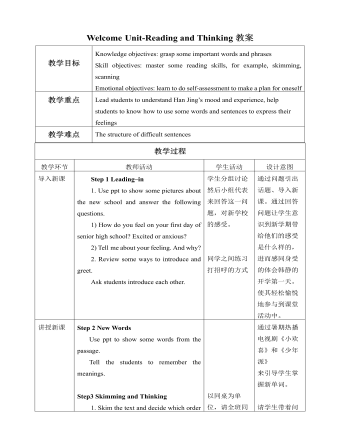
Step 2 New WordsUse ppt to show some words from the passage.Tell the students to remember the meanings.Step3 Skimming and Thinking1. Skim the text and decide which order Han Jing follows to talk about her first day. Time order or place order?Time order2. What is Han Jing worried about before she goes to senior high school?She is worried about whether she will make new friends and if no one talks to her, what she should do.Step 4 Fast Reading1. Match the main ideas with each paragraphParagraph 1:The worries about the new school day Paragraph 2Han Jing’s first maths classParagraph 3Han Jing’s first chemistry classParagraph 4Han Jing’s feelings about her first senior school dayStep 5 Careful Reading1. Fill in the chart with the words and phrases about Han Jing’s day. Answers: Senior high school, a little nervous; Her first maths class, classmates and teachers, friendly and helpful; Chemistry lab; new; great; annoying guy; Confident; a lot to explore2. Read the text again and discuss the questions.1) Why did Han Jing feel anxious before school?Because she was a new senior high student and she was not outgoing. What was more, she was worried about whether she can make friends.2) How was her first maths class?It was difficult but the teacher was kind and friendly. 3) What happened in the chemistry class? What would you do if this happened to you? A guy next to Han Jing tried to talk with her and she couldn’t concentrate on the experiment.
新人教版高中英语必修2Unit 1 Cultural Heritage-Listening&Speaking&Talking教案
Listening and Speaking introduces the topic of “Take part in a youth project”. The listening text is an interview about an international youth cultural heritage protection project. More than 20 high school students from seven countries participated in the project. The reporter interviewed two participants Stephanie and Liu Bin. By listening to the text, students can understand the significance of cultural heritage protection, and teenagers can use their knowledge, combine their own interests and advantages, etc. to participate in the action of cultural heritage protection. Listening and Talking introduces the theme of "Talk about history and culture". The listening text is a dialogue between two tourists and tour guides when they visit the Kremlin, red square and surrounding buildings. The dialogue focuses on the functional items of "starting a conversation", which is used to politely and appropriately attract the attention of the others, so as to smoothly start a conversation or start a new topic. The purpose of this section is to guide students to understand the history and current situation of Chinese and foreign cultural heritage in their own tourism experiences or from other people's tourism experiences, explore the historical and cultural values, and be able to express accurately and appropriately in oral communication.1. Guide students to understand the content of listening texts in terms of the whole and key details; 2. Cultivate students' ability to guess the meaning of words in listening; discuss with their peers how to participate in cultural heritage protection activities.3. Instruct students to use functional sentences of the dialogue such as “I beg your pardon, but…” “Forgive me for asking, but…" and so on to start the conversation more politely and appropriately.
新人教版高中英语必修2Unit 2 Wildlife Protection-Reading for Writing教案二
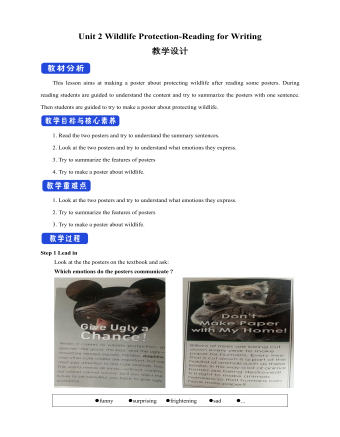
This lesson aims at making a poster about protecting wildlife after reading some posters. During reading students are guided to understand the content and try to summarize the posters with one sentence. Then students are guided to try to make a poster about protecting wildlife.1. Read the two posters and try to understand the summary sentences.2. Look at the two posters and try to understand what emotions they express.3. Try to summarize the features of posters4. Try to make a poster about wildlife.1. Look at the two posters and try to understand what emotions they express.2. Try to summarize the features of posters3. Try to make a poster about wildlife.Step 1 Lead inLook at the the posters on the textbook and ask:Which emotions do the posters communicate ?Step 2 Read the poster and answer the questions.1. What do you think of the animals in the poster on the left ?I think it is frightening and ugly.2. Why do we should protect the ugly animals ?All species--the good, the bad, and the ugly-- should be treated equally.The world needs all kinds--without variety, our planet cannot survive.3. Why are billions of trees being cut down every year ?To make paper for humans.4. What result will be lead to after the trees are cut down ?A lost of animal homes are being destroyed./The habitat of wildlife is being destroyed.Step 3 Find the feature of posters1. What does each poster use to stir up emotions ?On the left, it makes us a little frightened and it looks a little ugly, but it can activate our curiosity--What is it? And What is wrong with it?On the right, it makes us feel a little sad and want to protect them.
新人教版高中英语必修2Unit 1 Cultural Heritage-Reading and Thinking教案二
1. This section focuses on "Understanding how a problem was solved”, which is aimed to guide students to analyze and discuss the challenges and problems faced by cultural heritage protection during the construction of Aswan Dam, as well as the solutions. On the basis of understanding, students should pay attention to the key role of international cooperation in solving problems, and attach importance to the balance and coordination between cultural heritage protection and social and economic development. Students are encouraged to face challenges actively, be good at cooperation, and make continuous efforts to find reasonable ways and means to solve problems.2. Enable students to understand the main information and text structure of the reading text;3. Motivate students to use the reading strategy "make a timeline" according to the appropriate text genre;4. Enable students to understand how a problem was solved;5. Enable students to understand the value of protecting cultural heritage by teamwork and global community;1. Guide students to pay attention to reading strategies, such as prediction, self-questioning and scanning.2. Help students sort out the topic language about protecting cultural relics and understand the narrative characteristics of "time-event" in illustrative style3. Lead students to understand the value of protecting cultural heritage by teamwork and global community;
新人教版高中英语必修2Unit 2 Wildlife Protection-Listening and Speaking教案
This lesson is about wildlife protection. The listening and speaking is about “How to protect endangered wildlife ?” Faced with the facts and numbers of wildlife loss, people begin to detect the reasons, then people such as the celebrities (Prince William and Yao Ming) are calling on to protect them. So students are guided to enhance the awareness of protecting wildlife and try to take part in some volunteer activities of protecting wildlife.1. Predict the content by using visuals. 2. Learn to use the sentences such as “I’m concerned about.... But now they are in danger. I want to know the reasons/why./ What can we do to protect them ?3. Learn from the stars like Prince William and Yao Ming and enhance the awareness of protecting wildlife.4. Guide students to try to put forward the solutions to the problems of wildlife protection and then discuss them with partners and present the results of discussion.5. Master the pronunciation of stressed syllables.1. Learn from the stars like Prince William and Yao Ming and enhance the awareness of protecting wildlife.2. Guide students to try to put forward the solutions to the problems of wildlife protection and then discuss them with partners and present the results of discussion.3. Learn to use the sentences such as “I’m concerned about.... But now they are in danger. I want to know the reasons/why./ What can we do to protect them ?4. Master the pronunciation of stressed syllables.Part A Listening and Speaking--- How to save endangered wildlifeStep 1 Lead in1. Point at the pictures on P14 and ask Q1: What message do these posters share?
新人教版高中英语必修2Unit 2 Wildlife Protection-Reading and Thinking教案二
The theme of this unit is human and nature, focusing on the theme of wildlife protection. Nature is a complex ecosystem, in which there are delicate balance between animals and plants. Because of the role of the food chain, the extinction of one species will produce influence, causing a series of chain reaction. Large scale extinction of species will have a serious and even irreversible impact on the ecosystem, resulting in immeasurable losses. Therefore, it is of great significance to protect wild species. To protect wild species is to protect human beings themselves. The motto of this unit is "when the buying stops, the killing can too,” which is a public service advertising slogan to protect wildlife. It tells people that every rhinoceros horn, every fur, every bowl of shark fin soup, every Ivory product, and every tiger bone product, etc. consumed by human beings, are innocent wild animals slaughtered behind them. The mission of wild aid is to ban illegal trade in endangered wildlife and mitigate climate change. It aims to educate the public to reduce the consumption demand for endangered wildlife products through public publicity and improve the awareness of environmental protection.1. Improve the awareness of wildlife protection by acquiring the knowledge of wildlife protection.2. Focus on environmental protection and protection of all lives.3. Analysis of the living environment of wild animals with appropriate thinking mode.4. Skillfully use the vocabulary and grammar knowledge of this unit to cultivate self-study ability according to the unit content5. Develop cooperative learning ability through discussion and other ways1. Enable the Ss to talk about the current situation of wild animals.2. Guide the Ss to summarize the main idea of each paragraph as well as the main idea of the text.
新人教版高中英语必修2Unit 3 The Internet-Reading and Thinking教案二
Q5:What's Jan's next goal?Her next goal is to start a charity website to raise money for children in poor countries.Q6:What can we learn from her experiences?We learn that when we go through tough times, we can find help and support from other people online. We learn that we can feel less lonelyStep 5: While reading---rethinkingQ1: What is Jan’s attitude to the Internet ?Thankful/Grateful, because it has changed her and her life.Q2: What writing skills is used in the article ?Examples(Jan’s example, the 59-year-old man’s and the 61-year-old woman’s example)Q3: Can you get the main idea of the article ?The Internet has changed Jan’s life/Jan’s life has been changed by the Internet.Step 6 Post reading---Retell the storyMuch has been written about the wonders of the World Wide Web. There are countless articles (1)telling(tell) us how the Internet has made our lives more convenient. But the Internet has done a lot (2)more(much) for people than simply make life more convenient. People’s lives (3) have been changed(change) by online communities and social networks so far. Take Jan for example, who developed a serious illness that made her (4)stuck(stick) at home with only her computer to keep (5)her(she) company. She joined an online group (6)where she could share problems, support and advice with others. She considered the ability to remove the distance between people as one of the greatest (7)benefits(benefit). She was so inspired (8)that she started an IT club in which many people have been helped. She has started to learn more about how to use the Internet to make society better. Her next goal is to start a charity website to raise money (9)for children in poor countries. Jan’s life has been (10)greatly(great) improved by the Internet.
新人教版高中英语必修2Unit 5 Music-Listening and Speaking教案
This lesson is about music. Students can classify the types of music through the instruments and its sound and can talk about their preferences about music, even join some activities and play a role in them according to their musical talents. On the basis, they are guided to use the languages to express their preferences and some plosive sounds and their rules.1. Classify the music types through the instruments and its sound.2. Listen and understand what the speakers’ preferences are and the reasons; talk about their own preferences and give their own reasons, using these sentences: “What kind of music do you like? And why? “ “Because it makes/gives me energy/peaceful.../touches my heart...”.3. Learn some plosives and the rules.4. Join some activities and play a role in them according to the talents. 1. Listen and understand what the speakers’ preferences are and the reasons;2. talk about their own preferences and give their own reasons, using these sentences: “What kind of music do you like? And why? “ “Because it makes/gives me energy/peaceful.../touches my heart...”.3. Learn some plosives and incomplete plosives and its rules.Step 1 Lead inPoint at the pictures on P50 and ask Q1: What are the people doing in the pictures below?Q2: What kind of music they are?Then play the MP3s one by oneStep 2 ListeningTask 1: A reporter from the school newspaper is interviewing students about music. Listen to the interviews. Draw lines between the words to make complete sentences. Some words will not be used.