-
新人教版高中英语必修2Unit 5 Music-Reading and Thinking教案一
This section focuses on "learning about experiencing music Online". This virtual choir is a new form of music performance. Members from all over the world don't need to love to come to a place. Instead, they use the new technology to model the various parts and wonderful virtual harmony group of music in the family. Students need to understand the main meaning of each paragraph. Finding topic sentences is an important way to understand the general idea of a paragraph. After the topic sentence, it is usually the detail sentence that supports and explains the topic sentence. Some paragraphs have obvious subject sentences, for example, the first sentence of the second paragraph is the subject sentence of the paragraph, and the following sentenceStudents need to pay attention to the topic sentences and key sentences, and then pay attention to how the sentences after the meaning explain, explain and support the topic sentences or key sentences before.1.Guide students to learn about experiencing music online2.Guide students to scan and circle the information in the text.3.Guide students to find the numbers and dates to fill in the timeline.4.Guide students to learn more about music by completing the sentences with the correct forms of the words and phrases. And then make a mind map about the outline of the passage.1. Guide students to pay attention to reading strategies, such as prediction, self-questioning and scanning.2. Help students sort out the main meaning of each paragraph and understand the narrative characteristics of "timeline” in illustrative style.3. Lead students to understand the changes that have been caused by the Internet.
新人教版高中英语选修1Unit 3 Fascinating Parks教案
2. Explore the significance of the establishment of Sarek National Park.Q1: Which event is the most important one in the park’s history?Ss: The establishment of Sarek national park in 1909 is the most important one.Q2: Is it worth making a place like Sarek a national park? Give your reasons.Ss: Yes. In this way, the place can be kept in its natural state and natural beauties and other rare and valuable resources can be preserved instead of being destroyed by endless exploitation driven by profits.Q3: How does the writer organize his introduction to the history of Sarek?Ss: The writer organizes his introduction in the sequence of time, using time indicators such as “used to”, “around 9,000 years ago”, “soon after”, “following the reindeer”, and “in 1909”.Q4: What is the feature of the language used to introduce the history of the park?Ss: The introduction to the park is to provide facts, using time indicators to organize the events. Sentences starts with “third person” and passive voice is used more often, feeling objective.【设计意图】学生寻找和梳理公园历史上的重要事件,体会人与自然的和谐关系,评鉴介绍性语言的特点。【核心素养提升点】发展自主提取、梳理文本信息能力,训练逻辑思维和高阶思维。Activity 3: Highlighting the secret of the text
新人教版高中英语选修1Unit 2 Looking into the Future教案
【设计意图】以“新科技是一把双刃剑”为主题开展讨论活动。这个话题比较大,所以给了一定的限制,首先需要以智能家居为例来阐述科技发展对未来生活产生的影响,然后列举其优点和缺点,最后就以上现象发表自己的观点。这个活动是对整个文本的创意性总结与意义的升华,留给学生一定的想象空间,学生借此机会可以运用文本内容和语言表达自己对科技发展的看法和态度。Assignments:1. Finish Exercise 4 on Page 15 of the textbook.A smart home is one that integrated computers into the structure of the building itself. In this way, many of the things that we now do ourselves become automatic. For example, the smart home could control the air conditioning and lights so that you would no longer have to turn switches on and off, and so that your home would be more energy-efficient. The smart home could also monitor itself to make sure that everything is working as it should, and send you warnings if there is a problem. Such smart homes could even be programmed to detect your health problems, and then give you reasonable advice as to the food you should eat or if you should see a doctor. So, in a sense, smart homes will lead us to living smarter lives.2.Create a smart function for your home, and share your creation in the next period.
新人教版高中英语选修1Unit 4 Body Language教案
本阅读材料的话题是交际中的肢体语言,作者从三个方面讲述了肢体语言的特征与作用,通过主题句和举例阐述的方式让读者了解不同文化中肢体语言的相同或者不同的意义,并从更抽象、概括的维度深入认识肢体语言的特点,理解肢体语言的作用。基于肢体语言的特点,作者提醒读者在与人交流中,尤其是当文化背景有差异的时候,要使用得体的肢体语言,尊重、理解和包容不同的文化,进行有效、有素养的沟通。文本共由六个段落组成,篇章结构为“总—分”。第一段用简练的语言引出了话题,并且从我们自身表达的需要和了解他人感受两个角度讲述了肢体语言的作用。第二段阐述了肢体语言的第一个重要特点——肢体语言在不同的文化中有不同的内涵——这也是文中写作篇幅最大的一个要点,最为重要。通过讲述肢体语言的这一特点,作者向读者传递了要尊重不同的文化、要使用与所在文化相宜的肢体语言。
新人教版高中英语选修3Unit 1 Art教案
[2] An important breakthrough…was… [3] Another innovation was … [4] the emphasis increasingly shifted from…to… [5] New ideas and values gradually replaced… [6] While his paintings still had religious themes… … T: All these expressions serve to show how Western painting has developed. Some of them share similar structure but with varied use of words, which makes the text vivid and more readable. 【设计意图】主题类语言整理有助于学生类化语言应用,提高语言输出的丰富性。处理完文本内容信息后,进入语篇信息处理,进行主题相关的词块归类。引导学生快速阅读,寻找表达相同主题(发展或者艺术)的词和短语,再根据词性、用法和结构进行归类,储备主题相关词汇,丰富语言储备,提升语言素养。 Assignment: Go online to gather more information about Chinese painting and write a short history of it. 【设计意图】结合所学,迁移运用,根据实际语境,进行模仿性运用。在此过程中,学生尝试借鉴已学的语言、内容、语篇结构和写作手法来建构新文本,实现语篇输出,同时关注中西艺术文化的差别,加深对优秀文化的认同,培养文化意识。
新人教版高中英语选修3Unit 4 Adversity And Courage教案
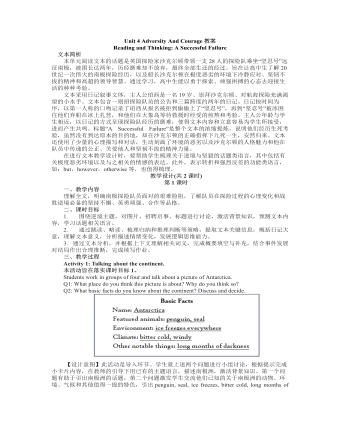
本活动旨在落实课时目标3。 The Student Union is looking for three students for a 3-week voluntary program in Guizhou province. The volunteers have got to be high school students, with a persevering personality and experiences in overcoming adversity. The volunteers need to stay, eat and teach with 20 pupils in a small school up on the hill of a village. There are no facilities but desks and a blackboard in the school. And there is no take-away food to be bought anywhere; the only way to feed yourself is to cook. You’re interested in applying. Write your application letter introducing what adversity you have ever overcome and how persevering you are as well as what you want to do when at work. Dear Student Union,【设计意图】此任务旨在迁移一、二课时所学,解决实际问题。学生对比自己经历过的挑战或挫折,写信给学生会申请前往贵州担任短期支教教师,把个人以前是怎么战胜挫折的经过书写出来。结合所学,迁移创新,分析解决自身实际问题,在真实情境中学生通过仿写进行主题语言的精确输出。完成任务的过程中,能较多地使用已学语言、内容、结构和写作手法来描述自己面对挫折的处理方式、态度和应有的品质,近一步激发学生树立正确的价值观,学会逆境出人才,坚忍不拔,从容不迫,又做到谦让、分享和合作。课后学生修正习作,再次提交。
新人教版高中英语选修4Unit 3 Reaching Out Across the Sea教案
本活动旨在落实课时目标3。 Think about the following questions and talk about your own attitude in pairs.Q1: As for this topic,what impresses you the most in the passage?Q2: What do you think of the future of China’s further exploration in sea? Are you in favor of the further exploration?Why or why not? 【设计意图】该活动是一个完全开放性的活动,每个学生都会有不同的答案。运用迁移所学,自由口头表达自己对海洋探索的态度。对于中国海洋探索的未来,每个人的想法是不一样的,有乐观,有担忧,有认为值得投入,也有认为不值得付出太大代价,这里给学生自由表达的空间只要学会有支撑自己观点的事实就可以了,进一步培养学生批判性思维和正确的价值观。 Assignment: 此任务旨在迁移一、二课时所学,培养学生辩证分析问题的能力。 Write about your idea of the future of China’s sea exploration. And add your attitude towards the effort China have made in sea exploration. You’re expected to use the language and the writing technique learnt in the passage.
新人教版高中英语选修4Unit 4 Sharing教案
【核心素养提升点】学会将抽象信息进行可视化表达,提高信息处理能力和分析、推理等高阶思维品质;在跨文化交际中学会以国际视野接受和包容不同的文化。 5.Read Paragraph 2, draw a mind map and answer the questions. Q1:What did Jo learn about Tombe’s life? Q2:What kind of life do the natives lead? Read paragraph 2-5 and draw a mind-map. (Focus on accommodation, possession, diet and belief) 【设计意图】引导学生利用思维导图和问题链等形式来厘清当地人的生活方式,更好地处理和归纳信息 【核心素养提升点】提高信息处理能力、分析和归纳能力,包容异国文化、扩展国际视野。 6.Read Paragraph 3 and answer the questions. Q1:What was Jo’s feeling upon arriving her own home? Q2:Why would she feel that way? Q3:Do you think “It was such a privilege to have spent a day with Tombe’s family”? 【设计意图】通过提问,让学生理解Jo的苦并快乐的心情,并通过对“It was such a privilege to have spent a day with Tombe’s family”这句话的理解,体验志愿者生活的伟大。 【核心素养提升点】学会对信息的综合和归纳,从而理解作者所表达的观点。 Activity4: Summarize the change of Jo's feelings
人教版新课标PEP小学英语三年级上册Lets eat教案
教师将本课A、B部分所学单词的图片卡贴在黑板上,找两个学生各手持一把新苍蝇拍,教师读出一个单词,学生就要马上找出来并拍立一下。第一个拍的学生获胜。(4)教师准备一个小场景:将所有学过的食品及饮料或模型放在一个铺着台布的桌上,请学生根据A、B部分的Let’s talk进行自由会话。2.新课展示(Presentation)(1)本课时Let’ s learn中的单词认读教学,可继续采用A部分第二课时的教学方法,利用课件,让学生利用已掌握的拼读规则,认读和学习新单词。(2)让学生听Let’s learn的录音,一边听,一边指着书上相应的图,力求做到“眼到,手到,口到,心到”。(3)用一组连贯的动作教Let’s do中的动词Pour,smell,taste,drink。首先,教师左手端着一个茶壶,右手拿一茶杯,对全班说:Look!I’m pouring the tea. Pour the tea.(边倒茶,边说两遍)。
人教版新课标PEP小学英语三年级上册Recycle 2教案
3 趣味操练 (Practice)(1)请学生拿出他们事先准备的材料,指导学生按步骤进行摇摇乐的制作,每句话中的第一个动作都是教师要强调的部分,一定要配合手势,帮助学生理解和记忆。教师可适当给学生充分的时间,让学生用颜色笔将摇摇乐画得更漂亮些,有条件的话,可以用相机将学生的作品拍下来,有机会可以展览。(2)让学生跟着录音一起唱歌曲 Happy New Year,可以在唱歌时打节拍或边唱边舞。4 课堂评价 (Assessment) 做活动手册本单元4、5 部分的练习。本次评价要与课本上的4—6单元评价相结合,让学生自己动手填写评价表,评价自己。5 扩展性活动(Add-activities)新年的时候将歌曲 Happy New Year唱给爷爷奶奶,爸爸妈妈听,祝贺他们新年快乐!板书设计:Recycle 2Let’s make 部分的制作流程图Happy New Year! (一月一日的日历)
人教版新课标PEP小学英语三年级上册We love animals教案
(1)游戏:向它那儿跑去(Run to it!)首先,用图片和词卡练习本课的6个新单词。学生边读老师边把卡片贴在黑板上。将全班分成两队。给学生下一个Run to the bird.这样的指令。每队的第一个学生向带有鸟的图卡和词卡的地方跑,并且用手摸一下这两张卡片。哪组学生先摸到卡片就给他们队得一分。教师也可以用本课刚学的指令:Walk to….Jump to ….Fly to….等指令学生用相同的动作走(跳,飞)到卡片前。(2)教师将Let’s do的图片打乱顺序,让学生听指令,选出正确的图片。(3)游戏:照我说的做(Do as I say)教师发指令,全班同学起立做动作。做错的同学随时坐下。最后,哪组站着的同学多,哪组获胜。教师参考指令: Climb like a monkey/bear.Jump like a squirrel/rabbit.Walk like an elephant/duck.Hunt like a mouse/pig.Act like a cat/dog.Fly like a bird.为了增加游戏的难度和趣味性,教师可逐渐加快指令的速度。4.课堂评价(Assessment)做活动手册本单元第5部分的练习。方法和步骤参考第一单元。
人教版新课标PEP小学英语四年级上册My Classroom教案
1、本单元要求会听,说,认读的单词: Window board light picture door floor classroom computer wall teacher’s desk fan what in the we have new go where2、本单元要求会听,说的单词和词组: Many our seat near classmate cleanhave a look good idea all right good job3、帮助学生在掌握单词的基础上造出句子,编出对话,学以致用。 4、培养学生用英语交流的能力,为学生的进一步学习奠定基础。 二、教学要求 1、能听懂、会说,会用每一课会话。 2、掌握本单元出现的生词,词组和字母。 3、会唱本单元的歌曲。 三、教学重点和难点 1、对于较长的单词如classroom, classmate, computer的掌握以及对于第一次出现的词组和短语如have a look, good job的掌握。2、对于礼貌用语“Thank you , Excuse me, After you”的掌握与应用。 3、描述教室中所有物件,并能据此编出对话。 四、教学时间 本单元共6课时,每周3课时,2周完成。 Lesson 1 1.Teaching Aims Let the students master the words: window, classroom, floor, light, door, board, and picture. When they see the objects, they can recognize and read them and do the action about them.
人教版新课标PEP小学英语四年级下册At a Farm教案
(二)新课呈现:学生以小组的形式指着挂图汇报,每组只谈论一种动物。(教师为尽可能多的学生提供对话机会,鼓励学生尽可能不重复别人说过的。)在对话的过程中,教师将单词卡片cat,dog,rabbit,duck,pig适时呈现给学生,让学生拼读单词。然后启发学生将每个单词中的元音字母的发音说出来,从而帮助学生记忆单词,同时为Pronunciation的教学进行铺垫。教师适当讲解单词拼写中需特别注意的地方。rabbit双写b;duck中ck发[k]的音。做找朋友的游戏:方法一:教师说单词:cat,dog,rabbit,duck,pig,分别请五个学生站到前面做出5种动物的动作;将5个单词的卡片面朝下分别发给5个学生,教师说Start!5名学生分别翻开卡片,根据单词意思到前面去找自己的朋友。教师对完成准确而且速度快的同学进行表扬。方法二:教师将cat,dog,rabbit,duck,pig的图片和单词卡片分别发给十个同学,看看谁能在最快的时间内找到自己的朋友。教师要表扬配合最密切的两个同学。
人教版新课标PEP小学英语四年级下册Recycle 2教案
第一课时教学设计教学内容:Read and act教学目标:1.通过游戏及筹备野炊的过程,在实际情景中复习有关天气、蔬菜、水果、食物的单词以及句型:What’s the weather like in…..?How much is/ are …?What do you have ? I have … .I want … .2.能听懂、会说句型:Tomorrow will be … .Let’s go shopping. What do you want to bring? Let’s have a picnic tomorrow.教学重点:能听、说、认读句型:I want … .I have….教学难点:在实际情景中灵活运用Read and act 中的主要句型。教学准备:1.教师准备录音机、磁带和一张大购物单。2.教师准备有关蔬菜、食物、水果和天气的图卡和词卡。3.学生以小组为单位准备一份购物单。教学过程:一、Preparation1.Sing the song :The Coat in the Window.(P66 Unit5 Let’s sing)2.复习有关蔬菜、食物和水果的单词。(蔬菜指的是第六单元中学过的;水果主要复习本课时涉及到的几种常见的即可。)在复习的过程中教师可先出示词卡,让学生认读,并让学生试着说出意思,然后教师出示图卡进行确认。同时教师在黑板上写出shop的字样,把复习过的蔬菜和水果的图卡依次贴到黑板上。
人教版新课标PEP小学英语四年级下册Our School教案
教学重点:Read and write 中的四个四会单词以及问句“Is this a teacher’s desk?”及其答句“Yes, it is.”在四线格中的正确书写。教学难点:拼读单词picture,在四线格中书写句型“Is this a …?”以及总结元音字母a的发音规则。教具准备:1.与教材内容相关的课件、声音、图片等媒体素材。2.教师准备相关的词卡。3.学生准备白纸和彩笔。教学过程(35sk. c om整理):(一)热身/复习(Warm-up/Revision)1.师生合唱该单元的歌曲和歌谣,边歌边舞。2.请学生表演Story time中的对话。3.猜谜语:教师给学生出一些简单的谜语,如:Jack is in a room. There are many books in it. He can see many students. They are reading books. They are quiet. Where is Jack?(二)呈现新课 (Presentation)1.请学生观察Read and write部分的情景图,预先空出来需要书写的四会单词,让学生独立思考,填充对话。
人教版新课标PEP小学英语四年级下册Recycle 1教案
1.Think and write接上一个环节,老师说“Zoom is careless. Where are his things? Let’s look.” 让学生看课本图片,认真观察。a. 教师给出例句,请同学仿照例句说出句子Zoom’s red shoes are in the library.Zoom’s green sweater is in the gym.b.学生完成课本图片后的短文。可以找程度好的同学在黑板上书写。c.让学生在小组内朗读句子。2. Let’s read..出示钟表模型,老师拨出几个有代表性的时间,学生分两组用“What time is it ? It’s ........It’s time to ……”进行问答。老师在学生回答时把时间和活动写在黑板上如下:Time Activities7:00 get up 7:30 go to school9:00have Chinese/math class10:00read books 或其他12:00 eat lunch3:15have P.E classOh, you have a busy day. Look, this is John’s day.a. 由上个环节引出John’s list. 教师引导学生仔细看Let’s read 部分的图,阅读John的活动时间表, 然后独立完成句子的正误判断,最后进行检查。b.让学生再次读John的活动时间表,回答下面的问题:What time does John go to school? Where does John read books?
人教版新课标PEP小学英语五年级上册My New Room教案
Let’s learn(1)教师在黑板上简单画一个房间,画上床、书架等家具。然后说:Look! This is my new room. I have a bed and a shelf. What else do I have? 教师在床头的位置画一面镜子,说:I also have a mirror. 然后拿出一面镜子,示范朗读mirror, 学生跟读。教师分别问几个学生:Do you have a mirror in your bedroom?如果学生的回答是肯定的,教师则有意再次重复一下“mirror”一词,说:Oh, you have a mirror.如果学生的回答是否定的,教师可以说:Oh, sorry. You don’t have a mirror. 导出其他单词,示范朗读,注意发音及口型。(2)做“冷暖”游戏。(3)教师在黑板上示范书写单词:mirror, curtain, closet, end table, trash bin,让学生在词卡反面或练习本上拼写、记忆单词。(4)播放本课录音,让学生在书上手指相应单词并跟读。巩固延伸:做句型接龙游戏;做“找同伴”活动;学唱歌曲;完成配套练习;练习书写单词第二课时教学设计教学目标与要求:1、 能够听懂、会说本课对话,并能做替换练习。2、 能够听、说、认读句型There is a ……/There are …并能在情景中正确运用。3、 了解Good to know内容。
人教版新课标PEP小学英语五年级上册My New Teachers教案
教师播放Let’s learn课件,提问:Guess, what does Wu Yifan do on Saturdays? 请3-4人回答后。用同样方法完成watch TV, read books,请学生听并且跟读。继续看课件,播放两个男孩的对话,请学生听并跟读,注意语音、语调。 在句子中练习单词,培养学生的表达能力。对话练习听录音中的对话 1-2遍,请同学说一说对话的内容。可选择自己喜欢的角色进行人机对话。分组练习,向你的朋友询问。培养学生的模仿力,并能在恰当情境中灵活运用所学句型。Let’s chant B出示B部分的歌谣,请学生小声试读,可以读出不同的节奏。播放歌谣,请学生仔细倾听2-3遍,说到相对应的地方,教师带领学生指一指画画、看电视、读书、玩电脑游戏这四种情景,帮助学生理解歌谣。请学生反复跟读。分角色演唱,可拍手掌握节奏。 看一看、说一说帮助学生巩固本课句型。转盘游戏教师拿出课前制作好的大转盘,上面有do homework, watch TV, read books这三幅图画。请一名学生拨动转盘,转盘快速转动,停止时看指针指向哪一幅图,该生提问What do you do on Sundays?其余同学回答,先回答出的同学可拨动转盘,游戏继续。
人教版新课标PEP小学英语五年级上册Recycle1教案
巩固延伸尝试与他人进行书信交流第三课时教学设计教学目的与要求:1、 能够使用所学四会句子完成Task time中的采访任务。2、 能够理解Let’s play中的问题并做出正确回答。3、 能够听懂、会唱歌曲“My Favourite Day”。教学重、难点:重点、难点为复习并使用四会句子完成Task time中的采访任务,并展示个人报道。课前准备:教学挂图、录音带、录音机、简历表教学过程:1、 热身(1) 放第二单元歌曲,学生跟唱,复习有关一周七天的单词。(2) 日常口语练习。2、 预习:放录音,欣赏歌曲。3、 新授Task time(1) 就歌曲内容向学生提问:Do you like weekends? What’s your favourite day? 引导学生回答:My favourite day is Saturday/Sunday. 并请学生说明理由,表述周末活动。出示采访表,回答问题。(2) 让学生参照学生用书的采访表进行小组交流,并在最短的时间内填充表格,然后每组派代表做汇报。Let’s play看图片,指导学生先读懂句子,再回答问题。Let’s sing学生理解并学唱本单元歌曲“My Favourite Day”.巩固延伸:采访教师;画画猜人
人教版新课标PEP小学英语五年级上册Recycle2教案
教学目标与要求:1、 通过活动和复习句型,介绍及动作短语等。2、 学唱歌曲。教学重、难点:重点为复习巩固介词及存在句型。难点为正确区分内容相近的图片。课前准备:词卡、录音机、录音带、图片教学过程:1、 热身(1) 放歌曲录音,学生跟唱。(2) 师生进行日常会话。2、 预习做“按我说的做”游戏。3、 新授(1) 看图片,问:Where is the …? Ss: It’s in /on/over…(2) 做“猜一猜”游戏。(3) 两人一组完成Pair work,连一连,说一说。(4) 听录音,完成练习。录音原文如下:There are mountains behind her village. There is a river near her house. There is a new air-conditioner in her bedroom. She cleans her bedroom every day.There is a lake near his village. There are many trees in front of his house. There is a big trash bin in his kitchen. He can cook tasty meals.There is a forest near his village. There is a road beside his house. There is a man under a tree. He often waters the flowers.There are many Paths in her village. There are new curtains on the window of her house. There are many new skirts in her closet. She washes the clothes every weekend.巩固延伸:做“幸运摸奖”游戏