-
人教版高中历史必修2古代商业的发展教案
中国古代商业的发展有哪些表现?综观中国古代历史,商业在不同的历史时期有不同的表现。主要表现在:(1)商业活动的场所的变化:先主要在城市中进行,后来农村集市贸易逐渐发展。唐时加快,明清时突出,出现了专业性的市集(如丝市、叶市、猪市等),以至逐渐形成了新兴的市镇(有的更是专业性的集散市集);而不是先有农村商业,而后才有城市商业的发展。(2)交易内容的变化:商业开始时以贩运、交流地区间的土特产品,经营统治者所需要的奢侈品为主要内容,以后随着商品货币经济的发展,市场商品种类增多、行业分细,为一般人民所需要的主要农副产品以及城市手工业所生产的大小商品在整个流通界地位提高。这种情况在宋代已经显现。(3)交易媒介的变化:商品交换最原始的形态是物物交换,不存在交易的媒介。随着商品交换的内容和地域的扩大,出现了以贝壳等为代表的一般等价物。
新人教版高中英语必修1Unit 1 Teenage Life-Discovering Useful Structure教案
(形容词短语most beautiful的构成形式为:副词+形容词,该短语在句中作定语修饰名词bird)④A good friend is someone who makes you really happy.好朋友就是能让你真正高兴的人。(形容词短语really happy的构成形式为:副词+形容词,该短语在句中作宾语补足语)[即学即练]画出下例句中的形容词短语并指明构成形式如:It is less cold today than it was yesterday.构成形式: 副词+形容词(1)Our country is becoming more and more beautiful.(2)The road is long enough.(3)The medicine is good for stomach.三、副词短语(Adverb Phrases)副词短语:指以一个副词为中心构成的短语,在句中的功能相当于副词,可以修饰动词、形容词或副词。常见副词短语的构成形式有:(副词)+副词如: much more beautifully①He did his work here yesterday.他昨天在这里工作。(副词短语here yesterday修饰动词did)②Bill did the work very well.比尔做的这份工作很好。副词短语very well修饰动词did③We are all entirely responsible for our action(副词短语all entirely, 修饰形容词短语responsible for)
新人教版高中英语必修1Unit 2 Travelling Around–Listening and Speaking教案
无论她说什么都不会对我们的安排有影响。Answers: for, arrangement3) Parents arrange everything for their children and spare no effort to pave the way for their success.父母为孩子安排好一切,不遗余力地为他们的成功铺路。4. extremely adv 极其,非常extreme adj 非常的1) Mary found it extremely difficult to get a job.2) I’m extremely sorry to have troubled you.Answers:玛丽发现找工作极其困难。给你添了麻烦,我十分抱歉。3) It had white-painted tunnels and bright red carriages, and proved _________ (extreme) popular with the public.它有白色的隧道和明亮的红色车厢,结果证明它非常受大众的欢迎。Answers: extremelyExercises1. I am continuing to apply_______ jobs though I have failed several times.2. All this had an _______ (extremely) bad effect on the criminal justice system.3. The invention would have wide ______ (apply) in industry.4. She’s happy with her unusual living _________ (arrange).5. I was banging so loudly that I’m ___________ (amaze) that they didn’t hear me.6. You haven’t changed at all you still look ___________ (exact) the same.7. “Was it what you expected?” “Yes, _________ (definite).”8. He was looking forward to______ (work) with the newPrime Minister. Answers: for extreme application arrangement amazed exactly definitely looking单句写作:1. _______________ (你要说些什么) when you get on the platform to accept the reward?2. Since_____________________(我们为这些事情做好了准备), we have nothing to worry about.
新人教版高中英语必修1Unit 2 Travelling Around-Reading and Thinking教案
Good expressions that students can choose to use: help the travelers choose which tour to take1. In my opinion, you could/might choose…, because you prefer to…2. …could be a perfect choice for you, for…3. As far as I am concerned, you would enjoy…, for…4. …would probably suit you, because you enjoy/love/hate doing…Step 5 Passage ConsolidationLanguage appreciation:1. You can then spend three days exploring the rainforest with a local guide and enjoying the plants and animals unique to the rainforest. 在接下来的三天里,您可以在当地导游的陪同下,深入雨林进行探索,欣赏雨林特有的动植物。本句主体结构为spend some time doing sth. 2. Inca builders cut stones to exact sizes so that nothing was needed to hold walls together other than the perfect fit of the stones. 印加的建筑工人将石头切割成精确的尺寸,仅仅凭着石头间的完美契合,即可稳固墙体。本句为so that引导的结果状语从句。nothing与the perfect fit为并列成分; other than在句中意为“除了”。Step 6 HomeworkSuppose you will travel to Peru, write a short essay about your three-day tour plan.
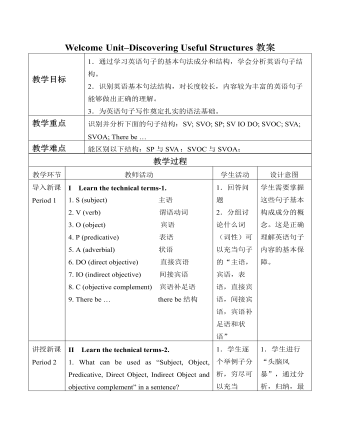
新人教版高中英语必修1Welcome Unit-Discovering Useful Structures教案
II Learn the technical terms-2.1. What can be used as “Subject, Object, Predicative, Direct Object, Indirect Object and objective complement” in a sentence?2. What can be used as “adverbial” in a sentence?3. What can be used as “verb” in a sentence?Answers to questions 1-3:1. Nouns, pronouns and appellations can be used as “Subject, Object, Predicative, Direct Object, Indirect Object and Objective Complement”. Besides, adjectives can be used as “Predicative and Objective Complement” in a sentence.2. Adverbs and prepositional phrases can be used as “Adverbial”.3. Verbs with actual meaning can be used as “Verb” in a sentence. Auxiliary verbs alone cannot be used as “Verb” in a sentence.III Learn to recognize the sentence structures.1. SV structure. For Example:(1) A bird flies.S V(2) A monkey jumps.S V(3) A fish swims.S V√ In SV structures, verbs are “intransitive verbs”.2. SVO structure. For Example:(1) A sheep eats grass.S V O(2) They like bananas.S V O(3) He wants candy.S V O√ In SVO structures, verbs are “transitive verbs”.3. SP structure. For Example:(1) This is great.S P (2) He looks well.S P (3) She became a teacher.S P √ In SP structures, Predicatives are formed by “link verbs” and “adjectives or nouns”.√ link verbs: be, become, grow, look, feel, taste, etc.4. SV IO DO structure. For Example:(1) He asked me a question.S V IO DO(2) Danny wrote me a letter.S V IO DO(3) Billy brought Sam a kite.S V IO DO√ In SV IO DO structures, the verbs are transitive and are followed by two objectives – pronouns or nouns as Indirect Objective, and nouns as Direct Objectives.
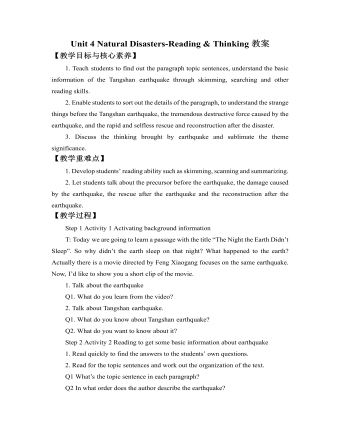
新人教版高中英语必修1Unit 4 Natural Disasters-Reading & Thinking教案
5. Read to get detailed information about Paragraph 5.Q1. What shows the revival of Tangshan?Q2. How can Tangshan revive itself and get up on its feet again?Q3. In times of disasters, how can we go through it?T: In times of disasters, we should unify, show the wisdom and stay positive.Step 4 Activity 4 Highlighting the theme and reflecting1. Make a summary of the text.2. Further understand the titleQ: After our learning, why do you think the earth didn’t sleep on that night?T: An earthquake happened. The people in the earthquake suffered a lot, and the people outside Tangshan were concerned about the people there a lot.3. Reflect through discussion on what can be learnt after reading.T: Disasters are powerful. Unpreparedness can be deadly. Life is weak, but if people work together to help each other, disasters can be defeated.There is no love from disaster, but we have love in the human heart.Step 5 Assignment How does the writer convey that the earthquake was deadly, and that people were helpless during the earthquake? Try to find some attractive and impressive expressions and note them down.
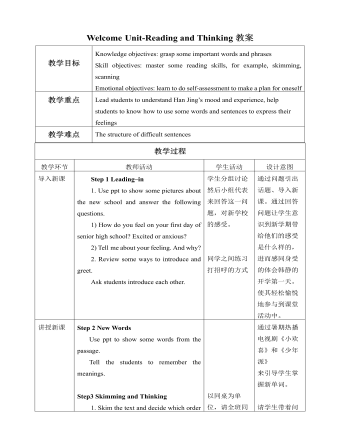
新人教版高中英语必修1Welcome Unit-Reading and Thinking教案
Step 2 New WordsUse ppt to show some words from the passage.Tell the students to remember the meanings.Step3 Skimming and Thinking1. Skim the text and decide which order Han Jing follows to talk about her first day. Time order or place order?Time order2. What is Han Jing worried about before she goes to senior high school?She is worried about whether she will make new friends and if no one talks to her, what she should do.Step 4 Fast Reading1. Match the main ideas with each paragraphParagraph 1:The worries about the new school day Paragraph 2Han Jing’s first maths classParagraph 3Han Jing’s first chemistry classParagraph 4Han Jing’s feelings about her first senior school dayStep 5 Careful Reading1. Fill in the chart with the words and phrases about Han Jing’s day. Answers: Senior high school, a little nervous; Her first maths class, classmates and teachers, friendly and helpful; Chemistry lab; new; great; annoying guy; Confident; a lot to explore2. Read the text again and discuss the questions.1) Why did Han Jing feel anxious before school?Because she was a new senior high student and she was not outgoing. What was more, she was worried about whether she can make friends.2) How was her first maths class?It was difficult but the teacher was kind and friendly. 3) What happened in the chemistry class? What would you do if this happened to you? A guy next to Han Jing tried to talk with her and she couldn’t concentrate on the experiment.
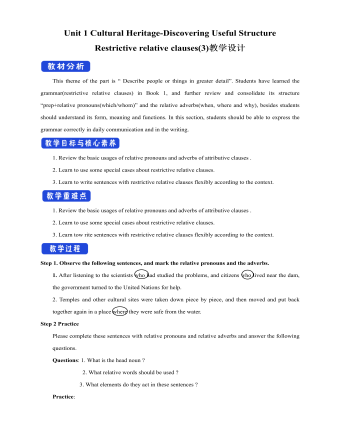
新人教版高中英语必修2Unit 1 Cultural Heritage-Discovering Useful Structure教案二
This theme of the part is “ Describe people or things in greater detail”. Students have learned the grammar(restrictive relative clauses) in Book 1, and further review and consolidate its structure “prep+relative pronouns(which/whom)” and the relative adverbs(when, where and why), besides students should understand its form, meaning and functions. In this section, students should be able to express the grammar correctly in daily communication and in the writing. 1. Review the basic usages of relative pronouns and adverbs of attributive clauses . 2. Learn to use some special cases about restrictive relative clauses.3. Learn to write sentences with restrictive relative clauses flexibly according to the context.1. Review the basic usages of relative pronouns and adverbs of attributive clauses .2. Learn to use some special cases about restrictive relative clauses.3. Learn tow rite sentences with restrictive relative clauses flexibly according to the context.Step 1. Observe the following sentences, and mark the relative pronouns and the adverbs. 1. After listening to the scientists who had studied the problems, and citizens who lived near the dam, the government turned to the United Nations for help.2. Temples and other cultural sites were taken down piece by piece, and then moved and put back together again in a place where they were safe from the water.Step 2 PracticePlease complete these sentences with relative pronouns and relative adverbs and answer the following questions.Questions: 1. What is the head noun ?2. What relative words should be used ?3. What elements do they act in these sentences ?
新人教版高中英语必修2Unit 1 Cultural Heritage-Discovering Useful Structure教案一
This teaching period mainly deals with grammar “restrictive relative clauses.” To begin with, teachers should lead students to revise what they have learned about the relative pronouns and relative adverbs. And then, teachers move on to stress more special cases concerning this grammar, such as the “preposition+ relative pronouns which and whom” and cases where we can omit the relative pronouns. This period carries considerable significance to the cultivation of students’ writing competence and lays a solid foundation for the basic appreciation of language beauty. The teacher is expected to enable students to master this period thoroughly and consolidate the knowledge by doing some exercises. 1. Guide students to review the basic usages of relative pronouns and adverbs of attributive clauses.2. Lead students to learn to use some special cases concerning restrictive relative clauses flexibly.2. Enable students to use the basic phrases structures flexibly.3. Strengthen students’ great interest in grammar learning.1. Help students to appreciate the function of relative pronouns and adverbs of attributive clauses in a sentence2. Instruct students to write essays using the proper relative pronouns and adverbs of attributive clauses.本节语法思考:定语从句在复合句中的作用是什么? 关系词有哪些?定语从句在复合句中的作用相当于形容词,它在句中作定语修饰名词或代词。他们在先行词和定语从句之间起到联系作用,同时在意义上代表先行词并在定语从句中担任一个成分。被定语从句所修饰的词称先行词,定语从句一般放在先行词的后面。
新人教版高中英语必修2Unit 1 Cultural Heritage-Listening&Speaking&Talking教案
Listening and Speaking introduces the topic of “Take part in a youth project”. The listening text is an interview about an international youth cultural heritage protection project. More than 20 high school students from seven countries participated in the project. The reporter interviewed two participants Stephanie and Liu Bin. By listening to the text, students can understand the significance of cultural heritage protection, and teenagers can use their knowledge, combine their own interests and advantages, etc. to participate in the action of cultural heritage protection. Listening and Talking introduces the theme of "Talk about history and culture". The listening text is a dialogue between two tourists and tour guides when they visit the Kremlin, red square and surrounding buildings. The dialogue focuses on the functional items of "starting a conversation", which is used to politely and appropriately attract the attention of the others, so as to smoothly start a conversation or start a new topic. The purpose of this section is to guide students to understand the history and current situation of Chinese and foreign cultural heritage in their own tourism experiences or from other people's tourism experiences, explore the historical and cultural values, and be able to express accurately and appropriately in oral communication.1. Guide students to understand the content of listening texts in terms of the whole and key details; 2. Cultivate students' ability to guess the meaning of words in listening; discuss with their peers how to participate in cultural heritage protection activities.3. Instruct students to use functional sentences of the dialogue such as “I beg your pardon, but…” “Forgive me for asking, but…" and so on to start the conversation more politely and appropriately.
新人教版高中英语必修2Unit 1 Cultural Heritage-Reading For Writing教案
This report is short, concise and has typical news content and language features. The title uses the verb phrases, embodying the characteristics of being concise and general. The introduction is the first two sentences in the first paragraph, describing the general situation of the cultural heritage protection project, including time, place, characters, events and other news elements, so that readers can see the main points of the news report at a glance. The main body is the second and third paragraphs, which report the important historical and cultural value of Mogao Grottoes and the production of Mogao Grottoes Material digital photos, which are of great significance to the inheritance of historical culture and the promotion of international cultural understanding, exchange and cooperation. Direct citation is used in the report, as well as background introduction and other news writing techniques.1. Get students to have a good understanding of some features about a news report by reading the text.2. Instruct students to write a summary about a news report properly using some newly acquired writing skills in this period.3. Develop students’ writing and cooperating abilities.4. Strengthen students’ great interest in writing discourses.1. Stimulate students to have a good understanding of how to a summary about a news report 2. Cultivate students to write a news report properly and concisely.Step 1: Lead in Do you think it is necessary for us to circulate our cultural heritage to the world? Why or why not?Do we need to learn more about other countries’ cultural heritage? Why or why not?Step 2: Read to discover details concerning the main body of the news report.
新人教版高中英语必修2Unit 2 Wildlife Protection-Discovering Useful Structure教案一
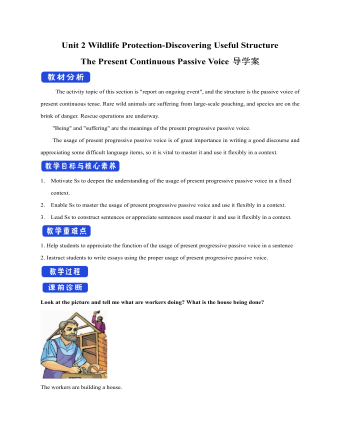
The activity topic of this section is "report an ongoing event", and the structure is the passive voice of present continuous tense. Rare wild animals are suffering from large-scale poaching, and species are on the brink of danger. Rescue operations are underway. "Being" and "suffering" are the meanings of the present progressive passive voice.The usage of present progressive passive voice is of great importance in writing a good discourse and appreciating some difficult language items, so it is vital to master it and use it flexibly in a context.1. Motivate Ss to deepen the understanding of the usage of present progressive passive voice in a fixed context.2. Enable Ss to master the usage of present progressive passive voice and use it flexibly in a context.3. Lead Ss to construct sentences or appreciate sentences used master it and use it flexibly in a context.1. Help students to appreciate the function of the usage of present progressive passive voice in a sentence2. Instruct students to write essays using the proper usage of present progressive passive voice.Look at the picture and tell me what are workers doing? What is the house being done?
新人教版高中英语必修2Unit 2 Wildlife Protection-Reading and Thinking教案二
The theme of this unit is human and nature, focusing on the theme of wildlife protection. Nature is a complex ecosystem, in which there are delicate balance between animals and plants. Because of the role of the food chain, the extinction of one species will produce influence, causing a series of chain reaction. Large scale extinction of species will have a serious and even irreversible impact on the ecosystem, resulting in immeasurable losses. Therefore, it is of great significance to protect wild species. To protect wild species is to protect human beings themselves. The motto of this unit is "when the buying stops, the killing can too,” which is a public service advertising slogan to protect wildlife. It tells people that every rhinoceros horn, every fur, every bowl of shark fin soup, every Ivory product, and every tiger bone product, etc. consumed by human beings, are innocent wild animals slaughtered behind them. The mission of wild aid is to ban illegal trade in endangered wildlife and mitigate climate change. It aims to educate the public to reduce the consumption demand for endangered wildlife products through public publicity and improve the awareness of environmental protection.1. Improve the awareness of wildlife protection by acquiring the knowledge of wildlife protection.2. Focus on environmental protection and protection of all lives.3. Analysis of the living environment of wild animals with appropriate thinking mode.4. Skillfully use the vocabulary and grammar knowledge of this unit to cultivate self-study ability according to the unit content5. Develop cooperative learning ability through discussion and other ways1. Enable the Ss to talk about the current situation of wild animals.2. Guide the Ss to summarize the main idea of each paragraph as well as the main idea of the text.
新人教版高中英语必修2Unit 4 History and Traditions-Reading and Thinking教案二
Step 5 While reading---Task 3Read the text again and answer the following questions.Q1: How many countries does the UK consist of ?4 Q2: What are the four countries of the United Kingdom?England, Wales, Scotland and Northern Ireland Q3: Which two were the first to be joined together ?England and WalesQ4: What are the two chief advantages of studying the history of a country ?The first one is to help you understand more about the country and its traditions.The second one is to make visiting it more enjoyable.Q5: What’s the author’s attitude towards studying the history ?Supportive/positiveStep 6 Post reading---Retell the textThe United Kingdom, Great Britain, Britain, England—many people are confused by (1)_____ these different names mean. In the 16th century, the nearby country of Wales (2) __________(join) to the Kingdom of England. In the 19 th century, the Kingdom of Ireland was added to create the United Kingdom of Great Britain and Ireland. Finally, the southern part of Ireland (3) ______ (break) away from the UK, which resulted in the full name we have today. However, most people just use the (4)_________(shorten) name: the UK. The four countries (5)__________ belong to the United Kingdom work together in some areas. There were four sets of invaders and the last group were the Normans. They had castles (6)_________(build) all around England and made changes (7)__________ the legal system. Studying the history of the country will make your visit much more (8)_________(enjoy). The capital city London is (9)___ ancient port city that has a history (10)______(date) back to Roman times. 1. what 2.was joined 3.broke 4.shortened 5.that 6. built 7.to 8.enjoyable 9.an 10.dating Step 6 Homework
新人教版高中英语必修2Unit 4 History and Traditions-Listening&Speaking&Talking教案二
Listening and Speaking introduces the topic of “Take part in a youth project”. The listening text is an interview about "sharing views on historical sites". Through listening to a dialogue between Chinese and foreign students on the way to the Confucius Temple, students can understand their views on the Confucius Temple, Confucius, Confucius' descendants and Confucius' educational thoughts, so as to realize and think about the profound influence of Confucius and his thoughts on Chinese historical tradition. At the same time, the dialogue naturally integrates English idioms and mentions Shakespeare, the British playwright, so as to provide language materials and context for students to understand English idioms and related cultural allusions, as well as to compare Chinese and foreign cultures, which is helpful for students to understand and express the language such as history, tradition, culture and custom significant impact.Text analysis: listening text is a dialogue between a British student and a Chinese student when he goes to the Confucius Temple. When William, a British student, visited the Confucius Temple, he asked Xiao Kong, a Chinese student, for directions. Xiao Kong was just going to the Confucius Temple to meet with the members of the research group, so they went together and exchanged their views on the Confucius Temple, Confucius, Confucius' descendants and Confucius' educational thoughts. From the perspective of foreign tourists, this paper describes their thoughts on Confucius, the great son of Confucius, who had a profound impact on Chinese history and cultural tradition, and his education.Listening and Talking introduces a visit to a historic tourist destination. Tourism is a common way to understand a country's history, culture, and customs and so on. Students listen to the dialogue between Xiao Yan, a youth hostel Usher, and Paul, a backpacker, to learn about Pingyao's famous historical and cultural attractions and Paul's travel experience and experience as a foreign tourist.
新人教版高中英语必修2Unit 4 History and Traditions-Reading for Writing教案
Step 1 Lead inThere are many interest of places in the UK. What do you know ?The Big Ben the London Tower the Thames RiverStep 2 Before reading---analyze the titleBeautiful Ireland and its traditionWe know that the article mainly tells about the beauty and traditions of Ireland. Step 3 While reading---Task 1Read the text and answer the following questions.Q1: What makes the Irish countryside exciting and inspiring?Its beauty and how it offers something for all the scenes.Q2: What are the best ways to experience some Irish traditions and cultures?By stopping by a village pub and relaxing with a drink and traditional meal while listening to music and watching dancingQ3: What is the meaning of “breathe in the sweet scent of fresh flowers while birds greet the new day with their morning song ?”It means to not just smell but also breathe in the smell of fresh flowers early in the morning as the birds sing their first song of the new day.Q4: What are the best ways to experience Chinese traditions and customs ?By travelling to different places and using all your senses to experience everything and by interacting with local people.Step 4 While reading---Task 2Analyze the descriptive paragraph1. Identify and underline the paragraph’s introductory sentence and the ending sentence.Introductory sentence: Ireland’s beautiful countryside has always had a great influence on its people and traditions.Ending sentence: And if you introduce yourself to a friendly face, you are more than likely to experience local culture and customs first-hand.2. The paragraph talks about different senses in different places. Write the senses and places in the order that they appear.
新人教版高中英语必修2Unit 4 History and traditions教案
这个地区有着深厚的传统。既学既练:为了让更多的外国游客了解中国文化,欣赏中国美丽的自然风光,感受中国发生的巨大变化,某外文杂志社将出版一本英语小册子来介绍中国的旅游景点。该杂志社邀请你为该小册子写一篇英语短文来介绍杭州,内容包括:1.杭州的位置(中国东南部)、面积(16 000多平方公里)及历史(2 200多年)等;2.杭州的旅游特色(自然风景、传统文化、特色小吃等);3.希望更多的游客来杭州参观。注意:1.词数80左右;2.可适当增加细节,以使行文连贯。Located in the southeast of China, Hangzhou is a beautiful city.Dating back more than 2,200 years, Hangzhou covers an area of more than 16,000 square kilometers.In Hangzhou, you can visit the West Lake, whose scenery is fascinating.In addition, you can’t miss its cultural relics and historical sites, from which you will learn more about excellent Chinese traditional culture and traditions.In Hangzhou, the special snacks are famous and visitors from different parts of the world think highly of them.As a tourist attraction, Hangzhou attracts a large number of visitors from home and abroad every year.Once you come to China, Hangzhou is a scenic spot you can’t miss.
新人教版高中英语必修2Unit 5 Music-Discovering Useful Structures教案二
4. When he got absorbed in his world of music, he felt as if he could “see” the beauty of the world around him, like he had in his previous life.P·P as adverbial: _________________________________________________________________.Function: _______________________________________________________________________.Step 5 Solid Complete the passage with the words in brackets in their correct forms.Well known as a successful band, the Impact members show quite a few striking qualities. They never ever give up. When _____________(question) by the media, they are not _____________(discourage) and practise even harder. They are improving themselves by attending several master training class. They are united. _____________(fill with) team spirit, they act as a whole, always aiming for glory. Step 6 Difference and similarity from -ingObserve the following examples.1. He went out, shutting the door behind him.=He went out, ________________________________________________________.2. Not knowing what to do, he went to his parents for help.=__________________________________________, he went to his parents for help.Similarity: _______________________________________________________________________________________________________________________________________________________.Difference : _______________________________________________________________________________________________________________________________________________________.Step Practice1. ________ in a hurry, this article was not so good. 因为写得匆忙, 这篇文章不是很好。2. ________ carefully, he found something he hadn’t known before. 他仔细读书时, 发现了一些从前不知道的东西。3. ________ why he did it, the monitor said it was his duty. 当被问及他为什么要这么做时, 班长说这是他的职责
新人教版高中英语必修2Unit 5 Music-Discovering Useful Structures教案一
Step1:自主探究。1.(教材P52)Born(bear) in the USA on 2 January 1970, Whitacre began studying music at the University of Nevada in 1988.2.(教材P52) Moved(move) by this music, he said, “It was like seeing color for the first time.”3.(教材P56)I was very afraid and I felt so alone and discouraged(discourage).4.(教材P58)Encouraged(encourage) by this first performance and the positive reaction of the audience, I have continued to play the piano and enjoy it more every day.Step2:语法要点精析。用法1:过去分词作表语1).过去分词可放在连系动词be, get, feel, remain, seem, look, become等之后作表语,表示主语所处的状态Tom was astonished to see a snake moving across the floor.汤姆很惊讶地看到一条蛇正爬过地板。Finally the baby felt tired of playing with those toys.终于婴儿厌倦了玩那些玩具。注意:1).过去分词作表语时与被动语态的区别过去分词作表语时,强调主语所处的状态;而动词的被动语态表示主语是动作的承受者,强调动作。The library is now closed.(状态)图书馆现在关闭了。The cup was broken by my little sister yesterday.(动作)昨天我妹妹把杯子打碎了。2)感觉类及物动词的现在分词与过去分词作表语的区别过去分词作表语多表示人自身的感受或事物自身的状态,常译作“感到……的”;现在分词多表示事物具有的特性,常译作“令人……的”。
新人教版高中英语必修2Unit 5 Music-Listening and Speaking教案
This lesson is about music. Students can classify the types of music through the instruments and its sound and can talk about their preferences about music, even join some activities and play a role in them according to their musical talents. On the basis, they are guided to use the languages to express their preferences and some plosive sounds and their rules.1. Classify the music types through the instruments and its sound.2. Listen and understand what the speakers’ preferences are and the reasons; talk about their own preferences and give their own reasons, using these sentences: “What kind of music do you like? And why? “ “Because it makes/gives me energy/peaceful.../touches my heart...”.3. Learn some plosives and the rules.4. Join some activities and play a role in them according to the talents. 1. Listen and understand what the speakers’ preferences are and the reasons;2. talk about their own preferences and give their own reasons, using these sentences: “What kind of music do you like? And why? “ “Because it makes/gives me energy/peaceful.../touches my heart...”.3. Learn some plosives and incomplete plosives and its rules.Step 1 Lead inPoint at the pictures on P50 and ask Q1: What are the people doing in the pictures below?Q2: What kind of music they are?Then play the MP3s one by oneStep 2 ListeningTask 1: A reporter from the school newspaper is interviewing students about music. Listen to the interviews. Draw lines between the words to make complete sentences. Some words will not be used.