-
人教版高中政治必修1面对经济全球化说课稿
2、传授新知与学生展示(35分钟) 先由老师点出本课的知识点,它包括:(1)经济全球化深入发展:结合课本91-93页理解经济全球化的含义;经济全球化的表现:生产全球化,贸易全球化,资本全球化;跨国公司是实现经济全球化的载体。(跨国公司的含义、目的、作用分别是什么)(2)经济全球化的影响: 经济全球化的实质:以发达资本主义国家为主导的经济全球化;消极影响积极影响;如何应对经济全球化。讲完了知识点,接着回归图片和书本的材料,给学生留下三个问题进行小组讨论:A :谈谈你感受到的经济全球化B :怎样理解经济全球化是一把“双刃剑”C:假如你是一位企业经营者,面对经济全球化趋势,你会怎么做?先完成讨论的小组可举手示意老师给予检查,老师根据需要抽查同学到讲台进行展示讨论的结果,并对表现突出的小组进行当堂奖励。
人教版高中政治必修1消费及其类型说课稿
(三)课堂小结接着进行课堂小结,先让学生自主总结,教师结合学生的总结,补充完善总结本节课的知识。并进行感情升华。这样设计课堂小结,是为了让学生学会自主总结知识,加深印象,教师总结帮助学生理清本课知识结构,并起到升华本节课的感情基调,落实教学目标。(四)课堂练习我将设计两道题让同学们做,巩固课堂知识。本课题板书设计我主要采用大纲的形式展现,让学生一目了然,便于识记和理解主干知识。五、教学预测最后我对本节课教学的效果进行预测:在这个教学过程中我都是从学生生活中感知的现象入手,设计情境,预设学生的分析,学生的体验,学生的感知,教师的点拨等。设计问题,学生自主合作探究,完成教学!通过这样的学习我想一定会收到较好的教学效果,当然,在实际的教学中,肯定也会出现一些意想不到的情况,我还会根据教学过程中的动态变化,及时地调整和修改预设内容。
人教版高中政治必修3传统文化的继承说课稿
只有对儒家的价值作出客观、公正、全面的评价,才可能避免陷入文化虚无主义或文化复古主义的误区,合理地、充分地开发利用儒学乃至整个国学的资源为现代社会服务,为促进我国经济发展服务。运用所学知识,谈谈对待儒学我们应该持有的态度。答案:(1)儒学是我国传统文化中一个非常重要的组成部分。传统文化具有相对稳定性,它的内涵又能够因时而变,因此,我们对待儒学的正确态度应该是“取其精华,去其糟粕,批判继承,古为今用”。(2)面对儒学,我们要辩证地认识它在现实生活中的作用,分辨其中的精华和糟粕。对于其中符合社会发展要求的、积极向上的内容,应该继续保持和发扬,使其为社会主义现代化建设服务;对于其中不符合社会发展要求的、落后的、腐朽的东西,必须“移风易俗”,自觉地加以改造和剔除。(五)作业布置传统文化的作用是什么?如何正确对待传统文化?
人教版高中政治必修3建设学习型社会说课稿
解析:材料是讲学习型社会所产生的影响,A项观点错误,在当前和今后相当长的时间里,学校教育仍然是人们获得知识的最重要的途径。B项观点错误,终身学习只是成就人生目的的手段、途径,而不是目的本身。D项说法错误,当前我国社会的中心工作是经济建设。二、问答题5.材料一:日本是公认的漫画大国,日本的动漫产业产值每年230万亿日元,成为日本的第二大支柱产业。在日本,漫画比电影、小说有时甚至比电视或音乐更受欢迎。日本漫画的热潮还席卷了世界:日本每年出口到美国的卡通片价值就达5 000亿日元,是日本对美国钢铁出口金额的4倍;漫画中的人物被迅速复制成电子游戏、卡通片及真人演出的节目。原来只是闲暇时候消遣的漫画,正飞速渗透到人们的生活中。值得警惕的是,除了催人奋进的精华之外,日本漫画中也存在暴力、色情、扭曲历史等诸多糟粕,对缺乏辨别能力的青少年产生了许多不良影响,更引发了一系列深刻的社会问题。
人教版高中政治必修4价值与价值观说课稿(一)
预测回答:成龙在影视,武术方面的价值,对于某个人,某个集团的价值。知识引导:人的价值体现在多方面的,可以是物质方面,也可以是精神方面,可以是对某个人或某个集团的价值,也可以是对人类和社会的价值。设置目的:从学生感兴趣的人物入手,分析对人的价值的评价。让学生自己分析总结,体现学生在新课改下的主体地位。从上述事例中我们可以看出人的价值是什么?如何评价?(学生活动)2.人的价值:在于创造价值,在于对社会的责任和贡献,即通过自己的活动满足自己所属的社会、他人以及自己的需要。(幻灯片显示)3.人的价值评价:看他的贡献,最根本的是对社会发展和人类进步事业的贡献。(幻灯片显示)老师总结:对社会的贡献并不是高高在上,不可触及。只要是做自己该做的事,从身边的小事做起,普普通通的劳动就是贡献社会和他人。学生归纳:人生价值原理二、价值观的导向作用(板书)1.价值观的含义人们在认识各种具体事物的价值的基础上,形成对事物价值的总的看法和根本观点。
人教版高中政治必修3体味文化说课稿
3、文化的力量。为了使学生能辨证地分析文化的力量,我设计了两个问题进行探讨:(1)是不是任何文化都能起促进作用?(2)你在听或唱国歌时感受到一种什么样的力量?这样,学生在对比中学会辨证地分析文化的力量——先进的、健康的文化能促进社会发展和个人成长;落后的、腐朽的文化则阻碍社会发展和个人成长。同时还能提高学生的文化赏析能力,从而引导学生装自觉参加健康有益的文化活动,抵制不良文化的影响,投身到社会主义精神文明建设中去。关于课堂练习,我准备了5个针对性比较强的选择题,从而加深巩固本框题的重难点知识。最后,播放歌曲《走进新时代》,展示本课知识结构,指出本框题需重点掌握的问题,结束本课教学。课后作业,我设计了这样一个辨析的题目:文化是人们创造的全部财富的总和,它是人类特有的现象。

人教版高中政治必修4意识的本质说课稿
师:分析得非常到位。大家来看看薛宝钗是怎么说的?薛宝钗的评论:“不像吟月了,月字底下放一个‘色’字倒还使得,你看句句倒是月色。这也罢了,原来诗从胡说来,再迟几天就好了。”生:(读第三首诗)“精华欲掩料应难,影自娟娟魄自寒。一片砧敲千里白,半轮鸡唱五更残。绿蓑江上秋闻笛,红袖楼头夜倚栏。博得嫦娥应借问,缘何不使永团圆!”这首诗语言很朴实,但意境很深远。我虽然读过《红楼梦》这本书,也看过电视剧,但我阅历太浅,说不出诗中所包含的深刻内涵。师:贾宝玉的评论:“这首不但好,而且新巧有意趣,可知俗语说的‘天下无难事,只怕有心人。2.意识的形式是主观的意识是人脑对客观存在的反映,意识是不是仅仅是人脑对客观存在原原本本的反映呢?“龙、凤”是中华民族的象征,是炎黄子孙的两大主要图腾,但地球上从来就没有出现过“龙、凤”,那么“龙、凤”的观念又是从何而来的呢?原来,“龙、凤”的观念最早产生于原始社会的图腾崇拜。、
人教版高中政治必修4价值与价值观说课稿(二)
二、学生情况分析(说学法)1、学生学习基础分析:学生通过对《生活与哲学》前面三个单元的学习,初步掌握了运用唯物论、辩证法、认识论的观点去认识问题、分析问题的能力;再通过对第十一课的学习,学生对马克思主义的历史观有了初步的理解,初步树立了正确的理想信念,这为本课教学目标的落实奠定了知识基础。 2、学生能力分析 :高二学生拥有一定生活体验,具备一定的信息收集和筛选能力、阅读能力、语言表达能力、对问题的一定的探究能力,同伴合作能力和具备初步逻辑思维能力。3、学生心理分析:在我国现阶段,以为人民服务为核心的社会主义道德建设过程中涌现了大批的先进人物和道德典范,但同时由于社会价值的多元化,个人主义、享乐主义、拜金主义等资本主义腐朽思想也同样在影响着当代的中学生。
人教版高中政治必修4意识的作用说课稿(一)
1、课题引入:我设计以提问哲学到底是什么?的问题激发学生的阅读兴趣。我设计典型事例,通过学生讨论,教师总结的形式,并得出其实哲学就在我们身边。2、讲授新课:(35分钟)通过教材第一目的讲解,让学生明白,生活和学习中有许多蕴涵哲学道理的故事,表明哲学并不神秘总结并过渡:生活也离不开哲学,哲学可以是我正确看待自然、人生、和社会的发展,从而指导人们正确的认识和改造世界。整个过程将伴随着多媒体影像资料和生生对话讨论以提高学生的积极性。3、课堂反馈,知识迁移。最后对本科课进行小结,巩固重点难点,将本课的哲学知识迁移到与生活相关的例子,实现对知识的升华以及学生的再次创新;可使学生更深刻地理解重点和难点,为下一框学习做好准备。
人教版高中政治必修4生活处处有哲学说课稿
(二)组织学生探究知识并形成新的知识。我从学生的生活体验入手,运用案例等形式创设情境呈现问题,使学生在自主探索、合作交流的过程中,发现问题、分析问题、解决问题,在问题的分析与解决中主动构建知识。主要通过几幅漫画让学生思考其中的哲学道理,开始接触哲学。漫画一:种瓜得瓜,种豆得豆,种鸡蛋得??漫画二:甲:下雨好极啦!乙:下雨糟透了!漫画三:——狂妄之徒,你竟然坏了祖上规矩!在引导学生思考、体验问题的过程中,可以使学生逐步学会分析、解决问题的方法。这样做既有利于发展学生的理解、分析、概括、想象等创新思维能力,又有利于学生表达、动手、协作等实践能力的提高,促进学生全面发展,力求实现教学过程与教学结果并重,知识与能力并重的目标。
人教版高中英语必修1Journey Down the Mekong说课稿
2. let the Ss complete the forms paragraph by paragraph. Purpose here is to help Ss to get the habit of reading a passage as a whole, and pay attention to the organization of the text, as a result the Ss will fully understand the whole passage.3. ask Ss to retell the passage with the help of the key words in the form.Since the Ss in the class are in different levels, so I let them to fill in the blank to understand the meaning of the words and phrases better. ( That’s all for the while-reading. Now let’s move to the fifth step.)Step V: Post-reading (10mins) ---DiscussionIn this part students are asked to discuss in groups and list Wang Kun’s and Wang Wei’s attitudes about the trip. After that, Ss are encouraged to express their attitudes with the whole class. Collect their answers and don’t forget to praise them even if their answers may not be perfect.In this activity, discussion provides a vivid and active learning environment for Ss to communicate in English with newly learned language items. (Finally it comes to the homework.)StepⅥ: Homework (1min)1. Ss are required to read the text again after class and figure out the meaning of some complex sentences.2. Do the exercises on P19; This can help Ss to consolidate what they’ve learnt and make preparation for the next lessonPart4. Blackboard design.(说板书设计)On the top, there is the title of this lesson. On the left, there are main ideas for each paragraph. On the right, there are some new words and expressions.Unit 3 Travel journalJourney down the MekongMain idea of each para.:Para1: deciding to take a great bike trip along the Mekong river.Para2: Different attitudes between Wang kun and Wang wei.
人教版高中英语必修1Anne's best friend说课稿
Step 7 Language points 1.Vocabulary (1) go through (2) set down (3) a series of (4) on purpose (5) in order to (6)at dusk (7)entirely (8)face to face 2.Important sentences (1)…I’ve grown so crazy about everything to do with nature. (2)There was a time when … (3)I stayed awake on purpose until … (4)It was the first time … that I’d seen the night … (5)It’s no pleasure looking through … Purpose: 1.Master the required vocabulary and sentence structures. 2.Use them freely. Step 8 Consolidation 1.Find out the topic sentences 2.Retell the text according to the topic sentences Purpose: I want to know if my students understand the text. Step 9 Discussion Imagine you have to go into hiding like Anne and her family, what would you miss most? Giveyour reasons. Purpose: Train Ss’ oral English ability. Step 10 Homework Write an article on Friends. Purpose: 1. Improve the Ss’ writing ability. 2 Train the Ss’ ability of self—teaching and looking up information by themselves. Part 5 Blackboard design(说板书设计)Unit 1 Friendship Reading Anne’s Best Friend 1.Main idea of each paragraph: Para. 1 Anne made her diary her best friend. Para .2 Anne wrote her feelings in her diary. Para .3 Anne missed nature. Para.4 Anne saw the night face to face Para.5 Anne wanted to experience nature outdoors. 2.Listening: Exx.1 P3 3.Discussion: Exx.3 P3 Purpose: 1.Make Ss familiar with the passage 2.Make the design inductive, instructive and artistic.
人教版高中英语必修1Nelson Mandela--A Modern Hero说课稿
In this step, give students a few minutes to read the passage . While they are reading, I will write some key words of the text on the blackboard. Then ask students to retell the passage according to the key words.By retelling, students can improve their ability of language organization and have an overall understanding of the article.Step 4 Group discussionIn this step, students will be divided into groups of 4 to discussion the following question: What qualities make a great person?After their discussion, invite a few groups to make a report to the class.This group discussion can practice students’ oral English and cultivate their abilities of cooperation and communication.Step 5. HomeworkLet students write a short passage to introduce a great person he or she admires.The homework can consolidate the knowledge the students have learned and cultivate their writing ability. Part 6 Blackboard Design(板书设计)That’s all my teaching procedures. Finally, I’d like to say sth about part 6 blackboard design. On the top is the title. On the left, there will be some new words and expressions. In the middle of the blackboard, I will write some useful sentence structures so that the students can know clearly what they’ve learned and then try to master the knowledge.OK. That’s all for my presentation. Thank you for your attention.
人教版高中政治必修4矛盾是事物发展的源泉和动力说课稿(二)
一、说教材1、本框的地位和作用本框题是人教版普通高中课程标准实验教科书思想政治必修4《生活与哲学》第三单元第九课第一个框题。从这一框开始学生学习唯物辩证法中最基本的概念——矛盾。世界是普遍联系和变化发展的,联系的根本内容是矛盾,发展的根本动力也是矛盾。矛盾的观点是唯物辩证法的根本观点。矛盾规律即对立统一规律揭示了事物发展的源泉和动力。矛盾分析法是我们认识世界和改造世界的根本方法。因而本框题起着承上启下的作用。2、教学目标知识与技能:识记:矛盾、矛盾同一性、斗争性的含义;矛盾普遍性、特殊性的含义。理解:矛盾同一性与斗争性的辩证关系;矛盾普遍性和特殊性的辩证关系及其重要意义。运用:联系实例,分析矛盾含义和矛盾普遍性含义;联系生活实例,分析矛盾特殊性含义。
人教版高中政治必修4矛盾是事物发展的源泉和动力说课稿(一)
《矛盾是事物发展的源泉和动力》是人教版普通高中课程标准实验教科书,《思想政治》必修第4册,《生活与哲学》第3单元第9课的第1框的内容。本节课的这部分内容,是在学生们学习了上一框用发展练习的观点看问题的基础上展开的,本框通过矛盾同一性和斗争性,普遍性与特殊性这两大关系,揭示矛盾是事物发展的源泉和动力。矛盾是本书的一个重要观点。对于学生树立正确的人生观以及下一阶段的学习都用很重要的作用。二、说教学目标(每个说1~2个)按照新课标教学目标,结合着高二年级学生他们的认知结构及其心理特征,我制定了以下的教学目标:1、知识目标:通过学习掌握矛盾的含义。矛盾的同一性和斗争性。矛盾的普遍性和特殊性。2、过程与方法的目标:使学生初步形成用矛盾的统一性和斗争性相统一的观点认识和把握事物的能力,以及通过运用矛盾普遍性和特殊性辩证关系的原理认识和解决问题的能力。
人教版高中地理必修1第四章第一节营造地表形态的力量说课稿
(一)教材的地位与作用教材的第一部分就从地质作用的能量来源的角度,讲述了内力作用和外力作用及其表现形式;又以地质作用不同的表现形式,来说明了激烈迅速的地质作用和极其缓慢的地质作用,从而使学生理解地表形态的变化及这种变化的时间尺度。第二部分,从三大类岩石的相互转变入手,图文结合,阐明了在内外力作用的参与下地壳物质循环的过程及其地理意义,该部分内容可以看作是全课教材的小结。(二)教学目标(1)知识与技能目标:1、结合实例,说明内力作用的能量来源及其表现形式,理解地壳运动是塑造地表形态的主要作用方式。2、说明外力作用的四种形式及其相互关系,尝试识别外力作用形成的不同地貌。3、会用图文资料说明地壳物质循环的过程及其产生循环的物质基础——三大类岩石的转化过程。4、培养学生运用地理图表分析归纳的能力,培养学生与其它同学交流、表达的能力。
人教版高中政治必修4唯物主义和唯心主义说课稿
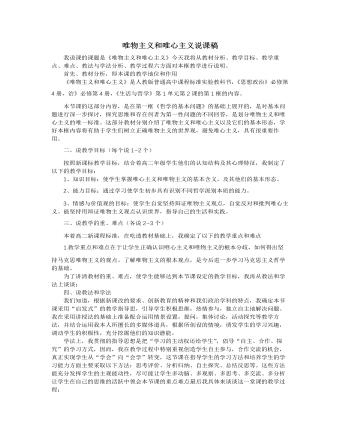
五、说教学过程(重点说)1、课题引入:我设计以提问哲学到底是什么?的问题激发学生的阅读兴趣。我设计典型事例,通过学生讨论,教师总结的形式,并得出其实哲学就在我们身边。2、讲授新课:(35分钟)通过教材第一目的讲解,让学生明白,生活和学习中有许多蕴涵哲学道理的故事,表明哲学并不神秘总结并过渡:生活也离不开哲学,哲学可以是我正确看待自然、人生、和社会的发展,从而指导人们正确的认识和改造世界。整个过程将伴随着多媒体影像资料和生生对话讨论以提高学生的积极性。3、课堂反馈,知识迁移。最后对本科课进行小结,巩固重点难点,将本课的哲学知识迁移到与生活相关的例子,实现对知识的升华以及学生的再次创新;可使学生更深刻地理解重点和难点,为下一框学习做好准备。
新人教版高中英语必修3Unit 2 Morals and Virtues-Discovering Useful Structure教学设计
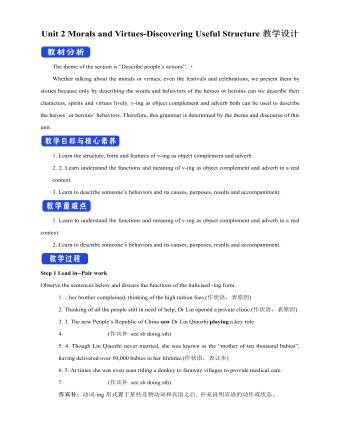
1. 表示时间。Hearing these stories, I’m skeptical about the place. = When I heard these stories. . . 2. 表示原因。Not knowing his address, I can’t send this book to him. = Because/Since/As I don’t know his address. . . 3. 表示结果。His father died, leaving him a lot of money. =. . . and left him a lot of money4. 表示条件。Going straight down the road, you will find the department store. = If you go straight down the road. . . 5. 表示让步。Being tired, they went on working. =Although they were tired. . . 6. 表示行为方式、伴随情况或补充说明。He lay on the grass, staring at the sky for a long time. =. . . and stared at the sky for a long time注意:非谓语动词作状语时, 如所提供的动词不能和句子中的主语保持一致, 动词-ing形式必须有自己的逻辑主语, 通常由名词或代词来担任, 这就是独立主格结构。The last bus having gone, we had to walk home. (having gone的逻辑主语是the last bus, 而不是we)Weather permitting, the football match will be played on Friday. (permitting的逻辑主语是time, 而不是the football match)Step 7 Practice1. ________(study) hard, you are sure to get first prize. 2. People use plastic in their daily life, _______(leave) large amounts of waste. 3. ________(work) hard at your lessons, you are to succeed. 4. The old man, ____________(work) abroad for twenty years, is on the way back to his motherland. 5. ______________(finish) his homework, he was playing on the playground. Answers: 1. Studying 2. leaving 3. Working 4.having worked 5. Having finishedStep 8 HomeworkFinish the homework on Page 22.
新人教版高中英语必修3Unit 2 Morals and Virtues-Listening &Speaking&Talking教学设计
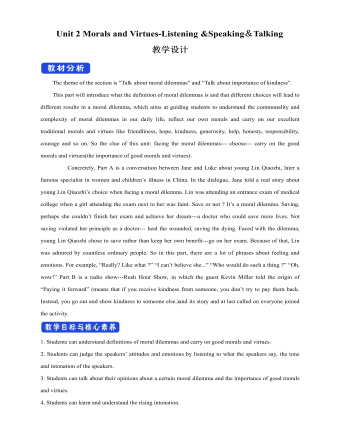
Example:One day, a poor boy who was trying to pay his way through school by sending newspapers door to door found that he only had one dime(一角)left. He was so hungry that he decided to beg for a meal at the next house.However, he lost his nerve when a lovely young woman opened the door. Instead of a meal he asked for a drink of water. She thought he looked hungry so she brought him a large glass of milk. He drank it slowly, and then asked, “How much do I owe you?” “You don’t owe me anything,” she replied, “Mother has taught me never to accept pay for a kindness.” “Then I thank you from the bottom of my heart.” With these words, Howard Kelly left that house.Years later the woman became badly ill and was finally sent to the hospital in a big city. Dr. Howard Kelly, now famous, was called in. When he heard the name of the town she came from, a strange light filled his eyes. Dressed in his doctor’s clothes, Dr. Kelly went into her room and recognized her at once. From that day on, he gave special attention to her, and decided to do his best to save her life.At last the woman was saved. Dr. Kelly asked the business office to pass the final bill to him. He looked at it and then wrote something on the side. The bill was sent to the woman’s room. She was afraid to open it because she was sure that it would take the rest of her life to pay for it off. Finally she looked, and the note on the side of the bill caught her attention. She read these words: “Paid in full with a glass of milk, Dr. Howard Kelly.” Tear of joy flooded her eyes.
新人教版高中英语必修3Unit 2 Morals and Virtues-Reading and Thinking教学设计
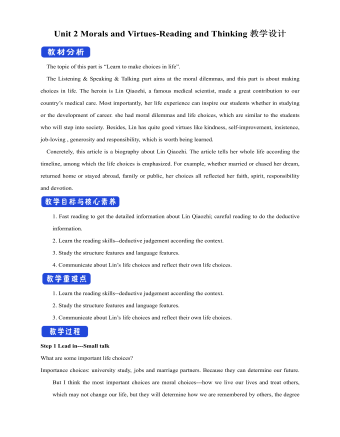
The topic of this part is “Learn to make choices in life”.The Listening & Speaking & Talking part aims at the moral dilemmas, and this part is about making choices in life. The heroin is Lin Qiaozhi, a famous medical scientist, made a great contribution to our country’s medical care. Most importantly, her life experience can inspire our students whether in studying or the development of career. she had moral dilemmas and life choices, which are similar to the students who will step into society. Besides, Lin has quite good virtues like kindness, self-improvement, insistence, job-loving , generosity and responsibility, which is worth being learned.Concretely, this article is a biography about Lin Qiaozhi. The article tells her whole life according the timeline, among which the life choices is emphasized. For example, whether married or chased her dream, returned home or stayed abroad, family or public, her choices all reflected her faith, spirit, responsibility and devotion.1. Fast reading to get the detailed information about Lin Qiaozhi; careful reading to do the deductive information.2. Learn the reading skills--deductive judgement according the context.3. Study the structure features and language features. 4. Communicate about Lin’s life choices and reflect their own life choices.1. Learn the reading skills--deductive judgement according the context.2. Study the structure features and language features.3. Communicate about Lin’s life choices and reflect their own life choices.Step 1 Lead in---Small talkWhat are some important life choices?Importance choices: university study, jobs and marriage partners. Because they can determine our future.