-
新人教版高中英语必修3Unit 5 The Value of Money- Discovering Useful Structure教学设计
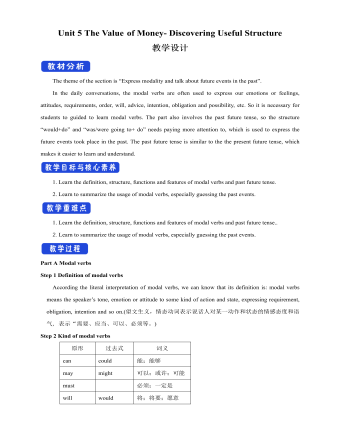
Step 3 Meaning1. 过去将来时表示从过去某一时间来看将要发生的动作或存在的状态, 常用在宾语从句中。一般由“would/should +动词原形”构成。She hoped that they would meet again someday. 她希望将来有一天他们能再见面。2. was/were going to+动词原形: 表示过去将要发生或很有可能发生的动作, 常用于口语中, 表示预言、意图或者打算等。He was going to start work the following week. 他打算下星期开始工作。3. was/were about to do: 常用来表示即将发生的动作, “刚要/正要做……”。注意该结构不与任何时间状语连用。I felt that something terrible was about to happen. 我感到某种可怕的事情即将发生。4.was/were to do: 表示“曾计划做某事”, 如果表示“本来计划做某事, 动作没实现”, 则需用 “was/were to have done”。She said she was to have told me about the accident. 她说她本来想告诉我关于事故的事。5.Start, go, come, leave, see, meet等动词的过去进行时: 表示就过去某一时刻而言即将发生的动作。She was coming later. 她随后就来。I had just put on my overcoat and was leaving to visit a friend of mine. 我刚穿上外套要去看我的一个朋友。
新人教版高中英语必修3Unit 5 The Value of Money-Listening &Speaking教学设计
Step 4: Listen again and decide if the following statements are true (T) or false (F).1 It was the first time Chen Liyan's story was reported. T口 F口2 Chen found 10,000 yuan in a small plastic bag in Taiyuan railway station口 F口3 Wang Zheng apologized to Chen because he couldn't offer her more money. T口 F口4 Chen took out a large loan to cure her daughter, T口 F口5 Wang set up a fundraising website for Chen's daughter after Chen told him about her situation. T口 F口Step 5:After listening, discuss the questions.1 What kind of person do you think Chen Liyan is?Chen Liyan is generous and honest because she returned a large sum of money to the owner.2 Did Chen return the money because she didn't need it?No. She returned the money because it was the right thing to do. Evidence for this is that she refused to accept the reward money because she felt that it had not been earned. 3 Is it common for people to do what Chen did?It depends on the culture. In some countries it is quite common to return money that has been found. In other countries, people believe "Finders are keepers!" 4 How did Wang Zheng feel about the return of his money?He must have been very happy and relieved to have gotten his money back. We know this because he thanked Chen repeatedly and even offered her a reward.5 Why did Ma Dongbao tell Wang about Chen's family?He must have had great sympathy for Chen and her daughter and wanted to help them.'We know this because he arranged help for them. 6 How did the news reporter feel about Chen's actions?The news reporter felt that it showed that money wasn't the most important thing in life. We know this because the reporter told us that this is what Chen believes. and then said, “that's a great attitude to take."
新人教版高中英语必修3Unit 5 The value of money-Reading and Thinking教学设计二
? Could you offer me some kind of work here?? I don’t want your charity, I just want an honest job.? Careless: I landed in Britain by accident.Step 7:Consolidation.? Find Henry? Roderick and Oliver were I .making a bet when they saw Henry, a poor young man. ? Know Henry? About a month ago, Henry was sailing and later he found himself carried out to sea by a strong wind. Fortunately, he 2.was spotted by a ship. And it was the ship that brought him to 3.England? Offer money to Henry ? Oliver and Roderick gave Henry a letter and told him that there was money in it. They 4.persuaded him to accept it, and made him 5.promise that it wouldn't be opened until 2 o'clock.Step 8:Language pointsa large amount of: a large quantity of; a great deal ofe.g. They bought a large amount of furniture before they moved their new house.make a bet: make an arrangement to risk money, etc. on an event of which the result is doubtful.e.g. We made a bet on the result of the match.permit sb to do something: allow somebody to do somethinge.g. My mother doesn’t permit me to ride in the street after it rained.by accident: as a result of chancee.g. I only found it by accident.stare at: look at somebody or something with the eyes wide open in a fixed gaze( in astonishment, wonder, fear, etc)to be honest: to tell you the truth; to be franke.g. To be honest, I don’t think we have a chance of winning.Step7 Homework:What do you think will happen to Henry? Will the bank-note help him or get him into trouble?
新人教版高中英语必修3Unit 5 The Value of Money-Reading for Writing教学设计二
2. 您能看到, 我头发太长了。You can see that my hair is much too long.3. 无论什么时候, 只要您想回来就回来。Please come back whenever you want.4. 您仅有很少的头发要理! You only have too little hair to cut !5. 为您服务是我的荣幸!It is my honour to serve you!Step 9 Writing(Henry is walking down the street when he sees a sign for a place that cuts hair. He decides to have it cut. )H=Henry B=BarberH: Good afternoon, I’d like to have my hair cut, if I may. (The barber looks at Henry’s hair and continues cutting another man’s hair. ) Er, I’d really like a haircut. As you can see it’s much too long. B: (in a rude manner) Yes, I can see that. Indeed, I can. H: Fine, well, I’ll have a seat then. (He sits in one of the barber’s chairs. The barber turns to look at Henry. )B: It’s quite expensive here, you know! Are you sure you can afford it?H: Yes. I think so. (After his hair is cut, the barber tells Henry how much he must pay. Henry shows the barber the bank note. )B: Why Mr. . . (looks shocked)H: Adams. Henry Adams. I’m sorry. I don’t have any change. B: Please don’t worry! (wearing a big smile) Nothing to worry about! Nothing at all! Please come back whenever you want, even if you only have too little hair to cut! It will be my honour to serve you!Step 10 Pair workExchange drafts with a partner. Use this checklist to help your partner revise his/her draft.1. Are all the elements of a play included and in good order ?2. Do the character use suitable language ?3. Are the stage directions clear and useful ?4. Is the plot clear and exciting enough ?
新人教版高中英语必修3Unit 5 the value of money-Reading For Writing教学设计一
【参考范文】Narrator:(Henry is smiling as he leaves the restaurant. As he is walking down the street, he sees a sign for a place that cuts hair. He decides to get it cut. )H=Henry;B=Barber;R=rude manH:Good afternoon, I'd like to get a cut, if I may. (The barber looks at Henry's hair and continues cutting another man's hair. )Er, I'd really like a haircut. As you can see it's much too long. B:(in a rude manner) Yes, I can see that. Indeed, I can. H:Fine, well I'll have a seat then. (He sits in one of the barber's chairs. The barber turns to look at Henry. )B:It's quite expensive here, you know!Are you sure you can afford it?H:Yes. I think so. (In comes the rude man. )R:Hey you there. I need a haircut quickly. Can you do me straightaway?B:All right, then, get in the chair and I'll see what I can do. R:Thank you. (sits down in one of the barber's chairs)H:Excuse me, but I was here first. Aren't you going to do my hair first?B:This man's in a hurry. H:Well so am I!I insist that you cut my hair first. B:OK, but I'll have to be quick. This gentleman is waiting. H:Thank you. (They both become quiet. After his hair is cut, the barber tells Henry how much he must pay. Henry shows the barber the bank note. )B:Why, Mr . . . (looks shocked)H:Adams. Henry Adams. I'm sorry, I don't have any change. R:You're that Mr Adams! Well,I'm glad I waited or I might never have known it was you. B:Why, Mr Adams, please don't worry!(wearing a big smile) Nothing to worry about!Nothing at all!Please come back any time, even if you only need too little hairs cut!It will be my honour to serve you!
人教版高中数学选择性必修二等比数列的概念 (1) 教学设计
新知探究我们知道,等差数列的特征是“从第2项起,每一项与它的前一项的差都等于同一个常数” 。类比等差数列的研究思路和方法,从运算的角度出发,你觉得还有怎样的数列是值得研究的?1.两河流域发掘的古巴比伦时期的泥版上记录了下面的数列:9,9^2,9^3,…,9^10; ①100,100^2,100^3,…,100^10; ②5,5^2,5^3,…,5^10. ③2.《庄子·天下》中提到:“一尺之锤,日取其半,万世不竭.”如果把“一尺之锤”的长度看成单位“1”,那么从第1天开始,每天得到的“锤”的长度依次是1/2,1/4,1/8,1/16,1/32,… ④3.在营养和生存空间没有限制的情况下,某种细菌每20 min 就通过分裂繁殖一代,那么一个这种细菌从第1次分裂开始,各次分裂产生的后代个数依次是2,4,8,16,32,64,… ⑤4.某人存入银行a元,存期为5年,年利率为 r ,那么按照复利,他5年内每年末得到的本利和分别是a(1+r),a〖(1+r)〗^2,a〖(1+r)〗^3,a〖(1+r)〗^4,a〖(1+r)〗^5 ⑥
人教版高中数学选择性必修二变化率问题教学设计
导语在必修第一册中,我们研究了函数的单调性,并利用函数单调性等知识,定性的研究了一次函数、指数函数、对数函数增长速度的差异,知道“对数增长” 是越来越慢的,“指数爆炸” 比“直线上升” 快得多,进一步的能否精确定量的刻画变化速度的快慢呢,下面我们就来研究这个问题。新知探究问题1 高台跳水运动员的速度高台跳水运动中,运动员在运动过程中的重心相对于水面的高度h(单位:m)与起跳后的时间t(单位:s)存在函数关系h(t)=-4.9t2+4.8t+11.如何描述用运动员从起跳到入水的过程中运动的快慢程度呢?直觉告诉我们,运动员从起跳到入水的过程中,在上升阶段运动的越来越慢,在下降阶段运动的越来越快,我们可以把整个运动时间段分成许多小段,用运动员在每段时间内的平均速度v ?近似的描述它的运动状态。
人教版高中数学选择性必修二导数的四则运算法则教学设计
求函数的导数的策略(1)先区分函数的运算特点,即函数的和、差、积、商,再根据导数的运算法则求导数;(2)对于三个以上函数的积、商的导数,依次转化为“两个”函数的积、商的导数计算.跟踪训练1 求下列函数的导数:(1)y=x2+log3x; (2)y=x3·ex; (3)y=cos xx.[解] (1)y′=(x2+log3x)′=(x2)′+(log3x)′=2x+1xln 3.(2)y′=(x3·ex)′=(x3)′·ex+x3·(ex)′=3x2·ex+x3·ex=ex(x3+3x2).(3)y′=cos xx′=?cos x?′·x-cos x·?x?′x2=-x·sin x-cos xx2=-xsin x+cos xx2.跟踪训练2 求下列函数的导数(1)y=tan x; (2)y=2sin x2cos x2解析:(1)y=tan x=sin xcos x,故y′=?sin x?′cos x-?cos x?′sin x?cos x?2=cos2x+sin2xcos2x=1cos2x.(2)y=2sin x2cos x2=sin x,故y′=cos x.例5 日常生活中的饮用水通常是经过净化的,随着水的纯净度的提高,所需进化费用不断增加,已知将1t水进化到纯净度为x%所需费用(单位:元),为c(x)=5284/(100-x) (80<x<100)求进化到下列纯净度时,所需进化费用的瞬时变化率:(1) 90% ;(2) 98%解:净化费用的瞬时变化率就是净化费用函数的导数;c^' (x)=〖(5284/(100-x))〗^'=(5284^’×(100-x)-"5284 " 〖(100-x)〗^’)/〖(100-x)〗^2 =(0×(100-x)-"5284 " ×(-1))/〖(100-x)〗^2 ="5284 " /〖(100-x)〗^2
人教版高中数学选择性必修二导数的概念及其几何意义教学设计
新知探究前面我们研究了两类变化率问题:一类是物理学中的问题,涉及平均速度和瞬时速度;另一类是几何学中的问题,涉及割线斜率和切线斜率。这两类问题来自不同的学科领域,但在解决问题时,都采用了由“平均变化率”逼近“瞬时变化率”的思想方法;问题的答案也是一样的表示形式。下面我们用上述思想方法研究更一般的问题。探究1: 对于函数y=f(x) ,设自变量x从x_0变化到x_0+ ?x ,相应地,函数值y就从f(x_0)变化到f(〖x+x〗_0) 。这时, x的变化量为?x,y的变化量为?y=f(x_0+?x)-f(x_0)我们把比值?y/?x,即?y/?x=(f(x_0+?x)-f(x_0)" " )/?x叫做函数从x_0到x_0+?x的平均变化率。1.导数的概念如果当Δx→0时,平均变化率ΔyΔx无限趋近于一个确定的值,即ΔyΔx有极限,则称y=f (x)在x=x0处____,并把这个________叫做y=f (x)在x=x0处的导数(也称为__________),记作f ′(x0)或________,即
人教版高中数学选择性必修二等比数列的前n项和公式 (1) 教学设计
新知探究国际象棋起源于古代印度.相传国王要奖赏国际象棋的发明者,问他想要什么.发明者说:“请在棋盘的第1个格子里放上1颗麦粒,第2个格子里放上2颗麦粒,第3个格子里放上4颗麦粒,依次类推,每个格子里放的麦粒都是前一个格子里放的麦粒数的2倍,直到第64个格子.请给我足够的麦粒以实现上述要求.”国王觉得这个要求不高,就欣然同意了.假定千粒麦粒的质量为40克,据查,2016--2017年度世界年度小麦产量约为7.5亿吨,根据以上数据,判断国王是否能实现他的诺言.问题1:每个格子里放的麦粒数可以构成一个数列,请判断分析这个数列是否是等比数列?并写出这个等比数列的通项公式.是等比数列,首项是1,公比是2,共64项. 通项公式为〖a_n=2〗^(n-1)问题2:请将发明者的要求表述成数学问题.
人教版高中数学选择性必修二等差数列的概念(1)教学设计
我们知道数列是一种特殊的函数,在函数的研究中,我们在理解了函数的一般概念,了解了函数变化规律的研究内容(如单调性,奇偶性等)后,通过研究基本初等函数不仅加深了对函数的理解,而且掌握了幂函数,指数函数,对数函数,三角函数等非常有用的函数模型。类似地,在了解了数列的一般概念后,我们要研究一些具有特殊变化规律的数列,建立它们的通项公式和前n项和公式,并应用它们解决实际问题和数学问题,从中感受数学模型的现实意义与应用,下面,我们从一类取值规律比较简单的数列入手。新知探究1.北京天坛圜丘坛,的地面有十板布置,最中间是圆形的天心石,围绕天心石的是9圈扇环形的石板,从内到外各圈的示板数依次为9,18,27,36,45,54,63,72,81 ①2.S,M,L,XL,XXL,XXXL型号的女装上对应的尺码分别是38,40,42,44,46,48 ②3.测量某地垂直地面方向上海拔500米以下的大气温度,得到从距离地面20米起每升高100米处的大气温度(单位℃)依次为25,24,23,22,21 ③
新人教版高中英语必修3Unit 1 Festivals and Celebrations-Listening &Speaking&Talking教学设计
The theme of this section is “Talk about festival activities and festival experiences”.Festival and holiday is a relaxing and interesting topic for students. This part talks about the topic from the daily life of students’. In the part A ---Listening and Speaking, there are three conversations among different speakers from three countries(Japan, Rio and China), where the speakers are participating in or going to participate in the festivals and celebrations. So listening for the relationship among them is a fundamental task. Actually, with the globalization and more international communication, it is normal for Chinese or foreigners to witness different festivals and celebrations in or out of China. In the Conversation 1, a foreign reporter is interviewing a Japanese young girl who just had participated in the ceremony of the Coming-of-Age Day on the street and asking her feeling about the ceremony and the afterwards activities. Conversation 2, Chinese girl Li Mei is witnessing the Rio Carnival for the first time, and her friend Carla gives her some advice on the costumes which enables her to match with the carnival to have a good time. Conversation 3, a Chinese guide is showing a group of foreign visitors around the Lantern Festival and introducing the customs of the festival to them. The three conversations have a strong vitality and insert the festival and cultural elements from different countries. So perceiving the festivals and cultures from different countries is the second task. At the same time, the scripts also insert the targeted grammar --- v-ing as attributive and predicative, which students can perceive and experience in a real context and make a road for the further study. That is the third task. In the Part B--- Listening and Talking, the theme is “Talk about festival experience”, which is the common topic in our daily conversations. During the conversation, Song Lin, a Chinese student, asked Canadian friend Max about how to spend Christmas. In the conversation, Song Lin talked about experience and the feelings during the Chinese Spring Festival, during which there are not only some enjoyable things but some unpleasant things. After the listening, perhaps students find there are some similarities between Christmas and the Chinese Spring Festival as there are some differences in the origins and celebrations. For example, people always visit friends and relatives, decorate their houses, have a big dinner together, chat and give presents to each other.
新人教版高中英语必修3Unit 1 Festivals and Celebrations-Reading for writing教学设计二
Step 3 Analyzing article structureActivity 31. Teachers raise questions to guide students to analyze the chapter structure of this diary and think about how to describe the festival experience. (1)What should be included in the opening/body/closing paragraph(s)?(2)How did the writer arrange his/her ideas?(3)What kind of interesting details did the writer describe?(4)How did the writer describe his/her feelings/emotions during the event?2. Students read and compare the three sentence patterns in activity 2. Try to rewrite the first paragraph of the diary with these three sentence patterns. After that, students exchange corrections with their partners. Such as:●This was my first time spending three days experiencing the Naadam Festival in China’s Inner Mongolia Autonomous Region and it was an enjoyable and exciting experience. ●I'll never forget my experience at the Naadam Festival because it was my first time to watch the exciting Mongolian games of horse racing, wrestling, and archery so closely. ●I'll always remember my first experience at the Naadam Festival in China’s Inner Mongolia Autonomous Region because it was so amazing to spend three days witnessing a grand Mongolian ceremony. Step 4 Accumulation of statementsActivity 41. Ask the students to read the diary again. Look for sentences that express feelings and emotions, especially those with the -ing form and the past participle. Such as:● …horse racing, wrestling, and archery, which are all so exciting to watch. ● some amazing performances● I was surprised to see…● I was a little worried about. . . ● feeling really tiredOther emotional statements:●I absolutely enjoyed the archery, too, but the horse races were my favourite part. ●I'm finally back home now, feeling really tired, but celebrating Naadam with my friend was totally worth it. ●He invited me back for the winter to stay in a traditional Mongolian tent and cat hot pot. I can’t wait!2. In addition to the use of the -ing form and the past participle, the teacher should guide the students in the appreciation of these statements, ask them to memorize them, and encourage them to use them reasonably in writing practice.
新人教版高中英语必修3Unit 5 The Value of Money-Listening &Speaking&Talking教学设计
4. A:We’d like to have someone to say a word at the beginning to welcome the group.B:↙Who?A:We thought that you or Dr.Johnson might do it.B用降调说Who,其意思是问,对方想让谁在开场时致欢迎词。Step 6 Pronunciation---Practice1. Listen to the short conversation and mark the intonation with ↗, ↙ or ↙, ↗. Then discuss with a partner what they intend to convey by using different intonation.Owner: You know what ?↗ It’s a million-pound bank note↙.Waiter 1: Really ?↗(question)Waiter 2: Really !↙(unbelievable and surprised)Waiter 3: Really ?!↙↗(first question then surprised)2. Listen to the conversations. Underline the parts that are stressed and mark the intonation. Then talk about the implied meanings of the responses with different intonations. Listen again and repeat.1) Henry: It’s a nice suit.Owner: Oh, it’s perfect!↙(The intonation means it is very suitable for Henry.)2) Henry: Well, that’s very kind of you.Owner: Kind, sir ?↗(what you said is not right) No, it’s kind of you. You must come whenever you want and have whatever you like. Just having you sit here is a great honour !!↙(welcome you to come again)3)Henry:Well, to be honest, I have none. Oliver:(happily) What luck!(excited) Brother↗, what luck!↙(It means “Didn’t you hear it?”)Henry: Well, it may seem lucky to you but not to me!↗(angry) If this is your idea of some kind of joke, I don’t think it’s very funny. Now if you’ll excuse me, I ought to be on my way.↙(If so, I would leave.)Roderick: Please don’t go↙...(hope Henry can wait for a moment)Part B Viewing and Talking---Describe people’s changing attitudes in a film clipStep 1 Before-listening---Tell the filmYou are going to watch part of the film The Million Pound Bank Note. Look at these photos and guess what happens in the film.
新人教版高中英语必修3Unit 5 The Value of Money-Reading and Thinking教学设计一
Everybody wants to get wealth.In today’s material world,making money or becoming wealthy symbolizes a person’s success and capability. Many people just make every effort, pay any price to attain greater wealth. With money,they can buy nice, large apartments in nice neighborhood. With money they can own luxurious cars. Wealth seems to bring all happiness in life.But is wealth the only road to happiness? Not really. There are many things in the world, which are beyond the means of money, such as friendship, love, health and knowledge. People are so preoccupied with struggling for money that they have no time or would not take the time to form or maintain friendship. What happiness can they feel living as lonely miserable creatures without love or friends in the world even if they accumulate tremendous wealth?In my opinion, people can’t do anything without money, but money is not everything. What money will bring you depends on your personal belief and goal in life. If you are kind enough to help others, especially the poor, money is a good thing to you. With it, you can do much more for the benefit of people and your country, and it will add to your own happiness. If you want money just for your own needs, you’ll never be satisfied or happy. In a word,you should have money spent for more people. Only then can money be the source of your happiness.Step 8 Homework4 students in a group, one acts Roderick, one Oliver, one servant and the fourth one acts Henry Adams, then listen to the tape, pay more attention to the difference between American English and British English in pronunciation, stress, tone.
人教版高中数学选择性必修二数列的概念(1)教学设计
情景导学古语云:“勤学如春起之苗,不见其增,日有所长”如果对“春起之苗”每日用精密仪器度量,则每日的高度值按日期排在一起,可组成一个数列. 那么什么叫数列呢?二、问题探究1. 王芳从一岁到17岁,每年生日那天测量身高,将这些身高数据(单位:厘米)依次排成一列数:75,87,96,103,110,116,120,128,138,145,153,158,160,162,163,165,168 ①记王芳第i岁的身高为 h_i ,那么h_1=75 , h_2=87, 〖"…" ,h〗_17=168.我们发现h_i中的i反映了身高按岁数从1到17的顺序排列时的确定位置,即h_1=75 是排在第1位的数,h_2=87是排在第2位的数〖"…" ,h〗_17 =168是排在第17位的数,它们之间不能交换位置,所以①具有确定顺序的一列数。2. 在两河流域发掘的一块泥板(编号K90,约生产于公元前7世纪)上,有一列依次表示一个月中从第1天到第15天,每天月亮可见部分的数:5,10,20,40,80,96,112,128,144,160,176,192,208,224,240. ②
人教版高中数学选择性必修二函数的单调性(1) 教学设计
1.判断正误(正确的打“√”,错误的打“×”)(1)函数f (x)在区间(a,b)上都有f ′(x)<0,则函数f (x)在这个区间上单调递减. ( )(2)函数在某一点的导数越大,函数在该点处的切线越“陡峭”. ( )(3)函数在某个区间上变化越快,函数在这个区间上导数的绝对值越大.( )(4)判断函数单调性时,在区间内的个别点f ′(x)=0,不影响函数在此区间的单调性.( )[解析] (1)√ 函数f (x)在区间(a,b)上都有f ′(x)<0,所以函数f (x)在这个区间上单调递减,故正确.(2)× 切线的“陡峭”程度与|f ′(x)|的大小有关,故错误.(3)√ 函数在某个区间上变化的快慢,和函数导数的绝对值大小一致.(4)√ 若f ′(x)≥0(≤0),则函数f (x)在区间内单调递增(减),故f ′(x)=0不影响函数单调性.[答案] (1)√ (2)× (3)√ (4)√例1. 利用导数判断下列函数的单调性:(1)f(x)=x^3+3x; (2) f(x)=sinx-x,x∈(0,π); (3)f(x)=(x-1)/x解: (1) 因为f(x)=x^3+3x, 所以f^' (x)=〖3x〗^2+3=3(x^2+1)>0所以f(x)=x^3+3x ,函数在R上单调递增,如图(1)所示
人教版高中语文必修3《爱的奉献 学习议论中的记叙》说课稿
教学过程:(一)导入:课前放《爱的奉献》歌曲,同时不断播放一些有关“爱”的主题的图片,渲染一种情感氛围。师说:同学们,谁能说说这组图片的主题应该是什么?生(七嘴八舌):母爱,不对是亲情……是友情、还有人与人互相帮助……那组军人图片是说保卫国家,应该是爱国……那徐本禹和感动中国呢?…………生答:是关于爱的方面师说:不错,是关于爱的方面。那么同学们,今天就以“爱的奉献”为话题,来写一篇议论文如何?生答:老师,还是写记叙文吧。生答:就是,要不议论文写出来也象记叙文。师问:为什么?生答:老师,这个话题太有话说了,一举例子就收不住了,怎么看怎么象记叙文。生答:就是,再用一点形容词,就更象了。众人乐。师说:那么同学们谁能告诉我,为什么会出现这种问题?一生小声说:还不是我们笨,不会写。师说:不是笨,也不是不会写,你们想为什么记叙文就会写,一到议论文就不会了,那是因为同学们没有明白议论文中的记叙与记叙文中的记叙有什么不同,所以一写起议论文中的记叙,还是按照记叙文的写法写作,这自然就不行了。那好,今天我们就从如何写议论文中的记叙讲起。
人教版高中生物必修1细胞中的元素和化合物说课稿
一、说教材的地位和作用《细胞中的元素和化合物》是人教版教材生物必修一第二章第1节内容。《细胞中的元素和化合物》这一节,首先在节的引言中,明确指出自然界的生物体中的元素是生物有选择地从无机自然界中获得的,没有一种元素是细胞特有的。但细胞与非生物相比,各元素的含量又大不相同。说明生物界与非生物界具有统一性和差异性。这部分内容较为浅显,但是结论非常重要,对于学生了解生物的物质性具有重要意义二、说教学目标根据本教材的结构和内容分析,结合着高一年级学生的认知结构及心理特征,我制定了以下的教学目标:1、知识目标:知道组成细胞的主要元素;知道为什么碳元素是构成细胞的基本元素2、能力目标:学会检测生物组织中的糖类、脂肪和蛋白质的方法。(1)通过对C元素的分析,说明有机化合物形成的可能性及必然性,初步培养学生跨学科综合分析问题的能力。(2)通过对组成细胞中的元素的百分比的分析,通过对不同化合物的质量分数的学习,培养学生理解、思考和分析问题的能力。
人教版高中地理必修1第一章第一节宇宙中的地球说课稿
(一)教材的地位与作用本节描述地球所处的宇宙环境包括两部分内容,一是能在天体系统中确定地球所在位置,二是结合太阳燃烧的稳定状态和大行星运轨道特征,说明地球存在生命的宇宙环境特征。这里需要补充太阳大小长期稳定的燃烧保证地球表面长期保持适宜的温度,有利生命进化;大小行星公转各行其道,保证地球宇宙环境的安全。这两点宜在讨论地球是特殊的行星时补充。说明地球是太阳系中一颗既普通又特殊的行星要通过 3引导学生从图文资料中找出地球与其他行星在运动特征和结构特征上的共性以及轨道位置和自身条件上的特性。运动特征共性包括同向性、共面性和近圆性;结构特征主要是通过与类地行星比较得出地球在质量和体积方面不具特殊性。地球上存在生命主要是因为日地距离适中,所以有适合的温度;因为地球质量和体积适中,所以能吸引住大气形成厚度、压力适合的大气层;因为地球存在岩浆活动,所以有地球内部氢氧分异化合的水汽溢出形成海洋。