-
新人教版高中英语必修3Unit 2 Morals and Virtues教学设计四
3.Teachers ask different groups to report the answers to the questions and ask them to try different sentence patterns.The teacher added some sentence patterns for students to refer to when writing.Step 4 Writing taskActivity 51.Write the first draft.Students first review the evaluation criteria in activity 5, and then independently complete the draft according to the outline of activity 4, the answers to the questions listed in the group discussion and report, and the reference sentence pattern.2.Change partners.The teacher guides the students to evaluate their partner's composition according to the checklist of activity 5 and proposes Suggestions for modification.3.Finalize the draft.Based on the peer evaluation, students revise their own compositions and determine the final draft.Finally, through group recommendation, the teacher selects excellent compositions for projection display or reading aloud in class, and gives comments and Suggestions.Step 5 Showing writingActivity 5T call some Ss to share their writing.Step 6 Homework1. Read the passage in this section to better understand the passage.2. Carefully understand the hierarchical structure of the article, and deeply understand the plot of the story according to the causes, process and results;3. Independently complete the relevant exercises in the guide plan.1、通过本节内容学习,学生是否理解和掌握阅读文本中的新词汇的意义与用法;2、通过本节内容学习,学生能否通过人物言行的对比分析道德故事的深层内涵;3、通过本节内容学习,学生能否根据故事的起因、经过和结果来深入理解故事的情节,从而了解文章的层次结构;4、结合现实生活案例发表自己的见解和看法,写一篇观点明确、层次分明的故事评论。
新人教版高中英语必修3Unit 1 Festivals and Celebrations教学设计一
本板块的活动主题是“谈论节日活动”(Talk about festival activities),主要是从贴近学生日常生活的角度来切入“节日”主题。学生会听到发生在三个国家不同节日场景下的简短对话,对话中的人们正在参与或将要亲历不同的庆祝活动。随着全球化的进程加速,国际交流日益频繁,无论是国人走出国门还是外国友人访问中国,都已成为司空见惯的事情。因此,该板块所选取的三个典型节日场景都是属于跨文化交际语境,不仅每组对话中的人物来自不同的文化背景,对话者的身份和关系也不尽相同。1. Master the new words related to holiday: the lantern, Carnival, costume, dress(sb)up, march, congratulation, congratulate, riddle, ceremony, samba, make - up, after all. 2. To understand the origin of major world festivals and the activities held to celebrate them and the significance of these activities;3. Improve listening comprehension and oral expression of the topic by listening and talking about traditional festivals around the world;4. Improve my understanding of the topic by watching pictures and videos about different traditional festivals around the world;5. Review the common assimilation phenomenon in English phonetics, can distinguish the assimilated phonemes in the natural language flow, and consciously use the assimilation skill in oral expression. Importance:1. Guide students to pay attention to the attitude of the speaker in the process of listening, and identify the relationship between the characters;2. Inspire students to use topic words to describe the festival activities based on their background knowledge. Difficulties:In the process of listening to the correct understanding of the speaker's attitude, accurately identify the relationship between the characters.
新人教版高中英语必修3Unit 2 Morals and virtues教学设计一
(2) students are divided into groups according to the requirements of activity 3. Each student shares a story of personal experience or hearing-witnessing kindness, and then selects the most touching story in the group and shares it with the whole class. Before the students share the story, the teacher can instruct them to use the words and sentence patterns in the box to express. For example, the words in the box can be classified:Time order: first of all, then, after that, later, finally logical relationship :so, however, although, butTeachers can also appropriately add some transitional language to enrich students' expression:Afterwards, afterwards, at last, in the end, eventuallySpatial order: next to, far from, on the left, in front ofOtherwise, nevertheless, as a result, therefore, furthermore, in addition, as well asSummary: in a word, in short, on the whole, to sum up, in briefStep 8 Homework1. Understand the definition of "moral dilemma" and establish a correct moral view;2. Accumulate vocabulary about attitudes and emotions in listening texts and use them to express your own views;3. Complete relevant exercises in the guide plan.1、通过本节内容学习,学生能否理解理解“道德困境”的定义;2、通过本节内容学习,学生能否通过说话人所表达的内容、说话的语气、语调等来判断其态度和情绪;3、通过本节内容学习,学生能否针对具体的道德困境发表自己的看法和见解,能否掌握听力理训练中的听力策略。
人教版高中英语必修4Women of achievement说课稿4篇
Good morning, distinguished judges:It’s my honor to talk about my teaching ideas with you. Today my topic is Women of Achievement. My presentation consists of six parts: the analysis of teaching material and student, teaching aims, key and difficult points, teaching and studying method, teaching procedures and blackboard design.First, let’s focus on the analysis of teaching material. This lesson is from New Senior English for China Student’s Book 4 Unit 1, the reading part. The main topic of the passage is the introduction of a student of Africanwildlife. After this lesson, the students will learn more information about her studying chimps in Africa, and their reading and speaking abilities can be developed as well.The next part is the analysis of students. My students are in senior high students. They have learnt English for many years, they’ve known many words and sentences, but their speaking and reading abilities are still not very good. So I will practice their speaking and reading abilities through different exercises.According to the New Standard Curriculum and the present situation, I set the teaching aims as follows: firstly, knowledge aims. Students can grasp some new words, such as worthwhile, move off. Moreover, students can understand the content of the passage and get familiar with the topic of studying chimps in wildlife. Secondly, ability aims. Students can use reading strategies such as skimming and scanning in reading process. Thirdly, emotional aims. Students can have the awareness of protecting animals and care about animals.Based on the above analysis, the key point of this lesson is to get the main idea and the detailed information from the passage; the difficult point is to talk about the wildlife protection and use reading strategies.
新人教版高中英语必修1Unit 3 Sports and Fitness-Reading and Thinking教案
2. Sort out detailed information about Michael Jordan.(1) Understand the transitional sentence.Q: Which part is about Michael Jordan as a master? Which part is about the example he set?(2) Have the Ss Focus on why Michael Jordan is a master and what good examples Michael Jordan set when they’re reading. And think about these questions as below:Q1: How does the author describe his impressive skills?Q2: How do you understand “time seemed to stand still”?Q3: What does “graceful” mean?Q4. Which sentence do you think best describes his mental strength?Q5. Which words is important in the sentence in describing his mental strength? Why?Q6: How do you understand “unique”?Q7: What can we learn from Michael Jordan?Step 5 Discussing and recommendingRecommend their own living legends of sports.Work in groups to choose your own living legend of sports and give the reasons of your choice. Step 6 HomeworkReview the stories of Lang Ping and Michael Jordan, and try to retell them.
新人教版高中英语必修1Unit 3 Sports and Fitness-Reading for Writing教案
Then have them write a short paragraph to describe and explain their changes. After that, get the Ss to exchange their drafts with their partners and use the checklist to give feedback on their drafts, and finally revise it.Step 5 Summary of how to write a wellness book1.健康书的审题步骤:第一步:明确要求该写作属于经验分享,故要用第一人称来写;时态以一股现在时为主。第二步:确定段落该类文章可以从以下三个方面人手:Para.1首先表明写作的目的Para.2自己的做法及心得体会Para.3表示期望及感谢第三步:提炼要点2.健康书常见句式:1) It is an honor for me to share my favorite sport with you,2) It makes me feel relaxed playing with my friends.3) It makes me rid myself of stress while playing with my friends.4) Moreover, it provides me a valuable chance to communicate with others.5) I we eat too little or too much, or if we choose the wrong food, we may become sick.6) We can do something to change the poor situation.Step 6Homework假如你的老师让你在班级Wellness Bok上分享自己的亲身经历及心得,请根据以下要点写一篇80字左右的文章1. 你喜欢的运动是什么?2. 你最喜欢的原因是什么?3. 你参加锻炼的体会。
新人教版高中英语选修2Unit 5 First Aid-Discovering useful structures教学设计
You have no excuse for not going.你没有理由不去。He was punished for not having finished his homework.他因未完成作业而受到惩罚。2.动词ing形式复合结构由物主代词或人称代词宾格、名词所有格或普通格加动词ing,即“sb./sb.'s+doing”构成。动词ing形式的复合结构实际上是给动词ing形式加了一个逻辑主语。动词ing形式的复合结构有四种形式:①形容词性物主代词+动词ing②名词所有格+动词ing③代词宾格+动词ing④名词+动词ingHer coming to help encouraged all of us.她来帮忙鼓舞了我们所有人。The baby was made awake by the door suddenly shutting.这个婴儿被突然的关门声吵醒了。Can you imagine him/Jack cooking at home?你能想象他/杰克在家做饭的样子吗?无生命名词无论是作主语还是作宾语都不能用第②种形式。Tom's winning first prize last year impressed me a lot.汤姆去年得了一等奖使我印象深刻。Do you mind my/me/Jack's/Jack leaving now?你介意我/杰克现在离开吗?Excuse me for my not coming on time.很抱歉我没能按时来。His father's being ill made him worried.他父亲病了,他很担心。We are looking forward to the singer's/the singer to give us a concert.我们盼望着这位歌手来给我们举办一场演唱会。
人教版高中英语必修3Festivals around the World说课稿3篇
Teaching plan for Unit 1 book3Good morning, teachers. It’s my great pleasure to be here because I can share my lesson with you and I can learn a lot from it. I’ll begin my lesson from the following four parts, the teaching material, the teaching methods, the studying methods and the teaching procedure.Firstly, let me talk about the teaching material. The content of my lesson is the reading passage festivals and celebrations of Unit 1 Festivals around the world. This passage is about festivals and celebrations. By studying this passage, we’ll enable the students to know that festivals exit everywhere, and many of festivals in different countries celebrate similar ideas. As we all know, the reading passage is the center of each unit. If the Ss can learn it well, it will be helpful to make the Ss learn the rest of this unit.After studying the teaching material, I think the teaching aims are as the followings:1. Knowledge aims:(1) The Ss can master the usage of the important words andexpressions.(2)The Ss can use the __________________ (grammar) in the proper situation.Make students know about the festivals all over the world and the detail of the festivals, such as origin, content, and the date of the holiday festivals.2. Ability aims:(1) Students can talk about festivals and celebrations in English(2) To improve the student’s reading ability, especially their skimming and scanning ability.3. Emotion aims:Make the Ss know about the foreign festivals, and respect other countries’ custom.Next, let’s come to the important points and the difficult points.The important point is how to make the Ss understand the text better and the difficult point is how can they talk about it. secondly, Teaching Methods:1. task-based Language Teaching2. Computer assisted language teaching.3. question-and–answer methodThirdly, Studying Methods:
人教版高中英语必修3The million pound bank note说课稿3篇
在接下来的细读环节,我套用了高考对阅读理解的考查方式设置了5个问题,分别为三个推理判断题,一个细节题和一个主旨大意题。学生需要对文章的内容进行分析、归纳、推理、猜测等高级思维活动才能做出正确的回答。【设计意图】这一过程是对学生进行细读的训练,培养学生获取特定信息和挖掘文章深层次信息的能力。第三环节:Intensive-reading (精读) 15′第三个环节精读,既是最重要的环节,也是突破本课重难点的关键。首先,让学生思考剧本中人物看到百万英镑前后的态度发生了怎样的变化。其次,让学生仔细阅读文章,找出可以表现人物态度变化的具体的语言和动作。最后,让学生总结人物的态度发生变化的根本原因是什么,从而引出Money Talks, 供学生思考。【设计意图】通过一系列的活动培养学生学习从人物的语言和动作探究人物的心理,使学生进一步体会戏剧语言的魅力,从而对文章背后所反映的社会问题进行思考,也为下一步的讨论环节做好铺垫。
人教版高中英语必修3Canada-the true north说课稿4篇
Good afternoon, teachers, It’s my great pleasure to be here sharing my lesson with you.The content of my lesson is Senior English Book 3 Unit 5 Canada —— “The true North”.I’ll be ready to begin this lesson from five parts. Analysis of the teaching material,the teaching methods,the studying methods, the teaching procedure,and Blackboard design.First, let me talk about the teaching material.Part 1 Teaching Material:This unit is about the introduction of Canada. By studying of this unit,we’ll enable the students to learn the geography, population, main cities, and natural beauty, natural resources of Canada. Through the training of the unit, it also requires students to learn some Language skills such as the expressions of position and emotions.So it plays an important part in the English teaching in this book.After studying the teaching material and analyzing the rule of children’s growing of mind,I think the teaching aims are the followings:1.Knowledge objects:(1) make the students learn some new words and phrases(2) make the students understand the content of the lesson.2.Ability objects:(1)To develop the Ss’ abilities of listening, speaking, reading and writing. Especially reading and speaking ability.(2) learn to talk about the characters of Canada in English(3)To train the Ss’ ability of working in pairs.3.Emotion objects:(1)Enable students to understand the characters of Canada..(2)Stimulate Ss to work hard to make China stronger.Part 2 Teaching Methods:I think helping students learn to master new words and phrases and improve the students’ reading and speaking ability is import and the difficult.According to the analysis of the teaching material and the import points and the difficult points,I will use the following teaching methods : question-guiding approach; fast-reading and careful reading; multi-media teaching methods; discussion
人教版高中英语必修4Working The Land说课稿3篇
Knowledge objectives:(1) to make Ss grasp the usage of words, expressions and sentence structures: statistics, struggle, thanks to, rid of, some patterns for persuasion, the “ing” form as subject and object;(2)to use learnt knowledge to persuade sb.Ability objectives:(1) to develop Ss’ reading skills(skimming, scanning, word guessing);(2) to improve Ss’ speaking, communicating and cooperating skills.Emotional objectives:to make Ss know the contribution of Yuan,and learn his spirit and his simple life time.Teaching important and difficult points:(1) some words, expressions and sentence structures mentioned above;(2)the content of the text;(3)training their reading and speaking skills.Teaching methods: CLT, TBLT,QT.Learning strategies: CLS, QLS, TBLS.Teaching procedures:Step 1 lead-in: (1) teacher plays a piece of recent news from CCTV about the harvest of the super hybrid rice, and ask students whether they know Yuan or not, and talk about him and his contribution.(2)Brain storm: let Ss describe Yuan in their minds including his appearance, his living condition and so on.Step 2 fast reading tasks:(1)teacher introduces Yuan and super hybrid rice(2)make Ss read the text as fast as possible with questions. Such as: what’s the general ideaof this passage? What’s Yuan’ dream? (skimming and scanning skill)Step 3 intensive reading tasks(1)let Ss read the text silently, find topic sentence of each paragraph and draw the difficult sentences and the knowledge what they don’t understand.(words guessing)(2)teacher and Ss talk about the important words, expressions and sentences together, and ask Ss to retell the content of the text.(summarizing and paraphrasing)(3)teacher summarize this part.(4) read again following the courseware.
人教版新课标PEP小学英语三年级上册Look at me教案(全英文版)
3、Practicea. Nice to meet you. Nice to meet you,too.b. Perform the dialogue.c. Arrange the dialogue according to the pictures or sentence cards.d. Let’s play.A: Good afternoon,B. This is C. Hello, C! Nice to meet you.C: Nice to meet you, too.A,B: Goodbye!C: Bye!4、Assessment Workbook page 10Add-activitiesa. Listen to the recording and repeat.b. Make a dialogue according to "Let’s talk".Second Period一、Teaching contents1. Let’s learn Words:body, leg, arm, hand, finger, foot.1. Let’s do二、Preparation1、a puppet2、Cards of body, leg, arm, hand, finger and foot.3、headgear of a captain三、Teaching steps1、Warm-up/ Revisiona. Captain says to review "let’s do" of Part A.b. Perform the students their own dialogues.2、Presentationa. Learn to say "body, leg, arm, hand, finger and foot."b. Listen to the recording and repeat.c. Let’s do. Clap your hands. Snap your fingers. Wave your arms. Cross your legs. Shake your body. Stamp your foot.3、Practicea. Let’s draw a person.b. Let’s do. Point out which picture.c. Let’s do. Who responses faster.4、Assessment Workbook page 115、Add-activitiesa. Listen to the recording, repeat and act out.b. Say all the names of the body to your parents.Third Period一、Teaching contents1. Let’s check2. Let’s chant二、Preparation1、stationeries1、pictures of parts of Zoom
新人教版高中英语选修2Unit 3 Food and Culture-Discovering useful structures教学设计
The newspaper reported more than 100 people had been killed in the thunderstorm.报纸报道说有一百多人在暴风雨中丧生。(2)before、when、by the time、until、after、once等引导的时间状语从句的谓语是一般过去时,以及by、before后面接过去的时间时,主句动作发生在从句的动作或过去的时间之前且表示被动时,要用过去完成时的被动语态。By the time my brother was 10, he had been sent to Italy.我弟弟10岁前就已经被送到意大利了。Tons of rice had been produced by the end of last month. 到上月底已生产了好几吨大米。(3) It was the first/second/last ... time that ...句中that引导的定语从句中,主语与谓语构成被动关系时,要用过去完成时的被动语态。It was the first time that I had seen the night fact to face in one and a half years. 这是我一年半以来第一次亲眼目睹夜晚的景色。(4)在虚拟语气中,条件句表示与过去事实相反,且主语与谓语构成被动关系时,要用过去完成时的被动语态。If I had been instructed by him earlier, I would have finished the task.如果我早一点得到他的指示,我早就完成这项任务了。If I had hurried, I wouldn't have missed the train.如果我快点的话,我就不会误了火车。If you had been at the party, you would have met him. 如果你去了晚会,你就会见到他的。
新人教版高中英语必修2Unit 2 Wildlife Protection-Listening &Speaking&Talking教案
Listening and Speaking introduces the topic of “how to save endangered wildlife and help wildlife in their neighborhood.” Due to the continuous deterioration of the living environment, a large number of wild animals are always facing the threat of endangered or extinction. Listening and speaking period enables students to understand the fact and reason why wild species are disappearing from the earth at an amazing speed, and realize that human beings ought to enhance the awareness of protecting wild species as soon as possible.Listening and Talking introduces the theme of " how to help wildlife in Ss’ neighborhood.". Now there are many volunteers who spontaneously protect wild animals, carry out various activities according to local conditions, and contribute their own strength to local animal protection with practical actions. Middle school students are also enthusiastic participants. They organize activities in their spare time, and take this opportunity to make friends, broaden their horizons, cultivate team spirit and communication skills. This section describes a bird watching activity organized by several middle school students of Bird watching Club. It aims to stimulate students' interest, improve their understanding of bird watching activities, and use the language structure of “being used for; in order to, so as to, to, so that, in order that ” to express the purpose for communication and discussion.1. Guide students to understand the content of listening texts in terms of using visuals to predict content.2. Cultivate students' ability to guess the meaning of words in listening; discuss with their peers how to save endangered wildlife and help wildlife in their neighborhood.3. Instruct students to use functional sentences of the dialogue such as “I am concerned about…” “what do you know about the endangered animals in…" and so on to talk about one of the endangered animals.
新人教版高中英语必修1Unit 2 Travelling Around–Listening and Speaking教案
无论她说什么都不会对我们的安排有影响。Answers: for, arrangement3) Parents arrange everything for their children and spare no effort to pave the way for their success.父母为孩子安排好一切,不遗余力地为他们的成功铺路。4. extremely adv 极其,非常extreme adj 非常的1) Mary found it extremely difficult to get a job.2) I’m extremely sorry to have troubled you.Answers:玛丽发现找工作极其困难。给你添了麻烦,我十分抱歉。3) It had white-painted tunnels and bright red carriages, and proved _________ (extreme) popular with the public.它有白色的隧道和明亮的红色车厢,结果证明它非常受大众的欢迎。Answers: extremelyExercises1. I am continuing to apply_______ jobs though I have failed several times.2. All this had an _______ (extremely) bad effect on the criminal justice system.3. The invention would have wide ______ (apply) in industry.4. She’s happy with her unusual living _________ (arrange).5. I was banging so loudly that I’m ___________ (amaze) that they didn’t hear me.6. You haven’t changed at all you still look ___________ (exact) the same.7. “Was it what you expected?” “Yes, _________ (definite).”8. He was looking forward to______ (work) with the newPrime Minister. Answers: for extreme application arrangement amazed exactly definitely looking单句写作:1. _______________ (你要说些什么) when you get on the platform to accept the reward?2. Since_____________________(我们为这些事情做好了准备), we have nothing to worry about.
新人教版高中英语必修1Unit 2 Travelling Around-Reading for Writing教案
Is there a clear purpose for the trip? :Does each paragraph have a clear main idea? Does the writer use the present continuous tense for future plans?Does the writer use commas, stops, and question marks correctly? Are all the words spelt correctly?Are all the proper nouns capitalized?Revise your draft according to your partner's comments.Step 5:The summary of how to write a travel plan.旅游计划是一种常见的应用文写作。旅游可分为观光游、文化游、美食游及探险游等不同类型,因此旅游计划也要根据不同的旅游目的进行设计。常规的旅游计划需要明确以下几个方面的问题:Travel planWhen will you leave for? Where is your the destination?How will you get there?What will you do there?How long will you there?Is there a clear purpose for the trip? 为了提升旅行计划的层级,还需注意以下几个方面的问题:1.每段是否有明确清晰的主题;2.用一般现在时代替一般将来时;3.用更高级的形容词词汇。例如:表达“好”时,不要总用“nice”,我们还可以用“smart, clean, excellent, exciting, beautiful, wonderful, clever, famous, grand”等表达更具有指向性的词汇;4.用更高级的动词词汇。比如:我们可以用“seem stand, lie .get stay, remain, look . sound, become . keep, grow”等代替"be";
新人教版高中英语必修1Unit 4 Natural Disasters-Listening and Speaking教案
【教材分析】高考听力材料的选用非常重视语言真实性和交际性的原则,语言材料一般来源于实际生活,对话的内容大都取材于日常生活,即衣、食、住、行、工作、学习、天气、生活环境等话题,可分为校园、公共场所、家庭等方面,如: shopping, finding the way, doing one’s homework, seeing a doctor, making a phone call, weather report, asking for different kinds of information等。新教材的特点就是利用生活中真实文本,只是降低难度,让学生注重语言的应用,将是我们高考把握方向的重要因素。【教学目标与核心素养】学习能力目标:在听力当中,学生应该有效规划学习方法,选择恰当的策略与方法。这节课的训练目标是让学生有正确的预测和抓住问题的关键信息,从而用心去听来找寻关键信息。根据生活中实际情况和高考常见语境,我们不难发现提前预测和抓住题干中的w很重要,即what, where, when, why等等。
新人教版高中英语必修1Welcome Unit-Reading and Thinking教案
Step 2 New WordsUse ppt to show some words from the passage.Tell the students to remember the meanings.Step3 Skimming and Thinking1. Skim the text and decide which order Han Jing follows to talk about her first day. Time order or place order?Time order2. What is Han Jing worried about before she goes to senior high school?She is worried about whether she will make new friends and if no one talks to her, what she should do.Step 4 Fast Reading1. Match the main ideas with each paragraphParagraph 1:The worries about the new school day Paragraph 2Han Jing’s first maths classParagraph 3Han Jing’s first chemistry classParagraph 4Han Jing’s feelings about her first senior school dayStep 5 Careful Reading1. Fill in the chart with the words and phrases about Han Jing’s day. Answers: Senior high school, a little nervous; Her first maths class, classmates and teachers, friendly and helpful; Chemistry lab; new; great; annoying guy; Confident; a lot to explore2. Read the text again and discuss the questions.1) Why did Han Jing feel anxious before school?Because she was a new senior high student and she was not outgoing. What was more, she was worried about whether she can make friends.2) How was her first maths class?It was difficult but the teacher was kind and friendly. 3) What happened in the chemistry class? What would you do if this happened to you? A guy next to Han Jing tried to talk with her and she couldn’t concentrate on the experiment.
新人教版高中英语必修2Unit 1 Cultural Heritage-Listening&Speaking&Talking教案
Listening and Speaking introduces the topic of “Take part in a youth project”. The listening text is an interview about an international youth cultural heritage protection project. More than 20 high school students from seven countries participated in the project. The reporter interviewed two participants Stephanie and Liu Bin. By listening to the text, students can understand the significance of cultural heritage protection, and teenagers can use their knowledge, combine their own interests and advantages, etc. to participate in the action of cultural heritage protection. Listening and Talking introduces the theme of "Talk about history and culture". The listening text is a dialogue between two tourists and tour guides when they visit the Kremlin, red square and surrounding buildings. The dialogue focuses on the functional items of "starting a conversation", which is used to politely and appropriately attract the attention of the others, so as to smoothly start a conversation or start a new topic. The purpose of this section is to guide students to understand the history and current situation of Chinese and foreign cultural heritage in their own tourism experiences or from other people's tourism experiences, explore the historical and cultural values, and be able to express accurately and appropriately in oral communication.1. Guide students to understand the content of listening texts in terms of the whole and key details; 2. Cultivate students' ability to guess the meaning of words in listening; discuss with their peers how to participate in cultural heritage protection activities.3. Instruct students to use functional sentences of the dialogue such as “I beg your pardon, but…” “Forgive me for asking, but…" and so on to start the conversation more politely and appropriately.
新人教版高中英语必修2Unit 2 Wildlife Protection-Reading for Writing教案二
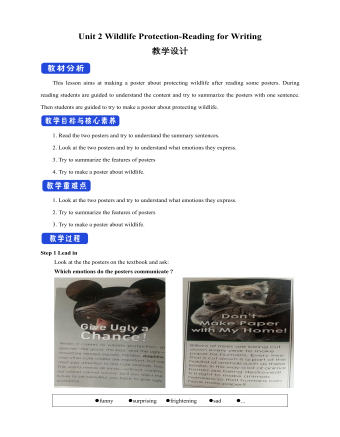
This lesson aims at making a poster about protecting wildlife after reading some posters. During reading students are guided to understand the content and try to summarize the posters with one sentence. Then students are guided to try to make a poster about protecting wildlife.1. Read the two posters and try to understand the summary sentences.2. Look at the two posters and try to understand what emotions they express.3. Try to summarize the features of posters4. Try to make a poster about wildlife.1. Look at the two posters and try to understand what emotions they express.2. Try to summarize the features of posters3. Try to make a poster about wildlife.Step 1 Lead inLook at the the posters on the textbook and ask:Which emotions do the posters communicate ?Step 2 Read the poster and answer the questions.1. What do you think of the animals in the poster on the left ?I think it is frightening and ugly.2. Why do we should protect the ugly animals ?All species--the good, the bad, and the ugly-- should be treated equally.The world needs all kinds--without variety, our planet cannot survive.3. Why are billions of trees being cut down every year ?To make paper for humans.4. What result will be lead to after the trees are cut down ?A lost of animal homes are being destroyed./The habitat of wildlife is being destroyed.Step 3 Find the feature of posters1. What does each poster use to stir up emotions ?On the left, it makes us a little frightened and it looks a little ugly, but it can activate our curiosity--What is it? And What is wrong with it?On the right, it makes us feel a little sad and want to protect them.