-
新人教版高中英语必修2Unit 1 Cultural Heritage-Listening&Speaking&Talking教案
Listening and Speaking introduces the topic of “Take part in a youth project”. The listening text is an interview about an international youth cultural heritage protection project. More than 20 high school students from seven countries participated in the project. The reporter interviewed two participants Stephanie and Liu Bin. By listening to the text, students can understand the significance of cultural heritage protection, and teenagers can use their knowledge, combine their own interests and advantages, etc. to participate in the action of cultural heritage protection. Listening and Talking introduces the theme of "Talk about history and culture". The listening text is a dialogue between two tourists and tour guides when they visit the Kremlin, red square and surrounding buildings. The dialogue focuses on the functional items of "starting a conversation", which is used to politely and appropriately attract the attention of the others, so as to smoothly start a conversation or start a new topic. The purpose of this section is to guide students to understand the history and current situation of Chinese and foreign cultural heritage in their own tourism experiences or from other people's tourism experiences, explore the historical and cultural values, and be able to express accurately and appropriately in oral communication.1. Guide students to understand the content of listening texts in terms of the whole and key details; 2. Cultivate students' ability to guess the meaning of words in listening; discuss with their peers how to participate in cultural heritage protection activities.3. Instruct students to use functional sentences of the dialogue such as “I beg your pardon, but…” “Forgive me for asking, but…" and so on to start the conversation more politely and appropriately.
新人教版高中英语必修2Unit 3 The Internet-Discovering Useful Structure教案二
This teaching period mainly deals with grammar “The Present Perfect Passive Voice.” To begin with, teachers should lead students to revise what they have learned about the Present Perfect Passive Voice. And then, teachers move on to stress more special cases concerning this grammar。This period carries considerable significance to the cultivation of students’ writing competence and lays a solid foundation for the basic appreciation of language beauty. The teacher is expected to enable students to master this period thoroughly and consolidate the knowledge by doing some exercises. 1. Guide students to review the basic usages of the Present Perfect Passive Voice2. Lead students to learn to use some special cases concerning the Present Perfect Passive Voice flexibly.2. Enable students to use the basic phrases structures flexibly.3. Strengthen students’ great interest in grammar learning.1. Help students to appreciate the function of the Present Perfect Passive Voice in a sentence2. Instruct students to write essays using the proper the Present Perfect Passive Voice.观察下列句子特点,总结共同点。1.(教材P28)Much has been written about the wonders of the World Wide Web.2.(教材P28)But the Internet has done much more for people than simply make life more convenient.3.(教材P28)Many people have been helped by the club.4.(教材P28)She no longer feels lonely, and her company has become quite successful.5.(教材P32)Today I thought I’d blog about a question that has been asked many times—how do you stay safe online and avoid bad experiences on the Internet?
新人教版高中英语必修2Unit 3 The Internet-Reading and Thinking教案二
Q5:What's Jan's next goal?Her next goal is to start a charity website to raise money for children in poor countries.Q6:What can we learn from her experiences?We learn that when we go through tough times, we can find help and support from other people online. We learn that we can feel less lonelyStep 5: While reading---rethinkingQ1: What is Jan’s attitude to the Internet ?Thankful/Grateful, because it has changed her and her life.Q2: What writing skills is used in the article ?Examples(Jan’s example, the 59-year-old man’s and the 61-year-old woman’s example)Q3: Can you get the main idea of the article ?The Internet has changed Jan’s life/Jan’s life has been changed by the Internet.Step 6 Post reading---Retell the storyMuch has been written about the wonders of the World Wide Web. There are countless articles (1)telling(tell) us how the Internet has made our lives more convenient. But the Internet has done a lot (2)more(much) for people than simply make life more convenient. People’s lives (3) have been changed(change) by online communities and social networks so far. Take Jan for example, who developed a serious illness that made her (4)stuck(stick) at home with only her computer to keep (5)her(she) company. She joined an online group (6)where she could share problems, support and advice with others. She considered the ability to remove the distance between people as one of the greatest (7)benefits(benefit). She was so inspired (8)that she started an IT club in which many people have been helped. She has started to learn more about how to use the Internet to make society better. Her next goal is to start a charity website to raise money (9)for children in poor countries. Jan’s life has been (10)greatly(great) improved by the Internet.
新人教版高中英语必修2Unit 4 History and Traditions-Discovering Useful Structure教案二
This teaching period mainly deals with grammar: The past participle is used as attributive and objective complement.1. Guide students to review the basic usages of the past participle used as attributive and objective complement.2. Lead students to learn to use some special cases concerning the past participle used as attributive and objective complement flexibly.3. Strengthen students’ great interest in grammar learning.1. Help students to appreciate the function of the past participle used as attributive and objective complement.2. Instruct students to write essays using the past participle used as attributive and objective complement.Step1:温故而知新。Analyze the underlined phrases and then sum up the common usages of the past participles.1.(教材P41)They had castles built(build) all around England, and made changes to the legal system.2.(教材P42)They use the same flag, known(know) as the Union Jack,...3.(教材P42)Judy and I had our car parked(park) in an underground car park near Trafalgar Square, where we could get our car battery charged(charge).Common points: f the past participle used as attributive and objective complement.Step 2:过去分词作定语时的意义1.及物动词的过去分词作定语,在语态上表示被动;在时间上,常表示动作已经发生或完成,有时也不表示时间性。Our teacher watched us doing the experiment and gave us a satisfied smile at last.我们的老师看着我们做实验,最后给了我们一个满意的微笑。The plan put forward at the meeting will be carried out soon.会上提出的计划将很快被执行。2.不及物动词的过去分词作定语,它不表示被动意义,只强调动作完成。Many little kids like gathering fallen leaves in the yard.
新人教版高中英语必修2Unit 5 Music-Discovering Useful Structures教案二
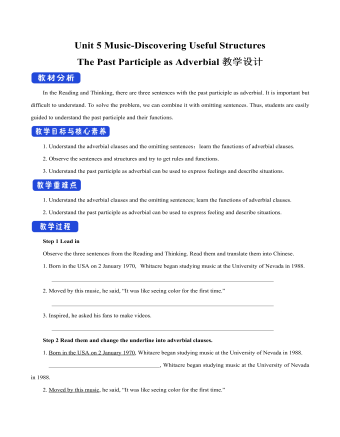
4. When he got absorbed in his world of music, he felt as if he could “see” the beauty of the world around him, like he had in his previous life.P·P as adverbial: _________________________________________________________________.Function: _______________________________________________________________________.Step 5 Solid Complete the passage with the words in brackets in their correct forms.Well known as a successful band, the Impact members show quite a few striking qualities. They never ever give up. When _____________(question) by the media, they are not _____________(discourage) and practise even harder. They are improving themselves by attending several master training class. They are united. _____________(fill with) team spirit, they act as a whole, always aiming for glory. Step 6 Difference and similarity from -ingObserve the following examples.1. He went out, shutting the door behind him.=He went out, ________________________________________________________.2. Not knowing what to do, he went to his parents for help.=__________________________________________, he went to his parents for help.Similarity: _______________________________________________________________________________________________________________________________________________________.Difference : _______________________________________________________________________________________________________________________________________________________.Step Practice1. ________ in a hurry, this article was not so good. 因为写得匆忙, 这篇文章不是很好。2. ________ carefully, he found something he hadn’t known before. 他仔细读书时, 发现了一些从前不知道的东西。3. ________ why he did it, the monitor said it was his duty. 当被问及他为什么要这么做时, 班长说这是他的职责
新人教版高中英语必修2Unit 5 Music-Listening and Speaking教案
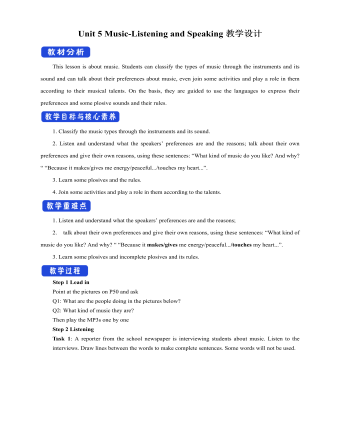
This lesson is about music. Students can classify the types of music through the instruments and its sound and can talk about their preferences about music, even join some activities and play a role in them according to their musical talents. On the basis, they are guided to use the languages to express their preferences and some plosive sounds and their rules.1. Classify the music types through the instruments and its sound.2. Listen and understand what the speakers’ preferences are and the reasons; talk about their own preferences and give their own reasons, using these sentences: “What kind of music do you like? And why? “ “Because it makes/gives me energy/peaceful.../touches my heart...”.3. Learn some plosives and the rules.4. Join some activities and play a role in them according to the talents. 1. Listen and understand what the speakers’ preferences are and the reasons;2. talk about their own preferences and give their own reasons, using these sentences: “What kind of music do you like? And why? “ “Because it makes/gives me energy/peaceful.../touches my heart...”.3. Learn some plosives and incomplete plosives and its rules.Step 1 Lead inPoint at the pictures on P50 and ask Q1: What are the people doing in the pictures below?Q2: What kind of music they are?Then play the MP3s one by oneStep 2 ListeningTask 1: A reporter from the school newspaper is interviewing students about music. Listen to the interviews. Draw lines between the words to make complete sentences. Some words will not be used.
新人教版高中英语必修2Unit 5 Music-Reading and Thinking教案二
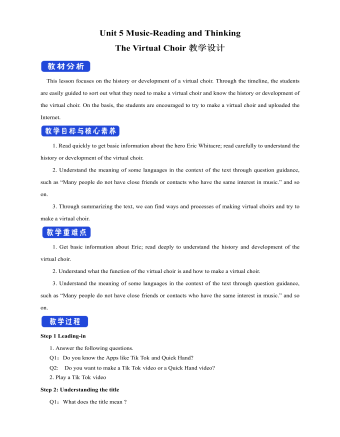
1. Get basic information about Eric; read deeply to understand the history and development of the virtual choir.2. Understand what the function of the virtual choir is and how to make a virtual choir.3. Understand the meaning of some languages in the context of the text through question guidance, such as “Many people do not have close friends or contacts who have the same interest in music.” and so on.Step 1 Leading-in1. Answer the following questions.Q1:Do you know the Apps like Tik Tok and Quick Hand?Q2: Do you want to make a Tik Tok video or a Quick Hand video?2. Play a Tik Tok video Step 2: Understanding the title Q1:What does the title mean ?Q2: Is the article a narration or exposition? Why? Q3: Can you change the title ? If you can, what is the title?Step 3: Scanning the whole text and getting the basic information1. Answer the following questions.Q1:Who came up with the idea for a virtual choir?Q2: Where did Eric studied the musical composition?Q3: What is his song?2. Find the main idea of each paragraph3. Deal with some new words.Step 4: Reading carefully to get detailed informationPara 1 How to make a virtual choir1. PreparationA. tools: a virtual camera; an Internet connectionB. hero/heroin: friends or some individuals who have the same interests2. Process
人教版高中地理必修2城市化精品教案
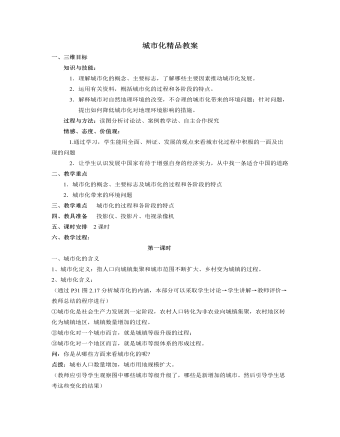
1.改善城市环境:治理河流、控制大气污染物、大力加强绿化建设为改善城市环境,上海市全面展开对大气、河流、噪声等多方面的治理工作。如苏州河的治理、降低城市污染物浓度、加强绿化建设,截止1990年,市区绿化覆盖率达到20.3%。2.改善城市交通、改善居住条件扩宽主干道,修建环城公路,修筑了南浦大桥和扬浦大桥,新修城市高架公路和地铁,改造住宅。3.控制城市规模建立卫星城,开发新区,有效地控制城市中心区的规模。思考:什么时候许多国家采取措施保护和改善城市环境?你认为可以采取哪些措施来保护和改善城市环境?上海市保护和改善城市环境的措施:上海的卫星城有哪些?上海新建了哪个新区?目前浦东新区在上海的地位如何?建立卫星城和开发新区可以起到什么作用?上海市为改善交通条件,做了哪些工作?
人教版高中地理必修2城市内部空间结构教案
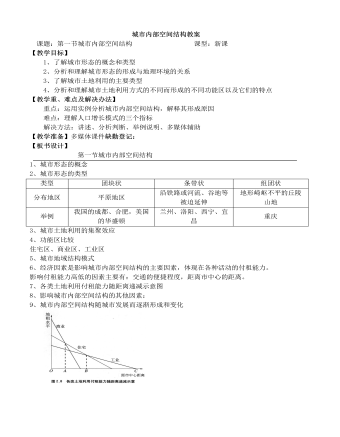
过渡:在实际生活中,城市内部空间结构并非完全按照这一经济规律呈现,而是更具复杂性。这说明除了经济因素外,还有很多其他因素在起作用,请大家结合你的认识、图2.9和案例1:纽约市的少数民族区谈谈你的看法。(2)其他因素I收入——形成不同级别住宅区的常见原因。有能力支付昂贵租金和选择最佳居住环境的人,其居住地往往形成高级住宅区。II知名度——城市内某些地区在历史、文化或经济方面具有很高的声誉,这往往会吸引更多新的住宅或商场建在该处,以提高其知名度。III种族聚居区的形成——在有些城市的某一区域内,如果某个种族或宗教团体占优势,就可能形成种族聚居区。如纽约市的唐人街、哈林区、小意大利区等。IV历史因素——城市的建筑物和街道设计可以维持久远,早期的土地利用方式对日后的功能分区有着深远的影响。
人教版高中地理必修2人口合理容量教案
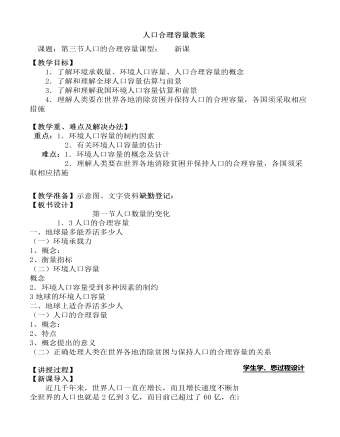
(1)请同学们结合日常生活实例和教材分析说明人类要在世界各地消除贫困并保持人口的合理容量任务的艰巨性?(2)采取何种措施才能更好的解决这一问题的出现?教师总结(1)现实中的人口问题(如人口过快增长、人口城市化和人口老龄化等)引发了严重的资源问题和环境问题。①发达国家的人均消耗资源量很大,索取资源和转嫁有害生产的地域超出了本国的范围。②发展中国家不仅人口数量多,人均消费水平低,而且一些国家的人口仍在快速增长。若在现有的经济基础上,把发展中国家人均生活质量提高到与发达国家相当的水平,所引发的资源短缺和环境问题将会相当严重,解决的难度也很大。(2)I就整个世界来说:①国际社会要倡导各国,尤其发展中国家要尽最大可能把人口控制在合理的规模之内;②建立公平的秩序,保证大多数人拥有不断追求高水平生活质量的平等权利。
人教版新课标高中物理必修1摩擦力教案2篇
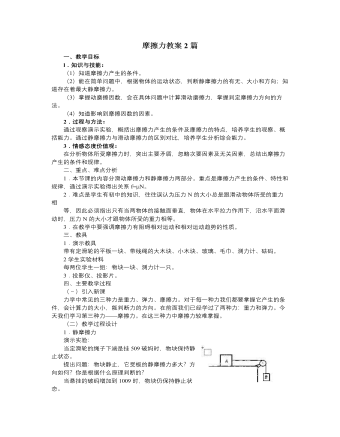
l.知识与技能:(1)知道摩擦力产生的条件。(2)能在简单问题中,根据物体的运动状态,判断静摩擦力的有无、大小和方向;知道存在着最大静摩擦力。(3)掌握动磨擦因数,会在具体问题中计算滑动磨擦力,掌握判定摩擦力方向的方法。(4)知道影响到摩擦因数的因素。2.过程与方法:通过观察演示实验,概括出摩擦力产生的条件及摩擦力的特点,培养学生的观察、概括能力。通过静摩擦力与滑动摩擦力的区别对比,培养学生分析综合能力。3.情感态度价值观:在分析物体所受摩擦力时,突出主要矛盾,忽略次要因素及无关因素,总结出摩擦力产生的条件和规律。二、重点、难点分析1.本节课的内容分滑动摩擦力和静摩擦力两部分。重点是摩擦力产生的条件、特性和规律,通过演示实验得出关系f=μN。2.难点是学生有初中的知识,往往误认为压力N的大小总是跟滑动物体所受的重力相等,因此必须指出只有当两物体的接触面垂直,物体在水平拉力作用下,沿水平面滑动时,压力N的大小才跟物体所受的重力相等。
人教版高中语文必修1《再别康桥》说课稿2篇
一、教材分析1、教学对象分析《再别康桥》的教学对象是高一学生,高一学生往往对那种纯粹的、原始的、本真的情感体会较为肤浅,《再别康桥》是新月派诗人徐志摩的传世之作,有极高美学价值,它所抒发的离愁别绪是人类共同的情感经历,通过诵读容易将学生带人诗境,唤醒他们沉寂的真情,从而引起强烈的共鸣。 2、教材地位及作用 高中语文第一册第一单元为诗歌单元,本单元收录了中国现当代的一些优秀诗篇。《再别康桥》安排在本单元的第二课,属于必读课。虽然本诗向来众说纷纭,但其艺术之美人所共知,培养学生高尚的审美情趣和良好的审美创造力是语文学科的任务,因此,从语言赏析入手,从情感体验切入,就可以让学生通过学习本课体会现代诗歌的特点,多方面感受体悟诗歌的情感,受到美的熏陶。
人教版高中语文必修1《烛之武退秦师》说课稿2篇
4、本文的重点是说辞,虽仅百余字,却委婉曲折,步步进逼,层层深入,表现出高超的劝说艺术、游说技巧。让学生细细品味并概括说辞中包含几层意思。第一层(“秦、晋围郑,郑既知亡矣”),分析形势,以退为进,博得好感。第二层(“若亡郑而有益于君”至“君之薄也”),亡郑陪邻,动摇联盟。第三层(“若舍郑以为东道主”至“君亦无所害”),存郑有益,利益引诱。第四层(“且君尝为晋君赐矣”至“唯君图之”),追溯历史,深入离间。可见烛之武面对大国的君主,巧舌如簧,不卑不亢,从容辞令,既不刺激对方也不失本国尊严,语言的分寸掌握得恰到好处。表现出烛之武机智善辩的外交才能。5、面对风云突变的局势,晋侯没有感情用事,而表现了清醒的头脑和理智的判断。这种隐忍不发、随机应变的胸怀和谋略,正是晋文公终成霸业的根本原因。设计意图:本环节的重点是全面把握烛之武这一人物性格特征,以及退秦师过程中体现出的非凡的胆识以及高超的谋略和语言艺术。
人教版高中语文必修2《赤壁赋》说课稿3篇
[教学反思]人教版高中语文必修二第三单元安排了《兰亭集序》《赤壁赋》《游褒禅山记》三篇古代山水游记散文,它们借游赏之事,探索生命的意义、治学的道理。师者,所以传道、授业、解惑也。高中的教材选用的都是历史经典名篇,每一篇都闪烁着儒道释等百家光辉的思想。编者要老师传道的意图很明显。即非如此,看着这些影响历代、影响世界的如日月之耀眼光华的伟大思想就躺在我们的教科书里,又如何能不讲呢?所以,我将本课的教学重难点拟定为:帮助学生建立积极的生死观,掌握多角度看问题的正确的思想方法。当然,也让学生领会了融写景、抒情、说理于一炉的大家手法。整堂课各教学环节,环环相扣,过渡自然,读、思、议、写训练到位,而且全部围绕“生死观”展开,如一篇形散神不散的散文。
人教版高中语文必修3《寡人之于国也》说课稿2篇
(明确:“寡人之于国也,尽心焉耳矣”,但“寡人之民不加多,何也?”)②他认为自己对国家政务尽心尽力了,他有哪些具体做法?(明确:移民移粟)③第2—4节中孟子是怎样说明梁惠王移民移粟的措施与“邻国之政”并无本质区别的?(明确:孟子不直接回答“民不加多”的问题,而是用梁惠王熟悉的“战”设喻——设圈套,诱使对方在不知不觉中说出“不可,直不百步耳,是亦走也。”)④孟子认为怎样才能做到“王道之始”?要想“王道之成”还需采取哪些措施?(明确:“不违农时,谷不可胜食也。数罟不入氵夸池,鱼鳖不可胜食也。斧斤以时入山林,材木不可胜用也。谷与鱼鳖不可胜食,材木不可胜用五亩之宅,树之以桑,五十者可以衣帛矣。鸡豚狗彘之畜,无失其时,七十者可以食肉矣。百亩之田,勿夺其时,数口之家,可以无饥矣。谨库序之教,申之以孝涕之义,颁白者不负戴于道路矣。)这一小步的目的是想让学生通过这些问题的解答,可以进一步理清思路,掌握文的大概内容。
人教版高中语文必修3《蜀道难》说课稿2篇
(1)“问君西游何时还……使人听此凋朱颜。”诗题下未注明送何人入蜀,所以这里的“问君”无妨假定实有其人,可以读得亲切一些。将行而问“何时还”,已有不可行之意,重音要落在“不可攀”三字上,当用劝说的语气读。以下四句借鸟声渲染旅途中悲凉凄清的氛围,读时要放低声调,有干里孤身之感,至“愁空山”徐徐而上。然后用感喟的语调读主旨句,至“凋朱颜”略作一顿,以示意犹未尽。(2)“连峰去天不盈尺……胡为乎来哉!”仍是说不可行,但内容加深了一层,因为说的是蜀道的险恶。前四句不是纯客观的描写,读时须设想这是旅游者攀援于“连峰”“绝壁”之上置身于“飞湍瀑流”之间,要使听者感到惊心动魄。读后可作稍长停顿,再用“其险也如此”缓缓收住。末句是诗人借用蜀人的口气,对历险而来的游者深表叹息——“胡为乎来哉”不是询问,当用降调读,暗含“何苦而来”之意。
人教版高中生物必修2伴性遗传说课稿
(1观察图解,色盲基因在性别间是如何传递的呢?(女--女、女--男、男--女)(2)为什么不能由男性传给男性?(色盲基因是在X染色体上,因此色盲基因是随X染色体的传递而传递。)(3)男性的色盲基因怎样才能传给男性呢?(通过女儿,传给外孙即交叉遗传)(4)从图解看色盲在男女中的发病情况怎样?(男性多于女性)(5)从社会调查也是这样,你是否能从基因和染色体的角度加以解释?(提示:女性染色体的构成,结合基因位置及显隐性进行分析)归纳特点:归纳出色盲基因遗传的特点并扩展到X染色体隐性遗传的特点上。色盲基因遗传(X隐性遗传)的特点:(1)男患者多于女患者(2)交叉遗传(3)女病儿子必病,男正女儿必正等。问题探讨:利用“遗传图解”结合“问题链”继续探讨,拓展到抗维生素D即X 染色体显性遗传的特点。(6)色盲基因在X染色体上属隐性基因,子代表现男多于女,对应的正常色觉基因则属于X显性基因,子代表现应如何?(女多于男)
人教版高中政治必修2对人民负责说课稿
在学生活动的基础上,教师总结归纳:要坚持从群众中来到群众中去的工作方法。要求:政府要通过各种途径,利用各种群众组织、社会团体广泛收集群众意见和建议,认真对待群众的来信来访。还要为群众诚心诚意办实事,尽心竭力解难事,坚持不懈。通过合作探究,以此来培养学生的分析能力,探究能力以及透过现象看本质的能力,培养学生获取信息的能力,自主学习的能力以及全面看问题的能力,再结合教师的讲授,给学生一种茅塞顿开的感觉。环节四 回归生活 提升情感我将引导学生阅读课本,通过设置活动探究课,结合生活实际从时效,便利,实效等方面请学生评述公民求助或投诉的四种方式的特点和优点。在这一过程中,我还会用多媒体展示常用的热线电话,政府网站上有关信访、政务公开及其他便民利民的栏目,丰富课堂资源。让学生阅读课本,自行归纳知识点,有助于培养学生自主学习能力。
人教版高中政治必修2共创幸福生活说课稿
环节三 案例分析 突破难点我将用多媒体展示两组反映中学生参与民主管理的一些作法的图片,和教材26-27页的三个镜头,然后请同学们根据图片和材料探究以下问题: 1. 联系自身实际谈谈这些做法对我们有何启示? 2.实行农村村民自治和城市居民自治有什么意义呢? 3. 我们在实际生活中应怎么做?这样,通过图片和材料的展示,点明了公民参与民主管理的意义,以此来诱发学生已有的真切体验,感受其境,增强学生共创想和文明社区的积极性和情感。同时,我们也希望学生在学习本课的知识后,又能做到学以致用,把所学的知识真正用到社区管理中,为所在社区管理提合理建议,从而真正实现了知识从生活中来,又回到生活中去的理念。环节四课堂小结 课后延伸将用多媒体展示本节课的知识框架,并注重引导学生将今天所学新知识与前面知识联系起来,帮助学生从宏观上把握各知识点之间的关系,有利于学生理解记忆,以此来帮助教师在第一时间掌握学生学习信息的反馈,同时培养学生归纳分析能力、概括能力。
人教版高中政治必修2管理与服务说课稿
环节四 课堂小结 巩固知识本节课我采用线索性的板书,整个知识结构一目了然,为了充分发挥学生在课堂的主体地位,我将课堂小结交由学生完成,请学生根据课堂学习的内容,结合我的板书设计来进行小结,以此来帮助教师在第一时间掌握学生学习信息的反馈,同时培养学生归纳分析能力、概括能力。环节五 情景回归,情感升华我的实习指导老师告诉过我们,政治这一门学科要从生活中来到生活去,所以在课堂的最后布置了课外探究题,以此培养学生对理论的实际运用能力,同时检验他们对知识的真正掌握情况,以此达到情感的升华,本节课,我根据建构主义理论,强调学生是学习的中心,学生是知识意义的主动建构者,是信息加工的主体,要强调学生在课堂中的参与性、以及探究性,不仅让他们懂得知识,更让他们相信知识,并且将知识融入到实践当中去,最终达到知、情、意、行的统一。