-
新人教版高中英语选修2Unit 4 Using langauge-Listening教学设计
The theme of the listening section is " talking about scenery and culture along a journey."The part is designed to further lead the students to understand Canadian natural geography and social environment, and integrated into the cultural contrast by mentioning the long train journey from Beijing to Moscow routes. On this basis, the part activates students related travel experience, lets the student serial dialogue, guides the student to explore further the pleasure and meaning of the long journey, and Chinese and foreign cultural comparison.The part also provides a framework for the continuation of the dialogue, which is designed to provide a framework for students to successfully complete their oral expressions, and to incorporate an important trading strategy to end the dialogue naturally.1. Help students to understand and master some common English idioms in the context, and experience the expression effect of English idioms.2. Guide the students to understand the identity of different people in the listening context, and finish the dialogue according to their own experience.3. Instruct the students to use appropriate language to express surprise and curiosity about space and place in the dialogue, and master the oral strategy of ending the dialogue naturally.1. Instruct students to grasp the key information and important details of the dialogue.2. Instruct students to conduct a similar talk on the relevant topic.
新人教版高中英语选修2Unit 5 Reading and thinking教学设计
The theme of this activity is to learn the first aid knowledge of burns. Burns is common in life, but there are some misunderstandings in manual treatment. This activity provides students with correct first aid methods, so as not to take them for granted in an emergency. This section guides students to analyze the causes of scald and help students avoid such things. From the perspective of text structure and collaborative features, the text is expository. Expository, with explanation as the main way of expression, transmits knowledge and information to readers by analyzing concepts and elaborating examples. This text arranges the information in logical order, clearly presents three parts of the content through the subtitle, accurately describes the causes, types, characteristics and first aid measures of burns, and some paragraphs use topic sentences to summarize the main idea, and the level is very clear.1. Guide students to understand the causes, types, characteristics and first aid methods of burns, through reading2. Enhance students’ ability to deal withburnss and their awareness of burns prevention3. Enable students to improve the ability to judge the types of texts accurately and to master the characteristics and writing techniques of expository texts.Guide students to understand the causes, types, characteristics and first aid methods of burns, through readingStep1: Lead in by discussing the related topic:1. What first-aid techniques do you know of ?CPR; mouth to mouth artificial respiration; the Heimlich Manoeuvre
新人教版高中英语选修2Unit 5 Using langauge-Listening教学设计
The theme of this section is to learn how to make emergency calls. Students should learn how to make emergency calls not only in China, but also in foreign countries in English, so that they can be prepared for future situations outside the home.The emergency telephone number is a vital hotline, which should be the most clear, rapid and effective communication with the acute operator.This section helps students to understand the emergency calls in some countries and the precautions for making emergency calls. Through the study of this section, students can accumulate common expressions and sentence patterns in this context. 1.Help students accumulate emergency telephone numbers in different countries and learn more about first aid2.Guide the students to understand the contents and instructions of the telephone, grasp the characteristics of the emergency telephone and the requirements of the emergency telephone.3.Guide students to understand the first aid instructions of the operators.4.Enable Ss to make simulated emergency calls with their partners in the language they have learned1. Instruct students to grasp the key information and important details of the dialogue.2. Instruct students to conduct a similar talk on the relevant topic.Step1:Look and discuss:Match the pictures below to the medical emergencies, and then discuss the questions in groups.
新人教版高中英语必修3Unit 1 Festivals and Celebrations教学设计二
1. Ss look at the picture and scan the passage to understand the main idea while teacher is giving the following questions to inspire Ss to think.*Where are those people?*What are they doing?*Why are they so excited?2. Ss complete the passage with the appropriate -ing form. Then discuss and check the answers with class.Answers: boring, interesting, taking, exciting, amazing3. The teacher raises questions for the students to discuss and encourages them to express their opinions.*Do you like La Tomatina? Why or why not?4. Each group representative reports the discussion result, the teacher gives feedback and the evaluation.Step 6 PracticeActivity 41. Ss complete the Ex 2 in Using structures.2. Check the answers after finishing the exercises.①The dragon boat races are the most exciting part of the Dragon Boat Festival.② The children were excited to go Easter egg hunting.③What an amazing performance! This is the best music festival I have ever been to.④We were amazed by her funny-looking hat.⑤His inspiring speech at the conference won the admiration/ favour of the audience.⑥This is a challenging game to test your memory and observation capabilities. 3. T asks Ss to finish Ex 3 and 4 in Using structures by themselves, then check the answers with class.Step 6 Homework1. Understand and master the functions and usage of the -ing form;2. Finish the other exercises in Using structures.1、通过本节内容学习,学生是否理解和掌握动词-ing形式作定语和表语的功能和意义;2、通过本节内容学习,学生能否在理解文段内容的基础上,根据上下文语境和表达逻辑,能正确运用动词-ing形式描述节日庆典。3、通过本节内容学习,学生是否归纳和积累用于表达情绪的相关词汇。
新人教版高中英语必修3Unit 3 Diverse Cultures教学设计四
该板块的活动主题是“介绍一个有显著文化特征的地方”( Describe a place with distinctive cultural identity)。该板块通过介绍中国城继续聚焦中国文化。本单元主题图呈现的是旧金山中国城的典型景象, Reading and Thinking部分也提到中国城,为该板块作铺垫。介绍中国城的目的主要是体现中国文化与美国多元文化的关系,它是美国多元文化的重要组成部分。中国城也是海外华人的精神家园和传播中国文化的重要窗口,外国人在中国城能近距离体验中国文化。1. Read the text to understand the cultural characteristics of Chinatown in San Francisco and the relationship between Chinese culture and American multiculturalism;2. Through reading, learn to comb the main information of the article, understand the author's writing purpose and writing characteristics;3. Learn to give a comprehensive, accurate, and organized description of the city or town you live in;Learn to revise and evaluate your writing.Importance:1. Guide the students to read the introduction of Chinatown in San Francisco and grasp its writing characteristics;2. Guide students to introduce their city or town in a comprehensive, accurate and organized way;3. Learn to comb the main information of the article, understand the author's writing purpose, and master the core vocabulary.
新人教版高中英语必修3Unit 3 Diverse Cultures教学设计一
Activity 81.Grasp the main idea of the listening.Listen to the tape and answer the following questions:Who are the two speakers in the listening? What is their relationship?What is the main idea of the first part of the listening? How about the second part?2.Complete the passage.Ask the students to quickly review the summaries of the two listening materials in activity 2. Then play the recording for the second time.Ask them to complete the passage and fill in the blanks.3.Play the recording again and ask the students to use the structure diagram to comb the information structure in the listening.(While listening, take notes. Capture key information quickly and accurately.)Step 8 Talking Activity 91.Focus on the listening text.Listen to the students and listen to the tape. Let them understand the attitudes of Wu Yue and Justin in the conversation.How does Wu Yue feel about Chinese minority cultures?What does Justin think of the Miao and Dong cultures?How do you know that?2.learn functional items that express concerns.Ask students to focus on the expressions listed in activity. 3.And try to analyze the meaning they convey, including praise (Super!).Agree (Exactly!)"(You're kidding.!)Tell me more about it. Tell me more about it.For example, "Yeah Sure." "Definitely!" "Certainly!" "No kidding!" "No wonder!" and so on.4.Ask the students to have conversations in small groups, acting as Jsim and his friends.Justin shares his travels in Guizhou with friends and his thoughts;Justin's friends should give appropriate feedback, express their interest in relevant information, and ask for information when necessary.In order to enrich the dialogue, teachers can expand and supplement the introduction of Miao, dong, Lusheng and Dong Dage.After the group practice, the teacher can choose several groups of students to show, and let the rest of the students listen carefully, after listening to the best performance of the group, and give at least two reasons.
新人教版高中英语选修2Unit 4 Reading and thinking教学设计
【词汇精讲】highlight n.最好或最精彩的部分 vt.突出;强调;使醒目One of the highlights of the trip was seeing the Taj Mahal.这次旅行的亮点之一是参观泰姬陵。Your resume should highlight your skills and achievements.你的简历应该突出你的技能和成就。The report highlights the major problems facing society today.报告强调了当今社会所面临的主要问题。I’ve highlighted the important passages in yellow.我用黄色标出了重要段落。7.Edmonton is freezing cold in winter,with daily temperatures averaging -10 ℃.埃德蒙顿冬季寒冷,日平均气温为-10°C。【词汇精讲】freezing adj.极冷的;冰冻的Leave a basin of water outside in freezing weather.在冰冻的天气里,放一盆水在室外。It’s freezing cold outside so wear a warm coat.外面超冷的,所以穿一个暖和一点的外套吧。8.It was not until 9:30 a.m.that they finally reached the capital of Ontario,Toronto.直到上午9时30分,他们才终于到达多伦多的首府安大略省。【句式剖析】本句是一个强调句,强调的是句子的时间状语until 9:30。含有not...until...的句子的强调句为It is not until...that...,that后面的句子要用肯定形式。It was not until then that I suddenly realized nobody was happier than I was.直到那时我才突然意识到没有人比我更幸福了。
新人教版高中英语选修2Unit 2 Learning about Language教学设计
The activity theme of this section is to design various activities around the key words in the first text. Therefore, the activities require students to pay attention to the spelling of words. On the other hand, let students grasp the meaning of words more accurately through sentences and short texts. This kind of teaching design also helps to improve the ability of using English thinking.1. Cultivating students' ability to use word formation to induce and memorize vocabulary, and the ability to use lexical chunks to express meaning.2. Guide the students to think independently and use the correct form of words to complete sentences3. Cultivate students' habit of using lexical chunks to express language completely, guide students to draw words in sentences quickly, pay attention to word collocation, so as to accumulate more authentic expressions4. Instruct students to create sentences with the chunks.1. Enable students to use the language points in the real situation or specific contexts flexibly and appropriately.2. Guiding the Ss to use unit topic words and the sentence patterns in a richer context.Step1: Think of a word that best fits each definition.1. to remember sth2.to accept, admit, or recognize sth or the truth/existence of sth3. the process of changing sth or yourself to suit a new situation4 .to make sb feel less worried or unhappy5. a strong desire to achieve sth
新人教版高中英语选修2Unit 5 Reading for writing教学设计
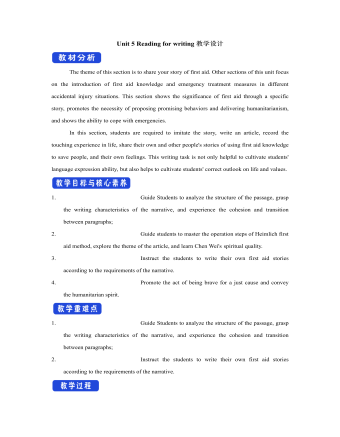
你校英语报计划出版一期急救常识专刊,现面向全校学生公开征集稿件,你有意参加。请你根据下面提示内容,用英语写一篇短文,介绍在车祸现场对伤者进行急救的方法和步骤。1.确保现场的安全;2.询问伤者,确保其呼吸正常;3.检查伤口,如流血则应采取止血措施;4.如需急救,确保其处于康复位置。注意:1.词数80左右;2.可以适当增加细节,以使行文连贯。参考词汇:康复位置 recovery positionAs we all know, having a knowledge of first aid can make a great difference in our daily life. If a traffic accident happens and someone is injured, the following steps can be used to treat the injured.In the first place, we should make sure that the accident scene is safe so that we won’t get hurt. We should ask the injured person if he is OK, and see if he is breathing. What’s more, we should check for cuts and wounds. If he is bleeding badly, it is vital that we should try to stop the bleeding by applying pressure to the injury. This is because if a person loses too much blood, he may die. If necessary, take the injured person to the hospital as soon as possible.Do remember: when giving first aid, please be sure to place the person in a recovery position.
新人教版高中英语选修2Unit 2 Using langauge-Listening教学设计
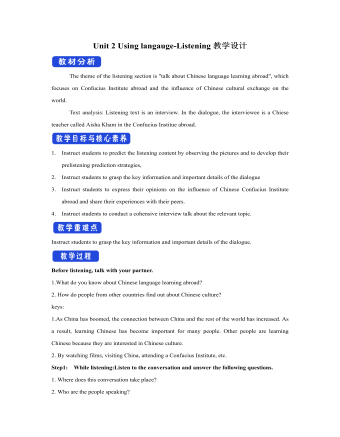
? B: Absolutely! Getting involved with Chinese cultural activities there definitely helped a lot. I got to practice my Chinese on a daily basis, and I could learn how native Chinese speakers spoke.? A: What do you feel is your biggest achievement?? B: Learning Chinese characters! I have learnt about 1,500 so far. When I first started, I didn't think it was even going to be possible to learn so many, but now I find that I can read signs, menus, and even some easy newspaper articles.? A: What are you most keen on?? B: I've really become keen on learning more about the Chinese culture, in particular Chinese calligraphy. As I have learnt Chinese characters, I have developed a great appreciation for their meaning. I want to explore Chinese characters by learning how to write them in a more beautiful way. ? A: Finally, what do you want to say to anyone interested in learning Chinese?? I have really become keen on learning more about the Chinese culture, in particular Chinese Calligraphy. As I have learnt Chinese character, I have developed a great appreciation for their meaning. I want to explore Chinese characters by learning how to write them in a more beautiful way.? A: Finally, what do you want to say to anyone interested in learning Chinese?? B: I'd say, give it a shot! While some aspects may be difficult, it is quite rewarding and you will be happy that you tried.? A: Thanks for your time. ? B:You're welcome.
新人教版高中英语选修2Unit 5 Learning about Language教学设计
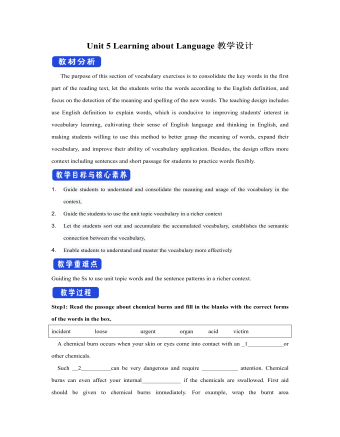
The purpose of this section of vocabulary exercises is to consolidate the key words in the first part of the reading text, let the students write the words according to the English definition, and focus on the detection of the meaning and spelling of the new words. The teaching design includes use English definition to explain words, which is conducive to improving students' interest in vocabulary learning, cultivating their sense of English language and thinking in English, and making students willing to use this method to better grasp the meaning of words, expand their vocabulary, and improve their ability of vocabulary application. Besides, the design offers more context including sentences and short passage for students to practice words flexibly.1. Guide students to understand and consolidate the meaning and usage of the vocabulary in the context, 2. Guide the students to use the unit topic vocabulary in a richer context3. Let the students sort out and accumulate the accumulated vocabulary, establishes the semantic connection between the vocabulary,4. Enable students to understand and master the vocabulary more effectivelyGuiding the Ss to use unit topic words and the sentence patterns in a richer context.Step1: Read the passage about chemical burns and fill in the blanks with the correct forms of the words in the box.
二年级音乐欣赏猫和老鼠教案教学设计
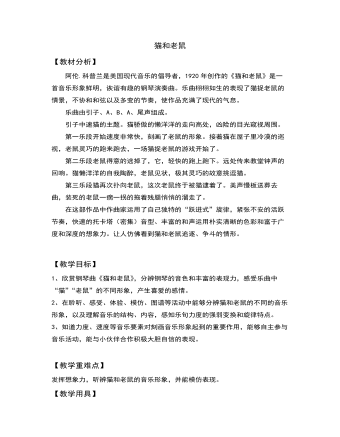
阿伦.科普兰是美国现代音乐的倡导者,1920年创作的《猫和老鼠》是一首音乐形象鲜明,诙谐有趣的钢琴演奏曲。乐曲栩栩如生的表现了猫捉老鼠的情景,不协和和弦以及多变的节奏,使作品充满了现代的气息。乐曲由引子、A、B、A、尾声组成。引子中速猫的主题。猫骄傲的懒洋洋的走向高处,凶险的目光窥视周围。第一乐段开始速度非常快,刻画了老鼠的形象。接着猫在屋子里冷漠的巡视,老鼠灵巧的跑来跑去,一场猫捉老鼠的游戏开始了。第二乐段老鼠得意的逃掉了,它,轻快的跑上跑下。远处传来教堂钟声的回响。猫懒洋洋的自我陶醉,老鼠见状,极其灵巧的故意挑逗猫。第三乐段猫再次扑向老鼠,这次老鼠终于被猫逮着了。美声慢板送葬去曲,装死的老鼠一瘸一拐的拖着残腿悄悄的溜走了。在这部作品中作曲家运用了自己独特的“跃进式”旋律,紧张不安的活跃节奏,快速的托卡塔(密集)音型、丰富的和声运用朴实清晰的色彩和富于广度和深度的想象力。让人仿佛看到猫和老鼠追逐、争斗的情形。
人音版小学音乐六年级上册小河淌水说课稿
长期以来,我们的高中音乐课堂在注重学生感官体验的同时,却忽略了对学生的音乐表现能力的培养,我们一直认为活泼、律动的音乐课是小学和初中的音乐课特点,而高中音乐课堂应该是知性的,理性的。但在本课的教学过程中,学生所表现出的热情与活跃,积极与投入改变了我的看法。但还是有不足之处:1、采用集体大课教学,无法对学生个体的歌唱问题进行纠正,因此学生个体的歌唱能力提高缓慢。仍然达不到理想的要求,常常有齐唱如花,个别唱如草的感叹。2、声乐课堂作业的完成情况不佳,许多同学下课后根本没练习,连歌词都记不了,在学习的监管上要加强。3、在课堂教学中没有让学生的个唱能力得到展现,不利于学生个性特征的发挥,也不利于学生学习兴趣的进一步激发。今后在课堂上应让更多的学生起来范唱,正面的、反面的都可以,这样能帮助大家树立声乐学习的正确认识,对声音的正确概念有比较明确的判断。
人音版小学音乐六年级上册校园小戏迷说课稿
教学反思:京剧是我们的“国粹”,既称“国粹”,自是国之经典,京剧博大精深,只要能够静下心来去听,静下心来去看,能够深入进去,一定能找到你喜欢的,有意思的内容,我们在课上了解京剧行当时很多学生都很感兴趣,学生对不同行当人物的装扮、亮相,一招一式都看的特别投入,有的学生还跟着表演起来,看的出学生觉得很有意思,至少能吸引他们的注意,然而在歌曲学唱中效果就一般了,由于歌曲京韵味很浓,一字多音特别多,因此,很多学生唱不准,京韵味就更难做出来了,课堂教学中,我只能以让学生多听、多模仿为主,然而很多学生不认真,自然是觉得没兴趣,因此,学唱效果一般。或许京剧流行的年代离学生们太远,平时接触的又少,因此,提倡的“京剧进课堂”的想法并不是我们一朝一夕能达到的,京剧进课堂,能否也唱进孩子们的心里?需要我们所有人重视并参与,让我们共同为京剧的美好明天而努力吧。
人音版小学音乐六年级上册龙的传人说课稿
2、指名读喜欢的部分,师生评议。3、播放歌曲,学生跟唱,引发情感共鸣。[在引导学生走进文本,受到情感熏陶的基础上,进一步引导学生将作者字里行间流露的深情通过朗读表达出来,激发学生与作者情感上的共鸣。使学生的民族自豪感得到培养(五)、拓展延伸1、搜集有关龙的资料,创办专题读书笔记。[这个问题的设计,是在学生深读积累的基础上进行拓展延伸,为学生创造性的学习提供一个空间,从而使学生自主学习的能力得到培养,体现语文工具性与人文性的统一。] 反思:本节课围绕“质疑、解难,读书、感悟,讨论、交流”展开教学,通过听歌导入,图片展示,让学生“乐中求知”,通过自读感悟,小组合作交流,教给学生学习方法,培养学生自主学习的能力,同时教师的相机点拨,又突出了重点。将以人为本,以学生发展为本的教育思想落到了实处。
人音版小学音乐六年级上册日出说课稿
(1)课外排演《日出》(节选)目的是让学生在他们所喜欢的表演过程中对人物语言进行更为深入的领会(2)根据材料,尝试创作一个戏剧片段目的等同于随堂小练习(3)课外阅读全本《日出》(此处用超链接的方式让学生看几张《日出》的剧照,引起学生对阅读全本的兴趣五、说教学预见和反馈1、学生学写的戏剧片断中,人物语言很可能不是很符合人物的身份和性格我认为学生写不好人物语言,是由于写作能力和生活阅历所决定的,不能强求学生写的话一定要像作家所写的那样,生动的反映人物的性格毕竟他们不是戏剧大家,只要他们能大胆的写,基本上能表现人物特点就可以2、探究戏剧矛盾冲突、分析人物性格特点要占用比较多的时间,有可能随堂练习不能在课堂上完成如果出现教学时间比较紧张,不能在课上完成的情况,则将它放在课外
人音版小学音乐六年级上册半屏山说课稿
B:休止符的地方,要提示学生此处不是换气的地方,要注意休止时声断而气息不可断。采用领唱与齐唱的演唱形式,有感情、完整的演唱歌曲。(4)教师完整地范唱歌曲,请学生找出刚才为歌曲伴奏的两种节奏,然后再引导学生发现旋律中还有一种节奏用得较多的切分节奏。准确的打出这三个节奏。(5)以上面三种节奏为主,编创4小节的节奏谱,尝试为歌曲伴奏。五、拓展延伸1.初听乐曲《丢丢铜仔》,听听这首乐曲的旋律与哪一首歌相似?2.简单介绍台湾民歌《丢丢铜仔》的背景及意思。《丢丢铜仔》是流行在台湾和福建闽南一带的民歌,两百多年前,顺水路运送木材的工作在返回宜兰的路上常常唱着这首歌走过山洞。丢丢铜仔的意思是模仿山洞里的滴水声。3.再听乐曲,听出乐曲是由什么乐器主奏的?听后请学生说一说对音乐的整体感受,可引导学生从主奏乐器二胡所表现的形象谈起。
人音版小学音乐六年级上册妈妈格桑拉说课稿
4、跟琴演唱2-3遍,教师弹奏歌曲学生跟琴演唱。要求:(1)速度不宜过快,学生用中速跟琴演唱(2)声音自然统一气息通畅,避免让学生用喊叫的声音演唱,注意保护嗓音。(三)表现歌曲1、学生齐唱,用歌声唱出对妈妈的爱。2、师生合作,用舞蹈跳出与妈妈的情。3、小组讨论交流:给妈妈送上真诚的祝福。(四)课堂小结五、说预设与反思音乐是一种情感教育。学生通过对音乐作品情绪、思想的感受和理解,使其情感世界受到感染和熏陶,在潜移默化中建立起对美好事物的挚爱之情,使学生在真善美的音乐艺术世界里受到高尚的情操的熏陶。通过本堂课学习,主旨在于让学生关心父母,知道父母抚育自己长大很不容易。任何一节看似准备充分的课,难免顾此失彼、多有失误,本节课也不例外。鉴于学习内容多、信息量大的特点,使得这节课突出的问题是时间的分配问题和歌曲的情感理解问题,有待进一步在演唱中体会。
人音版小学音乐六年级上册茉莉花说课稿
音乐新课标提供自主合作探究的学习方式,为了让学生进一步感受歌曲的美,我会提问:歌曲为我们展现了芳香四溢的茉莉花,当你面对这样美的花朵时,你还会用什么方式来表现歌曲?学生分组讨论,诱发学生展现自我,培养他们的合作意识、创新意识和创新精神。这时学生以小组为单位,有的用边画边唱的形式,有的用优美的舞蹈表现歌曲,最后全班同学用电子琴边弹边唱《茉莉花》,将课堂气氛推向高潮。在音乐声中,我的本堂音乐课也就轻松的完成了。(四)说教学评价反思本节课的教学,我始终围绕歌曲《茉莉花》为主线,在学生已有的知识水准上,通过听、说、唱、奏、演等艺术表现手法让学生在音乐活动的过程中感受美、表现美、创造美。学生在活动中积极主动。以多媒体课件作为辅助手段,让学生在视觉与共同感观中感受艺术的魅力。
人音版小学音乐六年级上册萤火虫说课稿
我说:同学们,你们觉得用独唱的的演唱形式就能把这首歌曲的情感、意境表现的非常好呢?学生回答。我对学生说:现在分组讨论,把你们认为合适的演唱方法表演给大家。(学生分组讨论)讨论结束,师生相互交流。最终确定前半段由女声演唱,表现出轻柔美好的声音;后半段由男生演唱,表现出萤火虫无私奉献光亮的精神。这一设计旨在拓宽学生的视野,丰富教学内涵,进一步加深对音乐情感的体验,激发学生对萤火虫的赞美之情。培养学生的想象力、创造力和合作协调能力。六、小结本课从情境导入、引导学生反复聆听音乐。通过师生共同的音乐活动,使学生轻松的学会歌曲。通过表现创造分组以不同的艺术形式进行创编活动进一步加深对音乐情感的体验,激发对家乡的热爱之情。培养学生的想象力、创造力和合作协调能力。最后,我指导学生在我的钢琴伴奏下再次有感情地演唱歌曲,结束本课教学。