-
新人教版高中英语必修3Unit 1 Festivals and Celebrations教学设计二
1. Ss look at the picture and scan the passage to understand the main idea while teacher is giving the following questions to inspire Ss to think.*Where are those people?*What are they doing?*Why are they so excited?2. Ss complete the passage with the appropriate -ing form. Then discuss and check the answers with class.Answers: boring, interesting, taking, exciting, amazing3. The teacher raises questions for the students to discuss and encourages them to express their opinions.*Do you like La Tomatina? Why or why not?4. Each group representative reports the discussion result, the teacher gives feedback and the evaluation.Step 6 PracticeActivity 41. Ss complete the Ex 2 in Using structures.2. Check the answers after finishing the exercises.①The dragon boat races are the most exciting part of the Dragon Boat Festival.② The children were excited to go Easter egg hunting.③What an amazing performance! This is the best music festival I have ever been to.④We were amazed by her funny-looking hat.⑤His inspiring speech at the conference won the admiration/ favour of the audience.⑥This is a challenging game to test your memory and observation capabilities. 3. T asks Ss to finish Ex 3 and 4 in Using structures by themselves, then check the answers with class.Step 6 Homework1. Understand and master the functions and usage of the -ing form;2. Finish the other exercises in Using structures.1、通过本节内容学习,学生是否理解和掌握动词-ing形式作定语和表语的功能和意义;2、通过本节内容学习,学生能否在理解文段内容的基础上,根据上下文语境和表达逻辑,能正确运用动词-ing形式描述节日庆典。3、通过本节内容学习,学生是否归纳和积累用于表达情绪的相关词汇。
新人教版高中英语必修3Unit 2 Morals and Virtues教学设计二
Activity 41. Students complete the task of activity 4, then teachers and students check the answers. 2. The teacher organized the students to work together and asked them to use the tables and mind maps sorted out before to retold the important choices in Lin Qiaozhi's life and their resultsStep 5 Language points1. The teacher asks the students to read the text carefully, find out the core words and long and difficult sentences in the text and draw lines, understand the use of vocabulary, and analyze the structure of long and difficult sentences. 2. The teacher explains and summarizes the usage of core vocabulary and asks the students to take notes. 3. The teacher analyzes and explains the long and difficult sentences that the students don't understand, so that the students can understand them better. Step 6 Homework1. Read the text again, in-depth understanding of the text; 2. Master the use of core vocabulary and understand the long and difficult sentences. 3. Complete relevant exercises in the guide plan. 1、通过本节内容学习,学生是否理解和掌握阅读文本中的新词汇的意义与用法;2、通过本节内容学习,学生能否结合文本特点总结林巧稚的人生原则和人格品质特征;3、通过本节内容学习,学生能否针对人生抉择发表自己的看法;能否全面地、客观地、理性地看待问题,进而对道德和人性有更加深入的思考和理解。
新人教版高中英语必修3Unit 2 Morals and virtues教学设计一
(2) students are divided into groups according to the requirements of activity 3. Each student shares a story of personal experience or hearing-witnessing kindness, and then selects the most touching story in the group and shares it with the whole class. Before the students share the story, the teacher can instruct them to use the words and sentence patterns in the box to express. For example, the words in the box can be classified:Time order: first of all, then, after that, later, finally logical relationship :so, however, although, butTeachers can also appropriately add some transitional language to enrich students' expression:Afterwards, afterwards, at last, in the end, eventuallySpatial order: next to, far from, on the left, in front ofOtherwise, nevertheless, as a result, therefore, furthermore, in addition, as well asSummary: in a word, in short, on the whole, to sum up, in briefStep 8 Homework1. Understand the definition of "moral dilemma" and establish a correct moral view;2. Accumulate vocabulary about attitudes and emotions in listening texts and use them to express your own views;3. Complete relevant exercises in the guide plan.1、通过本节内容学习,学生能否理解理解“道德困境”的定义;2、通过本节内容学习,学生能否通过说话人所表达的内容、说话的语气、语调等来判断其态度和情绪;3、通过本节内容学习,学生能否针对具体的道德困境发表自己的看法和见解,能否掌握听力理训练中的听力策略。
新人教版高中英语必修3Unit 3 Diverse Cultures教学设计三
The price is the same as(the price was)before the war.价格与战前相同。(4)定语从句中的“关系代词+助动词be”可以省略。The ticket(that/which was)booked by his sister has been sent to him.他妹妹订的那张票已送到了他那里。Step 5 PracticeActivity 3(1) Guide students to complete the four activities in the Using Structures part of exercise book, in which activities 1 and 2 focus on ellipsis in dialogue answers, activity 3 focus on signs and headlines, two typical situations where ellipsis is used, and activity 4 focus on ellipsis in diary, an informal style.(2) Combine the examples in the above activities, ask students to summarize the omitted situations in groups, and make their own summary into a poster, and post it on the class wall after class to share with the class.(This step should give full play to the subjectivity of students, and teachers should encourage students to conclude different ellipsis phenomena according to their own understanding, they can conclude according to the different parts omitted in the sentence.)Step 6 Homework1. Understand and master the usages of ellipsis;2. Finish the other exercises in Using structures of Workbook.1、通过本节内容学习,学生是否理解和掌握省略的用法;2、通过本节内容学习,学生能否根据上下文语境或情景恢复句子中省略的成分,体会使用省略的效果;3、通过本节内容学习,学生能否独立完成练习册和导学案中的相关练习。
新人教版高中英语必修3Unit 3 Diverse Cultures教学设计一
Activity 81.Grasp the main idea of the listening.Listen to the tape and answer the following questions:Who are the two speakers in the listening? What is their relationship?What is the main idea of the first part of the listening? How about the second part?2.Complete the passage.Ask the students to quickly review the summaries of the two listening materials in activity 2. Then play the recording for the second time.Ask them to complete the passage and fill in the blanks.3.Play the recording again and ask the students to use the structure diagram to comb the information structure in the listening.(While listening, take notes. Capture key information quickly and accurately.)Step 8 Talking Activity 91.Focus on the listening text.Listen to the students and listen to the tape. Let them understand the attitudes of Wu Yue and Justin in the conversation.How does Wu Yue feel about Chinese minority cultures?What does Justin think of the Miao and Dong cultures?How do you know that?2.learn functional items that express concerns.Ask students to focus on the expressions listed in activity. 3.And try to analyze the meaning they convey, including praise (Super!).Agree (Exactly!)"(You're kidding.!)Tell me more about it. Tell me more about it.For example, "Yeah Sure." "Definitely!" "Certainly!" "No kidding!" "No wonder!" and so on.4.Ask the students to have conversations in small groups, acting as Jsim and his friends.Justin shares his travels in Guizhou with friends and his thoughts;Justin's friends should give appropriate feedback, express their interest in relevant information, and ask for information when necessary.In order to enrich the dialogue, teachers can expand and supplement the introduction of Miao, dong, Lusheng and Dong Dage.After the group practice, the teacher can choose several groups of students to show, and let the rest of the students listen carefully, after listening to the best performance of the group, and give at least two reasons.
新人教版高中英语选修2Unit 5 Reading for writing教学设计
你校英语报计划出版一期急救常识专刊,现面向全校学生公开征集稿件,你有意参加。请你根据下面提示内容,用英语写一篇短文,介绍在车祸现场对伤者进行急救的方法和步骤。1.确保现场的安全;2.询问伤者,确保其呼吸正常;3.检查伤口,如流血则应采取止血措施;4.如需急救,确保其处于康复位置。注意:1.词数80左右;2.可以适当增加细节,以使行文连贯。参考词汇:康复位置 recovery positionAs we all know, having a knowledge of first aid can make a great difference in our daily life. If a traffic accident happens and someone is injured, the following steps can be used to treat the injured.In the first place, we should make sure that the accident scene is safe so that we won’t get hurt. We should ask the injured person if he is OK, and see if he is breathing. What’s more, we should check for cuts and wounds. If he is bleeding badly, it is vital that we should try to stop the bleeding by applying pressure to the injury. This is because if a person loses too much blood, he may die. If necessary, take the injured person to the hospital as soon as possible.Do remember: when giving first aid, please be sure to place the person in a recovery position.
新人教版高中英语选修2Unit 2 Reading and thinking教学设计
Her tutor told her to acknowledge __________ other people had said if she cited their ideas, and advised her _______(read) lots of information in order to form __________wise opinion of her own.Now halfway __________ her exchange year, Xie Lei felt much more at home in the UK. She said __________ (engage) in British culture had helped and that she had been__________ (involve) in social activities. She also said while learning about business, she was acting as a cultural messenger __________(build) a bridge between the two countries. keys:Xie Lei, a 19yearold Chinese student, said goodbye to her family and friends in China and boarded (board) a plane for London six months ago in order to get a business qualification. She was ambitious(ambition) to set up a business after graduation. It was the first time that she had left (leave) home.At first, Xie Lei had to adapt to life in a different country. She chose to live with a host family, who can help with her adaptation (adapt) to the new culture. When she missed home, she felt comforted (comfort) to have a second family. Also Xie Lei had to satisfy academic requirements. Her tutor told her to acknowledge what other people had said if she cited their ideas, and advised her to read lots of information in order to form a wise opinion of her own.Now halfway through her exchange year, Xie Lei felt much more at home in the UK. She said engaging (engage) in British culture had helped and that she had been involved (involve) in social activities. She also said while learning about business, she was acting as a cultural messenger building a bridge between the two countries.
新人教版高中英语选修2Unit 2 Using langauge-Listening教学设计
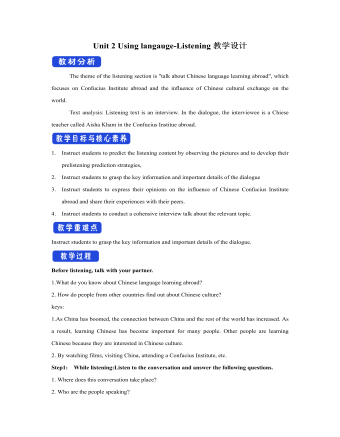
? B: Absolutely! Getting involved with Chinese cultural activities there definitely helped a lot. I got to practice my Chinese on a daily basis, and I could learn how native Chinese speakers spoke.? A: What do you feel is your biggest achievement?? B: Learning Chinese characters! I have learnt about 1,500 so far. When I first started, I didn't think it was even going to be possible to learn so many, but now I find that I can read signs, menus, and even some easy newspaper articles.? A: What are you most keen on?? B: I've really become keen on learning more about the Chinese culture, in particular Chinese calligraphy. As I have learnt Chinese characters, I have developed a great appreciation for their meaning. I want to explore Chinese characters by learning how to write them in a more beautiful way. ? A: Finally, what do you want to say to anyone interested in learning Chinese?? I have really become keen on learning more about the Chinese culture, in particular Chinese Calligraphy. As I have learnt Chinese character, I have developed a great appreciation for their meaning. I want to explore Chinese characters by learning how to write them in a more beautiful way.? A: Finally, what do you want to say to anyone interested in learning Chinese?? B: I'd say, give it a shot! While some aspects may be difficult, it is quite rewarding and you will be happy that you tried.? A: Thanks for your time. ? B:You're welcome.
新人教版高中英语选修2Unit 4 Learning about Language教学设计
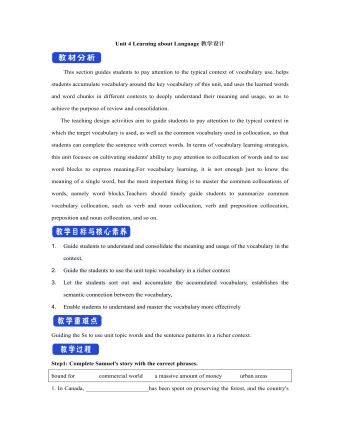
This section guides students to pay attention to the typical context of vocabulary use, helps students accumulate vocabulary around the key vocabulary of this unit, and uses the learned words and word chunks in different contexts to deeply understand their meaning and usage, so as to achieve the purpose of review and consolidation.The teaching design activities aim to guide students to pay attention to the typical context in which the target vocabulary is used, as well as the common vocabulary used in collocation, so that students can complete the sentence with correct words. In terms of vocabulary learning strategies, this unit focuses on cultivating students' ability to pay attention to collocation of words and to use word blocks to express meaning.For vocabulary learning, it is not enough just to know the meaning of a single word, but the most important thing is to master the common collocations of words, namely word blocks.Teachers should timely guide students to summarize common vocabulary collocation, such as verb and noun collocation, verb and preposition collocation, preposition and noun collocation, and so on.1. Guide students to understand and consolidate the meaning and usage of the vocabulary in the context, 2. Guide the students to use the unit topic vocabulary in a richer context3. Let the students sort out and accumulate the accumulated vocabulary, establishes the semantic connection between the vocabulary,4. Enable students to understand and master the vocabulary more effectivelyGuiding the Ss to use unit topic words and the sentence patterns in a richer context.
新人教版高中英语选修2Unit 5 Learning about Language教学设计
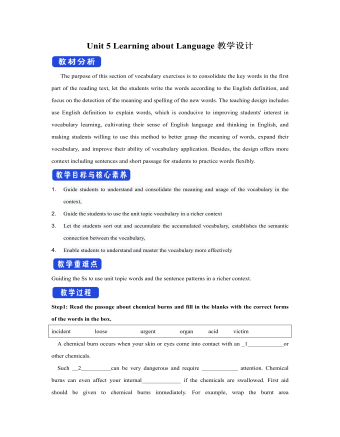
The purpose of this section of vocabulary exercises is to consolidate the key words in the first part of the reading text, let the students write the words according to the English definition, and focus on the detection of the meaning and spelling of the new words. The teaching design includes use English definition to explain words, which is conducive to improving students' interest in vocabulary learning, cultivating their sense of English language and thinking in English, and making students willing to use this method to better grasp the meaning of words, expand their vocabulary, and improve their ability of vocabulary application. Besides, the design offers more context including sentences and short passage for students to practice words flexibly.1. Guide students to understand and consolidate the meaning and usage of the vocabulary in the context, 2. Guide the students to use the unit topic vocabulary in a richer context3. Let the students sort out and accumulate the accumulated vocabulary, establishes the semantic connection between the vocabulary,4. Enable students to understand and master the vocabulary more effectivelyGuiding the Ss to use unit topic words and the sentence patterns in a richer context.Step1: Read the passage about chemical burns and fill in the blanks with the correct forms of the words in the box.
新人教版高中英语选修2Unit 5 Reading and thinking教学设计
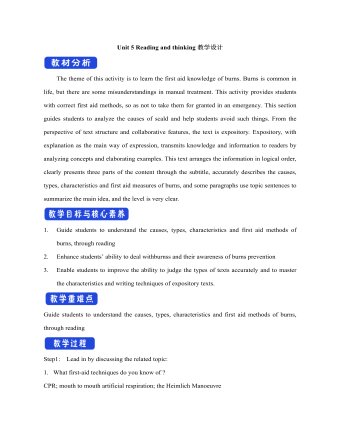
The theme of this activity is to learn the first aid knowledge of burns. Burns is common in life, but there are some misunderstandings in manual treatment. This activity provides students with correct first aid methods, so as not to take them for granted in an emergency. This section guides students to analyze the causes of scald and help students avoid such things. From the perspective of text structure and collaborative features, the text is expository. Expository, with explanation as the main way of expression, transmits knowledge and information to readers by analyzing concepts and elaborating examples. This text arranges the information in logical order, clearly presents three parts of the content through the subtitle, accurately describes the causes, types, characteristics and first aid measures of burns, and some paragraphs use topic sentences to summarize the main idea, and the level is very clear.1. Guide students to understand the causes, types, characteristics and first aid methods of burns, through reading2. Enhance students’ ability to deal withburnss and their awareness of burns prevention3. Enable students to improve the ability to judge the types of texts accurately and to master the characteristics and writing techniques of expository texts.Guide students to understand the causes, types, characteristics and first aid methods of burns, through readingStep1: Lead in by discussing the related topic:1. What first-aid techniques do you know of ?CPR; mouth to mouth artificial respiration; the Heimlich Manoeuvre
新人教版高中英语必修3Unit 1 Festivals and Celebrations教学设计三
*wide range of origins(= a great number of different origins, many kinds of origins)*It featured a parade and a great feast with music, dancing, and sports. (=A parade and a great feast with music, dancing, and sports were included as important parts of the Egyptian harvest festival.)*.. some traditions may fade away and others may be established.(= Some traditions may disappear gradually, while other new traditions may come into being.)Step 6 Practice(1) Listen and follow the tape.The teacher may remind the students to pay attention to the meaning and usage of the black words in the context, so as to prepare for the completion of the blanks in activity 5 and vocabulary exercises in the exercise book.(2) Students complete the text of activity 5 by themselves.The teacher needs to remind the students to fill in the blanks with the correct form of the vocabulary they have learned in the text.Students exchange their answers with their partners, and then teachers and students check their answers.(3)Finish the Ex in Activity 5 of students’ book.Step 7 Homework1. Read the text again, in-depth understanding of the text;2. Discuss the origin of festivals, the historical changes of related customs, the influence of commercial society on festivals and the connotation and essential meaning of festivals.3. Complete relevant exercises in the guide plan.1、通过本节内容学习,学生是否理解和掌握阅读文本中的新词汇的意义与用法;2、通过本节内容学习,学生能否结合文本特点快速而准确地找到主题句;3、通过本节内容学习,学生能否理清论说文的语篇结构和文本逻辑,了解节日风俗发展与变迁,感悟节日的内涵与意义。
新人教版高中英语选修2Unit 4 Reading for writing教学设计
假定你是英国的Jack,打算来中国旅行,请你给你的中国笔友李华写一封信,要点如下:1.你的旅行计划:北京→泰山→杭州;2.征求建议并询问他是否愿意充当你的导游。注意:1.词数80左右(开头和结尾已给出,不计入总词数);2.可以适当增加细节,以使行文连贯。参考词汇:故宫 the Forbidden City;泰山 Mount TaiDear Li Hua,I'm glad to tell you that 'm going to visit China.First,I am planning to visit Beijing,the capitalof China,where I am looking forward to enjoying the Great Wall,the Forbidden City and somebeautiful parks.Then I intend to go to visit Mount Tai in Shandong Province.I've heard that it is one ofthe most famous mountains in China and I can't wait to enjoy the amazing sunrise there.After that,I amalso going to Hangzhou.It is said that it is a beautiful modern city with breathtaking natural sights,among which the West Lake is a well- known tourist attraction.What do you think of my travel plan? Will you act as my guide? Hope to hear from you soon.
人教A版高中数学必修一正弦函数、余弦函数的图像教学设计(2)
由于三角函数是刻画周期变化现象的数学模型,这也是三角函数不同于其他类型函数的最重要的地方,而且对于周期函数,我们只要认识清楚它在一个周期的区间上的性质,那么它的性质也就完全清楚了,因此本节课利用单位圆中的三角函数的定义、三角函数值之间的内在联系性等来作图,从画出的图形中观察得出五个关键点,得到“五点法”画正弦函数、余弦函数的简图.课程目标1.掌握“五点法”画正弦曲线和余弦曲线的步骤和方法,能用“五点法”作出简单的正弦、余弦曲线.2.理解正弦曲线与余弦曲线之间的联系. 数学学科素养1.数学抽象:正弦曲线与余弦曲线的概念; 2.逻辑推理:正弦曲线与余弦曲线的联系; 3.直观想象:正弦函数余弦函数的图像; 4.数学运算:五点作图; 5.数学建模:通过正弦、余弦图象图像,解决不等式问题及零点问题,这正是数形结合思想方法的应用.
人教A版高中数学必修一正弦函数、余弦函数的性质教学设计(2)
本节课是正弦函数、余弦函数图像的继续,本课是正弦曲线、余弦曲线这两种曲线的特点得出正弦函数、余弦函数的性质. 课程目标1.了解周期函数与最小正周期的意义;2.了解三角函数的周期性和奇偶性;3.会利用周期性定义和诱导公式求简单三角函数的周期;4.借助图象直观理解正、余弦函数在[0,2π]上的性质(单调性、最值、图象与x轴的交点等);5.能利用性质解决一些简单问题. 数学学科素养1.数学抽象:理解周期函数、周期、最小正周期等的含义; 2.逻辑推理: 求正弦、余弦形函数的单调区间;3.数学运算:利用性质求周期、比较大小、最值、值域及判断奇偶性.4.数学建模:让学生借助数形结合的思想,通过图像探究正、余弦函数的性质.重点:通过正弦曲线、余弦曲线这两种曲线探究正弦函数、余弦函数的性质; 难点:应用正、余弦函数的性质来求含有cosx,sinx的函数的单调性、最值、值域及对称性.
人教A版高中数学必修一正切函数的图像与性质教学设计(2)
本节课是三角函数的继续,三角函数包含正弦函数、余弦函数、正切函数.而本课内容是正切函数的性质与图像.首先根据单位圆中正切函数的定义探究其图像,然后通过图像研究正切函数的性质. 课程目标1、掌握利用单位圆中正切函数定义得到图象的方法;2、能够利用正切函数图象准确归纳其性质并能简单地应用.数学学科素养1.数学抽象:借助单位圆理解正切函数的图像; 2.逻辑推理: 求正切函数的单调区间;3.数学运算:利用性质求周期、比较大小及判断奇偶性.4.直观想象:正切函数的图像; 5.数学建模:让学生借助数形结合的思想,通过图像探究正切函数的性质. 重点:能够利用正切函数图象准确归纳其性质并能简单地应用; 难点:掌握利用单位圆中正切函数定义得到其图象.
人教A版高中数学必修一函数模型的应用教学设计(2)
本节通过一些函数模型的实例,让学生感受建立函数模型的过程和方法,体会函数在数学和其他学科中的广泛应用,进一步认识到函数是描述客观世界变化规律的基本数学模型,能初步运用函数思想解决一些生活中的简单问题。课程目标1.能利用已知函数模型求解实际问题.2.能自建确定性函数模型解决实际问题.数学学科素养1.数学抽象:建立函数模型,把实际应用问题转化为数学问题;2.逻辑推理:通过数据分析,确定合适的函数模型;3.数学运算:解答数学问题,求得结果;4.数据分析:把数学结果转译成具体问题的结论,做出解答;5.数学建模:借助函数模型,利用函数的思想解决现实生活中的实际问题.重点:利用函数模型解决实际问题;难点:数模型的构造与对数据的处理.
人教A版高中数学必修一函数模型的应用教学设计(1)
本节课选自《普通高中课程标准实验教科书数学必修1本(A版)》的第五章的4.5.3函数模型的应用。函数模型及其应用是中学重要内容之一,又是数学与生活实践相互衔接的枢纽,特别在应用意识日益加深的今天,函数模型的应用实质是揭示了客观世界中量的相互依存有互有制约的关系,因而函数模型的应用举例有着不可替代的重要位置,又有重要的现实意义。本节课要求学生利用给定的函数模型或建立函数模型解决实际问题,并对给定的函数模型进行简单的分析评价,发展学生数学建模、数学直观、数学抽象、逻辑推理的核心素养。1. 能建立函数模型解决实际问题.2.了解拟合函数模型并解决实际问题.3.通过本节内容的学习,使学生认识函数模型的作用,提高学生数学建模,数据分析的能力. a.数学抽象:由实际问题建立函数模型;b.逻辑推理:选择合适的函数模型;c.数学运算:运用函数模型解决实际问题;
人教版高中数学选修3一元线性回归模型及其应用教学设计
1.确定研究对象,明确哪个是解释变量,哪个是响应变量;2.由经验确定非线性经验回归方程的模型;3.通过变换,将非线性经验回归模型转化为线性经验回归模型;4.按照公式计算经验回归方程中的参数,得到经验回归方程;5.消去新元,得到非线性经验回归方程;6.得出结果后分析残差图是否有异常 .跟踪训练1.一只药用昆虫的产卵数y与一定范围内的温度x有关,现收集了6组观测数据列于表中: 经计算得: 线性回归残差的平方和: ∑_(i=1)^6?〖(y_i-(y_i ) ?)〗^2=236,64,e^8.0605≈3167.其中 分别为观测数据中的温度和产卵数,i=1,2,3,4,5,6.(1)若用线性回归模型拟合,求y关于x的回归方程 (精确到0.1);(2)若用非线性回归模型拟合,求得y关于x回归方程为 且相关指数R2=0.9522. ①试与(1)中的线性回归模型相比较,用R2说明哪种模型的拟合效果更好 ?②用拟合效果好的模型预测温度为35℃时该种药用昆虫的产卵数.(结果取整数).
人教版高中数学选修3分类变量与列联表教学设计
一、 问题导学前面两节所讨论的变量,如人的身高、树的胸径、树的高度、短跑100m世界纪录和创纪录的时间等,都是数值变量,数值变量的取值为实数.其大小和运算都有实际含义.在现实生活中,人们经常需要回答一定范围内的两种现象或性质之间是否存在关联性或相互影响的问题.例如,就读不同学校是否对学生的成绩有影响,不同班级学生用于体育锻炼的时间是否有差别,吸烟是否会增加患肺癌的风险,等等,本节将要学习的独立性检验方法为我们提供了解决这类问题的方案。在讨论上述问题时,为了表述方便,我们经常会使用一种特殊的随机变量,以区别不同的现象或性质,这类随机变量称为分类变量.分类变量的取值可以用实数表示,例如,学生所在的班级可以用1,2,3等表示,男性、女性可以用1,0表示,等等.在很多时候,这些数值只作为编号使用,并没有通常的大小和运算意义,本节我们主要讨论取值于{0,1}的分类变量的关联性问题.