-
新人教版高中英语必修2Unit 1 Cultural Heritage-Reading and Thinking教案一
The theme of the reading and thinking is about “Understanding how a problem was solved”.The Listening & Speaking & Talking is about international co-work to protect the Mount Tai, in which the students from seven countries came up with many solutions even create the Mount Tai App. This section aims at showing how to solve a difficult and even tough problem about protecting the cultural heritage by the international co-work. So in this section, cultivating students’ international awareness is very clear and important. Concretely, with the economic development, how to balance the protection of cultural relics and social development is a big challenge for human. In the 1950s, the Egyptian government wanted to build the Aswan Dam across the Nile to control floods, produce electricity and water farms. But the proposal led to protests because it would destroy a lot of cultural relics. The Egyptian had no choice but ask the UN for help. Therefore, a international cooperation about how to protect the cultural relics began, which involved the time length about 20 years and a large amount of fund. Then, the problems was solved. 1. Read quickly to get the main idea and the structure of the article; read careful to get detailed information.2. Learn to use the reading strategy---making a timeline3. Learn how to solve a tough problem by asking for help and cooperation4. Have the international awareness and understand the great strength of international cooperation.1. Read quickly to get the main idea and the structure of the article; read careful to get detailed information.2. Learn to use the reading strategy---making a timeline.3. Learn how to solve a tough problem by asking for help and cooperation.
新人教版高中英语必修2Unit 2 Wildlife Protection-Discovering Useful Structure教案一
The activity topic of this section is "report an ongoing event", and the structure is the passive voice of present continuous tense. Rare wild animals are suffering from large-scale poaching, and species are on the brink of danger. Rescue operations are underway. "Being" and "suffering" are the meanings of the present progressive passive voice.The usage of present progressive passive voice is of great importance in writing a good discourse and appreciating some difficult language items, so it is vital to master it and use it flexibly in a context.1. Motivate Ss to deepen the understanding of the usage of present progressive passive voice in a fixed context.2. Enable Ss to master the usage of present progressive passive voice and use it flexibly in a context.3. Lead Ss to construct sentences or appreciate sentences used master it and use it flexibly in a context.1. Help students to appreciate the function of the usage of present progressive passive voice in a sentence2. Instruct students to write essays using the proper usage of present progressive passive voice.Look at the picture and tell me what are workers doing? What is the house being done?
新人教版高中英语必修2Unit 2 Wildlife Protection-Reading and Thinking教案一
The listening and speaking part aims at how to protect and help endangered animals by listening, speaking and talking about the facts and reasons. This lesson analyzes the decreasing clause of Tibetan antelope population and the measures of protecting Tibetan antelopes. So students can be guided to learn to analyse the title and use different reading skills or strategies, like scanning, skimming and careful reading.1. Read quickly to get the main ideas and the purpose of going to Tibetan; read carefully to understand what the author see and think.2. Understand the sentences of the present continuous passive voice such as “Much is being done to protect wildlife.” and the inverted sentence “Only when we learn to exist in harmony with nature can we stop being a threat to wildlife and to our planet.”3. Enhance the awareness of protecting wildlife.4. Cultivate the reading methods according to different materials.1. Read quickly to get the main ideas and the purpose of going to Tibetan; read carefully to understand what the author see and think.2. Understand the sentences of the present continuous passive voice such as “Much is being done to protect wildlife.” and the inverted sentence “Only when we learn to exist in harmony with nature can we stop being a threat to wildlife and to our planet.”3. Cultivate the reading methods according to different materials.Step 1 Leading-inWatch a video about elephants and whales and then ask:Why are they endangered ? They are killed/hunted
新人教版高中英语必修2Unit 2 Wildlife Protection-Listening &Speaking&Talking教案
Listening and Speaking introduces the topic of “how to save endangered wildlife and help wildlife in their neighborhood.” Due to the continuous deterioration of the living environment, a large number of wild animals are always facing the threat of endangered or extinction. Listening and speaking period enables students to understand the fact and reason why wild species are disappearing from the earth at an amazing speed, and realize that human beings ought to enhance the awareness of protecting wild species as soon as possible.Listening and Talking introduces the theme of " how to help wildlife in Ss’ neighborhood.". Now there are many volunteers who spontaneously protect wild animals, carry out various activities according to local conditions, and contribute their own strength to local animal protection with practical actions. Middle school students are also enthusiastic participants. They organize activities in their spare time, and take this opportunity to make friends, broaden their horizons, cultivate team spirit and communication skills. This section describes a bird watching activity organized by several middle school students of Bird watching Club. It aims to stimulate students' interest, improve their understanding of bird watching activities, and use the language structure of “being used for; in order to, so as to, to, so that, in order that ” to express the purpose for communication and discussion.1. Guide students to understand the content of listening texts in terms of using visuals to predict content.2. Cultivate students' ability to guess the meaning of words in listening; discuss with their peers how to save endangered wildlife and help wildlife in their neighborhood.3. Instruct students to use functional sentences of the dialogue such as “I am concerned about…” “what do you know about the endangered animals in…" and so on to talk about one of the endangered animals.
新人教版高中英语必修2Unit 2 Wildlife Protection-Listening and Speaking教案
This lesson is about wildlife protection. The listening and speaking is about “How to protect endangered wildlife ?” Faced with the facts and numbers of wildlife loss, people begin to detect the reasons, then people such as the celebrities (Prince William and Yao Ming) are calling on to protect them. So students are guided to enhance the awareness of protecting wildlife and try to take part in some volunteer activities of protecting wildlife.1. Predict the content by using visuals. 2. Learn to use the sentences such as “I’m concerned about.... But now they are in danger. I want to know the reasons/why./ What can we do to protect them ?3. Learn from the stars like Prince William and Yao Ming and enhance the awareness of protecting wildlife.4. Guide students to try to put forward the solutions to the problems of wildlife protection and then discuss them with partners and present the results of discussion.5. Master the pronunciation of stressed syllables.1. Learn from the stars like Prince William and Yao Ming and enhance the awareness of protecting wildlife.2. Guide students to try to put forward the solutions to the problems of wildlife protection and then discuss them with partners and present the results of discussion.3. Learn to use the sentences such as “I’m concerned about.... But now they are in danger. I want to know the reasons/why./ What can we do to protect them ?4. Master the pronunciation of stressed syllables.Part A Listening and Speaking--- How to save endangered wildlifeStep 1 Lead in1. Point at the pictures on P14 and ask Q1: What message do these posters share?
新人教版高中英语必修2Unit 4 History and Traditions-Discovering Useful Structure教案一
Step 5 Practice一、完成下列句子。1. Judy and I _______________(把车停下来(park))in an underground car Park near Trafalgar Square, where we could ______________________(让我们的车充电(charge)).2. When we finally reached the service desk to ask for audio guides, we heard it ___________ that there were no audio guides____________(留下,剩下).3. We__________________________(发现自己对...很惊讶)the large number of visitors and the amount of noise at the entrance of the National Gallery.4. Judy ____________________(眼神专注于) Van Gogh’s Sunflowers. It was hard to approach the painting as there were so many people around.5. She ____________________(把这幅画的复制品装箱(box)) to ensure that it was delivered safely.答案:1.had our car parked get our car battery charged 2. announced left 3. found ourselves very surprised 4. had her eyes fixed on 5. had a copy of the painting boxed二、用过去分词对下列句子进行改写。1. Loch Ness was surrounded by beautiful natural landscape, which made it look amazing.2. Carl and his friend stayed with a generous family who offered them bread with butter and honey that was homemade.3. The family’s ancestors once attended to soldiers who were wounded in the First World War.4. The young people were attracted by the legend of Loch Ness. They watched over the lake with their cameras and binoculars, which were positioned on the hill.答案:1. Loch Ness surrounded by beautiful natural landscape looks amazing.2. Carl and his friends stayed with a generous family who offered them homemade bread with butter and honey.3. The family’s ancestors once attended to wounded soldiers in the First World War.4. The young people attracted by the legend of Loch Ness watched over the lake with their cameras and binoculars positioned on the hill.
新人教版高中英语必修2Unit 4 History and Traditions-Listening&Speaking&Talking教案一
This unit is about history and traditions. From the opening page, we can know that this unit will introduce the history and traditions around the world. As Marcus Garvey says “A people without the knowledge of their past history, origin and culture is like a tree without roots”, it is important for students to realize the importance and value of knowing the history and traditions and their further meanings. And this part ( listening and speaking ) is divided into two parts: Part A---share views on historic sites, Part B ---talk about a visit to a historic tourist destination. By talking with a foreigner, the speakers introduce the historic attractions and their cultures. Part A is that William, a British student, who was going to visit the Confucius Temple and a Chinese student, Xiao Kong, who was going to the Confucius Temple to meet with the members of the research group, went together and exchanged their views on the Confucius Temple, Confucius, Confucius' descendants and Confucius' educational thoughts. Part B is a conversation between Xiao Yan, a youth hostel receptionist and Paul, a backpacker about the feelings and experience after visiting the Chinese famous tourist attraction Pingyao.1. Guide students to understand the content of listening texts in terms of the whole and key details; 2. Cultivate students' ability to guess the meaning of words in listening; discuss with their peers how to talk about historic spots and great person.3. Instruct students to use functional sentences of showing one’s excitement, surprise and disappointment.1. Guide students to understand the content of listening texts in terms of the whole and key details; 2. Cultivate students' ability to discuss with their peers the related topics.3. Enable students to use the functional items of showing one’s excitement, surprise and disappointment.
新人教版高中英语必修2Unit 4 History and Traditions-Reading and Thinking教案一
Features of languages1.Finally, in the 20th century, the southern part of Ireland broke away from the UK, which resulted in the full name we have today: the United Kingdom of Great Britain and Northern Ireland.该句是一个复合句。该句主句为:the southern part of Ireland broke away from the UK;which resulted in the full name we have today为which引导的定语从句代指前面整句话的内容,we have today为定语从句修饰先行词name。译文:最后,在20世纪,爱尔兰南部脱离英国,这导致了我们今天有的英国的全名:大不列颠及北爱尔兰联合王国。2.Almost everywhere you go in the UK, you will be surrounded by evidence of four different groups of people who took over at different times throughout history.该句是一个复合句。该句主句为:you will be surrounded by evidence of four different groups of people;其中Almost everywhere you go in the UK为让步状语从句; who took over at different times throughout history为定语从句修饰先行词people。译文:几乎无论你走到英国的任何地方,你都会发现历史上有四种不同的人在不同的时期统治过英国。3.The capital city London is a great place to start, as it is an ancient port city that has a history dating all the way back to Roman times.该句是一个复合句。该句主句为:The capital city London is a great place to start; as it is an ancient port city that has a history dating all the way back to Roman times.为原因状语从句;dating all the way back to Roman times为现在分词短语作定语修饰history。
新人教版高中英语必修2Unit 4 History and traditions教案
这个地区有着深厚的传统。既学既练:为了让更多的外国游客了解中国文化,欣赏中国美丽的自然风光,感受中国发生的巨大变化,某外文杂志社将出版一本英语小册子来介绍中国的旅游景点。该杂志社邀请你为该小册子写一篇英语短文来介绍杭州,内容包括:1.杭州的位置(中国东南部)、面积(16 000多平方公里)及历史(2 200多年)等;2.杭州的旅游特色(自然风景、传统文化、特色小吃等);3.希望更多的游客来杭州参观。注意:1.词数80左右;2.可适当增加细节,以使行文连贯。Located in the southeast of China, Hangzhou is a beautiful city.Dating back more than 2,200 years, Hangzhou covers an area of more than 16,000 square kilometers.In Hangzhou, you can visit the West Lake, whose scenery is fascinating.In addition, you can’t miss its cultural relics and historical sites, from which you will learn more about excellent Chinese traditional culture and traditions.In Hangzhou, the special snacks are famous and visitors from different parts of the world think highly of them.As a tourist attraction, Hangzhou attracts a large number of visitors from home and abroad every year.Once you come to China, Hangzhou is a scenic spot you can’t miss.
新人教版高中英语必修1Unit 1 Teenage Life-Reading and Thinking教案
【教材分析】The topic of this unit is about teenage life, which belongs to the theme context of “humans and oneself”.As teenagers who shoulder the responsibility of “Chinese great dream”, they must fully know themselves, including their strengths, weaknesses and challenges etc. They are supposed to improve themselves continuously and readily study their subjects, and thus foster their strategies and confidence in lifelong studies.This period is entitled the freshmen challenges, which mainly concerns some big challenges for new students in Senior high school. In this period, a teacher should lead students to find out what their challenges are and guide them to figure out how to crack the challenges and better themselves. More importantly, a teacher should instruct students to absorb new language points and appreciate the language. Besides, a teacher must instruct students to acquire some skills concerning reading efficiently and inspire them to talk more about their new school life, especially their new problems and solutions both at school and in life.【教学目标与核心素养】1. Enable students to acquire the basic usage of the new words and expressions concerning the freshmen challenges and learn to use them flexibly.2. Enable students to have a good understanding of the freshmen challenges in the new senior high school which is quite different from junior middle school.3. Develop students’ sense of cooperative learning and individual thinking capability. 4. Develop students’ different learning skills to solve different reading comprehensive problems.
新人教版高中英语必修1Welcome Unit-Discovering Useful Structures教案
II Learn the technical terms-2.1. What can be used as “Subject, Object, Predicative, Direct Object, Indirect Object and objective complement” in a sentence?2. What can be used as “adverbial” in a sentence?3. What can be used as “verb” in a sentence?Answers to questions 1-3:1. Nouns, pronouns and appellations can be used as “Subject, Object, Predicative, Direct Object, Indirect Object and Objective Complement”. Besides, adjectives can be used as “Predicative and Objective Complement” in a sentence.2. Adverbs and prepositional phrases can be used as “Adverbial”.3. Verbs with actual meaning can be used as “Verb” in a sentence. Auxiliary verbs alone cannot be used as “Verb” in a sentence.III Learn to recognize the sentence structures.1. SV structure. For Example:(1) A bird flies.S V(2) A monkey jumps.S V(3) A fish swims.S V√ In SV structures, verbs are “intransitive verbs”.2. SVO structure. For Example:(1) A sheep eats grass.S V O(2) They like bananas.S V O(3) He wants candy.S V O√ In SVO structures, verbs are “transitive verbs”.3. SP structure. For Example:(1) This is great.S P (2) He looks well.S P (3) She became a teacher.S P √ In SP structures, Predicatives are formed by “link verbs” and “adjectives or nouns”.√ link verbs: be, become, grow, look, feel, taste, etc.4. SV IO DO structure. For Example:(1) He asked me a question.S V IO DO(2) Danny wrote me a letter.S V IO DO(3) Billy brought Sam a kite.S V IO DO√ In SV IO DO structures, the verbs are transitive and are followed by two objectives – pronouns or nouns as Indirect Objective, and nouns as Direct Objectives.
新人教版高中英语必修1Welcome Unit-Discovering Useful Structures & Listening and Talking教案
常跟双宾语的动词有:(需借助to的)bring, ask, hand, offer, give, lend, send, show, teach, tell, write, pass, pay, promise, return等;基本句型 五S +V + O + OC(主+谓+宾+宾补)特点:动词虽然是及物动词,但是只跟一个宾语还不能表达完整的意思,必须加上一个补充成分来补足宾语,才能使意思完整。 判断原则:能表达成—宾语 是…/做…注:此结构由“主语+及物的谓语动词+宾语+宾语补足语”构成。宾语与宾语补足语之间有逻辑上的主谓关系或主表关系,若无宾语补足语,则句意不够完整。可以用做宾补的有:名词,形容词,副词,介词短语,动词不定式,分词等。如:He considers himself an expert on the subject.他认为自己是这门学科的专家。We must keep our classroom clean.我们必须保持教室清洁。I had my bike stolen.我的自行车被偷了。We invited him to come to our school.我们邀请他来我们学校。I beg you to keep secret what we talked here.我求你对这里所谈的话保密。用it做形式宾语,而将真正的宾语放到宾语补足语的后面,以使句子结构平衡,是英语常用的句型结构方式。即:主语+谓语+it+宾补+真正宾语。如:We think it a good idea to go climb the mountain this Sunday.
新人教版高中英语必修2Unit 1 Cultural Heritage-Listening&Speaking&Talking教案
Listening and Speaking introduces the topic of “Take part in a youth project”. The listening text is an interview about an international youth cultural heritage protection project. More than 20 high school students from seven countries participated in the project. The reporter interviewed two participants Stephanie and Liu Bin. By listening to the text, students can understand the significance of cultural heritage protection, and teenagers can use their knowledge, combine their own interests and advantages, etc. to participate in the action of cultural heritage protection. Listening and Talking introduces the theme of "Talk about history and culture". The listening text is a dialogue between two tourists and tour guides when they visit the Kremlin, red square and surrounding buildings. The dialogue focuses on the functional items of "starting a conversation", which is used to politely and appropriately attract the attention of the others, so as to smoothly start a conversation or start a new topic. The purpose of this section is to guide students to understand the history and current situation of Chinese and foreign cultural heritage in their own tourism experiences or from other people's tourism experiences, explore the historical and cultural values, and be able to express accurately and appropriately in oral communication.1. Guide students to understand the content of listening texts in terms of the whole and key details; 2. Cultivate students' ability to guess the meaning of words in listening; discuss with their peers how to participate in cultural heritage protection activities.3. Instruct students to use functional sentences of the dialogue such as “I beg your pardon, but…” “Forgive me for asking, but…" and so on to start the conversation more politely and appropriately.
人教版高中数学选修3分类加法计数原理与分步乘法计数原理(2)教学设计
当A,C颜色相同时,先染P有4种方法,再染A,C有3种方法,然后染B有2种方法,最后染D也有2种方法.根据分步乘法计数原理知,共有4×3×2×2=48(种)方法;当A,C颜色不相同时,先染P有4种方法,再染A有3种方法,然后染C有2种方法,最后染B,D都有1种方法.根据分步乘法计数原理知,共有4×3×2×1×1=24(种)方法.综上,共有48+24=72(种)方法.故选B.答案:B5.某艺术小组有9人,每人至少会钢琴和小号中的一种乐器,其中7人会钢琴,3人会小号,从中选出会钢琴与会小号的各1人,有多少种不同的选法?解:由题意可知,在艺术小组9人中,有且仅有1人既会钢琴又会小号(把该人记为甲),只会钢琴的有6人,只会小号的有2人.把从中选出会钢琴与会小号各1人的方法分为两类.第1类,甲入选,另1人只需从其他8人中任选1人,故这类选法共8种;第2类,甲不入选,则会钢琴的只能从6个只会钢琴的人中选出,有6种不同的选法,会小号的也只能从只会小号的2人中选出,有2种不同的选法,所以这类选法共有6×2=12(种).因此共有8+12=20(种)不同的选法.
人教版高中数学选修3分类加法计数原理与分步乘法计数原理(1)教学设计
问题1. 用一个大写的英文字母或一个阿拉伯数字给教室里的一个座位编号,总共能编出多少种不同的号码?因为英文字母共有26个,阿拉伯数字共有10个,所以总共可以编出26+10=36种不同的号码.问题2.你能说说这个问题的特征吗?上述计数过程的基本环节是:(1)确定分类标准,根据问题条件分为字母号码和数字号码两类;(2)分别计算各类号码的个数;(3)各类号码的个数相加,得出所有号码的个数.你能举出一些生活中类似的例子吗?一般地,有如下分类加法计数原理:完成一件事,有两类办法. 在第1类办法中有m种不同的方法,在第2类方法中有n种不同的方法,则完成这件事共有:N= m+n种不同的方法.二、典例解析例1.在填写高考志愿时,一名高中毕业生了解到,A,B两所大学各有一些自己感兴趣的强项专业,如表,
大班语言教案:《m, f》教学设计
2.学会声母“b”和单韵母“a”拼读音节的方法。 3.学会拼读“b p m f”与“u、o”组成的音节。 教学难点 掌握拼读声母和韵母组成的音节。 教学过程 一、谈话导入 我们已经认识了韵母家族的6个朋友(出示a o e i u ü)一起读读,你们读得真准,能不能按字母顺序摆一摆,再按顺序读一读。你们记得真清楚。这节课我们一起到拼音王国里再认识四个声母家族的朋友,你们愿意吗? 二、学习“b p m f ”的音形 (一)学习“b”的音形 1.出示“b”的图 (1)引导学生提问:图上的小朋友在干什么? (2)问:这个字母念什么?学生试读“b”。 (3)讲:听广播的“播”读得轻短些,发音时,把两片嘴闭合,把气 憋住,然后突然放开,让气流冲出双唇就是“b”的音。 (4)教师范读。 (5)学生学读,体会发音方法。 (6)开火车读。 2.学习“b”的形 (1)引导学生提问:怎样记住“b”的形?或“b”与图中的哪一部分很像? (2)你们能编一个记忆“b”的小儿歌吗? 拉开天线听广播“b b b”。 右下半圆“b b b”。 6字“b”。…… 3.指导书写b(1)讲:我们先认识一个字母基本笔画:“丨”上竖。 (2)请同学们观察书中字母“b”先写哪笔,再写哪笔,几笔写成?占什么格?同桌同学互相说说。(3)学生说笔顺、位置,教师范写,强调“b”的第一笔在上格的三分之一处起笔到第三条线停笔。 (4)学生书空笔顺。 (5)学生在拼音本上抄字头。教师行间巡视,进行个别辅导。纠正学生的写姿和执笔方法。对姿势正确的学生及时表扬鼓励。
大班语言教案:《i,u,ü》教学设计
2、学会正确认读i、u、ü的带调韵母。知道ü上标声调时,上面的小圆点不写。3、会在四线格里抄写i、u、ü三个单韵母。课时安排:2课时第一课时 教学目标:教学单韵母i、u并抄写。 教学过程: 一、 复习检查。 1、猜谜语。 (1)白鹅倒影是什么韵母? (2)圆脸小姑娘,小辫右边扎。这是什么韵母? (3)像个圆圈是什么韵母? 2、抽读字母卡片。 二、 教学单韵母i。 1、看图说话引出i。 图上画着什么?图上画着一件衣服。i的发音与“衣”的音相同。 2、教学i的发音,认清字形。 (1)发音要领:发音时嘴比发e时开得更小,只留一条小缝,舌前部升高,接近上腭,舌尖抵住下齿背,让气从舌尖和上腭中间自然流出。 (2)教师范读、领读。 (3)记忆字形。 i像什么?顺口溜:“像支蜡烛i、i、i。” 3、书写指导:先写竖,再写点,两笔写成。 三、 教学单韵母u。 1、看图说话引出u。 图上画着什么?“树上有一只乌鸦。”乌鸦的“乌”就是u。 2、教学u的发音,认清字形。 (1)发音要领:发音时把嘴唇收拢,嘴唇比发o时更圆更小,舌尖后缩,舌根抬高,让气从小洞中出来。 (2)教师范读,领读。 (3)记忆字形。 可用顺口溜:“像只茶杯u、u、u。” 3、书写指导:u一笔写成。 四、 巩固复习。
扇形统计图教案教学设计
教学目标1、明确扇形统计图的制作步骤,能够根据相关数据较为准确地制作扇形统计图.2、进一步理解扇形统计图的特点,建立百分比大小和扇形圆心角大小之间初步的直观敏感度.3、能够实现不同统计图数据间的合理转换,再次体会几种统计图的不同特点,为合理选择统计图表示数据打下一定的基础.4、通过实例,理解三种统计图的特点,能根据具体问题选择合适的统计图清晰、有效地描述数据.5、在统计活动的过程中,通过相互间的合作与交流,掌握画统计图和选择统计图的方法;经历数据的收集、整理和简单分析、作出决策的统计活动过程,发展统计观念.6、通过对现实生活中的数据分析,感受数学与现实生活的密切联系,说出统计图在现实生活中的应用,提高学习数学兴趣.
学做家常菜教学设计教案
小学五年级的学生应该具备一些生活技能, 学做家常菜是我们生活的必需,是每个,人都应该掌握的生存技能。本主题的目的通过学习做简单的家常菜,引领小学生走进家务劳动,锻炼生活的自理能力和提高适应生活的能力,体会生活和学习的乐趣,激发学生将学校学习和家务劳动密切结合起来,形成积极的生活和学习的态度。本主题安排了“问题与思考”“学习与探究”“实践与体验”总结与交流“拓展与创新”五个环节,从提出问题开始,到探究与体验,最后到学有所用,循序渐进,引导学习走进中式餐饮文化,学做日常生活中的家常菜,掌握劳动的技能和方法,体验做家务劳动带来的快乐和享受,激发学生对家常菜的探究与实践的兴趣,逐步掌握日常生活所需的基本技能,培养热爱劳动、热爱生活的意识。
认识三角形教案教学设计
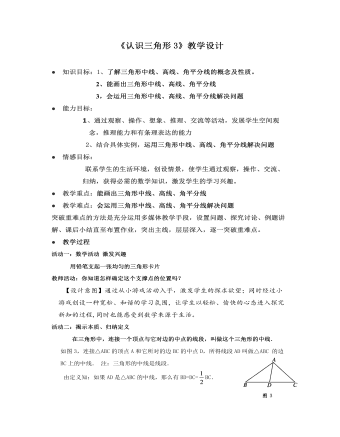
四个同学为一个合作小组;每个小组利用教师为其准备的各类三角形,作出它们的高.比一比,看哪一个小组做得最快,发现的结论多. 师生行为:学生操作、讨论,教师巡视、指导,使学生理解【设计意图】通过让学生操作、观察、推理、交流等活动,来培养学生的动手、动脑能力,发展其空间观察.活动结论:1.锐角三角形的三条高都在三角形内; 2.直角三角形的一条高在三角形内(即斜边上的高),而另两条高恰是它的两条直角边; 3.钝角三角形的一条高在三角形内,而另两条高在三角形外.(这是难点,需多加说明) 总之:任何三角形都有三条高,且三条高所在的直线相交于一点.(我们把这一点叫垂心)课堂小结 1.三角形中三条重要线段:三角形的高、中线和角平分线的概念. 2.学会画三角形的高、中线和角平分线.