-
新人教版高中英语必修1Welcome Unit-Discovering Useful Structures教案
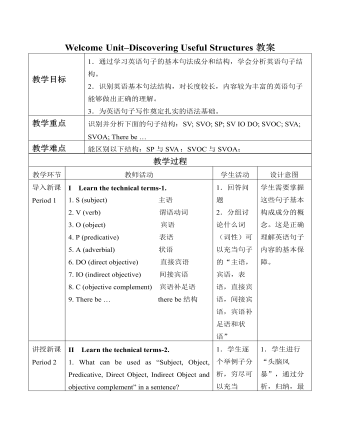
II Learn the technical terms-2.1. What can be used as “Subject, Object, Predicative, Direct Object, Indirect Object and objective complement” in a sentence?2. What can be used as “adverbial” in a sentence?3. What can be used as “verb” in a sentence?Answers to questions 1-3:1. Nouns, pronouns and appellations can be used as “Subject, Object, Predicative, Direct Object, Indirect Object and Objective Complement”. Besides, adjectives can be used as “Predicative and Objective Complement” in a sentence.2. Adverbs and prepositional phrases can be used as “Adverbial”.3. Verbs with actual meaning can be used as “Verb” in a sentence. Auxiliary verbs alone cannot be used as “Verb” in a sentence.III Learn to recognize the sentence structures.1. SV structure. For Example:(1) A bird flies.S V(2) A monkey jumps.S V(3) A fish swims.S V√ In SV structures, verbs are “intransitive verbs”.2. SVO structure. For Example:(1) A sheep eats grass.S V O(2) They like bananas.S V O(3) He wants candy.S V O√ In SVO structures, verbs are “transitive verbs”.3. SP structure. For Example:(1) This is great.S P (2) He looks well.S P (3) She became a teacher.S P √ In SP structures, Predicatives are formed by “link verbs” and “adjectives or nouns”.√ link verbs: be, become, grow, look, feel, taste, etc.4. SV IO DO structure. For Example:(1) He asked me a question.S V IO DO(2) Danny wrote me a letter.S V IO DO(3) Billy brought Sam a kite.S V IO DO√ In SV IO DO structures, the verbs are transitive and are followed by two objectives – pronouns or nouns as Indirect Objective, and nouns as Direct Objectives.
新人教版高中英语必修1Unit 4 Natural Disasters-Reading & Thinking教案
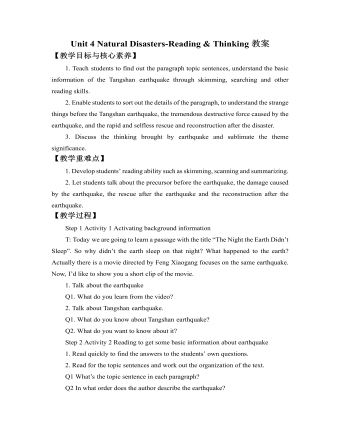
5. Read to get detailed information about Paragraph 5.Q1. What shows the revival of Tangshan?Q2. How can Tangshan revive itself and get up on its feet again?Q3. In times of disasters, how can we go through it?T: In times of disasters, we should unify, show the wisdom and stay positive.Step 4 Activity 4 Highlighting the theme and reflecting1. Make a summary of the text.2. Further understand the titleQ: After our learning, why do you think the earth didn’t sleep on that night?T: An earthquake happened. The people in the earthquake suffered a lot, and the people outside Tangshan were concerned about the people there a lot.3. Reflect through discussion on what can be learnt after reading.T: Disasters are powerful. Unpreparedness can be deadly. Life is weak, but if people work together to help each other, disasters can be defeated.There is no love from disaster, but we have love in the human heart.Step 5 Assignment How does the writer convey that the earthquake was deadly, and that people were helpless during the earthquake? Try to find some attractive and impressive expressions and note them down.
新人教版高中英语必修1Unit 5 Languages Around the World-Reading and Thinking教案
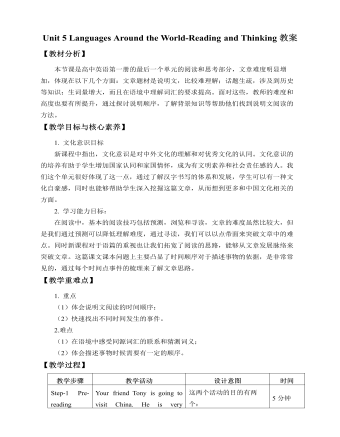
【教材分析】本节课是高中英语第一册的最后一个单元的阅读和思考部分,文章难度明显增加,体现在以下几个方面:文章题材是说明文,比较难理解;话题生疏,涉及到历史等知识;生词量增大,而且在语境中理解词汇的要求提高。面对这些,教师的难度和高度也要有所提升,通过探讨说明顺序,了解背景知识等帮助他们找到说明文阅读的方法。【教学目标与核心素养】1. 文化意识目标新课程中指出,文化意识是对中外文化的理解和对优秀文化的认同。文化意识的的培养有助于学生增加国家认同和家国情怀,成为有文明素养和社会责任感的人。我们这个单元很好体现了这一点,通过了解汉字书写的体系和发展,学生可以有一种文化自豪感,同时也能够帮助学生深入挖掘这篇文章,从而想到更多和中国文化相关的方面。2. 学习能力目标
新人教版高中英语必修1Welcome Unit-Reading and Thinking教案
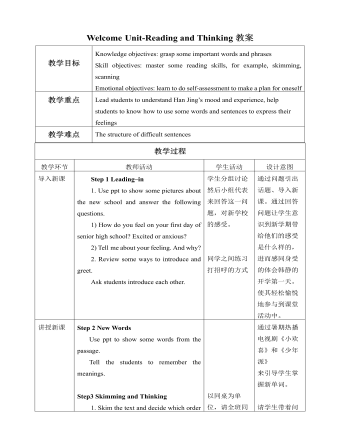
Step 2 New WordsUse ppt to show some words from the passage.Tell the students to remember the meanings.Step3 Skimming and Thinking1. Skim the text and decide which order Han Jing follows to talk about her first day. Time order or place order?Time order2. What is Han Jing worried about before she goes to senior high school?She is worried about whether she will make new friends and if no one talks to her, what she should do.Step 4 Fast Reading1. Match the main ideas with each paragraphParagraph 1:The worries about the new school day Paragraph 2Han Jing’s first maths classParagraph 3Han Jing’s first chemistry classParagraph 4Han Jing’s feelings about her first senior school dayStep 5 Careful Reading1. Fill in the chart with the words and phrases about Han Jing’s day. Answers: Senior high school, a little nervous; Her first maths class, classmates and teachers, friendly and helpful; Chemistry lab; new; great; annoying guy; Confident; a lot to explore2. Read the text again and discuss the questions.1) Why did Han Jing feel anxious before school?Because she was a new senior high student and she was not outgoing. What was more, she was worried about whether she can make friends.2) How was her first maths class?It was difficult but the teacher was kind and friendly. 3) What happened in the chemistry class? What would you do if this happened to you? A guy next to Han Jing tried to talk with her and she couldn’t concentrate on the experiment.
新人教版高中英语必修1Unit 4 Natural Disasters-Discovering Useful Structures教案
【教材分析】This teaching period mainly deals with the grammar: the restrictive relative clauses.This period carries considerable significance to the cultivation of students’ writing competence and lays a solid foundation for the basic appreciation of language beauty. The teacher is expected to enable students to master this period thoroughly and consolidate the knowledge by doing some exercise of good quality.【教学目标与核心素养】1. Get students to have a good understanding of the basic usages of the restrictive relative clauses.2. Enable students to use the restrictive relative clauses flexibly.3. Develop students’ speaking and cooperating abilities.4. Strengthen students’ great interest in grammar learning.【教学重难点】How to enable students to have a good understanding of the restrictive relative clauses, especially the uses of the relative words such as which, that, who, whom.【教学过程】Step1: 语法知识呈现定语从句(一)—关系代词的用法在复合句中, 修饰名词或代词的从句叫定语从句。定语从句通常由关系代词或关系副词引导,说明事物的具体信息,从句位于被修饰词之后。被定语从句修饰的词叫先行词,引导定语从句的词叫关系词,关系词指代先行词,并在定语从句中充当成分。关系词有两种:关系代词who, whom ,whose, that, which, as和关系副词when, where, why。
新人教版高中英语必修1Unit 4 Natural Disasters-Listening and Speaking教案
【教材分析】高考听力材料的选用非常重视语言真实性和交际性的原则,语言材料一般来源于实际生活,对话的内容大都取材于日常生活,即衣、食、住、行、工作、学习、天气、生活环境等话题,可分为校园、公共场所、家庭等方面,如: shopping, finding the way, doing one’s homework, seeing a doctor, making a phone call, weather report, asking for different kinds of information等。新教材的特点就是利用生活中真实文本,只是降低难度,让学生注重语言的应用,将是我们高考把握方向的重要因素。【教学目标与核心素养】学习能力目标:在听力当中,学生应该有效规划学习方法,选择恰当的策略与方法。这节课的训练目标是让学生有正确的预测和抓住问题的关键信息,从而用心去听来找寻关键信息。根据生活中实际情况和高考常见语境,我们不难发现提前预测和抓住题干中的w很重要,即what, where, when, why等等。
新人教版高中英语必修1Unit 5 Languages Around the World-Reading for Writing教案
Step 3: Read to sum upRead it again and sum up the problems of the three students, and then write down the advice that was given from others.Step 4: Work in pairs. List your learning problems in English and brainstorm some useful advice.Useful expressions ? I don't know how to…... Is a big difficulty for me. I cannot ...? You might try …. It's very important to…? I have no idea how/what .My biggest problem is .... ? I (also) have trouble with. My advice is …. This worked for me.? l cannot understand the teachers’ English in class.Step 5 Homework:为提高我校学生的英语口语水平,我们将举办英语演讲比赛(English- speaking contest),请你根据下面的信息,以学生会(the Students‘ Union)的名义写一份海报,欢迎全校同学参加,届时特邀本校美籍教师史密斯先生颁奖。? 报名时间 9月30日以前(报名:signup)? 报名地点 学生会办公室? 比赛时间 10月9日晚7:00~9:00? 比赛地点 学校大会议室? 奖励 前8名
新人教版高中英语必修1Welcome Unit-Reading for Writing教案
教学目标知识目标:让学生更好理解如何恰当地写一个人的信息介绍,并能让学生熟练地使用一些写作技能。能力目标:培养学生的写作能力和团队协作能力。情感目标:提升学生对写作的兴趣。教学重难点 教学重点:如何能让学生更好地理解个人信息介绍。教学难点:如何能让学生通过适当地使用一些写作技能来写一篇较好的个人信息介绍。教学准备 多媒体、黑板、粉笔一、Pre-class1. Greetings2. Leading-inAsk students how to write a profile. What kinds of aspects should be included? The teacher asks students to discuss the topic with each other and put forward to much more ideas about the answer.二、While-class1. The teacher lets students to read the student profiles on Page 8 silently and then asks students to discuss the questions below.1. What is Ann like? How do you know?2. What are Thando’s hobbies?3. Where does Thando come from?4. What is Thando’s dream?5. What does “You will never see me without a book or a pen” mean?
人教版高中历史必修3启蒙运动教案2篇
教学目标:1、知识与能力:(1)识记:理性、启蒙运动;伏尔泰、孟德斯鸠、卢梭等伟大的启蒙思想家及其主张;康德及启蒙运动的影响;(2)理解启蒙运动兴起的背景,分析启蒙思想的巨大影响;(3)认识上层建筑对社会发展的巨大反作用。2、过程与方法:(1)指导学生用表格法掌握启蒙运动主要代表人物及其思想主张;(2)运用比较法加深对启蒙思想家观点共性和个性的认识。(3)运用比较法对比文艺复兴和启蒙运动的异同,说明启蒙运动对人文主义思想的发展。3、情感态度与价值观:(1)通过本课的学习,让学生认识到“一定的文化是一定社会的政治和经济在观念上和形态上的反映”;(2)学习启蒙思想家追求真理的精神,培养学生远大的理想与抱负;(3)通过法国启蒙思想产生的巨大影响的分析,使学生认识意识形态对社会发展所起的重大作用,从而提高学习理论的自觉性。
人教版高中历史必修3宋明理学教案2篇
二、程朱理学:1、宋代“理学”的产生:(1)含义:所谓“理学”,就是用“理学”一词来指明当时两宋时期所呈现出来的儒学。广义的理学,泛指以讨论天道问题为中心的整个哲学思潮,包括各种不同的学派;狭义的理学,专指程颢、程颐、朱熹为代表的,以“理”为最高范畴的学说,称为“程朱理学”。理学是北宋政治、社会、经济发展的理论表现,是中国古代哲学长期发展的结果,是批判佛、道学说的产物。他们把“理”或“天理”视作哲学的最高范畴,认为理无所不在,不生不灭,不仅是世界的本原,也是社会生活的最高准则。在穷理方法上,程颢“主静”,强调“正心诚意”;程颐“主敬”,强调“格物致知”。在人性论上,二程主张“去人欲,存天理”,并深入阐释这一观点使之更加系统化。二程学说的出现,标志着宋代“理学”思想体系的正式形成。【合作探究】宋代“理学”兴起的社会条件:
新人教版高中英语必修2Unit 3 The Internet-Reading and Thinking教案二
Q5:What's Jan's next goal?Her next goal is to start a charity website to raise money for children in poor countries.Q6:What can we learn from her experiences?We learn that when we go through tough times, we can find help and support from other people online. We learn that we can feel less lonelyStep 5: While reading---rethinkingQ1: What is Jan’s attitude to the Internet ?Thankful/Grateful, because it has changed her and her life.Q2: What writing skills is used in the article ?Examples(Jan’s example, the 59-year-old man’s and the 61-year-old woman’s example)Q3: Can you get the main idea of the article ?The Internet has changed Jan’s life/Jan’s life has been changed by the Internet.Step 6 Post reading---Retell the storyMuch has been written about the wonders of the World Wide Web. There are countless articles (1)telling(tell) us how the Internet has made our lives more convenient. But the Internet has done a lot (2)more(much) for people than simply make life more convenient. People’s lives (3) have been changed(change) by online communities and social networks so far. Take Jan for example, who developed a serious illness that made her (4)stuck(stick) at home with only her computer to keep (5)her(she) company. She joined an online group (6)where she could share problems, support and advice with others. She considered the ability to remove the distance between people as one of the greatest (7)benefits(benefit). She was so inspired (8)that she started an IT club in which many people have been helped. She has started to learn more about how to use the Internet to make society better. Her next goal is to start a charity website to raise money (9)for children in poor countries. Jan’s life has been (10)greatly(great) improved by the Internet.
新人教版高中英语必修2Unit 4 History and Traditions-Listening&Speaking&Talking教案一
This unit is about history and traditions. From the opening page, we can know that this unit will introduce the history and traditions around the world. As Marcus Garvey says “A people without the knowledge of their past history, origin and culture is like a tree without roots”, it is important for students to realize the importance and value of knowing the history and traditions and their further meanings. And this part ( listening and speaking ) is divided into two parts: Part A---share views on historic sites, Part B ---talk about a visit to a historic tourist destination. By talking with a foreigner, the speakers introduce the historic attractions and their cultures. Part A is that William, a British student, who was going to visit the Confucius Temple and a Chinese student, Xiao Kong, who was going to the Confucius Temple to meet with the members of the research group, went together and exchanged their views on the Confucius Temple, Confucius, Confucius' descendants and Confucius' educational thoughts. Part B is a conversation between Xiao Yan, a youth hostel receptionist and Paul, a backpacker about the feelings and experience after visiting the Chinese famous tourist attraction Pingyao.1. Guide students to understand the content of listening texts in terms of the whole and key details; 2. Cultivate students' ability to guess the meaning of words in listening; discuss with their peers how to talk about historic spots and great person.3. Instruct students to use functional sentences of showing one’s excitement, surprise and disappointment.1. Guide students to understand the content of listening texts in terms of the whole and key details; 2. Cultivate students' ability to discuss with their peers the related topics.3. Enable students to use the functional items of showing one’s excitement, surprise and disappointment.
新人教版高中英语必修2Unit 4 History and Traditions-Discovering Useful Structure教案二
This teaching period mainly deals with grammar: The past participle is used as attributive and objective complement.1. Guide students to review the basic usages of the past participle used as attributive and objective complement.2. Lead students to learn to use some special cases concerning the past participle used as attributive and objective complement flexibly.3. Strengthen students’ great interest in grammar learning.1. Help students to appreciate the function of the past participle used as attributive and objective complement.2. Instruct students to write essays using the past participle used as attributive and objective complement.Step1:温故而知新。Analyze the underlined phrases and then sum up the common usages of the past participles.1.(教材P41)They had castles built(build) all around England, and made changes to the legal system.2.(教材P42)They use the same flag, known(know) as the Union Jack,...3.(教材P42)Judy and I had our car parked(park) in an underground car park near Trafalgar Square, where we could get our car battery charged(charge).Common points: f the past participle used as attributive and objective complement.Step 2:过去分词作定语时的意义1.及物动词的过去分词作定语,在语态上表示被动;在时间上,常表示动作已经发生或完成,有时也不表示时间性。Our teacher watched us doing the experiment and gave us a satisfied smile at last.我们的老师看着我们做实验,最后给了我们一个满意的微笑。The plan put forward at the meeting will be carried out soon.会上提出的计划将很快被执行。2.不及物动词的过去分词作定语,它不表示被动意义,只强调动作完成。Many little kids like gathering fallen leaves in the yard.
新人教版高中英语必修2Unit 4 History and Traditions-Reading and Thinking教案二
Step 5 While reading---Task 3Read the text again and answer the following questions.Q1: How many countries does the UK consist of ?4 Q2: What are the four countries of the United Kingdom?England, Wales, Scotland and Northern Ireland Q3: Which two were the first to be joined together ?England and WalesQ4: What are the two chief advantages of studying the history of a country ?The first one is to help you understand more about the country and its traditions.The second one is to make visiting it more enjoyable.Q5: What’s the author’s attitude towards studying the history ?Supportive/positiveStep 6 Post reading---Retell the textThe United Kingdom, Great Britain, Britain, England—many people are confused by (1)_____ these different names mean. In the 16th century, the nearby country of Wales (2) __________(join) to the Kingdom of England. In the 19 th century, the Kingdom of Ireland was added to create the United Kingdom of Great Britain and Ireland. Finally, the southern part of Ireland (3) ______ (break) away from the UK, which resulted in the full name we have today. However, most people just use the (4)_________(shorten) name: the UK. The four countries (5)__________ belong to the United Kingdom work together in some areas. There were four sets of invaders and the last group were the Normans. They had castles (6)_________(build) all around England and made changes (7)__________ the legal system. Studying the history of the country will make your visit much more (8)_________(enjoy). The capital city London is (9)___ ancient port city that has a history (10)______(date) back to Roman times. 1. what 2.was joined 3.broke 4.shortened 5.that 6. built 7.to 8.enjoyable 9.an 10.dating Step 6 Homework
新人教版高中英语必修2Unit 4 History and Traditions-Listening&Speaking&Talking教案二
Listening and Speaking introduces the topic of “Take part in a youth project”. The listening text is an interview about "sharing views on historical sites". Through listening to a dialogue between Chinese and foreign students on the way to the Confucius Temple, students can understand their views on the Confucius Temple, Confucius, Confucius' descendants and Confucius' educational thoughts, so as to realize and think about the profound influence of Confucius and his thoughts on Chinese historical tradition. At the same time, the dialogue naturally integrates English idioms and mentions Shakespeare, the British playwright, so as to provide language materials and context for students to understand English idioms and related cultural allusions, as well as to compare Chinese and foreign cultures, which is helpful for students to understand and express the language such as history, tradition, culture and custom significant impact.Text analysis: listening text is a dialogue between a British student and a Chinese student when he goes to the Confucius Temple. When William, a British student, visited the Confucius Temple, he asked Xiao Kong, a Chinese student, for directions. Xiao Kong was just going to the Confucius Temple to meet with the members of the research group, so they went together and exchanged their views on the Confucius Temple, Confucius, Confucius' descendants and Confucius' educational thoughts. From the perspective of foreign tourists, this paper describes their thoughts on Confucius, the great son of Confucius, who had a profound impact on Chinese history and cultural tradition, and his education.Listening and Talking introduces a visit to a historic tourist destination. Tourism is a common way to understand a country's history, culture, and customs and so on. Students listen to the dialogue between Xiao Yan, a youth hostel Usher, and Paul, a backpacker, to learn about Pingyao's famous historical and cultural attractions and Paul's travel experience and experience as a foreign tourist.
新人教版高中英语必修2Unit 4 History and Traditions-Reading and Thinking教案一
Features of languages1.Finally, in the 20th century, the southern part of Ireland broke away from the UK, which resulted in the full name we have today: the United Kingdom of Great Britain and Northern Ireland.该句是一个复合句。该句主句为:the southern part of Ireland broke away from the UK;which resulted in the full name we have today为which引导的定语从句代指前面整句话的内容,we have today为定语从句修饰先行词name。译文:最后,在20世纪,爱尔兰南部脱离英国,这导致了我们今天有的英国的全名:大不列颠及北爱尔兰联合王国。2.Almost everywhere you go in the UK, you will be surrounded by evidence of four different groups of people who took over at different times throughout history.该句是一个复合句。该句主句为:you will be surrounded by evidence of four different groups of people;其中Almost everywhere you go in the UK为让步状语从句; who took over at different times throughout history为定语从句修饰先行词people。译文:几乎无论你走到英国的任何地方,你都会发现历史上有四种不同的人在不同的时期统治过英国。3.The capital city London is a great place to start, as it is an ancient port city that has a history dating all the way back to Roman times.该句是一个复合句。该句主句为:The capital city London is a great place to start; as it is an ancient port city that has a history dating all the way back to Roman times.为原因状语从句;dating all the way back to Roman times为现在分词短语作定语修饰history。
新人教版高中英语必修2Unit 5 Music-Listening and Speaking教案
This lesson is about music. Students can classify the types of music through the instruments and its sound and can talk about their preferences about music, even join some activities and play a role in them according to their musical talents. On the basis, they are guided to use the languages to express their preferences and some plosive sounds and their rules.1. Classify the music types through the instruments and its sound.2. Listen and understand what the speakers’ preferences are and the reasons; talk about their own preferences and give their own reasons, using these sentences: “What kind of music do you like? And why? “ “Because it makes/gives me energy/peaceful.../touches my heart...”.3. Learn some plosives and the rules.4. Join some activities and play a role in them according to the talents. 1. Listen and understand what the speakers’ preferences are and the reasons;2. talk about their own preferences and give their own reasons, using these sentences: “What kind of music do you like? And why? “ “Because it makes/gives me energy/peaceful.../touches my heart...”.3. Learn some plosives and incomplete plosives and its rules.Step 1 Lead inPoint at the pictures on P50 and ask Q1: What are the people doing in the pictures below?Q2: What kind of music they are?Then play the MP3s one by oneStep 2 ListeningTask 1: A reporter from the school newspaper is interviewing students about music. Listen to the interviews. Draw lines between the words to make complete sentences. Some words will not be used.
新人教版高中英语必修2Unit 5 Music-Reading for Writing教案二
The Internet celebrity Gao Yifeng. Years ago, he owned 5 companies and the staffs over 1,000, but during the economy crisis, he became nothing but debt. He was so worried that his hair became white overnight. There was a time when he wanted to killed himself. But after listening to the song Start Over by Liu Huan, he decided to cheer himself up. He started a steamed bun shop and gradually became a national chain shops. Now he became successful again.Walter Haddon said, “Music is the medicine of a troubled mind.” Music contains such a pleasant and inspiring force. Music gave him courage and bravery. When he listened to the song, it made his spirit fly like a kite in the wind. Music gave him strength and brought him relief. It was the rock I leant on to become strong and to get through those hard times. I hope none of us have to go through the same kind of suffering that he did. At the same time, we all go through various periods when we feel sad or alone. During those times, music can help us in the same way that it helped him. I hope we all will somehow begin to treasure music and make it a part of our life. Thank you for your listening !5.Revise your writing each other.Does he/she explain how music has changed his/her/someone else’s life?Are some of the rhetorical devices included and used properly ?Does he/she talk about how music makes him/her/someone feel?Is the first word in each sentences capitalised?Does he/she use correct punctuation ?
新人教版高中英语必修2Unit 3 The Internet-Discovering Useful Structure教案二
This teaching period mainly deals with grammar “The Present Perfect Passive Voice.” To begin with, teachers should lead students to revise what they have learned about the Present Perfect Passive Voice. And then, teachers move on to stress more special cases concerning this grammar。This period carries considerable significance to the cultivation of students’ writing competence and lays a solid foundation for the basic appreciation of language beauty. The teacher is expected to enable students to master this period thoroughly and consolidate the knowledge by doing some exercises. 1. Guide students to review the basic usages of the Present Perfect Passive Voice2. Lead students to learn to use some special cases concerning the Present Perfect Passive Voice flexibly.2. Enable students to use the basic phrases structures flexibly.3. Strengthen students’ great interest in grammar learning.1. Help students to appreciate the function of the Present Perfect Passive Voice in a sentence2. Instruct students to write essays using the proper the Present Perfect Passive Voice.观察下列句子特点,总结共同点。1.(教材P28)Much has been written about the wonders of the World Wide Web.2.(教材P28)But the Internet has done much more for people than simply make life more convenient.3.(教材P28)Many people have been helped by the club.4.(教材P28)She no longer feels lonely, and her company has become quite successful.5.(教材P32)Today I thought I’d blog about a question that has been asked many times—how do you stay safe online and avoid bad experiences on the Internet?
新人教版高中英语必修2Unit 3 The Internet-Discovering Useful Structure教案一
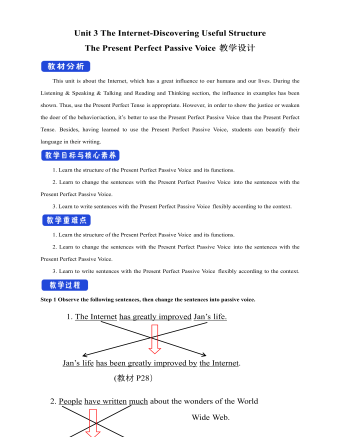
This unit is about the Internet, which has a great influence to our humans and our lives. During the Listening & Speaking & Talking and Reading and Thinking section, the influence in examples has been shown. Thus, use the Present Perfect Tense is appropriate. However, in order to show the justice or weaken the doer of the behavior/action, it’s better to use the Present Perfect Passive Voice than the Present Perfect Tense. Besides, having learned to use the Present Perfect Passive Voice, students can beautify their language in their writing. 1. Learn the structure of the Present Perfect Passive Voice and its functions. 2. Learn to change the sentences with the Present Perfect Passive Voice into the sentences with the Present Perfect Passive Voice. 3. Learn to write sentences with the Present Perfect Passive Voice flexibly according to the context. 1. Learn the structure of the Present Perfect Passive Voice and its functions. 2. Learn to change the sentences with the Present Perfect Passive Voice into the sentences with the Present Perfect Passive Voice. 3. Learn to write sentences with the Present Perfect Passive Voice flexibly according to the context. Step 1 Observe the following sentences, then change the sentences into passive voice.He has been selected to take part in the sports meeting.(肯定句)他已被挑选出来参加运动会。The ink has not been removed from his overcoat.(否定句)墨迹还没有从他外套上去掉。