-
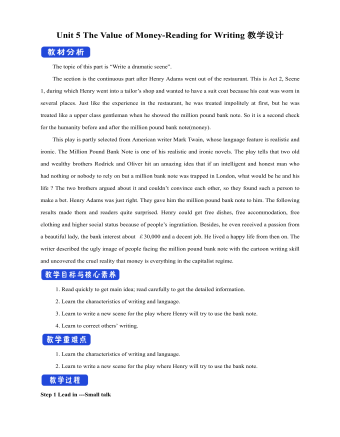
新人教版高中英语必修3Unit 5 The Value of Money-Reading for Writing教学设计二
2. 您能看到, 我头发太长了。You can see that my hair is much too long.3. 无论什么时候, 只要您想回来就回来。Please come back whenever you want.4. 您仅有很少的头发要理! You only have too little hair to cut !5. 为您服务是我的荣幸!It is my honour to serve you!Step 9 Writing(Henry is walking down the street when he sees a sign for a place that cuts hair. He decides to have it cut. )H=Henry B=BarberH: Good afternoon, I’d like to have my hair cut, if I may. (The barber looks at Henry’s hair and continues cutting another man’s hair. ) Er, I’d really like a haircut. As you can see it’s much too long. B: (in a rude manner) Yes, I can see that. Indeed, I can. H: Fine, well, I’ll have a seat then. (He sits in one of the barber’s chairs. The barber turns to look at Henry. )B: It’s quite expensive here, you know! Are you sure you can afford it?H: Yes. I think so. (After his hair is cut, the barber tells Henry how much he must pay. Henry shows the barber the bank note. )B: Why Mr. . . (looks shocked)H: Adams. Henry Adams. I’m sorry. I don’t have any change. B: Please don’t worry! (wearing a big smile) Nothing to worry about! Nothing at all! Please come back whenever you want, even if you only have too little hair to cut! It will be my honour to serve you!Step 10 Pair workExchange drafts with a partner. Use this checklist to help your partner revise his/her draft.1. Are all the elements of a play included and in good order ?2. Do the character use suitable language ?3. Are the stage directions clear and useful ?4. Is the plot clear and exciting enough ?
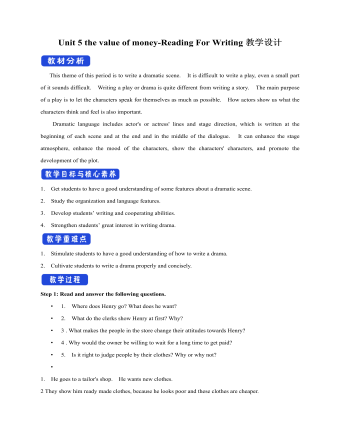
新人教版高中英语必修3Unit 5 the value of money-Reading For Writing教学设计一
【参考范文】Narrator:(Henry is smiling as he leaves the restaurant. As he is walking down the street, he sees a sign for a place that cuts hair. He decides to get it cut. )H=Henry;B=Barber;R=rude manH:Good afternoon, I'd like to get a cut, if I may. (The barber looks at Henry's hair and continues cutting another man's hair. )Er, I'd really like a haircut. As you can see it's much too long. B:(in a rude manner) Yes, I can see that. Indeed, I can. H:Fine, well I'll have a seat then. (He sits in one of the barber's chairs. The barber turns to look at Henry. )B:It's quite expensive here, you know!Are you sure you can afford it?H:Yes. I think so. (In comes the rude man. )R:Hey you there. I need a haircut quickly. Can you do me straightaway?B:All right, then, get in the chair and I'll see what I can do. R:Thank you. (sits down in one of the barber's chairs)H:Excuse me, but I was here first. Aren't you going to do my hair first?B:This man's in a hurry. H:Well so am I!I insist that you cut my hair first. B:OK, but I'll have to be quick. This gentleman is waiting. H:Thank you. (They both become quiet. After his hair is cut, the barber tells Henry how much he must pay. Henry shows the barber the bank note. )B:Why, Mr . . . (looks shocked)H:Adams. Henry Adams. I'm sorry, I don't have any change. R:You're that Mr Adams! Well,I'm glad I waited or I might never have known it was you. B:Why, Mr Adams, please don't worry!(wearing a big smile) Nothing to worry about!Nothing at all!Please come back any time, even if you only need too little hairs cut!It will be my honour to serve you!
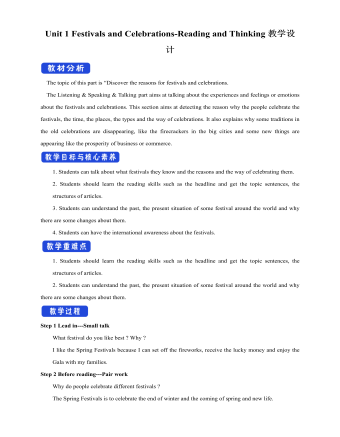
新人教版高中英语必修3Unit 1 Festivals and Celebrations-Reading and Thinking教学设计
The topic of this part is “Discover the reasons for festivals and celebrations.The Listening & Speaking & Talking part aims at talking about the experiences and feelings or emotions about the festivals and celebrations. This section aims at detecting the reason why the people celebrate the festivals, the time, the places, the types and the way of celebrations. It also explains why some traditions in the old celebrations are disappearing, like the firecrackers in the big cities and some new things are appearing like the prosperity of business or commerce. 1. Students can talk about what festivals they know and the reasons and the way of celebrating them.2. Students should learn the reading skills such as the headline and get the topic sentences, the structures of articles.3. Students can understand the past, the present situation of some festival around the world and why there are some changes about them. 4. Students can have the international awareness about the festivals.1. Students should learn the reading skills such as the headline and get the topic sentences, the structures of articles.2. Students can understand the past, the present situation of some festival around the world and why there are some changes about them.Step 1 Lead in---Small talkWhat festival do you like best ? Why ?I like the Spring Festivals because I can set off the fireworks, receive the lucky money and enjoy the Gala with my families.Step 2 Before reading---Pair workWhy do people celebrate different festivals ?The Spring Festivals is to celebrate the end of winter and the coming of spring and new life.The Mid-autumn Day is to celebrate the harvest and admire the moon.
新人教版高中英语必修3Unit 1 Festivals and Celebrations-Reading for writing教学设计二
Step 3 Analyzing article structureActivity 31. Teachers raise questions to guide students to analyze the chapter structure of this diary and think about how to describe the festival experience. (1)What should be included in the opening/body/closing paragraph(s)?(2)How did the writer arrange his/her ideas?(3)What kind of interesting details did the writer describe?(4)How did the writer describe his/her feelings/emotions during the event?2. Students read and compare the three sentence patterns in activity 2. Try to rewrite the first paragraph of the diary with these three sentence patterns. After that, students exchange corrections with their partners. Such as:●This was my first time spending three days experiencing the Naadam Festival in China’s Inner Mongolia Autonomous Region and it was an enjoyable and exciting experience. ●I'll never forget my experience at the Naadam Festival because it was my first time to watch the exciting Mongolian games of horse racing, wrestling, and archery so closely. ●I'll always remember my first experience at the Naadam Festival in China’s Inner Mongolia Autonomous Region because it was so amazing to spend three days witnessing a grand Mongolian ceremony. Step 4 Accumulation of statementsActivity 41. Ask the students to read the diary again. Look for sentences that express feelings and emotions, especially those with the -ing form and the past participle. Such as:● …horse racing, wrestling, and archery, which are all so exciting to watch. ● some amazing performances● I was surprised to see…● I was a little worried about. . . ● feeling really tiredOther emotional statements:●I absolutely enjoyed the archery, too, but the horse races were my favourite part. ●I'm finally back home now, feeling really tired, but celebrating Naadam with my friend was totally worth it. ●He invited me back for the winter to stay in a traditional Mongolian tent and cat hot pot. I can’t wait!2. In addition to the use of the -ing form and the past participle, the teacher should guide the students in the appreciation of these statements, ask them to memorize them, and encourage them to use them reasonably in writing practice.
新人教版高中英语必修3Unit 3 Diverse Cultures-Reading for Writing教学设计
The topic of this part is “Describe a place with distinctive cultural identity”.This section focuses on Chinese culture by introducing Chinatown, whose purpose is to show the relationship between the Chinese culture and American culture. The Chinese culture in Chinatown is an important part of American culture. Chinatown is an important window of spreading Chinese culture and the spirit homeland of oversea Chinese, where foreigners can experience Chinese culture by themselves.Concretely, the title is “Welcome to Chinatown!”, from which we can know that the article aims at introducing Chinatown. The author used the “Introduction--Body Paragraph--Conclusion” to describe the people, language, architecture, business, famous food and drinks and people’s activities, which can be a centre for Chinese culture and shows its unique charm.1. Read quickly to get main idea; read carefully to get the detailed information.2. Learn the characteristics of writing and language.3. Learn to introduce your own town according to the text.4. Learn to correct others’ writing.1. Learn the characteristics of writing and language.2. Learn to introduce your own town according to the text.Step 1 Lead in ---Small talkIn the reading part, we mentioned the Chinatown of San Francisco. How much do you know about Chinatown of San Francisco ?Chinatown is a main living place for Chinese immigrants, where you can see many Chinese-style buildings, costumes, operas, restaurants, music and even hear Chinese.Step 2 Before reading ---Predict the contentWhat is the writer’s purpose of writing this text ? How do you know ?From the title(Welcome to Chinatown) and some key words from the text(tourist, visit, visitors, experience), we can know the purpose of the text is to introduce Chinatown and show the relationship between Chinese culture and American culture.
新人教版高中英语必修3Unit 4 Space Exploration-Listening&Speaking&Talking教学设计一
Listening and Speaking introduces the topic of “talking about how to become an astronaut”. This period is aimed to inform students some details about the requirements of being an astronaut. Students can be motivated and inspired by the astronauts. Teachers ought to encourage students to learn from them and let them aim high and dream big.Listening and Talking introduces the theme of "talk about life in space". This part also informs students more details about life in space and can inspire students to be curious about this job. 1. Guide students to listen for numbers concerning dates, years and ages etc2. Cultivate students' ability to talk about how to become an astronaut and life in space ; 3. Instruct students to use functional sentences of the dialogue such as “ first of all, I am not sure, so what might be .. I guess.. I wonder…I am curious…)appropriately.1. Guide students to understand the content of listening texts in terms of the whole and key details; 2. Cultivate students' ability to guess the meaning of words in listening; discuss with their peers how to become a qualified astronaut and describe the life in space.Part 1: Listening and SpeakingStep 1: Lead inPredictionThe teacher can ask students to predict what the listening text is about by looking at the pictures.About how to become an astronaut./the requirements of an astronautStep 2: Then, play the radio which is about an interview a. And after finishing listening for the first time, the students need to solve the following tasks.
新人教版高中英语必修3Unit 4 Space Exploration-Discovering Useful Structure教学设计
The theme of the section is “Describe space facts and efforts to explore space”. Infinitives are one of non-finite verbs, as the subjects, objects, predicative, attributes and adverbials. This unit is about space exploration, which is a significant scientific activity, so every scientific activity has strong planning. Therefore, using the infinitives to show its purpose, explanations or restrictions is the best choice.1. Learn the structure, functions and features of infinitives.2. Learn to summarize some rules about infinitives to show purpose and modify.3. Learn to use infinitives in oral and writing English. 1. Learn the structure, functions and features of infinitives.2. Learn to summarize some rules about infinitives to show purpose and modify.3. Learn to use use infinitives in oral and writing English.Step 1 Lead in---Pair workLook at the following sentences and focus on the italicized infinitives. In pairs, discuss their functions. 1. I trained for a long time to fly airplanes as a fighter pilot..(作目的状语)2. As we all know, an astronaut needs to be healthy and calm in order to work in space..(作目的状语)3. First of all, you must be intelligent enough to get a related college degree..(作目的状语)4. Some scientist were determined to help humans realise their dream to explore space..(作定语)5. On 12 April 1961, Yuri Gagarin became the first person in the world to go into space..(作定语)Summary:1. 不定式的结构:to+do原形。2. 分析上面的句子,我们知道在描述太空探索时,动词不定式不仅可以用来表目的,还可以用来作定语,表修饰。
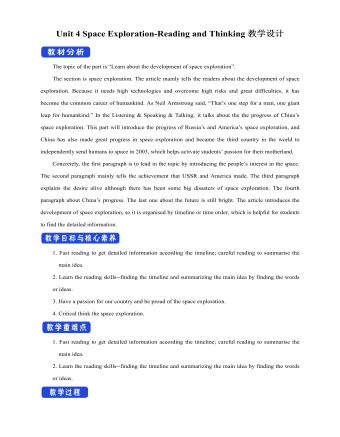
新人教版高中英语必修3Unit 4 Space Exploration-Reading and Thinking教学设计一
Q4: What is the function of the International exploration ?Having astronauts from different countries on boardQ5: What can you learn from Para 4 ?China has made great achievements in exploring spaceQ6: What is the attitude to the space exploration ?SupportiveStep 6 Post reading---RetellPeople have always wanted to learn more about space. Before the mid-20th century, most people felt (1)_________ (travel) into space was an impossible dream. However, (2)____ the help of scientists, peoplesucceeded in realizing their dream (3) _________ (explore) space. On 4 October 1957, the Sputnik 1 satellite (4) ____________(launch) by the USSR. (5) ________________ scientists try to make sure nothing goes wrong, accidents can still happen. These disasters made everyone(6)___________(disappoint), but people still believe in the importance of (7) ________(carry) on space exploration. In 2003, China became the third country to (8)_____________ (independent) send humans into space. Then Shenzhou 6 and 7 completed (9)____ second manned orbit and the first Chinese spacewalk. In spite of the difficulties, scientists hope future (10)__________ (discovery) will not only enable us to understand the universe but also help us survive well into the future.Answers: 1. travelling 2. with 3. to explore 4. was launched 5. Although6. disappointed 7. carrying 8. independently 9. a 10. discoveriesStep 6 Post reading---Critical thinkingQ1: What do you think of the space exploration ? I think it is beneficial to us. Through further study of space, people will make full use of it in the future, such as the space experiments by Wang Yaping in Tian Gong 1.Q2: If you are determined to be an astronaut, what should you prepare at present ?First of all, I should study hard to get a related college degree. Besides, I must keep mental and physical healthy.Step 7. HomeworkTry to summarize the structure of the article by a mind map.
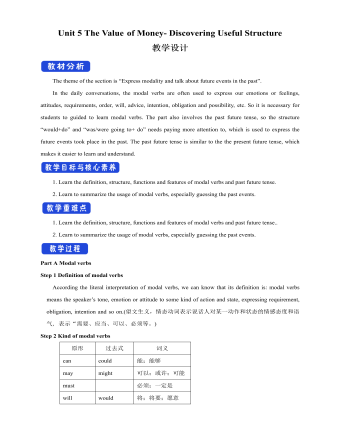
新人教版高中英语必修3Unit 5 The Value of Money- Discovering Useful Structure教学设计
Step 3 Meaning1. 过去将来时表示从过去某一时间来看将要发生的动作或存在的状态, 常用在宾语从句中。一般由“would/should +动词原形”构成。She hoped that they would meet again someday. 她希望将来有一天他们能再见面。2. was/were going to+动词原形: 表示过去将要发生或很有可能发生的动作, 常用于口语中, 表示预言、意图或者打算等。He was going to start work the following week. 他打算下星期开始工作。3. was/were about to do: 常用来表示即将发生的动作, “刚要/正要做……”。注意该结构不与任何时间状语连用。I felt that something terrible was about to happen. 我感到某种可怕的事情即将发生。4.was/were to do: 表示“曾计划做某事”, 如果表示“本来计划做某事, 动作没实现”, 则需用 “was/were to have done”。She said she was to have told me about the accident. 她说她本来想告诉我关于事故的事。5.Start, go, come, leave, see, meet等动词的过去进行时: 表示就过去某一时刻而言即将发生的动作。She was coming later. 她随后就来。I had just put on my overcoat and was leaving to visit a friend of mine. 我刚穿上外套要去看我的一个朋友。
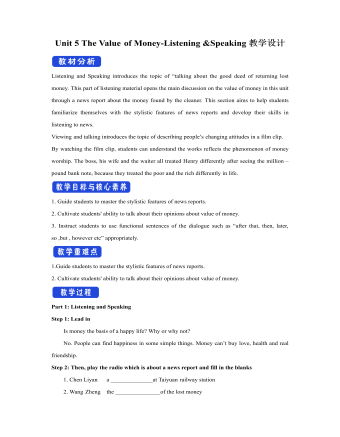
新人教版高中英语必修3Unit 5 The Value of Money-Listening &Speaking教学设计
Step 4: Listen again and decide if the following statements are true (T) or false (F).1 It was the first time Chen Liyan's story was reported. T口 F口2 Chen found 10,000 yuan in a small plastic bag in Taiyuan railway station口 F口3 Wang Zheng apologized to Chen because he couldn't offer her more money. T口 F口4 Chen took out a large loan to cure her daughter, T口 F口5 Wang set up a fundraising website for Chen's daughter after Chen told him about her situation. T口 F口Step 5:After listening, discuss the questions.1 What kind of person do you think Chen Liyan is?Chen Liyan is generous and honest because she returned a large sum of money to the owner.2 Did Chen return the money because she didn't need it?No. She returned the money because it was the right thing to do. Evidence for this is that she refused to accept the reward money because she felt that it had not been earned. 3 Is it common for people to do what Chen did?It depends on the culture. In some countries it is quite common to return money that has been found. In other countries, people believe "Finders are keepers!" 4 How did Wang Zheng feel about the return of his money?He must have been very happy and relieved to have gotten his money back. We know this because he thanked Chen repeatedly and even offered her a reward.5 Why did Ma Dongbao tell Wang about Chen's family?He must have had great sympathy for Chen and her daughter and wanted to help them.'We know this because he arranged help for them. 6 How did the news reporter feel about Chen's actions?The news reporter felt that it showed that money wasn't the most important thing in life. We know this because the reporter told us that this is what Chen believes. and then said, “that's a great attitude to take."
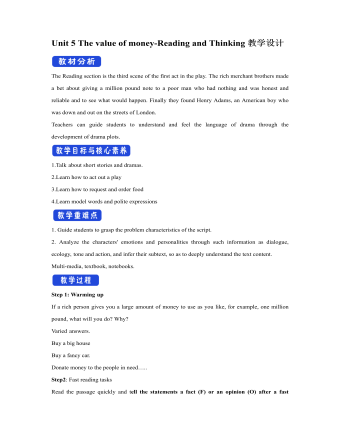
新人教版高中英语必修3Unit 5 The value of money-Reading and Thinking教学设计二
? Could you offer me some kind of work here?? I don’t want your charity, I just want an honest job.? Careless: I landed in Britain by accident.Step 7:Consolidation.? Find Henry? Roderick and Oliver were I .making a bet when they saw Henry, a poor young man. ? Know Henry? About a month ago, Henry was sailing and later he found himself carried out to sea by a strong wind. Fortunately, he 2.was spotted by a ship. And it was the ship that brought him to 3.England? Offer money to Henry ? Oliver and Roderick gave Henry a letter and told him that there was money in it. They 4.persuaded him to accept it, and made him 5.promise that it wouldn't be opened until 2 o'clock.Step 8:Language pointsa large amount of: a large quantity of; a great deal ofe.g. They bought a large amount of furniture before they moved their new house.make a bet: make an arrangement to risk money, etc. on an event of which the result is doubtful.e.g. We made a bet on the result of the match.permit sb to do something: allow somebody to do somethinge.g. My mother doesn’t permit me to ride in the street after it rained.by accident: as a result of chancee.g. I only found it by accident.stare at: look at somebody or something with the eyes wide open in a fixed gaze( in astonishment, wonder, fear, etc)to be honest: to tell you the truth; to be franke.g. To be honest, I don’t think we have a chance of winning.Step7 Homework:What do you think will happen to Henry? Will the bank-note help him or get him into trouble?
新人教版高中英语必修3Unit 3 Diverse Cultures-Reading and Thinking教学设计
Discuss these questions in groups.Q1: Have you ever been to a place that has a diverse culture ? What do you think about the culture diversity ?One culturally diverse place that I have been to is Harbin, the capital city of Heilongjiang Province. I went there last year with my family to see the Ice and Snow Festival, and I was amazed at how the culture as different to most other Chinese cities. There is a big Russian influence there, with beautiful Russian architecture and lots of interesting restaurants. I learnt that Harbin is called “the Oriental Moscow” and that many Russians settled there to help build the railway over 100 years ago.Q2: What are the benefits and challenges of cultural diversity ?The benefits: People are able to experience a wide variety of cultures, making their lives more interesting, and it can deepen the feelings for our national culture, it is also helpful for us to learn about other outstanding culture, which helps improve the ability to respect others. The challenges: People may have trouble communicating or understanding each other, and it may lead to disappearance of some civilizations and even make some people think “The western moon is rounder than his own.”Step 7 Post reading---RetellComplete the passage according to the text.Today, I arrived back in San Francisco, and it feels good (1) _____(be) back in the city again. The city succeeded in (2)_________ (rebuild) itself after the earthquake that (3)________ (occur) in 1906, and I stayed in the Mission District, enjoying some delicious noodles mixed with cultures. In the afternoon, I headed to a local museum (4)____ showed the historical changes in California. During the gold rush, many Chinese arrived, and some opened up shops and restaurants in Chinatown to earn a (5)_____ (live). Many others worked on (6)______ (farm), joined the gold rush, or went to build the railway that connected California to the east. The museum showed us (7)____ America was built by immigrants from (8)________ (difference) countries and cultures. In the evening, I went to Chinatown, and ate in a Cantonese restaurant that served food on (9)________(beauty) china plates. Tomorrow evening, I’m going to (10)__ jazz bar in the Richmond District. 答案:1. to be 2. rebuilding 3. occurred 4. that 5.living6. farms 7.how 8. different 9. beautiful 10. a
人教版高中政治必修3弘扬中华民族精神说课稿
3、评:以评促行。(6分钟)高中生的年龄特点决定了他们非常重视别人对自己的评价,渴望得到他人的肯定与鼓励。(所以我在班上组织一个活动:让同学们评选出班上“讲文明懂礼貌的文明之星”、“勤思考善创新的学习之星”(先让同学推举大家都认同的4位同学,然后对他们进行投票,投票结果将在下堂课上公布)以此活动来激发同学们用实际行动做民族精神的践行者和传播者。)4、唱:以情激行。(2分钟)在课程内容讲授结完毕后,组织全班同学跟着音乐高唱孙楠的《红旗飘飘》,生化情感,激发同学们的爱国情感。五、课堂拓展(请同学们各展才华:课后让同学们各自准备一个项目以体现民族精神。(项目形式是:或作文、书画;或剪纸、或歌曲小品)……让同学们用实际行动祝愿我们伟大的祖国更加繁荣昌盛!让我们的民族精神代代相传!)
人教版高中政治必修3在文化生活中选择说课稿3篇
生2:每逢清明,或其他一些死者的纪念日,人们总要为死去的亲人烧纸钱。这幅漫画由烧纸钱演变为烧“家电”,说明随着社会环境的变化,人们根深蒂固的一些封建思想,还在影响着人们的生活。要花大力气去破除封建迷信活动。师:说到底,算命、烧纸钱是封建迷信活动,从文化角度来说,是落后文化。我们一起来看看在现实生活中,还有哪些落后文化在影响着人们的生活。生1:在一些边远落后地区,大人小孩生了病,不是看医生,而是让巫婆神汉来治,结果往往耽误了诊疗时间,有的甚至还丢掉了性命。生2:“重男轻女”“多子多福”,红白事大操大办现象在有些地方还很严重。师:这些落后文化都有哪些共同特征?在你看来,这些现象有哪些危害?生3:这些落后文化,在内容上带有迷信、愚昧、颓废、庸俗等色彩,在形式上常常以传统习俗的形式表现出来,如人们常见的看相、算命、测字、看风水等。它会麻痹人的意志,使人消极、悲观、绝望,对理想、前途、信念丧失信心;破坏社会的风气。
人教版高中政治必修3在文化生活中选择说课稿
一、教材分析文化市场和大众传媒的发展,给我们的文化生活带来了许多可喜的变化。但是,文化市场的自发性和传媒的商业性也引发了令人忧虑的现象。文化生活有“喜”也有“忧”,让我们欢喜让我们忧。面对形式多样的文化生活,置身于文化生活的海洋之中,在文化生活中如何选择、怎样作出正确的选择是亟待向学生解决的问题。二、学情分析高二学生处于世界观、人生观和价值观形成的关键时期,身心迅速发展,自我意识和独立性较强,社会公共生活空间范围越来越大,并且开始理性地思考社会和人生的重大问题,他们可塑性强,但情绪仍然不稳定,有多变性,容易冲动或偏激,迫切需要提升思想意识,加强方法论的指导,使其在纷繁复杂的文化生活中能够进行正确的判断与选择。如果我们的学生不能把握正确的航向,是非观念模糊,良莠不分,就会陷入落后文化和腐朽文化的泥沼而不能自拔,甚至造成无法挽回的恶果。
人教版高中政治必修4在实践中追求和发展真理说课稿(二)
一、教学理论依据及设计理念以新课程理念和新课标为指针,依据建构主义理论、学科探究理论和多元智力理论,采用探究式的教学模式来组织实施本节课的教学。学生成为课堂的主体和知识的主动构建者。通过创设多种情境,让学生积极参与、体验、感悟,主动获得新知,并逐步提高学生发现问题、分析问题和解决问题的能力。教师从课堂的主宰变为课堂的主导,是学生学习活动的组织者、引导者和合作者。教学过程是一个发散式的学生自主学习的过程。采用自主、合作、探究式的教学方式,让学生有多元选择,激发他们的潜能,发展他们的个性。二、教材分析1.教材的地位与作用:本框题是《生活与哲学》第二单元《探索世界与追求真理》第六课“求索真理的历程”的第二节内容。本单元的核心问题是如何看待我们周围的世界,该问题也是《生活与哲学》整本书的核心问题之一。
人教版高中生物必修1能量之源—光与光合作用说课稿
1)他们在初中的生物学学习中已具备了一定的关于光合作用的基础知识,也做过“绿叶在光下制造淀粉”这个实验。2)他们具备物质转变和能量变化等相关的化学知识。3)在前面的《降低化学反应活化能的酶》一节的学习中已经学习过简单的对照实验和相关的实验设计原则,使本节课最后的实验设计得以顺利进行。4)他们具有一定的 分析问题的能力,实施问题探究教学是可行的。三、教法和学法根据上述对教材和学生的分析,本节采用以下教法和学法:1)实验法:以实验说明结论。生物学的教学就是实验的教学过程,实验的展示形式有学生分组实验、老师示范实验、动画和图片演示实验等,让实验现象说明问题,而不是直接让学生记住结论。2)问题探究教学发:以问题引发兴趣。整个教学过程要设置好问题,层层展开,层层递进,让新知识与旧知识融为一个整体,让学生在步步上升中攀登到知识的顶峰。3)比较学习法,同时采用多媒体辅助教学,解决光合作用抽象的过程。
人教版高中生物必修3第三章第三节《其他植物激素》说课稿
二、应用生长调节剂的注意事项1、效果不稳定。2、使用时期。3、使用浓度和方法。4、使用生长调节剂仅是葡萄栽培管理的辅助手段,不能盲目孤立地依赖生长调节剂。生2:我们小组查的资料是关于小麦使用生长调节剂。小麦应用植物生长调节剂,可以调节植株的生长发育,具有控旺促壮、增强抗逆性、增加粒重、提高产量并有利于优质、早熟等多重效果。生3:我找了一篇生长调节剂对矮牵牛大型穴盘生产。师:上面三位同学利用课下的时间,在网上查的三段文字都相当的不错,大家可以从中学到一些书本上没有的知识,请大家结合刚刚三位同学的三段文字以及自己平时所积累的知识,讨论以下几个问题。师:你知道哪些农产品在生产过程中使用了植物生长调节剂?师:哪些水果在上市前有可能使用了乙烯利?师:生产过程中施用植物生长调节剂,会不会影响农产品的品质?师:如果你是水果销售员,面对半青不熟的水果,你认为应当使用乙烯利催熟吗?作为一个消费者,你又怎么看?
人教版高中政治必修3加强思想道德建设说课稿
【讨论】只要继承和弘扬中国传统文化中传统美德,就可以构建思想道德体系。学生展示:法律中道德规范。老师展示:法治:以法律的权威性和强制性规范社会成员的行为(外律)。德治:以道德的说服力和感召力提高社会成员的思想认识和道德觉悟(内律)。结论:既要加强社会主义法制建设,依法治国;也要继承、发展、创新传统美德,加强思想道德建设,以德治国。建立社会主义思想道德体系要与法律法规相协调。设计意图:设计一个条件型辨析探究题开展讨论,把建设思想道德与优秀传统文竹也、法治的关系结合起来,把课堂探究与课前探究结合起来,有利于提高学生的思维能力和课堂教学效率。践行:思想道德建设从我做起你是否认同、选择下列行为?展示校园现象图片《作弊》与《小烟民》(略);展示中学生在家中表现的漫画《老子、儿子和孙子》(略);
人教版高中政治必修4价值判断和价值选择说课稿(一)
2.讲授新课:(约35分钟)结合教材内容重难点和学生实际,在讲课过程中,我对教材内容的顺序进行了重组,把教材内容由原来的两大部分划分为三大部分(第一,价值判断和价值选择的含义和关系;第二,价值判断和价值选择的特征;第三,做出正确的价值判断和价值选择的标准)。这一调整更符合学生的认知结构,便于从整体上把握课本内容。在讲授过程中,我充分利用课本素材——探究活动为课堂教学服务,此外,利用学生的生活与体验,挖掘实例,如结婚要礼由以前的旧三件到现如今的转变,引导学生理解价值判断和价值选择的社会历史性特征,以以《观祈雨》、以医生、艺术家、老学究对于《断臂的维纳斯》这个雕塑的不同见解、以新鲜实例韩国沉船事件和范跑跑为例启发学生价值判断和价值选择具有主体差异性特征以此突破难点,最后通过设疑、对比、追问正确的价值判断和价值选择的标准来深化主题,突出重点。3.课堂小结:(约2分钟)强化认识