-
新人教版高中英语必修2Unit 2 Wildlife Protection-Reading and Thinking教案一
The listening and speaking part aims at how to protect and help endangered animals by listening, speaking and talking about the facts and reasons. This lesson analyzes the decreasing clause of Tibetan antelope population and the measures of protecting Tibetan antelopes. So students can be guided to learn to analyse the title and use different reading skills or strategies, like scanning, skimming and careful reading.1. Read quickly to get the main ideas and the purpose of going to Tibetan; read carefully to understand what the author see and think.2. Understand the sentences of the present continuous passive voice such as “Much is being done to protect wildlife.” and the inverted sentence “Only when we learn to exist in harmony with nature can we stop being a threat to wildlife and to our planet.”3. Enhance the awareness of protecting wildlife.4. Cultivate the reading methods according to different materials.1. Read quickly to get the main ideas and the purpose of going to Tibetan; read carefully to understand what the author see and think.2. Understand the sentences of the present continuous passive voice such as “Much is being done to protect wildlife.” and the inverted sentence “Only when we learn to exist in harmony with nature can we stop being a threat to wildlife and to our planet.”3. Cultivate the reading methods according to different materials.Step 1 Leading-inWatch a video about elephants and whales and then ask:Why are they endangered ? They are killed/hunted
新人教版高中英语必修2Unit 2 Wildlife Protection-Reading and Thinking教案二
The theme of this unit is human and nature, focusing on the theme of wildlife protection. Nature is a complex ecosystem, in which there are delicate balance between animals and plants. Because of the role of the food chain, the extinction of one species will produce influence, causing a series of chain reaction. Large scale extinction of species will have a serious and even irreversible impact on the ecosystem, resulting in immeasurable losses. Therefore, it is of great significance to protect wild species. To protect wild species is to protect human beings themselves. The motto of this unit is "when the buying stops, the killing can too,” which is a public service advertising slogan to protect wildlife. It tells people that every rhinoceros horn, every fur, every bowl of shark fin soup, every Ivory product, and every tiger bone product, etc. consumed by human beings, are innocent wild animals slaughtered behind them. The mission of wild aid is to ban illegal trade in endangered wildlife and mitigate climate change. It aims to educate the public to reduce the consumption demand for endangered wildlife products through public publicity and improve the awareness of environmental protection.1. Improve the awareness of wildlife protection by acquiring the knowledge of wildlife protection.2. Focus on environmental protection and protection of all lives.3. Analysis of the living environment of wild animals with appropriate thinking mode.4. Skillfully use the vocabulary and grammar knowledge of this unit to cultivate self-study ability according to the unit content5. Develop cooperative learning ability through discussion and other ways1. Enable the Ss to talk about the current situation of wild animals.2. Guide the Ss to summarize the main idea of each paragraph as well as the main idea of the text.
人教版高中语文必修2《采薇》教案2篇
这两章是对战争场面的描写。写的是战车、战马、象弭、鱼服以及士兵的劳累奔波、饥渴难当,通过这些具体生动的细节描写来展现战争生活的图景。而没有写战场上的刀光剑影、厮打拼杀,但战争的残酷已可想见。4“昔我往矣,杨柳依依。今我来思,雨雪霏霏”被视为情景交融的佳句。清人王夫之在论《诗经·小雅·采薇》这两句时说:“以乐景写哀,以哀景写乐,一倍增其哀乐。”谈谈你的看法。一以往昔之虚衬眼前之实,以出征之乐衬内心之思亲之悲痛;二“杨柳依依”与“雨雪霏霏”对比,突出不胜今昔之感;三大雪交加,饥渴难当,情境实悲,以哀景写哀情。四、交流延伸1写一首诗或一段文字表达你对“乡愁”的新的体验。在全班交流。2课后搜集更多的表现乡情的诗歌散文作品,将你最感动的一篇拿到班上与同学分享感受。
人教版高中语文必修2《涉江采芙蓉》教案2篇
三、想象画面,把握意境1.指导想象学习陶渊明的《归园田居》我们脑海中自然会出现一幅幅的画面,比如他归家后的生活场景,我们会想象“榆柳”是如何遮蔽房屋的,而“桃李”又是如何摘种在房前的。我们会想象村落是如何在薄雾中若隐若现的,想象炊烟是如何袅袅升起的。《涉江采芙蓉》一诗只有8句话,更需要我们展开想象,去构画场景,这样才能深入诗歌,体会到诗歌的味道。2.学生想象要求学生闭目想象1分钟。3.学生展示想象结果(抽三四个学生回答即可)4.老师指导纠正学生想象不合理之处。要注意的地方:“江”可能学生会想象成小溪流、小池塘。“兰泽”可能学生理解成“湖泊”。注意字词“还顾”“漫浩浩”中隐含的情感,注意“离居”中流露的愁怨。5.时间允许的话,老师读自己的下水作文。
人教版高中语文必修2《我有一个梦想》教案2篇
全班齐读第五段内容。请一位同学分析,接着让这位同学按他分析的读一遍。3、4两自然段的平缓之后,第5段作者的情感再次抬升。为了满足这种情感的张扬,作一口气连用了四个排比句式“现在是……时候”,一方面这是情感发泄的需要,另一方面这种排山倒海的语势也加强了内容的表达,极强地突出了现实为自由、平等而战的重要性。四、学会演讲我们刚才细读了课文,但读和讲是有区别的。所谓演讲,是一门语言艺术,它的主要形式是“讲”,即运用有声语言并追求言辞的表现力和声音的感染力;同时还要辅之以“演”,即运用面部表情、手势动作、身体姿态乃至一切可以理解的态势语言,使讲话“艺术化”起来,从而产生一种非凡的艺术魅力。那么,接下来就假设一下假如你是马丁·路德·金,你会怎样去讲这篇演讲辞。
人教版高中语文必修2《离骚》教案2篇
四、品味诗歌艺术1、诗人是如何表现其品质的?运用了什么修辞手法?产生了怎样的表达效果?明确:诗句“扈江离与辟芷兮,纫秋兰以为佩”很好地体现了诗人光辉俊洁的人格。用“江离”“辟芷”“秋兰”三种香草来装饰自己,比喻自己,极其生动形象地表现了诗人自己美好的精神世界,使诗歌充满了浪漫主义气息。2、《离骚》中作者常以“香草”、“美物”来比喻自己、贤士和君王,并表达政治理想,这是《离骚》的一大艺术特色,这种方法叫做“移情法”,即不直接说出自己想说的话,而是把它寄寓于某一物上,也就是“移情于物”,这种方法在古典诗词中广泛运用,在政治不清明的时代,借用“移情”,可言难言之语,抒难抒之情。请找出相关的诗句,说说诗人是怎样运用这些比喻来表达政治理想的。
人教版高中语文必修2《巴黎圣母院》教案2篇
【教学设想】一、选题设想《巴黎圣母院》是雨果的代表作,无论从思想内容还是艺术风格都有明显的浪漫主义特征:奇异曲折、扣人心弦的故事情节;妙趣横生、别出心裁的奇遇巧合;强烈鲜明的美丑、善恶对比;丰富生动、珠玑迸发、富有哲理意味的语言。通过导读,来消除学生对外国名著的畏难情绪,增加学生课外阅读的兴趣和信心;让学生整体把握作品,窥一斑而识全豹,让学生高屋建瓴,了解其旨意,以极为精确而又充满意蕴的文字,对名著的概述及精要部分做了介绍;引导学生自主探究,交流合作,培养学生的独立思考的学习惯,指点进行名著阅读的门径。作为导读课,教师应注意不可“越位”,在学生学习的过程中,教师的“导”固然重要,学生的“读”更不可或缺,应避免以“导读”来代替名著阅读。因此,《巴黎圣母院》的教学定位为基于课内,面向课外,以求达到以学带读,以读促学的目的。
新人教版高中英语必修2Unit 2 Wildlife Protection-Reading for Writing教案二
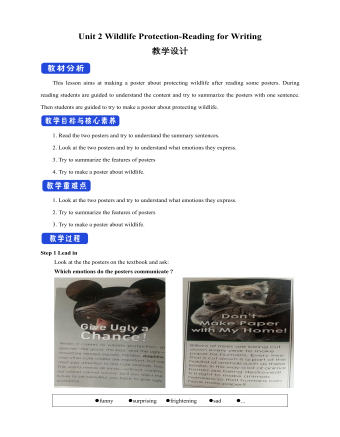
This lesson aims at making a poster about protecting wildlife after reading some posters. During reading students are guided to understand the content and try to summarize the posters with one sentence. Then students are guided to try to make a poster about protecting wildlife.1. Read the two posters and try to understand the summary sentences.2. Look at the two posters and try to understand what emotions they express.3. Try to summarize the features of posters4. Try to make a poster about wildlife.1. Look at the two posters and try to understand what emotions they express.2. Try to summarize the features of posters3. Try to make a poster about wildlife.Step 1 Lead inLook at the the posters on the textbook and ask:Which emotions do the posters communicate ?Step 2 Read the poster and answer the questions.1. What do you think of the animals in the poster on the left ?I think it is frightening and ugly.2. Why do we should protect the ugly animals ?All species--the good, the bad, and the ugly-- should be treated equally.The world needs all kinds--without variety, our planet cannot survive.3. Why are billions of trees being cut down every year ?To make paper for humans.4. What result will be lead to after the trees are cut down ?A lost of animal homes are being destroyed./The habitat of wildlife is being destroyed.Step 3 Find the feature of posters1. What does each poster use to stir up emotions ?On the left, it makes us a little frightened and it looks a little ugly, but it can activate our curiosity--What is it? And What is wrong with it?On the right, it makes us feel a little sad and want to protect them.
新人教版高中英语必修2Unit 2 Wildlife Protection-Discovering Useful Structure教案一
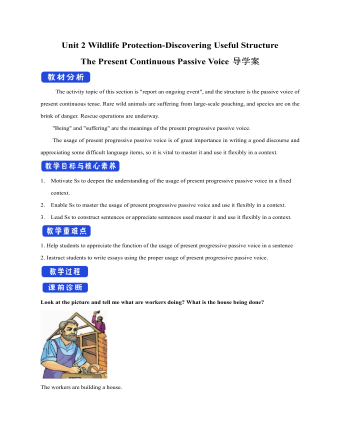
The activity topic of this section is "report an ongoing event", and the structure is the passive voice of present continuous tense. Rare wild animals are suffering from large-scale poaching, and species are on the brink of danger. Rescue operations are underway. "Being" and "suffering" are the meanings of the present progressive passive voice.The usage of present progressive passive voice is of great importance in writing a good discourse and appreciating some difficult language items, so it is vital to master it and use it flexibly in a context.1. Motivate Ss to deepen the understanding of the usage of present progressive passive voice in a fixed context.2. Enable Ss to master the usage of present progressive passive voice and use it flexibly in a context.3. Lead Ss to construct sentences or appreciate sentences used master it and use it flexibly in a context.1. Help students to appreciate the function of the usage of present progressive passive voice in a sentence2. Instruct students to write essays using the proper usage of present progressive passive voice.Look at the picture and tell me what are workers doing? What is the house being done?
新人教版高中英语必修2Unit 2 Wildlife Protection-Listening &Speaking&Talking教案
Listening and Speaking introduces the topic of “how to save endangered wildlife and help wildlife in their neighborhood.” Due to the continuous deterioration of the living environment, a large number of wild animals are always facing the threat of endangered or extinction. Listening and speaking period enables students to understand the fact and reason why wild species are disappearing from the earth at an amazing speed, and realize that human beings ought to enhance the awareness of protecting wild species as soon as possible.Listening and Talking introduces the theme of " how to help wildlife in Ss’ neighborhood.". Now there are many volunteers who spontaneously protect wild animals, carry out various activities according to local conditions, and contribute their own strength to local animal protection with practical actions. Middle school students are also enthusiastic participants. They organize activities in their spare time, and take this opportunity to make friends, broaden their horizons, cultivate team spirit and communication skills. This section describes a bird watching activity organized by several middle school students of Bird watching Club. It aims to stimulate students' interest, improve their understanding of bird watching activities, and use the language structure of “being used for; in order to, so as to, to, so that, in order that ” to express the purpose for communication and discussion.1. Guide students to understand the content of listening texts in terms of using visuals to predict content.2. Cultivate students' ability to guess the meaning of words in listening; discuss with their peers how to save endangered wildlife and help wildlife in their neighborhood.3. Instruct students to use functional sentences of the dialogue such as “I am concerned about…” “what do you know about the endangered animals in…" and so on to talk about one of the endangered animals.
新人教版高中英语必修2Unit 2 Wildlife Protection-Listening and Speaking教案
This lesson is about wildlife protection. The listening and speaking is about “How to protect endangered wildlife ?” Faced with the facts and numbers of wildlife loss, people begin to detect the reasons, then people such as the celebrities (Prince William and Yao Ming) are calling on to protect them. So students are guided to enhance the awareness of protecting wildlife and try to take part in some volunteer activities of protecting wildlife.1. Predict the content by using visuals. 2. Learn to use the sentences such as “I’m concerned about.... But now they are in danger. I want to know the reasons/why./ What can we do to protect them ?3. Learn from the stars like Prince William and Yao Ming and enhance the awareness of protecting wildlife.4. Guide students to try to put forward the solutions to the problems of wildlife protection and then discuss them with partners and present the results of discussion.5. Master the pronunciation of stressed syllables.1. Learn from the stars like Prince William and Yao Ming and enhance the awareness of protecting wildlife.2. Guide students to try to put forward the solutions to the problems of wildlife protection and then discuss them with partners and present the results of discussion.3. Learn to use the sentences such as “I’m concerned about.... But now they are in danger. I want to know the reasons/why./ What can we do to protect them ?4. Master the pronunciation of stressed syllables.Part A Listening and Speaking--- How to save endangered wildlifeStep 1 Lead in1. Point at the pictures on P14 and ask Q1: What message do these posters share?
新人教版高中英语必修2Unit 2 Wildlife Protection-Reading For Writing教案一
1. 标题首先根据海报的特点、格式写明标题。海报中往往把内容作为大标题。例如: Save the earth, Save the birds。2. 正文部分不同的海报其正文部分的侧重点不同。对于介绍性的海报, 首先要引出话题, 其次列出原因, 最后是总结。对于宣传类的海报, 要写明具体内容, 如: 活动内容, 地点以及参加活动的注意事项, 主持或举办单位等。1. 图片: 要选择引人注目的图片, 与主题要相关, 色彩明亮。话题句式 1. It is a treasure of our country. 它是我国的国宝。2. Believe it or not, at present only several thousand pandas exist in the world. 信不信由你, 目前世界上仅现存几千只熊猫。 3.It’s because of human activities that tigers are endangered. 正是因为人类的活动, 老虎处于濒危的状态。4. Many wild animals are in danger of dying out. 很多野生动物面临着灭绝的危险。 5. The government has taken effective measures to protect them. 政府已采取有效的措施来保护它们。6. People should raise the awareness of the protection of wild animals. 人们应该提高保护野生动物的意识。 7. It’s amazing that there are merely less than 1, 000 finless porpoises living in China. 非常令人吃惊, 目前中国仅有不足1 000只江豚。
人教版高中语文必修3《登高》教案2篇
【设计思想】诗歌教学的关键是感受诗景,体味诗情,领悟诗意,在此基础上孕育理解能力、鉴赏能力和审美情感。诗景、诗情、诗意均由文字来承载,把握文字组合的张力,是读诗赏诗的抓手。杜甫的诗歌素以炼字精深、涵盖深远著称,以《登高》而言,往往淡淡一字,平平一语,便笼大千于方寸,缩古今于一瞬。故细读文本,咀嚼字句,便是赏景、悟情、会意的基本路径。其次,不朽名作的特点是寄寓深广,古今评价甚多,见仁见智,不一而足。这正是培养学生问题意识、探究意识的极好凭借。第三,诗为语言之精华,是诗人心里涌出的情感之流。诵读乃赏诗之要着,精心感悟之时,设身处地,心惟口诵,是理解诗意的关键一步。基于是,笔者作如下同课异构,殊途同归。【教学目标】1.理解本诗所绘之景、所抒之情及绘景、抒情之法。2.学会用意象叠加法、字句推敲法、诵读体验法等欣赏诗歌。3.感受杜甫心系苍生、情寄邦国、忧国忧民、兼济天下的博大情怀。
人教版高中地理必修2人口的合理容量精品教案
师:在保证现代人生活幸福,同时又不降低未来人生存质量的前提下,一个地区、一个国家,乃至整个地球到底适合养活多少人呢?为了回答这个问题,科学家在环境人口容量的基础上,又提出了人口合理容量的概念。板书:(一)人口的合理容量1、概念:是指按照合理的生活方式,保障健康的生活水平,同时又不妨碍未来人口生活质量的前提下,一个国家或地区最适宜的人口数量。2、特点:理想的、难以确定精确数值的“虚数”3、概念提出的意义:对于制定一个地区或一个国家的人口战略和人口政策有着重要的意义,进而影响区域的经济社会发展战略。(二)正确处理人类在世界各地消除贫困与保持人口的合理容量的关系本部分采取教师提出问题——学生讨论——阅读教材——学生进一步探讨——学生代表发言——学生补充——教师总结的程序进行:(1)请同学们结合日常生活实例和教材分析说明人类要在世界各地消除贫困并保持人口的合理容量任务的艰巨性?
人教版高中语文必修3《寡人之于国也》教案2篇
一、引入:教师列举以下言论,让学生辨出哪些是孟子的,哪些不是。学生不知道的,由教师说出。学生不理解的,教师作简要解说。1.天将降大任于是人也,必先苦其心志,劳其筋骨,饿其体肤,空乏其身,行拂乱其所为。所以动心忍性,曾益其所不能。(孟子)2.域民不以封疆之界,固国不以山溪之险,威天下不以兵革之利。得道者多助,失道者寡助。(孟子)3.鱼,亦我所欲也,熊掌,亦我所欲也,二者不可得兼,舍鱼而取熊掌者也。生,亦我所欲也,义,亦我所欲也,二者不可得兼,舍生而取义者也。(孟子)4.富贵不能淫,贫贱不能移,威武不能屈。(孟子)5.非礼勿视,非礼勿听,非礼勿言,非礼勿动。(孔子)6.无恻隐之心非人也,无羞恶之心非人也,无辞让之心非人也,无是非之心非人也。(孟子)7.庖有肥肉,厩有肥马,民有饥色,野有饿殍。(孟子)8.人性之善也,犹水之就下也;人无有不善,水无有不下。(孟子)9.民为贵,社稷次之,君为轻。(孟子)10.君子坦荡荡,小人常戚戚。(孔子)
人教版新课标高中物理必修2生活中的圆周运动教案2篇
思考:洗衣机脱水时转速高时容易甩干衣物,还是转速低时容易甩干衣物?(2) 制作棉花糖的原理内筒与洗衣机的脱水筒相似,里面加入白砂糖,加热使糖熔化成糖汁。内筒高速旋转,黏稠的糖汁就做离心运动,从内筒壁的小孔飞散出去,成为丝状到达温度较低的外筒,并迅速冷却凝固,变得纤细雪白,像一团团棉花。5.离心现象的防止在水平公路上行驶的汽车,转弯时所需的向心力是由车轮与路面的静摩擦力提供的。如果转弯时速度过大,所需向心力F大于最大静摩擦力Fmax,汽车将做离心运动而造成交通事故。因此,在公路弯道处,车辆行驶不允许超过规定的速度。当高速转动的砂轮或者飞轮内部分子间相互作用力不足以提供所需向心力时,离心运动就会使他们破裂,甚至酿成事故。
人教版高中地理必修1常见天气系统教案
知识和技能 ⑴从图片和简易图中,了解气团(冷气团、暖气团)的概念;锋的概念与分类;低压(气旋)、高压(反气旋)、高压脊、低压槽的概念。⑵从气温、气压、湿度、降水、风等几方面分析各种天气系统的形成及其气流特点,并综合出各种天气系统控制下的天气状况过程与方法 ⑴让学生能阅读和简单分析天气图,解释天气变化现象;⑵用案例说明气象灾害发生的原因和危害;⑶结合我国常见的天气系统说明其对人们生产和生活的影响情感、态度与价值观激发学生探究天气的形成和变化的兴趣和动机,培养学生求真、求实的科学态度,提高地理审美情趣教学重点1.锋面系统。(锋面系统:一是要区别冷暖锋的成因,二是要掌握锋面两侧的气压、温度、湿度、风和天气差异)2.低压、高压系统。(要掌握其成因、气压特征、气流特征及其天气特点四个方面。)
人教版高中地理必修1全球气候变化教案
科学家预测,就地区而言,位于低纬度的大部分国家,农作物的产量将减少;而位于高纬度的国家,农作物产量有可能增加。由于不少发展中国家位于低纬度地区,因此,气候变化的这种区域差异性,可能会使发展中国家所面临的问题更为严峻。板书:3全球变暖将加剧水资源的不稳定性与供需矛盾。介绍:全球变暖会影响整个水循环过程,可能使蒸发加大,改变区域降水量和降水分布格局,增加降水极端异常事件的发生,导致洪涝、干旱灾害的频次和强度增加,以及地表径流发生变化。随着径流减少,蒸发增强,全球变暖将加剧水资源的不稳定性与供需矛盾。转折:既然全球变暖会引起很多不利影响,那么作为人类应如何面对这一挑战呢?这就是我们要讨论的第三个问题。板书:三、气候变化的适应对策讨论:请大家阅读结合教材P53气候变化的适应对策部分讨论人类应如何面对全球变暖这一问题 呢?
人教版高中地理必修3产业转移教案
1.国家石油价格上涨,导致依赖于国际石油而建立起来的日本重化工业的制造成本提高,产品价格相应提高,削弱了日本重化工产品在国际市场上的竞争力。2.日元 的大幅度升值,意味着日本产品在国际市场上的价格大幅度提高。例如,同样的日本产品,如果原来在国际市场上卖1美元,日元升值1倍后其在国际市场上的售价就达2美元。所以,以国际市场为依托的日本传统产业只好纷纷向海外转移。3.自身市场满足不了发展需求,国际市场上亚洲发展中国家和地区的同类产品具有明显的价格优势。所以,日本企业在其国内发展的空间很小。4.劳动力价格高反映为产品的价格高,而劳动力数量又满足 不了企业进一步扩展对劳动力的需求。所以,日本从事传统产业的国内企业生产受劳动力价格和数量的双重制约。5.促进日本企业生产的区位选择向国土的南、北部和海外扩展。6.“技术立国”的政策明显对传统产业在国内生产不利,即企业生产要么向知识技术密集型转换(这需要大量的投资),要么转向海外。
人教版高中地理必修1气压带和风带教案
知识和技能 1、指导学生绘制气压带和风带分布示意图,从中分析大气运动的规律性,并培养和提高学生绘制原理形成示意图的地理技能。2、运用海陆热力差异原理进行解释,加强学 生对半球冬夏季气压中心的形成和分布的理解解。3、使学生理解气压带和风带对气候的影响。过程与方法 1、通过三圈环流模拟演示,培养学生的空间思维能力。2、通过对海陆分布对大气环流影响的两图示的对比分析,让学生读图思考气压带、风带的分布规律和原因。3、利用成因分析法引导学生探究气压带和风带对气候的影响机制。情感、态度与价值观1、培养学生辩证唯物主义观。2、培养学生理论联系实际的能力。教学重点1、气压带和风带的分布。2、北半球气压中心冬夏分布及对气候的影响。3、气压带和风带对气候的影响。