-
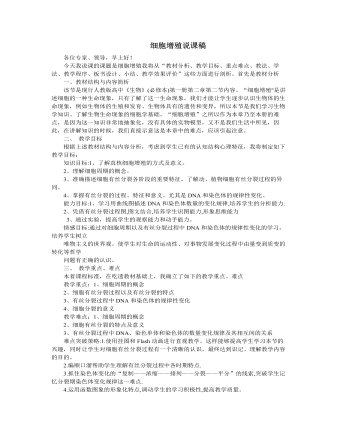
人教版高中生物必修1细胞增殖说课稿
f.有丝分裂的意义(讨论分析教学),首先引导学生结合所学知识讨论有丝分裂的的作用,最后有教师归纳总结,并要求学生在理解的基础上记忆。g.无丝分裂(图形直观教学、简介),本部分内容不是教学的重点,内容也相对简单,所以我的教学方法是直接给学生展示挂图,再进行简短介绍,让学生了解即可。h.引出减数分裂的概念,为第五章学习打下基础。小结:新课讲完以后由教师对本节内容进行总结巩固和反馈:进行一些课堂练习达到巩固和反馈的作用。最后布置作业,各种难度的作业题目均设置一些,其中简单题比重大,难题要求学生选作,这样提高学生学习积极性。2教学媒体程序设计: 细胞周期的概念(多媒体课件演示周期动画)植物细胞有丝分裂(多媒体课件演示分裂各期动画)动植物细胞有丝分裂异同点(多媒体课件演示分裂各期动画)有丝分裂过程中DNA和染色体数量的变化规律(挂图演示,包括表格和函数图象)
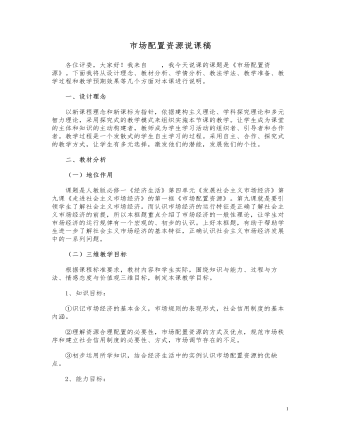
人教版高中政治必修1市场配置资源说课稿
(2)、市场调节存在固有的弊端:自发性:由于市场调节是在价值规律自发作用下进行的,在利益驱动下会产生一些违反市场原则的行为,如制造、销售假冒伪劣商品,大量排放废水、废气破坏环境,窃取他人智力成果等等。盲目性:由于人们不可能完全掌握生产各方面信息及其变化趋势,致使决策带有一定的盲目性。如某种商品有利可图则一哄而上,反之则一哄而退,从而造成资源浪费和消费得不到充分满足。滞后性:由于市场价格的形成和传递有一个过程,一旦传递到生产经营者手中进行生产调整,就有一个时间差,致使市场调节带有滞后性,成为一种事后调节。教师活动:请同学们想一想,市场的这些弊端和不足,会导致什么后果?(3)、危害教师总结:资源浪费,经济波动与混乱,分配不公两极分化等。设计意图:通过创设情景,加深对市场调节局限性的理解;要求学生结合生活实例探讨其弊端有助于加强对其产生原因和表现的记忆和理解。
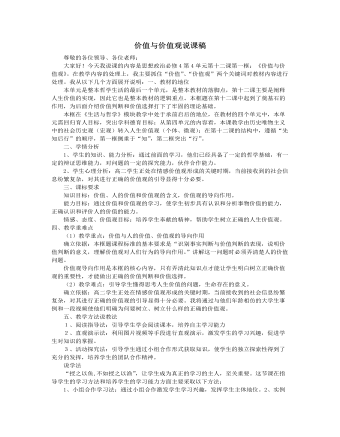
人教版高中政治必修4价值与价值观说课稿(一)
预测回答:成龙在影视,武术方面的价值,对于某个人,某个集团的价值。知识引导:人的价值体现在多方面的,可以是物质方面,也可以是精神方面,可以是对某个人或某个集团的价值,也可以是对人类和社会的价值。设置目的:从学生感兴趣的人物入手,分析对人的价值的评价。让学生自己分析总结,体现学生在新课改下的主体地位。从上述事例中我们可以看出人的价值是什么?如何评价?(学生活动)2.人的价值:在于创造价值,在于对社会的责任和贡献,即通过自己的活动满足自己所属的社会、他人以及自己的需要。(幻灯片显示)3.人的价值评价:看他的贡献,最根本的是对社会发展和人类进步事业的贡献。(幻灯片显示)老师总结:对社会的贡献并不是高高在上,不可触及。只要是做自己该做的事,从身边的小事做起,普普通通的劳动就是贡献社会和他人。学生归纳:人生价值原理二、价值观的导向作用(板书)1.价值观的含义人们在认识各种具体事物的价值的基础上,形成对事物价值的总的看法和根本观点。
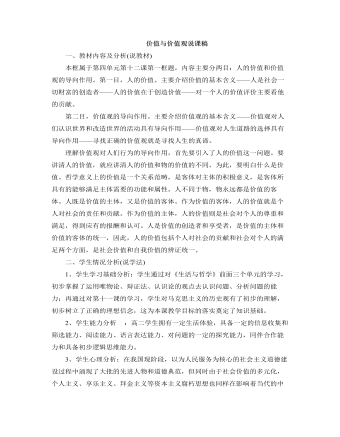
人教版高中政治必修4价值与价值观说课稿(二)
二、学生情况分析(说学法)1、学生学习基础分析:学生通过对《生活与哲学》前面三个单元的学习,初步掌握了运用唯物论、辩证法、认识论的观点去认识问题、分析问题的能力;再通过对第十一课的学习,学生对马克思主义的历史观有了初步的理解,初步树立了正确的理想信念,这为本课教学目标的落实奠定了知识基础。 2、学生能力分析 :高二学生拥有一定生活体验,具备一定的信息收集和筛选能力、阅读能力、语言表达能力、对问题的一定的探究能力,同伴合作能力和具备初步逻辑思维能力。3、学生心理分析:在我国现阶段,以为人民服务为核心的社会主义道德建设过程中涌现了大批的先进人物和道德典范,但同时由于社会价值的多元化,个人主义、享乐主义、拜金主义等资本主义腐朽思想也同样在影响着当代的中学生。
人教版高中政治必修4生活处处有哲学说课稿
(二)组织学生探究知识并形成新的知识。我从学生的生活体验入手,运用案例等形式创设情境呈现问题,使学生在自主探索、合作交流的过程中,发现问题、分析问题、解决问题,在问题的分析与解决中主动构建知识。主要通过几幅漫画让学生思考其中的哲学道理,开始接触哲学。漫画一:种瓜得瓜,种豆得豆,种鸡蛋得??漫画二:甲:下雨好极啦!乙:下雨糟透了!漫画三:——狂妄之徒,你竟然坏了祖上规矩!在引导学生思考、体验问题的过程中,可以使学生逐步学会分析、解决问题的方法。这样做既有利于发展学生的理解、分析、概括、想象等创新思维能力,又有利于学生表达、动手、协作等实践能力的提高,促进学生全面发展,力求实现教学过程与教学结果并重,知识与能力并重的目标。
人教版高中英语必修4Body Language说课稿4篇
Textbook: Senior English for China (Book 4), by Liu Daoyi Time Allotment: 1 period (40 minutes)Date: March 20, 2014Teaching aids: blackboard, Multi-media, Power Point, chalk I. Text Analysis (教材分析)This unit is about body language, and the text selected in the reading part demonstrates the difference and similarity of body language in many parts of the world. Through learning this passage, students are required to raise their awareness of using body language in different parts of the world. As body language is closely related to our daily life, it is easy to arouse students’ interest in learning this text. Reading skills and speaking training are designed around the text.II. Teaching Objectives (教学目标)By the end of the lesson, students will be able to:1. Language Skill Objective(语言技能目标): develop reading ability (skimming and scanning)as well as speaking ability.2. Cultural Knowledge Objective(文化知识目标): know about the cultural differences of using body language.3. Affective Objective(情感目标): increase students’ awareness of using body language correctly in different cultures. III.Teaching Focuses and Difficulties(教学重点和难点)1. Teaching Focuses(教学重点): the difference and similarity of body language in many parts of the world.2. Teaching Difficulties(教学难点): develop students’ reading abilities of skimming and scanning and ask the students to show their opinions with fluent English.
人教版高中英语必修1English around the world说课稿
(3)v. 给:提出;展现,显现present sb. with sth. ; present sth. to sb. 把. . 交给;颁发;授予present sth. (for sth. )/present sth. to sb. e. g. Om his birthday, his friends presented him a collection of stamps. 在他生日时,他的朋友们送给他一套邮票作为礼物。The sword was presented by the family to the museum. 这家人把宝剑捐赠给了博物馆。The committee will present the final report to Parliament in June. 委员会将在六月向议会提交最后的报告。You need to present yourself better. 你需要更善于展现自己。It is essential that we present a united front. 至关重要的是我们要表现得更加团结。Step 4 ConsolidationT:Now that we have got a general idea of these words and phrases. Lets make up some sentences using them to master them. Suggested sentences:1. Your duties include typing letters and answering the telephone. 2. It is one of the greatest roles that she has played. 3. A large number of people have applied for the job. 4. The number of the panda is declining. 5. I'11 go there, even if I have to walk. 6. He came up to me to ask for a light. 7. The novel is about a family who can't communicate with each other. 8. He based his plan on interests of most people. 9. Why doesn't he make use of his singing talent?Step 5 Summary and homeworkT:Today we dealt with several new words and phrases. After class I hope that youcan read them again and again to keep them in mind. That's all for today. You aredismissed.
人教版高中英语必修1Nelson Mandela--A Modern Hero说课稿
In this step, give students a few minutes to read the passage . While they are reading, I will write some key words of the text on the blackboard. Then ask students to retell the passage according to the key words.By retelling, students can improve their ability of language organization and have an overall understanding of the article.Step 4 Group discussionIn this step, students will be divided into groups of 4 to discussion the following question: What qualities make a great person?After their discussion, invite a few groups to make a report to the class.This group discussion can practice students’ oral English and cultivate their abilities of cooperation and communication.Step 5. HomeworkLet students write a short passage to introduce a great person he or she admires.The homework can consolidate the knowledge the students have learned and cultivate their writing ability. Part 6 Blackboard Design(板书设计)That’s all my teaching procedures. Finally, I’d like to say sth about part 6 blackboard design. On the top is the title. On the left, there will be some new words and expressions. In the middle of the blackboard, I will write some useful sentence structures so that the students can know clearly what they’ve learned and then try to master the knowledge.OK. That’s all for my presentation. Thank you for your attention.
人教版高中英语必修4A taste of English Humor说课稿3篇
Then I would ask them to think of a funny English or Chinese and tell it to partners. While telling stories, they can use expressions and some acting to help make the story funny. 5 minutes would be given to do this.Those stories they told there will be the material for their writing. Soletting them tell it at first is helpful. And they can make a difference between telling a funny story and writing it down. Generally speaking, it is difficult forstudents to write well because they don’t know what to write and how to write. Asking them to tell their own stories at first can help them come up with what to write.After their telling, I would invite someone to share his/her story with all of us and I would write it down on the blackboard.This example story would be used as a sample to illustrate the format of funny story. Different from a story from teacher or textbook, a story from students can obviously become a interesting material to draw students’ attention.Then I would ask the whole class to put this story into several parts. It might be a little bit difficult for them. So I would ask them to find out whether all the sentences are necessary. After delete some sentences, there are 6 sentences left behind. Then they can easily put them into three parts. After interaction with students, I would teach them the right terms for each part and conclude the format of funny story.This step is the key and difficult point in my lesson. So I mainly usetask-based teaching method in this part and the task for students was divided into several stages. With the separated difficult level, students can find there are usually three parts in writing. They can also learn to write without the unnecessary parts in the process of analyzing. And then I wouldn’t rush to tell them the right terms to them directly. Instead, I would ask them to name them by their own. A confused mind is better for acquiring knowledge.While-writing:Then I would give students 7 minutes to write down this story, without other requirements.With all the preparations in pre-writing, students’ difficulties were cleared. So it would be much easier for them to write down the story within 7 minutes. There are no other requirements because students’ first writing is actually a drafting. It would be revise and edit several times later. Writing, as a skill
人教版高中英语必修4Women of achievement说课稿4篇
Good morning, distinguished judges:It’s my honor to talk about my teaching ideas with you. Today my topic is Women of Achievement. My presentation consists of six parts: the analysis of teaching material and student, teaching aims, key and difficult points, teaching and studying method, teaching procedures and blackboard design.First, let’s focus on the analysis of teaching material. This lesson is from New Senior English for China Student’s Book 4 Unit 1, the reading part. The main topic of the passage is the introduction of a student of Africanwildlife. After this lesson, the students will learn more information about her studying chimps in Africa, and their reading and speaking abilities can be developed as well.The next part is the analysis of students. My students are in senior high students. They have learnt English for many years, they’ve known many words and sentences, but their speaking and reading abilities are still not very good. So I will practice their speaking and reading abilities through different exercises.According to the New Standard Curriculum and the present situation, I set the teaching aims as follows: firstly, knowledge aims. Students can grasp some new words, such as worthwhile, move off. Moreover, students can understand the content of the passage and get familiar with the topic of studying chimps in wildlife. Secondly, ability aims. Students can use reading strategies such as skimming and scanning in reading process. Thirdly, emotional aims. Students can have the awareness of protecting animals and care about animals.Based on the above analysis, the key point of this lesson is to get the main idea and the detailed information from the passage; the difficult point is to talk about the wildlife protection and use reading strategies.
人教版高中英语必修3Healthy Eating说课稿4篇
Language learning needs a context, which can help the learners to understand the language and then can product comprehensible output, so computer has the advantages to make the materials attractive.Part 3 Learning MethodsTask-based, self-dependent and cooperative learningPart 4 Teaching ProcedureStep One Lead-in“Interest is the best teacher.” Therefore, at the very beginning of the class, I should spark the students’ mind to focus on the centre topic “the band”. I’ll show some pictures of food to attract their attention and then bring some questions.Question:What kind of food they like?What should go into a good meal?The answers must relate to the diet. After this, the students will be eager to know something about a balance diet and this is the very time to naturally lead the class into Step 2Step 2 Reading for information: skimming and scanning In this step, I use Task-based Language Teaching method, which can give students a clear and specific purpose while skimming and scanning the context.Task 1 General ideaThe students will be asked to just glance at the title and the pictures of the passage, and then guess what they will read in the text. And they’ll be divided into groups of four to have a discussion.The purpose is to inspire the students to read actively, not passively. In addition, the task is to develop the students’ reading skill by making prediction and to encourage the students to express their thoughts in English and cooperate with each other.Task 2 Main idea of each paragraphCooperative learning can raise the students’ interest and create an atmosphere of achievement. Based on this theory, I divide the whole class into 4 groups to skim the whole text and get the main idea of each paragraph.
人教版高中英语必修4Working The Land说课稿3篇
Knowledge objectives:(1) to make Ss grasp the usage of words, expressions and sentence structures: statistics, struggle, thanks to, rid of, some patterns for persuasion, the “ing” form as subject and object;(2)to use learnt knowledge to persuade sb.Ability objectives:(1) to develop Ss’ reading skills(skimming, scanning, word guessing);(2) to improve Ss’ speaking, communicating and cooperating skills.Emotional objectives:to make Ss know the contribution of Yuan,and learn his spirit and his simple life time.Teaching important and difficult points:(1) some words, expressions and sentence structures mentioned above;(2)the content of the text;(3)training their reading and speaking skills.Teaching methods: CLT, TBLT,QT.Learning strategies: CLS, QLS, TBLS.Teaching procedures:Step 1 lead-in: (1) teacher plays a piece of recent news from CCTV about the harvest of the super hybrid rice, and ask students whether they know Yuan or not, and talk about him and his contribution.(2)Brain storm: let Ss describe Yuan in their minds including his appearance, his living condition and so on.Step 2 fast reading tasks:(1)teacher introduces Yuan and super hybrid rice(2)make Ss read the text as fast as possible with questions. Such as: what’s the general ideaof this passage? What’s Yuan’ dream? (skimming and scanning skill)Step 3 intensive reading tasks(1)let Ss read the text silently, find topic sentence of each paragraph and draw the difficult sentences and the knowledge what they don’t understand.(words guessing)(2)teacher and Ss talk about the important words, expressions and sentences together, and ask Ss to retell the content of the text.(summarizing and paraphrasing)(3)teacher summarize this part.(4) read again following the courseware.
人教版高中英语必修5First aid说课稿6篇
In this class, I have 3 teaching aims, that is, knowledge aims, ability aims and emotion aims.1) Knowledge-Teach students new words and expressions, such as temporary, bleed,sprain choke, first aid, fall ill and so on.-Enable students to have a better understanding for some basic knowledge of first aid.2) Ability-Train students’ speaking, reading and writing abilities by different teaching activities, such as skimming, comprehending, team work, role play, retelling and writing.-Develop students’ reading strategy on how to move general idea to specific information.3) Emotion-Promote students’ awareness of giving first aid.- Cultivate students’ creativities.Then let’s come to my teaching methods and activities.III. Teaching methods and activities:To achieve different teaching aims, various kinds of teaching methods and activities will be adopted throughout this period, such as TBL (task-based learning), skimming, team work, brainstorm and others, which can offer students opportunities to fulfill tasks in which they can use language to achieve a specific outcome.IV. Teaching aids:Computer and blackboardV. Teaching important points:1) Make students have a clear mind for the structure of the text.2) Help students understand the theme of the text.VI. Teaching difficulties:1) So many new words may affect students’ understanding.2) How to get students to know about the functions of the skin and thecauses, characteristics and treatments for different degree burns,and the knowledge about giving first aid. VII. Blackboard design:
人教版高中英语必修5Making the news说课稿4篇
今天我们来介绍一下必修五第四单元的授课方式。这个单元的题目是Making the news。应该是学生比较感兴趣的话题,学生往往对新闻工作充满好奇,所以我们可以利用这个机会多设计一些师生互动和学生互动,来激发起学习的积极性,提高学习效率。同时我们可以利用这个单元不仅帮助学生掌握语言知识,培养语言能力,同时让其了解新闻工作的重要性,培养起社会智能感。这个单元分为六个课时,它的教学目标是这样的:语言目标是掌握词汇表中的常用单词和短语,掌握倒装句的一些基本用法。 技能目标是能初步掌握约会的基本句型并在真实的场景下正确运用。新闻报道类文章的写作技能。采访的基本规范和沟通技能。情感目标是对新闻报道的客观性和真实性有更好的理解。对新闻记者的职业有更深入的了解,并能体会其工作的重要性。下面我们来介绍一下第一课时的授课方式,第一课的教学目标是这样的第一课时的教学目标语言目标:单词:Occupation, journalist, editor, photographer, curious, personality, enthusiasm
人教版高中英语必修5The United Kingdom说课稿4篇
Teaching Aims:Knowledge 1. Get the students to learn the useful new words and expressions in this section. Aims:2. Let the students learn about how the UK was formed and the four groups of invaders.1. Develop students’ reading ability and let them learn different Ability reading skills. Aims:2. Enable students to learn to talk about the United Kingdom and the Union Jack Emotional 1. Let students know more about the UK2. Develop students’ sense of cooperative learning Aims:Teaching Important Points:1. Let the students learn about the countries of the United Kingdom and the Union Jack2. Get the students to read the passage and know about how the UK was formed and the four groups of invaders.3. Have the students learn different reading skills.Teaching Difficult Ponts:1. Develop students’ reading ability.2. Enable students to talk about the United Kingdom and the Union Jack.3. Let students learn how the UK was formed geographically and historically.Teaching Methods:Showing pictures, asking, exercising, listening, reading etc.Teaching Aids:A computer,a projector and a blackboard.Teaching Procedures: 1) Show a map of the world, ask students the following questions:Where is the UK?What’s the full name of the UK?2) Ask the students work in pairs to do the quiz on Page 9.Do you want to test how many things you know about the United Kingdom? Let’s have a small test.Using the map on P9, students answer the following questions:?How many countries does the UK consist of? What are they??England is divided into three main areas. Do you know what they are? 1) Scanning (10Minutes )Let the students hold the questions asked in pre-reading and read the passagequickly and then let them do the following exercise.Join lines to the right answer.
人教版高中语文必修3《爱的奉献 学习议论中的记叙》说课稿
教学过程:(一)导入:课前放《爱的奉献》歌曲,同时不断播放一些有关“爱”的主题的图片,渲染一种情感氛围。师说:同学们,谁能说说这组图片的主题应该是什么?生(七嘴八舌):母爱,不对是亲情……是友情、还有人与人互相帮助……那组军人图片是说保卫国家,应该是爱国……那徐本禹和感动中国呢?…………生答:是关于爱的方面师说:不错,是关于爱的方面。那么同学们,今天就以“爱的奉献”为话题,来写一篇议论文如何?生答:老师,还是写记叙文吧。生答:就是,要不议论文写出来也象记叙文。师问:为什么?生答:老师,这个话题太有话说了,一举例子就收不住了,怎么看怎么象记叙文。生答:就是,再用一点形容词,就更象了。众人乐。师说:那么同学们谁能告诉我,为什么会出现这种问题?一生小声说:还不是我们笨,不会写。师说:不是笨,也不是不会写,你们想为什么记叙文就会写,一到议论文就不会了,那是因为同学们没有明白议论文中的记叙与记叙文中的记叙有什么不同,所以一写起议论文中的记叙,还是按照记叙文的写法写作,这自然就不行了。那好,今天我们就从如何写议论文中的记叙讲起。
人教版高中政治必修4时代的精神的精华说课稿
(二)能力目标培养学生运用哲学理论观察、分析、处理社会问题的能力,增强学生的时代感。(三)情感、态度与价值观目标培养学生与时俱进的思想品质,让学生关注时代、关注现实、关注生活,逐步树立科学的世界观、人生观、价值观。三、说教学重难点:时代精神的总结和升华是本框的难点,虽然学生在文化生活中学习了文化与经济政治的关系,但要让学生得出哲学是时代精神的总结和升华,还要联系前面关于哲学的基础知识进行总结归纳,因此可能会难以把握,另外关于什么样的哲学是真正的哲学的理解会稍有难度。社会变革的先导是本框的重点,一方面哲学源于时代,另一方面强调哲学反过来对时代又有重要的反作用,突出这一点能够更好地激发学生学习哲学的热情和信心,对于后面知识的学习是极为有益的,因此社会变革的先导这一目作重点处理。
高中思想政治人教版必修三《文化创新的途径》说课稿
二、说学情本课的教学对象为高二学生,他们思维活跃已具备一定归纳能力和分析、综合能力,能够自主地分析现实生活中的一些文化行为,但看问题往往比较偏激、片面,缺乏良好的逻辑思维能力。所以,在文化创新的途径上要对他们进行指导,以免走入误区。三、教学目标根据新课程标准、教材特点、学生的实际,我确定了如下教学目标:【知识与能力目标】1.理解文化创新的根本途径和两个基本途径;2.了解文化创新过程中需要坚持正确方向,克服错误倾向。
人教版高中数学选择性必修二等比数列的概念 (1) 教学设计
新知探究我们知道,等差数列的特征是“从第2项起,每一项与它的前一项的差都等于同一个常数” 。类比等差数列的研究思路和方法,从运算的角度出发,你觉得还有怎样的数列是值得研究的?1.两河流域发掘的古巴比伦时期的泥版上记录了下面的数列:9,9^2,9^3,…,9^10; ①100,100^2,100^3,…,100^10; ②5,5^2,5^3,…,5^10. ③2.《庄子·天下》中提到:“一尺之锤,日取其半,万世不竭.”如果把“一尺之锤”的长度看成单位“1”,那么从第1天开始,每天得到的“锤”的长度依次是1/2,1/4,1/8,1/16,1/32,… ④3.在营养和生存空间没有限制的情况下,某种细菌每20 min 就通过分裂繁殖一代,那么一个这种细菌从第1次分裂开始,各次分裂产生的后代个数依次是2,4,8,16,32,64,… ⑤4.某人存入银行a元,存期为5年,年利率为 r ,那么按照复利,他5年内每年末得到的本利和分别是a(1+r),a〖(1+r)〗^2,a〖(1+r)〗^3,a〖(1+r)〗^4,a〖(1+r)〗^5 ⑥
人教版高中数学选择性必修二等差数列的前n项和公式(1)教学设计
高斯(Gauss,1777-1855),德国数学家,近代数学的奠基者之一. 他在天文学、大地测量学、磁学、光学等领域都做出过杰出贡献. 问题1:为什么1+100=2+99=…=50+51呢?这是巧合吗?试从数列角度给出解释.高斯的算法:(1+100)+(2+99)+…+(50+51)= 101×50=5050高斯的算法实际上解决了求等差数列:1,2,3,…,n,"… " 前100项的和问题.等差数列中,下标和相等的两项和相等.设 an=n,则 a1=1,a2=2,a3=3,…如果数列{an} 是等差数列,p,q,s,t∈N*,且 p+q=s+t,则 ap+aq=as+at 可得:a_1+a_100=a_2+a_99=?=a_50+a_51问题2: 你能用上述方法计算1+2+3+… +101吗?问题3: 你能计算1+2+3+… +n吗?需要对项数的奇偶进行分类讨论.当n为偶数时, S_n=(1+n)+[(2+(n-1)]+?+[(n/2+(n/2-1)]=(1+n)+(1+n)…+(1+n)=n/2 (1+n) =(n(1+n))/2当n为奇数数时, n-1为偶数