-
新人教版高中英语选修2Unit 4 Reading for writing教学设计
假定你是英国的Jack,打算来中国旅行,请你给你的中国笔友李华写一封信,要点如下:1.你的旅行计划:北京→泰山→杭州;2.征求建议并询问他是否愿意充当你的导游。注意:1.词数80左右(开头和结尾已给出,不计入总词数);2.可以适当增加细节,以使行文连贯。参考词汇:故宫 the Forbidden City;泰山 Mount TaiDear Li Hua,I'm glad to tell you that 'm going to visit China.First,I am planning to visit Beijing,the capitalof China,where I am looking forward to enjoying the Great Wall,the Forbidden City and somebeautiful parks.Then I intend to go to visit Mount Tai in Shandong Province.I've heard that it is one ofthe most famous mountains in China and I can't wait to enjoy the amazing sunrise there.After that,I amalso going to Hangzhou.It is said that it is a beautiful modern city with breathtaking natural sights,among which the West Lake is a well- known tourist attraction.What do you think of my travel plan? Will you act as my guide? Hope to hear from you soon.
新人教版高中英语选修2Unit 5 Learning about Language教学设计
The purpose of this section of vocabulary exercises is to consolidate the key words in the first part of the reading text, let the students write the words according to the English definition, and focus on the detection of the meaning and spelling of the new words. The teaching design includes use English definition to explain words, which is conducive to improving students' interest in vocabulary learning, cultivating their sense of English language and thinking in English, and making students willing to use this method to better grasp the meaning of words, expand their vocabulary, and improve their ability of vocabulary application. Besides, the design offers more context including sentences and short passage for students to practice words flexibly.1. Guide students to understand and consolidate the meaning and usage of the vocabulary in the context, 2. Guide the students to use the unit topic vocabulary in a richer context3. Let the students sort out and accumulate the accumulated vocabulary, establishes the semantic connection between the vocabulary,4. Enable students to understand and master the vocabulary more effectivelyGuiding the Ss to use unit topic words and the sentence patterns in a richer context.Step1: Read the passage about chemical burns and fill in the blanks with the correct forms of the words in the box.
新人教版高中英语选修2Unit 5 Reading and thinking教学设计
The theme of this activity is to learn the first aid knowledge of burns. Burns is common in life, but there are some misunderstandings in manual treatment. This activity provides students with correct first aid methods, so as not to take them for granted in an emergency. This section guides students to analyze the causes of scald and help students avoid such things. From the perspective of text structure and collaborative features, the text is expository. Expository, with explanation as the main way of expression, transmits knowledge and information to readers by analyzing concepts and elaborating examples. This text arranges the information in logical order, clearly presents three parts of the content through the subtitle, accurately describes the causes, types, characteristics and first aid measures of burns, and some paragraphs use topic sentences to summarize the main idea, and the level is very clear.1. Guide students to understand the causes, types, characteristics and first aid methods of burns, through reading2. Enhance students’ ability to deal withburnss and their awareness of burns prevention3. Enable students to improve the ability to judge the types of texts accurately and to master the characteristics and writing techniques of expository texts.Guide students to understand the causes, types, characteristics and first aid methods of burns, through readingStep1: Lead in by discussing the related topic:1. What first-aid techniques do you know of ?CPR; mouth to mouth artificial respiration; the Heimlich Manoeuvre
新人教版高中英语必修3Unit 1 Festivals and Celebrations教学设计二
1. Ss look at the picture and scan the passage to understand the main idea while teacher is giving the following questions to inspire Ss to think.*Where are those people?*What are they doing?*Why are they so excited?2. Ss complete the passage with the appropriate -ing form. Then discuss and check the answers with class.Answers: boring, interesting, taking, exciting, amazing3. The teacher raises questions for the students to discuss and encourages them to express their opinions.*Do you like La Tomatina? Why or why not?4. Each group representative reports the discussion result, the teacher gives feedback and the evaluation.Step 6 PracticeActivity 41. Ss complete the Ex 2 in Using structures.2. Check the answers after finishing the exercises.①The dragon boat races are the most exciting part of the Dragon Boat Festival.② The children were excited to go Easter egg hunting.③What an amazing performance! This is the best music festival I have ever been to.④We were amazed by her funny-looking hat.⑤His inspiring speech at the conference won the admiration/ favour of the audience.⑥This is a challenging game to test your memory and observation capabilities. 3. T asks Ss to finish Ex 3 and 4 in Using structures by themselves, then check the answers with class.Step 6 Homework1. Understand and master the functions and usage of the -ing form;2. Finish the other exercises in Using structures.1、通过本节内容学习,学生是否理解和掌握动词-ing形式作定语和表语的功能和意义;2、通过本节内容学习,学生能否在理解文段内容的基础上,根据上下文语境和表达逻辑,能正确运用动词-ing形式描述节日庆典。3、通过本节内容学习,学生是否归纳和积累用于表达情绪的相关词汇。
新人教版高中英语必修3Unit 3 Diverse Cultures教学设计一
Activity 81.Grasp the main idea of the listening.Listen to the tape and answer the following questions:Who are the two speakers in the listening? What is their relationship?What is the main idea of the first part of the listening? How about the second part?2.Complete the passage.Ask the students to quickly review the summaries of the two listening materials in activity 2. Then play the recording for the second time.Ask them to complete the passage and fill in the blanks.3.Play the recording again and ask the students to use the structure diagram to comb the information structure in the listening.(While listening, take notes. Capture key information quickly and accurately.)Step 8 Talking Activity 91.Focus on the listening text.Listen to the students and listen to the tape. Let them understand the attitudes of Wu Yue and Justin in the conversation.How does Wu Yue feel about Chinese minority cultures?What does Justin think of the Miao and Dong cultures?How do you know that?2.learn functional items that express concerns.Ask students to focus on the expressions listed in activity. 3.And try to analyze the meaning they convey, including praise (Super!).Agree (Exactly!)"(You're kidding.!)Tell me more about it. Tell me more about it.For example, "Yeah Sure." "Definitely!" "Certainly!" "No kidding!" "No wonder!" and so on.4.Ask the students to have conversations in small groups, acting as Jsim and his friends.Justin shares his travels in Guizhou with friends and his thoughts;Justin's friends should give appropriate feedback, express their interest in relevant information, and ask for information when necessary.In order to enrich the dialogue, teachers can expand and supplement the introduction of Miao, dong, Lusheng and Dong Dage.After the group practice, the teacher can choose several groups of students to show, and let the rest of the students listen carefully, after listening to the best performance of the group, and give at least two reasons.
新人教版高中英语选修2Unit 4 Using langauge-Listening教学设计
The theme of the listening section is " talking about scenery and culture along a journey."The part is designed to further lead the students to understand Canadian natural geography and social environment, and integrated into the cultural contrast by mentioning the long train journey from Beijing to Moscow routes. On this basis, the part activates students related travel experience, lets the student serial dialogue, guides the student to explore further the pleasure and meaning of the long journey, and Chinese and foreign cultural comparison.The part also provides a framework for the continuation of the dialogue, which is designed to provide a framework for students to successfully complete their oral expressions, and to incorporate an important trading strategy to end the dialogue naturally.1. Help students to understand and master some common English idioms in the context, and experience the expression effect of English idioms.2. Guide the students to understand the identity of different people in the listening context, and finish the dialogue according to their own experience.3. Instruct the students to use appropriate language to express surprise and curiosity about space and place in the dialogue, and master the oral strategy of ending the dialogue naturally.1. Instruct students to grasp the key information and important details of the dialogue.2. Instruct students to conduct a similar talk on the relevant topic.
新人教版高中英语选修2Unit 5 Using langauge-Listening教学设计
The theme of this section is to learn how to make emergency calls. Students should learn how to make emergency calls not only in China, but also in foreign countries in English, so that they can be prepared for future situations outside the home.The emergency telephone number is a vital hotline, which should be the most clear, rapid and effective communication with the acute operator.This section helps students to understand the emergency calls in some countries and the precautions for making emergency calls. Through the study of this section, students can accumulate common expressions and sentence patterns in this context. 1.Help students accumulate emergency telephone numbers in different countries and learn more about first aid2.Guide the students to understand the contents and instructions of the telephone, grasp the characteristics of the emergency telephone and the requirements of the emergency telephone.3.Guide students to understand the first aid instructions of the operators.4.Enable Ss to make simulated emergency calls with their partners in the language they have learned1. Instruct students to grasp the key information and important details of the dialogue.2. Instruct students to conduct a similar talk on the relevant topic.Step1:Look and discuss:Match the pictures below to the medical emergencies, and then discuss the questions in groups.
初中数学人教版二元一次方程组教学设计教案
(一)例题引入篮球联赛中,每场比赛都要分出胜负,每队胜1场得2分,负1场得1分。某队在10场比赛中得到16分,那么这个队胜负场数分别是多少?方法一:(利用之前的知识,学生自己列出并求解)解:设剩X场,则负(10-X)场。方程:2X+(10-X)=16方法二:(老师带领学生一起列出方程组)解:设胜X场,负Y场。根据:胜的场数+负的场数=总场数 胜场积分+负场积分=总积分得到:X+Y=10 2X+Y=16
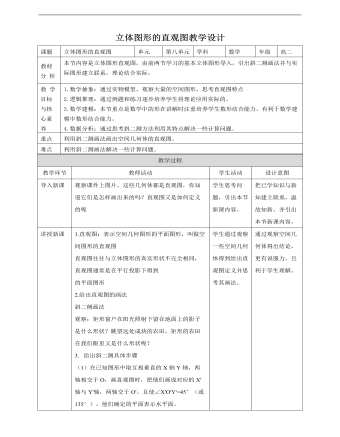
人教A版高中数学必修二立体图形直观图教学设计
1.直观图:表示空间几何图形的平面图形,叫做空间图形的直观图直观图往往与立体图形的真实形状不完全相同,直观图通常是在平行投影下得到的平面图形2.给出直观图的画法斜二侧画法观察:矩形窗户在阳光照射下留在地面上的影子是什么形状?眺望远处成块的农田,矩形的农田在我们眼里又是什么形状呢?3. 给出斜二测具体步骤(1)在已知图形中取互相垂直的X轴Y轴,两轴相交于O,画直观图时,把他们画成对应的X'轴与Y'轴,两轴交于O'。且使∠X'O'Y'=45°(或135°)。他们确定的平面表示水平面。(2)已知图形中平行于X轴或y轴的线段,在直观图中分别画成平行于X'轴或y'轴的线段。(3)已知图形中平行于X轴的线段,在直观图中保持原长度不变,平行于Y轴的线段,在直观图中长度为原来一半。4.对斜二测方法进行举例:对于平面多边形,我们常用斜二测画法画出他们的直观图。如图 A'B'C'D'就是利用斜二测画出的水平放置的正方形ABCD的直观图。其中横向线段A'B'=AB,C'D'=CD;纵向线段A'D'=1/2AD,B'C'=1/2BC;∠D'A'B'=45°,这与我们的直观观察是一致的。5.例一:用斜二测画法画水平放置的六边形的直观图(1)在六边形ABCDEF中,取AD所在直线为X轴,对称轴MN所在直线为Y轴,两轴交于O',使∠X'oy'=45°(2)以o'为中心,在X'上取A'D'=AD,在y'轴上取M'N'=½MN。以点N为中心,画B'C'平行于X'轴,并且等于BC;再以M'为中心,画E'F'平行于X‘轴并且等于EF。 (3)连接A'B',C'D',E'F',F'A',并擦去辅助线x轴y轴,便获得正六边形ABCDEF水平放置的直观图A'B'C'D'E'F' 6. 平面图形的斜二测画法(1)建两个坐标系,注意斜坐标系夹角为45°或135°;(2)与坐标轴平行或重合的线段保持平行或重合;(3)水平线段等长,竖直线段减半;(4)整理.简言之:“横不变,竖减半,平行、重合不改变。”
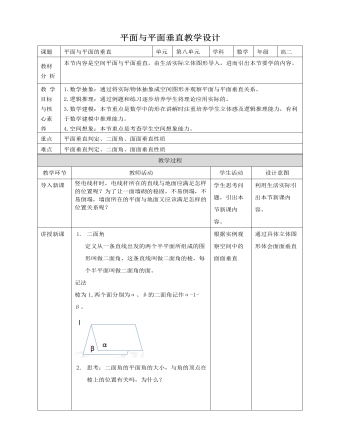
人教A版高中数学必修二平面与平面垂直教学设计
6. 例二:如图,AB是⊙O的直径,PA垂直于⊙O所在的平面,C是圆周上的一点,且PA=AC,求二面角P-BC-A的大小. 解:由已知PA⊥平面ABC,BC在平面ABC内∴PA⊥BC∵AB是⊙O的直径,且点C在圆周上,∴AC⊥BC又∵PA∩AC=A,PA,AC在平面PAC内,∴BC⊥平面PAC又PC在平面PAC内,∴PC⊥BC又∵BC是二面角P-BC-A的棱,∴∠PCA是二面角P-BC-A的平面角由PA=AC知△PAC是等腰直角三角形∴∠PCA=45°,即二面角P-BC-A的大小是45°7.面面垂直定义一般地,两个平面相交,如果它们所成的二面角是直二面角,就说这两个平面互相垂直,平面α与β垂直,记作α⊥β8. 探究:建筑工人在砌墙时,常用铅锤来检测所砌的墙面与地面是否垂直,如果系有铅锤的细绳紧贴墙面,工人师傅被认为墙面垂直于地面,否则他就认为墙面不垂直于地面,这种方法说明了什么道理?
小学数学人教版五年级上册《实际问题与方程 》说课稿
2. 教材分析这节课的教学是学生在掌握行程问题基本数量关系的基础上进行的,本课教材给学生提供了“骑车”的情境,通过简单的路线图等方式呈现了速度路程等信息。然后要求学生根据这些信息去解决2个问题:①让学生根据两辆车的速度信息进行估计,在哪个地方相遇。②用方程解决相遇问题中求相遇时间的问题。3. 学情分析学生已经在三年级接触了简单的行程问题,四年级上册,学生就真正的开始学习速度、时间、路程之间的关系,并用三者的数量关系来解决行程问题。而本节课正是运用这些学生已有的知识基础和生活经验进行相遇问题的探究。4、教学目标从知识与技能、过程与方法、情感态度价值观的三维目标出发,制定了以下的目标:①使学生理解相遇问题的意义及特点。②经历解决问题的过程,提高收集信息、处理信息和建立模型的能力。③会分析简单实际问题中的数量关系,提高用方程解决简单的实际问题的能力。
频率的稳定性教案教学设计
活动内容:教师首先让学生回顾学过的三类事件,接着让学生抛掷一枚均匀的硬币,硬币落下后,会出现正面朝上、正面朝下两种情况,你认为正面朝上和正面朝下的可能性相同吗?(让学生体验数学来源于生活)。活动目的:使学生回顾学过的三类事件,并由掷硬币游戏培养学生猜测游戏结果的能力,并从中初步体会猜测事件可能性。让学生体会猜测结果,这是很重要的一步,我们所学到的很多知识,都是先猜测,再经过多次的试验得出来的。而且由此引出猜测是需通过大量的实验来验证。这就是我们本节课要来研究的问题(自然引出课题)。
扇形统计图教案教学设计
教学目标1、明确扇形统计图的制作步骤,能够根据相关数据较为准确地制作扇形统计图.2、进一步理解扇形统计图的特点,建立百分比大小和扇形圆心角大小之间初步的直观敏感度.3、能够实现不同统计图数据间的合理转换,再次体会几种统计图的不同特点,为合理选择统计图表示数据打下一定的基础.4、通过实例,理解三种统计图的特点,能根据具体问题选择合适的统计图清晰、有效地描述数据.5、在统计活动的过程中,通过相互间的合作与交流,掌握画统计图和选择统计图的方法;经历数据的收集、整理和简单分析、作出决策的统计活动过程,发展统计观念.6、通过对现实生活中的数据分析,感受数学与现实生活的密切联系,说出统计图在现实生活中的应用,提高学习数学兴趣.
学做家常菜教学设计教案
小学五年级的学生应该具备一些生活技能, 学做家常菜是我们生活的必需,是每个,人都应该掌握的生存技能。本主题的目的通过学习做简单的家常菜,引领小学生走进家务劳动,锻炼生活的自理能力和提高适应生活的能力,体会生活和学习的乐趣,激发学生将学校学习和家务劳动密切结合起来,形成积极的生活和学习的态度。本主题安排了“问题与思考”“学习与探究”“实践与体验”总结与交流“拓展与创新”五个环节,从提出问题开始,到探究与体验,最后到学有所用,循序渐进,引导学习走进中式餐饮文化,学做日常生活中的家常菜,掌握劳动的技能和方法,体验做家务劳动带来的快乐和享受,激发学生对家常菜的探究与实践的兴趣,逐步掌握日常生活所需的基本技能,培养热爱劳动、热爱生活的意识。
感受可能性教案教学设计
(一)、创设情景,导入新课摸牌游戏:三位同学持三组牌,指定三位同学分别任意摸出一张,看谁能摸到红牌,他们一定能摸到红牌吗?请手持牌的同学根据自已手中牌的情况,用语言描述一下抽出红牌的情况。总结:在一定条件下,有些事情我们事先能肯定它一定发生,这些事情成为 事件。有些事情我们事先能肯定它一定不会发生,这些事情称为 事件。 事件和 事件统称为确定事件。许多事情我们事先无法肯定它会不会发生,这些事情称为 事件,也称为 事件。
《将进酒》教案教学设计
教师活动 学生活动设计意图 情境导入:教师配乐叙述诗歌创作背景投入倾听 尽可能调动学生情绪诵读入境:“读李诗者于雄快之中得其深远宕逸之神,才是谪仙人面目”(投影展示)教师范读,酝酿情感(播放配乐)1、学生自读感知诗韵 2、学生齐读进入诗境 调动学生积极性,诵读时用自己的情绪感染学生精读涵咏:教师就诗歌内容进行提问,李白怎样喝酒,劝朋友喝酒的方式、原因,他有那些愁并说明理由,并按照自己的理解诵读。教师必要时给出相应的提示。投影展示:人生苦短 怀才不遇 交流研讨诵读 引导学生从诗句入手,疏通诗意,把握情感
《将进酒》教案教学设计
(一)知识与能力 1、指导学生基本掌握诵读本诗的要领,培养学生声情并茂、准确传达情感的诵读能力. 2、帮助学生初步了解“初读—精读—悟读—美读”的诗歌鉴赏方法,培养学生鉴赏古典诗歌的能力。(二)、情感态度与价值观 1、走近李白的激情、浪漫、诗性和放达,感受全诗恢宏的气魄。 2、激发学生与文本、文人和文化的亲近之情
认识三角形教案教学设计
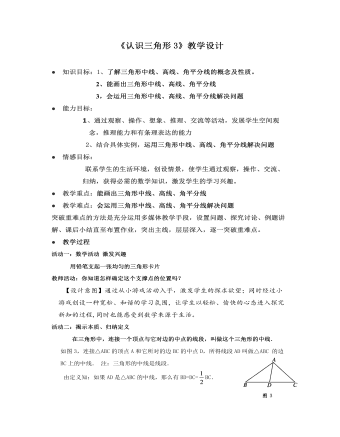
四个同学为一个合作小组;每个小组利用教师为其准备的各类三角形,作出它们的高.比一比,看哪一个小组做得最快,发现的结论多. 师生行为:学生操作、讨论,教师巡视、指导,使学生理解【设计意图】通过让学生操作、观察、推理、交流等活动,来培养学生的动手、动脑能力,发展其空间观察.活动结论:1.锐角三角形的三条高都在三角形内; 2.直角三角形的一条高在三角形内(即斜边上的高),而另两条高恰是它的两条直角边; 3.钝角三角形的一条高在三角形内,而另两条高在三角形外.(这是难点,需多加说明) 总之:任何三角形都有三条高,且三条高所在的直线相交于一点.(我们把这一点叫垂心)课堂小结 1.三角形中三条重要线段:三角形的高、中线和角平分线的概念. 2.学会画三角形的高、中线和角平分线.
李商隐诗两首教学设计教案
我们不妨将主旨放在“庄生晓梦迷蝴蝶,望帝春心托杜鹃。沧海月明珠有泪,蓝田日暖玉生烟。”二联之前,那么,事情就变得简单起来了:华年如庄生晓梦迷蝴蝶;华年如望帝春心托杜鹃;华年如沧海月明珠有泪;华年如蓝田日暖玉生烟。从课下注释,我们很容易就可以看出,这四句每一句都在用典。因此,我们通过对典故的解读,然后加以整理,将其理顺,似乎就可以完成对诗歌内容的解读;至于什么悼亡、爱情,不妨抛之脑后,毕竟,没有那些其他的主题,也并没有让诗歌失色,而加上这些捉摸不定的主题,只是让诗歌增加了所谓的神秘色彩,徒增阅读难度而已。
李商隐诗两首教学设计
《锦瑟》的主旨颇多,悼亡、恋情、自伤身世,每一种都有其支持者的长篇论述,但其首联中“一弦一柱思华年。”从这个角度来看,似乎将主题定调为对“华年”的追思,似乎更为妥帖。当我们有了一个明确的基调之后,后面几联在解读时就有了一个准确的方向。