-
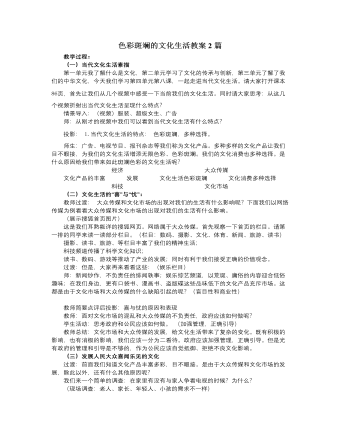
人教版高中政治必修3色彩斑斓的文化生活教案2篇
六、学习效果评价设计1、评价方式:我对学习效果的评价,来自两个方面。一是教师的教授是否认真、严肃、科学;二是学生的学习成果如何,是否达成了事先预设的教学目标,是否在学习过程中有提高的过程。评价的方式有:同伴评价;教师自我评价和反思;学生反馈。2、评价量规:我设置了几个问题用于课后的教学评价:(1)教学目标是否符合课标要求,是否符合三贴近原则,是否体现学生学习效果的生成性和过程性。(2)学习所用资源是否来自生活实际,是否真实,是否是学生感兴趣的问题。(3)教师在课堂教学过程中是否能有效的通过提问和资料的展示分析,引导学生自己生成思考过程,而不是“教师代替学生的思考”。(4)学生参与的广度和态度,学生是否提出有意义的观点和问题。学生的回答是否是实话。
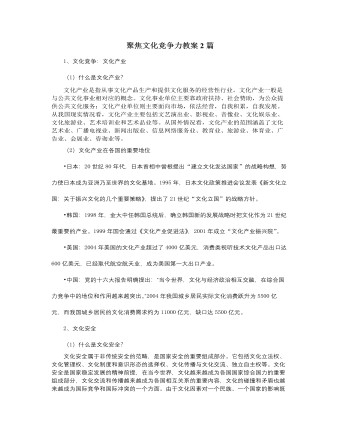
人教版高中政治必修3聚焦文化竞争力教案2篇
教学目的:通过学生课前收集资料、课堂展示、小组讨论及教师总结和讲解等形式,明确文化竞争力在国际竞争中的地位,感受各国各国日益激烈的文化竞争力,探讨如何提升中国特色社会主义文化的竞争力,培养学生的分析解决问题的能力,增强责任意识、科技意识和成才意识。教学时间:1小时课前准备:(1)学生分组收集美国、日本、英国等国家文化产业的发展状况和中国文化走向世界的资料,并要求制成简单的课件。(2)分组讨论课本P23—25的三个探究问题(①运用这些资料,从物质和精神两个方面,说明发展文化有什么意义。②你还能从社会生活的哪些现象中感受到一个国家的文化竞争力?③今天,中国文化为什么能够在世界各地赢得尊重与喝彩?),组长整理好讨论结果。
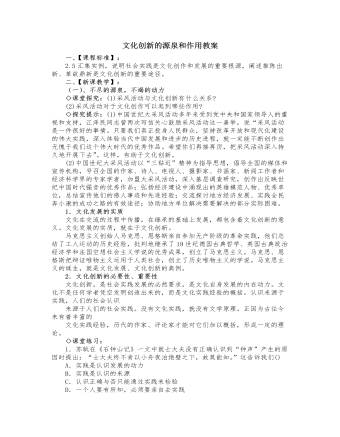
人教版高中政治必修3文化创新的源泉和作用教案
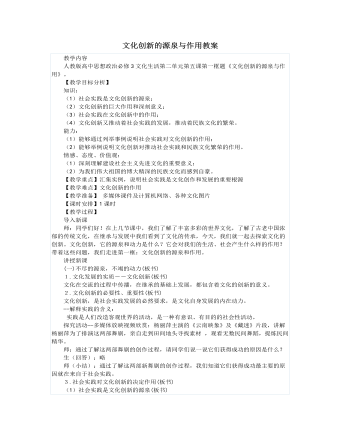
(1)社会实践是文化创新的源泉实践,作为人们改造客观世界的活动,是一种有目的、有意识的社会性活动。人类在改造自然和社会的实践中,创造出自己特有的文化。离开了社会实践;文化就会成为无源之水、无本之木,人们不可能从事任何有价值的文化创造。◇本课小结:1.关于本课逻辑结构的宏观把握:文化创新的源泉和作用这一问题,教材分三个层次展开论证:一是不尽的源泉,不竭的动力;二是巨大的作用,深刻的意义;三是呼唤文化创新的时代。教材运用辩证方法从文化创新的源泉和作用展开论述。即社会实践是文化创新的源泉,文化创新又推动社会实践的发展和促进民族文化的繁荣。教材关于文化创新的途径问题,从三个层次展开讲述:第一个层次是“继承传统,推陈出新”;第二个层次是“面向世界,博采众长”;第三个层次是“坚持正确方向,克服错误倾向”。三个层次三个角度,着重于分析每一个层次,然后予以归纳总结,即采用了分析归纳法,层次清晰,教学目标明确,既便于传授知识,又便于学生学习时识记、理解和把握。
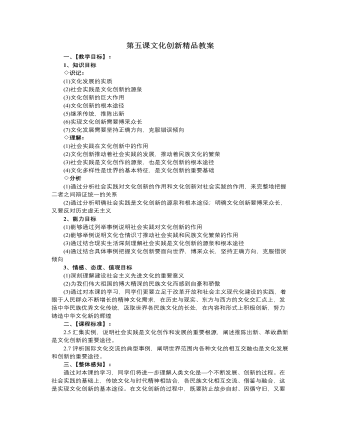
人教版高中政治必修3第五课文化创新精品教案
3.社会实践对文化创新的决定作用社会实践对文化创新具有两个方面的重要作用:(1)社会实践是文化创新的源泉实践,作为人们改造客观世界的活动,是一种有目的、有意识的社会性活动。人类在改造自然和社会的实践中,创造出自己特有的文化。离开了社会实践;文化就会成为无源之水、无本之木,人们不可能从事任何有价值的文化创造。◇本课小结:1.关于本课逻辑结构的宏观把握:文化创新的源泉和作用这一问题,教材分三个层次展开论证:一是不尽的源泉,不竭的动力;二是巨大的作用,深刻的意义;三是呼唤文化创新的时代。教材运用辩证方法从文化创新的源泉和作用展开论述。即社会实践是文化创新的源泉,文化创新又推动社会实践的发展和促进民族文化的繁荣。教材关于文化创新的途径问题,从三个层次展开讲述:第一个层次是“继承传统,推陈出新”;第二个层次是“面向世界,博采众长”;第三个层次是“坚持正确方向,克服错误倾向”。
人教版高中政治必修3文化创新的源泉和作用精品教案
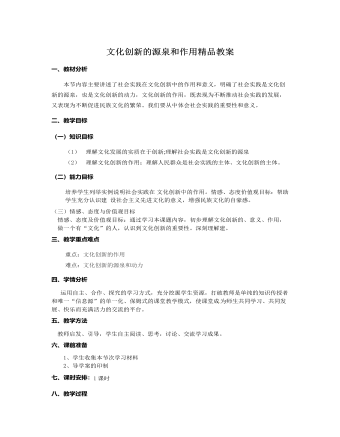
一、教材分析本节内容主要讲述了社会实践在文化创新中的作用和意义,明确了社会实践是文化创新的源泉,也是文化创新的动力,文化创新的作用,既表现为不断推动社会实践的发展,又表现为不断促进民族文化的繁荣。我们要从中体会社会实践的重要性和意义。二、教学目标(一)知识目标(1) 理解文化发展的实质在于创新;理解社会实践是文化创新的源泉(2) 理解文化创新的作用;理解人民群众是社会实践的主体、文化创新的主体。(二)能力目标培养学生列举实例说明社会实践在 文化创新中的作用。情感、态度价值观目标:帮助学生充分认识建 设社会主义先进文化的意义,增强民族文化的自豪感。 (三)情感、态度与价值观目标情感、态度及价值观目标:通过学习本课题内容,初步理解文化创新的、意义、作用,做一个有“文化”的人,认识到文化创新的重要性。深刻理解建。
人教版高中政治必修3文化创新的源泉与作用教案
(三)呼唤文化创新的时代(板书)1.人民群众是文化创造的主体--(板书)师:【图片文字展示】--《离骚》、《九歌》、《水浒传》、《三国演义》均取材自民间,在民间口述文字的基础上加工形成,所以,我们可以看到,文化创新的主体是谁?生:人民群众是文化创造的主体师:在新的历史时期,我们的青少年应该怎么做?生:虚心向人民群众学习,从人民群众的伟大实践和丰富多彩的生活中汲取营养,这是当代中国文化工作者的使命和职责。2.文化工作者必须坚定地走与人民群众的实践相结合的道路--(板书)3.当代中国文化创作者的使命和职责。(板书)【课堂小结】通过本节课的探究学习,我们认识到文化创新的源泉和作用,要求我们虚心向人民群众学习,从人民群众的伟大实践和丰富多彩的生活中汲取营养,刻苦钻研,锐意创新,为全面建设小康社会而奋斗。
人教版高中政治必修3文化创新的途径精品教案
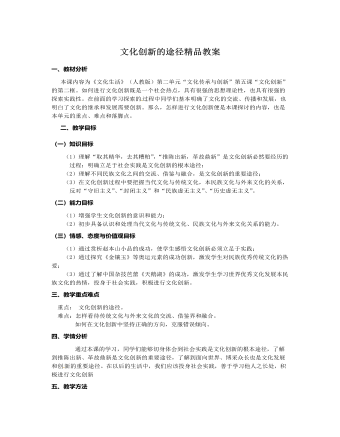
一、教材分析本课内容为《文化生活》(人教版)第二单元“文化传承与创新”第五课“文化创新”的第二框。如何进行文化创新既是一个社会热点,具有很强的思想理论性,也具有很强的探索实践性。在前面的学习探索的 过程中同学们基本明确了文化的交流、传播和发展,也明白了文化的继承和发展需要创新。那么,怎样进行文化创新便是本课探讨的内容,也是本单元的重点、难点和落脚点。二、教学目标(一)知识目标 (1)理解“取其精华,去其糟粕”,“推陈出新,革故鼎新”是文化创新必然要经历的过程;明确立足于社会实践是文化创新的根本途径;(2)理解不同民族文化之间的交流、借鉴与融合,是文化创新的重要途径;(3)在文化创新过程中要把握当代文化与传统文化,本民族文化与外来文化的关系,反对“守旧主义”、“封闭主义”和“民族虚无主义”、“历史虚无主义”。
人教版高中语文必修1《心音共鸣:写触动心灵的人和事》教案3篇
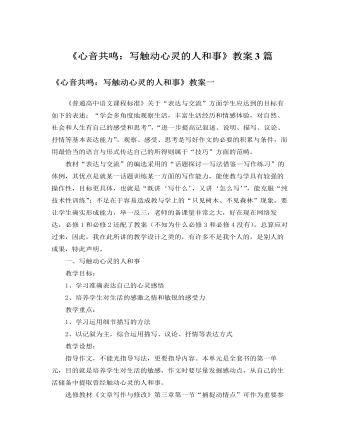
《普通高中语文课程标准》关于“表达与交流”方面学生应达到的目标有如下的表述:“学会多角度地观察生活,丰富生活经历和情感体验,对自然、社会和人生有自己的感受和思考”,“进一步提高记叙述、说明、描写、议论、抒情等基本表达能力”。观察、感受、思考是写好作文的必要的积累与条件,而用最恰当的语言与形式传达自己的所得则属于“技巧”方面的范畴。教材“表达与交流”的编选采用的“话题探讨—写法借鉴—写作练习”的体例,其优点是就某一话题训练某一方面的写作能力,能使教与学具有较强的操作性,目标更具体,也就是“既讲‘写什么’,又讲‘怎么写’”,能克服“纯技术性训练”;不足在于容易造成教与学上的“只见树木、不见森林”现象。要让学生确实形成能力,举一反三,老师的备课量非常之大,好在现在网络发达,必修1和必修2还配了教案(不知为什么必修3和必修4没有),总算应对过来,因此,我在此所讲的教学设计之类的,有许多不是我个人的,是别人的成果,特此声明。
人教版高中语文必修3《杜甫诗三首 咏怀古迹》教案
“千载琵琶作胡语,分明怨恨曲中论。”“怨恨”两字点明全篇主旨。千百年来,琵琶所演奏的总是从匈奴传来的撩人愁思的胡乐,正是昭君在诉说着她的怨恨!这两句从侧面烘托昭君的形象,既有对她的赞扬,又有对她的同情。读到这里,我们的耳边好像又响起了那深沉、幽怨的琵琶声!5、这首诗写的是昭君的怨恨,但首联一开始并没有写她的怨恨,写的是什么?这样写的目的又是什么?明确:群山万壑赴荆门山是群山起伏,连绵不绝;水是万壑争流,奔腾不息,直赴荆门山。其中的“赴”字用了拟人的手法,把迤逦不绝的千山万壑陡然间写活了,既有飞动之势,又有变幻之姿。从侧面烘托昭君的形象。两千多年前,一个青年女子远离父母之邦,嫁到异域,并在那里度过一生,确实需要巨大的勇气和毅力,而这雄伟的山川简直就是她那坚强的性格的象征。6、佳句鉴赏(这首诗歌当中,我认为有两句诗写得非常美,我自己很喜欢,不知道有没有同道中人?)
人教版高中语文必修2《我有一个梦想》说课稿2篇
(2).教学手段为了使我根据教材而设计的三个教学目标以及重点难点得以的突出和突破,达到最大化的展示境界,同时也为了配合以上我选择的四种教法得以完满实现,我决定采用“多媒体”教学手段进行全程教学。利用电脑的信息容量大,操作简便等优点,形象生动的直观展示教学内容,不但提高学习效率和质量,而且容易激发学生的学习兴趣和调动学习的积极性。四、说学法我为学生设计了三个学习方法:1.让学生学会在探究中学。通过“对黑人严酷处境的探究”和对文中重点语句的探究,培养学生在探究中学习的能力。2.让学生学会在读中学。通过“诵读法”指导学生在诵读过程中感受演讲词内在的魅力,学会在读中学。3.让学生学会在练习中学。通过“课外延伸练习法”,对所学的知识进行运用,培养学生的创新和自学能力。
人教版高中英语必修1Earth quake说课稿
(4)Finally, I will ask the SS what this sentence mean:It is always calm before a storm.Purpose: attract the SS attention and bring them into discussionStep 2: Pre-reading 读前Here, I will do the second question in pre-reading first. I will use the method of brainstorming to ask the SS what will happen before an earthquake; and list the phenomenon on the table. 2. Then I will show the SS the picture of abnormal phenomenon, at the same time, encourage the SS to describe.3、finally, I will summarize these phenomenon4、Do the first question in the pre-reading , Imaging your home begins to shake and you must leave it right away. You have time to take only one thing. What will you take? Why?Purpose: help the SS to get further understanding of the topic and stimulate their interests.Step3: While-reading 阅读(1). Skimming Read the text quickly and catch the meaning of the first and second sentence of each paragraph. Predict the meaning of new words(2).scanning(找读)A. Read the text again. Do the following question.1. When and where were the strange things happening?2. What are they?3. Why did the text say the world seemed to be at an end?4. How was the city destroyed after the quake?5. When did the second quake hit the city? What was the result of that?6. Who came to help Tangshan first? And how?B. Work in pairs to discuss the question.
人教版高中语文必修2《采薇》说课稿
三、疏通课文,体会情感学生朗读一至三节,找出通假字,如“莫”;语助词如“止”“曰”;古今异义词如“启”“居”。以及个别短语如“靡室靡家”“载饥载渴”的结构,结合上《卫风·氓》中出现的相同或类似的结构来理解。检查学生的自学情况,抽查翻译,纠正错误。这三节都以采薇起笔,让学生思考课文呢写了薇菜生长的哪几种形态,有什么作用?学生思考。这个问题不难,但学生回答可能不完整,只点到用于表达士卒思归之情的强烈。老师要补充,用薇菜的生长来反映归期的推移和不定期,思念之情更加沉重。同时在艺术手法上,同《卫风·氓》用“桑叶”来起兴一样,这里也是比兴手法,引出下文。另外,战士们靠野菜来充饥也反映了战士们生活艰苦,兴中有赋。
人教版高中英语必修4Body Language说课稿4篇
Textbook: Senior English for China (Book 4), by Liu Daoyi Time Allotment: 1 period (40 minutes)Date: March 20, 2014Teaching aids: blackboard, Multi-media, Power Point, chalk I. Text Analysis (教材分析)This unit is about body language, and the text selected in the reading part demonstrates the difference and similarity of body language in many parts of the world. Through learning this passage, students are required to raise their awareness of using body language in different parts of the world. As body language is closely related to our daily life, it is easy to arouse students’ interest in learning this text. Reading skills and speaking training are designed around the text.II. Teaching Objectives (教学目标)By the end of the lesson, students will be able to:1. Language Skill Objective(语言技能目标): develop reading ability (skimming and scanning)as well as speaking ability.2. Cultural Knowledge Objective(文化知识目标): know about the cultural differences of using body language.3. Affective Objective(情感目标): increase students’ awareness of using body language correctly in different cultures. III.Teaching Focuses and Difficulties(教学重点和难点)1. Teaching Focuses(教学重点): the difference and similarity of body language in many parts of the world.2. Teaching Difficulties(教学难点): develop students’ reading abilities of skimming and scanning and ask the students to show their opinions with fluent English.
人教版高中英语必修4Women of achievement说课稿4篇
Good morning, distinguished judges:It’s my honor to talk about my teaching ideas with you. Today my topic is Women of Achievement. My presentation consists of six parts: the analysis of teaching material and student, teaching aims, key and difficult points, teaching and studying method, teaching procedures and blackboard design.First, let’s focus on the analysis of teaching material. This lesson is from New Senior English for China Student’s Book 4 Unit 1, the reading part. The main topic of the passage is the introduction of a student of Africanwildlife. After this lesson, the students will learn more information about her studying chimps in Africa, and their reading and speaking abilities can be developed as well.The next part is the analysis of students. My students are in senior high students. They have learnt English for many years, they’ve known many words and sentences, but their speaking and reading abilities are still not very good. So I will practice their speaking and reading abilities through different exercises.According to the New Standard Curriculum and the present situation, I set the teaching aims as follows: firstly, knowledge aims. Students can grasp some new words, such as worthwhile, move off. Moreover, students can understand the content of the passage and get familiar with the topic of studying chimps in wildlife. Secondly, ability aims. Students can use reading strategies such as skimming and scanning in reading process. Thirdly, emotional aims. Students can have the awareness of protecting animals and care about animals.Based on the above analysis, the key point of this lesson is to get the main idea and the detailed information from the passage; the difficult point is to talk about the wildlife protection and use reading strategies.
人教版高中英语必修4Theme parks说课稿3篇
The oldest and the most popular park in the worldenjoy the exciting activities thereget close to the life-size cartoon characters like Mickey Mouse and Donald Duck Step 3 Pre-reading1.What do you suppose a theme park is ?2.What do you think you can see in a theme park?(1.It is a kind of amusement park which has a certain theme – that the whole park is based on. 2.buildings, castles, statues, rare animals and birds, and so on.) Step 4 Reading ----- Theme Parks –---- Fun and More Than Fun1.Predict : Read the title and the pictures on P. 34 and PredictWhat is the meaning of the title “Theme Park – Fun and more than fun”?(The title means that theme parks are fun to visit, but that they can also be educational and can offer useful information.)2.Skimming Fast read and answer:What activities can we take in a theme park?Amusement park: Bumper car Merry-go-round slide bungee jumping Free-fall rides Horror films Pirate ship Ferris wheel roller coaster3.Scanning Read again and you will find various theme parks are mentioned in the passage . Then what are they ?Theme parks: Sports theme park History theme park Culture theme park Marine or Ocean theme Park Future park Science theme park Disneyland4.Careful reading and find the main idea of each paragraph:THEME PARKS---- entertaining/ educationalPara.1 Traditional parks are places to go for relaxation and to have time away from our busy lives.Para.2 Theme parks are different They’re large and full of things to do, see and buy.Para.3 Theme parks are built around a single idea or theme. One example is a sports park.Para.4 Another kind of theme park is historical more and cultural and can be educational.Para.5 Disneylandwas the first theme park. It is based on the fantasy life and characters of Disney’s films.Para.6 Some examples of educational theme parks include sea world parks and science parks.
人教版高中英语必修3Healthy Eating说课稿4篇
Language learning needs a context, which can help the learners to understand the language and then can product comprehensible output, so computer has the advantages to make the materials attractive.Part 3 Learning MethodsTask-based, self-dependent and cooperative learningPart 4 Teaching ProcedureStep One Lead-in“Interest is the best teacher.” Therefore, at the very beginning of the class, I should spark the students’ mind to focus on the centre topic “the band”. I’ll show some pictures of food to attract their attention and then bring some questions.Question:What kind of food they like?What should go into a good meal?The answers must relate to the diet. After this, the students will be eager to know something about a balance diet and this is the very time to naturally lead the class into Step 2Step 2 Reading for information: skimming and scanning In this step, I use Task-based Language Teaching method, which can give students a clear and specific purpose while skimming and scanning the context.Task 1 General ideaThe students will be asked to just glance at the title and the pictures of the passage, and then guess what they will read in the text. And they’ll be divided into groups of four to have a discussion.The purpose is to inspire the students to read actively, not passively. In addition, the task is to develop the students’ reading skill by making prediction and to encourage the students to express their thoughts in English and cooperate with each other.Task 2 Main idea of each paragraphCooperative learning can raise the students’ interest and create an atmosphere of achievement. Based on this theory, I divide the whole class into 4 groups to skim the whole text and get the main idea of each paragraph.
人教版高中英语必修4Working The Land说课稿3篇
Knowledge objectives:(1) to make Ss grasp the usage of words, expressions and sentence structures: statistics, struggle, thanks to, rid of, some patterns for persuasion, the “ing” form as subject and object;(2)to use learnt knowledge to persuade sb.Ability objectives:(1) to develop Ss’ reading skills(skimming, scanning, word guessing);(2) to improve Ss’ speaking, communicating and cooperating skills.Emotional objectives:to make Ss know the contribution of Yuan,and learn his spirit and his simple life time.Teaching important and difficult points:(1) some words, expressions and sentence structures mentioned above;(2)the content of the text;(3)training their reading and speaking skills.Teaching methods: CLT, TBLT,QT.Learning strategies: CLS, QLS, TBLS.Teaching procedures:Step 1 lead-in: (1) teacher plays a piece of recent news from CCTV about the harvest of the super hybrid rice, and ask students whether they know Yuan or not, and talk about him and his contribution.(2)Brain storm: let Ss describe Yuan in their minds including his appearance, his living condition and so on.Step 2 fast reading tasks:(1)teacher introduces Yuan and super hybrid rice(2)make Ss read the text as fast as possible with questions. Such as: what’s the general ideaof this passage? What’s Yuan’ dream? (skimming and scanning skill)Step 3 intensive reading tasks(1)let Ss read the text silently, find topic sentence of each paragraph and draw the difficult sentences and the knowledge what they don’t understand.(words guessing)(2)teacher and Ss talk about the important words, expressions and sentences together, and ask Ss to retell the content of the text.(summarizing and paraphrasing)(3)teacher summarize this part.(4) read again following the courseware.
人教版高中英语必修5Great scientists说课稿4篇
通过写文章梗概,培养学生综合运用语言的能力,学习用恰当的英语描述科学家的故事。这是本课的教学难点。教师可以使用完形填空的方式来帮助学生整理语篇,从而来降低难度。本课的教学重点的突破方法是:在阅读前,让学生初步了解得出科学观点所需要的基本程序,从而轻松而自然地导入文章的阅读;在阅读过程中,由易到难设计快速阅读和精读的问题,层层推进各种阅读活动,让学生对阅读内容从整体感知到细节理解,最后深层读懂整篇文章,同时加强阅读策略的指导,让每个学生都主动参与课堂教学活动,最终达到提高阅读能力的目的。Step 4 Post-readingGroup Activities四人小组共同合作,在老师的适当指导下,就以下2个问题展开讨论,让学生就所知、所学、所感和所想融入话题,然后抽若干同学代表作小组发言。1. What do you think about John Snow, and what should we learn from him?2. Cholera was 19th century disease, which two diseases are similar to cholera today? Why?
人教版高中英语必修5Making the news说课稿4篇
今天我们来介绍一下必修五第四单元的授课方式。这个单元的题目是Making the news。应该是学生比较感兴趣的话题,学生往往对新闻工作充满好奇,所以我们可以利用这个机会多设计一些师生互动和学生互动,来激发起学习的积极性,提高学习效率。同时我们可以利用这个单元不仅帮助学生掌握语言知识,培养语言能力,同时让其了解新闻工作的重要性,培养起社会智能感。这个单元分为六个课时,它的教学目标是这样的:语言目标是掌握词汇表中的常用单词和短语,掌握倒装句的一些基本用法。 技能目标是能初步掌握约会的基本句型并在真实的场景下正确运用。新闻报道类文章的写作技能。采访的基本规范和沟通技能。情感目标是对新闻报道的客观性和真实性有更好的理解。对新闻记者的职业有更深入的了解,并能体会其工作的重要性。下面我们来介绍一下第一课时的授课方式,第一课的教学目标是这样的第一课时的教学目标语言目标:单词:Occupation, journalist, editor, photographer, curious, personality, enthusiasm
人教版高中英语必修4A taste of English Humor说课稿3篇
Then I would ask them to think of a funny English or Chinese and tell it to partners. While telling stories, they can use expressions and some acting to help make the story funny. 5 minutes would be given to do this.Those stories they told there will be the material for their writing. Soletting them tell it at first is helpful. And they can make a difference between telling a funny story and writing it down. Generally speaking, it is difficult forstudents to write well because they don’t know what to write and how to write. Asking them to tell their own stories at first can help them come up with what to write.After their telling, I would invite someone to share his/her story with all of us and I would write it down on the blackboard.This example story would be used as a sample to illustrate the format of funny story. Different from a story from teacher or textbook, a story from students can obviously become a interesting material to draw students’ attention.Then I would ask the whole class to put this story into several parts. It might be a little bit difficult for them. So I would ask them to find out whether all the sentences are necessary. After delete some sentences, there are 6 sentences left behind. Then they can easily put them into three parts. After interaction with students, I would teach them the right terms for each part and conclude the format of funny story.This step is the key and difficult point in my lesson. So I mainly usetask-based teaching method in this part and the task for students was divided into several stages. With the separated difficult level, students can find there are usually three parts in writing. They can also learn to write without the unnecessary parts in the process of analyzing. And then I wouldn’t rush to tell them the right terms to them directly. Instead, I would ask them to name them by their own. A confused mind is better for acquiring knowledge.While-writing:Then I would give students 7 minutes to write down this story, without other requirements.With all the preparations in pre-writing, students’ difficulties were cleared. So it would be much easier for them to write down the story within 7 minutes. There are no other requirements because students’ first writing is actually a drafting. It would be revise and edit several times later. Writing, as a skill