-
新人教版高中英语必修2Unit 5 Music-Listening and Speaking教案
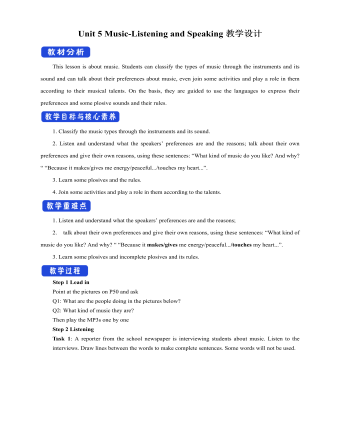
This lesson is about music. Students can classify the types of music through the instruments and its sound and can talk about their preferences about music, even join some activities and play a role in them according to their musical talents. On the basis, they are guided to use the languages to express their preferences and some plosive sounds and their rules.1. Classify the music types through the instruments and its sound.2. Listen and understand what the speakers’ preferences are and the reasons; talk about their own preferences and give their own reasons, using these sentences: “What kind of music do you like? And why? “ “Because it makes/gives me energy/peaceful.../touches my heart...”.3. Learn some plosives and the rules.4. Join some activities and play a role in them according to the talents. 1. Listen and understand what the speakers’ preferences are and the reasons;2. talk about their own preferences and give their own reasons, using these sentences: “What kind of music do you like? And why? “ “Because it makes/gives me energy/peaceful.../touches my heart...”.3. Learn some plosives and incomplete plosives and its rules.Step 1 Lead inPoint at the pictures on P50 and ask Q1: What are the people doing in the pictures below?Q2: What kind of music they are?Then play the MP3s one by oneStep 2 ListeningTask 1: A reporter from the school newspaper is interviewing students about music. Listen to the interviews. Draw lines between the words to make complete sentences. Some words will not be used.
新人教版高中英语必修2Unit 5 Music-Reading and Thinking教案一
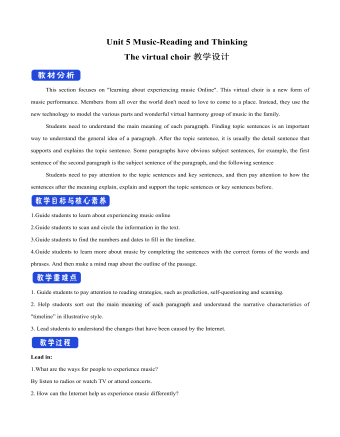
This section focuses on "learning about experiencing music Online". This virtual choir is a new form of music performance. Members from all over the world don't need to love to come to a place. Instead, they use the new technology to model the various parts and wonderful virtual harmony group of music in the family. Students need to understand the main meaning of each paragraph. Finding topic sentences is an important way to understand the general idea of a paragraph. After the topic sentence, it is usually the detail sentence that supports and explains the topic sentence. Some paragraphs have obvious subject sentences, for example, the first sentence of the second paragraph is the subject sentence of the paragraph, and the following sentenceStudents need to pay attention to the topic sentences and key sentences, and then pay attention to how the sentences after the meaning explain, explain and support the topic sentences or key sentences before.1.Guide students to learn about experiencing music online2.Guide students to scan and circle the information in the text.3.Guide students to find the numbers and dates to fill in the timeline.4.Guide students to learn more about music by completing the sentences with the correct forms of the words and phrases. And then make a mind map about the outline of the passage.1. Guide students to pay attention to reading strategies, such as prediction, self-questioning and scanning.2. Help students sort out the main meaning of each paragraph and understand the narrative characteristics of "timeline” in illustrative style.3. Lead students to understand the changes that have been caused by the Internet.
新人教版高中英语必修2Unit 5 Music-Reading For Writing教案一
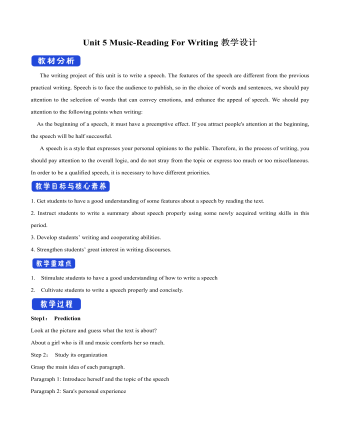
(4)Now we have heard a number of outstanding speeches ... 我们已经聆听了许多精彩的发言……(5)Because we wanted the nations of the world, working together, to deal with ... 因为我们希望全世界各国团结起来去应对……(6)And if we do not act ... 如果我们不采取行动……(7)Now, I share the concerns that have been expressed ... 我也同意对于……表达的担心(8)Let us show the world that by working together we can ... 让我们告诉全世界,通过一起努力我们可以……(9)It is now time for us to ... 是时候我们……(10)And I have always wished that ... 我一直希望……(11)Thank you for letting me share this day with me.感谢你们和我共度这一天。实践演练:假如你是高中生李华,你校将举办一次以“音乐”为主题的演讲比赛,请你按照主题,写下你的演讲稿。注意:词数100左右。First of all, thank you for listening to my speech. My topic is: love music like love yourself.Music is like the air we need to maintain our normal lives around us. You can't imagine how terrible a world without music would be. Movies and TV shows have no music, only dry conversations and scenes; mobile phones only vibrations; streets only noisy crowds; cafes, western restaurants only depressed meals. What a terrible world it is!As a student, I hope we all can enjoy the fun brought by music in our spare time. Instead of just listening to music, we can even make our own music. Let's enjoy the fun of music!Thanks again for your attention!
新人教版高中英语必修1Unit 2 Travelling Around-Discovering Useful Structure教案
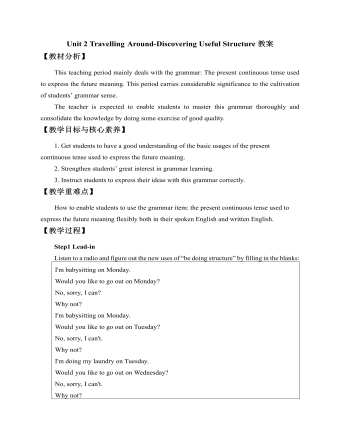
(5)be to do (可以和具体的时间状语连用)①表示按计划、安排即将发生的动作。②用于时间、条件状语从句中,表示“如果要……,想要……”。The students are to meet at the school gate tomorrow. 明天学生们将在学校大门口集会。 If you are to succeed, you must work as hard as possible. 如果你想要成功,比必须努力工作。(6)be about to do (不与具体的时间状语连用) 表示即将要发生的动作。We are about to start. 我们就要出发了。The new school year is about to begin. 新学年开学在即。(7)一般现在时表将来①表示按时间表规定将要发生的动作。常限于表示位置移动的短暂性动词。②在时间、条件或让步状语从句中,用一般现在时表将来。Look at the timetable. Hurry up! Flight 4026 takes off at 18:20. 你看看时刻表,快点!4026次航班的起飞时间是下午6点20分。Jane is in a hurry because the train to the airport leaves in half an hour. 简很匆忙,因为去机场的火车半小时后出发。
新人教版高中英语必修1Unit 2 Travelling Around-Reading for Writing教案
Is there a clear purpose for the trip? :Does each paragraph have a clear main idea? Does the writer use the present continuous tense for future plans?Does the writer use commas, stops, and question marks correctly? Are all the words spelt correctly?Are all the proper nouns capitalized?Revise your draft according to your partner's comments.Step 5:The summary of how to write a travel plan.旅游计划是一种常见的应用文写作。旅游可分为观光游、文化游、美食游及探险游等不同类型,因此旅游计划也要根据不同的旅游目的进行设计。常规的旅游计划需要明确以下几个方面的问题:Travel planWhen will you leave for? Where is your the destination?How will you get there?What will you do there?How long will you there?Is there a clear purpose for the trip? 为了提升旅行计划的层级,还需注意以下几个方面的问题:1.每段是否有明确清晰的主题;2.用一般现在时代替一般将来时;3.用更高级的形容词词汇。例如:表达“好”时,不要总用“nice”,我们还可以用“smart, clean, excellent, exciting, beautiful, wonderful, clever, famous, grand”等表达更具有指向性的词汇;4.用更高级的动词词汇。比如:我们可以用“seem stand, lie .get stay, remain, look . sound, become . keep, grow”等代替"be";
新人教版高中英语必修2Unit 1 Cultural Heritage-Listening&Speaking&Talking教案
Listening and Speaking introduces the topic of “Take part in a youth project”. The listening text is an interview about an international youth cultural heritage protection project. More than 20 high school students from seven countries participated in the project. The reporter interviewed two participants Stephanie and Liu Bin. By listening to the text, students can understand the significance of cultural heritage protection, and teenagers can use their knowledge, combine their own interests and advantages, etc. to participate in the action of cultural heritage protection. Listening and Talking introduces the theme of "Talk about history and culture". The listening text is a dialogue between two tourists and tour guides when they visit the Kremlin, red square and surrounding buildings. The dialogue focuses on the functional items of "starting a conversation", which is used to politely and appropriately attract the attention of the others, so as to smoothly start a conversation or start a new topic. The purpose of this section is to guide students to understand the history and current situation of Chinese and foreign cultural heritage in their own tourism experiences or from other people's tourism experiences, explore the historical and cultural values, and be able to express accurately and appropriately in oral communication.1. Guide students to understand the content of listening texts in terms of the whole and key details; 2. Cultivate students' ability to guess the meaning of words in listening; discuss with their peers how to participate in cultural heritage protection activities.3. Instruct students to use functional sentences of the dialogue such as “I beg your pardon, but…” “Forgive me for asking, but…" and so on to start the conversation more politely and appropriately.
新人教版高中英语必修2Unit 1 Cultural Heritage-Reading and Thinking教案一
The theme of the reading and thinking is about “Understanding how a problem was solved”.The Listening & Speaking & Talking is about international co-work to protect the Mount Tai, in which the students from seven countries came up with many solutions even create the Mount Tai App. This section aims at showing how to solve a difficult and even tough problem about protecting the cultural heritage by the international co-work. So in this section, cultivating students’ international awareness is very clear and important. Concretely, with the economic development, how to balance the protection of cultural relics and social development is a big challenge for human. In the 1950s, the Egyptian government wanted to build the Aswan Dam across the Nile to control floods, produce electricity and water farms. But the proposal led to protests because it would destroy a lot of cultural relics. The Egyptian had no choice but ask the UN for help. Therefore, a international cooperation about how to protect the cultural relics began, which involved the time length about 20 years and a large amount of fund. Then, the problems was solved. 1. Read quickly to get the main idea and the structure of the article; read careful to get detailed information.2. Learn to use the reading strategy---making a timeline3. Learn how to solve a tough problem by asking for help and cooperation4. Have the international awareness and understand the great strength of international cooperation.1. Read quickly to get the main idea and the structure of the article; read careful to get detailed information.2. Learn to use the reading strategy---making a timeline.3. Learn how to solve a tough problem by asking for help and cooperation.
新人教版高中英语必修2Unit 3 The Internet-Listening &Speaking&Talking教案一
Listening and Speaking introduces the topic of “ask about online habits”. Many middle school students have been surfing the Internet for many years, but what they do with the Internet and how much time they spend every day may not be very clear to themselves, nor to other students. This section allows students to investigate their peers' Internet use, which is conducive to their mutual understanding and understanding of the Internet. It can also help them reflect on their own online behavior, learn from other people's good online habits, and get rid of their bad online behavior.The listening text of this section is an investigation interview. The investigators interview specific groups with the same questions to obtain information, so as to understand their views, practices or attitudes on this issue. There are two specific questions: “how much time do you spend online every day? What do you usually do online?”. The answers of the three respondents provide rich and different information, and achieve the purpose of the investigators. The oral discourse structure of survey interviews generally includes greeting and explaining the purpose of the interview, presenting the interview questions and the respondents' answers. Listening and Talking introduces the theme of “choosing the right application ". Listening text is a conversation between Laura and Xiao Bo. In this part of listening, “oink”; “piggy bank” may cause the students' hearing comprehension limitation. Oink refers to sound word and pig's sound. So, add some oink to my piggy bank is often used to describe "making a little money".1. Guide students to understand the content of listening texts in terms of listening for definitions.2. Cultivate students' ability to define words and understand an investigation interview.
新人教版高中英语必修2Unit 3 The Internet-Reading and Thinking教案二
Q5:What's Jan's next goal?Her next goal is to start a charity website to raise money for children in poor countries.Q6:What can we learn from her experiences?We learn that when we go through tough times, we can find help and support from other people online. We learn that we can feel less lonelyStep 5: While reading---rethinkingQ1: What is Jan’s attitude to the Internet ?Thankful/Grateful, because it has changed her and her life.Q2: What writing skills is used in the article ?Examples(Jan’s example, the 59-year-old man’s and the 61-year-old woman’s example)Q3: Can you get the main idea of the article ?The Internet has changed Jan’s life/Jan’s life has been changed by the Internet.Step 6 Post reading---Retell the storyMuch has been written about the wonders of the World Wide Web. There are countless articles (1)telling(tell) us how the Internet has made our lives more convenient. But the Internet has done a lot (2)more(much) for people than simply make life more convenient. People’s lives (3) have been changed(change) by online communities and social networks so far. Take Jan for example, who developed a serious illness that made her (4)stuck(stick) at home with only her computer to keep (5)her(she) company. She joined an online group (6)where she could share problems, support and advice with others. She considered the ability to remove the distance between people as one of the greatest (7)benefits(benefit). She was so inspired (8)that she started an IT club in which many people have been helped. She has started to learn more about how to use the Internet to make society better. Her next goal is to start a charity website to raise money (9)for children in poor countries. Jan’s life has been (10)greatly(great) improved by the Internet.
新人教版高中英语必修2Unit 3 The Internet-Reading and Thinking教案一
Paragraph 3. Jan decided to start an IT club to teach old people how to use computers and the Internet. Paragraph 4. Jan has started taking online classes to learn more about how to use the Internet to make society better. Paragraph 5. Jan’s life has been greatly improved by the Internet. Step 5: Critical thinking:(1)How do you arrange your time spent on study and the Internet? Is it reasonable? I usually surf the Internet using my mobile phone for only an hour after class, and it is reasonable for me.(2)What are your online activities? Are they safe? I chat with my friends, read news and play games. I never give away my private information so I think they are safe.Step 4: summary Much has been written about the wonders of the World Wide Web. There are countless articles (1)______(tell) us how the Internet has made our lives more convenient. But the Internet has done a lot (2)_____(much) for people than simply make life more convenient. People’s lives (3) _________________(change) by online communities and social networks so far. Take Jan for example, who developed a serious illness that made her (4)_____(stick) at home with only her computer to keep (5)___(she) company. She joined an online group (6)______ she could share problems, support and advice with others. She considered the ability to remove the distance between people as one of the greatest (7)_______(benefit). She was so inspired (8)____ she started an IT club in which many people have been helped. She has started to learn more about how to use the Internet to make society better. Her next goal is to start a charity website to raise money (9)___ children in poor countries. Jan’s life has been (10)______(great) improved by the Internet. Step 5 Homework:Review what we have learned and find out the key language points in the text.
新人教版高中英语必修2Unit 3 The Internet-Reading For Writing教案一
⑦identity theft 身份盗窃⑧chat room 聊天室⑨draft your blog post 起草博客帖子⑩post embarrassing photos 张贴尴尬照片 【话题句式】 1. How do you stay safe online and avoid bad experiences on the Internet? 你如何在网上保持安全, 避免在网上的不良经历? 2. I’m not an expert, but many years as a blogger have taught me a thing or two. 我不是专家, 但作为一个博主, 我已经学了好几年了。 3. If you see or read something that makes you feel uncomfortable, leave the site immediately. 如果你看到或读到一些让你觉得不舒服的东西, 立即离开这个网站。4. Don’t give out your address or phone number. 别告诉别人你的地址或电话号码。 5. Identity theft is a common and serious problem. 身份盗窃是一个常见而严重的问题。6. Being online is no excuse for being rude, and you don’t want to become a target for a troll or cyberbully. 上网并不是无礼的借口, 你也不想成为发挑衅帖子的人或网络恶霸的目标。 7. Trolls often use several false names so that they can stay on a site. 发挑衅帖子的人经常使用几个假名, 这样他们就可以留在一个网站上。8. However, the more polite you are, the less likely it is you will be attacked. 然而, 你越有礼貌, 你被攻击的可能性就越小。
新人教版高中英语必修2Unit 4 History and Traditions-Listening&Speaking&Talking教案二
Listening and Speaking introduces the topic of “Take part in a youth project”. The listening text is an interview about "sharing views on historical sites". Through listening to a dialogue between Chinese and foreign students on the way to the Confucius Temple, students can understand their views on the Confucius Temple, Confucius, Confucius' descendants and Confucius' educational thoughts, so as to realize and think about the profound influence of Confucius and his thoughts on Chinese historical tradition. At the same time, the dialogue naturally integrates English idioms and mentions Shakespeare, the British playwright, so as to provide language materials and context for students to understand English idioms and related cultural allusions, as well as to compare Chinese and foreign cultures, which is helpful for students to understand and express the language such as history, tradition, culture and custom significant impact.Text analysis: listening text is a dialogue between a British student and a Chinese student when he goes to the Confucius Temple. When William, a British student, visited the Confucius Temple, he asked Xiao Kong, a Chinese student, for directions. Xiao Kong was just going to the Confucius Temple to meet with the members of the research group, so they went together and exchanged their views on the Confucius Temple, Confucius, Confucius' descendants and Confucius' educational thoughts. From the perspective of foreign tourists, this paper describes their thoughts on Confucius, the great son of Confucius, who had a profound impact on Chinese history and cultural tradition, and his education.Listening and Talking introduces a visit to a historic tourist destination. Tourism is a common way to understand a country's history, culture, and customs and so on. Students listen to the dialogue between Xiao Yan, a youth hostel Usher, and Paul, a backpacker, to learn about Pingyao's famous historical and cultural attractions and Paul's travel experience and experience as a foreign tourist.
新人教版高中英语必修2Unit 5 Music-Discovering Useful Structures教案一
Step1:自主探究。1.(教材P52)Born(bear) in the USA on 2 January 1970, Whitacre began studying music at the University of Nevada in 1988.2.(教材P52) Moved(move) by this music, he said, “It was like seeing color for the first time.”3.(教材P56)I was very afraid and I felt so alone and discouraged(discourage).4.(教材P58)Encouraged(encourage) by this first performance and the positive reaction of the audience, I have continued to play the piano and enjoy it more every day.Step2:语法要点精析。用法1:过去分词作表语1).过去分词可放在连系动词be, get, feel, remain, seem, look, become等之后作表语,表示主语所处的状态Tom was astonished to see a snake moving across the floor.汤姆很惊讶地看到一条蛇正爬过地板。Finally the baby felt tired of playing with those toys.终于婴儿厌倦了玩那些玩具。注意:1).过去分词作表语时与被动语态的区别过去分词作表语时,强调主语所处的状态;而动词的被动语态表示主语是动作的承受者,强调动作。The library is now closed.(状态)图书馆现在关闭了。The cup was broken by my little sister yesterday.(动作)昨天我妹妹把杯子打碎了。2)感觉类及物动词的现在分词与过去分词作表语的区别过去分词作表语多表示人自身的感受或事物自身的状态,常译作“感到……的”;现在分词多表示事物具有的特性,常译作“令人……的”。
新人教版高中英语必修2Unit 5 Music-Reading for Writing教案二
The Internet celebrity Gao Yifeng. Years ago, he owned 5 companies and the staffs over 1,000, but during the economy crisis, he became nothing but debt. He was so worried that his hair became white overnight. There was a time when he wanted to killed himself. But after listening to the song Start Over by Liu Huan, he decided to cheer himself up. He started a steamed bun shop and gradually became a national chain shops. Now he became successful again.Walter Haddon said, “Music is the medicine of a troubled mind.” Music contains such a pleasant and inspiring force. Music gave him courage and bravery. When he listened to the song, it made his spirit fly like a kite in the wind. Music gave him strength and brought him relief. It was the rock I leant on to become strong and to get through those hard times. I hope none of us have to go through the same kind of suffering that he did. At the same time, we all go through various periods when we feel sad or alone. During those times, music can help us in the same way that it helped him. I hope we all will somehow begin to treasure music and make it a part of our life. Thank you for your listening !5.Revise your writing each other.Does he/she explain how music has changed his/her/someone else’s life?Are some of the rhetorical devices included and used properly ?Does he/she talk about how music makes him/her/someone feel?Is the first word in each sentences capitalised?Does he/she use correct punctuation ?
人教版高中政治必修3文化塑造人生教案2篇
【教学内容】人教版高中思想政治必修3文化生活第一单元第二课第二框题《文化塑造人生》。【教学目标】1.知识目标理解优秀文化如何丰富人的精神世界、增强人的精神力量及促进人的全面发展。2.能力目标(1)能赏析优秀文化产品,感悟积极向上的文化生活对于丰富人们的精神世界,增强人民的精神力量的意义,确信其促进人的全面发展的重要作用。(2)结合文化塑造人生,不断丰富自己的精神世界,促进自身的全面发展3.情感、态度、价值观目标树立正确的世界观、人生观、价值观,丰富精神世界,增强精神力量,接受优秀文化,促进自身的全面发展。【教学重点】优秀文化能丰富人的精神世界,增强人的精神力量【教学难点】文化促进人的全面发展【教学准备】资料收集、多媒体课件【课时安排】1课时【教学过程】视频导入:播放我国残疾人艺术团在春节晚会上的精美舞蹈《千手观音》。
人教版高中政治必修3体味文化教案2篇
3、文化是人们的一种素养(1)人的文化素养是在社会生活、实践中形成的。每个人所具有的文化素养,不是天生的,而是通过对社会生活的体验,特别是通过参与文化生活、接受知识文化教育而逐步培养出来的。文化素养的形成,离不开生活、实践和教育。人们在社会实践中创造和发展文化,也在社会生活中获得和享用文化。(2)人的文化素养表现在日常言行中。教师活动:引导学生阅读教材7页“公交车漫画”材料,并思考所反映的问题学生活动:积极思考并讨论问题教师点评:人们的精神活动离不开物质活动,人们的文化素养总是要通过他在日常生活中的言行、在社会实践活动中的表现等表现出来。我们通过观察人们的社会行为,就可以从中透视人们的精神世界和精神生活。4、文化的传承和发展离不开物质载体。社会文化和精神产品离不开物质载体,一个时代的文化和精神产品,往往是这一时代社会发展轨迹的反映。
人教版新课标高中物理必修2生活中的圆周运动教案2篇
思考:洗衣机脱水时转速高时容易甩干衣物,还是转速低时容易甩干衣物?(2) 制作棉花糖的原理内筒与洗衣机的脱水筒相似,里面加入白砂糖,加热使糖熔化成糖汁。内筒高速旋转,黏稠的糖汁就做离心运动,从内筒壁的小孔飞散出去,成为丝状到达温度较低的外筒,并迅速冷却凝固,变得纤细雪白,像一团团棉花。5.离心现象的防止在水平公路上行驶的汽车,转弯时所需的向心力是由车轮与路面的静摩擦力提供的。如果转弯时速度过大,所需向心力F大于最大静摩擦力Fmax,汽车将做离心运动而造成交通事故。因此,在公路弯道处,车辆行驶不允许超过规定的速度。当高速转动的砂轮或者飞轮内部分子间相互作用力不足以提供所需向心力时,离心运动就会使他们破裂,甚至酿成事故。

人教版新课标高中物理必修2太阳与行星间的引力教案2篇
【学习内容分析】在行星运动规律与万有引力定律两节内容之间安排本节内容,是为了更突出发现万有引力定律的这个科学过程。如果说上一节内容是从运动学角度描述行星运动的话,那么,本节内容是从动力学角度来研究行星运动的,研究过程是依据已有规律进行的演绎推理过程。教科书在尊重历史事实的前提下,通过一些逻辑思维的铺垫,让学生以自己现有的知识基础身于历史的背景下,经历一次“发现”万有引力的过程,因此体验物理学研究问题的方法就成为主要的教学目标。【学情分析】在学太阳对行星的引力之前,学生已经对力、重力、向心力、加速度、重力加速度、向心加速度等概念有了较好的理解,并且掌握自由落体运动和圆周运动等运动规律,能熟练运用牛顿运动定律解决动力学问题。已经完全具备深入探究和学习万有引力定律的起点能力。所以在推导太阳与行星运动规律时,教师可以要求学生自主地运用原有的知识进行推导,并要求说明每一步推理的理论依据是什么,教师仅在难点问题上做适当的点拨。
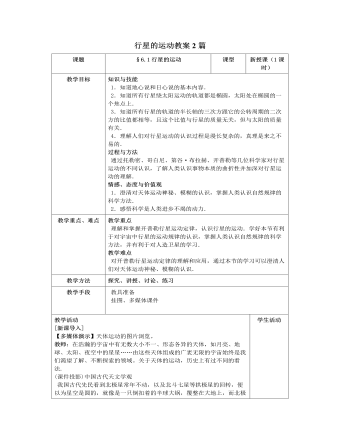
人教版新课标高中物理必修2行星的运动教案2篇
知识与技能1.知道地心说和日心说的基本内容.2.知道所有行星绕太阳运动的轨道都是椭圆,太阳处在椭圆的一个焦点上.3.知道所有行星的轨道的半长轴的三次方跟它的公转周期的二次方的比值都相等,且这个比值与行星的质量无关,但与太阳的质量有关.4.理解人们对行星运动的认识过程是漫长复杂的,真理是来之不易的.过程与方法通过托勒密、哥白尼、第谷·布拉赫、开普勒等几位科学家对行星运动的不同认识,了解人类认识事物本质的曲折性并加深对行星运动的理解.情感、态度与价值观1.澄清对天体运动裨秘、模糊的认识,掌握人类认识自然规律的科学方法.2.感悟科学是人类进步不竭的动力.教学重点理解和掌握开普勒行星运动定律,认识行星的运动.学好本节有利于对宇宙中行星的运动规律的认识,掌握人类认识自然规律的科学方法,并有利于对人造卫星的学习.
人教版新课标高中物理必修2探究弹性势能的表达式教案2篇
“做功的过程就是能量转化过程”,这是本章教学中的一条主线。对于一种势能,就一定对应于相应的力做功。类比研究重力势能是从分析重力做功入手的,研究弹簧的弹性势能则应从弹簧的弹力做功入手。然而弹簧的弹力是一个变力,如何研究变力做功是本节的一个难点,也是重点。首先,要引导学生通过类比重力做功和重力势能的关系得出弹簧的弹力做功和弹簧的弹性势能的关系。其次,通过合理的猜想与假设得出弹簧的弹力做功与哪些物理量有关。最后,类比匀变速直线运动求位移的方法,进行知识迁移,利用微元法的思想得到弹簧弹力做功的表达式,逐步把微分和积分的思想渗透到学生的思维中。本节课通过游戏引入课题,通过生活中拉弓射箭、撑杆跳高和弹跳蛙等玩具以及各种弹簧等实例来创设情景,提出问题。给学生感性认识,引起学生的好奇心;让学生对弹簧弹力做功的影响因素进行猜想和假设,提出合理的推测,激发学生的探索心理,构思实验,为定性探究打下基础。然后,引导学生通过类比重力做功与重力势能的关系得出弹簧弹性势能与弹簧弹力做功的关系。