-
人教版高中历史必修1祖国统一大业教案2篇
教材分析改革开放后我国的综合国力不断增强,人民对祖国统一的愿望越来越迫切。本节课以“一国两制”构想的提出,香港、澳门的回归和海峡两岸关系的发展为中心,说明实现祖国统一,完成中华民族复兴是历史发展的必然。第一目“‘一国两制’构想的提出”主要讲述了“一国两制”的含义及历史意义。第二目“香港、澳门的回归”着重讲述了香港回归、澳门回归的经过及历史意义,这是“一国两制”成功的实践。第三目“海峡两岸关系的发展”讲述了大陆注重发展与台湾的关系,促进海峡两岸的经济文化交流与合作,打破了几十年来海峡两岸的隔绝状态,促进了祖国统一的进程。此外,教材还通过“资料回放”“历史纵横”“学思之窗”等栏目,为学生学习提供了一些详细的史料。在教学中要分析图表资料,引导学生理解完成祖国统一大业,实现中华民族的复兴,是任何人也阻挡不了的历史潮流。
新人教版高中英语必修1Unit 2 Travelling Around-Reading for Writing教案
Is there a clear purpose for the trip? :Does each paragraph have a clear main idea? Does the writer use the present continuous tense for future plans?Does the writer use commas, stops, and question marks correctly? Are all the words spelt correctly?Are all the proper nouns capitalized?Revise your draft according to your partner's comments.Step 5:The summary of how to write a travel plan.旅游计划是一种常见的应用文写作。旅游可分为观光游、文化游、美食游及探险游等不同类型,因此旅游计划也要根据不同的旅游目的进行设计。常规的旅游计划需要明确以下几个方面的问题:Travel planWhen will you leave for? Where is your the destination?How will you get there?What will you do there?How long will you there?Is there a clear purpose for the trip? 为了提升旅行计划的层级,还需注意以下几个方面的问题:1.每段是否有明确清晰的主题;2.用一般现在时代替一般将来时;3.用更高级的形容词词汇。例如:表达“好”时,不要总用“nice”,我们还可以用“smart, clean, excellent, exciting, beautiful, wonderful, clever, famous, grand”等表达更具有指向性的词汇;4.用更高级的动词词汇。比如:我们可以用“seem stand, lie .get stay, remain, look . sound, become . keep, grow”等代替"be";
新人教版高中英语必修1Unit 4 Natural Disasters- Reading for writing教案
①标题——标题应当简洁明了。②导语——导语是消息开头的第一段或第一句话,简明扼要地揭示出消息的核心内容。③主体——主体是消息的主要部分,要用充足的事实表现主题,对导语的内容作进一步的展开和阐述。④结束语——通常是对全文内容进行概括性的总结。3. 新闻报道增分句子(1)陈述事实常用的句型:①A terrible storm hit/struck ... , killing ..②It was a cool autumn night when the earthquake happened. A large number of buildings fell down and roads were destroyed, leaving a great many people homeless.地震发生在一个凉爽的秋夜。大量的建筑物倒塌,道路被毁,许多人无家可归。③With the help of the rescue team, people who were the trapped in the flood were saved.在救援队的帮助下,困在洪水中的人们得救了。(2)陈述观点常用的句型:①Clearly/Obviously/In my opinion/It seemed that people were shocked.显然/在我看来/似乎人们震惊了。②The whole city was in ruins after the earthquake.地震后整个城市成了一片废墟。(3)揭示原因常用的句型:Because of/As a result of/Thanks to the help of the army, people who got injured were sent to the hospital immediately.
新人教版高中英语必修1Unit 4 Natural Disasters-Reading & Thinking教案
5. Read to get detailed information about Paragraph 5.Q1. What shows the revival of Tangshan?Q2. How can Tangshan revive itself and get up on its feet again?Q3. In times of disasters, how can we go through it?T: In times of disasters, we should unify, show the wisdom and stay positive.Step 4 Activity 4 Highlighting the theme and reflecting1. Make a summary of the text.2. Further understand the titleQ: After our learning, why do you think the earth didn’t sleep on that night?T: An earthquake happened. The people in the earthquake suffered a lot, and the people outside Tangshan were concerned about the people there a lot.3. Reflect through discussion on what can be learnt after reading.T: Disasters are powerful. Unpreparedness can be deadly. Life is weak, but if people work together to help each other, disasters can be defeated.There is no love from disaster, but we have love in the human heart.Step 5 Assignment How does the writer convey that the earthquake was deadly, and that people were helpless during the earthquake? Try to find some attractive and impressive expressions and note them down.
新人教版高中英语必修1Welcome Unit-Reading and Thinking教案
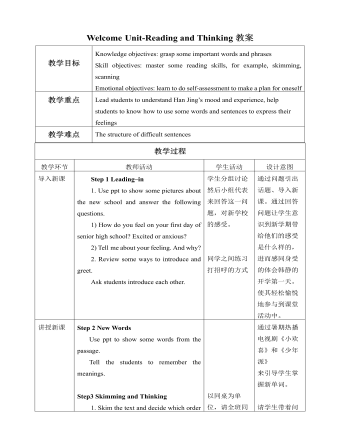
Step 2 New WordsUse ppt to show some words from the passage.Tell the students to remember the meanings.Step3 Skimming and Thinking1. Skim the text and decide which order Han Jing follows to talk about her first day. Time order or place order?Time order2. What is Han Jing worried about before she goes to senior high school?She is worried about whether she will make new friends and if no one talks to her, what she should do.Step 4 Fast Reading1. Match the main ideas with each paragraphParagraph 1:The worries about the new school day Paragraph 2Han Jing’s first maths classParagraph 3Han Jing’s first chemistry classParagraph 4Han Jing’s feelings about her first senior school dayStep 5 Careful Reading1. Fill in the chart with the words and phrases about Han Jing’s day. Answers: Senior high school, a little nervous; Her first maths class, classmates and teachers, friendly and helpful; Chemistry lab; new; great; annoying guy; Confident; a lot to explore2. Read the text again and discuss the questions.1) Why did Han Jing feel anxious before school?Because she was a new senior high student and she was not outgoing. What was more, she was worried about whether she can make friends.2) How was her first maths class?It was difficult but the teacher was kind and friendly. 3) What happened in the chemistry class? What would you do if this happened to you? A guy next to Han Jing tried to talk with her and she couldn’t concentrate on the experiment.
新人教版高中英语必修2Unit 1 Cultural Heritage-Listening&Speaking&Talking教案
Listening and Speaking introduces the topic of “Take part in a youth project”. The listening text is an interview about an international youth cultural heritage protection project. More than 20 high school students from seven countries participated in the project. The reporter interviewed two participants Stephanie and Liu Bin. By listening to the text, students can understand the significance of cultural heritage protection, and teenagers can use their knowledge, combine their own interests and advantages, etc. to participate in the action of cultural heritage protection. Listening and Talking introduces the theme of "Talk about history and culture". The listening text is a dialogue between two tourists and tour guides when they visit the Kremlin, red square and surrounding buildings. The dialogue focuses on the functional items of "starting a conversation", which is used to politely and appropriately attract the attention of the others, so as to smoothly start a conversation or start a new topic. The purpose of this section is to guide students to understand the history and current situation of Chinese and foreign cultural heritage in their own tourism experiences or from other people's tourism experiences, explore the historical and cultural values, and be able to express accurately and appropriately in oral communication.1. Guide students to understand the content of listening texts in terms of the whole and key details; 2. Cultivate students' ability to guess the meaning of words in listening; discuss with their peers how to participate in cultural heritage protection activities.3. Instruct students to use functional sentences of the dialogue such as “I beg your pardon, but…” “Forgive me for asking, but…" and so on to start the conversation more politely and appropriately.
新人教版高中英语必修2Unit 1 Cultural Heritage-Reading and Thinking教案一
The theme of the reading and thinking is about “Understanding how a problem was solved”.The Listening & Speaking & Talking is about international co-work to protect the Mount Tai, in which the students from seven countries came up with many solutions even create the Mount Tai App. This section aims at showing how to solve a difficult and even tough problem about protecting the cultural heritage by the international co-work. So in this section, cultivating students’ international awareness is very clear and important. Concretely, with the economic development, how to balance the protection of cultural relics and social development is a big challenge for human. In the 1950s, the Egyptian government wanted to build the Aswan Dam across the Nile to control floods, produce electricity and water farms. But the proposal led to protests because it would destroy a lot of cultural relics. The Egyptian had no choice but ask the UN for help. Therefore, a international cooperation about how to protect the cultural relics began, which involved the time length about 20 years and a large amount of fund. Then, the problems was solved. 1. Read quickly to get the main idea and the structure of the article; read careful to get detailed information.2. Learn to use the reading strategy---making a timeline3. Learn how to solve a tough problem by asking for help and cooperation4. Have the international awareness and understand the great strength of international cooperation.1. Read quickly to get the main idea and the structure of the article; read careful to get detailed information.2. Learn to use the reading strategy---making a timeline.3. Learn how to solve a tough problem by asking for help and cooperation.
新人教版高中英语必修3Unit 1 Festivals and Celebrations教学设计一
本板块的活动主题是“谈论节日活动”(Talk about festival activities),主要是从贴近学生日常生活的角度来切入“节日”主题。学生会听到发生在三个国家不同节日场景下的简短对话,对话中的人们正在参与或将要亲历不同的庆祝活动。随着全球化的进程加速,国际交流日益频繁,无论是国人走出国门还是外国友人访问中国,都已成为司空见惯的事情。因此,该板块所选取的三个典型节日场景都是属于跨文化交际语境,不仅每组对话中的人物来自不同的文化背景,对话者的身份和关系也不尽相同。1. Master the new words related to holiday: the lantern, Carnival, costume, dress(sb)up, march, congratulation, congratulate, riddle, ceremony, samba, make - up, after all. 2. To understand the origin of major world festivals and the activities held to celebrate them and the significance of these activities;3. Improve listening comprehension and oral expression of the topic by listening and talking about traditional festivals around the world;4. Improve my understanding of the topic by watching pictures and videos about different traditional festivals around the world;5. Review the common assimilation phenomenon in English phonetics, can distinguish the assimilated phonemes in the natural language flow, and consciously use the assimilation skill in oral expression. Importance:1. Guide students to pay attention to the attitude of the speaker in the process of listening, and identify the relationship between the characters;2. Inspire students to use topic words to describe the festival activities based on their background knowledge. Difficulties:In the process of listening to the correct understanding of the speaker's attitude, accurately identify the relationship between the characters.
人教版高中政治必修3文化塑造人生教案2篇
【教学内容】人教版高中思想政治必修3文化生活第一单元第二课第二框题《文化塑造人生》。【教学目标】1.知识目标理解优秀文化如何丰富人的精神世界、增强人的精神力量及促进人的全面发展。2.能力目标(1)能赏析优秀文化产品,感悟积极向上的文化生活对于丰富人们的精神世界,增强人民的精神力量的意义,确信其促进人的全面发展的重要作用。(2)结合文化塑造人生,不断丰富自己的精神世界,促进自身的全面发展3.情感、态度、价值观目标树立正确的世界观、人生观、价值观,丰富精神世界,增强精神力量,接受优秀文化,促进自身的全面发展。【教学重点】优秀文化能丰富人的精神世界,增强人的精神力量【教学难点】文化促进人的全面发展【教学准备】资料收集、多媒体课件【课时安排】1课时【教学过程】视频导入:播放我国残疾人艺术团在春节晚会上的精美舞蹈《千手观音》。
人教版高中政治必修3在文化生活中选择教案
◇小辞典:绿色阅读随着知识经济时代的到来,全球化信息浪潮正铺天盖地席卷而来。尤其足随着我国加入世贸组织由梦想变为现实,同国外进行频繁而广泛的经济文化交流,在所难免。在大量文化信息面前,就像物质生活中倡导绿色食品一样,对于精神食粮,也应该倡导绿色阅读。绿色阅读,是一种无污染的有利于人健康文明生活的阅读。文化就像大自然那种绿色带给我们永久愉悦一样,它是高科技竞争中源源不断地给我们充电的高效营养库,是一个沙漠中穿行人身心交瘁时望到的一片绿洲,是一个人葆有的、没有受到任何污染的、永远都清如许的“半亩方塘”。◇课堂练习:在我国,必须大力倡导“爱国守法、明礼诚信、团结友善、勤俭自强、敬业奉献,的基本道德规范。这些基本道德规范()①是我国社会主义文化建设的重要内容②是我国社会主义社会的重要特征③是我国社会主义道德的重要体现④是社会主义经济建设的唯一精神动力
人教版高中政治必修4真正的哲学都是自己时代的精神上的精华说课稿
2、讲授新课:(35分钟)通过教材第一目的讲解,让学生明白,生活和学习中有许多蕴涵哲学道理的故事,表明哲学并不神秘总结并过渡:生活也离不开哲学,哲学可以是我正确看待自然、人生、和社会的发展,从而指导人们正确的认识和改造世界。整个过程将伴随着多媒体影像资料和生生对话讨论以提高学生的积极性。3、课堂反馈,知识迁移。最后对本科课进行小结,巩固重点难点,将本课的哲学知识迁移到与生活相关的例子,实现对知识的升华以及学生的再次创新;可使学生更深刻地理解重点和难点,为下一框学习做好准备。4、板书设计我采用直观板书的方法,对本课的知识网络在多媒体上进行展示。尽可能的简洁,清晰。使学生对知识框架一目了然,帮助学生构建本课的知识结构。5、布置作业我会留适当的自测题及教学案例让同学们做课后练习和思考,检验学生对本课重点的掌握以及对难点的理解。并及时反馈。对学生在理解中仍有困难的知识点,我会在以后的教学中予以疏导。
人教版新课标高中物理必修1用牛顿运动定律解决问题(二)说课稿2篇
教师活动:(1)组织学生回答相关结论,小组之间互相补充评价完善。教师进一步概括总结。(2)对学生的结论予以肯定并表扬优秀的小组,对不理想的小组予以鼓励。(3)多媒体投放板书二:超重现象:物体对支持物的压力(或对悬挂物的拉力)大于物体所受到的重力的情况称为超重现象。实质:加速度方向向上。失重现象:物体对支持物的压力(或对悬挂物的拉力)小于物体所受到的重力的情况称为失重现象。实质:加速度方向向下。(4)运用多媒体展示电梯中的现象,引导学生在感性认识的基础上进一步领会基本概念。4.实例应用,结论拓展:教师活动:展示太空舱中宇航员的真实生活,引导学生应用本节所学知识予以解答。学生活动:小组讨论后形成共识。教师活动:(1)引导学生分小组回答相关问题,小组间互相完善补充,教师加以规范。(2)指定学生完成导学案中“思考与讨论二”的两个问题。
人教版高中地理必修3第三章第一节能源资源的开发教案
山西省总结出了许多重点工矿区的生态环境建设模式,即围绕煤田的露天开采区、居民点和主要交通线建设区,通过工程及生物措施,结合土地的复垦,充分利用厂矿的人力、财力和科技优势,建立集约经营的高效蔬菜、水果及肉蛋奶生产基地(图3.13)。1.说一说图中各种工程及生物措施的作用。点拨:参考图3.13图中各工程及措施的作用:(1)隔离护坝:主要作用是将采掘区与河流隔开,以免河水流入采掘区。(2)排水沟:主要作用是引开可能进入采掘区的雨水或其他水源。(3)公路紧靠采掘区,方便运输车辆就近从工地上公路。(4)“固沙草方格”,即在流沙表面用麦草、稻草扎成1×1米的草方格,使流沙不易被风 吹起,达到阻沙、固沙的目的,并在草方格上栽种沙蒿、花棒、籽蒿、拧条等沙生植物,建立起旱生植物带,营造挡沙树林。
《拿来主义》说课稿(二) 2021-2022学年统编版高中语文必修上册
四、说教学过程(一)结合现实、自然导入随着我国开放的深入发展,国外的科学、文化、技术以及资产阶级的腐朽思想,生活作风等等也随之大量涌来,我们应采取怎样的态度和方法才是正确的呢?鲁迅先生在30年代就继承文化遗产问题曾写过一篇杂文,我们可以从中获得那些启示呢?(二)整体感知、疏瀹文意1.请同学介绍“我所知道的鲁迅”,教师补充写作背景。教师有针对性的进行预习检查,能促使学生养成课前预习的习惯。2.理清文章的思路,分析文章的整体结构教师范读课文,针对较难的字音进行正读。学生快速浏览课文,把握全文框架,小组讨论后分出层次。(让学生通过自主合作探究来概括文意可以让同学们参与到教学活动中,锻炼学生实际动手能力)
《拿来主义》说课稿(一) 2022-2023学年统编版高中语文必修上册
(三)说目标鉴于以上学情分析,结合单元学习任务群——思辨性阅读与表达的定位,确定本课教学目标为通过设置任务情境,带领学生在活动中认识表达的有针对性、论述的层次逻辑性以及感受文章蕴含的批判力量。其中以表达的有针对性为教学重点,以论述的层次逻辑性为难点。(四)说理念根据课标和教材特点,结合学情,授课将依托“学为中学理论”“建构主义学习理论”和“最近发展区理论”等,积极开展阅读与鉴赏、表达与交流、梳理与探究等语文实践活动提升学生语文核心素养。三、教学实施(一)设定学习情境为引导广大学生合理对待外来文化,学校辩论社拟设定辩题——如何正确对待外来文化展开辩论。有同学说坚决抵制外来文化(正方),也有同学说要积极吸收(反方)……那么如果你是其中一位辩手,你将在《拿来主义》中如何撷取素材呢?
《拿来主义》说课稿(三) 2021-2022学年统编版高中语文必修上册
学生展示:鲁迅在《拿来主义》讨论“送去主义”时使用的不是徐、刘二人欧洲巡展的事实,而是《大晚报》评价二人欧洲巡展为“发扬国光”这一事实,故用了“叫作”,且是加引号的“发扬国光”;用“送”字表明自己针对的对象不是梅兰芳本人及其艺术,而是“送梅兰芳博士到苏联去”的人及其行为,即强行将中国戏剧与象征主义相联系的牵强附会的行径。可见,鲁迅针对的是当时国民政府一味送去的行径和主流媒体宣扬为“发扬国光”的舆论导向。设计意图:有的放矢,针砭时弊是杂文的突出特征。耙子指向哪儿、时弊是什么是必须思考的问题。有学生误以为鲁迅在批判徐悲鸿、刘海粟、梅兰芳等人,甚至调侃说鲁迅“怼人狂魔”“老阴阳师”。通过此活动,细读文本,还原历史,抓住“叫作”与“送”的主体,找准鲁迅批判的对象和针对的现象。同时,引导学生用不可随意使用所谓网络“梗文化”来消解名人、伟人等事迹的严肃性,不可以娱乐心态品读经典作品。
人教版高中政治必修3源远流长的中华文化精品教案
(一)知识目标(1)识记中华 文化源远流长的主要见证是文字和史学典籍 ,文字的作用、意义 ,史学典籍 ,中华文化的包容性。(2)说明中华文化源远流长的发展过程,是世界上唯一没有中断的文明 ,汉字与史学典籍是中华文化源远流长和见证,如何再创中华文化新的辉煌(3)分析说明中华文化源远流长,是当今世界上唯一没有中断的文明(二)能力目标通过学生课外探究、信息资源的收集整合,培养学生的信息素养、实践能力,激发学生的生活智慧与学习智慧、时代创新精神与团队合作精神。培养同学们综合思维能力,全面、辩证、历史地分析中华文化的基本特征。培养同学们辩证分析能力,辨析中华文化的区域特征,说明中华文化是中国各族人民共同创造的;展现源远流长的中华文化是中华民族延续和发展的重要标识。
人教版高中政治必修3源远流长的中华文化教案
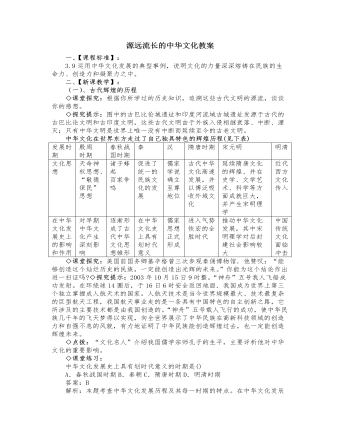
②在经济上:资本主义经济产生并发展,产生工业革命,开始冲击封建自然经济。③思想上:继文艺复兴后产生启蒙运动,人们的思想观念更加开放,动摇了封建统治的思想,冲击封建统治,人们的民族、民主意识增强。④在文化上:近代自然科学蓬勃发展,奠定近代自然科学的基础。⑤随着新航路的开辟,工业革命开展,西方国家展开殖民掠夺与,各大洲之间相对孤立状态被打破,世界日益成为一个相互影响、联系紧密的整体。(2)①清朝统治者极力提供程朱理学,残酷压抑进步思想.中国思想界“万马齐喑”,死气沉沉。②中国传统科技进入总结时期,现代科技水平落后,日益落在世界潮流后面;③人们封建落后意识浓厚.民族、民主意识薄弱。④以中因为中心的东亚文化圈浙渐稿失。⑤西学大量传入中田,西学东渐现象不断发晨,冲击中国传统思想文化。(3)①国家衰落使文化失去发展的政治、经济条件,加速了文化的衰落。国家衰落是文化衰落的决定性因素。②文化衰落是国家衰落的重要表现,反映了国家衰落.不利于国家发展。
人教版高中政治必修3文化创新的源泉与作用教案
(三)呼唤文化创新的时代(板书)1.人民群众是文化创造的主体--(板书)师:【图片文字展示】--《离骚》、《九歌》、《水浒传》、《三国演义》均取材自民间,在民间口述文字的基础上加工形成,所以,我们可以看到,文化创新的主体是谁?生:人民群众是文化创造的主体师:在新的历史时期,我们的青少年应该怎么做?生:虚心向人民群众学习,从人民群众的伟大实践和丰富多彩的生活中汲取营养,这是当代中国文化工作者的使命和职责。2.文化工作者必须坚定地走与人民群众的实践相结合的道路--(板书)3.当代中国文化创作者的使命和职责。(板书)【课堂小结】通过本节课的探究学习,我们认识到文化创新的源泉和作用,要求我们虚心向人民群众学习,从人民群众的伟大实践和丰富多彩的生活中汲取营养,刻苦钻研,锐意创新,为全面建设小康社会而奋斗。
人教版高中政治必修3文化创新的源泉和作用教案
(1)社会实践是文化创新的源泉实践,作为人们改造客观世界的活动,是一种有目的、有意识的社会性活动。人类在改造自然和社会的实践中,创造出自己特有的文化。离开了社会实践;文化就会成为无源之水、无本之木,人们不可能从事任何有价值的文化创造。◇本课小结:1.关于本课逻辑结构的宏观把握:文化创新的源泉和作用这一问题,教材分三个层次展开论证:一是不尽的源泉,不竭的动力;二是巨大的作用,深刻的意义;三是呼唤文化创新的时代。教材运用辩证方法从文化创新的源泉和作用展开论述。即社会实践是文化创新的源泉,文化创新又推动社会实践的发展和促进民族文化的繁荣。教材关于文化创新的途径问题,从三个层次展开讲述:第一个层次是“继承传统,推陈出新”;第二个层次是“面向世界,博采众长”;第三个层次是“坚持正确方向,克服错误倾向”。三个层次三个角度,着重于分析每一个层次,然后予以归纳总结,即采用了分析归纳法,层次清晰,教学目标明确,既便于传授知识,又便于学生学习时识记、理解和把握。