-
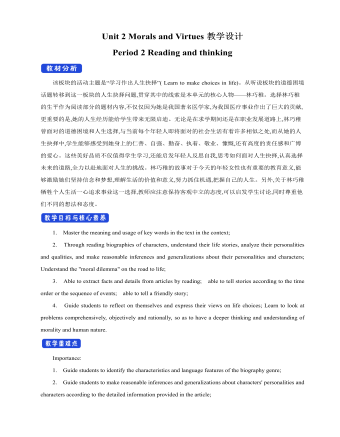
新人教版高中英语必修3Unit 2 Morals and Virtues教学设计二
Activity 41. Students complete the task of activity 4, then teachers and students check the answers. 2. The teacher organized the students to work together and asked them to use the tables and mind maps sorted out before to retold the important choices in Lin Qiaozhi's life and their resultsStep 5 Language points1. The teacher asks the students to read the text carefully, find out the core words and long and difficult sentences in the text and draw lines, understand the use of vocabulary, and analyze the structure of long and difficult sentences. 2. The teacher explains and summarizes the usage of core vocabulary and asks the students to take notes. 3. The teacher analyzes and explains the long and difficult sentences that the students don't understand, so that the students can understand them better. Step 6 Homework1. Read the text again, in-depth understanding of the text; 2. Master the use of core vocabulary and understand the long and difficult sentences. 3. Complete relevant exercises in the guide plan. 1、通过本节内容学习,学生是否理解和掌握阅读文本中的新词汇的意义与用法;2、通过本节内容学习,学生能否结合文本特点总结林巧稚的人生原则和人格品质特征;3、通过本节内容学习,学生能否针对人生抉择发表自己的看法;能否全面地、客观地、理性地看待问题,进而对道德和人性有更加深入的思考和理解。
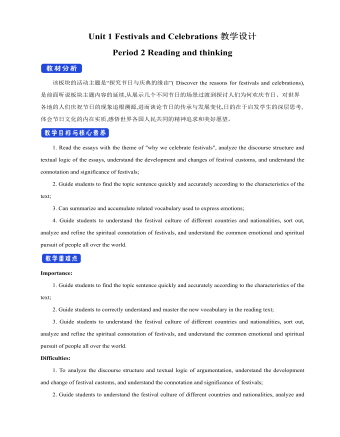
新人教版高中英语必修3Unit 1 Festivals and Celebrations教学设计三
*wide range of origins(= a great number of different origins, many kinds of origins)*It featured a parade and a great feast with music, dancing, and sports. (=A parade and a great feast with music, dancing, and sports were included as important parts of the Egyptian harvest festival.)*.. some traditions may fade away and others may be established.(= Some traditions may disappear gradually, while other new traditions may come into being.)Step 6 Practice(1) Listen and follow the tape.The teacher may remind the students to pay attention to the meaning and usage of the black words in the context, so as to prepare for the completion of the blanks in activity 5 and vocabulary exercises in the exercise book.(2) Students complete the text of activity 5 by themselves.The teacher needs to remind the students to fill in the blanks with the correct form of the vocabulary they have learned in the text.Students exchange their answers with their partners, and then teachers and students check their answers.(3)Finish the Ex in Activity 5 of students’ book.Step 7 Homework1. Read the text again, in-depth understanding of the text;2. Discuss the origin of festivals, the historical changes of related customs, the influence of commercial society on festivals and the connotation and essential meaning of festivals.3. Complete relevant exercises in the guide plan.1、通过本节内容学习,学生是否理解和掌握阅读文本中的新词汇的意义与用法;2、通过本节内容学习,学生能否结合文本特点快速而准确地找到主题句;3、通过本节内容学习,学生能否理清论说文的语篇结构和文本逻辑,了解节日风俗发展与变迁,感悟节日的内涵与意义。
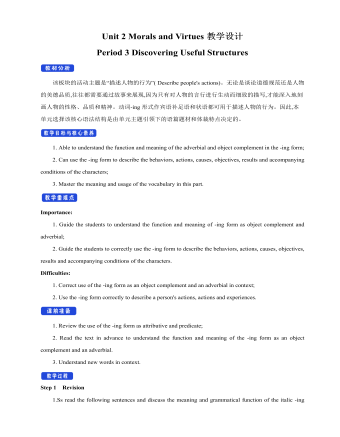
新人教版高中英语必修3Unit 2 Morals and Virtues教学设计三
The joke set her crying.这个玩笑使她哭起来。Step 5 ReadingActivity 31. Students read the small text in activity 3. The teacher provides several small questions to check whether students understand the content of the text and the ideographic function of the -ing form in the text.*Where are those people?*Why did Dr Bethune come to China?*How did he help the Chinese people during the war?*What did Chairman Mao Zedong say about him?2. Ss try to rewrite some sentences using the -ing form. Then check the answers. When checking the answers, the teacher can ask different students to read the rewritten sentences and give comments.Answers:1. he became very interested in medicine, deciding to become a doctor.2. …after hearing that many people were dying in the war.3. Helping to organise hospitals, he taught doctors and nurses, and showed people how to give first aid./ He helped to organise hospitals, teaching doctors and nurses, and showing people how to give first aid.4. …praising Dr Bethune as a hero to be remembered in China.Step 6 PracticeActivity 4Students complete grammar activities 2 and 3 on page 69 of the workbook.Step 6 Homework1. Understand and master the functions and usage of the -ing form;2. Finish the other exercises in Using structures.1、通过本节内容学习,学生是否理解和掌握动词-ing形式作宾语补足语语和状语语的功能和意义;2、通过本节内容学习,学生能否正确使用动词-ing形式描述人物的行为、动作及其经历;3、通过本节内容学习,学生能否独立完成练习册和导学案中的相关练习。
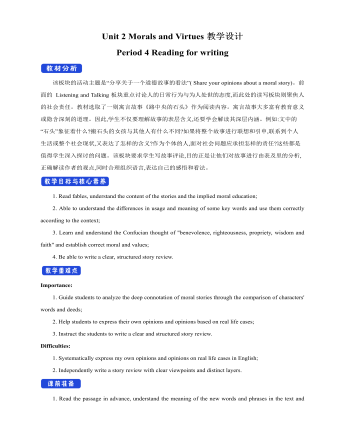
新人教版高中英语必修3Unit 2 Morals and Virtues教学设计四
3.Teachers ask different groups to report the answers to the questions and ask them to try different sentence patterns.The teacher added some sentence patterns for students to refer to when writing.Step 4 Writing taskActivity 51.Write the first draft.Students first review the evaluation criteria in activity 5, and then independently complete the draft according to the outline of activity 4, the answers to the questions listed in the group discussion and report, and the reference sentence pattern.2.Change partners.The teacher guides the students to evaluate their partner's composition according to the checklist of activity 5 and proposes Suggestions for modification.3.Finalize the draft.Based on the peer evaluation, students revise their own compositions and determine the final draft.Finally, through group recommendation, the teacher selects excellent compositions for projection display or reading aloud in class, and gives comments and Suggestions.Step 5 Showing writingActivity 5T call some Ss to share their writing.Step 6 Homework1. Read the passage in this section to better understand the passage.2. Carefully understand the hierarchical structure of the article, and deeply understand the plot of the story according to the causes, process and results;3. Independently complete the relevant exercises in the guide plan.1、通过本节内容学习,学生是否理解和掌握阅读文本中的新词汇的意义与用法;2、通过本节内容学习,学生能否通过人物言行的对比分析道德故事的深层内涵;3、通过本节内容学习,学生能否根据故事的起因、经过和结果来深入理解故事的情节,从而了解文章的层次结构;4、结合现实生活案例发表自己的见解和看法,写一篇观点明确、层次分明的故事评论。
新人教版高中英语必修3Unit 2 Morals and virtues教学设计一
(2) students are divided into groups according to the requirements of activity 3. Each student shares a story of personal experience or hearing-witnessing kindness, and then selects the most touching story in the group and shares it with the whole class. Before the students share the story, the teacher can instruct them to use the words and sentence patterns in the box to express. For example, the words in the box can be classified:Time order: first of all, then, after that, later, finally logical relationship :so, however, although, butTeachers can also appropriately add some transitional language to enrich students' expression:Afterwards, afterwards, at last, in the end, eventuallySpatial order: next to, far from, on the left, in front ofOtherwise, nevertheless, as a result, therefore, furthermore, in addition, as well asSummary: in a word, in short, on the whole, to sum up, in briefStep 8 Homework1. Understand the definition of "moral dilemma" and establish a correct moral view;2. Accumulate vocabulary about attitudes and emotions in listening texts and use them to express your own views;3. Complete relevant exercises in the guide plan.1、通过本节内容学习,学生能否理解理解“道德困境”的定义;2、通过本节内容学习,学生能否通过说话人所表达的内容、说话的语气、语调等来判断其态度和情绪;3、通过本节内容学习,学生能否针对具体的道德困境发表自己的看法和见解,能否掌握听力理训练中的听力策略。
新人教版高中英语必修3Unit 3 Diverse Cultures教学设计三
The price is the same as(the price was)before the war.价格与战前相同。(4)定语从句中的“关系代词+助动词be”可以省略。The ticket(that/which was)booked by his sister has been sent to him.他妹妹订的那张票已送到了他那里。Step 5 PracticeActivity 3(1) Guide students to complete the four activities in the Using Structures part of exercise book, in which activities 1 and 2 focus on ellipsis in dialogue answers, activity 3 focus on signs and headlines, two typical situations where ellipsis is used, and activity 4 focus on ellipsis in diary, an informal style.(2) Combine the examples in the above activities, ask students to summarize the omitted situations in groups, and make their own summary into a poster, and post it on the class wall after class to share with the class.(This step should give full play to the subjectivity of students, and teachers should encourage students to conclude different ellipsis phenomena according to their own understanding, they can conclude according to the different parts omitted in the sentence.)Step 6 Homework1. Understand and master the usages of ellipsis;2. Finish the other exercises in Using structures of Workbook.1、通过本节内容学习,学生是否理解和掌握省略的用法;2、通过本节内容学习,学生能否根据上下文语境或情景恢复句子中省略的成分,体会使用省略的效果;3、通过本节内容学习,学生能否独立完成练习册和导学案中的相关练习。
新人教版高中英语必修3Unit 3 Diverse Cultures教学设计二
(2)Consolidate key vocabulary.Ask the students to complete the exercises of activity 6 by themselves. Then ask them to check the answers with their partners.(The first language:Damage of the 1906 San Francisco earthquake and fire.A second language: Yunnan - one of the most diverse provinces in China).Step 5 Language points1. The teacher asks the students to read the text carefully, find out the more words and long and difficult sentences in the text and draw lines, understand the use of vocabulary, and analyze the structure of long and difficult sentences.2. The teacher explains and summarizes the usage of core vocabulary and asks the students to take notes.3. The teacher analyzes and explains the long and difficult sentences that the students don't understand, so that the students can understand them better.Step 6 Homework1. Read the text again, in-depth understanding of the text;2. Master the use of core vocabulary and understand the long and difficult sentences.3. Complete relevant exercises in the guide plan.1、通过本节内容学习,学生是否理解和掌握阅读文本中的新词汇的意义与用法;2、通过本节内容学习,学生能否结合文本特点了解文章的结构和作者的写作逻辑;3、通过本节内容学习,学生能否了解旧金山的城市风貌、文化特色,以及加利福尼亚州的历史,体会多元文化对美国的影响。
新人教版高中英语必修3Unit 3 Diverse Cultures教学设计四
该板块的活动主题是“介绍一个有显著文化特征的地方”( Describe a place with distinctive cultural identity)。该板块通过介绍中国城继续聚焦中国文化。本单元主题图呈现的是旧金山中国城的典型景象, Reading and Thinking部分也提到中国城,为该板块作铺垫。介绍中国城的目的主要是体现中国文化与美国多元文化的关系,它是美国多元文化的重要组成部分。中国城也是海外华人的精神家园和传播中国文化的重要窗口,外国人在中国城能近距离体验中国文化。1. Read the text to understand the cultural characteristics of Chinatown in San Francisco and the relationship between Chinese culture and American multiculturalism;2. Through reading, learn to comb the main information of the article, understand the author's writing purpose and writing characteristics;3. Learn to give a comprehensive, accurate, and organized description of the city or town you live in;Learn to revise and evaluate your writing.Importance:1. Guide the students to read the introduction of Chinatown in San Francisco and grasp its writing characteristics;2. Guide students to introduce their city or town in a comprehensive, accurate and organized way;3. Learn to comb the main information of the article, understand the author's writing purpose, and master the core vocabulary.
新人教版高中英语必修3Unit 3 Diverse Cultures教学设计一
Activity 81.Grasp the main idea of the listening.Listen to the tape and answer the following questions:Who are the two speakers in the listening? What is their relationship?What is the main idea of the first part of the listening? How about the second part?2.Complete the passage.Ask the students to quickly review the summaries of the two listening materials in activity 2. Then play the recording for the second time.Ask them to complete the passage and fill in the blanks.3.Play the recording again and ask the students to use the structure diagram to comb the information structure in the listening.(While listening, take notes. Capture key information quickly and accurately.)Step 8 Talking Activity 91.Focus on the listening text.Listen to the students and listen to the tape. Let them understand the attitudes of Wu Yue and Justin in the conversation.How does Wu Yue feel about Chinese minority cultures?What does Justin think of the Miao and Dong cultures?How do you know that?2.learn functional items that express concerns.Ask students to focus on the expressions listed in activity. 3.And try to analyze the meaning they convey, including praise (Super!).Agree (Exactly!)"(You're kidding.!)Tell me more about it. Tell me more about it.For example, "Yeah Sure." "Definitely!" "Certainly!" "No kidding!" "No wonder!" and so on.4.Ask the students to have conversations in small groups, acting as Jsim and his friends.Justin shares his travels in Guizhou with friends and his thoughts;Justin's friends should give appropriate feedback, express their interest in relevant information, and ask for information when necessary.In order to enrich the dialogue, teachers can expand and supplement the introduction of Miao, dong, Lusheng and Dong Dage.After the group practice, the teacher can choose several groups of students to show, and let the rest of the students listen carefully, after listening to the best performance of the group, and give at least two reasons.
新人教版高中英语必修1Unit 1 Teenage Life-Reading and Thinking教案
【教材分析】The topic of this unit is about teenage life, which belongs to the theme context of “humans and oneself”.As teenagers who shoulder the responsibility of “Chinese great dream”, they must fully know themselves, including their strengths, weaknesses and challenges etc. They are supposed to improve themselves continuously and readily study their subjects, and thus foster their strategies and confidence in lifelong studies.This period is entitled the freshmen challenges, which mainly concerns some big challenges for new students in Senior high school. In this period, a teacher should lead students to find out what their challenges are and guide them to figure out how to crack the challenges and better themselves. More importantly, a teacher should instruct students to absorb new language points and appreciate the language. Besides, a teacher must instruct students to acquire some skills concerning reading efficiently and inspire them to talk more about their new school life, especially their new problems and solutions both at school and in life.【教学目标与核心素养】1. Enable students to acquire the basic usage of the new words and expressions concerning the freshmen challenges and learn to use them flexibly.2. Enable students to have a good understanding of the freshmen challenges in the new senior high school which is quite different from junior middle school.3. Develop students’ sense of cooperative learning and individual thinking capability. 4. Develop students’ different learning skills to solve different reading comprehensive problems.
新人教版高中英语必修1Welcome Unit-Reading for Writing教案
教学目标知识目标:让学生更好理解如何恰当地写一个人的信息介绍,并能让学生熟练地使用一些写作技能。能力目标:培养学生的写作能力和团队协作能力。情感目标:提升学生对写作的兴趣。教学重难点 教学重点:如何能让学生更好地理解个人信息介绍。教学难点:如何能让学生通过适当地使用一些写作技能来写一篇较好的个人信息介绍。教学准备 多媒体、黑板、粉笔一、Pre-class1. Greetings2. Leading-inAsk students how to write a profile. What kinds of aspects should be included? The teacher asks students to discuss the topic with each other and put forward to much more ideas about the answer.二、While-class1. The teacher lets students to read the student profiles on Page 8 silently and then asks students to discuss the questions below.1. What is Ann like? How do you know?2. What are Thando’s hobbies?3. Where does Thando come from?4. What is Thando’s dream?5. What does “You will never see me without a book or a pen” mean?
新人教版高中英语必修2Unit 2 Wildlife Protection-Reading and Thinking教案一
The listening and speaking part aims at how to protect and help endangered animals by listening, speaking and talking about the facts and reasons. This lesson analyzes the decreasing clause of Tibetan antelope population and the measures of protecting Tibetan antelopes. So students can be guided to learn to analyse the title and use different reading skills or strategies, like scanning, skimming and careful reading.1. Read quickly to get the main ideas and the purpose of going to Tibetan; read carefully to understand what the author see and think.2. Understand the sentences of the present continuous passive voice such as “Much is being done to protect wildlife.” and the inverted sentence “Only when we learn to exist in harmony with nature can we stop being a threat to wildlife and to our planet.”3. Enhance the awareness of protecting wildlife.4. Cultivate the reading methods according to different materials.1. Read quickly to get the main ideas and the purpose of going to Tibetan; read carefully to understand what the author see and think.2. Understand the sentences of the present continuous passive voice such as “Much is being done to protect wildlife.” and the inverted sentence “Only when we learn to exist in harmony with nature can we stop being a threat to wildlife and to our planet.”3. Cultivate the reading methods according to different materials.Step 1 Leading-inWatch a video about elephants and whales and then ask:Why are they endangered ? They are killed/hunted
人教版高中语文必修3《登高》教案2篇
【设计思想】诗歌教学的关键是感受诗景,体味诗情,领悟诗意,在此基础上孕育理解能力、鉴赏能力和审美情感。诗景、诗情、诗意均由文字来承载,把握文字组合的张力,是读诗赏诗的抓手。杜甫的诗歌素以炼字精深、涵盖深远著称,以《登高》而言,往往淡淡一字,平平一语,便笼大千于方寸,缩古今于一瞬。故细读文本,咀嚼字句,便是赏景、悟情、会意的基本路径。其次,不朽名作的特点是寄寓深广,古今评价甚多,见仁见智,不一而足。这正是培养学生问题意识、探究意识的极好凭借。第三,诗为语言之精华,是诗人心里涌出的情感之流。诵读乃赏诗之要着,精心感悟之时,设身处地,心惟口诵,是理解诗意的关键一步。基于是,笔者作如下同课异构,殊途同归。【教学目标】1.理解本诗所绘之景、所抒之情及绘景、抒情之法。2.学会用意象叠加法、字句推敲法、诵读体验法等欣赏诗歌。3.感受杜甫心系苍生、情寄邦国、忧国忧民、兼济天下的博大情怀。
人教版高中语文必修1《论语》教案2篇
【教学意图】要了解中国传统文化,必须阅读古诗文名著名篇。但在中国文化形成过程中影响最大的是什么?可以说是儒家学说,包括《论语》这部经典。《论语》等书是读书人求仕做官的必修课本,是知识分子的思想言行基础,而且影响到整个社会生活,内容包括伦理道德、教育体制、民间习俗等方面的思想。因此,要了解中国传统文化,有必要读一读《论语》。【教学设计】因《论语》的年代已久远,对学生而言,要理解透彻文句是比较深奥困难的,因此必须在充分理解文意的基础上,对《论语》进行思想上的解读。可由教师从《论语》中概括出几点与生活、现实相关的要点,要求学生分组进行透彻的学习和领会,如“小人与君子”、“学习的方法”、“教育的理念”等等。〖教学重点、难点〗读《论语》知儒家思想。〖教学方法〗讲解启发、探究梳理、拓展延伸。
人教版高中语文必修3《寡人之于国也》教案2篇
一、引入:教师列举以下言论,让学生辨出哪些是孟子的,哪些不是。学生不知道的,由教师说出。学生不理解的,教师作简要解说。1.天将降大任于是人也,必先苦其心志,劳其筋骨,饿其体肤,空乏其身,行拂乱其所为。所以动心忍性,曾益其所不能。(孟子)2.域民不以封疆之界,固国不以山溪之险,威天下不以兵革之利。得道者多助,失道者寡助。(孟子)3.鱼,亦我所欲也,熊掌,亦我所欲也,二者不可得兼,舍鱼而取熊掌者也。生,亦我所欲也,义,亦我所欲也,二者不可得兼,舍生而取义者也。(孟子)4.富贵不能淫,贫贱不能移,威武不能屈。(孟子)5.非礼勿视,非礼勿听,非礼勿言,非礼勿动。(孔子)6.无恻隐之心非人也,无羞恶之心非人也,无辞让之心非人也,无是非之心非人也。(孟子)7.庖有肥肉,厩有肥马,民有饥色,野有饿殍。(孟子)8.人性之善也,犹水之就下也;人无有不善,水无有不下。(孟子)9.民为贵,社稷次之,君为轻。(孟子)10.君子坦荡荡,小人常戚戚。(孔子)
人教版高中语文必修3《老人与海》教案2篇
(一)导入[以视频欣赏导入]同学们,刚才欣赏的是大家熟悉、喜欢的电视剧《亮剑》中的精彩片段——李云龙论述什么是“亮剑”精神?同学们听后觉得好不好?牛不牛?“亮剑”精神简单理解就是敢于与强大的敌人(对手)做斗争,无论对手多么强大,都要满腔勇气和信心,永不放弃、永不言败,要敢于亮剑……今天我们一起来学习世界100部著名文学作品之一、美国里程碑式30部文学作品之一的世界名著——海明威的《老人与海》,看看主人公桑提亚哥“硬汉”性格和李云龙“亮剑”精神有么相似的地方。(请同学们翻到课文,课件显示课题《老人与海》)(二)走进作者:请同学们自己谈收集到的有关海明威的资料,然后教师梳理出下列核心内容识记:(课件显示)海明威(1899~1961),美国现代作家,20世纪美国文学史上最耀眼的名字之一。早期作品表现了第一次世界大战青年一代的彷徨情绪,以“迷惘的一代”的代表著称。20世纪末回到美国,写了不小以拳击家、渔民、猎人等为主人公的短篇小说,创造了“硬汉子”性格。
人教版高中语文必修2《采薇》教案2篇
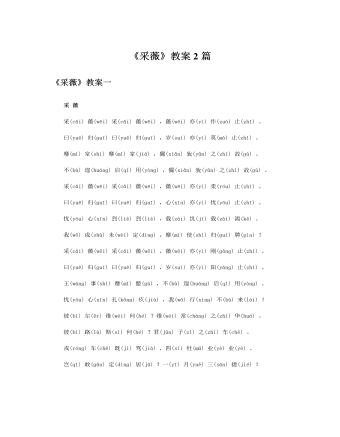
这两章是对战争场面的描写。写的是战车、战马、象弭、鱼服以及士兵的劳累奔波、饥渴难当,通过这些具体生动的细节描写来展现战争生活的图景。而没有写战场上的刀光剑影、厮打拼杀,但战争的残酷已可想见。4“昔我往矣,杨柳依依。今我来思,雨雪霏霏”被视为情景交融的佳句。清人王夫之在论《诗经·小雅·采薇》这两句时说:“以乐景写哀,以哀景写乐,一倍增其哀乐。”谈谈你的看法。一以往昔之虚衬眼前之实,以出征之乐衬内心之思亲之悲痛;二“杨柳依依”与“雨雪霏霏”对比,突出不胜今昔之感;三大雪交加,饥渴难当,情境实悲,以哀景写哀情。四、交流延伸1写一首诗或一段文字表达你对“乡愁”的新的体验。在全班交流。2课后搜集更多的表现乡情的诗歌散文作品,将你最感动的一篇拿到班上与同学分享感受。
人教版高中语文必修2《涉江采芙蓉》教案2篇
三、想象画面,把握意境1.指导想象学习陶渊明的《归园田居》我们脑海中自然会出现一幅幅的画面,比如他归家后的生活场景,我们会想象“榆柳”是如何遮蔽房屋的,而“桃李”又是如何摘种在房前的。我们会想象村落是如何在薄雾中若隐若现的,想象炊烟是如何袅袅升起的。《涉江采芙蓉》一诗只有8句话,更需要我们展开想象,去构画场景,这样才能深入诗歌,体会到诗歌的味道。2.学生想象要求学生闭目想象1分钟。3.学生展示想象结果(抽三四个学生回答即可)4.老师指导纠正学生想象不合理之处。要注意的地方:“江”可能学生会想象成小溪流、小池塘。“兰泽”可能学生理解成“湖泊”。注意字词“还顾”“漫浩浩”中隐含的情感,注意“离居”中流露的愁怨。5.时间允许的话,老师读自己的下水作文。
人教版高中语文必修2《孔雀东南飞并序》教案2篇
让学生仔细聆听美妙的音乐,合作讨论,加深理解。(1)本诗文中的“兰芝被遣”和“兰芝抗婚”的情节,可与乐曲展开部第一阶段“逼嫁抗婚”对比阅读。文中的刘兰芝是在封建礼教的压迫下被遣归及被迫“改嫁”,刘兰芝与祝英台一样都进行了抗争。乐曲中的乐器奏出了具有威胁力的封建势力的主题,代表着封建势力的凶暴残酷,同时叙述了祝英台的悲痛和不安心情,表现了控诉、抗争的感情。(2)本诗文中的“夫妻誓别”的情节,可与乐曲呈示部中的结束部“长亭惜别”对比阅读。文中刘兰芝与焦仲卿的誓别。二人分手之际,依依不舍,“举手长劳劳,二情同依依”。乐曲中梁祝分别时依依不舍又充满悲伤,音调抒情徐缓。让学生在徐缓的音乐中去感受刘兰芝与焦仲卿生离死别的痛苦。
人教版高中语文必修2《囚绿记》教案2篇
教学设想:本节课的主题是“生命之绿,璞玉心灵”,用圈点批注法解读爱绿的感情,让学生在批注中明确“绿”的象征意义,而不只是结论的传递。同时借助于阅读、感受和理解把握作者对绿的认识是不断升华的,由一般对生命希望之绿的喜爱,到与绿交往后被它的不畏强暴,永远向阳的精神所折服,最后在特定的时代背景下绿在作者的心目中已经成了我们民族不屈精神的象征。让学生评中求解,评中悟情,评中明理,评中品味。教学进程:一、导语上节课我们学习了朱自清的《绿》,初步了解了读书动笔的基本方法,这节课我们继续用圈点批注的方法来学习陆蠡的散文《囚绿记》。二、释题师:看标题,囚绿之“绿”在文中具体指什么?(一株常春藤)“囚”就是囚禁的意思,那题目就是记述囚禁绿色常春藤的经过。三、圈点、把握情节作者为什么要囚绿呢?文中除了写“囚绿”之外,还写了哪些有关绿的意念和行动?带着这样的质疑用自己喜欢的方式朗读课文,请同学们圈点出疑难字词,或结合书下注释,或同学合作解决,解决不了的,可提出来我们共同解决。标注段落节次。勾画出表现作者对绿意念和行动的句子。